‘Defensiveness’ from Feminist Perspective on Resistance

Standard

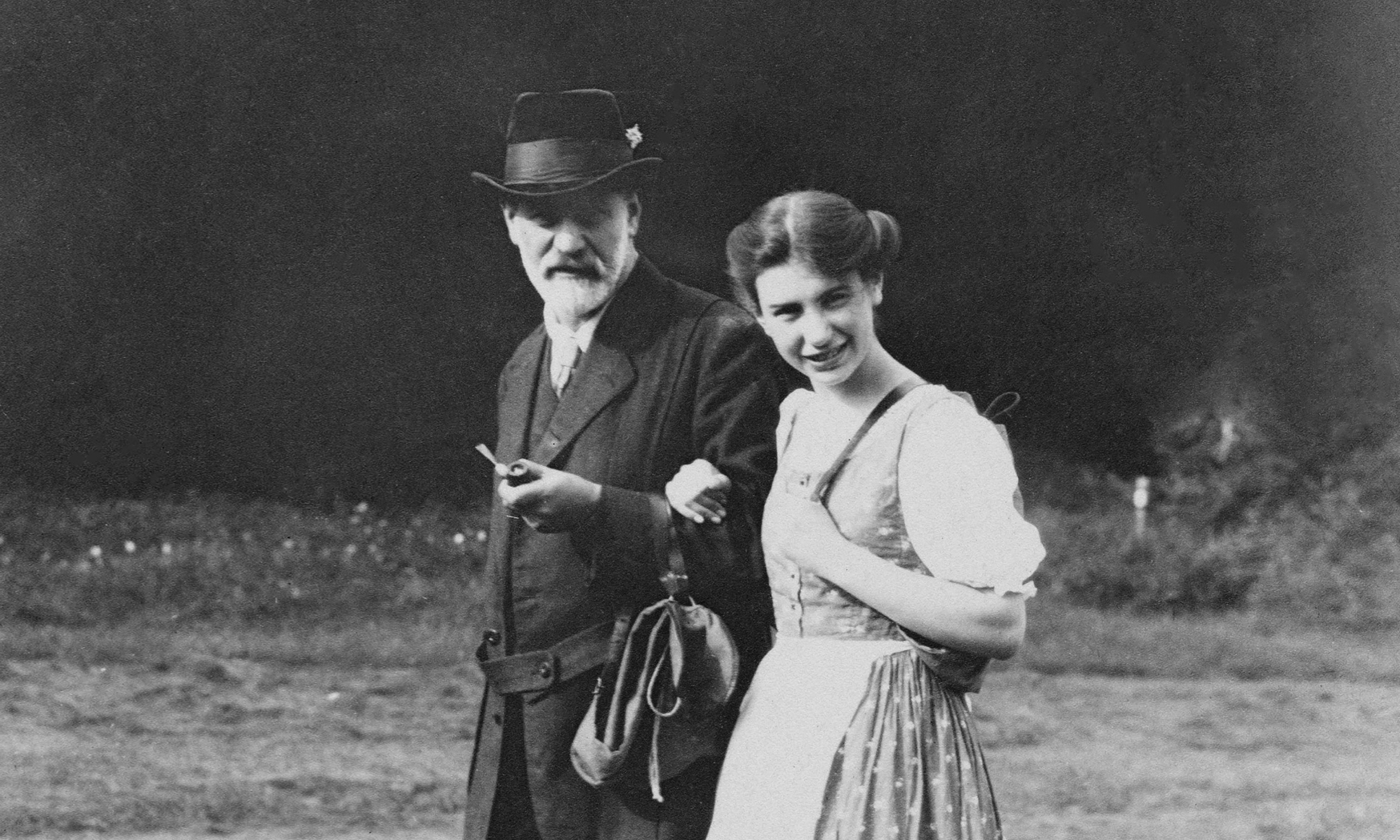
Today, I want to share a throwback to one of my Facebook posts from a few weeks ago, of course, more extensive, perhaps for a change, and because of this fascinating woman in the history of psychology.
Actually, I’ve also been considering writing about Sigmund Freud, the originator of psychoanalysis, and this might be a good starting point.

Honestly, I previously didn’t know much about Anna Freud, or rather, I didn’t think highly of her. However, after watching the film ‘Freud’s Last Session‘ about Sigmund Freud’s final days, her brief appearance still caught my attention.

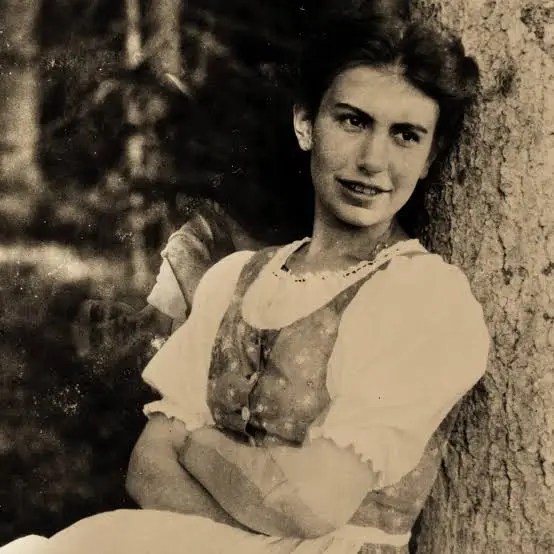
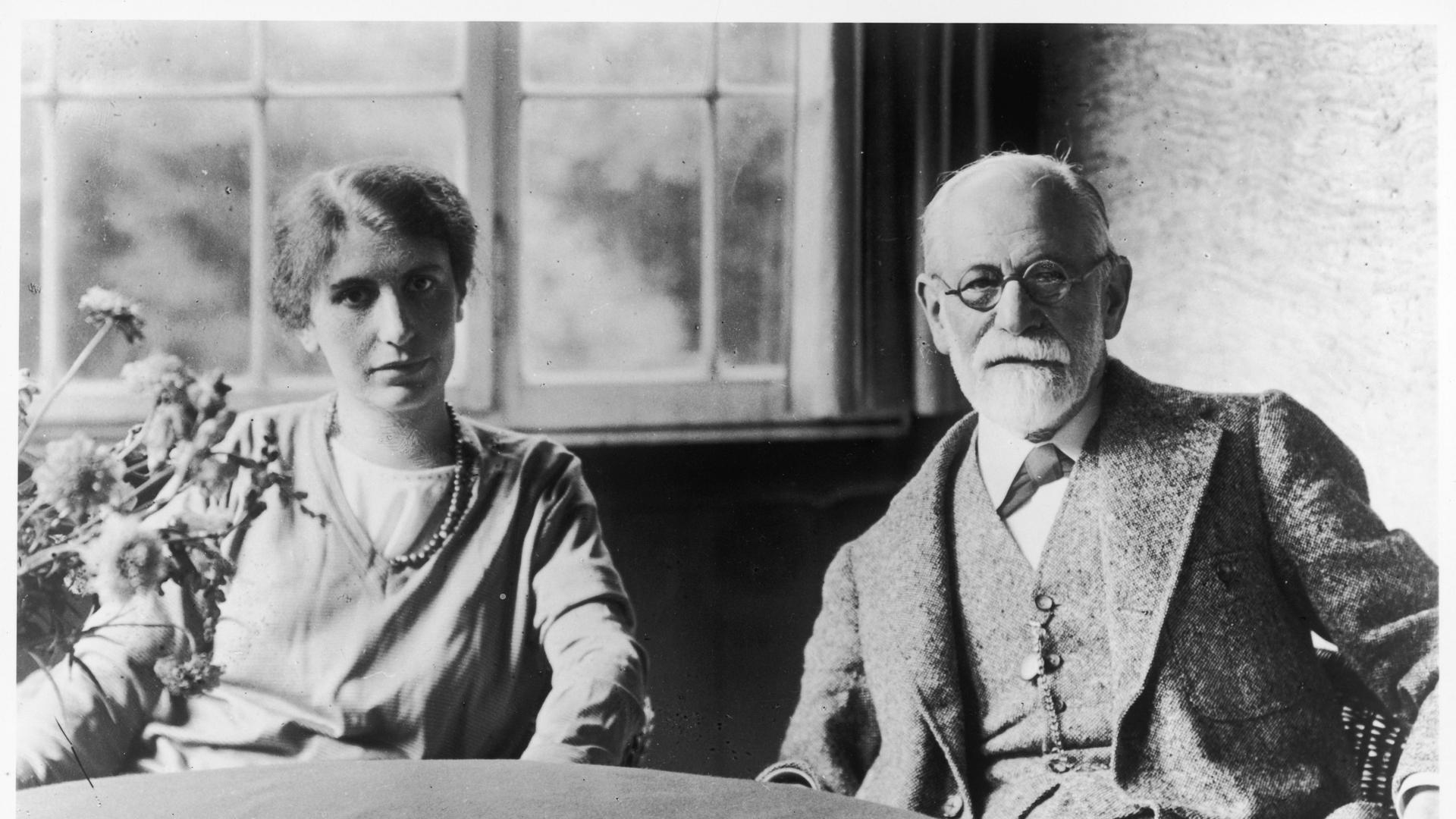
Anna Freud was a trailblazing psychoanalyst who made significant contributions to child psychology. Born in Vienna in 1895, the youngest daughter of Sigmund Freud, she grew up in an intellectually stimulating environment. She was deeply interested in her father’s work and eventually became his close collaborator. Originally trained as a teacher, Anna developed a keen interest in children’s development. In the 1920s, she began psychoanalytic training and started working with children, establishing Vienna’s first child psychoanalysis clinic in 1927. At this clinic, she developed innovative observation and treatment methods. Her influential book, “The Ego and the Mechanisms of Defence” (1936), built on her father’s theories by explaining how the ego defends against anxiety through mechanisms such as repression and denial. Fleeing the Nazis in 1938, she settled in London, where she co-founded the Hampstead Child Therapy Course and Clinic, a prominent centre for child psychoanalysis. Anna emphasised the importance of observing children in their natural settings and customising therapy to each child’s needs. Her contributions remain influential in psychoanalysis and child psychology, setting new standards through her research and clinical work.

In her 1936 work “The Ego and the Mechanisms of Defence,” Anna Freud identified defence mechanisms as unconscious protections employed by the ego. These mechanisms serve to shield individuals from anxiety, shame, and the instinctual urges of the id that the superego prohibits. Among the major defence mechanisms are repression, projection, reaction formation, regression, and sublimation.

In the film mentioned above, I noticed she had no relationships with men. There is no public or scholarly evidence regarding her sexuality. She never married but had close relationships with women, especially Dorothy Burlingham, her lifelong partner and collaborator. Some biographers speculate about their relationship, but Anna Freud never publicly discussed her sexuality, and no records confirm whether she was lesbian, bisexual, or otherwise. Her private life was discreet, centred on work and family. Any discussion of her sexuality is largely speculative, based on personal correspondence and life choices.

Children have an almost uncanny instinct for the teacher’s personal shortcomings.
They know the false from the true far better than one likes to admit.
Therefore, the teacher should monitor his own psychic condition so he can spot the source of trouble when anything goes wrong with the children entrusted to his care.
Civilisation in Transition (The Collected Works of C. G. Jung, Volume 10)

via Carl Jung DepthPsychology 🙏

Thank you all for your support and presence. Wishing you a peaceful weekend. 🙏🌹

What a Pity!

Standard

As I hover over the news and feel the hangover from all this stress, I give my mind another chance to relax by jotting down a few words.
Of course, I didn’t swear an oath to post every week (like some, daily; oh my goodness, save me!😛). However, as I mentioned in my last post, I need to talk to my “Patient Stone” to help me gather my scattered thoughts.

Honestly, I have numerous projects and ideas to pursue and share, but my busy mind is too preoccupied to concentrate on them. On the other hand, I had to delete many of my old posts because WP warned me that my 13 GB storage limit was full, leaving me with the choice of upgrading or deleting. Since I couldn’t afford to upgrade, I had no option but to delete them. Now I have some space to post more!

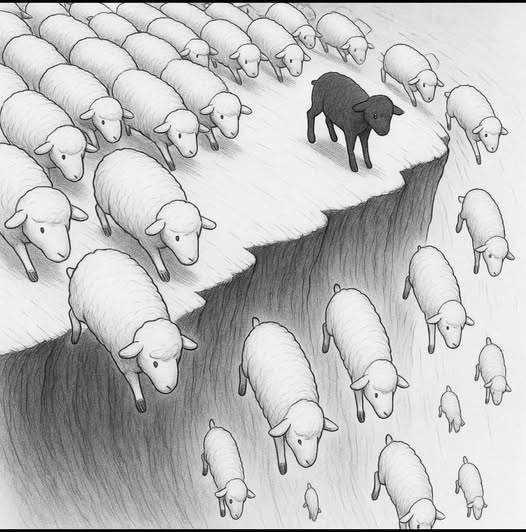
I think, as well as believe, that the animals have their own characters and, in their own instinctual life, have their own species-specific way of living, even though we compare some of them, like sheep, with humans in the form of messes.

Dr Jung viewed “mass-mindedness” and mass psychology as perilous, believing crowds trigger “the dynamisms of the collective man,” transforming individuals into “beasts or demons” until they join a mob. Crowds diminish morality, incite fears, provoke “infantile behaviour,” and can cause even the most virtuous to lose their significance, resulting in “psychologically abnormal” individuals. Mobs foster “herd psychology” and produce “mass man,” who is childish, irrational, irresponsible, and emotional. The crowd dissolves personal responsibility, facilitating crimes and increasing reliance on the state.

The levelling down of the masses through suppression of the aristocratic or hierarchical structure natural to a community is bound, sooner or later, to lead to disaster. For when everything outstanding is levelled down, the signposts are lost, and the longing to be led becomes an urgent necessity.
~Carl Jung, CW 17, Para 248

Now, I’d like to share one of my Facebook posts that reflects my thoughts. It is a poem by Lawrence Ferlinghetti, a notable American poet, painter, and social activist. Ferlinghetti published works of many Beat poets and is sometimes considered a Beat poet himself, although he never liked that label!

You are Whitman, you are Poe, you are Mark Twain, you are Emily Dickinson and Edna St. Vincent Millay, you are Neruda and Mayakovsky and Pasolini, you are an American or a non-American, you can conquer the conquerors with words….
~ Lawrence Ferlinghetti. From Poetry as Insurgent Art [I am signalling you through the flames]
.

Pity the Nation (After Khalil Gibran)

Pity the nation whose people are sheep
And whose shepherds mislead them
Pity the nation whose leaders are liars
Whose sages are silenced
and whose bigots haunt the airways
Pity the nation that raises not its voice
but aims to rule the world
by force and by torture
And knows
No other language but its own
Pity the nation whose breath is money
and sleeps the sleep of the too well fed
Pity the nation, oh, pity the people of my country
My country, tears of thee
Sweet land of liberty!

I’d also like to share one of Mozart’s greatest works, a requiem, to comfort the spirits. Wishing all individuals friends a peaceful time. 💖🙏

Searching for the Eternal Girl/Boy P. 3 Puella Aeterna/Puer Aeternus and Corne/Senex

Standard

I’ll borrow life and not grow old;
And nightingales and trees
Shall keep me, though the veins be cold,
As young as Sophocles.
And when I may no longer live,
They’ll say, who knows the truth,
He gave whate’er he had to give
To Freedom and to Youth.
~William Corey, Master at Eton c. 1850-1870

Success achieved, he never stays
For only by never staying does he not depart.
~Dao Tzu, Dao De Jing.

From Now or Neverland, p. 156

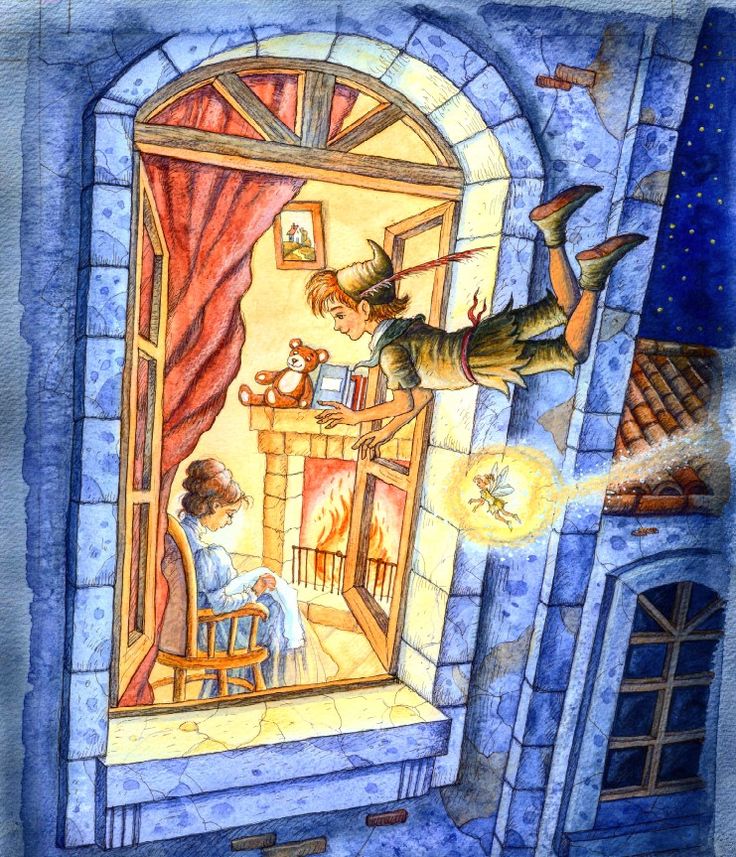
In this third part, let’s revisit the inspiring book, Now or Neverland, which motivated me to write these articles.

Here’s a brief essay on Now or Neverland by Ann Yeoman:

Ann Yeoman’s book “Now or Neverland: Peter Pan and the Myth of Eternal Youth” analyses the enduring charm of J.M. Barrie’s story, emphasising its psychological and mythological elements. She interprets Neverland as a metaphor for humanity’s longing to escape time and mortality. Yeoman considers Peter Pan an archetype embodying wonder and the peril of avoiding growth.
She explains that Neverland represents the myth of eternal youth—a place where responsibilities cease. This dream enables Peter to evade adult challenges but also leads him to miss meaningful relationships and personal development. Her study suggests Barrie’s tale celebrates youth but also warns against escapism.
In “Now or Neverland,” Yeoman encourages reflection on individual perceptions of time, change, and maturation, transforming a children’s story into a profound meditation on memory, imagination, and ageing.

Yesterday, I attended a birthday party for a dear family member, where my grandchildren were also present. I hadn’t seen them in a long time due to my illness and hospital stay. As always, I was the only adult the kids enjoyed playing with, because they knew the child in me well. It reminded me of what Yeoman mentioned in her book:

…Paradoxically, whereas lightness, freedom and space may be the necessary conditions for play, play itself is far from light, in that it has the capacity to ground one in the wholeness of one’s being. In a discussion of the importance of play in childhood, Anthony Stevens cites Johan Huizinga’s claim, in Homo Ludens, his work on the subject of play, that “in play there is something ‘at play’ which transcends the immediate needs of life.” This is because the archetypal activities of human life are filled with possibilities for play. Notes Stevens:

Hence, Schiller’s famous aphorism, “Man is only truly himself when he is at play.”
… Childhood is a period of immense vitality and inventiveness, when imagination is given free rein to complement the realities or compensate for the deficiencies of everyday existence…
It is one of the misfortunes of growing up that we readily lose touch with this rich land of childhood … Yet nothing is lost to the Self, and play, like the child who sponsors it, lives on as a propensity of the psyche to its dying day. (250On Jung, pp. 87f.)

What is of particular interest in our discussion of Barrie is Stevens’s emphasis that fantasy, as introverted play,

is the product of play between the archetypes of the collective unconscious and the living circumstances of the individual. . . . Fantasy is not a regressive means of escape from reality . . . but the modus operandi of psychological growth: it is the stuff of life, leading us on into the future. (251 Ibid., pp. 88f.)

Play and fantasy lead us into the future because they make us creators. They legitimise our re-formation and re-creation of the world, allowing us to remember and so re-deem the scattered fragments of ordinary life. They make us gods for an hour or a day, enabling an activity which affirms our sense of Self because it affords unlimited scope to our desire for realisation, fulfilment and creative power in a world of our own making that is secret and therefore safe. The task of the artist is then to establish a vital connection between the hidden world of possibility and the world of actuality.

However, according to Winnicott, the “place” of play and fantasy is precarious, “because it belongs to the interplay in the . . . mind of that which is subjective (near-hallucination) and that which is objectively perceived (actual or shared reality).” (Playing and Reality, p. 61)

…This place is the No-man’s land, an intermediary realm of the imagination that the artist must continually interpret and re-interpret. Here, one might encounter the god-child, buried deep in the personality. The challenge for the writer, like Barrie, who feels more at home in the imaginal realm, is to interpret such experiences within the real world. But in Peter Pan, Barrie’s two worlds remain as opposed at the end as at the beginning, with no space in the Edwardian world for the richness found in Neverland. Ultimately, Barrie cannot show that reality offers room for self-fulfilment, unlike other children’s classics such as Grahame’s The Wind in the Willows or Milne’s Winnie-the-Pooh.

In Barrie, there’s an apparent devaluation of cosy domesticity and an iconoclastic streak visible in his work, especially in Peter Pan and other heroes resembling Peter’s mysterious presence. We find in Peter Pan the masculine energy of the trickster, a mythic figure known as a lawbreaker who embodies instinctual desires. (Barbara Greenfield, “The Archetypal Masculine,” in Andrew Samuels, ed., The Father, p. 192.)

The trickster often marks an early stage in the development of the heroic ego, reflecting nature’s transformative power while resisting change. Barrie’s hero also resists transformation, with little evidence of active sexuality or development beyond a boy-trickster to a mature hero or Wise Old Man. Instead, Peter Pan’s iconoclasm risks becoming an idol of boyish rebellion for its own sake.

(Ibid., p. 191. Greenfield argues that “The boy, Don Juan, and the trickster show us the ego in its early stages of development, while the hero, the father and the wise old man represent later stages of development. As a whole, the animus, or male archetype, unifies these disparate figures because it exists as those principles which underlie them all.” She suggests that the most powerful mythological forms of the masculine archetype are those of the father and the trickster, claiming the trickster as “an early incarnation of the father” rather than an archetype separate from that of the father, as it is treated by Jung. Her view supports our earlier discussion of the inherent similarities of Peter Pan and Hook and is useful when individual development and personal pathology are the issue. However, what we may describe as the “creative iconoclasm” of the Self in its impulse to further consciousness favours Jung’s treatment of the trickster and his recognition of its essential and constant role in the archetypal drama of the psyche. Perhaps this presents a case for “both/and” rather than “either/or” terminology; and for a concept of co-existing levels of activity rather than a more linear development from one stage to the next, with only faint traces of earlier characteristics evident in the later stages.)

Remember to cherish the child within you; thank you! 🙏

Edgar Allan Poe and Herman Melville

Standard

Hello friends!

I am back for a while from my holiday trip, although I am not fully recovered from a cold I caught a week ago, which I am still fighting to get rid of (it seems my immune system has been damaged after that problem earlier this year!). I didn’t plan to make a post today, but when I came across an article about the relationship between Poe and Melville, which I didn’t know about, I thought I would share it with you. Indeed, I should mention that I once published an article on Allan Poe; here it is!

As a new New Yorker, I once travelled across three boroughs to Woodlawn Cemetery to visit Herman Melville’s grave. I didn’t worship him as a hero but as a friend. Through the words of Professor Angela O’Donnell, who says that reading great writers is like having a conversation with them and fosters intimacy, I promised to visit often. Still, I was distracted by city life and never went back. However, a friend of another 19th-century American author never missed a visit.
The Baltimore Sun reports that, for decades, an anonymous “Poe Toaster” left three roses and a bottle of cognac at Edgar Allan Poe’s grave every January 19th. His mystery remains unsolved, as does Poe’s own death.

On October 7, 1849, the literary community remembered Edgar Allan Poe, a master of the macabre whose death remains shrouded in mystery. Although his anniversary has passed, his short, tragic life and death remain deeply saddening. He was found delirious on Baltimore’s streets, and the exact cause of his death remains unclear, speculated to be linked to alcoholism, rabies, or other health issues.

In the days leading up to his death, Poe grappled with personal turmoil and bouts of depression, reflecting the dark themes prevalent in his writing. His life mirrored the tragedies he explored—loss, madness, and mortality.

As we remember Poe, we not only honour his legacy as a pioneering voice in Gothic literature but also reflect on the profound connections between art and the struggles of existence, inviting us to confront the deeper aspects of the human condition he so eloquently captured.

The relationship between Edgar Allan Poe and Herman Melville is a compelling exploration of two iconic figures in American literature, whose works have shaped literary history. Both authors are monumental, yet their life paths and artistic styles diverged significantly, revealing profound themes of existentialism and the complexities of the human experience.

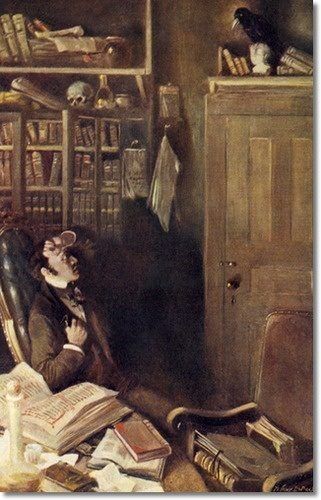
Edgar Allan Poe, born in 1809 in Boston, faced a tumultuous early life marked by personal tragedies. Orphaned as a child, he experienced the pain of loss that profoundly influenced his writing. His struggles with poverty and alcoholism fueled the dark themes in his work. Masterfully crafted tales such as “The Raven,” “The Tell-Tale Heart,” and “The Fall of the House of Usher” explore death, madness, and despair, establishing Poe as a master of horror and Gothic literature.

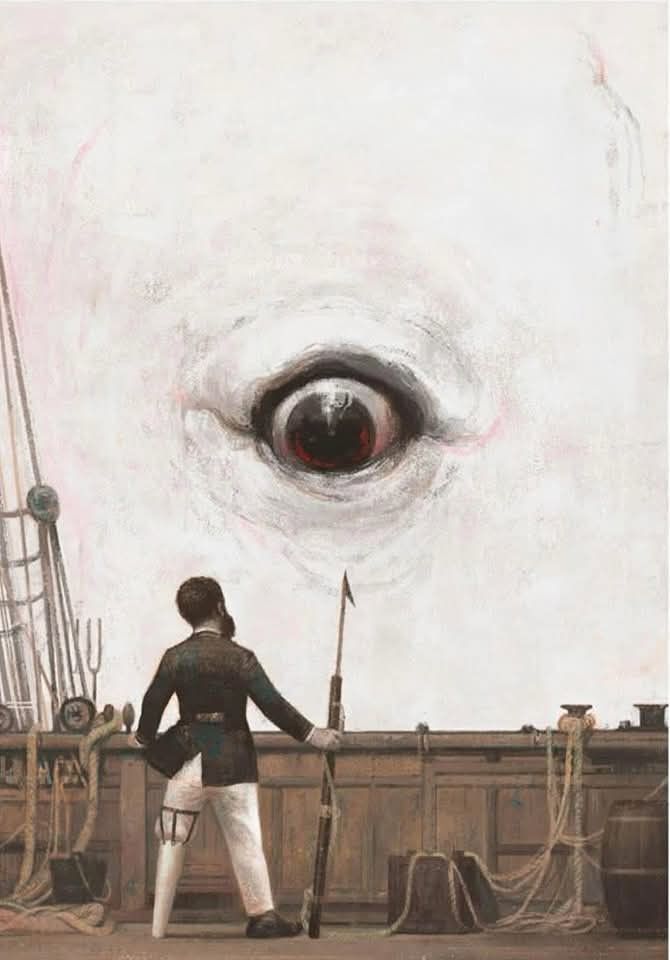
In contrast, Herman Melville, born in 1819 in New York City, enjoyed a more privileged upbringing that was disrupted by his father’s early death. This formative loss set him on a path of adventure at sea, which culminated in his magnum opus, “Moby-Dick.” Melville’s works engage with grand themes of nature and humanity, showcasing a narrative style that embodies the complexities of existence and human ambition.

Despite their differences, Melville and Poe respected each other’s literary talents. Poe’s sharp critiques of Melville’s early works, such as “Typee,” acknowledged Melville’s gift while highlighting differences in their narrative styles. Poe favoured compact storytelling, while Melville embraced sprawling narratives laden with existential questions.

Both writers engaged with themes of death and isolation, particularly evident in Melville’s Captain Ahab, who mirrors the psychological depths of Poe’s characters. Their respective narratives challenge audiences to confront profound aspects of the human condition. Timing also affected their careers; though Poe achieved fame earlier, Melville’s “Moby-Dick” was initially overlooked, though it would eventually be recognised as a key literary work.

Ultimately, the legacies of both authors flourished posthumously, with Poe celebrated for his innovative contributions to literature and Melville emerging as a foundational figure. This interplay between the two writers encourages contemporary readers to explore the connections that define their works.

In conclusion, the relationship between Poe and Melville offers a striking study of contrasting yet complementary voices in American literature. Their distinct views on existential despair and the human experience create a rich tapestry that continues to inspire and intrigue, leaving a lasting impact on generations of writers and readers alike.

Thanks, and have a good time, everybody.

Searching for the Eternal Girl/Boy P. 2 Puella Aeterna/Puer Aeternus and Corne/Senex

Standard

The dynamic principle of fantasy is play, a characteristic also of the child, and as such, it appears inconsistent with the principle of serious work. But without this playing with fantasy, no creative work has ever yet come to birth. The debt we owe to the play of imagination is incalculable. It is, therefore, short-sighted to treat fantasy, on account of its risky or unacceptable nature, as a thing of little worth.
~Carl Jung; Psychological Types Ch. 1; Page 82.
Fantasy is the creative function—the living form is a result of fantasy. Fantasy is a pre-stage of the symbol, but it is an essential characteristic of the symbol that it is not mere fantasy.
~Carl Jung, 1925 Seminar, Page 11
Source: Carl Jung Depth Psychology

Continuing from the first part of my blog, I recall the days when Al and I created our own worlds, feeling utterly disconnected from the outside world. My childhood was filled with dreams and wishes, driven by my imagination and a touch of fantasy. Perhaps it was my name that ignited my desire to make my wishes come true, with a hint of magic.

On the other hand, I didn’t want to be treated like a child. I don’t know what the issue was; maybe it was because I’d been isolated at that age. I mean, there we were, a group of five boys, Al and me, including three cousins, all nearly the same age. One of the cousins, Ham, who was around Al’s age, about two years older than me, and the other two were roughly two years younger than me, and I was stuck in the middle.

Dream Catcher by Michael Cheval

As I remember, one evening in Mashhad, when we were visiting our aunt, we were playing hide and seek — a game like ‘catch me if you can find me!’ I was so engrossed in the game that I didn’t notice Al and Ham were missing. At first, when I caught my breath from running around to find a hiding spot, I thought, ‘What’s going on with me?’ and scolded myself for acting like a child. But then I got angry when I found out Al and Ham weren’t playing with us – they were off to see a movie, and I wanted to be there with them so badly! In the evening, when we gathered again, Al and Ham began by making a reference and a joke about the movie, which I remember was called Madame. This made me feel jealous and sad. It was so obvious that my mother recognised it and tried to comfort me, but to me, her effort was like giving milk to a crying infant! So I felt even more alone and forsaken.

In Ann Yeoman’s book, we can read:
…In terms of personality traits, a strong emotional attachment to what we may call the mother-realm manifests on the one hand in a certain preciousness, a sense of specialness and difference, a fictional example of which we see in James Joice’s young hero Stephen, who is always “on the fringe,” a little apart from his fellows, an isolate. On the other hand, when out of the province of the mother and, metaphorically, the reach of the mother’s watchful eye, the mother’s son experiences an incapacity to stand on his own and embrace the risks, challenges and unpredictable fullness of life, or realise the courage “to live, to err, to fall, to triumph, to recreate life out of life,”> to cite Joice once again>(A Portrait of the Artist as a Young Amn, p. 172).
As a result, the puer remains dissociated from his feelings. In order to shield himself unconsciously from suffering, he protects himself from the possibility of abandonment, rejection and disappointment with an array of defences which prevent him from fully committing himself to life in the first place.
Jung describes the neurosis of such a “mother’s boy” in terms of a “secret conspiracy between mother and so…. [in which] each helps the other to betray life” He continues:

Where does the guilt lie? With the mother, or with the son? Probably with both. The unsatisfied longing of the son for life and the world ought to be taken seriously. There is in him a desire to touch reality, to embrace the earth and fructify the field of the world.
But he makes no more than a series of fitful starts, for his initiative as well as his staying power are crippled by the secret memory that the world and happiness may be had as a gift from the mother. The fragment of the world which he, like every man, must encounter again and again is never quite the right one, since it does not fall into his lap, does not meet him halfway, but remains resistant, has to be conquered, and submits only to force.
It makes demands on the masculinity of a man, on his ardour, above all on his courage and resolution when it comes to throwing his whole being into the scales. For this, he would need a faithless Eros, one capable of forgetting his mother and undergoing the pain of relinquishing the first love of his life.
~Carl Jung, The Syzygy, Anima & Animus, Aion, CW 9ii, par. 20-21

I may laugh at that event now, but as I recall every detail, it seems it left a particular impression on me. I know I wanted to be noticed and taken seriously. However, my mother, as she always had, saw me as her lost daughter. That’s why, when I finally found my solitude, it was mostly when I woke early in the morning in my bed and looked out of the window into the street, where the summer breeze made the leaves of the poplar tree dance. I immersed myself in my fantasy world and let my imagination run freely.

I will definitely try to write another episode.🙏💖

Searching for the Eternal Girl/Boy P. 1 Puella Aeterna/Puer Aeternus and Corne/Senex

Standard

Does fantasy lead to escape, or to the embracing of a new perspective? In other words, does it support psychic growth or impede it? That distinction is often complicated by paradox, but it helps to ask ourselves, “Is concentrating on this fantasy or daydream opening my creative possibilities, or is this sapping my ego strength in the real world?” ~Marion Woodman

This excerpt begins Marion Woodman‘s foreword from Ann Yeoman’s book, Now or Neverland, which I read some time ago, thanks to Deborah Gregory‘s recommendation, and I am very grateful for it.

Frankly, when I began reading this book, I felt at home; I saw myself as a puer aeternus, struggling to stay balanced on life’s rollercoaster.

Traditionally, the term ‘puer aeternus’ (Latin for ‘eternal boy’) is used to describe a child-god who remains eternally young. In Carl Jung’s psychology, it refers to an older person whose emotional life remains stuck in adolescence, often referred to as the “Peter Pan syndrome”. Jung suggests that the puer lives a “provisional life” due to a fear of being trapped. They seek independence, resist boundaries, and find restrictions intolerable. In Greek mythology, the term ‘puer aeternus’ originates from the Metamorphoses, an epic poem by Roman poet Ovid (43 BC – c. 17 AD) that explores Greek and Roman myths. Ovid refers to the child-god Iacchus as “puer aeternus” and praises his role in the Eleusinian mysteries. Iacchus is linked to Dionysus and Eros. The puer represents a deity of vegetation, resurrection, and divine youth, similar to Tammuz, Attis, and Adonis.

Senex is a Latin term that literally means “old man.” It can also be used to describe: a wise, elderly person, an archetype. The wise older person (also known as senex, sage, or sophos) is an archetype outlined by Carl Jung, as well as a familiar literary figure, often portrayed as a stock character. Such a figure can be a profound philosopher renowned for wisdom and sound judgment.

Marie-Louise Von Franz summarised her view of the puer as follows:
None of his reactions are particularly personal or special. He becomes a type—the type of the puer aeternus. He becomes an archetype, and if you become that, you are not at all original… He is merely the archetype of the eternal-youth god, and, therefore, he has all the features of the god: he has a nostalgic longing for death, he thinks of himself as being something special, and he is the one sensitive being among all the other tough sheep. He will have a problem with an aggressive, destructive shadow that he will not want to live with and generally projects. There is nothing special whatsoever. The worse the identification with the youthful god, the less individual the person, although he himself feels so special. (Puer Aeternus, pp. 121f)
Another type of puer that does not display the charm of eternal youth, nor does the archetype of the divine youth shine through him. On the contrary, he lives in a continual sleepy daze, and that, too, is a typical adolescent characteristic… The sleepy daze is only an outer aspect, however, and if you can penetrate it, you will find that a lively fantasy life is being cherished within. (Puer Aeternus, p.2)

Reflecting on my childhood, after my father passed away and my mother kept it a secret from my brother Al and me, I became very introverted. Once I learned the truth, I simply didn’t want to grow up. Al and I drew closer because of our mother’s lie, and over time, during our youth, we swapped roles as eternal children. Initially, I wanted to remain a child forever, while Al, aware of our father’s death almost from the moment it happened, tried to act as a mature older brother to look after me.

As we entered puberty, our roles underwent significant changes. I developed a strong sexual desire much earlier and believed I had to act like a man to attract girls, while Al began creating his own solitary world. For many years, this condition persisted. Although I was accepted into Al’s world and was part of it, I was the one who had to maintain contact with the outside world. As a result, I assumed the role of the senex, but I longed for my puer aeternus and tried to keep it concealed yet protected.

Let’s conclude this now, and I look forward to discussing this topic further in the next part. 🖖🙏

Queen Tiye, the Ruler of Upper and Lower Egypt!

Standard
Ägyptisches Museum (Egyptian Museum), Berlin (Wikimedia)

Queen Tiye, recognised for her intellect and formidable character, earned the respect of foreign dignitaries, who were keen to interact with her directly. She maintained an active presence in foreign relations and became the first Egyptian queen whose name was inscribed on official documents.

Head of Queen Tiye. Egyptian Museum, Cairo. JE 38257

Here is an impressive presentation by Marie Grillot about a captivating piece of art represented by a magnificent statue that resonates with us through her story.

Wishing you all the best for the Easter holidays. 💖🙏

Tiyi, a face of royal beauty

via égyptophile

Head of a statuette of Queen Tiye – dark green schistose steatite – New Kingdom – 18th Dynasty
Discovered in 1905 by William Matthew Flinders Petrie in the Temple of Hathor at Serabit el-Khadim (Sinai)
Egyptian Museum, Cairo – JE 38257

In 1905, the English Egyptologist William Matthew Flinders Petrie led an expedition to the Sinai Peninsula. He was particularly interested in the site of the temple of Serabit el-Khadim. Built during the reign of Snefu for workers who came to work in the turquoise mines, it remained in use until the New Kingdom. The sanctuary is dedicated to the goddess Hathor, “mistress of turquoise,” and the eastern falcon god Sopdu.

The excavation season is expected to yield the discovery of a small female head, measuring 7.2 cm, in a very dark stone.

Head of a statuette of Queen Tiye – dark green schistose steatite – New Kingdom – 18th Dynasty
Discovered in 1905 by William Matthew Flinders Petrie in the Temple of Hathor at Serabit el-Khadim (Sinai)
Egyptian Museum, Cairo – JE 38257

Here is an excerpt from W.M.F. Petrie’s description in his 1906 report “Researches in Sinai”: “A queen has left here one of the most striking portraits ever carved in Egypt. The very famous Queen Thyi, wife of the great Amenhotep III, was hitherto known from a few carved reliefs, but not yet from such a portrait in the round. Strangely, such a remote spot should have preserved this representation, which we have identified from the cartouche in the middle of the crown. The schistose stone is dark green steatite.

The entire statuette must have measured about a foot in height. Unfortunately, we have found no fragments other than the head. The great dignity of the face is combined with a fascinating uprightness. The delicacy of the contours of the eyes and cheekbones testifies to the quality of execution. The lips, whose curious curve curves downwards, are complete and delicate, yet express a disdain devoid of malice. They are, most certainly, a likeness to the truth… The ear is pierced, as is also the case with her son Akhenaten. The crown she wore was probably with gold inlays. The two-winged cobras stretch their length in loops around the head, until they meet at the back; while in the middle of the forehead, they support the cartouche with the name of the great queen of Upper and Lower Egypt. This piece alone was worth all the rest of our earnings for the year; it is now in the Cairo Museum.”

“Head of statuette of Queen Tiye – Dark green steatite” (Egyptian Museum, Cairo JE 38257)
published here by William Matthew Flinders Petrie in “Researches in Sinai” (1906), plate 133 – p. 127

In his book “Essays on Egyptian Art” published in 1912, Gaston Maspero describes it thus: “The right wing of the wig is missing, and the nose has suffered from an unfortunate shock on the left nostril, without however losing the essential part of its shape: a cartouche engraved on the front of the hairstyle tells us the name, and the piece gives, at first glance, the conviction of a portrait likeness. It is not flattering. If we are to believe him, Tiyi presented the racial characteristics of the Berberines or the women of the Egyptian desert, small eyes slanted towards the temples, noses with a wide tip and disdainful nostrils, a heavy and sullen mouth, with drooping corners and whose lower lip is pulled back by a receding chin.”

Head of a statuette of Queen Tiye – dark green schistose steatite – New Kingdom – 18th Dynasty
Discovered in 1905 by William Matthew Flinders Petrie in the Temple of Hathor at Serabit el-Khadim (Sinai)
Egyptian Museum, Cairo JE 38257 – Published here by Gaston Maspero in “Essays on Egyptian Art”, 1912

What femininity, what willpower, what pride, and what presence! The personality that emanates from this little face is visibly inspiring… And it is touching, even moving, to see how much each Egyptologist is keen to decipher it…

Head of a statuette of Queen Tiye – dark green schistose steatite – New Kingdom – 18th Dynasty
Discovered in 1905 by William Matthew Flinders Petrie in the Temple of Hathor at Serabit el-Khadim (Sinai)
Egyptian Museum, Cairo – JE 38257 – Museum photo

Thus, for Mohamed Saleh and Hourig Sourouzian (“Official Catalogue of the Egyptian Museum in Cairo”): “The oval face with high cheekbones, almond-shaped eyes and a thick, almost disillusioned mouth is that of a determined and serious woman, who exudes a high spirituality despite her apparent youth.”

In “The Wonders of the Egyptian Museum in Cairo,” Francesco Tiradritti provides the following interpretation: “The corners of the mouth, curved downwards, give the whole face an air of gravity that was often interpreted as an allusion to the decisive and inflexible temperament of Tiyi.”

Head of a statuette of Queen Tiye – dark green schistose steatite – New Kingdom – 18th Dynasty
Discovered in 1905 by William Matthew Flinders Petrie in the Temple of Hathor at Serabit el-Khadim (Sinai)
Egyptian Museum, Cairo JE 38257 (museum photo)

Jean-Pierre Corteggiani’s analysis (“Egypt of the Pharaohs at the Cairo Museum”) is also not devoid of realism: “There is something haughty, if not contemptuous, in this young and energetic face of a woman who is both highly aware of her rank and proud to have managed to occupy it.”

There are many known representations of the queen, the most famous of which are those in the Egyptian Museum in Berlin (ÄM 21834 – yew wood head found in 1904 in Medinet Gourab), those in the Louvre (N 2312, E 25493 – glazed steatite – Salt Collection), as well as those in the Metropolitan Museum of Art in New York (26.7.1396 yellow jasper, discovered in Amarna from the Carnarvon Collection), without forgetting, of course, the imposing statuary group where she appears seated alongside her husband and with three of their daughters (atrium of the Cairo Museum – ref. GM 610 – JE 33906).

Head of Queen Tiye – yew wood statue in the round
discovered in 1904 in Medinet Gourab
Berlin Museum – ÄM 21834 (museum photo)

Tiyi lived in the New Kingdom; she was the daughter of Youya and Touya, whom Pierre Tallet (“12 Queens of Egypt Who Changed History”) describes as follows: “Youya was from Akhmim in Middle Egypt and held the titles of director of the royal stables and divine father; her mother Touya was a ‘royal ornament’ and singer of Amun.” She was therefore close to the Court…

“In the palace, rumour had preceded the event: Tiyi would be queen… she was and assumed this role with exceptional talent,” relates Christian Leblanc in his “Queens of the Nile.” And he continues: “Announced beyond the borders by an issue of large commemorative scarabs, the marriage of Tiyi with Amenhotep III was celebrated with great pomp in Memphis… Very quickly, Tiyi had a great influence on the government of the country. Through her strong personality, she exercised a role as confidante and political advisor to her husband.” It appears that her role also continued during the reign of her son, Amenhotep IV, also known as Akhenaten.

Head of a statuette of Queen Tiye – dark green schistose steatite – New Kingdom – 18th Dynasty
Discovered in 1905 by William Matthew Flinders Petrie in the Temple of Hathor at Serabit el-Khadim (Sinai)
Egyptian Museum, Cairo – JE 38257

The one who was adorned with so many laudatory titles: “Noble lady”, “Great favourite”, “Great royal wife”, “Sovereign of the Two lands”, “Who fills the palace with love”, died between the 12th and 15th year of her son’s reign.

Head of a statuette of Queen Tiye – dark green schistose steatite – New Kingdom – 18th Dynasty
Discovered in 1905 by William Matthew Flinders Petrie in the temple of Serabit el-Khadim (Sinai)
Egyptian Museum, Cairo JE 38257 – museum photo

The quality of this stone portrait is therefore “up to” the great lady that she was… We must salute the sculptor who was able to render her character traits so accurately and so finely and who, in a way, helps us to better “perceive” the subtle personality of the sovereign…

Presented under number 4257 of the “Visitor’s Guide to the Cairo Museum” (Gaston Maspero, 1915), it was recorded in the museum’s Journal of Entries under reference JE 38257.

Marie Grillot

Sources:

Head from a statuette of Queen Tiye
https://egyptianmuseumcairo.eg/artefacts/head-from-statuette-of-queen-tiye/
William Matthew Flinders Petrie, Researches in Sinai, John Murray, London, 1906
http://www.serendipity.li/petrie/rs01.htm
https://archive.org/details/researchesinsina00petruoft/page/n11/mode/2up
Jean-Pierre Corteggiani, Egypt of the Pharaohs at the Cairo Museum, Hachette Paris, 1986
Charles Bonnet, Dominique Valbelle, The Temple of Hathor, Mistress of Turquoise, at Serabit el-Khadim, Proceedings of the meetings of the Academy of Inscriptions and Belles-Lettres, 1995, 139-4 pp. 915-941
http://www.persee.fr/web/revues/home/prescript/article/crai_0065-0536_1995_num_139_4_15537
Mohamed Saleh, Hourig Sourouzian, Official Catalogue of the Egyptian Museum in Cairo, Verlag Philippe von Zabern, 1997
Francesco Tiradritti, Treasures of Egypt – The Wonders of the Egyptian Museum in Cairo, Gründ, 1999
Abeer El-Shahawy, The Egyptian Museum in Cairo, Matḥaf al-Miṣrī, American University in Cairo Press, 2005
Pierre Tallet, 12 Queens of Egypt Who Changed History, Pygmalion, 2013

Published on January 17, 2015 by Marie Grillot

How We Can Welcome Death!

Standard
“Whoever fights with monsters should be careful not to become a monster himself. When you gaze long into an abyss, it also gazes into you.”
~Friedrich Nietzsche, Jenseits von Gut und Böse (1886) ch. 4, no. 146

Actually, I need to rest and post less frequently than before, but this short essay by adorable Laura London, an excellent Jungian expert at X (formerly Twitter), invigorated me. I couldn’t resist sharing it with you.

For many, contemplating and analyzing death is uncomfortable or even frightening. However, when we psychologically examine the world around us, we observe everything as dualistic, such as warm and cold, dark and light, love and hate, joy and grief… and, of course, life and death; neither can exist without the other!

There is no reason for many young people to think about death, except for some like me who are confronted with it by losing a part of their parent or both. However, as we reach a certain age, this challenge becomes unavoidable. Fear is not a solution, as we will inevitably confront the other side. Therefore, it is better to attempt to understand or envision it as much as possible. Reading this essay soothes the soul!

This quote from Jung is one of my favourites because it offers a breakthrough in our understanding of death.

Now, let’s read a tiny Colletti of Jung’s explanation on this issue, with heartfelt thanks to Laura London, which also included an introduction to an excellent book by Richard Wilhelm.

“From 1929 to 1934, #Jung presented his more mature thoughts about the mystery of death in three separate essays.⁵ In one of these essays, he stated that ‘anyone should draw the conclusion that the psyche, in its deepest reaches, participates in a form of existence beyond space and time, and thus partakes of what is inadequately and symbolically described as ‘eternity’’ [CW 8, par. 815]. Because of this, he also stated that as a doctor, I make every effort to strengthen the belief in immortality, especially with older patients … For … death is not an end but a goal, and life’s inclination towards death begins as soon as the meridian is passed’ [CW 13, par. 68]. Jung argued that the crisis of the second half of life is a sign that ‘nature prepares itself for death’ [CW 8, par. 808], hence, ‘it is hygienic … to discover in death a goal towards which one can strive’ [CW 8, par. 792], since ‘dying … has its onset long before actual death’ [CW 8, par. 809]. Jung concluded that ‘the #unconscious is all the more interested in how one dies; that is, whether the attitude of #consciousness is adjusted to dying or not’ [par. 809]. Death, then, became not only a goal for Jung but also a reality that could enrich life. Death begins before it happens, in midlife, so how one lives with death and how one approaches that goal became for Jung of paramount importance. In 1928, Jung received a copy of The Secret of the Golden Flower, a Chinese Taoist-alchemical text that, together with a dream he had which was set in Liverpool [Memories, Dreams, Reflections, pp. 220–223], confirmed to him that the goal of the #individuation process is the self, ‘the archetype of wholeness’ [CW 9ii, par. 351].”

⁵ “Commentary on ‘The Secret of the Golden Flower’” (1929); “The Stages of Life” (1930); “The Soul and Death” (1934).

~Luis Moris, Jungian psychoanalyst, “Jung’s Confrontation with Death: An Introduction, Confronting Death, pp. 7-8

🌼 You can watch my interview with Jungian psychoanalyst Luis Moris, editor of the book Confronting Death, in Episode 139 of Speaking of Jung.

The Book of the Dead, or The Book for Day-Wandering (To the Other Side?)!

Standard

Throughout human history, numerous hints—such as books, signs, or symbols—have sought to reveal the truth or, at the very least, refresh our forgotten memories. However, we often appear too naive or too lazy to make the effort to understand.

Here is one: although we may be able to read and decipher it, we must also discern the underlying meaning—”reading between the lines!”—and therein lies the key!

In the upper register, Ani and his wife face the “Seven Gates of the House of Osiris.” Below are ten of the twenty-one “Mysterious Portals of the House of Osiris in the Field of Reeds.” They are all protected by fearsome guardians. (from Historicaleve)

So, let’s continue engaging and aim to gather more information. Here is Marie Grillot‘s brilliant report on this topic for its purpose!

The Book of the Dead by Kha, Architect of the Place of Truth

via égyptophile

Book of the Dead of Kha and Merit – plant fiber/papyrus, ink, pigments
New Kingdom – 18th Dynasty – reigns of Amenhotep II, Thutmose IV, Amenhotep III – circa 1425 – 1353 BC
from their tomb – TT 8 – discovered on February 15, 1906, in the necropolis of Deir el-Medina
by Ernesto Schiaparelli and Francesco Ballerini of the Italian Archaeological Mission of the Turin Museum
exhibited at the Museo Egizio in Turin – Inv. No.: Suppl. 8316/03 = Suppl.8438 – museum photo

“In use from the beginning of the New Kingdom to the Roman period, the Book of the Dead, of which a ‘canonical’ version appeared in the Saite period, could be written on leather, on the mummy’s own bandages, on pieces of funerary furniture or, particularly at Deir el-Medina, on the walls of the vault, but it was almost always on a papyrus roll, bearing the name and titles of the deceased, that the various chapters that constituted it succeeded one another. Their titles being written in red ink – the literal meaning of the term ‘rubric’ – these were written in cursive hieroglyphs, in hieratic, then in demotic, and were almost always, especially in the New Kingdom, accompanied by beautiful painted ‘vignettes’ that make the Book of the Dead the oldest illuminated book in the world” indicates Jean-Pierre Corteggiani in “Ancient Egypt and its Gods”.

The “Book of the Dead” was originally called the “Book for going out during the day”. This “recent” name is due to the Egyptologist Richard Lepsius, who, in 1842, while translating a papyrus kept in the Turin Museum, called it “Todtenbuch” (“Book of the Dead”).

Book of the Dead of Kha and Merit – plant fiber/papyrus, ink, pigments
New Kingdom – 18th Dynasty – reigns of Amenhotep II, Thutmose IV, Amenhotep III – circa 1425 – 1353 BC
from their tomb – TT 8 -discovered on February 15, 1906 in the necropolis of Deir el-Medina
by Ernesto Schiaparelli and Francesco Ballerini of the Italian Archaeological Mission of the Turin Museum
exhibited at the Museo Egizio in Turin – Inv. No.: Suppl. 8316/03 = Suppl.8438 – museum photo

Paul Barguet, who also made a translation published by Éditions du Cerf, recalls its “divine” genesis: “The god Thoth is said to be the mythical author of the magic formulas of the Book of the Dead (or “Book to go out at/the day”, a title preferred by Jean-Louis de Cénival). Each time a deceased person recites a formula, he is theoretically the author since he reactivates it at the moment of pronunciation. But the formulas of the Book of the Dead were indeed written a very first time. The Egyptian priests identified this first author. In their minds, it was a divinity, not expressly named, but originating from Hermopolis. It would then seem that it was the god Thoth. This first paternity is rarely mentioned in the Book of the Dead, but it exists in the formula sections 30B, 64, 137A and 148″…

This precious collection, intended to ensure the well-being of the deceased and to be a true guide to eternal life, was placed in the tombs of the royal sphere and in those of individuals. It contained prayers for the divinities, religious and magical texts, listed the formulas allowing one to cross the doors to access the afterlife, to be “justified”, to face dangers and threats, to benefit from offerings, to feed oneself, to go out on earth during the day after having, during the night, crossed the underground world of Osiris…

Book of the Dead of Kha and Merit – plant fiber/papyrus, ink, pigments
New Kingdom – 18th Dynasty – reigns of Amenhotep II, Thutmose IV, Amenhotep III – circa 1425 – 1353 BC
from their tomb – TT 8 – discovered on February 15, 1906, in the necropolis of Deir el-Medina
by Ernesto Schiaparelli and Francesco Ballerini of the Italian Archaeological Mission of the Turin Museum
exhibited at the Museo Egizio in Turin – Inv. No.: Suppl. 8316/03 = Suppl.8438 – museum photo

In “The Egyptians,” Françoise Dunand and Roger Lichtenberg specify that the one who knows the formulas “will go to earth among the living… He will go out every day, he wants, and return to his tomb without being arrested… Thus, while the body remains in the tomb, the soul, ba (represented as a bird with a human head), is supposed to leave it to wander at will on earth and then find it again”…

The total number of formulas stated is sometimes indicated as 150, 165, or even 194; this difference is probably due to the periods… The copies that have come down to us are not all identical; they vary in fact in the number of formulas as well as in that of the “vignettes”. Thus, Florence Maruejol, the ancient Egyptians, asked “the scribes of the Houses of Life for a choice of chapters. Or it is the scribes themselves who make the selection… The shortest measures 1 or 2 meters in length, the majority reach about fifteen meters, and the longest exceed 25 meters. The chapters are generally illustrated by vignettes drawn in line or painted by an artist who takes over from the scribe”.

Book of the Dead of Kha and Merit – plant fiber/papyrus, ink, pigments
New Kingdom – 18th Dynasty – reigns of Amenhotep II, Thutmose IV, Amenhotep III – circa 1425 – 1353 BC
from their tomb – TT 8 – discovered on February 15, 1906, in the necropolis of Deir el-Medina,
by Ernesto Schiaparelli and Francesco Ballerini of the Italian Archaeological Mission of the Turin Museum
exhibited at the Museo Egizio in Turin – Inv. No.: Suppl. 8316/03 = Suppl.8438 – museum photo

The “Book of the Dead” of Kha, architect of the Place of Truth, was found in the tomb he shared with his beloved wife, Merit. Discovered on February 15, 1906, in the northern circus of the necropolis of Deir el-Medina, by Ernesto Schiaparelli and Francesco Ballerini of the Italian archaeological mission of the Turin Museum, it contained more than 500 objects that constitute highly instructive testimonies of the life of a couple of the New Kingdom who had been particularly successful in this ‘microcosm’ that was then the community of artisans.

Left, top: Statuette of the architect Kha-wood – Museo Egizio Turin, S. 8335
Funeral mask of his wife Merit – painted and gilded stucco cardboard – Museo Egizio Turin, S 8473
Left bottom: The inviolate tomb of Kha and Merit – 18th dynasty – TT 8 Deir el-Medineh – when it was discovered on February 15, 1906,
by the Italian Archaeological Mission of the Turin Museum led by Ernesto Schiaparelli and Francesco Ballerini
Right: Artifacts coming out of the tomb – photos Museo Egizio

Curiously, their “Book of the Dead” was not “rolled up” but was found folded and placed on the intermediate coffin of Kha, who died after his wife. “Composed of 38 sheets of papyrus, stuck together for almost 14 meters in total length… it lists 33 formulas arranged from left to right, often accompanied by abundantly illustrated vignettes. The introductory scene shows Kha and Merit before the god Osiris enthroned under a canopy facing a richly decorated pedestal table; this scene synthesizes the axis around which the concept of death is articulated in ancient Egypt, that is to say the encounter with the god Osiris, sovereign of the world of the dead, whose judgment determines access or not to eternal life” specifies Enrico Ferraris in the “Museo Egizio”…

The following sheets (all 35 centimeters wide) contain other formulas related to the funeral procession, the ritual of opening the mouth, protecting the deceased, amulets, etc.

Book of the Dead of Kha and Merit – plant fiber/papyrus, ink, pigments
New Kingdom – 18th Dynasty – reigns of Amenhotep II, Thutmose IV, Amenhotep III – circa 1425 – 1353 BC
from their tomb – TT 8 – discovered on February 15, 1906, in the necropolis of Deir el-Medina
by Ernesto Schiaparelli and Francesco Ballerini of the Italian Archaeological Mission of the Turin Museum
exhibited at the Museo Egizio in Turin – Inv. No.: Suppl. 8316/03 = Suppl.8438 – museum photo

Dated 1425 – 1353 BC, from the reigns of Amenhotep II, Thutmose IV, and Amenhotep III, this “Book of the Dead” was registered in the Museo Egizio – S. 8316/03 = S.8438. In the work cited above, Enrico Ferraris notes “strong formal and sequential analogies with the copy found in the tomb of Yuya and Tuya, parents of Queen Tiye, wife of Amenhotep III, which could suggest the use of a reference model shared by the workshops that wrote these two funerary papyri…

Marie Grillot

Sources:

Kha’s Book of the Dead Egyptian Museum of Turin – S. 8316/03 = S.8438 https://collezioni.museoegizio.it/it-IT/material/S_8316_03_S_8438/?description=LIBRO+DEI+MORTI+KHA&inventoryNumber=&title=&cgt=&yearFrom=&yearTo=&materials=&provenance=&acquisition=&epoch=&dynasty=&pharaoh= The TT 8 au Museum Egyptian https://collezioni.museoegizio.it/it-IT/search/?action=s&description=&title=&inventoryNumber=&cgt=&yearFrom=&yearTo=&provenance=Deir+el-Medina+%2F+tomba+di+Kha+%28TT8%29&acquisition= Fouilles de Schiaparelli. Documentary fund Francesco Ballerini. CEFB, Come, Italy Jeanne Vandier d’Abbadie, Geneviève Jourdain, Two Tombs of Deir El Médineh, The Chapel of Khâ, The Tomb of the Royal Scribe Amenemopet (1939), MIFAO 73, IFAO, 1939 https://archive.org/details/MIFAO73/page/n5/mode/2up Bertha Porter, Rosalind L. B. Moss, Topographical Bibliography of Ancient Egyptian Hieroglyphic Texts, Reliefs, and Paintings – I. The Theban Necropolis Part 1. Private Tombs, Second edition revised and augmented – Griffith Institute Ashmolean Museum Oxford, 1960 http://www.griffith.ox.ac.uk/topbib/pdf/pm1-1.pdf#page=338 Ernest Scamuzzi, Egyptian Art at the Museum de Turin, Hachette, 1966
Paul Barguet, Le Livre des Morts des anciens Égyptiens, Éditions du Cerf, Paris 1967
Le musée égyptien Turin, Federico Garolla Editore, 1988
Isabelle Franco, Dictionnaire de mythologie égyptienne, Pygmalion 1999
Egypte, le Livres des Morts, version abrégée, traduit de l’égyptien par E. A. Wallis Budge, Hazan, 2001
Nicholas Reeves, Ancient Egypt. The great discoveries, Thames & Hudson, 2002, Les Grandes découvertes de l’Egypte ancienne Editions du Rocher, 2001
Les artistes de pharaon, Deir el Medineh et la Vallée des Rois, Louvre, 2002
Françoise Dunand, Roger Lichtenberg, Les Égyptiens, Éditions du Chêne, 2004
Eleni Vassilika, Trésors d’Art du museo Egizio, Allemandi & Co, 2006
Jean-Pierre Corteggiani, L’Egypte ancienne et ses dieux, Fayard, 2007
Raffaella Bianucci, Michael E. Habicht, Stephen Buckley, Joann Fletcher, Roger Seiler, Lena M. Öhrström, Eleni Vassilika, Thomas Böni, Frank J. Rühli, Shedding New Light on the 18th Dynasty Mummies of the Royal Architect Kha and His Spouse Merit, Mark Spigelman Editor, 2015 https://www.ncbi.nlm.nih.gov/pmc/articles/PMC4511739/ Guide museo Egizio, Franco Cosimo Panini Editions, 2015
Consiglio Nazionale delle Ricerche webtv, a torino per rivivere la scoperta della tomba di kha, 2015 https://www.cnrweb.tv/10146/ Museo Egizio, Fondazione Museo delle Antichità Egizie di Torino, Franco Cosimo Panini Editore, 2016
Ève Gran-Aymarich, Les chercheurs du past 1798-1945 : Aux sources de l’archéologie, CNRS Editions via OpenEdition, 2016 https://books.google.fr/books?id=wIKlDAAAQBAJ&pg=PA1155&lpg=PA1155&dq=schiaparelli+maspero&source=bl&ots=eiKoGLOzaj&sig=Q12 Ot2EYTNn209S0gdRSiKjjG58&hl=fr&sa=X&ved=0ahUKEwi8ivmMjdbRAhWBQBQKHbB2DJoQ6AEIMzAI#v=onepage&q=schiaparelli%20maspero&f=false Florence Maruéjol, L’Egypte ancienne pour les Nuls, First Editions, 2017
Gallica, Le Livre pour sortir au jour or Livre des Morts des Anciens Egypt https://gallica.bnf.fr/accueil/fr/html/le-livre-pour-sortir-au-jour-ou-livre-des-morts-des-anciens-egyptiens

Published 4 weeks ago by Marie Grillot

Friedrich Nietzsche’s Political View; A Look at the State.

Standard

Recently, I saw a critical performance of Richard Wagner on German TV about his racism, presented by an Italian or Spanish artist whose name I have forgotten. However, this reminded me of Nietzsche’s distancing himself from Wagner due to his disgust towards specific individuals, even though Nietzsche was in love with his sister, Cosima. (The reason may also be that Nietzsche had a very close relationship with a man named Paul Rée, who was Jewish.)
For Nietzsche, the Tribschen period was far from idyllic. It was challenging as he constantly tested himself to meet Wagner’s expectations. He began writing his first book while regularly visiting the Wagners’ home in Tribschen, anxious about whether his work would satisfy Wagner. This era was marked by aspiration, vulnerability, and self-testing for Nietzsche. He was essentially an apprentice to a genius, experiencing a vital rite of passage in his creative journey.

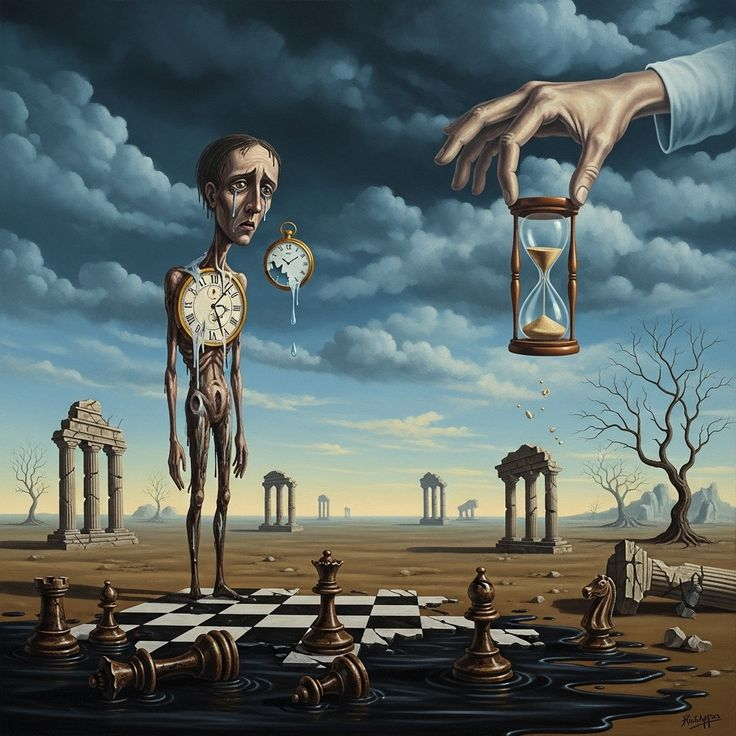
Free AI Art
(On the top: Surreal Abstract Painting.)

Neither Nietzsche nor Wagner understood one another realistically. Nietzsche saw Wagner as a benevolent father but felt disappointed by his egotism. Conversely, Wagner viewed Nietzsche as a loyal son who became a rebellious thinker. Both pursued psychological needs that overshadowed their friendship and intimacy.

Anyway, I found two paragraphs I’ve translated from one of his books, Menschliches, Allzumenschliches (Human, All Too Human). I present them to you because I believe they are very relevant to our “political” society today.

From the Book “Human, All Too Human”, Volume One

(No. 458) Guiding Spirits and their Tools.

We see great statesmen and generally all those who have to use many people to carry out their plans, sometimes proceed in this way, sometimes in that way: either they select very finely and carefully the people who suit their plans and then give them relatively great freedom because they know that the nature of these chosen people will lead them to where they themselves want them to go, or they choose poorly, even take what comes to hand, but form something suitable for their purposes out of every ton. This last type is the more violent; it also requires submissive tools, its knowledge of human nature is usually much less, and its contempt for human nature is greater than that of the first-mentioned minds. Still, the machine they construct generally works better than the machine from the workshop of the former.

Spiral to the Hole

(No. 460) The Great Man of the Masses.

The recipe for what the masses call a great man is easy to give. Whatever the circumstances, get them something they find very pleasant, or first put it into their heads that this and that would be very pleasant, and then give it to them. But not immediately at any price: you have to fight for it with the greatest effort or seem to be fighting for it. The masses must have the impression that there is a powerful, even indomitable willpower; at least, it must seem to be there. Everyone admires a strong will because no one has it, and everyone says to themselves that if they had it, there would be no limits to them and their egoism. If it turns out that such a firm will achieve something that the masses find very pleasant, people admire it once again and wish themselves luck instead of listening to the wishes of its greed. Moreover, he has all the qualities of the masses: the less they are ashamed of him, the more popular he is. So, He is violent, jealous, exploitative, scheming, flattering, grovelling, conceited (narcissist) or anything, depending on the circumstances.


A brief update: My challenging circumstances remain the same, but I’m relieved that my boss has exited the hospital. His blood tests are standard, yet he still cannot return to work. Therefore, I must continue managing things as the acting boss!
I am always grateful for your support and companionship, and I wish you all a lovely weekend.🙏💖