Searching for the Eternal Girl/Boy P. 3 Puella Aeterna/Puer Aeternus and Corne/Senex

Standard

I’ll borrow life and not grow old;
And nightingales and trees
Shall keep me, though the veins be cold,
As young as Sophocles.
And when I may no longer live,
They’ll say, who knows the truth,
He gave whate’er he had to give
To Freedom and to Youth.
~William Corey, Master at Eton c. 1850-1870

Success achieved, he never stays
For only by never staying does he not depart.
~Dao Tzu, Dao De Jing.

From Now or Neverland, p. 156

In this third part, let’s revisit the inspiring book, Now or Neverland, which motivated me to write these articles.

Here’s a brief essay on Now or Neverland by Ann Yeoman:

Ann Yeoman’s book “Now or Neverland: Peter Pan and the Myth of Eternal Youth” analyses the enduring charm of J.M. Barrie’s story, emphasising its psychological and mythological elements. She interprets Neverland as a metaphor for humanity’s longing to escape time and mortality. Yeoman considers Peter Pan an archetype embodying wonder and the peril of avoiding growth.
She explains that Neverland represents the myth of eternal youth—a place where responsibilities cease. This dream enables Peter to evade adult challenges but also leads him to miss meaningful relationships and personal development. Her study suggests Barrie’s tale celebrates youth but also warns against escapism.
In “Now or Neverland,” Yeoman encourages reflection on individual perceptions of time, change, and maturation, transforming a children’s story into a profound meditation on memory, imagination, and ageing.

Yesterday, I attended a birthday party for a dear family member, where my grandchildren were also present. I hadn’t seen them in a long time due to my illness and hospital stay. As always, I was the only adult the kids enjoyed playing with, because they knew the child in me well. It reminded me of what Yeoman mentioned in her book:

…Paradoxically, whereas lightness, freedom and space may be the necessary conditions for play, play itself is far from light, in that it has the capacity to ground one in the wholeness of one’s being. In a discussion of the importance of play in childhood, Anthony Stevens cites Johan Huizinga’s claim, in Homo Ludens, his work on the subject of play, that “in play there is something ‘at play’ which transcends the immediate needs of life.” This is because the archetypal activities of human life are filled with possibilities for play. Notes Stevens:

Hence, Schiller’s famous aphorism, “Man is only truly himself when he is at play.”
… Childhood is a period of immense vitality and inventiveness, when imagination is given free rein to complement the realities or compensate for the deficiencies of everyday existence…
It is one of the misfortunes of growing up that we readily lose touch with this rich land of childhood … Yet nothing is lost to the Self, and play, like the child who sponsors it, lives on as a propensity of the psyche to its dying day. (250On Jung, pp. 87f.)

What is of particular interest in our discussion of Barrie is Stevens’s emphasis that fantasy, as introverted play,

is the product of play between the archetypes of the collective unconscious and the living circumstances of the individual. . . . Fantasy is not a regressive means of escape from reality . . . but the modus operandi of psychological growth: it is the stuff of life, leading us on into the future. (251 Ibid., pp. 88f.)
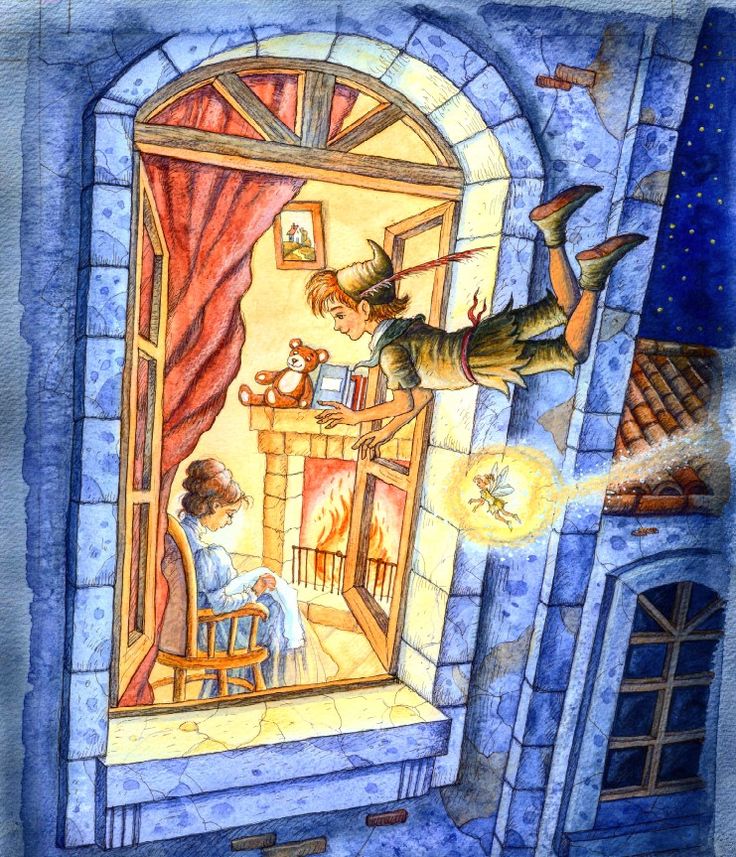
Play and fantasy lead us into the future because they make us creators. They legitimise our re-formation and re-creation of the world, allowing us to remember and so re-deem the scattered fragments of ordinary life. They make us gods for an hour or a day, enabling an activity which affirms our sense of Self because it affords unlimited scope to our desire for realisation, fulfilment and creative power in a world of our own making that is secret and therefore safe. The task of the artist is then to establish a vital connection between the hidden world of possibility and the world of actuality.

However, according to Winnicott, the “place” of play and fantasy is precarious, “because it belongs to the interplay in the . . . mind of that which is subjective (near-hallucination) and that which is objectively perceived (actual or shared reality).” (Playing and Reality, p. 61)

…This place is the No-man’s land, an intermediary realm of the imagination that the artist must continually interpret and re-interpret. Here, one might encounter the god-child, buried deep in the personality. The challenge for the writer, like Barrie, who feels more at home in the imaginal realm, is to interpret such experiences within the real world. But in Peter Pan, Barrie’s two worlds remain as opposed at the end as at the beginning, with no space in the Edwardian world for the richness found in Neverland. Ultimately, Barrie cannot show that reality offers room for self-fulfilment, unlike other children’s classics such as Grahame’s The Wind in the Willows or Milne’s Winnie-the-Pooh.

In Barrie, there’s an apparent devaluation of cosy domesticity and an iconoclastic streak visible in his work, especially in Peter Pan and other heroes resembling Peter’s mysterious presence. We find in Peter Pan the masculine energy of the trickster, a mythic figure known as a lawbreaker who embodies instinctual desires. (Barbara Greenfield, “The Archetypal Masculine,” in Andrew Samuels, ed., The Father, p. 192.)

The trickster often marks an early stage in the development of the heroic ego, reflecting nature’s transformative power while resisting change. Barrie’s hero also resists transformation, with little evidence of active sexuality or development beyond a boy-trickster to a mature hero or Wise Old Man. Instead, Peter Pan’s iconoclasm risks becoming an idol of boyish rebellion for its own sake.

(Ibid., p. 191. Greenfield argues that “The boy, Don Juan, and the trickster show us the ego in its early stages of development, while the hero, the father and the wise old man represent later stages of development. As a whole, the animus, or male archetype, unifies these disparate figures because it exists as those principles which underlie them all.” She suggests that the most powerful mythological forms of the masculine archetype are those of the father and the trickster, claiming the trickster as “an early incarnation of the father” rather than an archetype separate from that of the father, as it is treated by Jung. Her view supports our earlier discussion of the inherent similarities of Peter Pan and Hook and is useful when individual development and personal pathology are the issue. However, what we may describe as the “creative iconoclasm” of the Self in its impulse to further consciousness favours Jung’s treatment of the trickster and his recognition of its essential and constant role in the archetypal drama of the psyche. Perhaps this presents a case for “both/and” rather than “either/or” terminology; and for a concept of co-existing levels of activity rather than a more linear development from one stage to the next, with only faint traces of earlier characteristics evident in the later stages.)

Remember to cherish the child within you; thank you! 🙏
Searching for the Eternal Girl/Boy P. 2 Puella Aeterna/Puer Aeternus and Corne/Senex

Standard

The dynamic principle of fantasy is play, a characteristic also of the child, and as such, it appears inconsistent with the principle of serious work. But without this playing with fantasy, no creative work has ever yet come to birth. The debt we owe to the play of imagination is incalculable. It is, therefore, short-sighted to treat fantasy, on account of its risky or unacceptable nature, as a thing of little worth.
~Carl Jung; Psychological Types Ch. 1; Page 82.
Fantasy is the creative function—the living form is a result of fantasy. Fantasy is a pre-stage of the symbol, but it is an essential characteristic of the symbol that it is not mere fantasy.
~Carl Jung, 1925 Seminar, Page 11
Source: Carl Jung Depth Psychology

Continuing from the first part of my blog, I recall the days when Al and I created our own worlds, feeling utterly disconnected from the outside world. My childhood was filled with dreams and wishes, driven by my imagination and a touch of fantasy. Perhaps it was my name that ignited my desire to make my wishes come true, with a hint of magic.

On the other hand, I didn’t want to be treated like a child. I don’t know what the issue was; maybe it was because I’d been isolated at that age. I mean, there we were, a group of five boys, Al and me, including three cousins, all nearly the same age. One of the cousins, Ham, who was around Al’s age, about two years older than me, and the other two were roughly two years younger than me, and I was stuck in the middle.

Dream Catcher by Michael Cheval

As I remember, one evening in Mashhad, when we were visiting our aunt, we were playing hide and seek — a game like ‘catch me if you can find me!’ I was so engrossed in the game that I didn’t notice Al and Ham were missing. At first, when I caught my breath from running around to find a hiding spot, I thought, ‘What’s going on with me?’ and scolded myself for acting like a child. But then I got angry when I found out Al and Ham weren’t playing with us – they were off to see a movie, and I wanted to be there with them so badly! In the evening, when we gathered again, Al and Ham began by making a reference and a joke about the movie, which I remember was called Madame. This made me feel jealous and sad. It was so obvious that my mother recognised it and tried to comfort me, but to me, her effort was like giving milk to a crying infant! So I felt even more alone and forsaken.

In Ann Yeoman’s book, we can read:
…In terms of personality traits, a strong emotional attachment to what we may call the mother-realm manifests on the one hand in a certain preciousness, a sense of specialness and difference, a fictional example of which we see in James Joice’s young hero Stephen, who is always “on the fringe,” a little apart from his fellows, an isolate. On the other hand, when out of the province of the mother and, metaphorically, the reach of the mother’s watchful eye, the mother’s son experiences an incapacity to stand on his own and embrace the risks, challenges and unpredictable fullness of life, or realise the courage “to live, to err, to fall, to triumph, to recreate life out of life,”> to cite Joice once again>(A Portrait of the Artist as a Young Amn, p. 172).
As a result, the puer remains dissociated from his feelings. In order to shield himself unconsciously from suffering, he protects himself from the possibility of abandonment, rejection and disappointment with an array of defences which prevent him from fully committing himself to life in the first place.
Jung describes the neurosis of such a “mother’s boy” in terms of a “secret conspiracy between mother and so…. [in which] each helps the other to betray life” He continues:

Where does the guilt lie? With the mother, or with the son? Probably with both. The unsatisfied longing of the son for life and the world ought to be taken seriously. There is in him a desire to touch reality, to embrace the earth and fructify the field of the world.
But he makes no more than a series of fitful starts, for his initiative as well as his staying power are crippled by the secret memory that the world and happiness may be had as a gift from the mother. The fragment of the world which he, like every man, must encounter again and again is never quite the right one, since it does not fall into his lap, does not meet him halfway, but remains resistant, has to be conquered, and submits only to force.
It makes demands on the masculinity of a man, on his ardour, above all on his courage and resolution when it comes to throwing his whole being into the scales. For this, he would need a faithless Eros, one capable of forgetting his mother and undergoing the pain of relinquishing the first love of his life.
~Carl Jung, The Syzygy, Anima & Animus, Aion, CW 9ii, par. 20-21

I may laugh at that event now, but as I recall every detail, it seems it left a particular impression on me. I know I wanted to be noticed and taken seriously. However, my mother, as she always had, saw me as her lost daughter. That’s why, when I finally found my solitude, it was mostly when I woke early in the morning in my bed and looked out of the window into the street, where the summer breeze made the leaves of the poplar tree dance. I immersed myself in my fantasy world and let my imagination run freely.

I will definitely try to write another episode.🙏💖

Fifty + Years Loneliness XIII, Or Desperate Or Might Being Frantic Sometimes! (Just an add!)

Standard

A Foreword and Update!

Today (on Saturday!😮), I had to take my boss’s place, and I have just got back home, but I need to head out again soon!😜 I hadn’t planned to post anything but came across an old article I wrote years ago. So, I thought I’d share it with you before it goes stale. I hope you enjoy it somehow!🙏💖

Please don’t be shocked; this will not be an endless story! I have just a feeling that my last post about my yelping was, after all, too emotional and not clear enough.

To contemplate thereabout, I have to look at my past and review my life, but to avoid the immense length, I try to write it in a list form. First, I thank all my dear friends for their feedback, and especially among them, for their valuable suggestions.

My life is like a labyrinth; explaining this with my broken tongue (pen) is difficult.

1- It might be because of our mother’s lie to Al and me about our father’s death, which I had to carry for almost two months till I found it out by myself.

2- The next point is that Al and I were almost alone in our childhood. Our mother had to find a job to pay our father’s debt; though he was a famous writer and could be rich, he could never be a moneymaker. We had a big house with a broad yard, and you could imagine how frightening it would be for two children, nine & eleven-year-old to stay home in the evening, waiting for their mother to come home.

3- There, eternity loneliness develops, don’t you think? We have kept each other like the guardian angel, especially Al, because he was older than me, older in the year, and significantly older in mind.

4- The years passed, and we, Al and I, had made a wall to protect us. A wall, but not against our mother, a wall against the society in which we lived. That was a must, to avoid the stranger in our world. Oh yes, we have made a world just for us and nobody else. And it made us like foreigners in our own country.

5- It went all through our age of puberty, and there came the time of our mother’s death. She was married to another man then, and we (unfortunately) couldn’t accept him as a replacement for our father. Therefore, the wall grew taller and taller. The solitude casts our life.

6- We had a lot of experiences those days, so you might think twice about looking for people with walls around. I might tell you that in such countries under dictatorship and also the pressure of its traditions, the only way to escape to freedom is drugs. We had tried all possible and impossible stuff for many, many years. I can be proud to announce that I had all the drops in my veins, and now I am free of all.

7- Now about me: I have learned from my parents’ way of life that there had to be a genius to live with (in the form of a Couple. Two genius to live together… I don’t think that it might be advisable. I felt so because I had noticed how genius Al was. Therefore, I dedicated all my energy to my brother Al because I was convinced of his ability to create art. In Iran, I worked to earn money, managed a house, and all that was needed. It was, for me, a matter of course, even in our addiction period. (I was the one who could get the stuff.)

8- In all these happenings, I have forgotten to find my own identity! I know many people out there want to show me how to find it, but please stop! You have no idea!! I noticed that people, especially these days, want to give advice. (That is always calming to show the way to others) Thank you so much, but I think I am too far to see further. I might not know where I am going, but I am on my way.

9- Just to keep it short, since I lost my brother to serve him, I had to find my identity and what I am good for: I could be a musician, I could be an actor, I remember, as I gave up to make music and worked as a taxi driver, Al told me; Hey, don’t you want to continue composing? Then try writing! I thought, oh god, writing… how can I do that! I know that he knew we were both the offspring of artists. Therefore, we had to do art!

Buy me a Coffee!😁🙏

Choose an amount

€5.00
€15.00
€100.00

Or enter a custom amount


Your contribution is appreciated.

(Buy me a Coffee!)

The Mystery Of “Mana Personality” Part Three

Standard

Translated from volumes published by Lorenz Jung based on the edition “Gesammelte Werke” dtv.de The Symbols of Transformation (1952) and Aion (1950)

Mana-personality. A personified archetypal image of a supernatural force.

The Mana-personality is a dominant of the collective unconscious, the well-known archetype of the mighty man in the form of hero, chief, magician, medicine-man, saint, ruler of men and spirits, and the friend of God.[The Mana-Personality,” CW 7, par. 377.]

Mana is a Melanesian word referring to a bewitching or numinous quality in gods and sacred objects.

Historically, the Mana-Personality evolves into the hero and the godlike being, whose earthly form is the priest. How very much the doctor is still Mana is the whole plaint of the analyst! [Ibid., par. 389.]

Art by thecyclopssun

A Mana-Personality embodies this magical power. In individual psychology, Jung used it to describe the inflationary effect of assimilating autonomous unconscious contents, particularly those associated with anima and animus. (The text and the image are from Carl Jung’s Depth Psychology by my brilliant friend Lewis Lafontaine.)

I started with these specific sections of my friend’s website to better understand this enigmatic topic. Personally, I find Mana to be funny, attractive, amusing, intriguing, and, at the same time, very monstrous.

And now, after sharing parts one and two, I present part three, which is a short one so as not to bore you, or better to say, because of the preparations for my trip! I will be taking a two-week vacation, and the internet connection can be difficult on this trip. But after that, I promise to share a larger and more interesting part when I return!!💖

Individuation
The Mana Personality (P3)

In contrast, our pitifully limited “I”, if it possesses even a spark of self-knowledge, can only withdraw and quickly abandon any illusion of power and importance. It was an illusion: the “I” has not overcome the anima and, therefore, has not acquired its Mana. The consciousness has not become master of the unconscious, but the anima has lost its domineering presumption to the extent that the “I” has been able to come to terms with the unconscious. This conflict, however, was not a victory of consciousness over the unconscious but the establishment of a balance between the two worlds.

The ‘magician’ could only take possession of the “I” because the “I” dreamed of a victory over the anima. This was an attack, and every attack by the “I” would be followed by an attack by the unconscious.

>In a transformed figure
I exercise grim power. <
(Goethe: Faust II, Act 5, Scene 4, in Works in ten volumes, Vol. 4, 1961)

Faust surrounded by his Illustration, to Goethe’s Faust by Harry Clarke 1925

Therefore, if the “I” abandons its claim to victory, the obsession by the magician automatically ceases. But where does the Mana go? Who or what becomes Mana if even the magician can no longer perform magic? We now know that neither the conscious nor the unconscious has Mana, for it is certain that if the “I” does not claim power, then no obsession arises, which means that the unconscious has also lost its supremacy. In this state, the Mana must have fallen into the hands of Something that is conscious and unconscious, or neither conscious nor unconscious. This Something is the sought-after “centre” of the personality, that indescribable Something between the opposites, or the unifier of the opposites, or the result of the conflict, or the “achievement” of the energetic tension, the development of the personality, a most individual step forward, the next stage.

I do not expect the reader to follow the rapid overview of the whole problem in every detail. He should consider it a kind of exposition, the more detailed intellectual elaboration of which I will give in the following…

To be continued! I wish you all a great time.💖🙏💖🌹

PS: As the World Wide Web chaos happened yesterday, I hope our flight stays intact!!😁😅🙏

The Mystery of “Mana Personality” Part One

Standard

Translated from volumes published by Lorenz Jung based on the edition “Gesammelte Werke” dtv.de The Symbols of Transformation (1952) and Aion (1950)

Another challenge? Yes! I have decided to present a perhaps tricky but important topic; of course, I will try to make it as understandable as possible. I believe Dr. Jung’s theories and thoughts are not difficult to understand. They may seem strange, or rather, they are still new to us, which might make them seem difficult to comprehend. However, they are essential because they show us how to understand our undiscovered inner soul, which we might never notice deeply. Often, we look for problems outside of ourselves.

I understand his concerns about whether he adequately and comprehensively explains his lessons, although he never intended to present himself as a teacher. This may be due to the monstrous and sinister issues he has researched and discovered.
“The only real danger that exists is man himself,” he says. “He is the great danger, and we are pitifully unaware of it.” He has seen this danger and tried to show us how to recognize and handle it.

In November of 1960, seven months before his death, C.G. Jung suffered what he called “the lowest ebb of feeling I ever experienced.” He explained the sentiment in a letter to Eugene Rolfe:
I had to understand that I was unable to make the people see what I’ve been after. I am practically alone. There are a few who understand this and that, but almost nobody sees the whole… I have failed in my foremost task: to open people’s eyes to the fact that man has a soul, and there is a buried treasure in the field, and that our religion and philosophy are in a lamentable state.

I will do my best and hope that what he tries to convey to us will become more understandable. The topic of Mana might be an unknown subject, though very familiar to all of us. It is with us, man or woman, from childhood to old age. (I decided to translate the original Jung’s words myself because, as I found out, some online translations are incorrect due to false interpretations. Yes, it is hard work, but trustfully!)
Here is just a foretaste because it will take some parts more than one post! So, let’s begin:

According to Jung, the ‘Mana Personality’ represents an archetypal phase of the individuation process of remarkable interest in psychological, hermeneutic, and theoretical terms. This figure is characterized by a high initiate potential that fosters the approximation of the Self’s consciousness.

Individuation
The Mana Personality

Klingsor verflucht Kundry (Gemälde von Franz Stassen)

My starting material for the following discussion is those cases in which what was presented as the next goal in the previous chapter was achieved, namely the overcoming of the anima as an autonomous complex and its transformation into a function of the relationship of the conscious to the unconscious. By achieving this goal, it is possible to free the ego from all its entanglements with collectivity and the collective unconscious. Through this process, the anima loses the demonic power of the autonomous complex, i.e. it can no longer exercise possession as it is depotentiated. It is no longer the guardian of unknown treasures, it is no longer Kundry, the demonic messenger of the Grail of a divine-animal nature, no longer the >Mistress-Soul<, but a psychological function of an intuitive nature, of which one could say with the primitive: >He goes into the forest to talk to the spirits<, or: >My snake spoke to me<, or expressed in mythological infantile language: >The little finger told me.<

Those of my readers who are familiar with Rider Haggard‘s description of the ‘She-who-must-be-obeyed‘ will certainly remember the magical powers of this personality. She is a mana personality, a being full of occult, magical qualities (Mana) endowed with mystical knowledge and powers. All these attributes, of course, arise from the naive projection of unconscious self-knowledge, expressed in less poetic terms, which would be something like this: ‘I recognize that there is a psychic factor at work within me which can escape my conscious will most incredibly. It can put extraordinary ideas into my head, cause me unwanted and unwelcome moods and effects, induce me to perform astonishing actions for which I cannot take responsibility, disturb my relations with other people in an irritating way, and so on. I feel powerless in the face of this fact, and what is worse, I am in love with her, so I have yet to admire her. < (Poets often call this the artistic temperament; unpoetic ones excuse themselves in other ways.)

If the factor >Anima< loses its Mana, where has it gone? Evidently, the person who mastered the anima has acquired that Mana, in accordance with the primitive idea that the person who kills the Mana person absorbs its Mana.

Being continued! 😉😅

PS: I’m writing this post between doing the laundry, mowing the lawn and cleaning the windows, and unfortunately, I had to skip the second post; I’m completely exhausted! (I always wonder how some people can produce posts every hour!!). Thank you all, and have a lovely weekend.🙏💖🤗