Searching for the Eternal Girl/Boy P. 3 Puella Aeterna/Puer Aeternus and Corne/Senex

Standard

I’ll borrow life and not grow old;
And nightingales and trees
Shall keep me, though the veins be cold,
As young as Sophocles.
And when I may no longer live,
They’ll say, who knows the truth,
He gave whate’er he had to give
To Freedom and to Youth.
~William Corey, Master at Eton c. 1850-1870

Success achieved, he never stays
For only by never staying does he not depart.
~Dao Tzu, Dao De Jing.

From Now or Neverland, p. 156

In this third part, let’s revisit the inspiring book, Now or Neverland, which motivated me to write these articles.

Here’s a brief essay on Now or Neverland by Ann Yeoman:

Ann Yeoman’s book “Now or Neverland: Peter Pan and the Myth of Eternal Youth” analyses the enduring charm of J.M. Barrie’s story, emphasising its psychological and mythological elements. She interprets Neverland as a metaphor for humanity’s longing to escape time and mortality. Yeoman considers Peter Pan an archetype embodying wonder and the peril of avoiding growth.
She explains that Neverland represents the myth of eternal youth—a place where responsibilities cease. This dream enables Peter to evade adult challenges but also leads him to miss meaningful relationships and personal development. Her study suggests Barrie’s tale celebrates youth but also warns against escapism.
In “Now or Neverland,” Yeoman encourages reflection on individual perceptions of time, change, and maturation, transforming a children’s story into a profound meditation on memory, imagination, and ageing.

Yesterday, I attended a birthday party for a dear family member, where my grandchildren were also present. I hadn’t seen them in a long time due to my illness and hospital stay. As always, I was the only adult the kids enjoyed playing with, because they knew the child in me well. It reminded me of what Yeoman mentioned in her book:

…Paradoxically, whereas lightness, freedom and space may be the necessary conditions for play, play itself is far from light, in that it has the capacity to ground one in the wholeness of one’s being. In a discussion of the importance of play in childhood, Anthony Stevens cites Johan Huizinga’s claim, in Homo Ludens, his work on the subject of play, that “in play there is something ‘at play’ which transcends the immediate needs of life.” This is because the archetypal activities of human life are filled with possibilities for play. Notes Stevens:

Hence, Schiller’s famous aphorism, “Man is only truly himself when he is at play.”
… Childhood is a period of immense vitality and inventiveness, when imagination is given free rein to complement the realities or compensate for the deficiencies of everyday existence…
It is one of the misfortunes of growing up that we readily lose touch with this rich land of childhood … Yet nothing is lost to the Self, and play, like the child who sponsors it, lives on as a propensity of the psyche to its dying day. (250On Jung, pp. 87f.)

What is of particular interest in our discussion of Barrie is Stevens’s emphasis that fantasy, as introverted play,

is the product of play between the archetypes of the collective unconscious and the living circumstances of the individual. . . . Fantasy is not a regressive means of escape from reality . . . but the modus operandi of psychological growth: it is the stuff of life, leading us on into the future. (251 Ibid., pp. 88f.)

Play and fantasy lead us into the future because they make us creators. They legitimise our re-formation and re-creation of the world, allowing us to remember and so re-deem the scattered fragments of ordinary life. They make us gods for an hour or a day, enabling an activity which affirms our sense of Self because it affords unlimited scope to our desire for realisation, fulfilment and creative power in a world of our own making that is secret and therefore safe. The task of the artist is then to establish a vital connection between the hidden world of possibility and the world of actuality.

However, according to Winnicott, the “place” of play and fantasy is precarious, “because it belongs to the interplay in the . . . mind of that which is subjective (near-hallucination) and that which is objectively perceived (actual or shared reality).” (Playing and Reality, p. 61)

…This place is the No-man’s land, an intermediary realm of the imagination that the artist must continually interpret and re-interpret. Here, one might encounter the god-child, buried deep in the personality. The challenge for the writer, like Barrie, who feels more at home in the imaginal realm, is to interpret such experiences within the real world. But in Peter Pan, Barrie’s two worlds remain as opposed at the end as at the beginning, with no space in the Edwardian world for the richness found in Neverland. Ultimately, Barrie cannot show that reality offers room for self-fulfilment, unlike other children’s classics such as Grahame’s The Wind in the Willows or Milne’s Winnie-the-Pooh.

In Barrie, there’s an apparent devaluation of cosy domesticity and an iconoclastic streak visible in his work, especially in Peter Pan and other heroes resembling Peter’s mysterious presence. We find in Peter Pan the masculine energy of the trickster, a mythic figure known as a lawbreaker who embodies instinctual desires. (Barbara Greenfield, “The Archetypal Masculine,” in Andrew Samuels, ed., The Father, p. 192.)

The trickster often marks an early stage in the development of the heroic ego, reflecting nature’s transformative power while resisting change. Barrie’s hero also resists transformation, with little evidence of active sexuality or development beyond a boy-trickster to a mature hero or Wise Old Man. Instead, Peter Pan’s iconoclasm risks becoming an idol of boyish rebellion for its own sake.

(Ibid., p. 191. Greenfield argues that “The boy, Don Juan, and the trickster show us the ego in its early stages of development, while the hero, the father and the wise old man represent later stages of development. As a whole, the animus, or male archetype, unifies these disparate figures because it exists as those principles which underlie them all.” She suggests that the most powerful mythological forms of the masculine archetype are those of the father and the trickster, claiming the trickster as “an early incarnation of the father” rather than an archetype separate from that of the father, as it is treated by Jung. Her view supports our earlier discussion of the inherent similarities of Peter Pan and Hook and is useful when individual development and personal pathology are the issue. However, what we may describe as the “creative iconoclasm” of the Self in its impulse to further consciousness favours Jung’s treatment of the trickster and his recognition of its essential and constant role in the archetypal drama of the psyche. Perhaps this presents a case for “both/and” rather than “either/or” terminology; and for a concept of co-existing levels of activity rather than a more linear development from one stage to the next, with only faint traces of earlier characteristics evident in the later stages.)

Remember to cherish the child within you; thank you! 🙏

Everything is Relative; Even Happiness!

Standard

Put your hand on a hot stove for a minute, and it seems like an hour. Sit with a pretty girl for an hour, and it seems like a minute. That’s relativity.
~Albert Einstein

I was always sceptical about the concepts of time and space. As I explored Einstein’s theory of relativity, I realised that it encompasses not just time and space, but everything else as well, including happiness.

Indeed, it pertains to an individual’s life circumstances or, more precisely, it is linked to them. For example, someone living a stress-free and trouble-free life may experience a lack of happiness, but when faced with tough times, they may find happiness more readily.

My life has been filled with challenges, but this year has been especially tough. As you know, I had issues with my lower abdomen and underwent three surgeries to fix it, or so I thought. However, a problem arose when I went to the toilet, which caused concern, and I visited my doctor. After the examination, he stated that an apparent mistake had occurred during the last operation, a part had been injured, and I would require another procedure. I won’t go into the details, but after some anxious days, I’ve managed to secure a scheduled appointment for next Wednesday, as the procedure needs to be done soon to prevent kidney issues.

I gathered some insights and words from my teacher, Carl Jung, who held that the psyche and cosmos are fundamentally timeless. Working with Einstein and Pauli, he examined a concept of timelessness that goes beyond linear clock time. Jung proposed that accurate understanding involves transcending causality because time in the psyche and reality is relative. Although our conscious mind perceives time linearly, embracing a sense of timelessness can enhance learning. His goal was to unify physical and psychic realities and how they interact.

He believed in a psychological “relativity of time,” where perception is subjective and affected by inner states. He connected this to synchronicity, implying that the psyche and material world are not always ruled by linear cause-and-effect but can relate in other ways. Jung pointed out that, similar to the space-time continuum in modern physics, the unconscious also exhibits “indistinctness” or psychic relativity, which blurs the boundaries between time and space.

For Jung: “[Synchronicity] cannot be a question of cause and effect, but of a falling together in time, a kind of simultaneity. Because of this quality of simultaneity, I have chosen the term ‘synchronicity’ to designate a hypothetical factor equal in rank to causality as a principle of explanation.”
Jung, C. G. (1952). The Structure and Dynamics of the Psyche; Synchronicity: An Acausal Connecting Principle, in CW, Vol. 8.

Now, what about happiness? I tell you this: when I go to the toilet and manage to pee, I feel the entire joy of life again and find happiness!

Humour plays a vital role, and hope remained until the very end. In my seventy years, I have enjoyed good health and no surgeries, but this year I face my fourth operation. Here’s to a brighter year ahead. Wishing you all health and prosperity.

The frames must be put in place; you just need to know where to cut and sew.

Standard
“Crazy Woman” Lara Lisa Bella” Designed by Marko Köppe

This isn’t just about revenge; I am honoured to share a magnificent work by an exceptional artist: Experience Film

He stands out as one of the most talented thinkers and creators!

Renaissance: the Pinnacle of Humanity’s Artistic and Philosophical Achievement!

Standard

Raffaello Sanzio, Leonardo da Vinci, and Michelangelo are legendary figures of the Renaissance, each contributing uniquely to the era’s art and thought. Raffaello is celebrated for his balanced compositions and perspective, especially in The School of Athens, embodying ideals of knowledge and beauty. Leonardo da Vinci, a true polymath, excelled in painting, science, and anatomy, with works such as the Mona Lisa and The Last Supper showcasing his innovative methods and deep understanding of human emotion. Michelangelo, renowned for his sculptures and paintings, created masterpieces such as the Statue of David and the Sistine Chapel ceiling, which reflect his keen insight into human anatomy and emotion. These artists collectively represented the Renaissance spirit, merging art, science, and philosophy, and their enduring legacies continue to inspire us.

But what is the most interestingly depicted in art history during the Renaissance? Two masterworks tell their own story: Raffaello’s ‘School of Athens’ and Michelangelo’s ‘Sistine Chapel ceiling.’

Indeed, Leonardo da Vinci’s Last Supper should not be overlooked, as it is a Renaissance masterpiece that captures the moment after Jesus reveals that one of his apostles will betray him. Raffaello’s The School of Athens also employs one-point perspective, similar to da Vinci’s method: the composition is centred on a single vanishing point with all lines converging on Jesus, highlighting him as the focal point. However, it’s a different story!

I previously covered that topic, mainly from a philosophical angle rather than focusing on developing the art self. Now, let’s explore this masterpiece creatively and artistically.

Raffaello’s masterpiece, The School of Athens, exemplifies the Renaissance by highlighting its core principles of knowledge, philosophy, and beauty. This famous fresco depicts a gathering of history’s greatest thinkers, including Plato and Aristotle, each representing distinct philosophical perspectives. Plato, resembling Leonardo da Vinci, represents idealism and the importance of ideas, while Aristotle stands for empirical observation. Figures like Socrates, Ptolemy, and Euclid enrich the discussion. Raffaello’s masterful use of perspective draws viewers into a vibrant intellectual hub of the Renaissance. The influence of Michelangelo is evident, demonstrating outstanding artistic talent. The School of Athens celebrates individual genius and the collaborative spirit of the Renaissance, a time when art, science, and humanism thrived.

Raffaello’s ‘School of Athens’ and Michelangelo’s ‘Sistine Chapel ceiling’ are iconic Renaissance masterpieces. ‘School of Athens’ portrays philosophers amidst impressive architecture, symbolising art, philosophy, and science.

Michelangelo’s ceiling is renowned for dramatic scenes like ‘Creation of Adam’, showcasing his skill and religious themes.

Both works are culturally and historically significant, reflecting Renaissance intellectual and artistic progress.

Here’s a video titled “How to read ‘The School of Athens’ – a triumph of Renaissance art” from Aeon, a recommended site.
In Great Art Explained, UK curator and video essayist James Payne explores Raphael’s The School of Athens (1509-11), a Renaissance icon. He highlights its location in the Pope’s private Vatican library, symbolising philosophy alongside theology, poetry, and law. Payne describes how Raphael’s composition merges Classical and Christian ideas, showing their interconnectedness in the quest for truth.

I hope you enjoy it and wish everyone a wonderful weekend. 🤗💖

Edgar Allan Poe and Herman Melville

Standard

Hello friends!

I am back for a while from my holiday trip, although I am not fully recovered from a cold I caught a week ago, which I am still fighting to get rid of (it seems my immune system has been damaged after that problem earlier this year!). I didn’t plan to make a post today, but when I came across an article about the relationship between Poe and Melville, which I didn’t know about, I thought I would share it with you. Indeed, I should mention that I once published an article on Allan Poe; here it is!

As a new New Yorker, I once travelled across three boroughs to Woodlawn Cemetery to visit Herman Melville’s grave. I didn’t worship him as a hero but as a friend. Through the words of Professor Angela O’Donnell, who says that reading great writers is like having a conversation with them and fosters intimacy, I promised to visit often. Still, I was distracted by city life and never went back. However, a friend of another 19th-century American author never missed a visit.
The Baltimore Sun reports that, for decades, an anonymous “Poe Toaster” left three roses and a bottle of cognac at Edgar Allan Poe’s grave every January 19th. His mystery remains unsolved, as does Poe’s own death.

On October 7, 1849, the literary community remembered Edgar Allan Poe, a master of the macabre whose death remains shrouded in mystery. Although his anniversary has passed, his short, tragic life and death remain deeply saddening. He was found delirious on Baltimore’s streets, and the exact cause of his death remains unclear, speculated to be linked to alcoholism, rabies, or other health issues.

In the days leading up to his death, Poe grappled with personal turmoil and bouts of depression, reflecting the dark themes prevalent in his writing. His life mirrored the tragedies he explored—loss, madness, and mortality.

As we remember Poe, we not only honour his legacy as a pioneering voice in Gothic literature but also reflect on the profound connections between art and the struggles of existence, inviting us to confront the deeper aspects of the human condition he so eloquently captured.

The relationship between Edgar Allan Poe and Herman Melville is a compelling exploration of two iconic figures in American literature, whose works have shaped literary history. Both authors are monumental, yet their life paths and artistic styles diverged significantly, revealing profound themes of existentialism and the complexities of the human experience.

Edgar Allan Poe, born in 1809 in Boston, faced a tumultuous early life marked by personal tragedies. Orphaned as a child, he experienced the pain of loss that profoundly influenced his writing. His struggles with poverty and alcoholism fueled the dark themes in his work. Masterfully crafted tales such as “The Raven,” “The Tell-Tale Heart,” and “The Fall of the House of Usher” explore death, madness, and despair, establishing Poe as a master of horror and Gothic literature.

In contrast, Herman Melville, born in 1819 in New York City, enjoyed a more privileged upbringing that was disrupted by his father’s early death. This formative loss set him on a path of adventure at sea, which culminated in his magnum opus, “Moby-Dick.” Melville’s works engage with grand themes of nature and humanity, showcasing a narrative style that embodies the complexities of existence and human ambition.

Despite their differences, Melville and Poe respected each other’s literary talents. Poe’s sharp critiques of Melville’s early works, such as “Typee,” acknowledged Melville’s gift while highlighting differences in their narrative styles. Poe favoured compact storytelling, while Melville embraced sprawling narratives laden with existential questions.

Both writers engaged with themes of death and isolation, particularly evident in Melville’s Captain Ahab, who mirrors the psychological depths of Poe’s characters. Their respective narratives challenge audiences to confront profound aspects of the human condition. Timing also affected their careers; though Poe achieved fame earlier, Melville’s “Moby-Dick” was initially overlooked, though it would eventually be recognised as a key literary work.

Ultimately, the legacies of both authors flourished posthumously, with Poe celebrated for his innovative contributions to literature and Melville emerging as a foundational figure. This interplay between the two writers encourages contemporary readers to explore the connections that define their works.

In conclusion, the relationship between Poe and Melville offers a striking study of contrasting yet complementary voices in American literature. Their distinct views on existential despair and the human experience create a rich tapestry that continues to inspire and intrigue, leaving a lasting impact on generations of writers and readers alike.

Thanks, and have a good time, everybody.

My (Carl Jung’s) Most Difficult Experiment [P. 3]

Standard

“We need a force not to start conflicts but to protect our nation and freedom. Therefore, making military service more attractive could draw more young people”. Said German Bundeskanzler Friedrich März a few days ago.
I wonder how and with what we can make being a soldier attractive. A soldier’s role involves killing; how can we make that aspect attractive?

I remember the 1960s and 1970s, during the Cold War and Vietnam War, when crowds gathered to protest against conflicts and advocate for peace. Over time, Western governments began to prioritise peace more and engaged in disarmament talks, seeking peaceful coexistence. Yet today, they focus on strengthening their military to defend peace and freedom!

What’s happening? Isn’t there enough war worldwide? Is Germany yearning for the glorious days of the 1930s? The facts appear this way!

However, this has always occurred whenever politicians become oblivious to the horrific machinery of war. Therefore, it might be meaningful to consider two of Jung’s dreams from before WWI, as excerpted from his autobiography. “Memories, Dreams, Reflections” describes Carl Jung’s dreams from 1913 to 1914. With thanks to Lewis Lafontaine. 🙏

In October [1913], while I was alone on a journey, I was suddenly seized by an overpowering vision: I saw a monstrous flood covering all the northern and low-lying lands between the North Sea and the Alps.
When it came to Switzerland, I saw that the mountains grew higher and higher to protect our country.
I realised that a frightful catastrophe was in progress.
I saw the mighty yellow waves, the floating rubble of civilisation, and the drowned bodies of uncounted thousands.
Then the whole sea turned to blood.
This vision lasted about one hour.
I was perplexed and nauseated, and ashamed of my weakness.

Thunder is no longer the voice of a god, nor is lightning his avenging missile.
No river contains a spirit, no tree makes a man’s life, no snake is the embodiment of wisdom, and no mountain still harbours a great demon.
Neither do things speak to him nor can he speak to things, like stones, springs, plants and animals.”
~ Carl Jung, CW 18, Para 585

Two weeks passed; then the vision recurred, under the same conditions, even more vividly than before, and the blood was more emphasised.
An inner voice spoke. “Look at it well; it is wholly real, and it will be so. You cannot doubt it.”
That winter, someone asked me what I thought were the political prospects of the world in the near future.
I replied that I had no thoughts on the matter, but that I saw rivers of blood.
I asked myself whether these visions pointed to a revolution, but I could not really imagine anything of the sort.
And so I concluded that they had to do with me myself, and decided that a psychosis menaced me.
The idea of war did not occur to me at all.
Soon afterwards, in the spring and early summer of 1914, I had a thrice-repeated dream that in the middle of summer an Arctic cold wave descended and froze the land to ice.
I saw, for example, the entire region of Lorraine and its canals frozen, and the whole area totally deserted by human beings.
All living green things were killed by frost.
This dream came in April and May, and for the last time in June 1914.
In the third dream, frightful cold had again descended from out of the cosmos.
This dream, however, had an unexpected end. There stood a leaf-bearing tree, but without fruit (my tree of life, I thought), whose leaves had been transformed by the effects of the frost into sweet grapes full of healing juices.
I plucked the grapes and gave them to a large, waiting crowd…

On August 1, World War I broke out!

Now, let’s continue with the next section, following (1, 2), about Dr Jung’s dreams and examining how a forecaster can predict potential human self-destructive plans. As mentioned in Part Two, Jung described hearing a strange woman’s voice in his mind and tried to analyse it.

He believed the voice was “the soul in the primitive sense,” known as the anima, and stated that he employed his analysis to write letters to his anima, experiencing it as both a ghost and a woman. He remembered this voice as that of a Dutch patient from 1912 to 1918, who convinced a colleague that he was a misunderstood artist. The woman had thought the unconscious was art, but Jung had maintained it was a natural phenomenon. The woman was likely Maria Moltzer, and the psychiatrist was Jung’s friend Franz Riklin, who shifted from analysis to painting, studying Augusto Giacometti in 1913. Riklin’s art was semi-figurative and abstract, with a notable 1915/6 work, Verkündigung, in Zürich, donated by Moltzer in 1945. Giacometti found Riklin’s psychological insights exciting, calling him a modern magician.

Franz Beda Riklin Verkündigung 1915, Wikimedia

The November entries in Black Book 2 depict Jung’s return to his soul. He recalled dreams that led him to his scientific career and recent dreams bringing him back to his soul. In 1925, he noted his first writing phase ended in November: ” Not knowing what would come next, I thought perhaps more introspection was needed… I devised such a boring method by fantasising that I was digging a hole, and by accepting this fantasy as perfectly real. ” This experiment occurred on December 12, 1913 (See Liber Primus, chapter 5, p. 147).

To be continued …………

Thank you for reading! I don’t want to spoil your mood, but sometimes thinking more deeply can help us and prepare us for the worst. While I am on my way to spend the holidays, please note that responses to comments, if any, may be delayed.🙏💖

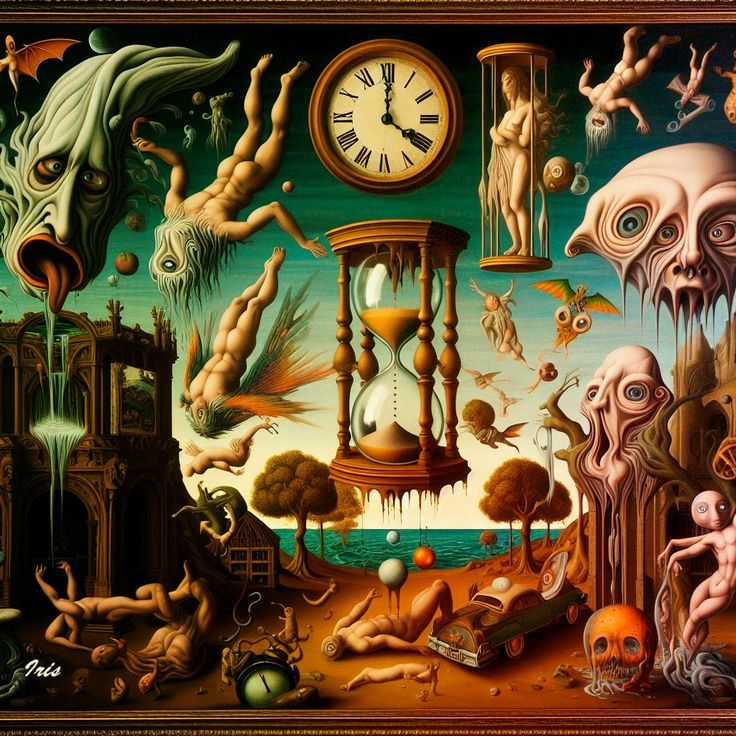
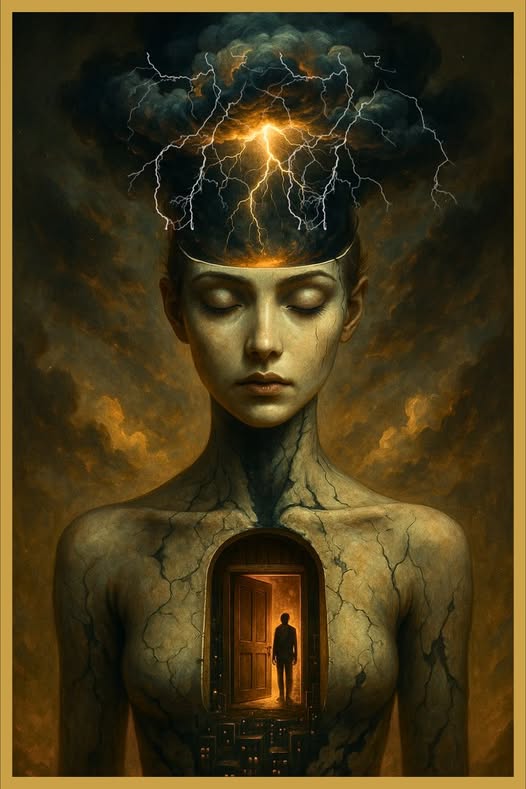
Illustration art at the top: Dali-Inspired Dreamscape

A trip to Westkapelle, Netherlands, during a Chilly Summer.

Standard

Foreword:
I spent most of the day, from early morning to the afternoon, at a birthday party hosted by my wife’s colleague. Since I will be visiting a friend next week and won’t be at home, I thought I’d share my “two” posts today. Here is the second one!

I believe I posted my last travel report quite some time ago; therefore, I have decided to pause sharing deep, tragic, and pensive ones and instead share something amusing! Although this trip could have been more enjoyable if summer had truly arrived, unfortunately, the temperature refused to rise above twenty degrees, and the wind stubbornly refused to change its direction from north to south.

Actually, we, or rather my lovely wife (!), aim to plan vacations in sunny, warm destinations—what we miss most during the year in Germany. This year, because of my health issues, she organised a trip to Holland so we could return home quickly if needed. As you likely know, good weather in northern Europe can be quite unpredictable. It often depends on luck, but unfortunately, we didn’t have any this time!

I even developed a thirty-degree fever after we ran back to our apartment in the rain and storm following dinner at a restaurant, and I was lying flat for two days!

Of course, it wasn’t all bad; we also enjoyed some sunshine, especially on my birthday. The great gods, Zeus, Poseidon, or Boreas (the god of the cold north wind and winter), protected us and allowed the sun to shine while the wind rested.

As usual, we wandered around, exploring different sites, including cathedrals, even though there were only a few in the small village of Westkapelle.

Finally, I must admit that it wouldn’t have been possible without a bike tour! And, as you might notice, I’ve lost some hair from the wind!

Wishing everyone a fantastic time! Take care of yourselves, and remember there’s a whole world beyond the internet waiting to be explored. Enjoy your treats, but be mindful not to overdo it!

Searching for the Eternal Girl/Boy P. 2 Puella Aeterna/Puer Aeternus and Corne/Senex

Standard

The dynamic principle of fantasy is play, a characteristic also of the child, and as such, it appears inconsistent with the principle of serious work. But without this playing with fantasy, no creative work has ever yet come to birth. The debt we owe to the play of imagination is incalculable. It is, therefore, short-sighted to treat fantasy, on account of its risky or unacceptable nature, as a thing of little worth.
~Carl Jung; Psychological Types Ch. 1; Page 82.
Fantasy is the creative function—the living form is a result of fantasy. Fantasy is a pre-stage of the symbol, but it is an essential characteristic of the symbol that it is not mere fantasy.
~Carl Jung, 1925 Seminar, Page 11
Source: Carl Jung Depth Psychology

Continuing from the first part of my blog, I recall the days when Al and I created our own worlds, feeling utterly disconnected from the outside world. My childhood was filled with dreams and wishes, driven by my imagination and a touch of fantasy. Perhaps it was my name that ignited my desire to make my wishes come true, with a hint of magic.

On the other hand, I didn’t want to be treated like a child. I don’t know what the issue was; maybe it was because I’d been isolated at that age. I mean, there we were, a group of five boys, Al and me, including three cousins, all nearly the same age. One of the cousins, Ham, who was around Al’s age, about two years older than me, and the other two were roughly two years younger than me, and I was stuck in the middle.

Dream Catcher by Michael Cheval

As I remember, one evening in Mashhad, when we were visiting our aunt, we were playing hide and seek — a game like ‘catch me if you can find me!’ I was so engrossed in the game that I didn’t notice Al and Ham were missing. At first, when I caught my breath from running around to find a hiding spot, I thought, ‘What’s going on with me?’ and scolded myself for acting like a child. But then I got angry when I found out Al and Ham weren’t playing with us – they were off to see a movie, and I wanted to be there with them so badly! In the evening, when we gathered again, Al and Ham began by making a reference and a joke about the movie, which I remember was called Madame. This made me feel jealous and sad. It was so obvious that my mother recognised it and tried to comfort me, but to me, her effort was like giving milk to a crying infant! So I felt even more alone and forsaken.

In Ann Yeoman’s book, we can read:
…In terms of personality traits, a strong emotional attachment to what we may call the mother-realm manifests on the one hand in a certain preciousness, a sense of specialness and difference, a fictional example of which we see in James Joice’s young hero Stephen, who is always “on the fringe,” a little apart from his fellows, an isolate. On the other hand, when out of the province of the mother and, metaphorically, the reach of the mother’s watchful eye, the mother’s son experiences an incapacity to stand on his own and embrace the risks, challenges and unpredictable fullness of life, or realise the courage “to live, to err, to fall, to triumph, to recreate life out of life,”> to cite Joice once again>(A Portrait of the Artist as a Young Amn, p. 172).
As a result, the puer remains dissociated from his feelings. In order to shield himself unconsciously from suffering, he protects himself from the possibility of abandonment, rejection and disappointment with an array of defences which prevent him from fully committing himself to life in the first place.
Jung describes the neurosis of such a “mother’s boy” in terms of a “secret conspiracy between mother and so…. [in which] each helps the other to betray life” He continues:

Where does the guilt lie? With the mother, or with the son? Probably with both. The unsatisfied longing of the son for life and the world ought to be taken seriously. There is in him a desire to touch reality, to embrace the earth and fructify the field of the world.
But he makes no more than a series of fitful starts, for his initiative as well as his staying power are crippled by the secret memory that the world and happiness may be had as a gift from the mother. The fragment of the world which he, like every man, must encounter again and again is never quite the right one, since it does not fall into his lap, does not meet him halfway, but remains resistant, has to be conquered, and submits only to force.
It makes demands on the masculinity of a man, on his ardour, above all on his courage and resolution when it comes to throwing his whole being into the scales. For this, he would need a faithless Eros, one capable of forgetting his mother and undergoing the pain of relinquishing the first love of his life.
~Carl Jung, The Syzygy, Anima & Animus, Aion, CW 9ii, par. 20-21

I may laugh at that event now, but as I recall every detail, it seems it left a particular impression on me. I know I wanted to be noticed and taken seriously. However, my mother, as she always had, saw me as her lost daughter. That’s why, when I finally found my solitude, it was mostly when I woke early in the morning in my bed and looked out of the window into the street, where the summer breeze made the leaves of the poplar tree dance. I immersed myself in my fantasy world and let my imagination run freely.

I will definitely try to write another episode.🙏💖

A Collaborative Fusion of two Great Poets Exploring Human Curiosity. Could the answer lie in dreams?

Standard

It’s a lovely day today, and it feels like summer is making one last bid to say goodbye. I was out in the garden, but not sunbathing – I had to mow the lawn! As tenants, these sorts of tasks are our responsibility.
And now, after giving the flat a good vacuum, I thought it was a good time to write a post.

Tomorrow is Leonard Cohen‘s birthday, and I thought it would be a great chance to celebrate with a poem by Pablo Neruda as a tribute.
The theme is human curiosity (the ‘Whys!’), how little we know, and, as Leonard Cohen suggests, why not stand on your own two feet and be your own individual?

There’s no doubt that they’re still alive, truly in our hearts, thanks to their lasting arts and wisdom.

Through a closed mouth, the flies enter
by Pablo Neruda:

Why, with those red flames at hand,
Are rubies so ready to burn?

Why does the heart of the topaz
reveal a yellow honeycomb?
Why does the rose amuse itself
by hanging the colour of its dreams?
Why does the emerald shiver
like a drowned submarine?

Why does the sky grow pale
under the June stars?
Where does the lizard’s tail
Get its fresh supply of paint?
Where is the underground fire
That revives the carnations?

Where does the salt acquire
The transparency of its glance?
Where did the coal sleep
That it awoke so dark?
And where, where does the tiger buy
Its stripes of mourning, its stripes of gold?

When did the jungle begin
to breathe its own perfume?
When did the pine tree realise
its own sweet-smelling consequence?
When did the lemons learn
The same laws as the sun?

When did smoke learn to fly?
When do roots converse?
What is water like in the stars?
Why is the scorpion poisonous?
Is the elephant benign?

What is the tortoise brooding on?
Where does shade withdraw to?
What song does the rain repeat?
When are the birds going to die?
And why should leaves be green?

What we know is so little,
and what we presume so much,
So slowly do we learn
that we ask questions, then die.
Better for us to keep our pride
for the city of the dead
on the day of the departed,
And there, when the wind blows through
the holes in your skull,
It will unveil to you such mysteries,
whispering the truth to you
through the spaces that were your ears.

I shall forever remember those days when Al and I closed many doors one after another to society, and by listening to Cohen’s songs, we immersed ourselves in our solitude.

Have a great time, everyone. 🙏💖🤗

Source: “Through a closed mouth the flies enter” from EXTRAVAGARIA by Pablo Neruda, translated by Alastair Reid. Copyright © 1958 Pablo Neruda and Fundación Pablo Neruda. Translation copyright © 1974 by Alastair Reid. Used by permission of Farrar, Straus and Giroux and Fundación Pablo Neruda.

Searching for the Eternal Girl/Boy P. 1 Puella Aeterna/Puer Aeternus and Corne/Senex

Standard

Does fantasy lead to escape, or to the embracing of a new perspective? In other words, does it support psychic growth or impede it? That distinction is often complicated by paradox, but it helps to ask ourselves, “Is concentrating on this fantasy or daydream opening my creative possibilities, or is this sapping my ego strength in the real world?” ~Marion Woodman

This excerpt begins Marion Woodman‘s foreword from Ann Yeoman’s book, Now or Neverland, which I read some time ago, thanks to Deborah Gregory‘s recommendation, and I am very grateful for it.

Frankly, when I began reading this book, I felt at home; I saw myself as a puer aeternus, struggling to stay balanced on life’s rollercoaster.

Traditionally, the term ‘puer aeternus’ (Latin for ‘eternal boy’) is used to describe a child-god who remains eternally young. In Carl Jung’s psychology, it refers to an older person whose emotional life remains stuck in adolescence, often referred to as the “Peter Pan syndrome”. Jung suggests that the puer lives a “provisional life” due to a fear of being trapped. They seek independence, resist boundaries, and find restrictions intolerable. In Greek mythology, the term ‘puer aeternus’ originates from the Metamorphoses, an epic poem by Roman poet Ovid (43 BC – c. 17 AD) that explores Greek and Roman myths. Ovid refers to the child-god Iacchus as “puer aeternus” and praises his role in the Eleusinian mysteries. Iacchus is linked to Dionysus and Eros. The puer represents a deity of vegetation, resurrection, and divine youth, similar to Tammuz, Attis, and Adonis.

Senex is a Latin term that literally means “old man.” It can also be used to describe: a wise, elderly person, an archetype. The wise older person (also known as senex, sage, or sophos) is an archetype outlined by Carl Jung, as well as a familiar literary figure, often portrayed as a stock character. Such a figure can be a profound philosopher renowned for wisdom and sound judgment.

Marie-Louise Von Franz summarised her view of the puer as follows:
None of his reactions are particularly personal or special. He becomes a type—the type of the puer aeternus. He becomes an archetype, and if you become that, you are not at all original… He is merely the archetype of the eternal-youth god, and, therefore, he has all the features of the god: he has a nostalgic longing for death, he thinks of himself as being something special, and he is the one sensitive being among all the other tough sheep. He will have a problem with an aggressive, destructive shadow that he will not want to live with and generally projects. There is nothing special whatsoever. The worse the identification with the youthful god, the less individual the person, although he himself feels so special. (Puer Aeternus, pp. 121f)
Another type of puer that does not display the charm of eternal youth, nor does the archetype of the divine youth shine through him. On the contrary, he lives in a continual sleepy daze, and that, too, is a typical adolescent characteristic… The sleepy daze is only an outer aspect, however, and if you can penetrate it, you will find that a lively fantasy life is being cherished within. (Puer Aeternus, p.2)

Reflecting on my childhood, after my father passed away and my mother kept it a secret from my brother Al and me, I became very introverted. Once I learned the truth, I simply didn’t want to grow up. Al and I drew closer because of our mother’s lie, and over time, during our youth, we swapped roles as eternal children. Initially, I wanted to remain a child forever, while Al, aware of our father’s death almost from the moment it happened, tried to act as a mature older brother to look after me.

As we entered puberty, our roles underwent significant changes. I developed a strong sexual desire much earlier and believed I had to act like a man to attract girls, while Al began creating his own solitary world. For many years, this condition persisted. Although I was accepted into Al’s world and was part of it, I was the one who had to maintain contact with the outside world. As a result, I assumed the role of the senex, but I longed for my puer aeternus and tried to keep it concealed yet protected.

Let’s conclude this now, and I look forward to discussing this topic further in the next part. 🖖🙏