This is my final post of the year, and I reflected on the joy of carrying music into the new year; may it be a year filled with peace, love, and music.
Music, a universal language, has played a crucial role in human civilisation, shaping emotions, cultures, and societies for centuries. It can evoke feelings and memories, reduce stress, and uplift mood, supporting mental well-being. Music influences cultures, brings communities together, and promotes social cohesion through events like ceremonies, concerts, and festivals. It connects generations, displays creativity, and allows us to express ourselves and build connections. Moreover, music is a significant educational resource, transmitting stories and messages across generations via lyrics and melodies. National anthems, protest songs, and lullabies inspire, motivate, and offer comfort to people from all backgrounds. Overall, music’s significance extends beyond entertainment; it fosters emotional health, strengthens bonds, and enriches cultural traditions. It remains a vital aspect of the human experience, deserving of recognition and preservation.
Rainy Blues, Painting by Michael Cheval. 2024
We all, more or less, consciously or unconsciously, listen to music every day. Since the songs are created by humans rather than artificial means, they primarily affect our mood. I grew up surrounded by music because my mother loved it. My older brother, Soroosh, who brought home many LPs and singles, taught Al and me numerous songs, bands, and songwriters.
I don’t know about you, but I prefer listening to music on recorders or vinyl in my home rather than in a concert hall. You know, in this way, I can immerse myself more deeply in each note or sound and feel the composer’s emotions. It reminds me of a film I saw many years ago: Luchino Visconti’s Conversation Piece (Italian: Gruppo di famiglia in un interno),starring Burt Lancaster and Helmut Berger, etc. In which Professor (Burt Lancaster) says the same to Konrad (Helmut Berger).
However, I didn’t come across that part!😁😅
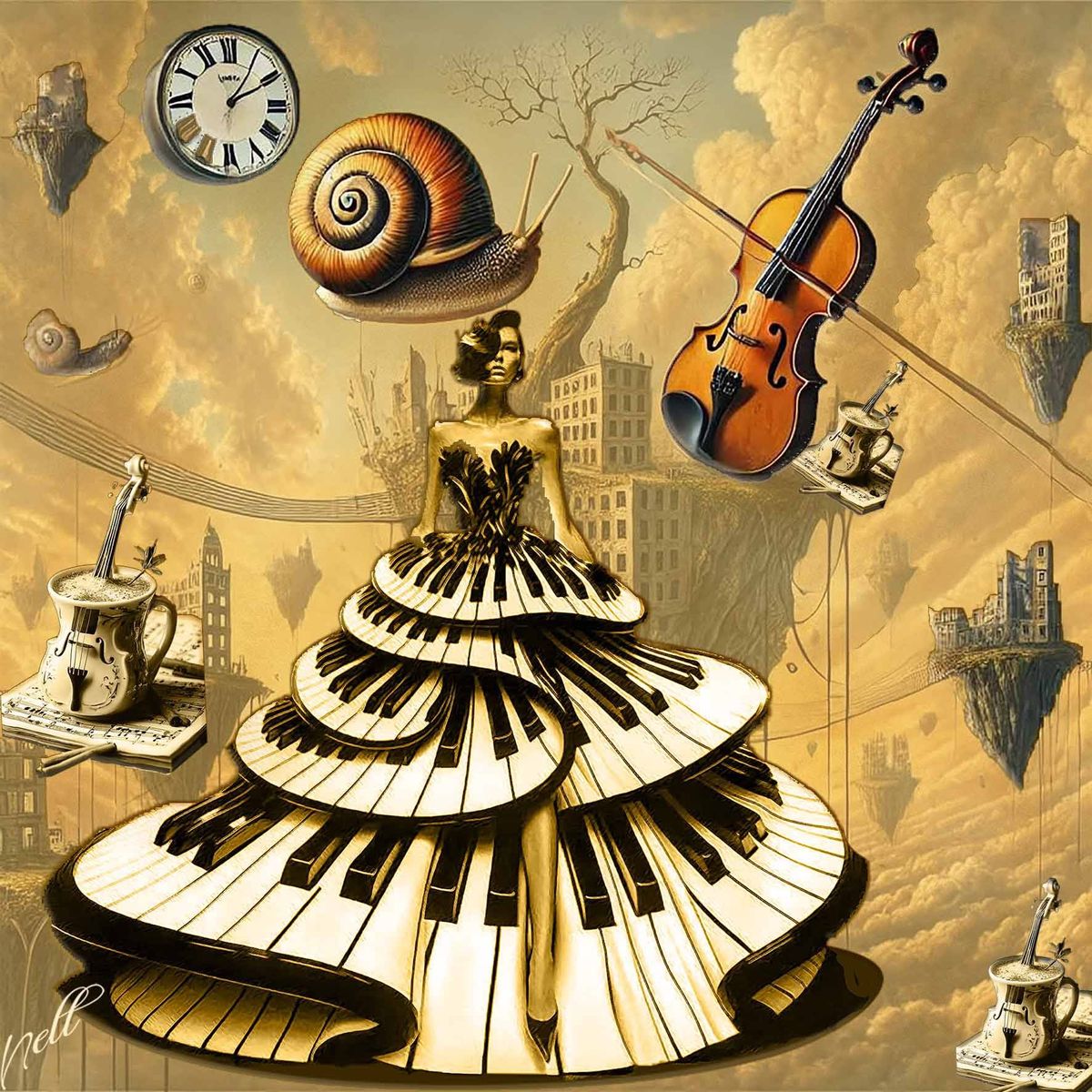
I came across these illustrations of classical music, created with modern techniques or AI, to show how melodies express emotion. I found them quite fascinating.
And here’s a surprising twist: artificial intelligence shows it understands art far better than humans!
I hope you enjoy them! Wishing you, wherever you are, a wonderful Silvester Eve and a joyful start to the New Year, filled with peace and love. Take good care! 💖🌟🥰🥂
In my view, during Christmas, fairy tales feel more meaningful and relevant than at any other time. I’m not sure why; perhaps because love and forgiveness are more apparent, and the longing, wishing, and hidden desires gain greater strength to make dreams come true.
We often believe fairy tales are purely imaginary, but what is truly real? Who can definitively prove that events involving elves, gnomes, fairies, leprechauns, gorgons, mermaids, and similar beings have never occurred? We can’t be certain, but fairies are an excellent gift for enhancing and refining our “Weltanschauung,” or worldview.
Fairy tales have captivated audiences for centuries, creating worlds of wonder and possibility that spark the imagination. Usually set in enchanted realms with talking animals, brave heroes, and clever villains, they do more than entertain—they inspire us to dream beyond reality’s boundaries. Central to every fairy tale is the power of imagination. Through fantastical adventures and impossible feats, they encourage us to envision worlds where anything is possible. Castles floating in the clouds, animals speaking with wisdom, and ordinary characters changing their fates with a clever wish or brave act—all stimulate creativity and expand our view of what the world could become. Additionally, fairy tales offer a safe space to explore complex emotions, moral challenges, and the victory of good over evil. They teach important life lessons while nurturing imagination, empathy, and resilience. Ultimately, fairy tales show us that with imagination, even the toughest challenges can be overcome, and that magic exists in everyday life.
Now, as Christmas Eve approaches, let our imagination take flight—fly freely to Neverland and Wonderland; may we find joy and peace.
Wishing everyone a peaceful and serene Christmas Eve. Sweet dreams to all!😉🥰🙏💖
Last night I begged the Wise One to tell me the secret of the world. Gently, gently, he whispered, “Be quiet, the secret cannot be spoken, It is wrapped in silence.”
Rumi
I wonder if any of you, my dear friends, have noticed how this hurried pace of life is affecting us globally, with people rushing unconsciously, often unaware of their surroundings or the noise around them. It seems time is passing faster than it used to, and this perception isn’t related to age, contrary to some beliefs. In both modern and traditional contexts, we often overlook an essential aspect: silence. I particularly notice this when I step into the forest, pause, and listen quietly.
Silence holds significant value that is often overlooked in our noisy world. It creates a space for reflection, helping us process our thoughts and emotions without external distractions. During quiet moments, creativity can flourish, fostering deeper thinking and the development of new ideas. Additionally, silence can foster a sense of peace and calm. In a hectic environment, pausing to embrace silence can refresh the mind and spirit, ease stress, and sharpen decision-making. In conversations, silence can be powerful, as listening is a sign of intelligence. It enables thoughtful responses and promotes meaningful dialogue. By embracing silence, we can enhance our listening skills and better understand others. Ultimately, silence’s value is in its ability to connect us with ourselves and others, encouraging introspection and stronger relationships. Whether through meditation, nature, or solitude, embracing silence can enrich our lives in many ways.
After sharing a quote from Rumi, I would like to offer a poem by Pablo Neruda. I hope you enjoy them and might relish a moment of silence to cherish.
Keeping Quiet By Pablo Neruda
Trans. Alastair Reid
Now we will count to twelve And we will all keep still for once on the face of the earth, let’s not speak in any language; let’s stop for a second, and not move our arms so much.
It would be an exotic moment without rush, without engines; We would all be together in a sudden strangeness.
Fishermen in the cold sea would not harm whales and the man gathering salt would not look at his hurt hands.
Those who prepare for green wars, wars with gas, wars with fire, victories with no survivors, would put on clean clothes and walk about with their brothers in the shade, doing nothing.
What I want should not be confused with total inactivity. Life is what it is about. I want no truck with death.
If we were not so single-minded about keeping our lives moving, and for once could do nothing, perhaps a huge silence might interrupt this sadness of never understanding ourselves and of threatening ourselves with death. Perhaps the earth can teach us, as when everything seems dead and later proves to be alive.
Now I’ll count up to twelve. And you keep quiet, and I will go.
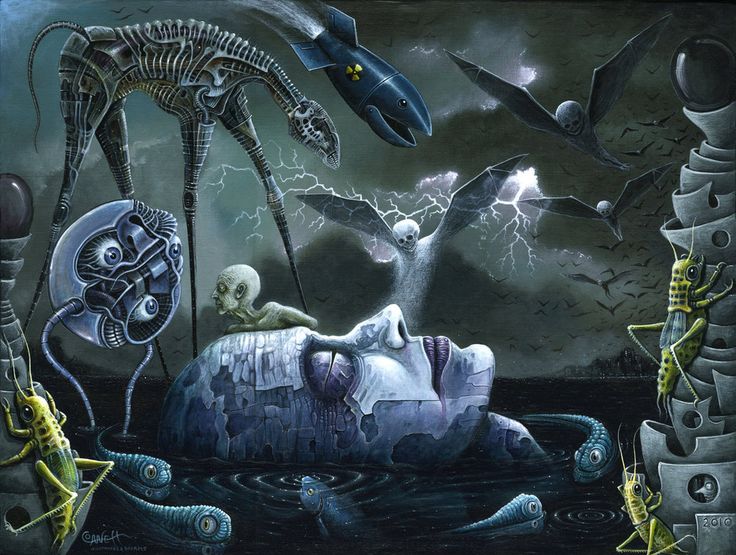
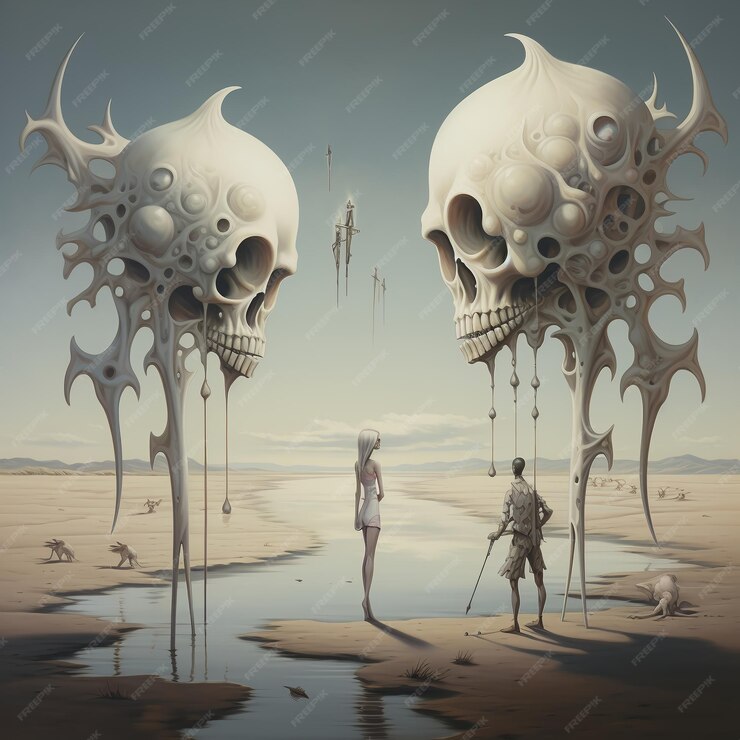
Title image: Dreamscapes and nightmares by the artist R.S. Connett.
Recently, I’ve been overwhelmed by memories and dreams that take me back to the past, recalling the unforgettable times when Al and I faced our ups and downs and challenging moments.
I avoid saying things like “happy heavenly birthday” because birthdays are truly earthly, not heavenly! In heaven, every day might be a birthday! And I believe it’s simply a traditional custom to use these anniversaries as reminders. However, I remember Al daily and in everything I do, and I can’t help but think of him and his lessons.
One of these memories is our arrival in Germany after fleeing Iran, and this time, it feels somehow significant because it marked the fortieth anniversary. We arrived at Düsseldorf airport in the evening on October 19th.
Although we had a close friend in the city, we didn’t want to trouble him. We considered renting a hotel room, but it was too costly. An airport staff member overheard us and suggested, “Why not sleep on a couch at the airport for the night?” We appreciated the kind idea, and even if it wasn’t as comfortable as a hotel, it was free!
Before we carried out that experiment, we took a walk through the large airport. As I clearly remember, in the department where packages are received, two older women were trying to manoeuvre their luggage onto a trolley, although the suitcases seemed too heavy for them. Al reacted quickly and helped them load the items onto the trolley. One of the women, thankfully, took some coins from her purse and offered them to Al, but he refused immediately and turned away. They were quite surprised, and I later learned that such acts are common in Germany, although Al felt a bit offended. Honestly, that money could have been useful to us, but Al was very proud, and it didn’t suit his class!
Anyway, that was a remarkable memory of that period, and I thought I would share it here, on his seventy-third earthly birthday. Yes, as I might repeat, every day is a birthday in heaven, as well as Christmas!
I am a forest, and a night of dark trees: but he who is not afraid of my darkness will find banks full of roses beneath my cypresses. The higher we soar, the smaller we appear to those who cannot fly. ~Friedrich Nietzsche, Thus Spoke Zarathustra
Understanding duality and the existence of opposites is essential for comprehending both our world and ourselves. Today, I often see the phrase ‘We are good & They are bad’ being misused and exploited. Good and evil are present within everyone!
Duality promotes understanding of the balance and tension between opposing elements, showing that complexity and harmony come from these interactions. Jung extensively studied duality, viewing it not just as external contrasts like light versus dark, cold versus warm, or above versus below, but as essential components of the human psyche and the process of individuation.
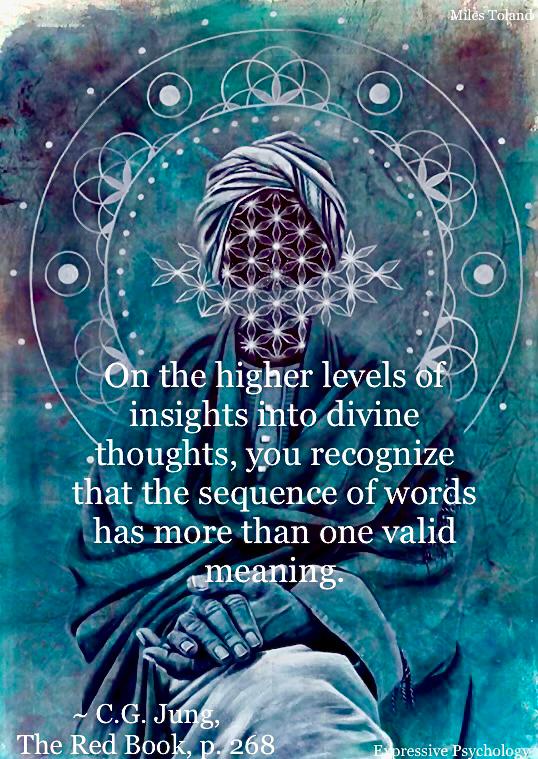
Jung says: Roots of Life reach into Hell. A core idea in Jung’s view of human existence is the concept of Duality and the Principle of Opposites. He argued that the psyche operates under the “principle of opposites,” meaning that every psychological concept or experience—such as light, warmth, consciousness, or life—inevitably has its opposite, like darkness, cold, unconsciousness, or death. The ongoing tension between these opposing forces is vital for psychological development and transformation. Dualities are not always entirely opposite; instead, they often depend on each other and define one another. For instance, light derives meaning only through its contrast with darkness. Many philosophies, including Taoism, highlight that these opposites are interconnected and mutually dependent, creating a balanced whole (yin and yang).
Jung’s psychology focuses on a fundamental duality between the conscious mind—associated with light, warmth, and awareness—and the unconscious, linked to darkness, coldness, and forgotten elements. The unconscious includes repressed or unknown parts, with the ‘shadow’ representing darker aspects we often reject or ignore. Recognising and accepting the shadow is crucial for achieving psychological wholeness. The process of individuation involves integrating these opposites, acknowledging and reconciling them, rather than suppressing one side. Jung explored myths, dreams, and alchemy, which frequently symbolised these dualities—such as sun/moon, king/queen, above/below—as part of psychic development. He saw alchemy as a metaphor for merging the conscious and unconscious components of the psyche.
Jung’s idea of duality illustrates how opposites are essential and creative elements of the mind. Concepts like light and dark, cold and warm, or the branches of a tree reaching upward and downward symbolise both external facts and internal truths. Personal development requires embracing these dualities to achieve a more integrated and authentic self.
An 1847 depiction of the Norse Yggdrasil as described in the Icelandic Prose Edda by Oluf Olufsen Bagge. Via Carl Jung Depth Psychology
He perceives the tree of life, whose roots extend into Hell and whose top reaches Heaven. He no longer distinguishes between right and wrong, holy and unholy, genuine and false, or good and evil. The only difference he recognises is between below and above: he sees that the tree of life grows from the ground upward, with its crown at the top, clearly separate from the roots. This view is unquestionable to him, and it guides his path to salvation. To unlearn all distinctions except that of direction is part of your salvation. This liberates you from the old curse of knowing good and evil. Although you separated good from evil based on your best judgment, aiming only for the good and denying the evil you did- and struggled to accept it- your roots no longer drew dark nourishment from below, causing your tree to weaken and wither. Therefore, the ancients said that after Adam ate the apple, the tree of paradise withered. Your life needs the dark. But knowing it is evil makes acceptance impossible, leading to suffering and confusion. You cannot accept it as evil, or your sense of goodness will reject you. Nor can you deny it, because you know both good and evil. This knowledge of good and evil became an insurmountable curse.
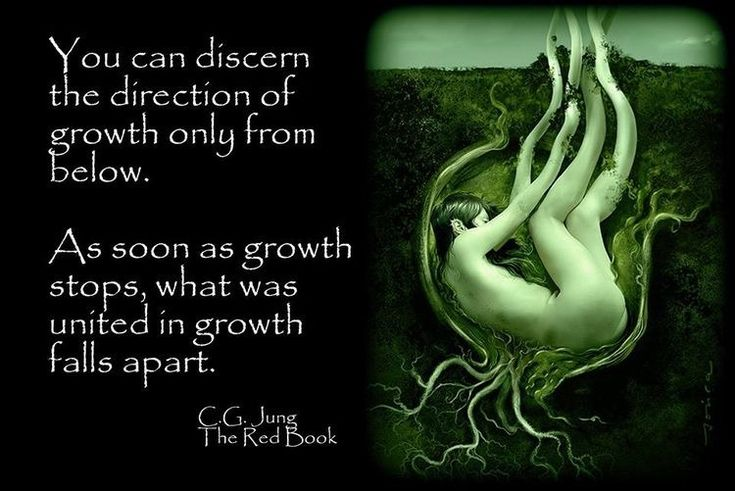
But if you return to primal chaos and recognise that which hangs stretched between the two unbearable poles of fire, you will notice that you can no longer conclusively separate good and evil, neither through feeling nor through knowledge, but that you can discern the direction of growth only from below to above. You thus forget the distinction between good and evil, and you no longer know it as long as your tree grows from below to above. But as soon as growth stops, what was united in growth falls apart, and once more you recognise good and evil. You can never deny your knowledge of good and evil to yourself, so that you could betray your good in order to live evil. For as soon as you separate good and evil, you recognise them. They are united only in growth. But you grow if you stand still in the greatest doubt, and therefore, steadfastness in great doubt is a veritable flower of life. He who cannot bear doubt does not bear himself. Such a one is doubtful; he does not grow, and hence he does not live. Doubt is the sign of both the strongest and the weakest. The strong have doubt, but doubt has the weak.
Therefore, the weakest is close to the strongest, and if he can say to his doubt: “I have you,” then he is the strongest. But no one can say yes to their doubt unless they endure wide-open chaos. Because there are so many among us who can talk about anything, pay heed to what they live. What someone says can be very much or very little. Thus, examine his life.
My speech is neither light nor dark, since it is the speech of someone who is growing. ~Carl Jung, Red Book, Page 301







 lampmagician
You must be logged in to post a comment.