An Innocent Little Mistake!

Standard
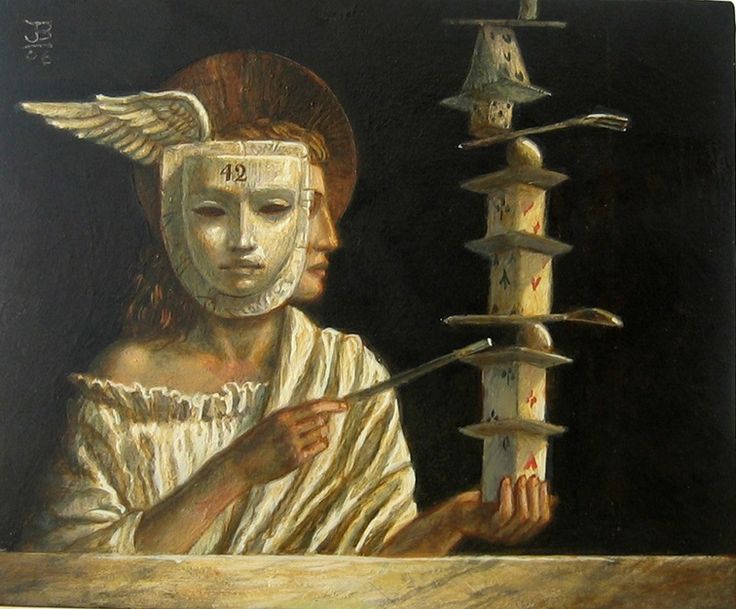
2007 The Card Trick by Jake Baddeley

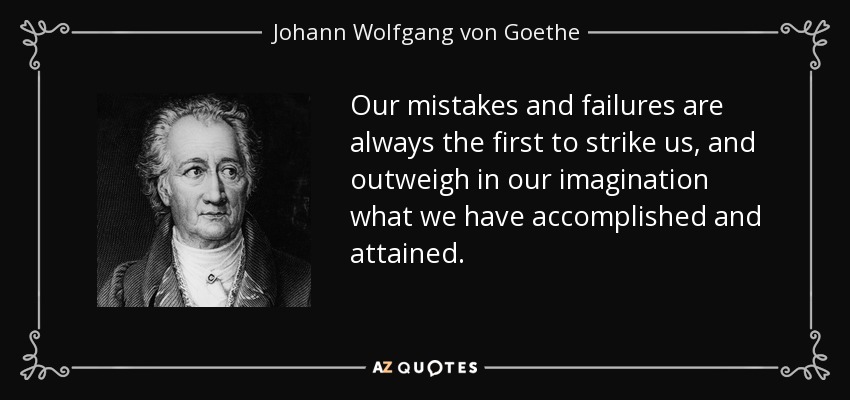
As I reflect on my past life, the passing years prompt me to recall memories, and I see how I wish to revisit specific moments to alter them or improve them. I have led an adventurous life (as you may recall from my series of posts about my memories), and I acknowledge that I have made numerous mistakes, which I deeply regret. However, with guidance from great thinkers, I have learned to view these mistakes from a different perspective: The Value of Experience!

It is a prevalent issue for people around the world to avoid making mistakes. I, myself, am one of those who strive for perfection, and I recognise that it is misguided!
Johann Wolfgang von Goethe says, “Geschlagener Quark macht breit, nicht fest!” (Beaten curd becomes broad, not strong!)

“If we look at the problems raised by Aristotle, we are astonished at his gift of observation. What incredible eyes the Greeks had for many things! Only they committed the mistake of being overhasty, of passing straightway from the phenomenon to the explanation of it, and thereby produced specific theories that are pretty inadequate. But this is the mistake of all time, and is still made in our own day.”

From Maxims & Reflections, Johann Wolfgang von Goethe; Science, 559

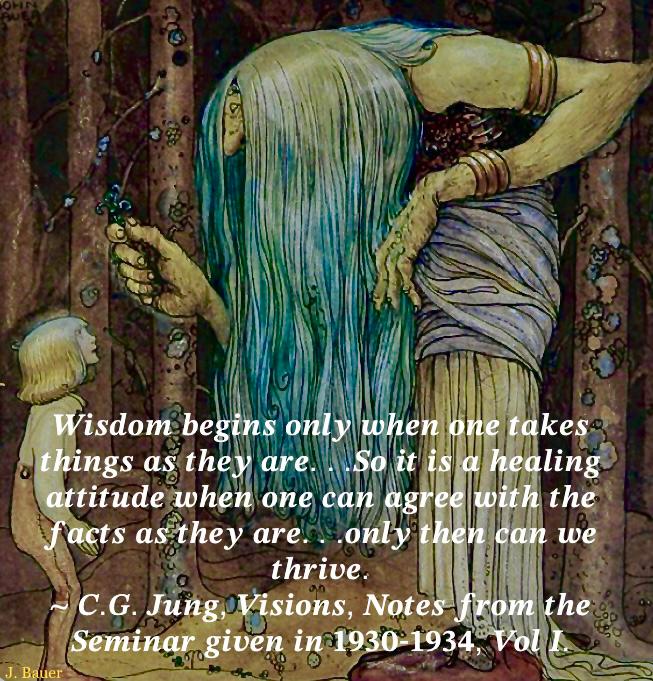
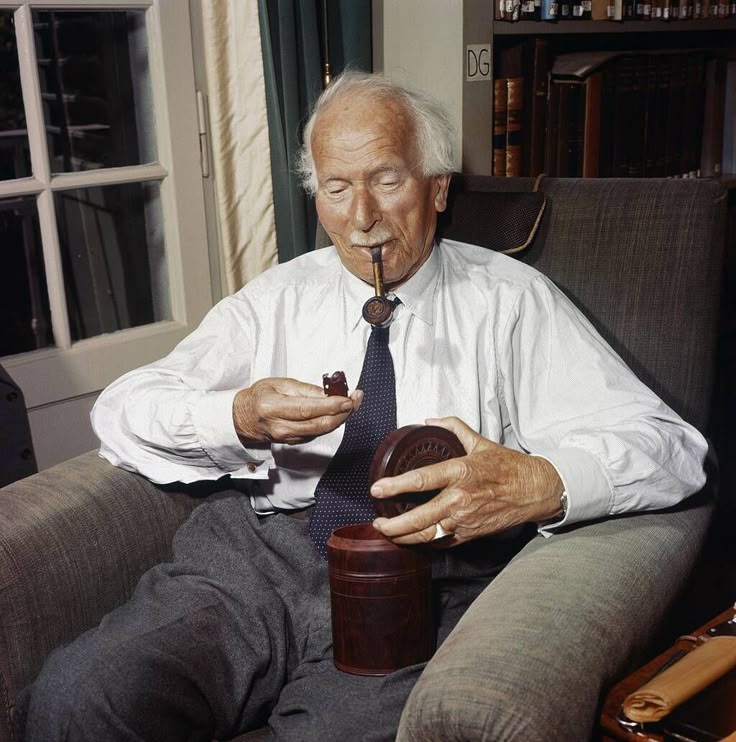
Additionally, Carl Gustav Jung reminds us that we can make mistakes and learn from them.

Whatever we look at, and however we look at it, we see only through our own eyes. For this reason, science is never made by one man but by many. The individual merely offers their contribution, and in this sense, I dare to speak only of my way of seeing things.
~Carl Jung, Modern man in Search of a Soul, p.84.

Plato proposed that absolute knowledge can be gained through acquaintance, meaning through intellectual insight into the otherworldly Forms. Jung shared a similar notion regarding acquaintance with the archetypes of the “unus mundus” (one world), representing the primordial, unified reality from which all things originate. Nevertheless, in contrast to Plato, Jung asserted that archetypes cannot be perceived directly. Instead, we can comprehend their psychic significance, gaining at least a hint of absolute knowledge.

I believe we can make mistakes, but after each one, we should take a step back and carefully examine how and where it happened, then try to approach the experience more thoughtfully. Experience teaches us more than thousands of books ever could!

Jung inspired individuals to engage with the world and savour life, rather than rely solely on theoretical knowledge from books. He regarded the unconscious mind as a treasure trove of experiences accessible through reflection and symbolic language. Ultimately, Jung’s work emphasises that while books and knowledge are valuable, they shouldn’t overshadow the importance of direct experience and self-reflection. Genuine growth and understanding flourish when we engage with our surroundings and explore our inner lives.

Sometimes a tree tells you more than can be read in books.
~ C.G. Jung; Letters Volume 1; Page 179.

Experience, not books, is what leads to understanding.
~Carl Jung, CW 12, Para 564

Thank you for reading; have a lovely holiday! 🙏🤗🌹💕

My (Carl Jung’s) Most Difficult Experiment [P. 1]

Standard

Regarding foresight, few individuals possess this ability, or perhaps it exists in everyone, yet most fail to recognise it. I knew some of my relatives, and one of my aunts had mastered it. She had seen ghosts in her large, old house, conversed with them, and could perceive events (in dreams) before they occurred. My brother Al also possessed such a gift, particularly in the final years of his life when he underwent surgery on his head to remove a tumour. I do not know if it is a gift, a curse, or a blessing; nonetheless, I would treasure that.

I, myself, have a small example: I had a dream in which one of my customers, an elderly woman I had driven to the doctor for many years but could no longer assist because she needed special transport, urgently called me to ask if I could pick her up and take her to her doctor. I wondered why I had dreamt of her after all this time. Two days after my dream, while driving a guest from her neighbourhood, she told me she recognised me as the person who had driven her friend from next door for a long time and asked if I knew she had passed away. I said no and asked when it had happened. She replied it was the night before last, the same night I had dreamt of her!

Dream analysis stands or falls with [the hypothesis of the unconscious]. Without it, the dream appears to be merely a freak of nature, a meaningless conglomerate of memory fragments left over from the day’s happenings.
~Carl Jung
“Modern Man in Search of a Soul”, p.2, Psychology Press

Now, let us read about one of the great minds in this field: Carl Gustav Jung. He was among the most sensitive and intuitive visionaries of all time. Here, he talks about his dreams, odd and extraordinary dreams. Once, he was even afraid that he had schizophrenia.

<Although it is from The Red Book, which everyone might have or may have even read, I believe many still do not notice the fineness in the “Introduction” at the beginning of the book, as I find it fascinating.>

From Carl Jung’s “The Red Book, Liber Novus: A Reader’s Edition,” by Sonu Shamdasani. (Introduction)

In 1912, Jung had some significant dreams that he did not understand. He gave particular importance to two of these, which, as he felt, showed the limitations of Freud’s conceptions of dreams. The first follows:

I was in a southern town, on a rising street with narrow half-landings. It was twelve o’clock midday–bright sunshine. An old Austrian customs guard or someone similar passes by me, lost in thought. Someone says, “That is one who cannot die. He died already 30 – 40 years ago but has not yet managed to decompose.”

I was very surprised. Here, a striking figure came, a knight of powerful build clad in yellowish armour. He looks solid and inscrutable, and nothing impresses him. On his back, he carries a red Maltese cross. He has continued to exist since the 12th century, and he takes the same route daily between 12 and 1 o’clock midday. No one marvelled at these two apparitions, but I was extremely surprised.

I hold back my interpretive skills. As regards the old Austrian, Freud occurred to me; as regards the knight, I myself.

Inside, a voice calls, “It is all empty and disgusting.” I must bear it. (Black Book 2, pp. 25-26)

Jung found this dream oppressive and bewildering, and Freud was unable to interpret it.

(In 1925, he gave the following interpretation to this dream: “The meaning of the dream lies in the principle of the ancestral figure: not the Austrian officer – obviously he stood for the Freudian theory – but the other, the Crusader, is an archetypal figure, a Christian symbol living for the twelfth century, a symbol that does not really live today, but on the other hand in not wholly dead either. It comes out of the time of Meister Eckhart, the time of the culture of the Knights, when many ideas blossomed, only to be killed again, but they are coming to life again now. However, when I had this dream, I did not know this interpretation” (Introduction to Jungian Psychology, p. 42).

Around half a year later, Jung had another dream:

I dreamt at that time (it was shortly after Christmas 1912) that I was sitting with my children in a marvellous and richly furnished castle apartment – an open columned hall – we were sitting at a round table, whose top was a marvellous dark green stone. Suddenly, a gull or a dove flew in and sprang lightly onto the table. I admonished the children to be quiet so they would not scare away the beautiful white bird. Suddenly, this bird turned into a child of eight years, a small blond child, and ran around playing with my children in the marvellous columned colonnades. Then, the child suddenly turned into the gull or dove. She said the following to me: “Only in the first hour of the night can I become human while the male dove is busy with the twelve dead.” With these words, the bird flew away, and I awoke. (Black Book 2, pp. 17-18)

In Black Book 2, Jung noted that it was this dream that made him decide to embark on a relationship with a woman he had met three years earlier (Toni Wolff, Ibid., p. 17). In 1925, he remarked that this dream “was the beginning of a conviction that the unconscious did not consist of inert material only, but that there was something living down there (Introduction to Jungian Psychology, p. 42). He added that he thought of the story of the Tabula Smaragdina (emerald tablet), the twelve apostles, the signs of the Zodiac, and so on, but that he “could make nothing out of the dream except that there was a tremendous animation of the unconscious. I knew no technique for getting to the bottom of this activity; all I could do was just wait, keep on living, and watch the fantasies.”

I include this footnote to highlight his insatiable greed and relentless pursuit to decipher the meaning behind his dream and how he developed the interpretation.

Ibid., pp. 40-41. E. A. Benner noted Jung’s comments on this dream: “At first, he thought ‘twelve dead men’ referred to the twelve days before Christmas, for that is the dark time of the year, when traditionally witches are about. To say ‘before Christmas’ is to say before the sun lives again, for Christmas day is at the turning point of the year when the sun’s birth was celebrated in the Mithraic religion… Only much later did he relate the dream to Hermes and the twelve doves” (Meeting with Jung: Conversations recorded by E.A. Brenner during the years 1946-1961 [London: Anchor Press,1982; Zürich, Daimon Verlag, 1985], p. 93). In 1951, in “The Psychological Aspects of the Kore”, Jung presented some material from Liber Novus (describing them all as part of a dream series) in an anonymous form (“case Z.”), tracing the transformations of the anima. He noted that this dream “shows the anima as a elflike, i.e., only partially human. She can just as well be a bird, which means that she may belong wholly to nature and can vanish (i.e., become unconscious) from the human sphere (i.e., consciousness)” (CW9, I, § 371). See also Memories, pp. 195-96.

These dreams led him to analyse his childhood memories, but this did not resolve anything. He realised that he needed to recover the emotional tone of childhood. He recalled that as a child, he used to like to build houses and other structures, and he took this up again.

While he was engaged in this self-analytic activity, he continued to develop his theoretical work. At the Munich Psycho-Analytical Congress in September 1913, he spoke on psychological types. He argued that there were two basic movements of the libido: extraversion, in which the subject’s interest was oriented towards the outer world, and introversion, in which the subject’s interest was directed inward. Following from this, he posited two types of people, characterised by the predominance of one of these tendencies. The psychologies of Freud and Adler were examples of the fact that psychologies often took what was true of their type as generally valid. Hence, what was required was a psychology that did justice to both of these types (“On the question of psychological types,” CW 6).

Although this captivating story continues, I will share it in parts to facilitate understanding and enjoyment. Thank you for taking the time to read!

PS: In case someone interested, I will try to write about my new condition in a separate post. 🙏💖


The Unconscious Mind!

Standard

Sorry, it’s me again! I intended to share a brief message on Facebook, and I thought, why not just do it on my site, too? So here it is: We must look deeply around us and think twice. I send you all immense gratitude and wish you a lovely weekend.😁🤗💖🙏🦋🌹

Title image; Art by Andrew Ferez

From Collected Works of C.G. Jung, Volume 7: Two Essays in Analytical Psychology,

via Carl Jung Depth Psychology and Craig Nelson

I must recall at this point a serious misunderstanding to which my readers often succumb, and doctors most commonly.
They invariably assume, for reasons unknown, that I never write about anything except my method of treatment.
This is far from being the case. I write about psychology.
I must, therefore, expressly emphasize that my method of treatment does not consist in causing my patients to indulge in strange fantasies for
the purpose of changing their personality and other nonsense of that kind.
I merely put it on record that there are certain cases where such a development occurs, not because I force anyone to it, but because it springs from inner necessity.
For many of my patients, these things are and must remain double Dutch.
Indeed, even if it were possible for them to tread this path, it
would be a disastrously wrong turning, and I would be the first to hold them back.
The way of the transcendent function is an individual destiny.
But on no account should one imagine that this way is equivalent to the life of a psychic anchorite, to alienation from the world.
Quite the contrary, for such a way is possible and profitable only when the specific worldly tasks which these individuals set themselves are carried out in reality.
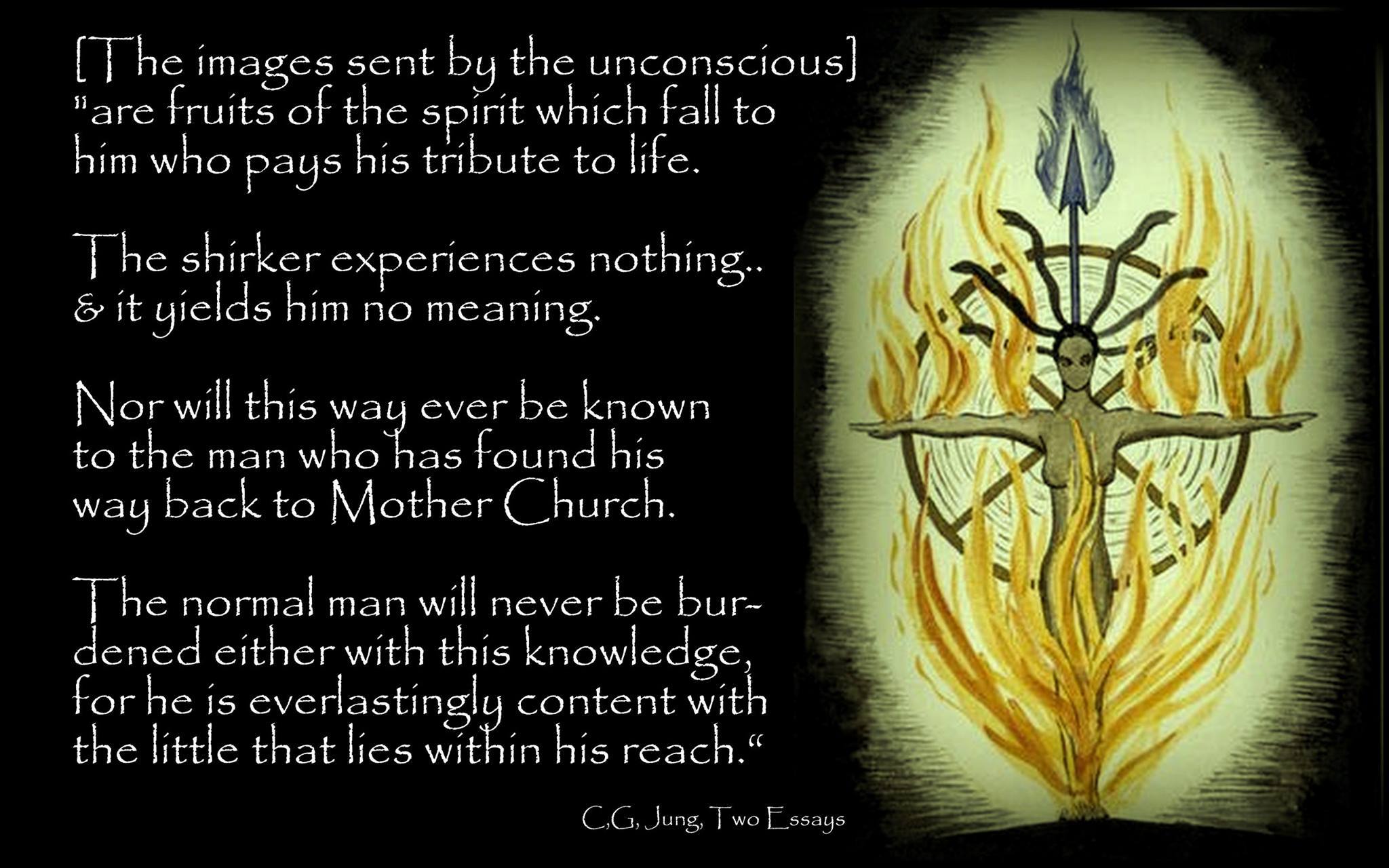
Fantasies are no substitute for living; they are fruits of the spirit which fall to him who pays his tribute to life.


The shirker experiences nothing but his own morbid fear, and it yields him no meaning.
Nor will this way ever be known to the man who has found his way back to Mother Church.
There is no doubt that the mysterium magnum is hidden in her forms, and in these, he can live his life sensibly.
Finally, the normal man will never be burdened, either, with this knowledge, for he is everlastingly content with the little that lies within his reach.
Wherefore I entreat my reader to understand that I write about things which actually happen and am not propounding methods of treatment.
~Carl Jung, CW 7, Pages 223-224

Let’s Expand the Mind Once (or) More!

Standard

Hello, friends!
As I mentioned in my last post two weeks ago, I decided to take a break from sharing new posts to alleviate some pressure on myself. Unfortunately, my brief explanation about this decision led to misunderstandings among many of you, while a few friends grasped my point. So, to make it clear, I am not on holiday; I am working more than usual because my boss is still in the hospital. I appreciate your understanding!

Anyway, as you can see, I have a new post yet, though not something heavy. It’s light and deep, for sure! Simply put, as I’ve been reflecting on my experiences with WordPress over the past couple of years, I’ve realized that artists need inspiration to create art. However, that inspiration isn’t always readily available. This platform provides a wonderful opportunity for us to share our thoughts and feelings naturally rather than treating it like a mandatory series production we must complete out of obligation. Consequently, I have decided to give myself time and share my thoughts when I believe they are valuable. 🤗

I’m still experiencing a tough time because of my “Standby” position (Imagine waking up each day unsure if you can work from home or need to jump out and drive around!). I find it hard to focus on anything that could calm my restless mind, and I feel like losing my creative spark. I started working on the Egypt post, but it didn’t satisfy me, so I decided to share an instructive story and some charming videos about a great and knowledgeable thinker, Alan Watts.
I hope you will enjoy it, and I can take another break!!

Let’s examine our lives and our existence. It is not so difficult; we just need to loosen the tension in every muscle in our body, especially our brains, and surf around.

Alan Watts played a significant role in popularizing Zen Buddhism in the West, paving the way for traditional teachers like Soto priest Suzuki Roshi. However, Watts did not consider himself a Zen Buddhist. In a talk animated by Trey Parker and Matt Stone, he clarifies, “I am not a Zen Buddhist; I am not advocating Zen Buddhism or trying to convert anyone. I have nothing to sell.” He identifies himself simply as “an entertainer.” Is he joking?

Watts was ordained an Episcopal priest in 1945 and served until 1950. He was a complex character—a strict anti-dogmatist who found rigid doctrine irritating at best and profoundly oppressive and dehumanizing at worst.

Watts wasn’t a strict Zen priest but learned a lot from Japanese Buddhist concepts, which he explains in the short section of the video above. He also found similar insights about the interconnectedness of all things in Daoism. Above, you’ll see a short animation by Eddie Rosas from The Simpsons, where Watts illustrates “Daoism in perfection” through a simple parable.

In this short animated parable by Steve Agnos below, he states, “The whole process of nature is an integrated process of immense complexity.” However, instead of illustrating a lesson about unity, he suggests that nature and reality are ultimately beyond our understanding. He argues that “it is really impossible to determine whether anything that occurs within it is good or bad.” Therefore, the most reasonable approach seems to avoid judging in either direction.

And how it can be easy to open our minds, honestly, to ourselves and use our brain to think over and not take the easy way to judge:

Alan Watts critiques the human tendency to make hasty judgments, as seen in this mastery “talk-animated” below by Tim McCourt and Wesley Louis of Westminster Arts & Film London. He explores personal identity and the ego’s separation from reality, emphasizing the theme of interconnectedness. Watts asserts it is “impossible to cut ourselves off from the social and natural environments; we are that.” To discover this truth, he encourages us to become “deep listeners” and to let go of embarrassment, shyness, and anxiety.

I am not selling anything, either! 😅 (unfortunately!!?), but I send my best wishes to you all. Have a lovely time and till then.🙏💖🌹

Source: OenCulture

The Mystery Of “Mana Personality” Part Nine

Standard

Translated from volumes published by Lorenz Jung based on the edition “Gesammelte Werke” dtv.de The Symbols of Transformation (1952) and Aion (1950)

Today, I share the final part of the translation of Mana-Personality. It was full of joy for me to learn more and even better from his works because I had to read them word by word to achieve an understandable translation. I hope it was the same for you.

We often wonder why there are so many injustices, differences, and failures in human progress (decline?). Is God flawed? Dr. Jung suggests that God must be imperfect; otherwise, we cannot reach Him.

In the figure of the divine hero, God himself wrestles with his own imperfect, suffering, living creation; he even takes its suffering condition upon himself and, by this sacrificial act, accomplishes the opus magnum of salvation and victory over death.

Credit Text and Image Carl Jung Depth Psychology 🙏

He, instead, talks about the importance of the Self and Individuality.

He personally also admits that his explanation is sensitive to experiences that some may not have practised. He emphasizes:

I am deeply aware that in this work, I have not made any ordinary demands on the understanding of my reader. I have made every effort to smooth the path to understanding. Still, I have not been able to remove one great difficulty, namely the fact that the experiences underlying my explanations are probably unknown to most people and, therefore, strange...

Still, he tries to enlighten us on the matter based on his experiences.

Image credit Carl Jung Depth Psychology

Previous

Now, let’s move on to the final chords:

Individuation
The Mana Personality (P9)

The conception of God as an autonomous, psychological content makes God a moral problem – and that is, admittedly, very uncomfortable. But if this problem does not exist, then God is not real either because he does not intervene in our lives anywhere. Then, he is a historical conceptual bogeyman or a philosophical sentimentality.

If we leave the idea of ​​a “divine” out of the equation and speak only of autonomous contents, we may remain intellectually and empirically correct, but we thereby conceal a note that psychologically cannot be missed. If we use the idea of ​​a “divine”, we are thereby aptly expressing the peculiar way in which we experience the effects of autonomous content. We can also use the term “demonic” as long as we do not imply that we have reserved a concrete God somewhere who completely corresponds to our wishes and ideas. However, our intellectual sleight of hand tricks do not help us to create a being according to our wishes in reality, just as the world does not adapt to our expectations. If we, therefore, attribute the effects of autonomous contents with the attribute “divine”, we thereby acknowledge their relative superiority. And this superior is the power that has forced a man of all ages to think of the most unthinkable things and to inflict the greatest suffering on himself in order to do justice to those effects. This power is as real as hunger and fear of death.

The Self could be characterized as a kind of compensation for the conflict between inside and outside. This formulation may not be a lousy fit insofar as the Self has the character of something that is a result, an achieved goal, something that has only gradually come about and has become possible through much effort. Thus, the Self is also the goal of life, for it is the complete expression of the combination of destinies that we call the individual, and not just of the individual human being, but of a whole group in which one completes the other to form the complete picture.

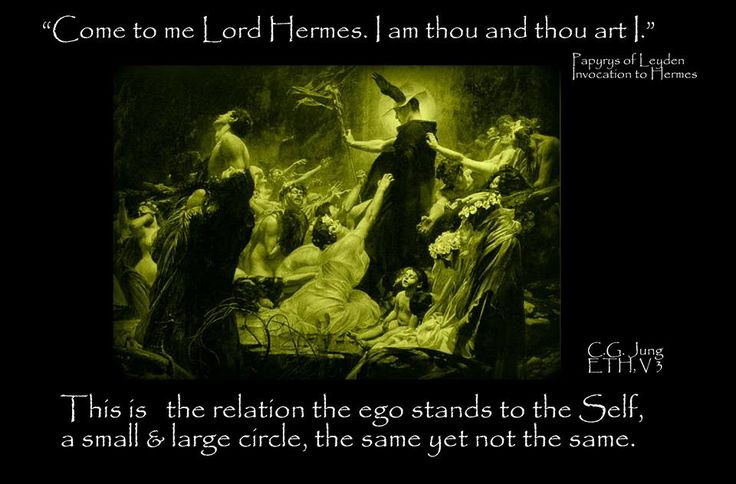
With the sensation of the Self as something irrational, indefinable, to which the ego is not opposed and not subject, but rather attached and around which it rotates, as the earth rotates around the sun, the goal of individuation is achieved. I use the word “sensation” to describe the perceptual character of the relationship between “I” and Self. There is nothing recognizable in this respect because we are unable to say anything about the contents of the Self. The “I” is the only content of the Self that we know. The individualized “I” perceives itself as the object of an unknown and superior subject. It seems to me that the psychological statement reaches its extreme end here because the idea of ​​a Self is in and of itself a transcendent postulate that can be justified psychologically but cannot be proven scientifically. The step beyond science is an absolute requirement of the psychological development described here because, without this postulate, I could not adequately formulate the empirically occurring psychological processes. The Self, therefore, claims at least the value of a hypothesis corresponding to that of the atomic structure. And – should we still be enclosed in an image here – then it is something overwhelmingly alive, the interpretation of which is beyond my capabilities. I do not doubt that it is an image, but one in which we are still contained.

Youri Ivanov _ DIGITAL GRAPHIC ART _ SD World 141

I am deeply aware that in this work, I have not made any ordinary demands on the understanding of my reader. I have made every effort to smooth the path to understanding. Still, I have not been able to remove one great difficulty, namely the fact that the experiences underlying my explanations are probably unknown to most people and, therefore, strange. As a result, I cannot expect my readers to follow all of my conclusions. Although every author naturally enjoys understanding their audience, interpreting my observations is less important to me than pointing out a broad area of ​​experience that has hardly been explored, which I would like to make accessible to many through this book. In this area, which has been so obscure up to now, it seems to me that the answers are recumbent to many puzzles that the psychology of consciousness has never even come close to solving. I do not wish to claim under any circumstances to have formulated these answers definitively. I am, therefore, quite content if my paper can be regarded as a tentative attempt at an answer.

I sincerely appreciate your support and interest. Thank you!🤗🙏💖

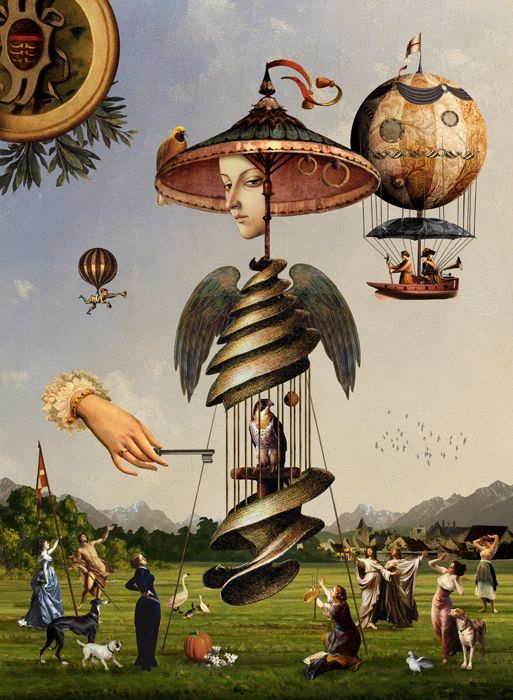
The title image: Maiden Voyage of the Airship Falcon” by Alexei Gurl

Back again from Extraneous, with Kafka and a Daydream!

Standard

When my brother, Al, was in the hospital to undergo surgery to remove a tumour from his brain, one of the professors told him that we humans know almost nothing ( just ten per cent) about how our brains work – The rest is still a puzzle! Therefore, unexplained phenomena, such as strange things like seeing ghosts, daydreams, or schizophrenia, are always fascinating topics for inquisitive minds.

According to Dr Carl Jung: …in schizophrenia, the complexes have become disconnected and autonomous fragments, which either do not reintegrate back to the psychic totality, or, in the case of remission, are unexpectedly joined together again as if nothing happened” (1939).

Franz Kafka Dreams >Wrestling matches every night<

During our trip to Serbia (I will write a post about it soon), I brought along some books as I do on any trip. This time, I discovered some surprises. While renovating the apartment, I found a book I couldn’t remember owning. Upon picking it up, I found a shopping receipt in the book dating back to 1995. It was clear that the book belonged to Al. Apart from a few novels, Franz Kafka wrote thousands of letters about his thoughts, dreams, and daydreams, and I was excited to have this particular book. The book is in German, and I translated a description and one of his letters about his dreams. I often considered the similarities between Kafka and Dostoevsky, as the latter frequently had daydreams like a schizophrenic. In this dream, Dostoevsky is interestingly present! I hope you will enjoy it.

The New Yorker

According to Jean-Paul, dreams substantially affect a poet because he is used to fantasy. In contrast, Kafka’s dreams intensified his daytime fears. Taken out of context, his dreams form an interesting “storybook” of events and changes involving real people and places from his life. Kafka’s descriptive notes allow the reader to relive each dream-like episode as if watching a film vividly. This collection also serves as a documentary, presenting the dreams chronologically and reproducing Kafka’s comments on the phenomenon of dreams and dreaming.

Frank Kortan – THE METAMORPHOSiS

Gregor Samsa woke up one morning to find himself transformed into a monstrous vermin. Franz Kafka’s “The Metamorphosis” challenges readers to accept this transformation as real, denying the possibility of dismissing it as merely a dream. This may frustrate those who rely on reason to understand the world and expect literature to assist them in this endeavour. In 1916, Franz Herwig criticized the rejection of realism and its associated positive aspects in an essay about the authors of the series “The Judgement Day,” in which Kafka’s story appeared. Gregor Samsa’s story “The Metamorphosis” challenges our understanding of reality and urges us to see the world in a new light. Kafka emphasizes that incomprehensible forces are shaping our lives, which may be more influential than we can rationally explain. According to his commentary on the story “The Judgement,” which he wrote in one go from ten o’clock in the evening to six o’clock in the morning, this is the only way to write in such a context—with a complete openness of body and soul! In this type of writing, the usual censorship of the mind is primarily eliminated. Everything can be risked, and a great fire is prepared for everyone for the strangest ideas, in which they perish and rise again.

Dream!
[To Milena Jesenska, August 1920; M 170-172]

Today, I think I dreamt of you for the first time since I’ve been in Prague. A dream towards morning, short and heavy, still caught up in sleep after a bad night. I know little about it. You were in Prague; we were walking along Ferdinand Street, a little opposite Vilimek, in the direction of the quay; some acquaintances of yours were walking past on the other side; we turned to look at them; you spoke of them, perhaps there was also talk of Krasa [I know he is not in Prague, I will find out his address]. You said as usual, but there was something incomprehensible, indescribable about rejection in it; I didn’t mention it but cursed myself, thereby only expressing the curse that was on me. Because we were in the coffee house, probably in the Kaffee Union (it was on the way, and it was also the coffee house from Reiner’s last evening), a man and a girl were sitting at our table, but I couldn’t remember them. Then, there was a man who looked very similar to Dostoyevsky but young, with a deep black beard and hair. Everything, for example, the eyebrows and the bulges over the eyes, were incredibly strong. Then you were there, and I. Again, nothing betrayed your aloof manner, but the rejection was there.

Painting: Jorge Ignacio Nazabal

Your face was – I could not look away from the tormenting oddity – powdered, and it was overly obvious, clumsy, bad; it was probably hot, and so whole powder lines had formed on your cheeks; I can still see them in front of me. Again and again, I leaned forward to ask why you were powdered; when you noticed that I wanted to ask, you asked obligingly – the rejection was simply not noticeable – >What do you want?< But I could not ask, I did not dare, and yet I somehow suspected that being powdered was a test for me, a crucial test, that I should ask, and I wanted to but did not dare. And so the sad dream rolled over me. At the same time, the Dostoyevsky man tormented me. His behaviour towards me was similar to yours but still a little different. When I asked him something, he was very friendly, sympathetic, leaned over, and open-hearted. Still, when I didn’t know what to ask or say – this happened every moment – he would withdraw with a jerk, sink into a book, know nothing more about the world and especially not about me, disappear into his beard and hair. I don’t know why I found this unbearable, again and again – I couldn’t do anything else – I had to pull him over to me with a question and again and again, I lost him through my own fault! 💖🙏🤗

The Imagen at top:  Youri Ivanov – Artiste Russe (Russian)

The Mystery Of “Mana Personality” Part Two

Standard

Translated from volumes published by Lorenz Jung based on the edition “Gesammelte Werke” dtv.de The Symbols of Transformation (1952) and Aion (1950)

Recently, on X (Twitter), during one of Perian’s talks titled “The Way of Democratic Talk,” someone mentioned that social morals are crucial for keeping people mindful of their behaviour towards others. I responded that social morals are relative and not constant; throughout human history, they have consistently changed after wars or revolutions. I prefer to use the word “conscience.” Another friend said she would stick with “morals” because she was tired of having a guilty conscience. I replied that conscience is based on inner awareness and individuality and, therefore, has a more substantial and profound foundation, strengthening our consciousness as individuals.

Anyway, it was a prologue to noticing that words like consciousness, ego, anima, and their influential product, Mana, are important to take seriously. Mana may sound strange and unknown, but we all have it inside us!

Jung has always attempted to clarify that good and evil exist within every human and has made significant efforts to help us realize that it all depends on us to recognize these and find the balance between them.

Illustration at the top: NIKOLAY ZAITSEV

Here, in the continuation of the first part, I share some more words from this magical Mana.

Individuation
The Mana Personality (P2)

‘Parsifal’ illustrations for Richard Wagner’s opera by Franz Stassen.

Who has now come to terms with the anima? Apparently, the conscious “I”, and therefore the “I”, has taken over the Mana. In this way, the conscious “I” becomes the Mana personality. The Mana personality, however, is a Dominant of the collective unconscious, the well-known archetype of the mighty man in the form of the hero, the chief, the magician, the medicine man and saint, the lord of men and spirits, the friend of God.

This is now a male collective figure that emerges from the dark background and takes possession of the conscious personality. This psychological danger is of a subtle nature; by inflating consciousness, it can destroy everything that has been gained through the confrontation with the anima. It is, therefore, of no minor practical importance to know that in the hierarchy of the unconscious, the anima is only the lowest level and one of the possible figures and that its overcoming creates another collective figure that now takes over its Mana. In reality, it is the figure of the magician – as I will call her in short – that draws the Mana, that is, the autonomous value of the anima to itself. Only insofar as I am unconsciously identical with this figure can I imagine that I myself possess the Mana of the anima. But under these circumstances, I will do so infallibly.

SD World _ Youri Ivanov _ Jouris Kunst

The figure of the magician has a no less dangerous equivalent for women: it is a maternal, superior figure, the great mother, the all-merciful one who understands everything and forgives everything and always wanted the best, who always lived for others and never sought her own, the discoverer of great love, just as it is the herald of the ultimate truth. And just as great love is never appreciated, great wisdom is never understood either. And they can’t stand each other at all.

There must be a serious misunderstanding here because it is undoubtedly a case of inflation. The “I” has appropriated something that does not belong to it. But how did it appropriate this Mana? If it really was the ego that overcame the anima, then the Mana also belongs to it, and then the conclusion is correct: one has become significant. But why does this significance, the Mana, not affect others? That would be an essential criterion! It does not work because one has not become significant but has simply merged with an archetype, another unconscious figure. So, we must conclude that “I” has not overcome the anima and, therefore, has not acquired the Mana. It is just that a new merger has occurred, with a figure of the same sex that corresponds to the father’s imago and has perhaps even greater power.

From the power that binds all beings,
The person who overcomes himself frees himself<

(Goethe: The Mysteries. A Fragment, in. Works in ten volumes, Vol. 7, 1962)

Thus, he becomes a superman, superior to all powers, a demigod, perhaps even more. ‘I and the Father are one’, this powerful confession in all its terrible ambiguity stemming from precisely this psychological moment.

To be continued! 🙏💖

The Future is Feminine!

Standard
Museum of Fine Arts, Boston
‘Satan Watching the Caresses of Adam and Eve’; watercolour by William Blake for John Milton’s Paradise Lost, 1808

During one of my workdays, I had a guest in my car – an intelligent woman who left a lasting impression on me with her profound awareness. We delved into a conversation about various topics such as God, the world, and eventually, my birthland, Iran. I shared my views on equality between men and women. Then I dared to discuss Femininity, Anima, Animus, and Dr Jung’s idea of their existence, which are present in every human. She listened attentively, found my words intriguing, and even agreed somewhat. However, she expressed her preference for being a “pure woman” and did not desire to have any masculine traits in herself!

I believe the current wave of feminism is a form of emancipation fueled by frustration toward men. This frustration stems from the fact that men have dominated the world’s history. However, I wanted to discuss this further to convince her to understand my perspective.
Unfortunately, we arrived at her destination before we finished, and she got out of the car and left.

I have gathered here some words and quotes on femininity, body and soul, which I believe has very little to do with gender (as Marion Woodman says so well), and we might need a vested development to comprehend it.

The Body and The Soul

The Garden of Love – William Blake
I went to the Garden of Love and saw what I had never seen: A Chapel was built in the midst, Where I used to play on the green. And the gates of this Chapel were shut, and “Thou shalt not” writ over the door; So I turned to the Garden of Love that so many sweet flowers bore; and I saw it was filled with graves, and tomb-stones where flowers should be; and Priests in black gowns were walking their rounds, And binding with briars my joys & desires.
“Do what you will; this world’s a fiction and is made up of contradiction.” William Blake (UK 1757-1827) Infant Joy – Infant Sorrow – by William Blake

Ascension by William Blake

William and Marion

“William Blake says the body is ‘that portion of soul discerned by the five senses’ I live with that idea. I sit and look out my window here in Canada, and the autumn trees are golden against the blue sky. I can feel their “food” coming into my eyes and going down, down, down, interacting inside, and I fill up with gold. My soul is fed. I see, I smell, I taste, I hear, I touch. Through the orifices of my body, I give, and I receive. I am not trying to capture what is absent. It’s that interchange between the embodied soul and the outside world that is the dynamic process. That’s how growth takes place. That is life.”

~Marion Woodman, Conscious Femininity, P. 44-45

The Worship of the Serpent: The Awakening of Eve and the Generation of Nature The Symbol of the Serpent

Award-winning author Teri Degler quoted:

“….embodying the divine feminine is critically important for our times. (Teri Degler: The Divine Feminine Fire)

It shows you how to accomplish this by getting to know your body, bringing your body and your dreams together, and uniting body and soul. Marion Woodman, author of Dancing in the Flames

This issue might have a long way to go, and as I am involved in something more primitive like the situation in Iran, I can see those women who are beyond all boundaries and fighting for their rights; I discern light at the end of the tunnel! Thank you all for your interest. Have a lovely weekend, everybody.🙏💖🥰

The Psychology of The Child Archetype (P4)

Standard

The Function of The Archetype

I laid awake for at least three hours last night! In fact, I fell asleep initially but woke up after about two hours, and my thoughts started working. It’s not the first time I’ve been lying awake more often lately. The reason is not any concern about private life; however, there are enough issues to consider, and not limited to my birthplace, Iran and its young freedom fighters; what worries me is the future of humanity as a whole. A theory develops in my head!

These days, I’m very busy with the world’s condition. I see how humanity is on a downward spiral and think about what could be the reason, and it forced me to theorize!

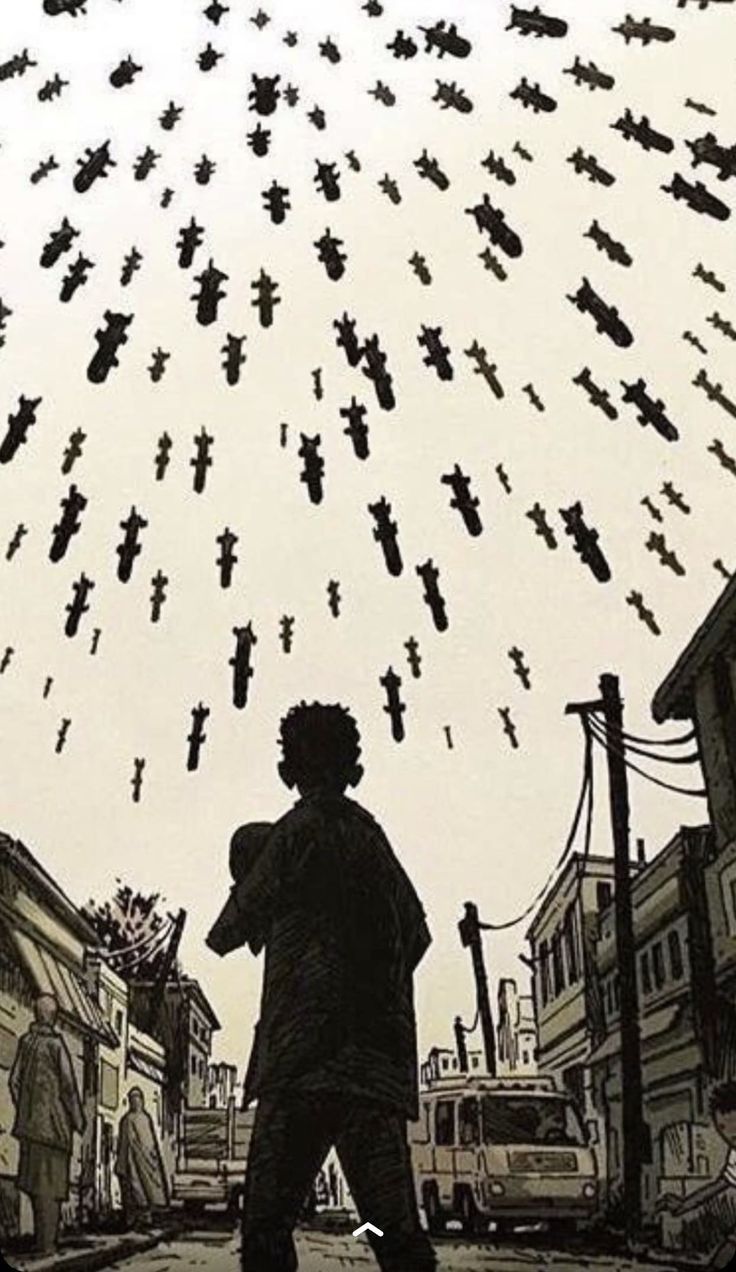
I see greed and hate. I see children suffering due to the thoughtlessness and mistakes of their parents, and politics makes it worse. While I might bite my tongue, I ask myself, is it not better to die as a child than to grow up and continue fighting? How can someone believe that peace can be achieved by bombarding a folk? How is it possible to forget one’s pain of losing the mother, father, or entire family? Those who sow hatred will reap vengeance!

I observe how people chase after happiness as it slips away, and I believe that our obsession with money, possessions, and accumulating more and more has caused us to lose sight of what truly matters – enjoying life.
I believe that enjoyment lies in the limitation of having!
As Lao Tzu said: Have little, and you will gain. Have much, and you will be confused.

The entire statement is instructive:
Bend, and you will be whole. Curl, and you will be straight. Keep empty, and you will be filled. Grow old, and you will be renewed.
Have little, and you will gain. Have much, and you will be confused.
“Tao Te Ching: Chapter 22” by Lao Tzu

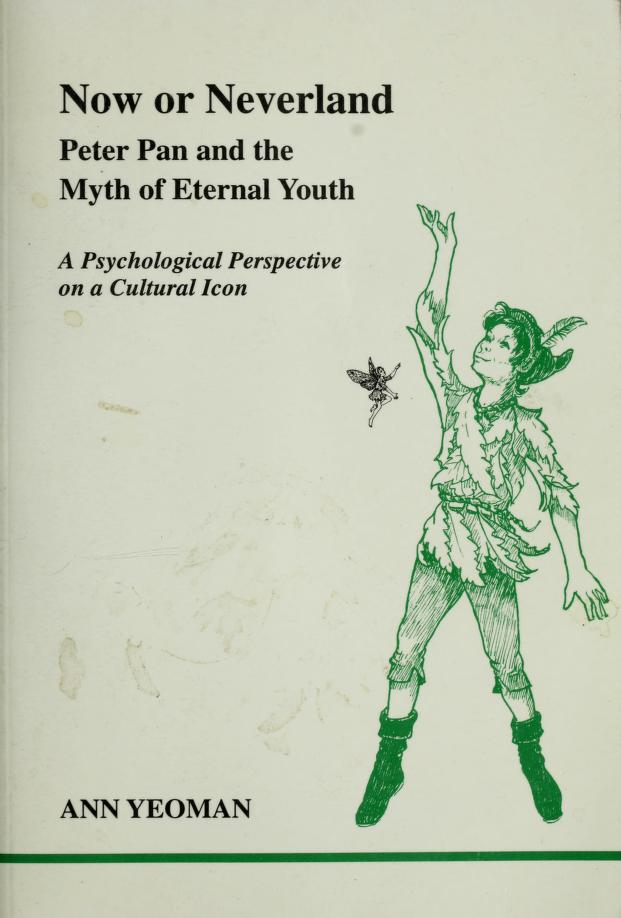
What we often forget is that the child in us never dies! I have previously shared some information on this topic (as it is part 4). In Part 1, I provided a translated summary of “The Archetype as a Past State.” Now, I would like to share Dr. Jung’s thesis on Child Archetypes: “The Function of the Archetype”, which may help us understand and awaken in adulthood.
To begin with, I will provide a brief introduction to Archetypes.

(Archetypes are not myths themselves but rather components of myths due to their typical nature. They are present in myths, fairy tales, dreams, and even psychotic fantasy products. In an individual, archetypes appear as unreal manifestations of unconscious processes. In myths, they are traditional forms of mostly inestimable age. These myths are usually tribal, transmitted from generation to generation through retelling. The primitive mind state differs from the civilized one primarily in that consciousness is much less developed in extent and intensity. The spontaneity of the act of thinking lies in the unconscious.)

Carl Jung: The Integration of The Personality, P. 285

The Function of the Archetype (On the psychology of the child archetype (1940): In the Pantheon Akademische Verlagsanstallt, Amsterdam and Leipzig 1940, under the title “The Divine Child.)

The child motif not only represents something that has been and is long past but also something present. That means it is not just a remnant but a currently functioning system intended to meaningfully compensate for or correct the inevitable one-sidedness and extravagances of consciousness. The essence of consciousness is concentration on relatively few contents, which are, if possible, increased to a level of complete clarity. Consciousness has a necessary consequence and prerequisite, the exclusion of other contents that are currently equally capable of consciousness. This exclusion inevitably causes a certain one-sidedness in the content of consciousness. Since the differentiated consciousness of civilized people is now given an effective instrument for the practical implementation of its contents in the form of the dynamics of the will, the greater the development of the will, the greater the danger of straying into one-sidedness and of digressing into lawlessness and rootlessness.

On the one hand, this is the possibility of human freedom, but on the other hand, it is also the source of endless instinctual contradictions. Primitive humans are, therefore, characterized – from the point of view of instinct, like animals – by neophobia and attachment to tradition. To our liking, it is embarrassingly backward while we praise progress. On the one hand, our progressiveness makes many of the most beautiful wish fulfillments possible. Still, on the other hand, an equally gigantic Promethean debt accumulates, which from time to time requires repayment in the form of fateful catastrophes. How long has humanity dreamed of flying, and now we have already arrived at aerial bombardments! Today, people laugh at the Christian hope for the afterlife and often fall into chiliasms, which are a hundred times more unreasonable than the idea of a joyful afterlife! Differentiated consciousness is always threatened by uprooting, which is why compensation is required through the still-existing childhood state.

Carl Jung Foreword: The Inner World Of The Child – Carl Jung Depth Psychology

However, from the standpoint of progress, compensation symptoms are formulated in unflattering terms, such as inertia, backwardness, scepticism, nagging, conservatism, timidity, pettiness, etc. But insofar as humanity has a high degree of ability to get rid of its own foundations, it can also allow itself to be carried away uncritically by dangerous one-sidedness and even catastrophe. The retarding ideal is always more primitive, more natural (in a good or bad sense) and more “moral” insofar as it adheres faithfully to the traditional law. The progressive ideal is always more abstract, unnatural, and “immoral,” which requires disloyalty to tradition. Progress forced by will is always hard and cramped. Although backwardness is close to naturalness, it is constantly threatened by an embarrassing awakening. The older view was aware that progress is only possible ‘Deo Concedente’, with which it identifies itself through the possession of opposite consciousness and repeats the ancient >rites d’entrée et de sortie< to a higher level. But the more consciousness differentiates, the greater the danger of its separation from the root state. The complete separation occurs when the ‘Deo Concedente’ is forgotten. It is now a psychological principle that a part of the soul that has been split off from consciousness is only apparently inactivated, but in reality, leads to an obsession of the personality, whereby its objective is distorted in the sense of the part of the soul that has been split off. Suppose the childlike state of the collective soul is repressed to the point of complete exclusion. In that case, the unconscious content takes control of the conscious goal, whereby its realization is inhibited, falsified or even destroyed. However, viable progress only comes about through the cooperation of both. (Archetypen, dtv.)

Children are our fellowship for the future, and our responsibility is to leave a legacy that fosters their growth and development. Thank you for reading.🙏💖🙏

Women’s Day? Women’s World! The Man’s Unrevealed Better Half!

Standard
Egyptian civilization. Papyrus. Scene of creation. The sky-goddess Nut, covered with stars, is generated by Geb, the god of the earth. Reconstruction of a fresco from a tomb at Thebes, Valley of the Kings. Cairo, Istituto Del Papiro

As we all know, yesterday marked International Women’s Day, and many posts were published on this topic. I apologize for being late to the celebration; I was until now occupied with my grandson, Ilias! This is the first time I have decided to participate in this acknowledgement match, not just because of a lack of time but because I have some reservations about celebrating a cause on a single day and then forgetting about it for the rest of the year. Perhaps it’s true that those in charge choose to memorialize and celebrate under a specific title to alleviate their guilt instead of resolving the issues. However, I believe in using this special day to awaken their consciousness and galvanize them into action.

How well described Marion Woodman about the core of the issue.

via Petra Glimmdall 🙏💖

I have frequently written about women’s missing rights and opportunities in society, and I have noticed that progress is being made. A recent example is the approval of a new law by the French parliament to add the right to abortion to their constitution. Bravo! Viva France!

Liberté, Égalité, Fraternité:

The concept is that if we believe in the duality of everything: cold – warm, above – below, bright – dark, woman – man, etc. Then, they not only mutually prove each other’s existence but also complement each other’s evolution. To comprehend these concepts, we should ponder twice (as the Germans say: Nachdenken!). Coldness would hold no significance if we always had everything cold and were unaware of warmth. Similarly, if we were constantly surrounded by brightness without ever experiencing darkness, we would never be able to comprehend the value of brightness. And it would be the same about feminine and masculine: Anima & Animus.

C. G. Jung introduced terms to describe specific functions of the human “soul” and “mind” ( Anima and Animus, Latin). I have published a partitional post about this issue before. Anima names the feminine unconscious factor in a man, while animus applies to the corresponding masculine factor in a woman’s unconscious.

I believe these are suitable lessons that will make us aware of how to help each other along the difficult path towards achieving the goal or the Self. This is how we can help each other because without encountering the other side, we are incomplete!

However, I have to repeat myself sadly, of man’s blindness as his stupid vanity has damaged a perhaps brave new world!

via Petra Glimmdall 🙏💖