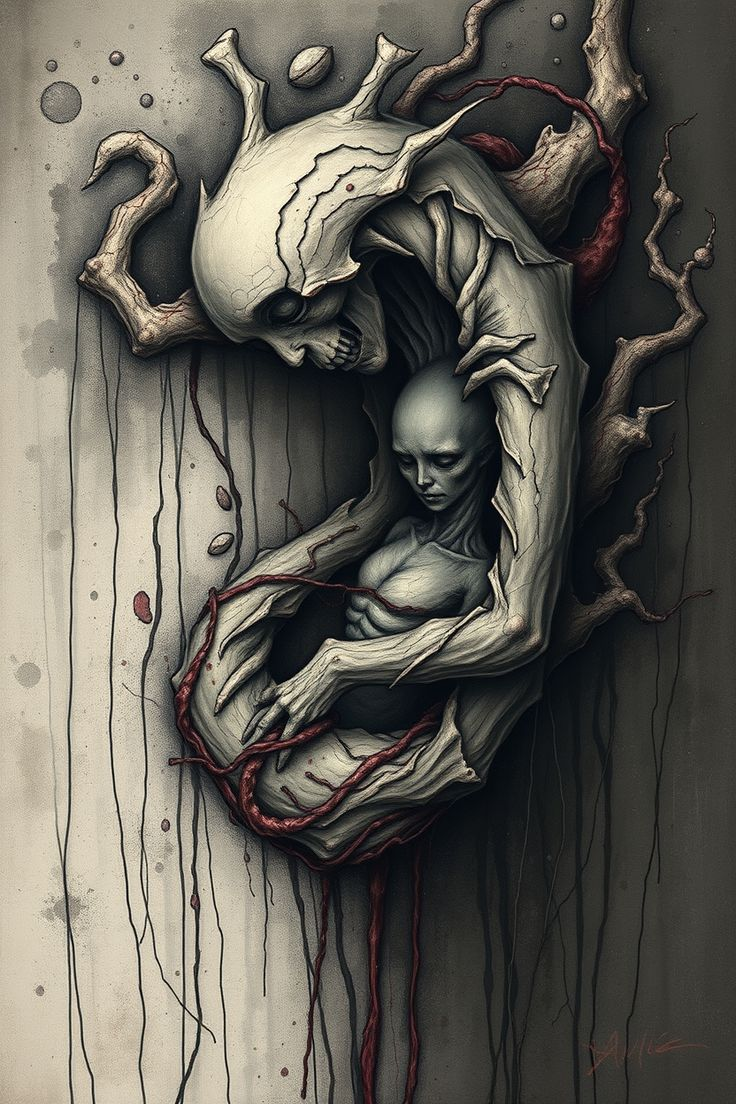
Observing the Depths from Below!

Standard

I am a forest, and a night of dark trees: but he who is not afraid of my darkness will find banks full of roses beneath my cypresses. The higher we soar, the smaller we appear to those who cannot fly.
~Friedrich Nietzsche, Thus Spoke Zarathustra

Understanding duality and the existence of opposites is essential for comprehending both our world and ourselves. Today, I often see the phrase ‘We are good & They are bad’ being misused and exploited. Good and evil are present within everyone!

Duality promotes understanding of the balance and tension between opposing elements, showing that complexity and harmony come from these interactions. Jung extensively studied duality, viewing it not just as external contrasts like light versus dark, cold versus warm, or above versus below, but as essential components of the human psyche and the process of individuation.

Jung says: Roots of Life reach into Hell. A core idea in Jung’s view of human existence is the concept of Duality and the Principle of Opposites. He argued that the psyche operates under the “principle of opposites,” meaning that every psychological concept or experience—such as light, warmth, consciousness, or life—inevitably has its opposite, like darkness, cold, unconsciousness, or death. The ongoing tension between these opposing forces is vital for psychological development and transformation. Dualities are not always entirely opposite; instead, they often depend on each other and define one another. For instance, light derives meaning only through its contrast with darkness. Many philosophies, including Taoism, highlight that these opposites are interconnected and mutually dependent, creating a balanced whole (yin and yang).

Jung’s psychology focuses on a fundamental duality between the conscious mind—associated with light, warmth, and awareness—and the unconscious, linked to darkness, coldness, and forgotten elements. The unconscious includes repressed or unknown parts, with the ‘shadow’ representing darker aspects we often reject or ignore. Recognising and accepting the shadow is crucial for achieving psychological wholeness.
The process of individuation involves integrating these opposites, acknowledging and reconciling them, rather than suppressing one side.
Jung explored myths, dreams, and alchemy, which frequently symbolised these dualities—such as sun/moon, king/queen, above/below—as part of psychic development. He saw alchemy as a metaphor for merging the conscious and unconscious components of the psyche.

Jung’s idea of duality illustrates how opposites are essential and creative elements of the mind. Concepts like light and dark, cold and warm, or the branches of a tree reaching upward and downward symbolise both external facts and internal truths. Personal development requires embracing these dualities to achieve a more integrated and authentic self.

An 1847 depiction of the Norse Yggdrasil as described in the Icelandic Prose Edda by Oluf Olufsen Bagge. Via Carl Jung Depth Psychology

He perceives the tree of life, whose roots extend into Hell and whose top reaches Heaven. He no longer distinguishes between right and wrong, holy and unholy, genuine and false, or good and evil. The only difference he recognises is between below and above: he sees that the tree of life grows from the ground upward, with its crown at the top, clearly separate from the roots. This view is unquestionable to him, and it guides his path to salvation.
To unlearn all distinctions except that of direction is part of your salvation. This liberates you from the old curse of knowing good and evil. Although you separated good from evil based on your best judgment, aiming only for the good and denying the evil you did- and struggled to accept it- your roots no longer drew dark nourishment from below, causing your tree to weaken and wither.
Therefore, the ancients said that after Adam ate the apple, the tree of paradise withered. Your life needs the dark. But knowing it is evil makes acceptance impossible, leading to suffering and confusion. You cannot accept it as evil, or your sense of goodness will reject you. Nor can you deny it, because you
know both good and evil. This knowledge of good and evil became an insurmountable curse.

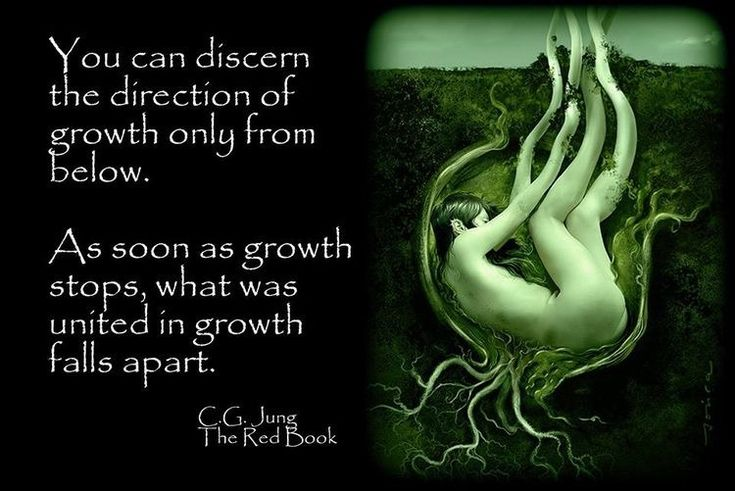
But if you return to primal chaos and recognise that which hangs stretched between the two unbearable poles of fire, you will notice that you can no longer conclusively separate good and evil, neither through feeling nor through knowledge, but that you can discern the direction of growth only from below to above. You thus forget the distinction between good and evil, and you no longer know it as long as your tree grows from below to above. But as soon as growth stops, what was united in growth falls apart, and once more you recognise good and evil.
You can never deny your knowledge of good and evil to yourself, so that you could betray your good in order to live evil. For as soon as you separate good and evil, you recognise them. They are united only in growth. But you grow if you stand still in the greatest doubt, and therefore, steadfastness in great doubt is a veritable flower of life.
He who cannot bear doubt does not bear himself. Such a one is doubtful; he does not grow, and hence he does not live. Doubt is the sign of both the strongest and the weakest. The strong have doubt, but doubt has the weak.

Therefore, the weakest is close to the strongest, and if he can say to his doubt: “I have you,” then he is the strongest. But no one can say yes to their doubt unless they endure wide-open chaos. Because there are so many among us who can talk about anything, pay heed to what they live. What someone says can be very much or very little. Thus, examine his life.

My speech is neither light nor dark, since it is the speech of someone who is growing. ~Carl Jung, Red Book, Page 301

Thank you for taking the time to read. 🙏

Searching for the Eternal Girl/Boy P. 3 Puella Aeterna/Puer Aeternus and Corne/Senex

Standard

I’ll borrow life and not grow old;
And nightingales and trees
Shall keep me, though the veins be cold,
As young as Sophocles.
And when I may no longer live,
They’ll say, who knows the truth,
He gave whate’er he had to give
To Freedom and to Youth.
~William Corey, Master at Eton c. 1850-1870

Success achieved, he never stays
For only by never staying does he not depart.
~Dao Tzu, Dao De Jing.

From Now or Neverland, p. 156

In this third part, let’s revisit the inspiring book, Now or Neverland, which motivated me to write these articles.

Here’s a brief essay on Now or Neverland by Ann Yeoman:

Ann Yeoman’s book “Now or Neverland: Peter Pan and the Myth of Eternal Youth” analyses the enduring charm of J.M. Barrie’s story, emphasising its psychological and mythological elements. She interprets Neverland as a metaphor for humanity’s longing to escape time and mortality. Yeoman considers Peter Pan an archetype embodying wonder and the peril of avoiding growth.
She explains that Neverland represents the myth of eternal youth—a place where responsibilities cease. This dream enables Peter to evade adult challenges but also leads him to miss meaningful relationships and personal development. Her study suggests Barrie’s tale celebrates youth but also warns against escapism.
In “Now or Neverland,” Yeoman encourages reflection on individual perceptions of time, change, and maturation, transforming a children’s story into a profound meditation on memory, imagination, and ageing.

Yesterday, I attended a birthday party for a dear family member, where my grandchildren were also present. I hadn’t seen them in a long time due to my illness and hospital stay. As always, I was the only adult the kids enjoyed playing with, because they knew the child in me well. It reminded me of what Yeoman mentioned in her book:

…Paradoxically, whereas lightness, freedom and space may be the necessary conditions for play, play itself is far from light, in that it has the capacity to ground one in the wholeness of one’s being. In a discussion of the importance of play in childhood, Anthony Stevens cites Johan Huizinga’s claim, in Homo Ludens, his work on the subject of play, that “in play there is something ‘at play’ which transcends the immediate needs of life.” This is because the archetypal activities of human life are filled with possibilities for play. Notes Stevens:

Hence, Schiller’s famous aphorism, “Man is only truly himself when he is at play.”
… Childhood is a period of immense vitality and inventiveness, when imagination is given free rein to complement the realities or compensate for the deficiencies of everyday existence…
It is one of the misfortunes of growing up that we readily lose touch with this rich land of childhood … Yet nothing is lost to the Self, and play, like the child who sponsors it, lives on as a propensity of the psyche to its dying day. (250On Jung, pp. 87f.)

What is of particular interest in our discussion of Barrie is Stevens’s emphasis that fantasy, as introverted play,

is the product of play between the archetypes of the collective unconscious and the living circumstances of the individual. . . . Fantasy is not a regressive means of escape from reality . . . but the modus operandi of psychological growth: it is the stuff of life, leading us on into the future. (251 Ibid., pp. 88f.)

Play and fantasy lead us into the future because they make us creators. They legitimise our re-formation and re-creation of the world, allowing us to remember and so re-deem the scattered fragments of ordinary life. They make us gods for an hour or a day, enabling an activity which affirms our sense of Self because it affords unlimited scope to our desire for realisation, fulfilment and creative power in a world of our own making that is secret and therefore safe. The task of the artist is then to establish a vital connection between the hidden world of possibility and the world of actuality.

However, according to Winnicott, the “place” of play and fantasy is precarious, “because it belongs to the interplay in the . . . mind of that which is subjective (near-hallucination) and that which is objectively perceived (actual or shared reality).” (Playing and Reality, p. 61)

…This place is the No-man’s land, an intermediary realm of the imagination that the artist must continually interpret and re-interpret. Here, one might encounter the god-child, buried deep in the personality. The challenge for the writer, like Barrie, who feels more at home in the imaginal realm, is to interpret such experiences within the real world. But in Peter Pan, Barrie’s two worlds remain as opposed at the end as at the beginning, with no space in the Edwardian world for the richness found in Neverland. Ultimately, Barrie cannot show that reality offers room for self-fulfilment, unlike other children’s classics such as Grahame’s The Wind in the Willows or Milne’s Winnie-the-Pooh.

In Barrie, there’s an apparent devaluation of cosy domesticity and an iconoclastic streak visible in his work, especially in Peter Pan and other heroes resembling Peter’s mysterious presence. We find in Peter Pan the masculine energy of the trickster, a mythic figure known as a lawbreaker who embodies instinctual desires. (Barbara Greenfield, “The Archetypal Masculine,” in Andrew Samuels, ed., The Father, p. 192.)

The trickster often marks an early stage in the development of the heroic ego, reflecting nature’s transformative power while resisting change. Barrie’s hero also resists transformation, with little evidence of active sexuality or development beyond a boy-trickster to a mature hero or Wise Old Man. Instead, Peter Pan’s iconoclasm risks becoming an idol of boyish rebellion for its own sake.

(Ibid., p. 191. Greenfield argues that “The boy, Don Juan, and the trickster show us the ego in its early stages of development, while the hero, the father and the wise old man represent later stages of development. As a whole, the animus, or male archetype, unifies these disparate figures because it exists as those principles which underlie them all.” She suggests that the most powerful mythological forms of the masculine archetype are those of the father and the trickster, claiming the trickster as “an early incarnation of the father” rather than an archetype separate from that of the father, as it is treated by Jung. Her view supports our earlier discussion of the inherent similarities of Peter Pan and Hook and is useful when individual development and personal pathology are the issue. However, what we may describe as the “creative iconoclasm” of the Self in its impulse to further consciousness favours Jung’s treatment of the trickster and his recognition of its essential and constant role in the archetypal drama of the psyche. Perhaps this presents a case for “both/and” rather than “either/or” terminology; and for a concept of co-existing levels of activity rather than a more linear development from one stage to the next, with only faint traces of earlier characteristics evident in the later stages.)

Remember to cherish the child within you; thank you! 🙏

Everything is Relative; Even Happiness!

Standard

Put your hand on a hot stove for a minute, and it seems like an hour. Sit with a pretty girl for an hour, and it seems like a minute. That’s relativity.
~Albert Einstein

I was always sceptical about the concepts of time and space. As I explored Einstein’s theory of relativity, I realised that it encompasses not just time and space, but everything else as well, including happiness.

Indeed, it pertains to an individual’s life circumstances or, more precisely, it is linked to them. For example, someone living a stress-free and trouble-free life may experience a lack of happiness, but when faced with tough times, they may find happiness more readily.

My life has been filled with challenges, but this year has been especially tough. As you know, I had issues with my lower abdomen and underwent three surgeries to fix it, or so I thought. However, a problem arose when I went to the toilet, which caused concern, and I visited my doctor. After the examination, he stated that an apparent mistake had occurred during the last operation, a part had been injured, and I would require another procedure. I won’t go into the details, but after some anxious days, I’ve managed to secure a scheduled appointment for next Wednesday, as the procedure needs to be done soon to prevent kidney issues.

I gathered some insights and words from my teacher, Carl Jung, who held that the psyche and cosmos are fundamentally timeless. Working with Einstein and Pauli, he examined a concept of timelessness that goes beyond linear clock time. Jung proposed that accurate understanding involves transcending causality because time in the psyche and reality is relative. Although our conscious mind perceives time linearly, embracing a sense of timelessness can enhance learning. His goal was to unify physical and psychic realities and how they interact.

He believed in a psychological “relativity of time,” where perception is subjective and affected by inner states. He connected this to synchronicity, implying that the psyche and material world are not always ruled by linear cause-and-effect but can relate in other ways. Jung pointed out that, similar to the space-time continuum in modern physics, the unconscious also exhibits “indistinctness” or psychic relativity, which blurs the boundaries between time and space.

For Jung: “[Synchronicity] cannot be a question of cause and effect, but of a falling together in time, a kind of simultaneity. Because of this quality of simultaneity, I have chosen the term ‘synchronicity’ to designate a hypothetical factor equal in rank to causality as a principle of explanation.”
Jung, C. G. (1952). The Structure and Dynamics of the Psyche; Synchronicity: An Acausal Connecting Principle, in CW, Vol. 8.

Now, what about happiness? I tell you this: when I go to the toilet and manage to pee, I feel the entire joy of life again and find happiness!

Humour plays a vital role, and hope remained until the very end. In my seventy years, I have enjoyed good health and no surgeries, but this year I face my fourth operation. Here’s to a brighter year ahead. Wishing you all health and prosperity.

My (Carl Jung’s) Most Difficult Experiment [P. 3]

Standard

“We need a force not to start conflicts but to protect our nation and freedom. Therefore, making military service more attractive could draw more young people”. Said German Bundeskanzler Friedrich März a few days ago.
I wonder how and with what we can make being a soldier attractive. A soldier’s role involves killing; how can we make that aspect attractive?

I remember the 1960s and 1970s, during the Cold War and Vietnam War, when crowds gathered to protest against conflicts and advocate for peace. Over time, Western governments began to prioritise peace more and engaged in disarmament talks, seeking peaceful coexistence. Yet today, they focus on strengthening their military to defend peace and freedom!

What’s happening? Isn’t there enough war worldwide? Is Germany yearning for the glorious days of the 1930s? The facts appear this way!

However, this has always occurred whenever politicians become oblivious to the horrific machinery of war. Therefore, it might be meaningful to consider two of Jung’s dreams from before WWI, as excerpted from his autobiography. “Memories, Dreams, Reflections” describes Carl Jung’s dreams from 1913 to 1914. With thanks to Lewis Lafontaine. 🙏

In October [1913], while I was alone on a journey, I was suddenly seized by an overpowering vision: I saw a monstrous flood covering all the northern and low-lying lands between the North Sea and the Alps.
When it came to Switzerland, I saw that the mountains grew higher and higher to protect our country.
I realised that a frightful catastrophe was in progress.
I saw the mighty yellow waves, the floating rubble of civilisation, and the drowned bodies of uncounted thousands.
Then the whole sea turned to blood.
This vision lasted about one hour.
I was perplexed and nauseated, and ashamed of my weakness.

Thunder is no longer the voice of a god, nor is lightning his avenging missile.
No river contains a spirit, no tree makes a man’s life, no snake is the embodiment of wisdom, and no mountain still harbours a great demon.
Neither do things speak to him nor can he speak to things, like stones, springs, plants and animals.”
~ Carl Jung, CW 18, Para 585

Two weeks passed; then the vision recurred, under the same conditions, even more vividly than before, and the blood was more emphasised.
An inner voice spoke. “Look at it well; it is wholly real, and it will be so. You cannot doubt it.”
That winter, someone asked me what I thought were the political prospects of the world in the near future.
I replied that I had no thoughts on the matter, but that I saw rivers of blood.
I asked myself whether these visions pointed to a revolution, but I could not really imagine anything of the sort.
And so I concluded that they had to do with me myself, and decided that a psychosis menaced me.
The idea of war did not occur to me at all.
Soon afterwards, in the spring and early summer of 1914, I had a thrice-repeated dream that in the middle of summer an Arctic cold wave descended and froze the land to ice.
I saw, for example, the entire region of Lorraine and its canals frozen, and the whole area totally deserted by human beings.
All living green things were killed by frost.
This dream came in April and May, and for the last time in June 1914.
In the third dream, frightful cold had again descended from out of the cosmos.
This dream, however, had an unexpected end. There stood a leaf-bearing tree, but without fruit (my tree of life, I thought), whose leaves had been transformed by the effects of the frost into sweet grapes full of healing juices.
I plucked the grapes and gave them to a large, waiting crowd…

On August 1, World War I broke out!

Now, let’s continue with the next section, following (1, 2), about Dr Jung’s dreams and examining how a forecaster can predict potential human self-destructive plans. As mentioned in Part Two, Jung described hearing a strange woman’s voice in his mind and tried to analyse it.

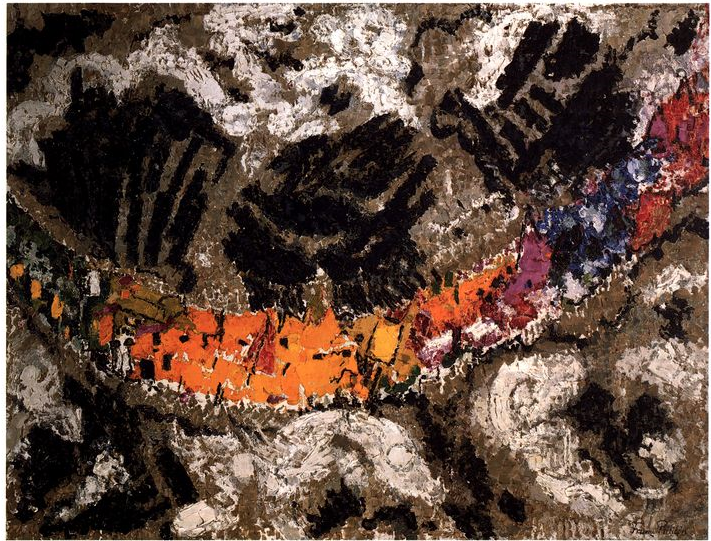
He believed the voice was “the soul in the primitive sense,” known as the anima, and stated that he employed his analysis to write letters to his anima, experiencing it as both a ghost and a woman. He remembered this voice as that of a Dutch patient from 1912 to 1918, who convinced a colleague that he was a misunderstood artist. The woman had thought the unconscious was art, but Jung had maintained it was a natural phenomenon. The woman was likely Maria Moltzer, and the psychiatrist was Jung’s friend Franz Riklin, who shifted from analysis to painting, studying Augusto Giacometti in 1913. Riklin’s art was semi-figurative and abstract, with a notable 1915/6 work, Verkündigung, in Zürich, donated by Moltzer in 1945. Giacometti found Riklin’s psychological insights exciting, calling him a modern magician.

Franz Beda Riklin Verkündigung 1915, Wikimedia

The November entries in Black Book 2 depict Jung’s return to his soul. He recalled dreams that led him to his scientific career and recent dreams bringing him back to his soul. In 1925, he noted his first writing phase ended in November: ” Not knowing what would come next, I thought perhaps more introspection was needed… I devised such a boring method by fantasising that I was digging a hole, and by accepting this fantasy as perfectly real. ” This experiment occurred on December 12, 1913 (See Liber Primus, chapter 5, p. 147).

To be continued …………

Thank you for reading! I don’t want to spoil your mood, but sometimes thinking more deeply can help us and prepare us for the worst. While I am on my way to spend the holidays, please note that responses to comments, if any, may be delayed.🙏💖

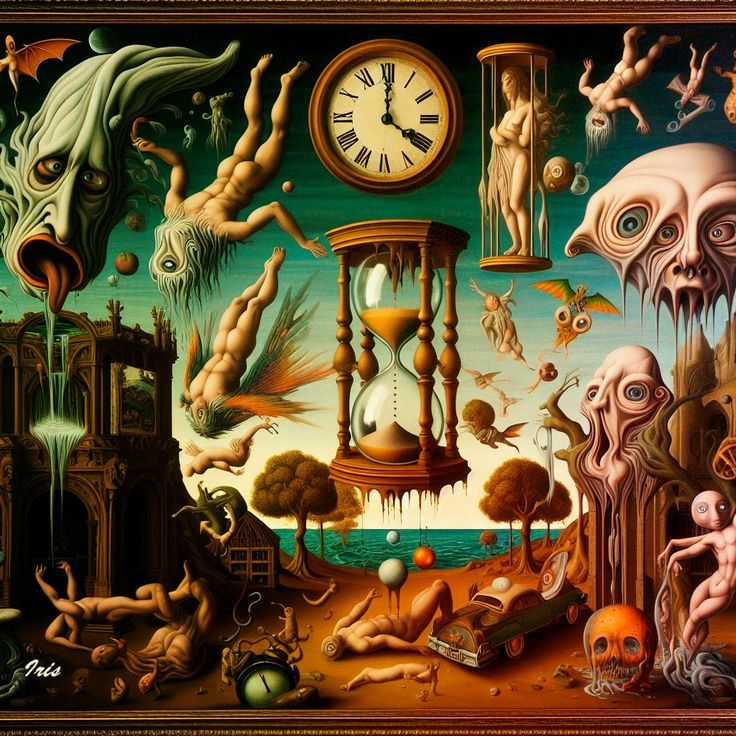
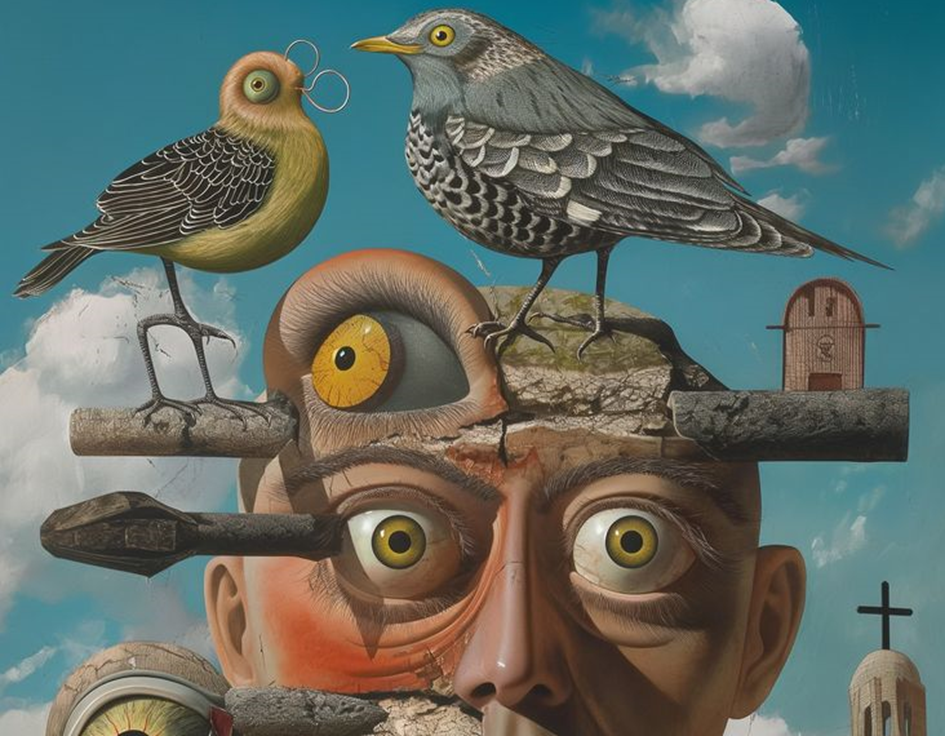
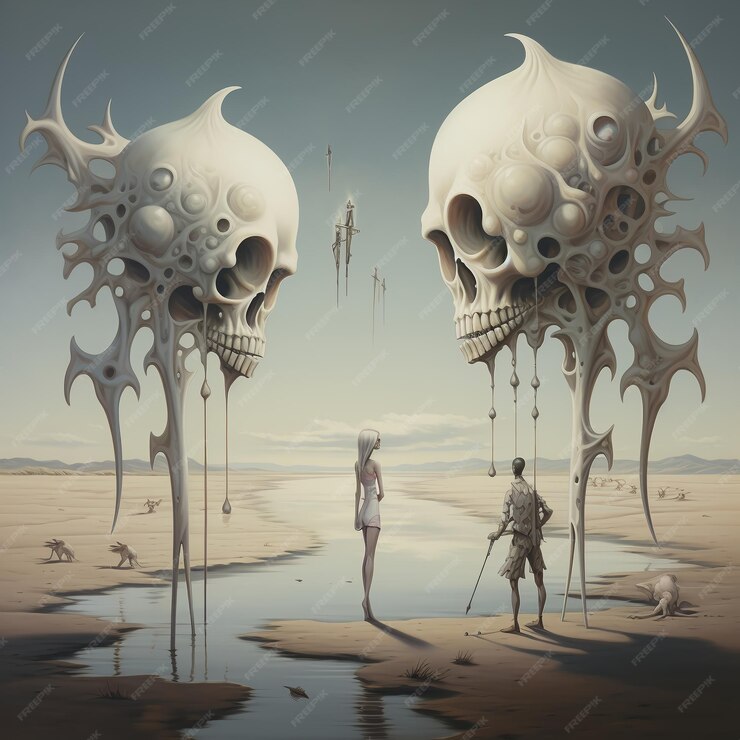
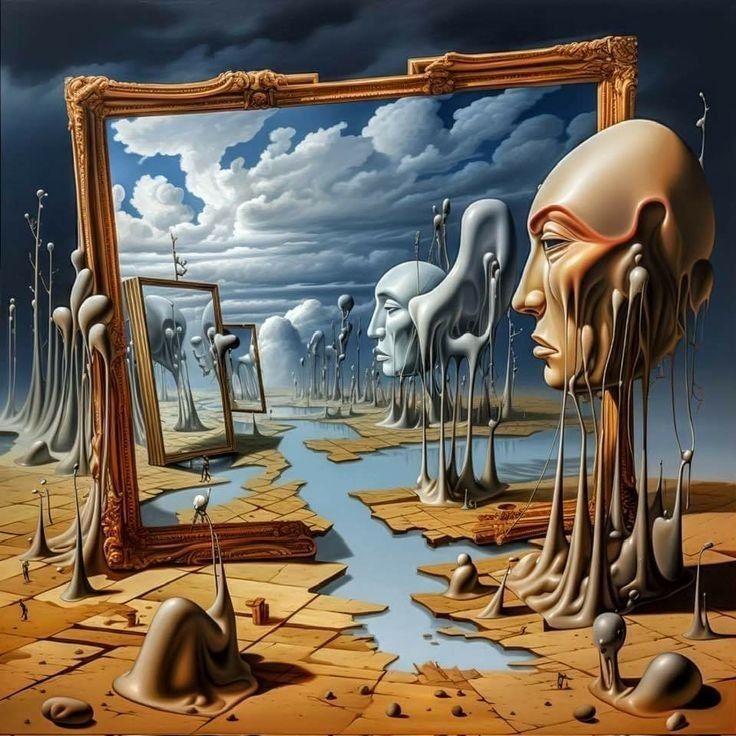
Illustration art at the top: Dali-Inspired Dreamscape

A Collaborative Fusion of two Great Poets Exploring Human Curiosity. Could the answer lie in dreams?

Standard

It’s a lovely day today, and it feels like summer is making one last bid to say goodbye. I was out in the garden, but not sunbathing – I had to mow the lawn! As tenants, these sorts of tasks are our responsibility.
And now, after giving the flat a good vacuum, I thought it was a good time to write a post.

Tomorrow is Leonard Cohen‘s birthday, and I thought it would be a great chance to celebrate with a poem by Pablo Neruda as a tribute.
The theme is human curiosity (the ‘Whys!’), how little we know, and, as Leonard Cohen suggests, why not stand on your own two feet and be your own individual?

There’s no doubt that they’re still alive, truly in our hearts, thanks to their lasting arts and wisdom.

Through a closed mouth, the flies enter
by Pablo Neruda:

Why, with those red flames at hand,
Are rubies so ready to burn?

Why does the heart of the topaz
reveal a yellow honeycomb?
Why does the rose amuse itself
by hanging the colour of its dreams?
Why does the emerald shiver
like a drowned submarine?

Why does the sky grow pale
under the June stars?
Where does the lizard’s tail
Get its fresh supply of paint?
Where is the underground fire
That revives the carnations?

Where does the salt acquire
The transparency of its glance?
Where did the coal sleep
That it awoke so dark?
And where, where does the tiger buy
Its stripes of mourning, its stripes of gold?

When did the jungle begin
to breathe its own perfume?
When did the pine tree realise
its own sweet-smelling consequence?
When did the lemons learn
The same laws as the sun?

When did smoke learn to fly?
When do roots converse?
What is water like in the stars?
Why is the scorpion poisonous?
Is the elephant benign?

What is the tortoise brooding on?
Where does shade withdraw to?
What song does the rain repeat?
When are the birds going to die?
And why should leaves be green?

What we know is so little,
and what we presume so much,
So slowly do we learn
that we ask questions, then die.
Better for us to keep our pride
for the city of the dead
on the day of the departed,
And there, when the wind blows through
the holes in your skull,
It will unveil to you such mysteries,
whispering the truth to you
through the spaces that were your ears.

I shall forever remember those days when Al and I closed many doors one after another to society, and by listening to Cohen’s songs, we immersed ourselves in our solitude.

Have a great time, everyone. 🙏💖🤗

Source: “Through a closed mouth the flies enter” from EXTRAVAGARIA by Pablo Neruda, translated by Alastair Reid. Copyright © 1958 Pablo Neruda and Fundación Pablo Neruda. Translation copyright © 1974 by Alastair Reid. Used by permission of Farrar, Straus and Giroux and Fundación Pablo Neruda.

Searching for the Eternal Girl/Boy P. 1 Puella Aeterna/Puer Aeternus and Corne/Senex

Standard

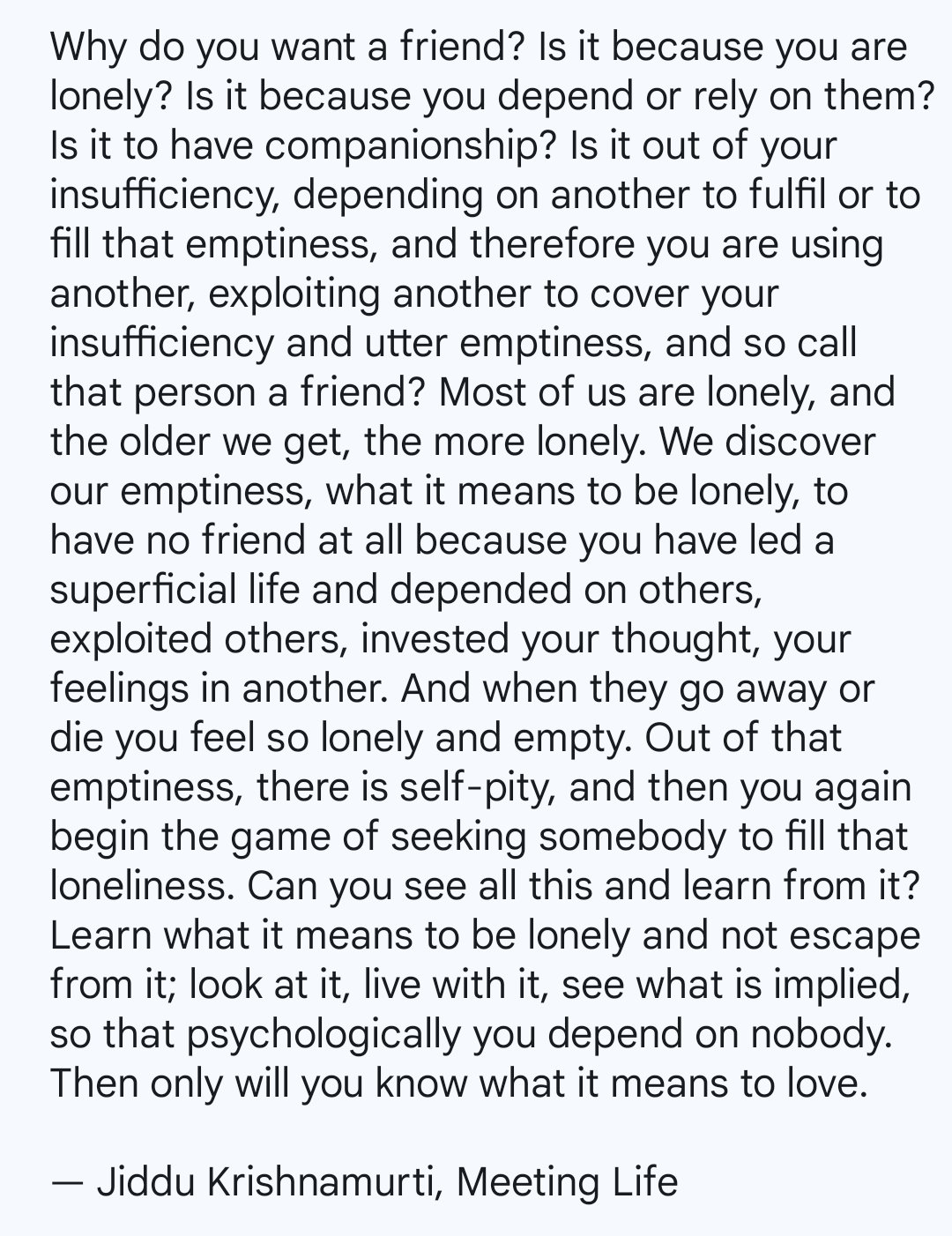
Does fantasy lead to escape, or to the embracing of a new perspective? In other words, does it support psychic growth or impede it? That distinction is often complicated by paradox, but it helps to ask ourselves, “Is concentrating on this fantasy or daydream opening my creative possibilities, or is this sapping my ego strength in the real world?” ~Marion Woodman

This excerpt begins Marion Woodman‘s foreword from Ann Yeoman’s book, Now or Neverland, which I read some time ago, thanks to Deborah Gregory‘s recommendation, and I am very grateful for it.

Frankly, when I began reading this book, I felt at home; I saw myself as a puer aeternus, struggling to stay balanced on life’s rollercoaster.

Traditionally, the term ‘puer aeternus’ (Latin for ‘eternal boy’) is used to describe a child-god who remains eternally young. In Carl Jung’s psychology, it refers to an older person whose emotional life remains stuck in adolescence, often referred to as the “Peter Pan syndrome”. Jung suggests that the puer lives a “provisional life” due to a fear of being trapped. They seek independence, resist boundaries, and find restrictions intolerable. In Greek mythology, the term ‘puer aeternus’ originates from the Metamorphoses, an epic poem by Roman poet Ovid (43 BC – c. 17 AD) that explores Greek and Roman myths. Ovid refers to the child-god Iacchus as “puer aeternus” and praises his role in the Eleusinian mysteries. Iacchus is linked to Dionysus and Eros. The puer represents a deity of vegetation, resurrection, and divine youth, similar to Tammuz, Attis, and Adonis.

Senex is a Latin term that literally means “old man.” It can also be used to describe: a wise, elderly person, an archetype. The wise older person (also known as senex, sage, or sophos) is an archetype outlined by Carl Jung, as well as a familiar literary figure, often portrayed as a stock character. Such a figure can be a profound philosopher renowned for wisdom and sound judgment.

Marie-Louise Von Franz summarised her view of the puer as follows:
None of his reactions are particularly personal or special. He becomes a type—the type of the puer aeternus. He becomes an archetype, and if you become that, you are not at all original… He is merely the archetype of the eternal-youth god, and, therefore, he has all the features of the god: he has a nostalgic longing for death, he thinks of himself as being something special, and he is the one sensitive being among all the other tough sheep. He will have a problem with an aggressive, destructive shadow that he will not want to live with and generally projects. There is nothing special whatsoever. The worse the identification with the youthful god, the less individual the person, although he himself feels so special. (Puer Aeternus, pp. 121f)
Another type of puer that does not display the charm of eternal youth, nor does the archetype of the divine youth shine through him. On the contrary, he lives in a continual sleepy daze, and that, too, is a typical adolescent characteristic… The sleepy daze is only an outer aspect, however, and if you can penetrate it, you will find that a lively fantasy life is being cherished within. (Puer Aeternus, p.2)

Reflecting on my childhood, after my father passed away and my mother kept it a secret from my brother Al and me, I became very introverted. Once I learned the truth, I simply didn’t want to grow up. Al and I drew closer because of our mother’s lie, and over time, during our youth, we swapped roles as eternal children. Initially, I wanted to remain a child forever, while Al, aware of our father’s death almost from the moment it happened, tried to act as a mature older brother to look after me.

As we entered puberty, our roles underwent significant changes. I developed a strong sexual desire much earlier and believed I had to act like a man to attract girls, while Al began creating his own solitary world. For many years, this condition persisted. Although I was accepted into Al’s world and was part of it, I was the one who had to maintain contact with the outside world. As a result, I assumed the role of the senex, but I longed for my puer aeternus and tried to keep it concealed yet protected.

Let’s conclude this now, and I look forward to discussing this topic further in the next part. 🖖🙏

My (Carl Jung’s) Most Difficult Experiment [P. 2]

Standard

What fascinates me about Jung is his commitment to self-exploration and his use of analysis to discover his Self through the interpretation of dreams. He dedicated his life to this pursuit with genuine honesty and sincerity. Today, I present another section of The Red Book, Liber Novus, by Carl Jung, from Sonu Shamdasani’s Reader’s Edition.🙏

The following month, on a train journey to Schaffhausen, Jung experienced a waking vision of Europe being devastated by a catastrophic flood, which was repeated two weeks later, on the same journey. Commenting on this experience in 1925, he remarked: “I could be taken as Switzerland fenced in by mountains and the submergence of the world could be the debris of my former relationships.” This led him to the following diagnosis of his condition: “I thought to myself, ‘If this means anything, it means that I am hopelessly off.’ ” (Introduction to Jungian Psychology, pp. 47-48). After this experience, Jung feared that he would go mad.
(Barbara Hannah recalls that “Jung used to say in later years that his tormenting doubts as to his own sanity should have been allayed by the amount of success he was having at the same time in the outer world, especially in America” [C. G. Jung: His Life and Work. A Biographical Memoir/ New York: Perigree, 1976/, p. 109]. )
He recalled that he first thought that the images of the vision indicated a revolution, but as he could not imagine this, he concluded that he was “menaced with a psychosis.” (Memories, p. 200). After this, he had a similar vision:

In the following winter, I was standing at the window one night and looked North. I saw a blood-red glow, like the flicker of the sea seen from afar, stretched from East to West across the northern horizon. And at that time, someone asked me what I thought about global events in the near future. I said that I had no thoughts, but saw blood, rivers of blood (Draft, p. 8).

In the year directly preceding the outbreak of war, apocalyptic imagery was widespread in European arts and literature. For example, in 1912, Wassily Kandinsky wrote of a coming universal catastrophe.
From 1912 to 1914. Ludwig Meidner painted a series of works known as the Apocalyptic Landscapes, featuring scenes of destroyed cities, corpses, and turmoil (Gerda Bauer and Ines Wagemann, Ludwig Meidner: Zeichner, Maler, Literat 1884-1966 / Stuttgart: Verlag Gerd Hatje, 1991). Prophecy was in the air!
In 1899, the renowned American medium Leonora Piper predicted that in the coming century, a terrible war would erupt in various parts of the world, purging the world and revealing the truths of spiritualism. In 1918, Arthur Conan Doyle, the spiritualist and author of the Sherlock Holmes stories, viewed this as prophetic (A. C. Doyle, The New Revelation and the Vital Message / London: Psychic Press, 1918, p. 9).

Dream _ A Great Work Of Art Is Like A Dream.
Artwork: Henri Rousseau
From the Carl Jung depth psychology site

In Jung’s account of the fantasy on the train in Liber Novus, the inner voice said that what the fantasy depicted would become completely real. Initially, he interpreted this subjectively and prospectively, that is, as depicting the imminent destruction of his world. His reaction to this experience was to undertake a psychological self-investigation. In this epoch, self-experimentation was used in medicine and psychology. Introspection had been one of the main tools of psychological research.

Jung came to realise that Transformations and Symbols of the Libido “could be taken as myself and that an analysis of it leads inevitably into an analysis of my own unconscious processes” (Introduction to Jungian Psychology, p. 28). He had projected his material onto that of Miss Frank Miller, whom he had never met. Up to this point, Jung had been an active thinker and had been averse to fantasy: “as a form of thinking I held it to be altogether impure, a sort of incestuous intercorse, thoroughly immoral from an intellectual viewpoint” (Ibid.). He now turned to analyse his fantasies, carefully noting everything. He had to overcome considerable resistance in doing this: “Permitting fantasy in myself had the same effect as would be produced on a man if he came into his workshop and found all the tools flying about doing things independently of his will” (Ibid.). In studying his fantasies, Jung realised that he was examining the myth-creating function of the mind (MP, p. 23).

Jung picked up the brown notebook, which he had set aside in 1902, and began writing in it (The subsequent notebooks are black, hence Jung referred to them as the Black Books). He noted his inner states in metaphors, such as being in a desert with an unbearably hot sun (that is, consciousness). In the 1925 seminar, he recalled that it occurred to him that he could write down his reflections in a sequence. He was “writing autobiographical material, but not as an autobiography” (Introduction to Jungian Psychology, p. 48).
From the time of the Platonic dialogues onward, the dialogical CE, St. Augustine wrote his Soliloquies, which presented an extended dialogue between himself and “Reason,” who instructed him. They commenced with the following lines:

When I had been pondering many different things to myself for a long time, and had for many days been seeking my own Self and what my own good was, and what evil was to be avoided, there suddenly spoke to me – what was it? I myself or someone else, inside or outside me? (This is the very thing I would love to know but don’t.) [St. Augustine, Soliloquies and Immorality of the Soul, ed. and tr. Gerald Watson (Warminster: Aris & Phillips, 1990), p. 23. Watson notes that Augustine “had been through a period of intense strain, close to nervous breakdown, and the Soliloquies are a form of therapy, an effort to cure himself by talking, or rather writing” /p. v/).]

While Jung was writing in Black Book 2:

I said to myself, “What is this I’m doing? This certainly is not science. What is it?” Then a voice said to me, “That is art!” This made the strangest sort of impression upon me, because it was not in any sense my impression that what I was writing was art. Then I came to this: “Perhaps my unconscious is forming a personality that is not I, but which is insisting on coming through to expression.” I don’t know why exactly, but I knew to a certainty that the voice that had said my writing was art had come from a woman … Well, I said very emphatically to this voice that what I was doing was not art, and I felt a great resistance grow up in me. No voice came through, however, and I kept on writing. This time, I caught her and said, “No, it is not”, and I felt as though an argument would ensue. {Ibid., p. 42. In Jung’s account, it appears that his dialogue took place in the autumn of 1913, although this is not certain, as the dialogue itself does not occur in the Black Book, and no other manuscript has yet come to light. If this dating is followed, and in the absence of the other material, it would appear that the material of the voice is referring to the November entries in Black Book 2, and not the subsequent text of Liber Novus or the paintings.}

To be continued!💖

The image on top: Pang Torsuwan -WHILE YOU WERE SLEEPING!

The Intoxication of Mythology (an Add!)

Standard

“Living with these things all the time, I can see how there are certain universal patterns for these manifestations. A shaman among the Navajo or in the Congo will say things that sound remarkably similar to those of Nicholas Cusanus, Thomas Aquinas, or C. G. Jung, leading one to realise that these ranges of experiences are common to the human race. There are some people who close themselves away from them, some people who open themselves to them …”
-Joseph Campbell
“Living Myths: A Conversation with Joseph Campbell,” Parabola, Volume I, Issue 2, Spring 1976, p. 70

In this tumultuous world, where corrupt leaders continue to pursue their plans for the “New World Order,” the most prudent approach is to allow our strained minds to be guided by the wisdom of eminent thinkers and to find solace in uniting our bewildered souls.

Surreal Abstract Painting (“Dadaism in nature” or “Psychedelic Surrealism”. )

My anger has subsided somewhat since last week, given how my words might have been taken. Nevertheless, I’m completely drained and fed up! Especially after that so-called ceasefire, which is like leaving an injured monster in a room with inocent people and locking the door!

These days, death has become the norm. We can see that the lives (of others, of course!) are not so important, but as we all know, the grim reaper is lurking, waiting for us all, regardless of our wealth or status, around the world. So, it’s essential to remember this.

That’s why I turn to myth, as an addendum to my recent post, and death!

Carl Gustav Jung around 1960 in his house in Zurich. (Photo RUE DES ARCHIVES)

Here are some words by Carl Jung:

For example, I do not know for what reason the universe has come into being, and I shall never know. Therefore, I must drop this question as a scientific or intellectual problem. But if an idea about it is offered to me—in dreams or in mythic traditions—I ought to take note of it. …They (The foreknowledge) may be in accord with reality, and then again they may not. I have, however, learned that the views I have been able to form based on such hints from the unconscious have been most rewarding.
Naturally, I am not going to write a book of revelations about them, but I will acknowledge that I have a “myth” that encourages me to look deeper into this whole realm.
“Myths are the earliest form of science.”
When I speak of things after death, I am speaking out of inner prompting and can go no farther than to tell you dreams and myths related to this subject.
Naturally, one can contend from the start that myths and dreams concerning the continuity of life after death are merely compensating fantasies inherent in our natures—all life desires eternity. The only argument I can adduce in answer to this is the myth itself.

~Carl Jung, The Atlantic Monthly, December 1962, From On Life after Death by C.G. Jung, via Carl Jung Depth Psychology Site

Sending love and peace!

The image at the top is a striking piece of digital art titled “Chakra” by DeviantArt user paranormalilly32. 

Make Peace, No War; Is It Possible?!

Standard

Today, I can only articulate my perplexed reflections regarding this event, which I may have somewhat anticipated yet did not expect. I am referring to the conflict that commenced yesterday between Israel and Iran. I do not wish to convey any patriotic sentiment, as I do not possess such feelings; however, I still experience ambivalent emotions regarding the dismantling of the Islamic regime and my connection to my place of origin.
That is what Carl Jung called the “Collective Unconscious.”

As I once responded to a dear friend’s question regarding my feelings; I have never supported war, but when one resides in a country governed by such a regime—killing young and old of one’s own people without mercy—and each day when venturing out onto the streets, uncertain if one will return alive, there is no other conclusion to draw!

via Lewis Lafontaine 🙏

Carl Jung’s perspective on war is complex and nuanced. He viewed war as a reflection of deeper psychological processes in individuals and nations, rather than just a political clash. Jung believed the “shadow” – the darker aspects of the human psyche – significantly influences this, with nations projecting undesirable traits onto enemies. He warned against the dangers of mass psychology and unconscious forces overwhelming reason, which can lead to destruction.
Jung’s views on war extend beyond military tactics; they explore the psychological roots of conflict, highlighting self-awareness, the risks of unchecked unconscious forces, and how individuation fosters peace.

Recalling the phallus dream and brick games, Jung forms associations leading to his adult views on global devastation and “rivers of blood.” In autumn 1913, he sensed a sombre atmosphere, an oppression that appeared to emanate from external sources, as if something significant lingered in the air. He recalls how this feeling grew stronger over the months, eventually leading to a remarkable vision that took hold of him:

“I saw a monstrous flood covering all the northern and low-lying lands between the North Sea and the Alps. When it came to Switzerland, I saw that the mountains grew higher and higher to protect our country. I realised that a frightful catastrophe was in progress. I saw the mighty yellow waves, the floating rubble of civilisation, and the drowned bodies of uncounted thousands. Then the whole sea turned to blood.” Jung recalls several recurring dreams, regarding them as premonitions of world destruction leading up to the First World War.”

Anyway, I’ll just have to deal with it, just like so many others who have the same concerns. I truly hope this situation comes to a swift and favourable resolution, ultimately leading to a free and prosperous Iran.

An Innocent Little Mistake!

Standard
2007 The Card Trick by Jake Baddeley

As I reflect on my past life, the passing years prompt me to recall memories, and I see how I wish to revisit specific moments to alter them or improve them. I have led an adventurous life (as you may recall from my series of posts about my memories), and I acknowledge that I have made numerous mistakes, which I deeply regret. However, with guidance from great thinkers, I have learned to view these mistakes from a different perspective: The Value of Experience!

It is a prevalent issue for people around the world to avoid making mistakes. I, myself, am one of those who strive for perfection, and I recognise that it is misguided!
Johann Wolfgang von Goethe says, “Geschlagener Quark macht breit, nicht fest!” (Beaten curd becomes broad, not strong!)

“If we look at the problems raised by Aristotle, we are astonished at his gift of observation. What incredible eyes the Greeks had for many things! Only they committed the mistake of being overhasty, of passing straightway from the phenomenon to the explanation of it, and thereby produced specific theories that are pretty inadequate. But this is the mistake of all time, and is still made in our own day.”

From Maxims & Reflections, Johann Wolfgang von Goethe; Science, 559

Additionally, Carl Gustav Jung reminds us that we can make mistakes and learn from them.

Whatever we look at, and however we look at it, we see only through our own eyes. For this reason, science is never made by one man but by many. The individual merely offers their contribution, and in this sense, I dare to speak only of my way of seeing things.
~Carl Jung, Modern man in Search of a Soul, p.84.

Plato proposed that absolute knowledge can be gained through acquaintance, meaning through intellectual insight into the otherworldly Forms. Jung shared a similar notion regarding acquaintance with the archetypes of the “unus mundus” (one world), representing the primordial, unified reality from which all things originate. Nevertheless, in contrast to Plato, Jung asserted that archetypes cannot be perceived directly. Instead, we can comprehend their psychic significance, gaining at least a hint of absolute knowledge.

I believe we can make mistakes, but after each one, we should take a step back and carefully examine how and where it happened, then try to approach the experience more thoughtfully. Experience teaches us more than thousands of books ever could!

Jung inspired individuals to engage with the world and savour life, rather than rely solely on theoretical knowledge from books. He regarded the unconscious mind as a treasure trove of experiences accessible through reflection and symbolic language. Ultimately, Jung’s work emphasises that while books and knowledge are valuable, they shouldn’t overshadow the importance of direct experience and self-reflection. Genuine growth and understanding flourish when we engage with our surroundings and explore our inner lives.

Sometimes a tree tells you more than can be read in books.
~ C.G. Jung; Letters Volume 1; Page 179.

Experience, not books, is what leads to understanding.
~Carl Jung, CW 12, Para 564

Thank you for reading; have a lovely holiday! 🙏🤗🌹💕