Sorry, it’s me again! I intended to share a brief message on Facebook, and I thought, why not just do it on my site, too? So here it is: We must look deeply around us and think twice. I send you all immense gratitude and wish you a lovely weekend.😁🤗💖🙏🦋🌹
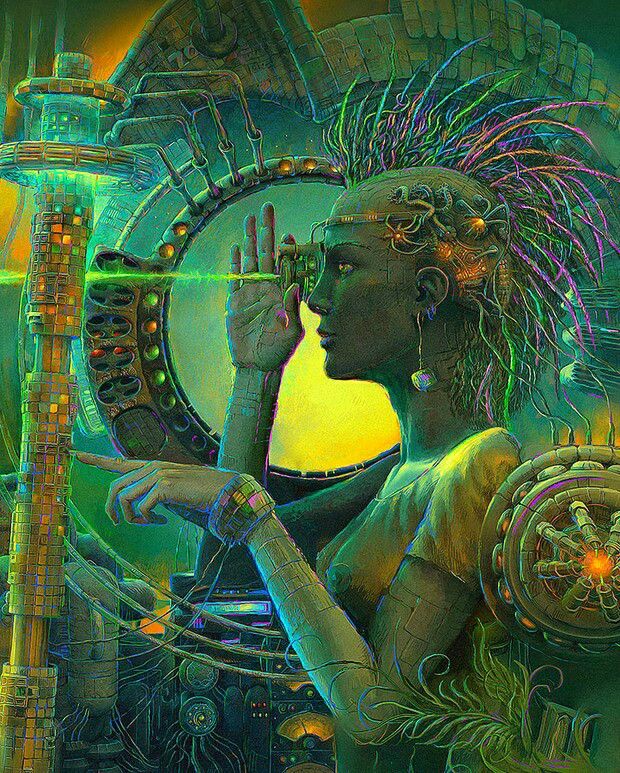
Title image; Art by Andrew Ferez
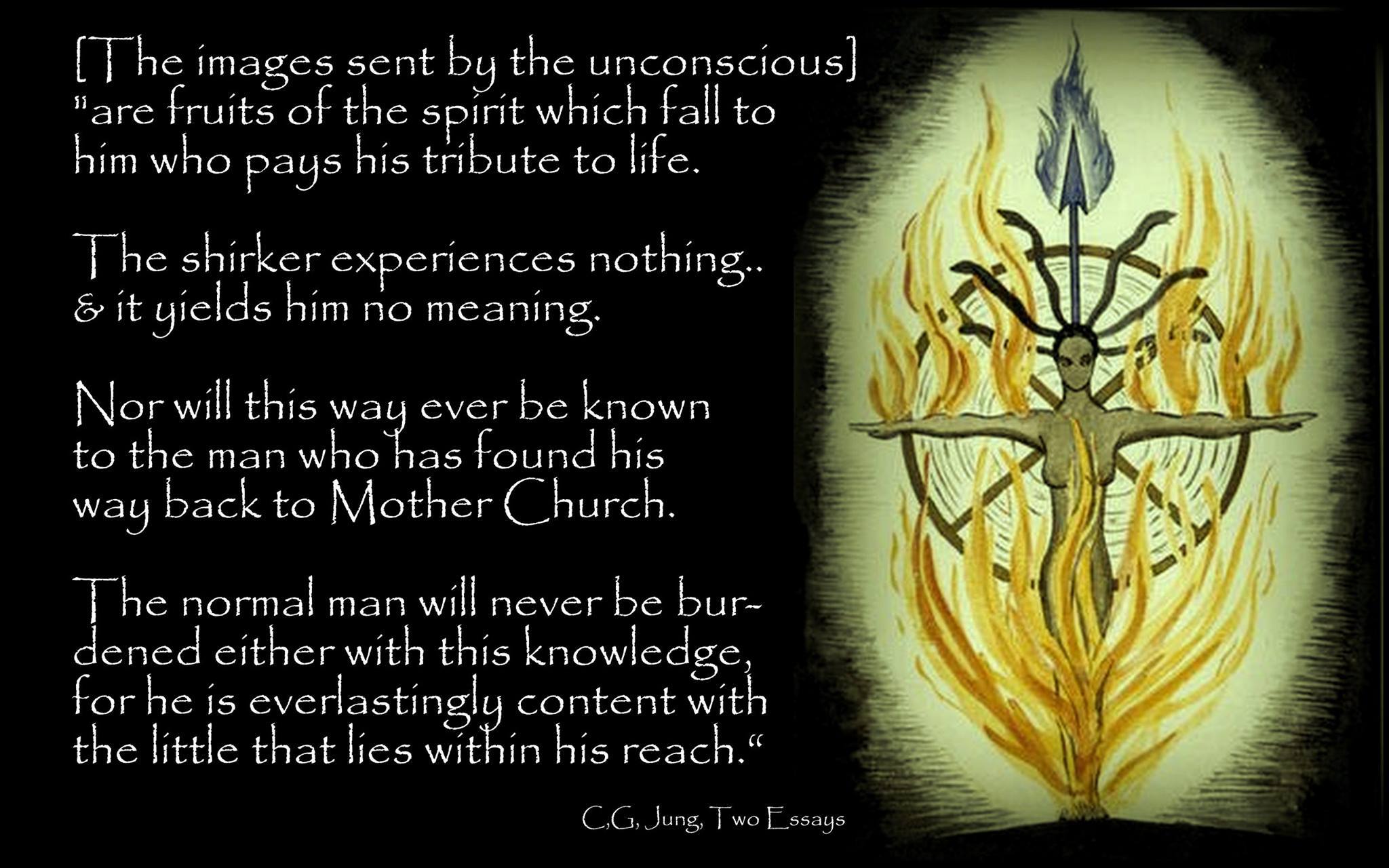
From Collected Works of C.G. Jung, Volume 7: Two Essays in Analytical Psychology,
I must recall at this point a serious misunderstanding to which my readers often succumb, and doctors most commonly. They invariably assume, for reasons unknown, that I never write about anything except my method of treatment. This is far from being the case. I write about psychology. I must, therefore, expressly emphasize that my method of treatment does not consist in causing my patients to indulge in strange fantasies for the purpose of changing their personality and other nonsense of that kind. I merely put it on record that there are certain cases where such a development occurs, not because I force anyone to it, but because it springs from inner necessity. For many of my patients, these things are and must remain double Dutch. Indeed, even if it were possible for them to tread this path, it would be a disastrously wrong turning, and I would be the first to hold them back. The way of the transcendent function is an individual destiny. But on no account should one imagine that this way is equivalent to the life of a psychic anchorite, to alienation from the world. Quite the contrary, for such a way is possible and profitable only when the specific worldly tasks which these individuals set themselves are carried out in reality. Fantasies are no substitute for living; they are fruits of the spirit which fall to him who pays his tribute to life.
The shirker experiences nothing but his own morbid fear, and it yields him no meaning. Nor will this way ever be known to the man who has found his way back to Mother Church. There is no doubt that the mysterium magnum is hidden in her forms, and in these, he can live his life sensibly. Finally, the normal man will never be burdened, either, with this knowledge, for he is everlastingly content with the little that lies within his reach. Wherefore I entreat my reader to understand that I write about things which actually happen and am not propounding methods of treatment. ~Carl Jung, CW 7, Pages 223-224
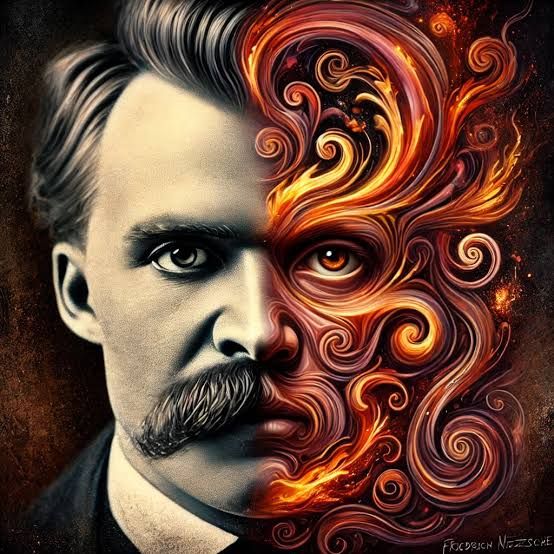
Recently, I saw a critical performance of Richard Wagner on German TV about his racism, presented by an Italian or Spanish artist whose name I have forgotten. However, this reminded me of Nietzsche’s distancing himself from Wagner due to his disgust towards specific individuals, even though Nietzsche was in love with his sister, Cosima. (The reason may also be that Nietzsche had a very close relationship with a man named Paul Rée, who was Jewish.) For Nietzsche, the Tribschen period was far from idyllic. It was challenging as he constantly tested himself to meet Wagner’s expectations. He began writing his first book while regularly visiting the Wagners’ home in Tribschen, anxious about whether his work would satisfy Wagner. This era was marked by aspiration, vulnerability, and self-testing for Nietzsche. He was essentially an apprentice to a genius, experiencing a vital rite of passage in his creative journey.
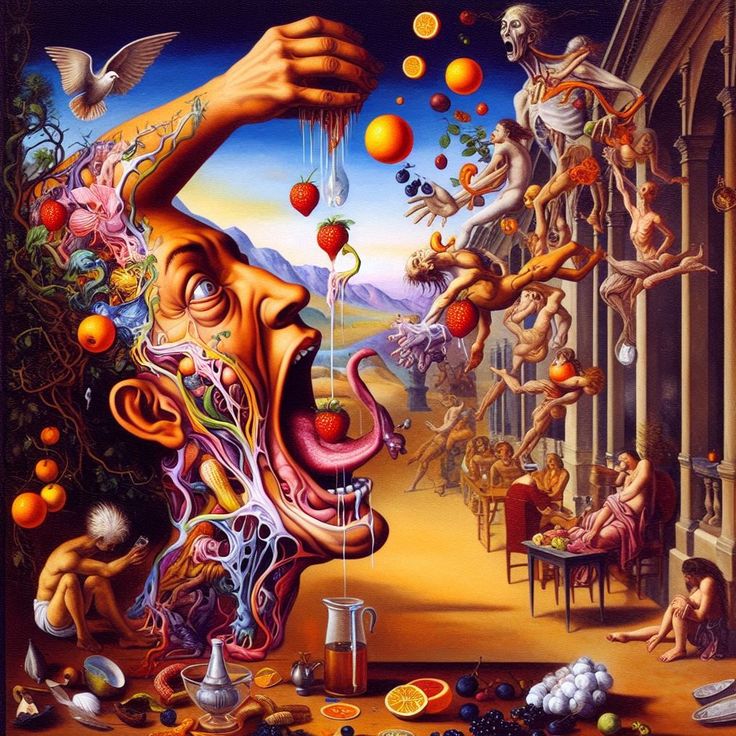
Free AI Art (On the top: Surreal Abstract Painting.)
Neither Nietzsche nor Wagner understood one another realistically. Nietzsche saw Wagner as a benevolent father but felt disappointed by his egotism. Conversely, Wagner viewed Nietzsche as a loyal son who became a rebellious thinker. Both pursued psychological needs that overshadowed their friendship and intimacy.
Anyway, I found two paragraphs I’ve translated from one of his books, Menschliches, Allzumenschliches (Human, All Too Human). I present them to you because I believe they are very relevant to our “political” society today.
From the Book “Human, All Too Human”, Volume One
(No. 458) Guiding Spirits and their Tools.
We see great statesmen and generally all those who have to use many people to carry out their plans, sometimes proceed in this way, sometimes in that way: either they select very finely and carefully the people who suit their plans and then give them relatively great freedom because they know that the nature of these chosen people will lead them to where they themselves want them to go, or they choose poorly, even take what comes to hand, but form something suitable for their purposes out of every ton. This last type is the more violent; it also requires submissive tools, its knowledge of human nature is usually much less, and its contempt for human nature is greater than that of the first-mentioned minds. Still, the machine they construct generally works better than the machine from the workshop of the former.
Spiral to the Hole
(No. 460) The Great Man of the Masses.
The recipe for what the masses call a great man is easy to give. Whatever the circumstances, get them something they find very pleasant, or first put it into their heads that this and that would be very pleasant, and then give it to them. But not immediately at any price: you have to fight for it with the greatest effort or seem to be fighting for it. The masses must have the impression that there is a powerful, even indomitable willpower; at least, it must seem to be there. Everyone admires a strong will because no one has it, and everyone says to themselves that if they had it, there would be no limits to them and their egoism. If it turns out that such a firm will achieve something that the masses find very pleasant, people admire it once again and wish themselves luck instead of listening to the wishes of its greed. Moreover, he has all the qualities of the masses: the less they are ashamed of him, the more popular he is. So, He is violent, jealous, exploitative, scheming, flattering, grovelling, conceited (narcissist) or anything, depending on the circumstances.
A brief update: My challenging circumstances remain the same, but I’m relieved that my boss has exited the hospital. His blood tests are standard, yet he still cannot return to work. Therefore, I must continue managing things as the acting boss! I am always grateful for your support and companionship, and I wish you all a lovely weekend.🙏💖
Hello, friends! As I mentioned in my last post two weeks ago, I decided to take a break from sharing new posts to alleviate some pressure on myself. Unfortunately, my brief explanation about this decision led to misunderstandings among many of you, while a few friends grasped my point. So, to make it clear, I am not on holiday; I am working more than usual because my boss is still in the hospital. I appreciate your understanding!
Anyway, as you can see, I have a new post yet, though not something heavy. It’s light and deep, for sure! Simply put, as I’ve been reflecting on my experiences with WordPress over the past couple of years, I’ve realized that artists need inspiration to create art. However, that inspiration isn’t always readily available. This platform provides a wonderful opportunity for us to share our thoughts and feelings naturally rather than treating it like a mandatory series production we must complete out of obligation. Consequently, I have decided to give myself time and share my thoughts when I believe they are valuable. 🤗
I’m still experiencing a tough time because of my “Standby” position (Imagine waking up each day unsure if you can work from home or need to jump out and drive around!). I find it hard to focus on anything that could calm my restless mind, and I feel like losing my creative spark. I started working on the Egypt post, but it didn’t satisfy me, so I decided to share an instructive story and some charming videos about a great and knowledgeable thinker, Alan Watts. I hope you will enjoy it, and I can take another break!!
Let’s examine our lives and our existence. It is not so difficult; we just need to loosen the tension in every muscle in our body, especially our brains, and surf around.
Alan Watts played a significant role in popularizing Zen Buddhism in the West, paving the way for traditional teachers like Soto priest Suzuki Roshi. However, Watts did not consider himself a Zen Buddhist. In a talk animated by Trey Parker and Matt Stone, he clarifies, “I am not a Zen Buddhist; I am not advocating Zen Buddhism or trying to convert anyone. I have nothing to sell.” He identifies himself simply as “an entertainer.” Is he joking?
Watts was ordained an Episcopal priest in 1945 and served until 1950. He was a complex character—a strict anti-dogmatist who found rigid doctrine irritating at best and profoundly oppressive and dehumanizing at worst.
Watts wasn’t a strict Zen priest but learned a lot from Japanese Buddhist concepts, which he explains in the short section of the video above. He also found similar insights about the interconnectedness of all things in Daoism. Above, you’ll see a short animation by Eddie Rosas from The Simpsons, where Watts illustrates “Daoism in perfection” through a simple parable.
In this short animated parable by Steve Agnos below, he states, “The whole process of nature is an integrated process of immense complexity.” However, instead of illustrating a lesson about unity, he suggests that nature and reality are ultimately beyond our understanding. He argues that “it is really impossible to determine whether anything that occurs within it is good or bad.” Therefore, the most reasonable approach seems to avoid judging in either direction.
And how it can be easy to open our minds, honestly, to ourselves and use our brain to think over and not take the easy way to judge:
Alan Watts critiques the human tendency to make hasty judgments, as seen in this mastery “talk-animated” below by Tim McCourt and Wesley Louis of Westminster Arts & Film London. He explores personal identity and the ego’s separation from reality, emphasizing the theme of interconnectedness. Watts asserts it is “impossible to cut ourselves off from the social and natural environments; we are that.” To discover this truth, he encourages us to become “deep listeners” and to let go of embarrassment, shyness, and anxiety.
I am not selling anything, either! 😅 (unfortunately!!?), but I send my best wishes to you all. Have a lovely time and till then.🙏💖🌹
Sorry! I can’t simply ignore this issue or stop worrying about the current situation. Perhaps it’s because I was born and raised in a dictatorship, which gives me a deeper understanding of the coming danger than many of my friends here, who have mostly been born and live in freedom.
The question is, when a nation feels disappointed with its situation and confused about its future, how easily can its patriotism be aroused and nationalism used to heal its social wounds? It is not related to a country’s political governing and social freedom, as we observe it occurring in both directories and Western democratic nations. I often wonder why people tend to embrace nationalism during moments of last-ditch pride, frequently seen in contexts like football national cups (a common occurrence in South America), historical racism (as observed in German history), or in leaning on their ancient heritage (as seen with figures like Mussolini in Italy and the Persians, which still resonates today).
Through scientific understanding, our world has become dehumanized. Man feels himself isolated in the cosmos. He is no longer involved in nature and has lost his emotional participation in natural events, which hitherto had a symbolic meaning for him… He no longer has a bush-soul identifying him with a wild animal. His immediate communication with nature is gone forever, and the emotional energy it generated has sunk into the unconscious. (C. G. Jung 1948/1980, para 585)
In today’s world, and likely in the years to come, politics will inevitably influence our lives, whether we want it to or not. I don’t intend to denigrate anyone, but when a single individual holds leadership in one of the most influential roles in the world with vast authority, it raises alarms about the potential for tyranny. And I’m sure all friends here must admit that no one will be immune to that seduction!
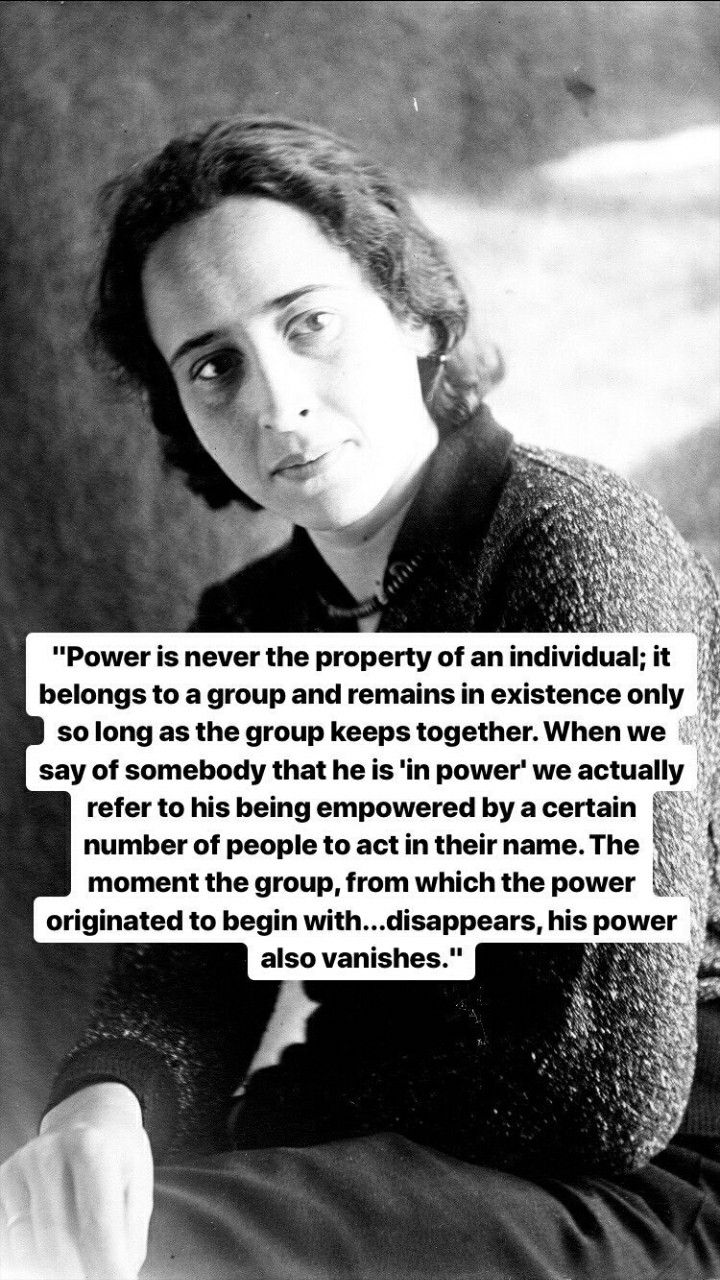
The word “democracy” originates from the Greek terms “demos,” meaning “people,” and “kratos,” meaning “power.” Therefore, democracy can be understood as the “power of the people”—a form of governance that relies on the people’s will. The idea of democracy derives its moral strength – and popular appeal – from two fundamental principles: 1- Individual Autonomy: This principle asserts that no one should be subject to rules others impose. People should be able to control their own lives within reasonable limits. 2- Equality: This principle holds that everyone should have the same opportunity to influence society’s decisions. Essentially, it emphasizes the disempowerment of concentrated power held by a single individual, transforming governance into a system where leaders serve the population rather than rule over them.
Lyndsey Stonebridge explains in her book “We Are Free To Change The World” (Hannah Arendt’s Lessons of Love and Disobedience): >In Arendt’s sense, having a free mind means turning away from dogma, political certainties, theoretical comfort zones, and satisfying ideologies. It means learning instead to cultivate the art of staying true to reality’s hazards, vulnerabilities, mysteries, and perplexities because, ultimately, that is our best chance of remaining human.< She also reflects that fundamental questions about the human condition are not beside the point in dire political times; they are the point. How can we think straight amidst cynicism and mendacity? What is there left to love, to cherish, to fight for? How can we act to secure it best? What fences and bridges do we need to build to protect freedom, and which walls do we need to destroy?
Hannah Arendt closely examined the regimes of Hitler and Stalin, their functionaries, the ideology of scientific racism, and the role of propaganda in creating what she described as “a curiously varying mixture of gullibility and cynicism.” This mixture is how individuals are expected to respond to their leaders’ ever-changing lies. In her 1951 work, “Origins of Totalitarianism,” she elaborated that this combination of gullibility and cynicism is prevalent across all levels of totalitarian movements:
In an ever-changing, incomprehensible world, the masses had reached the point where they would simultaneously believe everything and nothing, think that everything was possible and nothing was true… The totalitarian mass leaders based their propaganda on the correct psychological assumption that, under such conditions, one could make people believe the most fantastic statements one day and trust that if the next day they were given irrefutable proof of their falsehood, they would take refuge in cynicism; instead of deserting the leaders who had lied to them, they would protest that they had known all along that the statement was a lie and would admire the leaders for their superior tactical cleverness.
It is important to recognize the significant danger of trusting someone who makes promises. Why do such individuals often resort to constant and blatant lying? One reason is that it serves as a way to control their subordinates completely. These followers may feel compelled to abandon their own integrity to echo outrageous falsehoods, subsequently becoming tied to the leader through feelings of shame and complicity. Professor Jacob T. Levy from McGill University highlights the insights of prominent thinkers like George Orwell, Hannah Arendt, and Vaclav Havel. He notes that they can help us identify a specific type of falsehood. He states that “saying something obviously untrue and forcing your subordinates to repeat it earnestly in their own words is a shocking demonstration of power over them. This practice was widespread in totalitarian regimes.”
“You can read my lips… Repeat my words as I repeat them! Doesn’t this sound familiar? Arendt and others noted— as Levy writes— that “being forced to repeat an obvious lie makes it clear that you’re powerless.” She also identified how an avalanche of lies can render a populace unable to resist, a phenomenon we now refer to as ” “gaslighting”:
The result of a consistent and total substitution of lies for factual truth is not that the lie will now be accepted as truth and truth be defamed as a lie, but that the sense by which we take our bearings in the real world—and the category of truth versus falsehood is among the mental means to this end—is being destroyed.
However, time will reveal how a people or a nation can differentiate between right and wrong and how much their practice of democracy can help them recognize truth and falsehood. Democracy is not a gift that can be simply given; it requires thorough training to achieve its ultimate goal.
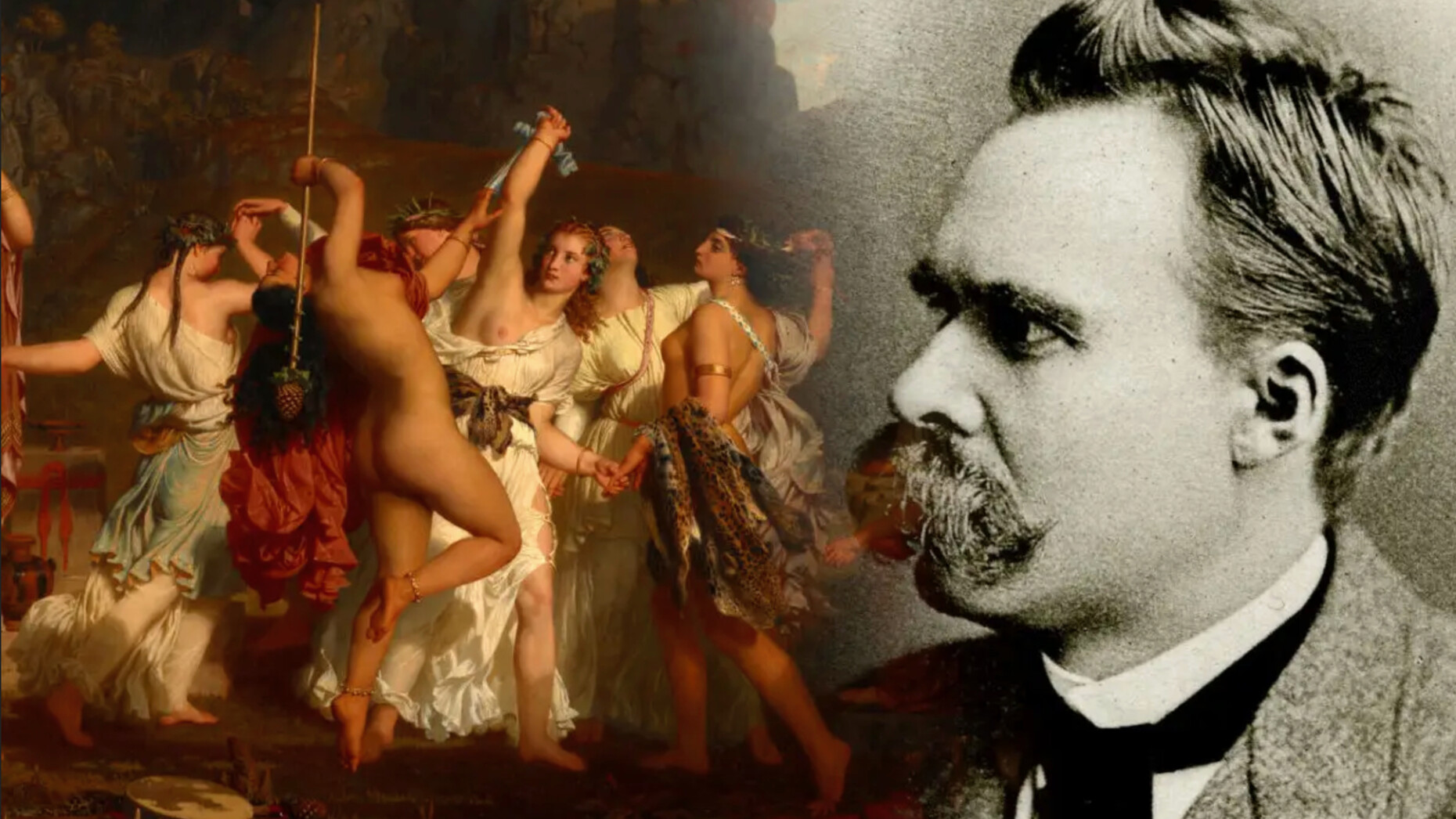
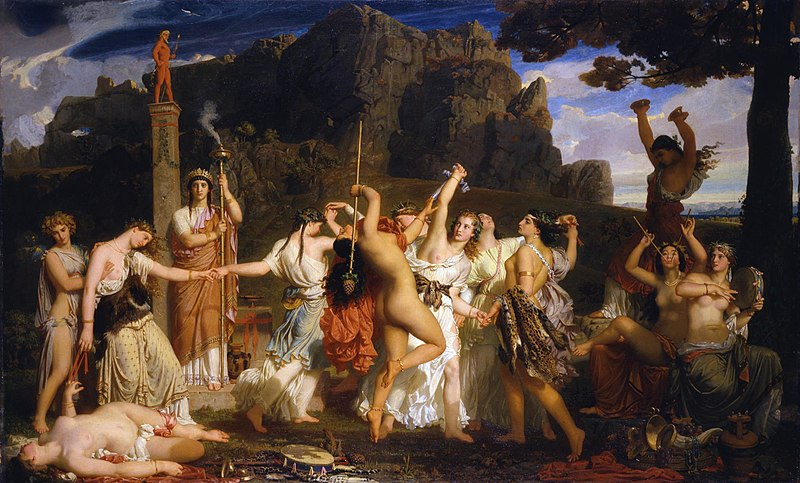
The Dance of the Bacchants, by Charles Gleyre and Friedrich Nietzsche (Artwork: Mark Rothko)
Recently, I read a post on FB from a good friend, Scott D. Smith, about how we might have to get through Nietzsche to understand Dr. Jung better! I agree totally; though Dr. Jung’s works are not philosophical but psychological, Nietzsche has an immense influence on Jung’s doctrine work and his psychological analysis in general.
Nietzsche admired Greece and Greek mythology, often quoting Schopenhauer and using Hegelian ideas to discuss art. He connected ancient Greek tragedy with Richard Wagner’s opera. Let’s see what he meant by Dionysian.
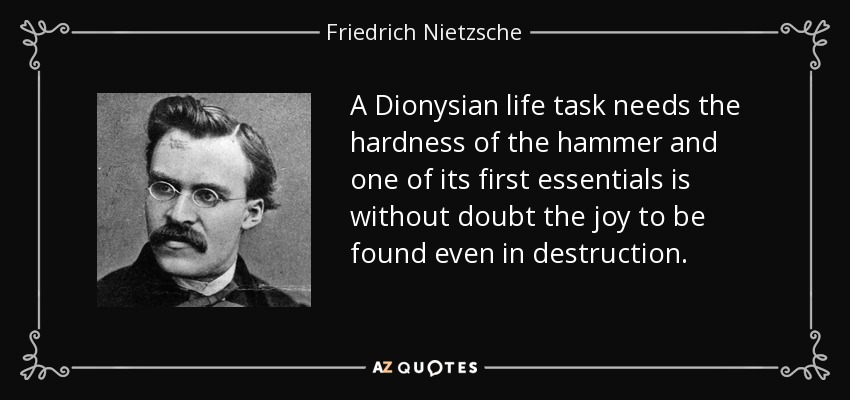
Dionysus, the Greek god of wine and music, is associated with the Dionysian, a state of self-forgetting where individuals unite with others and nature. According to Nietzsche, the Apollonian and the Dionysian are essential to art creation. Dionysian art, particularly music, represents madness and drunkenness, appealing to primal human desires and mystical unity with nature. In “The Birth of Tragedy” (1872), Nietzsche introduced the terms Apollonian and Dionysian to describe contrasting forces in art. The Apollonian represents a calm, rational art, while the Dionysian embodies intense emotion and ecstasy. Nietzsche believed these forces could come together to create a unique art form, as seen in the Greek tragedies of Aeschylus and Sophocles.
“The saying Yes to life even in its strangest and hardest problems; the will to life, rejoicing over its inexhaustibility even in the very sacrifice of its highest types – that is what I call Dionysian.”
Charles Gleyre La Danse des bacchantes. Wikimedia The Dance of the Bacchantes, the last painting by Gleyre exhibited publicly in Paris (at the Salon of 1849)
I believe his thoughts are timeless, as humans almost permanently experience the same failures based on ignorance. Here he speaks:
“Now we see the struggle, pain, the destruction of appearances as necessary because of the abundance of countless forms pressing into life because of the boundless fecundity of the world will…That primal Dionysian delight experienced even in the presence of pain is common to music and tragic myth.” “Dionysian art wants to convince us of the eternal delight of existence… Now struggle, pain, and destruction… are seen as necessary…Despite terror and pity we rejoice in living not as individuals but as part of the life force with whose procreative lust, we have become one.” “the world is becoming and perishing, creation and destruction, without any moral content, in eternal innocence.” “Now, sure of united victory, We celebrate the feast of feasts: Friend Zarathustra has come, the guest of guests! Now the world is full of laughter, the gruesome curtain is rent, The wedding day has come for light and darkness.” Nietzsche: Disciple of Dionysus
Sometimes, our strengths push us so far that we can no longer bear our weaknesses and decline from them.
Of course, we happen to predict this way out, but we can’t change anything. And then we become cruel in that which we ought to guard within ourselves, and our greatness makes us barbarous.
This experience, which we are ultimately forced to pay for with our lives, symbolizes bad people’s effect on others and their time.
With the best they possess—they have within themselves—with that which only they can accomplish, they destroy too many weak, uncertain, unformed, and hesitant beings with the best they have and thus become harmful.
And it can even happen that they do nothing but cause harm because this oldest part of themselves is suddenly emptied, so to speak, only by beings who suffocate their logic and individuality in a glass of strong drink.
And they get drunk to such a point that they can’t help but break their whole body – hands, legs – in all the ways that their drunkenness will lead them.
“‘Man is evil‘ – all the wisest have told me that to comfort me. Ah, if only it were still true today! For evil is man’s best strength. ‘Man must become better and more evil’ – thus, I teach. The most evil is necessary for the “Übermensch’s” best. It may have been good for that preacher of the little people to suffer and be burdened by man’s sin. But I rejoice in great sin as my great consolation. – But such things are not said for long ears. Neither does every word suit every mouth. These are subtle, remote things: sheep’s hooves should not reach for them!” Thus Spoke Zarathustra:
Let us think of the idea in its most terrible form: “existence as it is, without meaning or purpose, but inevitably returning, without a finale into nothingness: ‘the eternal return’. That is the extreme form of nihilism: nothingness (the ‘senseless’) eternal!”
And here, I add one of his poems, Last Will, translated from German.
Last Will
To die thus, as I once saw him die -, the friend who cast divine lightning and glances into my dark youth. Mutinous and deep, a dancer in battle -, the most cheerful among warriors, the most difficult among victors, Fate resting upon his doom, hard, thoughtful, premeditated – trembling that he had won, rejoicing that he had won while dying – commanding as he died- and he commanded that man should destroyed… To die thus, as I once saw him die: Victorious, Destroying…
Thank you, as always, for your presence and stopping by. Have a peaceful weekend, everybody.🙏💖✌
Today, I want to share something familiar, maybe ordinary, yet an important issue: Marriage! Of course, we can translate it into the modern language as a partnership, friendship, bedmate or lifemate, etc. But the main point is how much a couple should merge into each other, how close they must be and how deep.
Rene Magritte; Perfect Woman
I’ve had various experiences in the realm of relationships. I’ve had many different connections with different women, and you can imagine how much effort it took to understand the intricacies of this adorable gender. However, my current wife is the first and only one I’ve married. It took me about twenty-three years until to say “yes” and marry her and two more years to move in together. It wasn’t easy for either of us, but we’ve slowly but surely learned to respect each other’s boundaries and individualities over the years. We share one Life but have our own dreams, all while maintaining love and respect for each other.
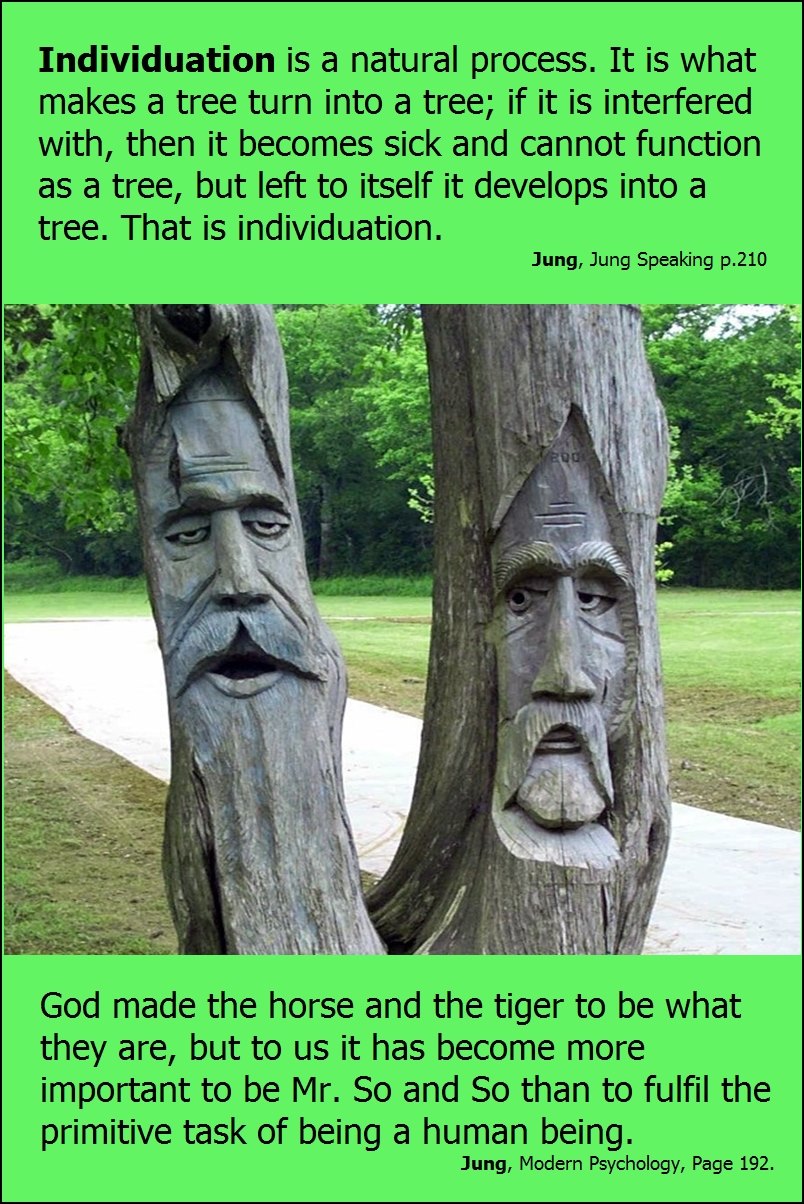
I have spent my life trying to understand the crucial topic in psychology called individuality. I finally succeeded with the help of Dr. Jung. It is essential for discovering and proving my uniqueness.
As it turns out, Kahlil Gibran also agrees with me. Here, I share a part of his book, “The Prophet”, about Marriage. I hope you enjoy reading it. Thanks, and have a peaceful weekend.
Sing and dance together and be joyous, but let each one of you be alone. Even as the strings of a lute are alone, though they quiver with the same music.
“Love is the only freedom in the world because it so elevates the spirit that the laws of humanity and the phenomena of nature do not alter its course_” Text and art by Kahlil Gibran
On Marriage, From the Book “The Prophet”
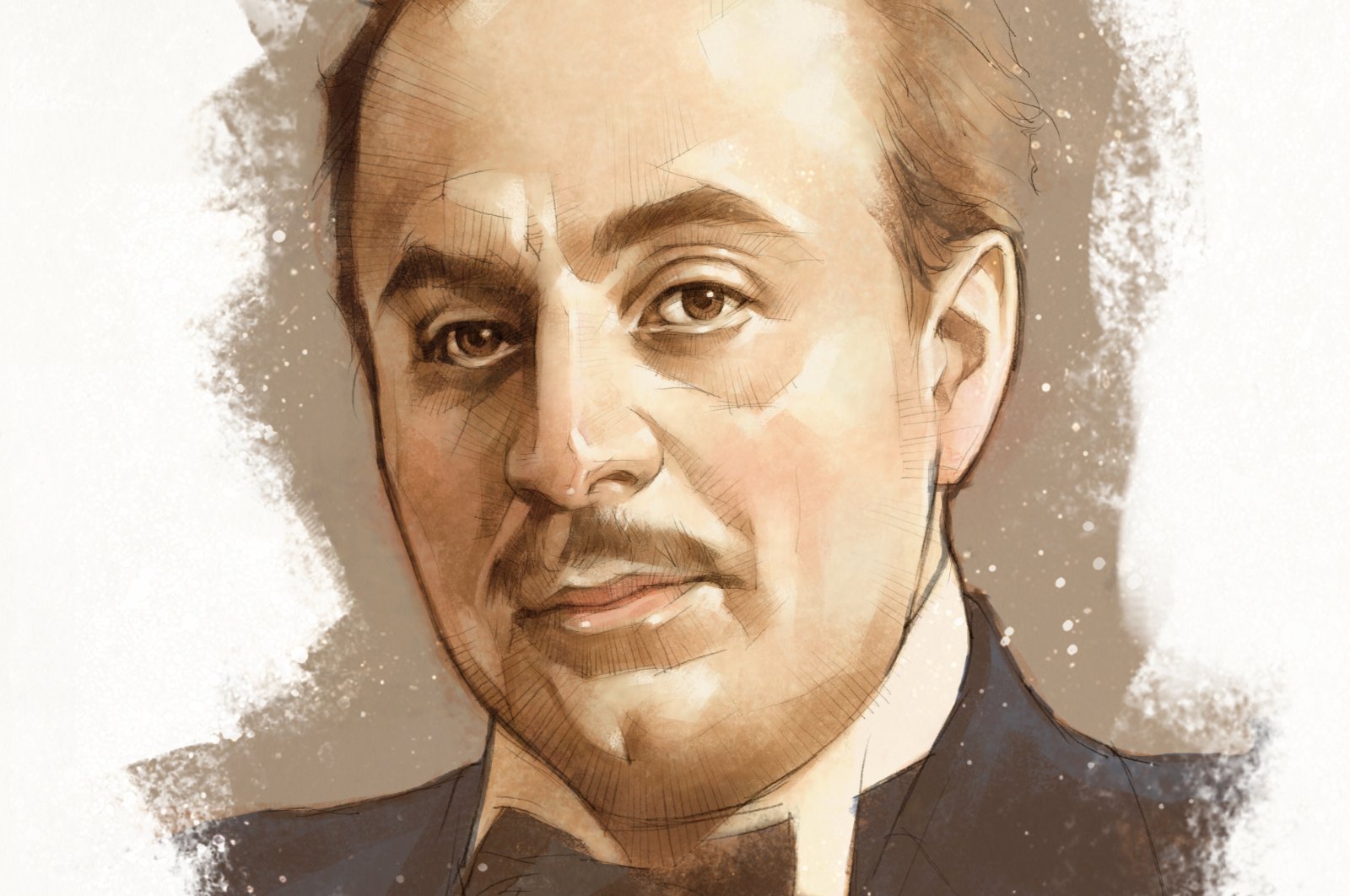
An illustration of Khalil Gibran. (Shutterstock)
Then Almitra spoke again and said: And what of Marriage, master? And he answered, saying: You were born together, and together you shall be forevermore. You shall be together when the white wings of death scatter your days. Aye, you shall be together even in the silent memory of God. But let there be spaces in your togetherness. And let the winds of the heavens dance between you. Love one another, but make not a bond of love: Let it rather be a moving sea between the shores of your souls. Fill each other’s cup but drink not from one cup. Give one another of your bread but eat not from the same loaf. Sing and dance together and be joyous, but let each one of you be alone. Even as the strings of a lute are alone, they quiver with the same music. Give your hearts, but not into each other’s keeping. For only the hand of Life can contain your hearts. And stand together, yet not too near together: For the pillars of the temple stand apart, And the oak tree and the cypress grow not in each other’s shadow.
Translated from volumes published by Lorenz Jung based on the edition “Gesammelte Werke” dtv.de The Symbols of Transformation (1952) and Aion (1950)
Here, I present another aspect of “Mana—Personality,” and honestly, I’m getting more and more excited to delve deeper and deeper into the subject! (The past episodes: 1, 2, 3, 4, 5, 6,) In this part, Jung continues explaining the concept of Mana and its impact on our lives from childhood to adulthood. He describes our inner try of separation from our parents, the process of growing up within a religious context, and the acknowledgement of God. He also provides an excellent explanation of our attitudes and behaviours towards authority figures and those in power.
By distinguishing the “I” from the archetype of the Mana Personality, one is now compelled – just as in the case of the anima – to make conscious those unconscious contents which are specific to the Mana Personality. Historically, the Mana Personality is always in possession of the secret name or of the special knowledge or the prerogative of a special action (quod licet Jovi, non licet bovi), in a word: of Individual Distinction. Becoming aware of the content that builds up the archetype of the Mana Personality means for the man the second and true liberation from the father, for the woman from the mother and thus the first feeling of her own individuality. This part of the process corresponds precisely to the intention of the concrete primitive initiations up to baptism, namely the separation from the >carnal< (or >animal<) parents and the rebirth >in novam infantiam<, into the state of immortality and spiritual childhood, as formulated by certain ancient mystery religions, including Christianity.
One may not identify with the Mana Personality, opting to view it as an extramundane ‘Father in Heaven’ embodying Absoluteness, which many find significant; if faith is achieved, this leads to an absolute dominance of the unconscious, causing the entire world to flow toward it.
(Absolute means “detached”. To declare God to be absolute is to place him outside of all connection with man. Man cannot act on him, and he cannot act on man. Such a God would be a completely irrelevant thing. One can, therefore, only reasonably speak of a God who is relative to humans as is to God. The Christian conception of God as a “Father in heaven” expresses the relativity of God in exquisite form. Quite apart from the fact that man can make out less about God than an ant can about the contents of the British Museum, this urge to declare God absolute arises only from the fear that God might become ‘psychological’. That would, of course, be dangerous. An absolute God, on the other hand, is of no concern to us at all, whereas a “psychological” God would be real. This God could reach man. The Church seems to be a magical instrument to protect man from this eventuality, for it is said that “it is a fearful thing to fall into the hands of the living God”.)
The logical consequence of this is that only a miserable, inferior, useless and sin-laden bunch of people remains. As is well known, this solution has become a historical worldview. Since I am only moving on psychological ground here and have no inclination to dictate my eternal truths to the universe, I must critically note that if I push all the highest value onto the side of the unconscious and construct a summum bonum from it, I have found myself in the unpleasant position of also inventing a devil of equal weight and size who maintains the psychological balance of my summum bonum. But under no circumstances will my modesty allow me to identify myself with the devil. That would be too presumptuous and would also put me in unbearable opposition to my highest values. But I cannot afford that, given my moral deficit.
That I feed the hungry, that I forgive an insult, that I love my enemy in the name of Christ — all these are undoubtedly great virtues. ~C.G. Jung, Memories, Dreams, Reflections Carl Jung Depth Psychology
For psychological reasons, I would, therefore, recommend not constructing a God from the archetype of the Mana Personality, that is, not making it concrete, because, in this way, I avoid projecting my values and non-values onto God and the devil, and, in this way I preserve my human dignity, my own specific weight, which I need so much in order not to become the unresisting plaything of unconscious powers. When you deal with the visible world, you have to be crazy to assume that you are the master of this world. Here, the principle of non-resistance to all superior factors is naturally followed up to a certain individual limit. At this point, even the most peaceful citizen becomes a bloody revolutionary. Our bowing to law and state is a recommendable model for our general attitude toward the collective unconscious. (>Give to Caesar what is Caesar’s, and to God what is God’s. <) Our bowing would not be difficult up to this point. But there are also factors in the world to which our conscience does not necessarily say yes, and we bow before them. Why? It is practically more beneficial than the opposite. Likewise, there are factors in the unconscious where we have to be nothing but clever. (>Do not resist evil. < >Make friends for yourselves in the huts of unjust mammon. < >The children of the world are cleverer than the children of light<, ergo: >Be wise as serpents and gentle as doves. <)
Translated from volumes published by Lorenz Jung based on the edition “Gesammelte Werke” dtv.de The Symbols of Transformation (1952) and Aion (1950)
Continuing the concept of Mana-Personality, Dr. Jung advises us not to underestimate the unconscious mind and even offers a prescription for better managing this issue. (I dearly share here the last parts, 1–2–3–4–5, if someone wants to check out!)🙏
As I read more from Dr. Jung, I find that the issues he discusses do not pertain to a specific time period; they are fundamental and timeless, as we can clearly observe them in the present.
So, I believe following his concepts can heal our ailing society. He did an excellent job of helping us understand our inner unknown. Let’s read another chapter of this Mana riddle.
Individuation The Mana Personality (P6)
The Mana personality develops historically into a heroic figure and a god-man (according to popular belief, the highest Christian king could cure epilepsy with his Mana by laying on hands), whose earthly figure is the priest. The analysts can tell us something about how much the doctor is still a man-personality. Insofar as the “I” apparently draws the power belonging to the anima to itself, the ego becomes a mana personality. This development is an almost regular occurrence. I have never seen a more or less advanced development process of this kind where identification with the archetype of the Mana personality did not take place, at least temporarily. And it is the most natural thing in the world that should happen this way because not only you do expect it yourself, but everyone else expects it too. One can hardly help but admire oneself a little because one has seen deeper than others, and the others have such a need to find somewhere a tangible hero or a superior wise man, a leader and father, an unquestionable authority, that they are very willing to build temples and burn incense to even petty gods. It is not just the lamentable foolishness of the uncritical followers but a psychological law of nature that what was before will always be again. And this will always be the case as long as consciousness does not interrupt the naive concretization of the archetypes. I do not know whether it is desirable for consciousness to alter the eternal laws; I only know that it sometimes alters them and that this measure is a vital necessity for certain people, which, however, does not prevent them from placing themselves on the throne of the father in order to make the old rule come true once again. Indeed, it is difficult to see how one could escape the overwhelming power of the archetypes.
Johfra Bosschart Occult Surrealist
I don’t believe that one can escape this overwhelming power. One can only change one’s attitude towards it and thereby prevent oneself from naively falling into an archetype and then being forced to play a role at the expense of one’s humanity. Being obsessed with an archetype turns a person into a mere collective figure, a kind of Mask behind which humanity can no longer develop but instead increasingly atrophies. One must, therefore, be aware of the danger of falling prey to the dominant Mana personality. The danger is not only that one becomes the FatherMask oneself but also that one falls prey to this Mask if someone else wears it. In this sense, master and student are the same.
The dissolution of the anima means that one has gained insight into the driving forces of the unconscious, but not that we have rendered these forces ineffective ourselves. They can attack us again in a new form at any time. And they will inevitably do so again if there is a gap in the conscious attitude. Power stays against power. When the “I” assumes power over the unconscious, the unconscious reacts with a subtle attack, in this case, with the dominance of the Mana personality, whose enormous prestige captivates the “I”. The only way to protect oneself against this is to fully admit one’s own weakness in the face of the forces of the unconscious. In this way, we do not oppose the unconscious with power, and as a result, we do not provoke the unconscious either.
Illustration: Nikolai Zaitsev
It may sound strange to the reader when I speak of the unconscious, so to speak, in a personal way. I do not want to provoke condemnation by thinking of the unconscious as personal. The unconscious consists of natural processes that lie beyond the human-personal. Only our consciousness is >personal<. So when I talk about >provoking<, I don’t mean that the unconscious is somehow offended and – like the old gods – does something to someone out of jealousy or vengeance. I often mean something like a psychological diet error that upsets my digestion. The unconscious reacts automatically, like my stomach, which figuratively takes revenge on me. If I assume power over the unconscious, that is a psychological dietary error, an unsatisfactory attitude that is best avoided in the interest of one’s own well-being. My unpoetic comparison is, however, a little too mild considering the far-reaching and devastating moral effects of a disturbed unconscious. In this respect, I would prefer to speak of the vengeance of offended gods.
Translated from volumes published by Lorenz Jung based on the edition “Gesammelte Werke” dtv.de The Symbols of Transformation (1952) and Aion (1950)
Recently, on X (Twitter), during one of Perian’s talks titled “The Way of Democratic Talk,” someone mentioned that social morals are crucial for keeping people mindful of their behaviour towards others. I responded that social morals are relative and not constant; throughout human history, they have consistently changed after wars or revolutions. I prefer to use the word “conscience.” Another friend said she would stick with “morals” because she was tired of having a guilty conscience. I replied that conscience is based on inner awareness and individuality and, therefore, has a more substantial and profound foundation, strengthening our consciousness as individuals.
Anyway, it was a prologue to noticing that words like consciousness, ego, anima, and their influential product, Mana, are important to take seriously. Mana may sound strange and unknown, but we all have it inside us!
Jung has always attempted to clarify that good and evil exist within every human and has made significant efforts to help us realize that it all depends on us to recognize these and find the balance between them.
Illustration at the top: NIKOLAY ZAITSEV
Here, in the continuation of the first part, I share some more words from this magical Mana.
Individuation The Mana Personality (P2)
‘Parsifal’ illustrations for Richard Wagner’s opera by Franz Stassen.
Who has now come to terms with the anima? Apparently, the conscious “I”, and therefore the “I”, has taken over the Mana. In this way, the conscious “I” becomes the Mana personality. The Mana personality, however, is a Dominant of the collective unconscious, the well-known archetype of the mighty man in the form of the hero, the chief, the magician, the medicine man and saint, the lord of men and spirits, the friend of God.
This is now a male collective figure that emerges from the dark background and takes possession of the conscious personality. This psychological danger is of a subtle nature; by inflating consciousness, it can destroy everything that has been gained through the confrontation with the anima. It is, therefore, of no minor practical importance to know that in the hierarchy of the unconscious, the anima is only the lowest level and one of the possible figures and that its overcoming creates another collective figure that now takes over its Mana. In reality, it is the figure of the magician – as I will call her in short – that draws the Mana, that is, the autonomous value of the anima to itself. Only insofar as I am unconsciously identical with this figure can I imagine that I myself possess the Mana of the anima. But under these circumstances, I will do so infallibly.
SD World _ Youri Ivanov _ Jouris Kunst
The figure of the magician has a no less dangerous equivalent for women: it is a maternal, superior figure, the great mother, the all-merciful one who understands everything and forgives everything and always wanted the best, who always lived for others and never sought her own, the discoverer of great love, just as it is the herald of the ultimate truth. And just as great love is never appreciated, great wisdom is never understood either. And they can’t stand each other at all.
There must be a serious misunderstanding here because it is undoubtedly a case of inflation. The “I” has appropriated something that does not belong to it. But how did it appropriate this Mana? If it really was the ego that overcame the anima, then the Mana also belongs to it, and then the conclusion is correct: one has become significant. But why does this significance, the Mana, not affect others? That would be an essential criterion! It does not work because one has not become significant but has simply merged with an archetype, another unconscious figure. So, we must conclude that “I” has not overcome the anima and, therefore, has not acquired the Mana. It is just that a new merger has occurred, with a figure of the same sex that corresponds to the father’s imago and has perhaps even greater power.
From the power that binds all beings, The person who overcomes himself frees himself< (Goethe: The Mysteries. A Fragment, in. Works in ten volumes, Vol. 7, 1962)
Thus, he becomes a superman, superior to all powers, a demigod, perhaps even more. ‘I and the Father are one’, this powerful confession in all its terrible ambiguity stemming from precisely this psychological moment.
One essay from Thus Spoke Zarathustra: The Speeches of Zarathustra.
I took on another challenging task, even though I didn’t have as much time as I thought! Nevertheless, I managed to translate another part of Nietzsche’s “Thus Spoke Zarathustra,” which I believe closely relates to the current human situation and way of life. Although Nietzsche seems to be a bitter and pessimistic philosopher, I find that he made valid points about the human condition that, in my opinion, he addressed reasonably.
His writing style is poetic and difficult to translate, using old-fashioned German. I did my best to make it more apprehensive. I hope you enjoy it.🙏💖🌹
(The word Hinterweltler literally means Backworlders, but he intends to show the unknown people living behind and around the subjects, unaware of the centre. I couldn’t find any word in English that matched this one, so I didn’t translate it!).
About The Hinterweltler
Zarathustra once cast his madness beyond man, like all other Hinterweltlers. The world seemed to me to be the work of a suffering and tormented God.
The world seemed to me a dream, the poetry of god-coloured smoke before the eyes of one who was divinely dissatisfied.
Good and evil and pleasure and pain and I and you – it seemed to me like coloured smoke before creative eyes. The Creator wanted to look away from himself – so he created the world. It is a drunken pleasure for the sufferer to look away from his suffering and lose himself. The world seemed to me to be one and the same: drunken pleasure and losing oneself.
This world… eternally imperfect, an image and an imperfect image of an eternal contradiction – a drunken pleasure of its imperfect Creator – so the world once seemed to me.
So I, too, once cast my madness beyond man, like all Hinterweltlern. Beyond man in truth? Their books, too, this God that I created was the work of man and madness, like all gods!
He was human, and only a poor piece of human and I: This ghost came to me from my own ashes and embers, and honestly! It did not come to me from the beyond!
What happened, my brothers? I overcame myself, the sufferer, I carried my own ashes to the mountain, I invented a brighter flame for myself. And behold! Then the ghost left me!
It would be suffering for me now and torment for those who have recovered to believe in such ghosts: it would be suffering for me now and humiliation. So I speak to the Hinterweltlern.
It was an unfortunate, and inability – that created all the Hinterweltlern: and that brief madness of happiness that only the most suffering experience.
Tiredness that wants to reach the last will with one leap; with a deathly leap, one poor, ignorant tiredness that no longer even wants to want: that created all gods and Hinterwelten. Believe me, my brothers! It was the body that despaired at the end – it heard the belly of the being speaking to it. And then it wanted to go through the last walls with its head, and not just with its head – over to “that world”.
But ‘that world’ is well bent before man, that dehumanized, inhuman world which is a heavenly nothingness, and the belly of being does not speak to man at all, unless as a human being.
Truly, all beings are difficult to prove and difficult to make them speak. Tell me, brothers, is it not the most wonderful of all things, the best proven?
Yes, this ego and the ego’s contradiction and confusion still speaks most honestly about its being, this creative, willing, evaluating ego, which is the measure and the world of things. And this honest being, the ego – that speaks of the body, and it still wants the body, even when it writes poetry and raves and flutters with broken wings.
Constantly learns to speak more and more honestly, the ego: and the more it learns, the more it finds words and honours for body and earth. My ego taught me a new pride, and I teach it to people: no longer to bury one’s head in the sand of heavenly things but to carry it freely, an earthly head that gives meaning to the earth!
The Cyclops Sun
I teach people a new will: to want this path that man has blindly walked, to welcome it, and no longer sneak away from it like the sick and dying.
It was the sick and dying who despised body and earth and found the heavenly and the redeeming blood stopper, but they also took these sweet and dark poisons from body and earth.
They wanted to escape their misery, and the stars were too far away for them. Then they sighed: >Oh if only there were heavenly ways to sneak into another existence and happiness!< – So they invented their tricks and bloody potions! They thought they were now removed from their bodies and this earth, these ungrateful people. But whom did they thank for their rapture, their pain and their bliss? Their bodies and this earth.
Zarathustra is gentle with the sick. Indeed, he is not angry with their forms of consolation and ingratitude. May they recover and conquer and create a higher body for themselves! Zarathustra is not angry with the recovering people either when he looks tenderly upon their madness and sneaks around the grave of their God at midnight: But illness and a sick body remain for me, and their tears still remain.
There have always been many sick people among those who write poetry and are God-addicted; they furiously hate those who know and that youngest of virtues, which is called honesty.
They always look back to dark times. Of course, madness and faith were two different things then; the madness of reason was godlike, and doubt was a sin.
I know these godlike people all too well: They want people to believe in them, and doubt is a sin. I also know all too well what they themselves believe in best.
Truly not in the Hinterwelten and redeeming drops of blood, but they instead believe best in the body, and their own body is their thing for itself.
But it is a sick matter to them, and they would gladly lose their temper. That is why they listen to the preachers of death and preach about the Hinterwelten.
Listen to me instead, my brothers, to the voice of the healthy body: This is a more honest and purer voice.
The healthy body speaks more honestly and more purely, the perfect and right-angled one: And it speaks of the meaning of the earth.
















 lampmagician
You must be logged in to post a comment.