
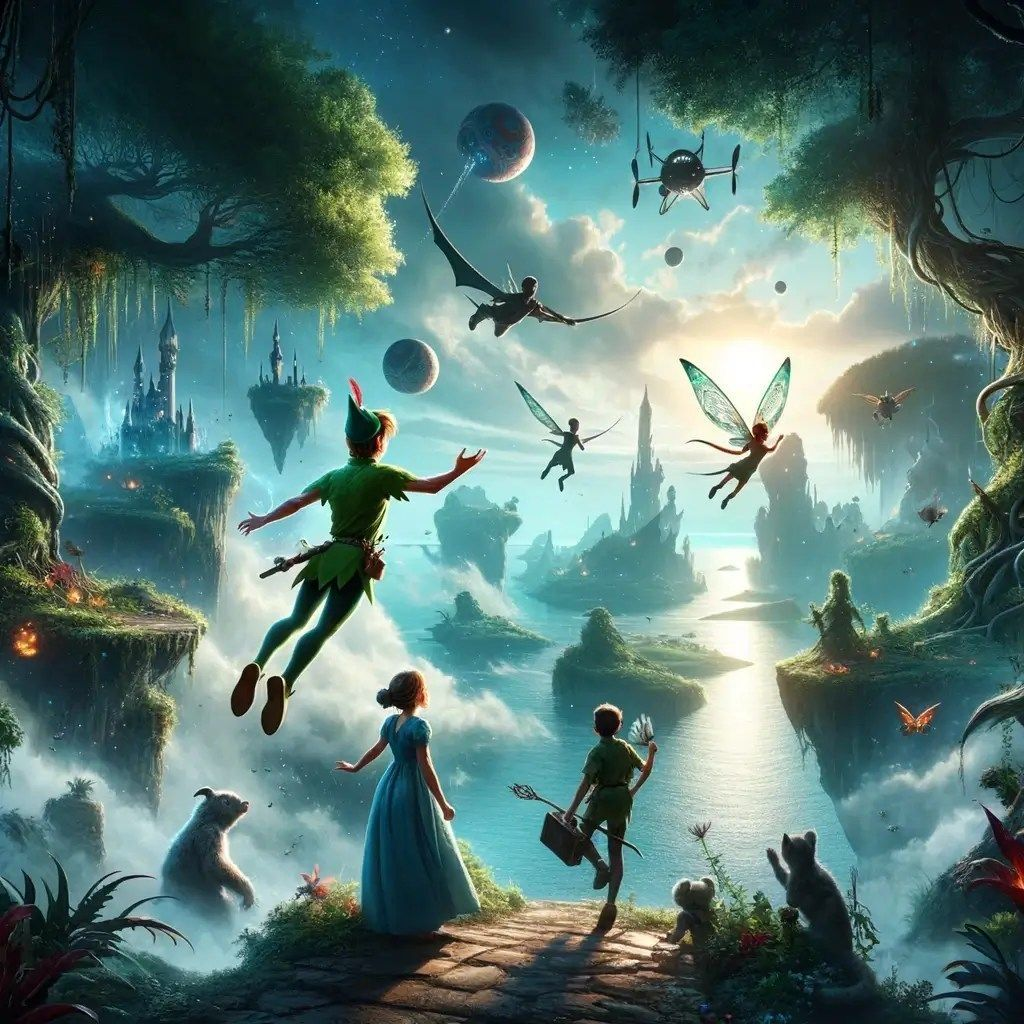
I’ll borrow life and not grow old;
And nightingales and trees
Shall keep me, though the veins be cold,
As young as Sophocles.
And when I may no longer live,
They’ll say, who knows the truth,
He gave whate’er he had to give
To Freedom and to Youth.
~William Corey, Master at Eton c. 1850-1870
Success achieved, he never stays
For only by never staying does he not depart.
~Dao Tzu, Dao De Jing.
From Now or Neverland, p. 156
In this third part, let’s revisit the inspiring book, Now or Neverland, which motivated me to write these articles.
Here’s a brief essay on Now or Neverland by Ann Yeoman:
Ann Yeoman’s book “Now or Neverland: Peter Pan and the Myth of Eternal Youth” analyses the enduring charm of J.M. Barrie’s story, emphasising its psychological and mythological elements. She interprets Neverland as a metaphor for humanity’s longing to escape time and mortality. Yeoman considers Peter Pan an archetype embodying wonder and the peril of avoiding growth.
She explains that Neverland represents the myth of eternal youth—a place where responsibilities cease. This dream enables Peter to evade adult challenges but also leads him to miss meaningful relationships and personal development. Her study suggests Barrie’s tale celebrates youth but also warns against escapism.
In “Now or Neverland,” Yeoman encourages reflection on individual perceptions of time, change, and maturation, transforming a children’s story into a profound meditation on memory, imagination, and ageing.

Yesterday, I attended a birthday party for a dear family member, where my grandchildren were also present. I hadn’t seen them in a long time due to my illness and hospital stay. As always, I was the only adult the kids enjoyed playing with, because they knew the child in me well. It reminded me of what Yeoman mentioned in her book:
…Paradoxically, whereas lightness, freedom and space may be the necessary conditions for play, play itself is far from light, in that it has the capacity to ground one in the wholeness of one’s being. In a discussion of the importance of play in childhood, Anthony Stevens cites Johan Huizinga’s claim, in Homo Ludens, his work on the subject of play, that “in play there is something ‘at play’ which transcends the immediate needs of life.” This is because the archetypal activities of human life are filled with possibilities for play. Notes Stevens:
Hence, Schiller’s famous aphorism, “Man is only truly himself when he is at play.”
… Childhood is a period of immense vitality and inventiveness, when imagination is given free rein to complement the realities or compensate for the deficiencies of everyday existence…
It is one of the misfortunes of growing up that we readily lose touch with this rich land of childhood … Yet nothing is lost to the Self, and play, like the child who sponsors it, lives on as a propensity of the psyche to its dying day. (250On Jung, pp. 87f.)
What is of particular interest in our discussion of Barrie is Stevens’s emphasis that fantasy, as introverted play,
is the product of play between the archetypes of the collective unconscious and the living circumstances of the individual. . . . Fantasy is not a regressive means of escape from reality . . . but the modus operandi of psychological growth: it is the stuff of life, leading us on into the future. (251 Ibid., pp. 88f.)
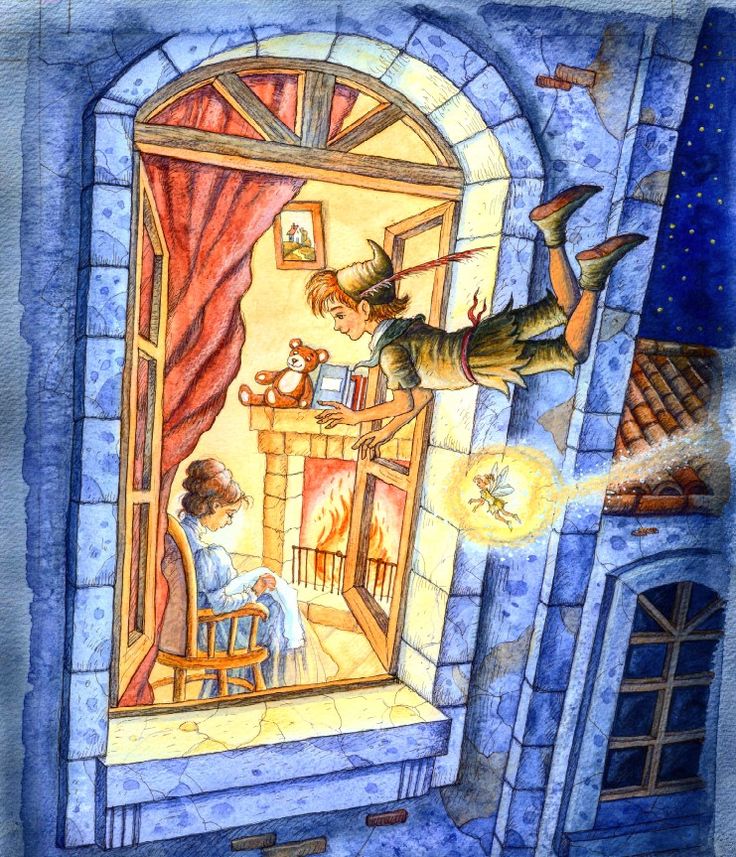
Play and fantasy lead us into the future because they make us creators. They legitimise our re-formation and re-creation of the world, allowing us to remember and so re-deem the scattered fragments of ordinary life. They make us gods for an hour or a day, enabling an activity which affirms our sense of Self because it affords unlimited scope to our desire for realisation, fulfilment and creative power in a world of our own making that is secret and therefore safe. The task of the artist is then to establish a vital connection between the hidden world of possibility and the world of actuality.
However, according to Winnicott, the “place” of play and fantasy is precarious, “because it belongs to the interplay in the . . . mind of that which is subjective (near-hallucination) and that which is objectively perceived (actual or shared reality).” (Playing and Reality, p. 61)
…This place is the No-man’s land, an intermediary realm of the imagination that the artist must continually interpret and re-interpret. Here, one might encounter the god-child, buried deep in the personality. The challenge for the writer, like Barrie, who feels more at home in the imaginal realm, is to interpret such experiences within the real world. But in Peter Pan, Barrie’s two worlds remain as opposed at the end as at the beginning, with no space in the Edwardian world for the richness found in Neverland. Ultimately, Barrie cannot show that reality offers room for self-fulfilment, unlike other children’s classics such as Grahame’s The Wind in the Willows or Milne’s Winnie-the-Pooh.

In Barrie, there’s an apparent devaluation of cosy domesticity and an iconoclastic streak visible in his work, especially in Peter Pan and other heroes resembling Peter’s mysterious presence. We find in Peter Pan the masculine energy of the trickster, a mythic figure known as a lawbreaker who embodies instinctual desires. (Barbara Greenfield, “The Archetypal Masculine,” in Andrew Samuels, ed., The Father, p. 192.)
The trickster often marks an early stage in the development of the heroic ego, reflecting nature’s transformative power while resisting change. Barrie’s hero also resists transformation, with little evidence of active sexuality or development beyond a boy-trickster to a mature hero or Wise Old Man. Instead, Peter Pan’s iconoclasm risks becoming an idol of boyish rebellion for its own sake.
(Ibid., p. 191. Greenfield argues that “The boy, Don Juan, and the trickster show us the ego in its early stages of development, while the hero, the father and the wise old man represent later stages of development. As a whole, the animus, or male archetype, unifies these disparate figures because it exists as those principles which underlie them all.” She suggests that the most powerful mythological forms of the masculine archetype are those of the father and the trickster, claiming the trickster as “an early incarnation of the father” rather than an archetype separate from that of the father, as it is treated by Jung. Her view supports our earlier discussion of the inherent similarities of Peter Pan and Hook and is useful when individual development and personal pathology are the issue. However, what we may describe as the “creative iconoclasm” of the Self in its impulse to further consciousness favours Jung’s treatment of the trickster and his recognition of its essential and constant role in the archetypal drama of the psyche. Perhaps this presents a case for “both/and” rather than “either/or” terminology; and for a concept of co-existing levels of activity rather than a more linear development from one stage to the next, with only faint traces of earlier characteristics evident in the later stages.)
Remember to cherish the child within you; thank you! 🙏


 lampmagician
You must be logged in to post a comment.