Regarding foresight, few individuals possess this ability, or perhaps it exists in everyone, yet most fail to recognise it. I knew some of my relatives, and one of my aunts had mastered it. She had seen ghosts in her large, old house, conversed with them, and could perceive events (in dreams) before they occurred. My brother Al also possessed such a gift, particularly in the final years of his life when he underwent surgery on his head to remove a tumour. I do not know if it is a gift, a curse, or a blessing; nonetheless, I would treasure that.
I, myself, have a small example: I had a dream in which one of my customers, an elderly woman I had driven to the doctor for many years but could no longer assist because she needed special transport, urgently called me to ask if I could pick her up and take her to her doctor. I wondered why I had dreamt of her after all this time. Two days after my dream, while driving a guest from her neighbourhood, she told me she recognised me as the person who had driven her friend from next door for a long time and asked if I knew she had passed away. I said no and asked when it had happened. She replied it was the night before last, the same night I had dreamt of her!
Dream analysis stands or falls with [the hypothesis of the unconscious]. Without it, the dream appears to be merely a freak of nature, a meaningless conglomerate of memory fragments left over from the day’s happenings.
~Carl Jung
“Modern Man in Search of a Soul”, p.2, Psychology Press
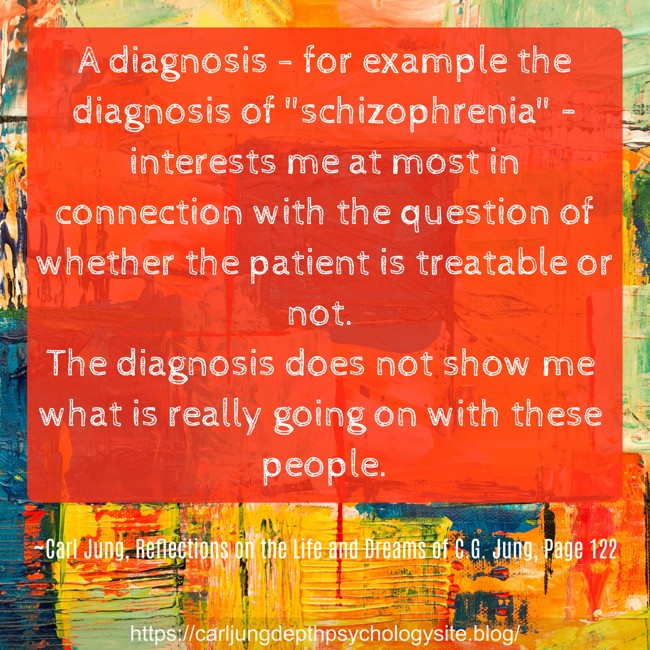
Now, let us read about one of the great minds in this field: Carl Gustav Jung. He was among the most sensitive and intuitive visionaries of all time. Here, he talks about his dreams, odd and extraordinary dreams. Once, he was even afraid that he had schizophrenia.
<Although it is from The Red Book, which everyone might have or may have even read, I believe many still do not notice the fineness in the “Introduction” at the beginning of the book, as I find it fascinating.>
From Carl Jung’s “The Red Book, Liber Novus: A Reader’s Edition,” by Sonu Shamdasani. (Introduction)
In 1912, Jung had some significant dreams that he did not understand. He gave particular importance to two of these, which, as he felt, showed the limitations of Freud’s conceptions of dreams. The first follows:
I was in a southern town, on a rising street with narrow half-landings. It was twelve o’clock midday–bright sunshine. An old Austrian customs guard or someone similar passes by me, lost in thought. Someone says, “That is one who cannot die. He died already 30 – 40 years ago but has not yet managed to decompose.”
I was very surprised. Here, a striking figure came, a knight of powerful build clad in yellowish armour. He looks solid and inscrutable, and nothing impresses him. On his back, he carries a red Maltese cross. He has continued to exist since the 12th century, and he takes the same route daily between 12 and 1 o’clock midday. No one marvelled at these two apparitions, but I was extremely surprised.
I hold back my interpretive skills. As regards the old Austrian, Freud occurred to me; as regards the knight, I myself.
Inside, a voice calls, “It is all empty and disgusting.” I must bear it. (Black Book 2, pp. 25-26)
Jung found this dream oppressive and bewildering, and Freud was unable to interpret it.
(In 1925, he gave the following interpretation to this dream: “The meaning of the dream lies in the principle of the ancestral figure: not the Austrian officer – obviously he stood for the Freudian theory – but the other, the Crusader, is an archetypal figure, a Christian symbol living for the twelfth century, a symbol that does not really live today, but on the other hand in not wholly dead either. It comes out of the time of Meister Eckhart, the time of the culture of the Knights, when many ideas blossomed, only to be killed again, but they are coming to life again now. However, when I had this dream, I did not know this interpretation” (Introduction to Jungian Psychology, p. 42).
Around half a year later, Jung had another dream:
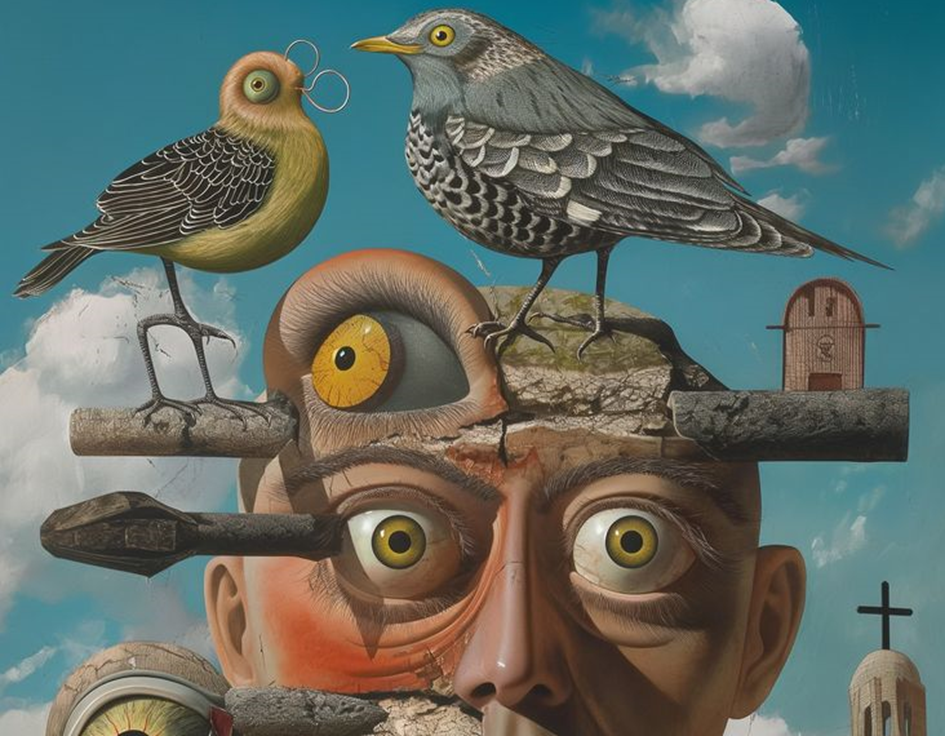
I dreamt at that time (it was shortly after Christmas 1912) that I was sitting with my children in a marvellous and richly furnished castle apartment – an open columned hall – we were sitting at a round table, whose top was a marvellous dark green stone. Suddenly, a gull or a dove flew in and sprang lightly onto the table. I admonished the children to be quiet so they would not scare away the beautiful white bird. Suddenly, this bird turned into a child of eight years, a small blond child, and ran around playing with my children in the marvellous columned colonnades. Then, the child suddenly turned into the gull or dove. She said the following to me: “Only in the first hour of the night can I become human while the male dove is busy with the twelve dead.” With these words, the bird flew away, and I awoke. (Black Book 2, pp. 17-18)
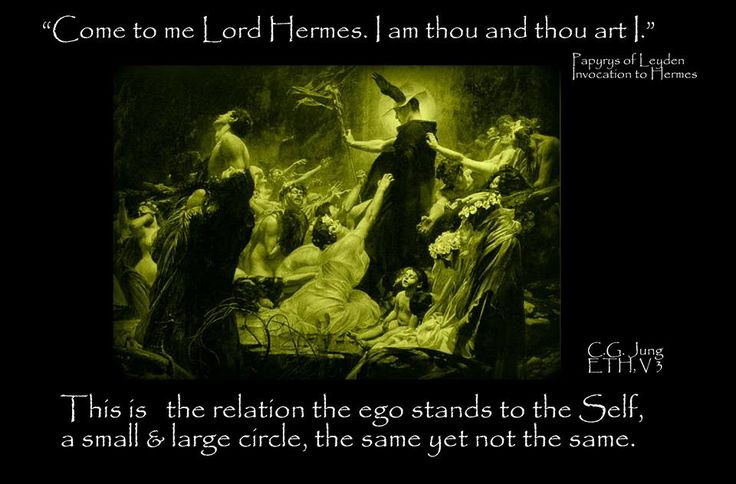
In Black Book 2, Jung noted that it was this dream that made him decide to embark on a relationship with a woman he had met three years earlier (Toni Wolff, Ibid., p. 17). In 1925, he remarked that this dream “was the beginning of a conviction that the unconscious did not consist of inert material only, but that there was something living down there (Introduction to Jungian Psychology, p. 42). He added that he thought of the story of the Tabula Smaragdina (emerald tablet), the twelve apostles, the signs of the Zodiac, and so on, but that he “could make nothing out of the dream except that there was a tremendous animation of the unconscious. I knew no technique for getting to the bottom of this activity; all I could do was just wait, keep on living, and watch the fantasies.”
I include this footnote to highlight his insatiable greed and relentless pursuit to decipher the meaning behind his dream and how he developed the interpretation.
Ibid., pp. 40-41. E. A. Benner noted Jung’s comments on this dream: “At first, he thought ‘twelve dead men’ referred to the twelve days before Christmas, for that is the dark time of the year, when traditionally witches are about. To say ‘before Christmas’ is to say before the sun lives again, for Christmas day is at the turning point of the year when the sun’s birth was celebrated in the Mithraic religion… Only much later did he relate the dream to Hermes and the twelve doves” (Meeting with Jung: Conversations recorded by E.A. Brenner during the years 1946-1961 [London: Anchor Press,1982; Zürich, Daimon Verlag, 1985], p. 93). In 1951, in “The Psychological Aspects of the Kore”, Jung presented some material from Liber Novus (describing them all as part of a dream series) in an anonymous form (“case Z.”), tracing the transformations of the anima. He noted that this dream “shows the anima as a elflike, i.e., only partially human. She can just as well be a bird, which means that she may belong wholly to nature and can vanish (i.e., become unconscious) from the human sphere (i.e., consciousness)” (CW9, I, § 371). See also Memories, pp. 195-96.
These dreams led him to analyse his childhood memories, but this did not resolve anything. He realised that he needed to recover the emotional tone of childhood. He recalled that as a child, he used to like to build houses and other structures, and he took this up again.
While he was engaged in this self-analytic activity, he continued to develop his theoretical work. At the Munich Psycho-Analytical Congress in September 1913, he spoke on psychological types. He argued that there were two basic movements of the libido: extraversion, in which the subject’s interest was oriented towards the outer world, and introversion, in which the subject’s interest was directed inward. Following from this, he posited two types of people, characterised by the predominance of one of these tendencies. The psychologies of Freud and Adler were examples of the fact that psychologies often took what was true of their type as generally valid. Hence, what was required was a psychology that did justice to both of these types (“On the question of psychological types,” CW 6).
Although this captivating story continues, I will share it in parts to facilitate understanding and enjoyment. Thank you for taking the time to read!
PS: In case someone interested, I will try to write about my new condition in a separate post. 🙏💖









 lampmagician

You must be logged in to post a comment.