

Hello, dear friends! It has been a long time since I last shared my translation of Freud’s The Interpretation of Dreams. Of course, most of you know that my stay—or, more accurately, my residence—in the hospital hindered my progress. To put it bluntly, I had to gather my thoughts and reflect on where I was and how far the term had gone! In any case, that’s life, and I had to leave my laziness behind to dare to start anew. So, let’s do a quick review:
In the previous post, Freud discussed how dreams take on a characteristic form—or, as Jung describes it, symbols.
By studying these characteristics, he believed we could better understand the unconscious mind and the hidden meanings of our dreams.
I often forget my dreams, and I believe they are important doors to a world we have forgotten! So we must keep them in mind and try to understand them.
Here are a few example explanations, in order:
- Disregard for Logic and Reality: Dreams often ignore the rules of logic and the constraints of the real world. Impossible or contradictory things in waking life can happen easily in dreams.
- Condensation and Displacement: Freud notes that dreams often condense multiple ideas or images into a single symbol (condensation) and shift emotional significance from important things to seemingly trivial ones (displacement).
- Visual and Sensory Elements: Dreams are primarily visual and sensory, rather than verbal or rational. They play out as vivid scenes or images rather than logical arguments.
- Lack of Critical Judgment: In dreams, our critical thinking is reduced. We rarely question the strangeness or impossibility of what we experience while dreaming.
- Emotional Intensity: Dreams can evoke strong emotions, sometimes more intense than those we feel when awake.
- Memory Distortions: Dreams often use fragments of recent memories, but they rearrange and transform them in unexpected ways.
However, I will keep my right to ask whether we really know what reality is and what isn’t, and, as we know, our imagination is vast; we may try to understand its origins. In imagination, there is no place for logic—or, better to say, it has its own logic!
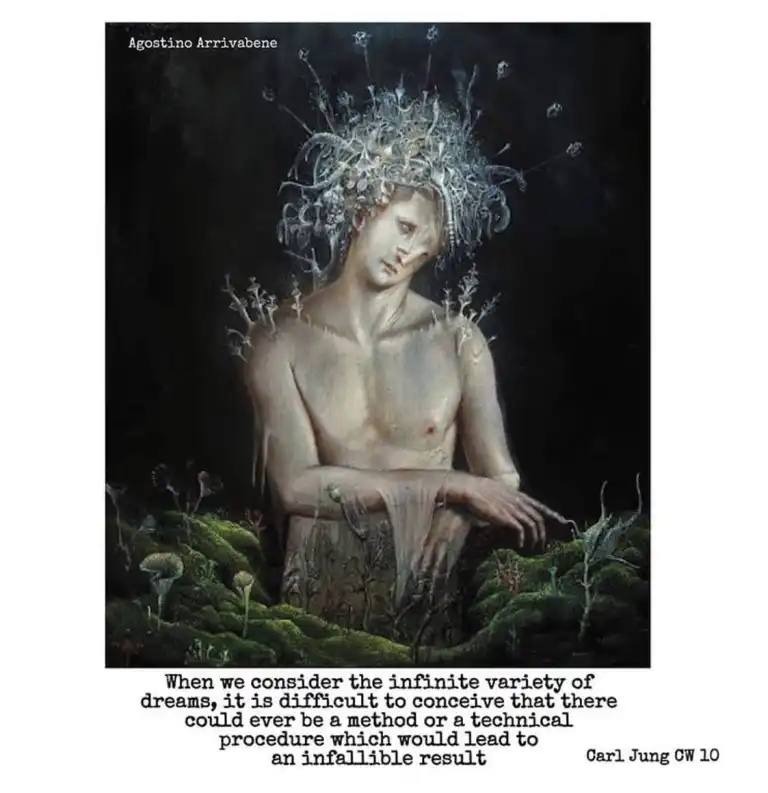
The title image: a surrealist homage to René Magritte
The psychological characteristics of dreams (Die psychologischen Besonderheiten des Traumes)
Now, let’s carry on!
If withdrawal from the outside world is thus elevated to the decisive factor in shaping the most striking characteristics of dream life, it is worth citing a few astute observations by the elder Burdach, which shed light on the relationship between the sleeping soul and the outside world and serve as a caution against overestimating the deductions presented above. “Sleep occurs only on the condition,” says Burdach, “that the soul is not stimulated by sensory stimuli… yet it is not so much the absence of sensory stimuli that is the condition for sleep, but rather the lack of interest in them; indeed, certain sensory impressions are themselves necessary insofar as they serve to calm the soul—just as the miller sleeps only when he hears the clattering of his mill, and the person who deems it necessary to keep a nightlight burning for safety’s sake cannot fall asleep in the dark.” (p. 457.)
“During sleep, the soul isolates itself from the outside world and withdraws from the periphery… Yet the connection is not entirely broken: if one were to hear and feel not during sleep itself but only after waking, it would be impossible to wake up at all. The persistence of sensation is further evidenced by the fact that one is awakened not always by the mere sensory intensity of an impression, but by its psychological significance; an indifferent word does not rouse the sleeper, yet if he is called by name, he wakes… thus, the soul distinguishes between sensations during sleep. … Consequently, one can also be awakened by the absence of a sensory stimulus—provided it relates to something significant for one’s mental representation; thus, one wakes when a nightlight goes out, and a miller wakes when his mill stops—that is, upon the cessation of sensory activity—which presupposes that this activity had been perceived but, being indifferent or rather satisfying, had not disturbed the soul.”
(p. 460 et seq.)
Even if we choose to set aside these objections—which are by no means insignificant—we must still admit that the characteristics of dream life considered thus far (derived from withdrawal from the outside world) fail to fully account for its alien nature. Otherwise, it would be possible to transform dream hallucinations back into mental images and dream situations back into thoughts, thereby solving the problem of dream interpretation. Yet this is precisely the procedure we follow when reproducing a dream from memory after waking; and whether this retranslation succeeds fully or only in part, the dream retains its enigmatic quality undiminished.
The authors also assume, without hesitation, that dreams bring other, more profound changes to the ideational material of waking life. Strümpell singles out one of these in the following discussion (p. 17): “With the cessation of active sensory perception and normal waking consciousness, the soul also loses the foundation in which its feelings, desires, interests, and actions are rooted. Even those mental states, feelings, interests, and valuations that attach to memory-images during waking life are subject… to an obscuring pressure, as a result of which their connection with the images dissolves; the perceptual images of things, persons, locations, events, and actions from waking life are reproduced individually in great numbers, yet none of them carries its psychic value with it. This value has become detached from them, and they therefore drift about within the soul according to their own devices…”
According to Strümpell, this stripping away of images’ psychological value—a process itself attributable to turning away from the external world—plays a major part in the impression of strangeness with which the dream, in our memory, stands in contrast to waking life.
We have already heard that the very act of falling asleep entails relinquishing one of our mental activities: namely, the voluntary direction of the train of thought. This naturally leads to the surmise that the state of sleep might extend to other mental functions as well. Some of these functions may be completely suspended; the question now arises whether the remaining ones continue to operate undisturbed, and whether they can perform normal work under such conditions. The view holds that the peculiarities of dreams can be explained by a state of diminished mental functioning during sleep—an interpretation supported by the impression dreams leave on our waking judgment. Dreams are incoherent; they combine the most glaring contradictions without a second thought, admit impossibilities, disregard the knowledge that guides us by day, and reveal us as ethically and morally obtuse. Anyone behaving in waking life as a dream does in its scenarios would be considered insane; anyone speaking or attempting to convey the kind of content found in dreams while awake would strike us as deranged or feeble-minded. Thus, we believe we are merely describing the facts when we rate mental activity during sleep as very low, declaring higher intellectual functions to be suspended—or at least severely impaired—during the dream state.
With unusual unanimity—exceptions will be discussed elsewhere—authors have reached conclusions about dreams that point directly towards a specific theory or explanation of dream life. It is time for me to supplement the summary I have just offered by presenting a collection of statements from various authors—philosophers and physicians—regarding the psychological characteristics of dreams. According to Lemoine, the incoherence of dream imagery is the only essential characteristic of a dream.
Maury concurs; he states (Le sommeil, p. 163): “There are no dreams that are entirely rational; every dream contains some degree of incoherence, some anachronism, or some absurdity.” (Il n’y a pas des rêves absolument raisonnables et qui ne contiennent quelque incohérence, quelque anachronisme, quelque absurdité.)
According to Hegel, as cited by Spitta, dreams lack any objective, intelligible coherence.
Dugas says: “The dream is psychic, affective, and mental anarchy; it is the game of functions delivered to themselves and exercised without control or purpose; in the dream, the mind is a spiritual automaton.” (Le rêve, c’est l’anarchie psychique, affective et mentale, c’est le jeu des fonctions livrées à elles-mêmes et s’exerçant sans contrôle et sans but; dans le rêve l’esprit est un automate spirituel.)
Even Volkelt (p. 14) acknowledges the “loosening, dissolution, and jumble of the mental life held together in waking by the logical force of the central ego,” according to whose theory psychic activity during sleep is by no means pointless.
The absurdity of the mental associations found in dreams can hardly be condemned more sharply than Cicero (De divin. II) already did: “Nothing can be conceived so praepostere, so incondite, so monstruose cogitari potest, quod non possimus somniare.”
Fechner says (p. 522): “It is as if psychological activity had migrated from the brain of a rational person to that of a fool.”
Radestock (p. 145): “Indeed, it seems impossible to discern any fixed laws in this madcap activity. Escaping the strict control of reason, the will guiding the waking course of ideas, and attention, the dream, in a madcap game, whirls everything around in a kaleidoscopic jumble.”
Hildebrand (p. 45): “What strange leaps the dreamer takes—for instance, in his logical deductions! With what nonchalance he views the most well-established empirical truths being turned completely on their heads! What ridiculous contradictions in the order of nature or society can he tolerate—before, as the saying goes, things become too absurd, and the sheer excess of nonsense triggers an awakening! We might, quite innocently, perform a calculation: three times three equals twenty; we are not in the least surprised that a dog recites a verse to us, that a dead person walks to his own grave on his own two feet, or that a rock floats on water; we might, in all seriousness and acting under official orders, travel to the Duchy of Bernburg or the Principality of Liechtenstein to observe the nation’s navy, or allow ourselves to be recruited as volunteers by Charles XII shortly before the Battle of Poltava.”
Binz (p. 33) points to a theory of dreams that emerges from these impressions: “Out of every ten dreams, at least nine contain absurd material.
In them, we link together people and objects that have not the slightest connection to one another. The very next moment—much like in a kaleidoscope—the arrangement shifts into something else, perhaps even more nonsensical and bizarre than it was before; and so, this ever-changing play of the imperfectly sleeping brain continues until we wake, reach up to touch our foreheads, and ask ourselves whether we are, in fact, still capable of rational thought and reasoning.”
Maury (Le sommeil, p. 50) offers a comparison—one particularly striking to a physician—regarding the relationship between dream imagery and waking thoughts: “The production of these images—which, in a waking person, is most often prompted by the will—corresponds, in terms of intellect, to the way certain movements seen in cases of chorea or paralytic conditions relate to voluntary motor function… (La production de ces images, chez l’homme éveillé, fait le plus souvent naître la
volonté, correspond, pour l’intelligence, à ce que sont, pour la motilité, certains mouvements que nous offrent la chorée et les affections paralytiques …) ” Furthermore, he characterises the dream as “an entire series of degradations of the faculty of thought and reason” (p. 27).
To be continued!
Thanks—I truly appreciate your interest. 🥰🙏

