

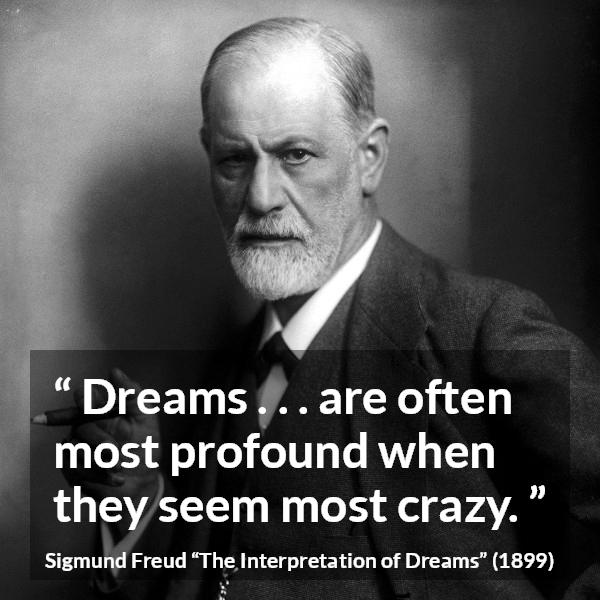
Sigmund Freud believed that memories and dreams are deeply interconnected. According to Freud, dreams are not random or meaningless; rather, they express unconscious desires, fears, and—most importantly—memories. He argued that many dreams are constructed from fragments of past experiences, some of which may be long forgotten or repressed.
Freud introduced the concept of “day residues”, in which events and thoughts from the previous day often appear in dreams, intermingled with older memories from childhood or earlier life. He believed that dreams serve as a way for the unconscious mind to process unresolved conflicts, using both recent and distant memories as material. These memories may be disguised, condensed, or symbolically represented in the dream, making their true meaning difficult to recognise without analysis.
One of Freud’s key ideas was that repressed memories—those which are too painful or unacceptable to face consciously—often find their way into dreams. Through the process of “dream work,” the mind transforms these latent memories into the strange and sometimes confusing images we remember upon waking. By analysing dreams, Freud believed we could uncover hidden memories and gain insight into our deepest desires and anxieties.
In summary, Freud saw dreams as a window into the unconscious, built from layers of memories both recent and distant. For him, exploring the connection between memories and dreams was essential for understanding the human mind and the hidden forces that shape our thoughts and behaviours.
Now, following parts one & two, let’s proceed to the next chapter of his book, Dream Interpretation. I divided this chapter due to its length!
The Material of Dreams—Memory in the Dream (Das Traummaterial – Das Gedächtnis im Traum)
That all the material comprising the content of a dream derives in some way from lived experience—that is, that it is reproduced or recalled within the dream—may be accepted, at the very least, as an indisputable fact. Yet it would be an error to assume that such a connection between the dream content and waking life must emerge effortlessly as an immediately obvious result of comparison. Rather, this connection must be sought out with close attention, and in a considerable number of cases, it manages to remain concealed for a long time. The reason for this lies in several peculiarities exhibited by the faculty of memory during dreaming—peculiarities which, though widely noted, have hitherto eluded all explanation. It will be well worth the effort to examine these characteristics in detail.
It happens, in the first place, that the content of a dream features material that, upon waking, one does not recognise as belonging to one’s own knowledge or experience. One may well recall having dreamt the specific item in question, but cannot recall when one actually experienced it. One thus remains in the dark about the source from which the dream drew its material—and is indeed tempted to believe in an independently creative activity on the part of the dream—until, often after a long interval, a new experience restores the lost memory of the earlier event, thereby revealing the dream’s true source. One is then compelled to concede that, in the dream, one possessed knowledge of—and was reminded of—something that had been inaccessible to one’s powers of recollection while awake.
Delboeuf recounts a particularly striking example of this kind, drawn from his own dream experience. In his dream, he saw the courtyard of his house covered in snow; there, he discovered two small lizards—half-frozen and buried beneath the snow—which, being an animal lover, he took in, warmed, and returned to the small niche in the masonry intended for them. Furthermore, he tucked in a few fronds of a small fern growing on the wall—a plant he knew they were very fond of. In the dream, he knew the plant’s name: Asplenium ruta-murale. The dream then continued; after a brief interlude, it returned to the lizards and—to Delboeuf’s astonishment—revealed two new little creatures feasting upon the remnants of the fern. He then turned his gaze towards the open field and saw a fifth, then a sixth lizard, making their way towards the hole in the wall; eventually, the entire street was covered by a procession of lizards, all moving in the same direction, and so on.
In his waking life, Delboeuf’s botanical knowledge encompassed only a few Latin plant names and did not include any familiarity with the genus Asplenium. To his great astonishment, he subsequently verified that a fern of this very name does, in fact, exist.
Asplenium ruta muraria was its correct designation—a name the dream had slightly distorted. One could hardly attribute this to mere coincidence; yet it remained a mystery to Delboeuf how he had acquired knowledge of the name “Asplenium” in his dream.
The dream had occurred in 1862; sixteen years later, while visiting a friend, the philosopher spotted a small album of dried flowers—the kind sold to travellers as souvenirs in certain regions of Switzerland. A memory stirred within him; he opened the herbarium, found the Asplenium from his dream inside it, and recognised his own handwriting in the accompanying Latin names.
The connection could now be established. A sister of this friend had visited Delboeuf in 1860—two years before the lizard dream—while on her honeymoon. At the time, she had with her this album intended for her brother, and Delboeuf had taken the trouble to write out the Latin name beneath each of the dried plants, dictating them from a botanist.
The favour of chance—which renders this example so eminently worth recounting—allowed Delboeuf to trace yet another element of this dream’s content to its forgotten source. One day in 1877, an old volume of an illustrated magazine fell into his hands, and he saw the entire procession of lizards depicted exactly as he had dreamed it in 1862. The volume bore the date 1861, and Delboeuf recalled that he had been a subscriber to the magazine since its inception.
To be continued! 💖🙏


‘According to Freud, dreams are not random or meaningless…’. That is, as you no better than me. Again, you are magic. All the best, Mike
LikeLiked by 2 people
You are my best teacher, as I just believe it; thank you! Always yours, Aladin.
LikeLike
Dreams are endlessly fascinating to me, Magician. Although I prefer hearing about the dreams of other people, rather than my own. Mine are… well let’s just say that a weird, bizarre dream is about as close to good as mine get. They’re more often awful and I consider myself lucky when I don’t remember them. Regardless, wishing you happy dreams each night. Hugs.
LikeLiked by 1 person
PS: That image/painting is a perfect illustration. It’s splendid.
LikeLiked by 2 people
Thanks! I recognise you as an expert, and you’ve truly made my day! ☺️💖
LikeLiked by 1 person
You are far too kind, Aladin. I blush. 😊
LikeLiked by 1 person
It’s totally true. 🥰👍🌹❤️
LikeLike
Dear Teagan, there is a reason for every dream, and yours, even if they sound awful or bizarre, says something about your unconscious. I would recommend writing them down; you will understand them one day. However, thank you a bunch for stopping by and for writing such a kind and inspiring comment. Sending warm hugs.🫂💖🙏
LikeLiked by 1 person
Oh, I understand them… LOL, I wish I didn’t. 🙈🙉🙊
LikeLiked by 1 person
No fear, dear! They come from your repressed unknown corner of your soul. 🤗❤️❤️🫂
LikeLike
This is a fascinating post, thank you Aladin!
Of course it has brought some dreams to mind, some I have made connections to, some not.
I look forward to the last part. and maybe I will have … a revelation … something more insightful to say.
🤗❦🌹❦🤗
LikeLiked by 1 person
We will all reveal, for sure, lovely friend. I find Freud so fascinating because his focus is fundamental, and it’s helpful to understand where it all started.
Thank you, as always, for your inspiration, my dear friend.
🥰💖🙏🙏🫂
LikeLiked by 1 person
Thank you for all you fabulous posts, dear Aladin!
🥰💖xo🥰💖
LikeLiked by 1 person
Wonderful! Sorry I missed this extra post from last Saturday!
LikeLiked by 1 person
No need to apologize, dear friend. Your kindness is always valued, regardless of the timing. 🙏
LikeLiked by 1 person
I appreciate that!
LikeLiked by 1 person