Jiddu Krishnamurti: The Philosopher Who Rejected Authority

Standard

I think it’s time to set aside our current critical perspective on life for a moment and take a deeper look. Jiddu Krishnamurti can gently guide us and help us see things anew.

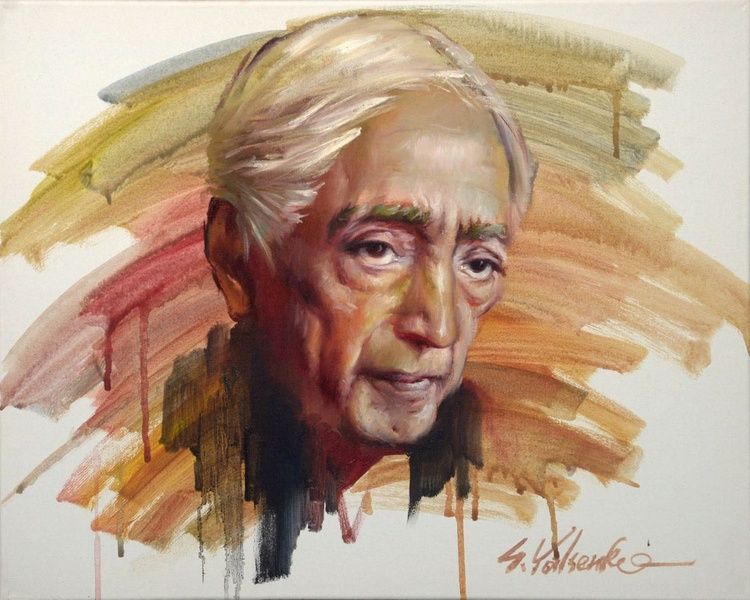
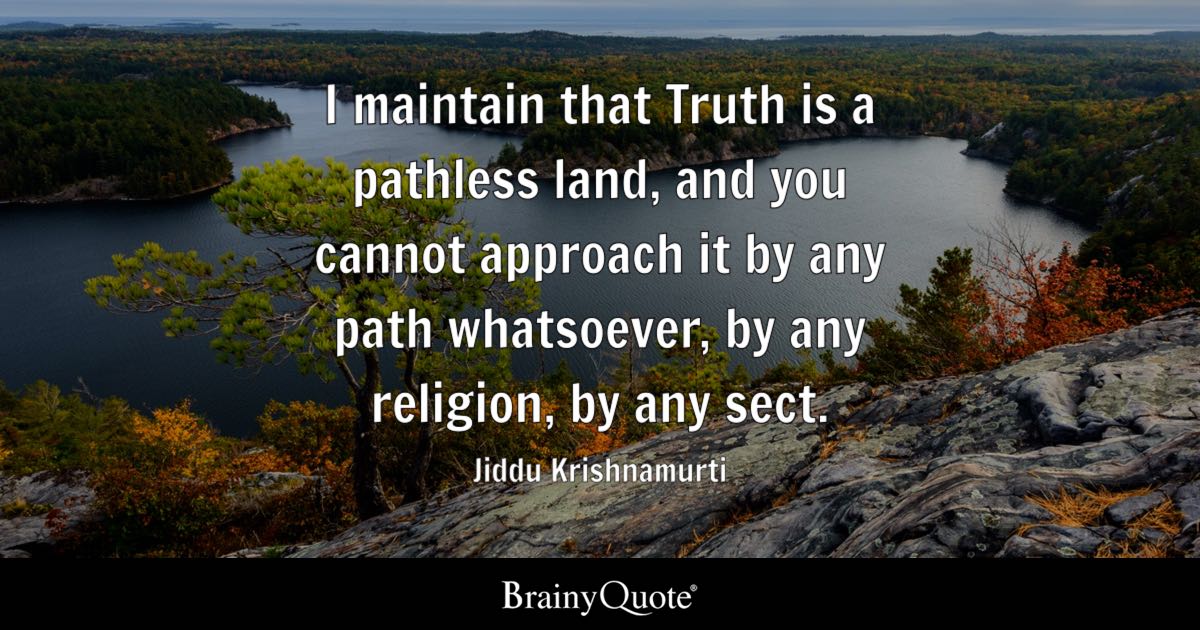
Jiddu Krishnamurti (1895-1986) was a prominent spiritual teacher and philosopher, famous for his rejection of organised religion, gurus, and spiritual authorities, including his own. Born in colonial India, his life changed when members of the Theosophical Society recognised him as the expected “World Teacher.” In 1929, at age 34, he disbanded his organisation, stating that “truth is a pathless land” and no belief system ensures understanding. Over more than sixty years, Krishnamurti travelled globally, giving talks on the mind, consciousness, and suffering. His teachings emphasised direct observation and awareness, urging questioning of authority to achieve psychological freedom. He believed that the separation between the observer and the observed causes conflict. He encouraged living without fear, exploring love and relationships, and transforming consciousness. His legacy includes books, talks, and schools, inspiring individuals to seek truth from within rather than externally.
Jiddu Krishnamurti’s Parables and Poems

Jiddu Krishnamurti’s parables and poems are central to his teachings, offering glimpses of truth through imagery and metaphor rather than through direct argument. These works appeal to intuition and feeling, promoting immediate perception, often inspired by nature—such as a flower blooming or a bird flying—while highlighting his core idea that truth is perceived directly rather than through thought or belief. They do not explain but point, creating space for sudden insights beyond words. His poems share this sense of immediacy; they are simple, unembellished, emerging from attentive presence—watching, listening, and being aware. Their language is calm, observing without a separate observer, often dissolving the boundary between seer and seen, reflecting his teaching that authentic perception occurs only when the self is absent. These works are essential because they echo his main message: transformation arises through direct insight, not through knowledge. Instead of enriching conceptual understanding, they invite us to set aside concepts, to observe, listen, and remain present without interpretation. His literary works might be his most genuine expression—offering not solutions but gateways to experience.

Once upon a time, when there was great understanding and in a world full of rejoicing, there lived a gentlewoman full of years. One day, she found herself in a temple before an altar made by human hands. She was crying bitterly to heaven, and none was there to comfort her, till in the long last, a friend of God took notice of her and asked the reason for her tears. “God must have forgotten me. My husband is gracious and well. My children are full and strong. Many servants are there to care for us. All things are well with me, and mine own. God has forgotten us.” The friend of God replied, “God never forgets His children.” When she came home, she found her son dead. She
never cried. “God remembers me and mine own.”
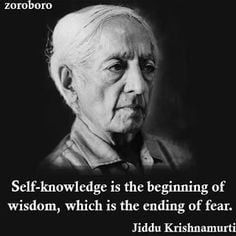
Every step we take in life lays the foundation for the experiences we gather. Krishnamurti soon recognised these and attempted to share his experience with us.
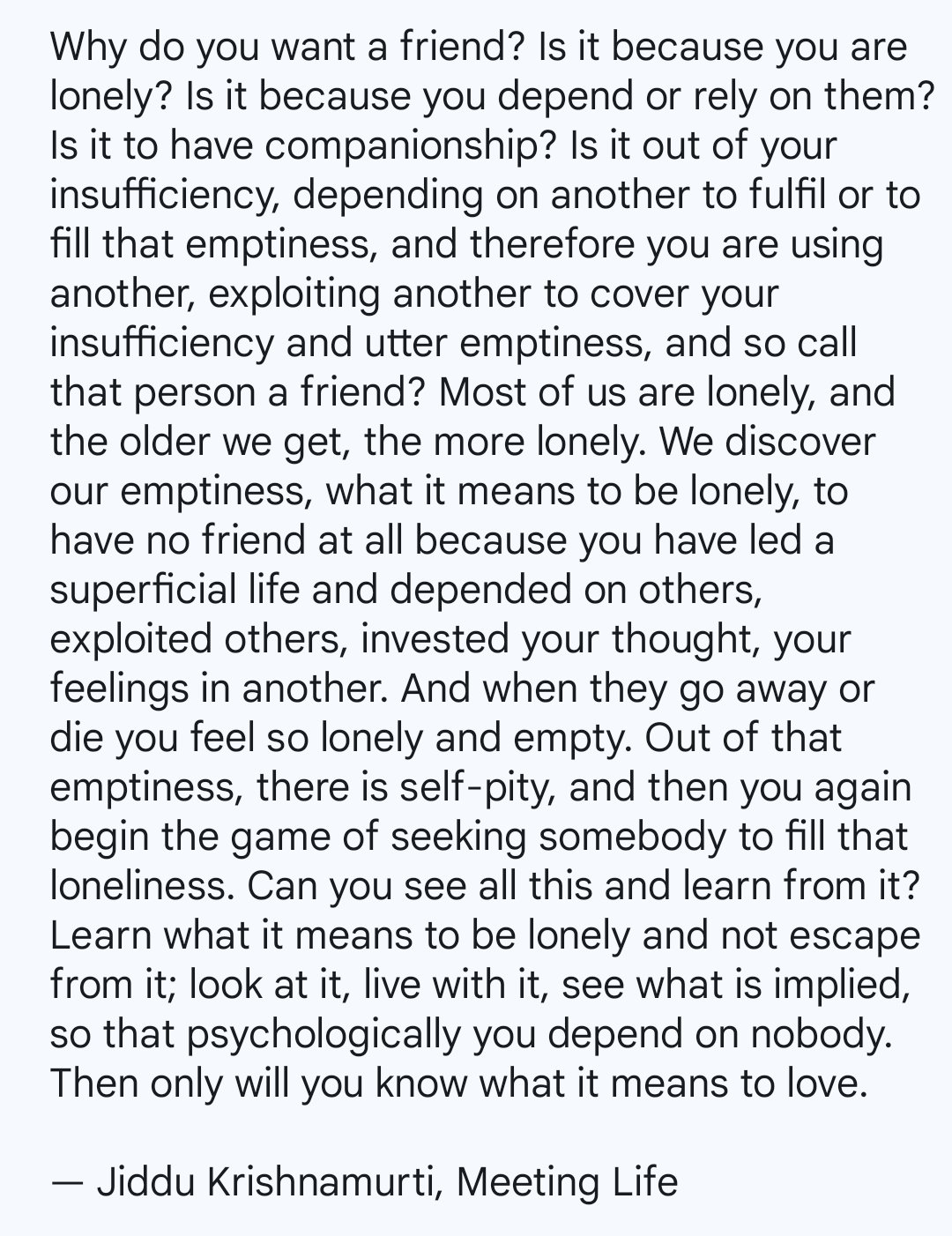
A HYMN

I have stood in Thy holy presence. I have seen the splendour of Thy face. I prostrate at Thy sacred feet. I kiss the hem of Thy garment, I have felt the glory of Thy beauty. I have seen Thy serene look.
Thy wisdom has opened my closed eyes. Thine eternal peace has transfigured me.
Thy tenderness, the tenderness of a mother to her child,
The teacher to his pupil, I have felt.
Thy compassion for all things, living and non-living, the animate and inanimate, I have felt.
Thy joy, indescribable, has thrilled me.
Thy voice has opened in me many voices.
Thy touch has awakened my heart. Thine eyes have opened mine eyes.
Thy glory has kindled the glory in me.
Master of Masters, I have longed, yea, yearned for this happy hour, when I should stand in Thy holy presence.
At last, it has been granted unto me.

I am happy. I am peaceful, peaceful as the bottom of a deep, blue lake. I am calm, calm as the snow-clad mountain-top above the storm clouds.
I have longed for this hour; it has come.
I shall follow humbly in Thy footsteps along that path
which Thy holy feet have trodden. I shall humbly serve the world, the world for which
Thou hast suffered, sacrificed and toiled. I shall bring that peace into the world. I have longed for this happy hour; it has come.

Thine image is in mine heart.
Thy compassion is burning in me.
Thy wisdom guides me.
Thy peace enlightens me.
Thy tenderness has given me the power to sacrifice.
Thy love has given me energy.
Thy glory pervades my entire being.

I have yearned for this hour; it has come, in all the
splendour of a glorious spring. I am as young as the youngest. I am as old as the oldest.
I am happy as a blind lover, for I have found my love. I have seen.
I can never be blind, though a thousand years pass. I have seen Thy divine face everywhere, in the stone, in the blade of grass, in the giant pines of the forest,
in the reptile, in the Hon, in the criminal, in the saint. I have longed for this magnificent moment; it came and

I have grasped it.
I have stood in Thy presence.
I have seen the splendour of Thy face.
I prostrate at Thy sacred feet.
I kiss the hem of Thy garment.


Thanks a lot for visiting and for your time in reading! 🙏💖🙏
Keep Quiet, and Listen; Silence Speaks!

Standard

Last night
I begged the Wise One to tell me
the secret of the world.
Gently, gently, he whispered,
“Be quiet,
the secret cannot be spoken,
It is wrapped in silence.”

Rumi

I wonder if any of you, my dear friends, have noticed how this hurried pace of life is affecting us globally, with people rushing unconsciously, often unaware of their surroundings or the noise around them. It seems time is passing faster than it used to, and this perception isn’t related to age, contrary to some beliefs. In both modern and traditional contexts, we often overlook an essential aspect: silence. I particularly notice this when I step into the forest, pause, and listen quietly.

Silence holds significant value that is often overlooked in our noisy world. It creates a space for reflection, helping us process our thoughts and emotions without external distractions. During quiet moments, creativity can flourish, fostering deeper thinking and the development of new ideas. Additionally, silence can foster a sense of peace and calm. In a hectic environment, pausing to embrace silence can refresh the mind and spirit, ease stress, and sharpen decision-making. In conversations, silence can be powerful, as listening is a sign of intelligence. It enables thoughtful responses and promotes meaningful dialogue. By embracing silence, we can enhance our listening skills and better understand others. Ultimately, silence’s value is in its ability to connect us with ourselves and others, encouraging introspection and stronger relationships. Whether through meditation, nature, or solitude, embracing silence can enrich our lives in many ways.

After sharing a quote from Rumi, I would like to offer a poem by Pablo Neruda. I hope you enjoy them and might relish a moment of silence to cherish.

Keeping Quiet
By Pablo Neruda


Trans. Alastair Reid

Now we will count to twelve
And we will all keep still
for once on the face of the earth,
let’s not speak in any language;
let’s stop for a second,
and not move our arms so much.

It would be an exotic moment
without rush, without engines;
We would all be together
in a sudden strangeness.

Fishermen in the cold sea
would not harm whales
and the man gathering salt
would not look at his hurt hands.

Those who prepare for green wars,
wars with gas, wars with fire,
victories with no survivors,
would put on clean clothes
and walk about with their brothers
in the shade, doing nothing.

What I want should not be confused
with total inactivity.
Life is what it is about.
I want no truck with death.

If we were not so single-minded
about keeping our lives moving,
and for once could do nothing,
perhaps a huge silence
might interrupt this sadness
of never understanding ourselves
and of threatening ourselves
with death.
Perhaps the earth can teach us,
as when everything seems dead
and later proves to be alive.

Now I’ll count up to twelve.
And you keep quiet, and I will go.

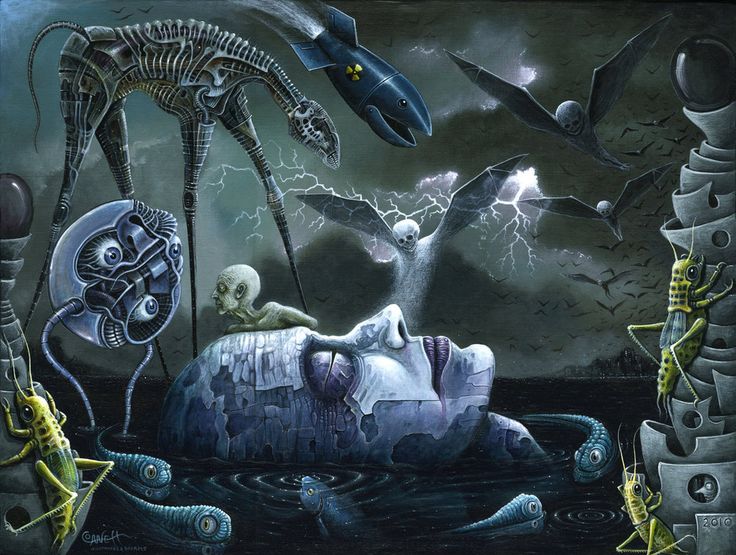
Title image: Dreamscapes and nightmares by the artist R.S. Connett.

Thank you. Peace and Love.

A Collaborative Fusion of two Great Poets Exploring Human Curiosity. Could the answer lie in dreams?

Standard

It’s a lovely day today, and it feels like summer is making one last bid to say goodbye. I was out in the garden, but not sunbathing – I had to mow the lawn! As tenants, these sorts of tasks are our responsibility.
And now, after giving the flat a good vacuum, I thought it was a good time to write a post.

Tomorrow is Leonard Cohen‘s birthday, and I thought it would be a great chance to celebrate with a poem by Pablo Neruda as a tribute.
The theme is human curiosity (the ‘Whys!’), how little we know, and, as Leonard Cohen suggests, why not stand on your own two feet and be your own individual?

There’s no doubt that they’re still alive, truly in our hearts, thanks to their lasting arts and wisdom.

Through a closed mouth, the flies enter
by Pablo Neruda:

Why, with those red flames at hand,
Are rubies so ready to burn?

Why does the heart of the topaz
reveal a yellow honeycomb?
Why does the rose amuse itself
by hanging the colour of its dreams?
Why does the emerald shiver
like a drowned submarine?

Why does the sky grow pale
under the June stars?
Where does the lizard’s tail
Get its fresh supply of paint?
Where is the underground fire
That revives the carnations?

Where does the salt acquire
The transparency of its glance?
Where did the coal sleep
That it awoke so dark?
And where, where does the tiger buy
Its stripes of mourning, its stripes of gold?

When did the jungle begin
to breathe its own perfume?
When did the pine tree realise
its own sweet-smelling consequence?
When did the lemons learn
The same laws as the sun?

When did smoke learn to fly?
When do roots converse?
What is water like in the stars?
Why is the scorpion poisonous?
Is the elephant benign?

What is the tortoise brooding on?
Where does shade withdraw to?
What song does the rain repeat?
When are the birds going to die?
And why should leaves be green?

What we know is so little,
and what we presume so much,
So slowly do we learn
that we ask questions, then die.
Better for us to keep our pride
for the city of the dead
on the day of the departed,
And there, when the wind blows through
the holes in your skull,
It will unveil to you such mysteries,
whispering the truth to you
through the spaces that were your ears.

I shall forever remember those days when Al and I closed many doors one after another to society, and by listening to Cohen’s songs, we immersed ourselves in our solitude.

Have a great time, everyone. 🙏💖🤗

Source: “Through a closed mouth the flies enter” from EXTRAVAGARIA by Pablo Neruda, translated by Alastair Reid. Copyright © 1958 Pablo Neruda and Fundación Pablo Neruda. Translation copyright © 1974 by Alastair Reid. Used by permission of Farrar, Straus and Giroux and Fundación Pablo Neruda.

If You Forget Me!

Standard

By Pablo Neruda

“I would like to bid farewell to the old year by sharing a great poem by Pablo Neruda since this is my last post for the year. I know that some of my friends share posts daily or a few even hourly, but I do not have that much free time. Therefore, I would like to take this opportunity to wish everyone a happy New Year’s Eve and a healthy new year.” Viva Freedom!🙏🤗💖

Benito Cerna, 1960 ~ Figurative painter

I want you to know
one thing.

You know how this is:
if I look
at the crystal moon, at the red branch
of the slow autumn at my window,
if I touch
near the fire
the impalpable ash
or the wrinkled body of the log,
everything carries me to you,
as if everything that exists,
aromas, light, metals,
were little boats
that sail
toward those isles of yours that wait for me.

Well, now,
if, little by little, you stop loving me
I shall stop loving you little by little.

If suddenly
you forget me
do not look for me,
for I shall already have forgotten you.

If you think it long and mad,
the wind of banners
that passes through my life,
and you decide
to leave me at the shore
of the heart where I have roots,
remember
that on that day,
at that hour,
I shall lift my arms
and my roots will set off
to seek another land.

But
if each day,
each hour,
you feel that you are destined for me
with implacable sweetness,
if each day, a flower
climbs up to your lips to seek me,
ah, my love, ah, my own,
in me, all that fire is repeated,
in me, nothing is extinguished or forgotten,
my love feeds on your love, beloved,
and as long as you live, it will be in your arms
without leaving mine.