My (Carl Jung’s) Most Difficult Experiment [P. 3]

Standard

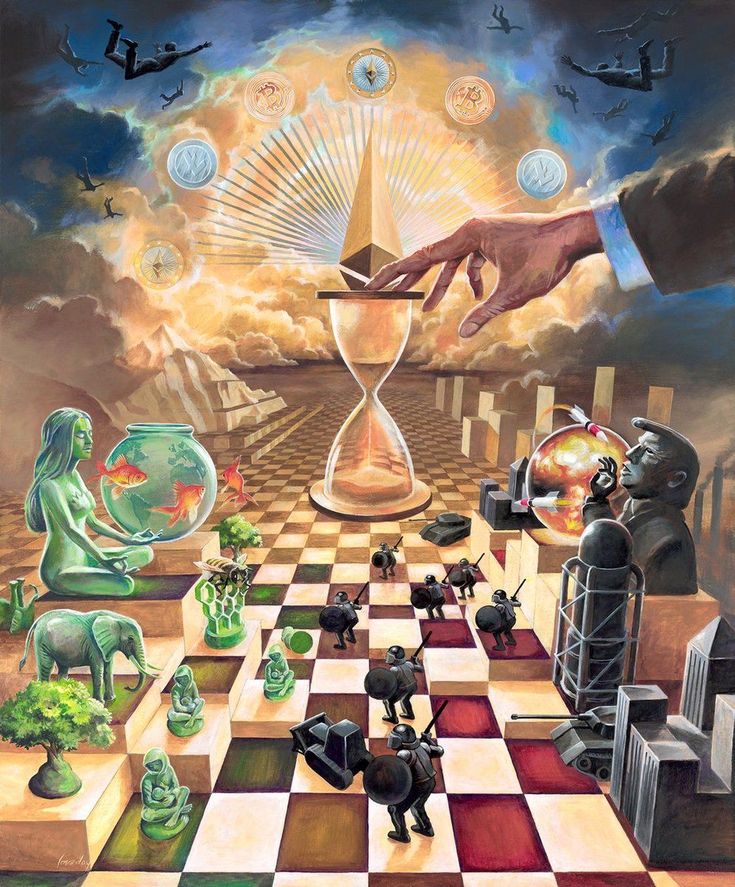
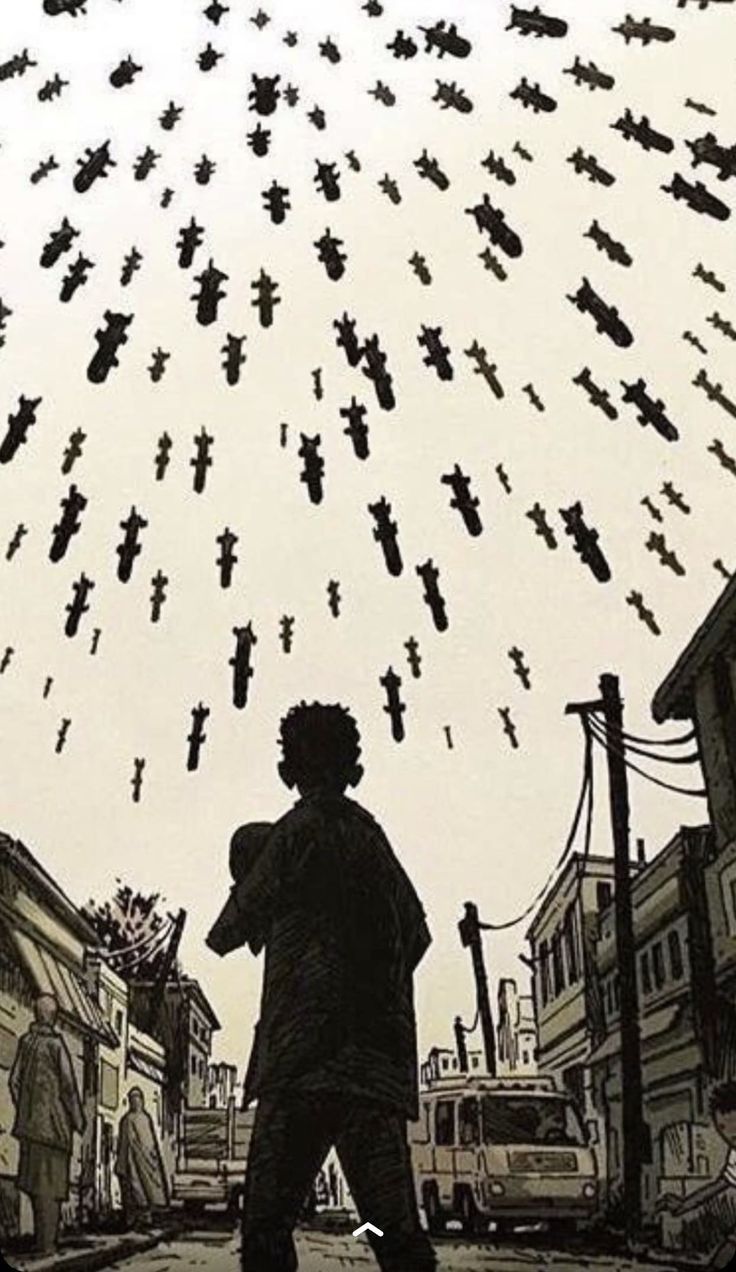
“We need a force not to start conflicts but to protect our nation and freedom. Therefore, making military service more attractive could draw more young people”. Said German Bundeskanzler Friedrich MΓ€rz a few days ago.
I wonder how and with what we can make being a soldier attractive. A soldier’s role involves killing; how can we make that aspect attractive?

I remember the 1960s and 1970s, during the Cold War and Vietnam War, when crowds gathered to protest against conflicts and advocate for peace. Over time, Western governments began to prioritise peace more and engaged in disarmament talks, seeking peaceful coexistence. Yet today, they focus on strengthening their military to defend peace and freedom!

What’s happening? Isn’t there enough war worldwide? Is Germany yearning for the glorious days of the 1930s? The facts appear this way!

However, this has always occurred whenever politicians become oblivious to the horrific machinery of war. Therefore, it might be meaningful to consider two of Jung’s dreams from before WWI, as excerpted from his autobiography. “Memories, Dreams, Reflections” describes Carl Jung’s dreams from 1913 to 1914. With thanks to Lewis Lafontaine. πŸ™

In October [1913], while I was alone on a journey, I was suddenly seized by an overpowering vision: I saw a monstrous flood covering all the northern and low-lying lands between the North Sea and the Alps.
When it came to Switzerland, I saw that the mountains grew higher and higher to protect our country.
I realised that a frightful catastrophe was in progress.
I saw the mighty yellow waves, the floating rubble of civilisation, and the drowned bodies of uncounted thousands.
Then the whole sea turned to blood.
This vision lasted about one hour.
I was perplexed and nauseated, and ashamed of my weakness.

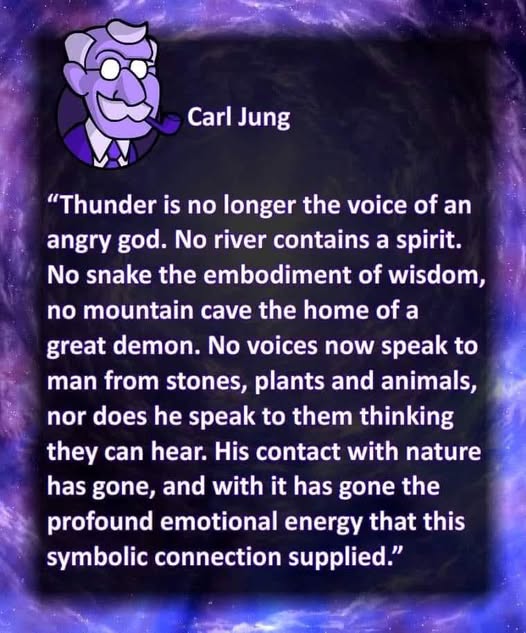
Thunder is no longer the voice of a god, nor is lightning his avenging missile.
No river contains a spirit, no tree makes a man’s life, no snake is the embodiment of wisdom, and no mountain still harbours a great demon.
Neither do things speak to him nor can he speak to things, like stones, springs, plants and animals.”
~ Carl Jung, CW 18, Para 585

Two weeks passed; then the vision recurred, under the same conditions, even more vividly than before, and the blood was more emphasised.
An inner voice spoke. “Look at it well; it is wholly real, and it will be so. You cannot doubt it.”
That winter, someone asked me what I thought were the political prospects of the world in the near future.
I replied that I had no thoughts on the matter, but that I saw rivers of blood.
I asked myself whether these visions pointed to a revolution, but I could not really imagine anything of the sort.
And so I concluded that they had to do with me myself, and decided that a psychosis menaced me.
The idea of war did not occur to me at all.
Soon afterwards, in the spring and early summer of 1914, I had a thrice-repeated dream that in the middle of summer an Arctic cold wave descended and froze the land to ice.
I saw, for example, the entire region of Lorraine and its canals frozen, and the whole area totally deserted by human beings.
All living green things were killed by frost.
This dream came in April and May, and for the last time in June 1914.
In the third dream, frightful cold had again descended from out of the cosmos.
This dream, however, had an unexpected end. There stood a leaf-bearing tree, but without fruit (my tree of life, I thought), whose leaves had been transformed by the effects of the frost into sweet grapes full of healing juices.
I plucked the grapes and gave them to a large, waiting crowd…

On August 1, World War I broke out!

Now, let’s continue with the next section, following (1, 2), about Dr Jung’s dreams and examining how a forecaster can predict potential human self-destructive plans. As mentioned in Part Two, Jung described hearing a strange woman’s voice in his mind and tried to analyse it.

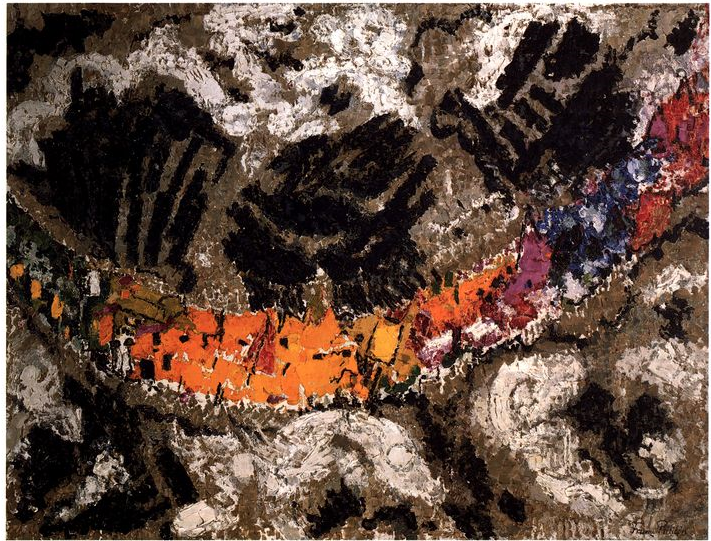
He believed the voice was “the soul in the primitive sense,” known as the anima, and stated that he employed his analysis to write letters to his anima, experiencing it as both a ghost and a woman. He remembered this voice as that of a Dutch patient from 1912 to 1918, who convinced a colleague that he was a misunderstood artist. The woman had thought the unconscious was art, but Jung had maintained it was a natural phenomenon. The woman was likely Maria Moltzer, and the psychiatrist was Jung’s friend Franz Riklin, who shifted from analysis to painting, studying Augusto Giacometti in 1913. Riklin’s art was semi-figurative and abstract, with a notable 1915/6 work, VerkΓΌndigung, in ZΓΌrich, donated by Moltzer in 1945. Giacometti found Riklin’s psychological insights exciting, calling him a modern magician.

Franz Beda Riklin VerkΓΌndigung 1915, Wikimedia

The November entries in Black Book 2 depict Jung’s return to his soul. He recalled dreams that led him to his scientific career and recent dreams bringing him back to his soul. In 1925, he noted his first writing phase ended in November: ” Not knowing what would come next, I thought perhaps more introspection was needed… I devised such a boring method by fantasising that I was digging a hole, and by accepting this fantasy as perfectly real. ” This experiment occurred on December 12, 1913 (See Liber Primus, chapter 5, p. 147).

To be continued …………

Thank you for reading! I don’t want to spoil your mood, but sometimes thinking more deeply can help us and prepare us for the worst. While I am on my way to spend the holidays, please note that responses to comments, if any, may be delayed.πŸ™πŸ’–

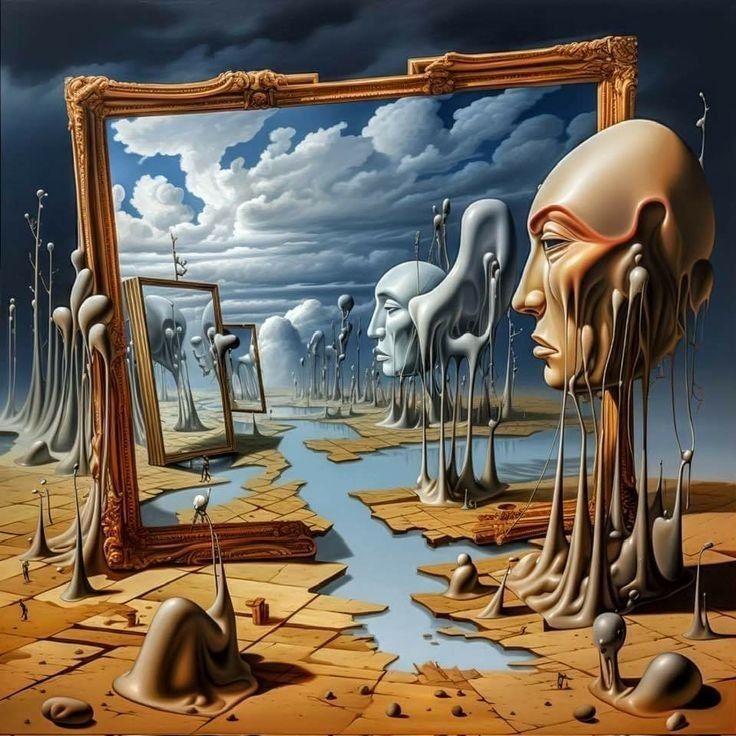
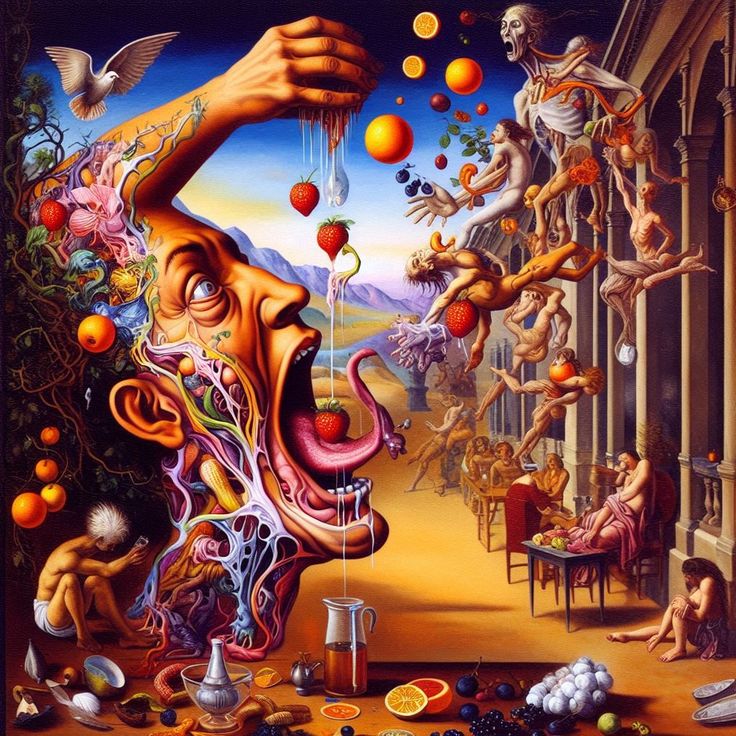
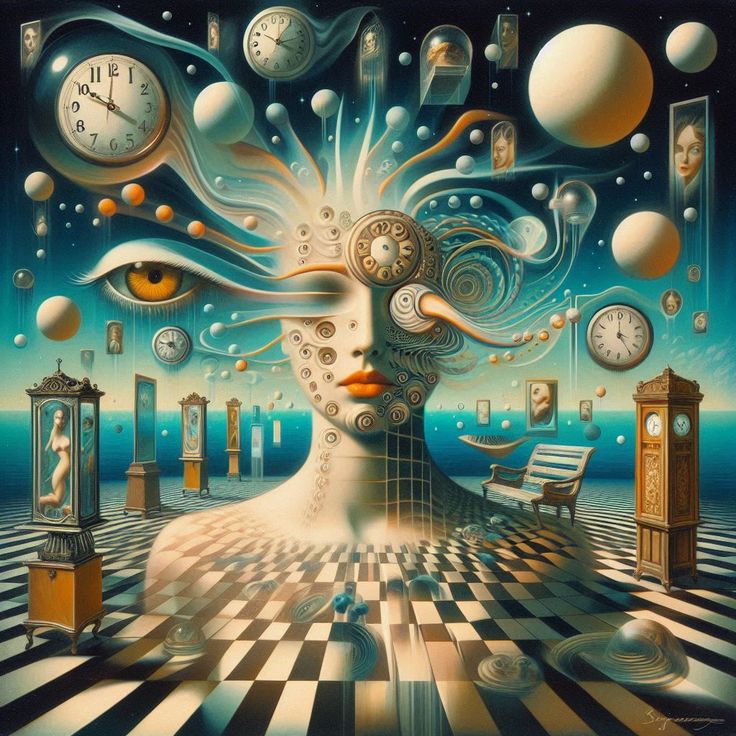
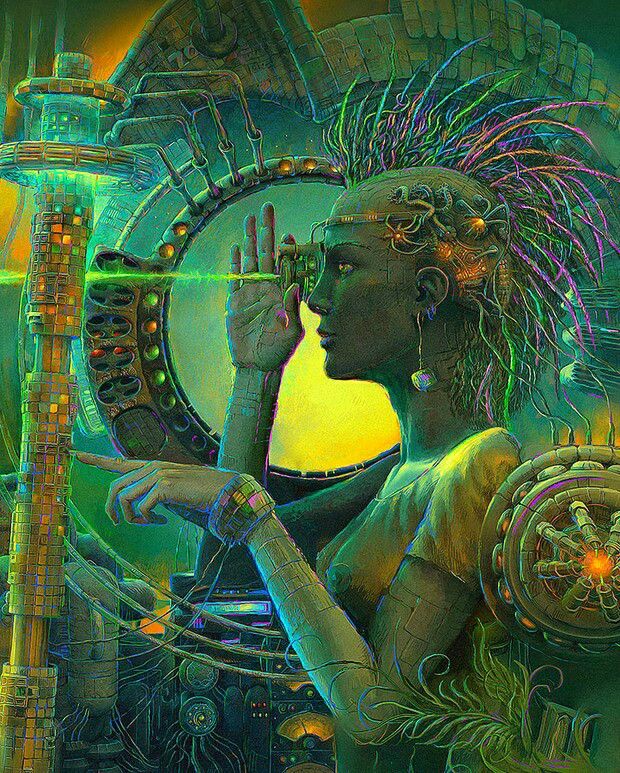
Illustration art at the top: Dali-Inspired Dreamscape

My (Carl Jung’s) Most Difficult Experiment [P. 2]

Standard

What fascinates me about Jung is his commitment to self-exploration and his use of analysis to discover his Self through the interpretation of dreams. He dedicated his life to this pursuit with genuine honesty and sincerity. Today, I present another section of The Red Book, Liber Novus, by Carl Jung, from Sonu Shamdasani’s Reader’s Edition.πŸ™

The following month, on a train journey to Schaffhausen, Jung experienced a waking vision of Europe being devastated by a catastrophic flood, which was repeated two weeks later, on the same journey. Commenting on this experience in 1925, he remarked: “I could be taken as Switzerland fenced in by mountains and the submergence of the world could be the debris of my former relationships.” This led him to the following diagnosis of his condition: “I thought to myself, ‘If this means anything, it means that I am hopelessly off.’ ” (Introduction to Jungian Psychology, pp. 47-48). After this experience, Jung feared that he would go mad.
(Barbara Hannah recalls that “Jung used to say in later years that his tormenting doubts as to his own sanity should have been allayed by the amount of success he was having at the same time in the outer world, especially in America” [C. G. Jung: His Life and Work. A Biographical Memoir/ New York: Perigree, 1976/, p. 109]. )
He recalled that he first thought that the images of the vision indicated a revolution, but as he could not imagine this, he concluded that he was “menaced with a psychosis.” (Memories, p. 200). After this, he had a similar vision:

In the following winter, I was standing at the window one night and looked North. I saw a blood-red glow, like the flicker of the sea seen from afar, stretched from East to West across the northern horizon. And at that time, someone asked me what I thought about global events in the near future. I said that I had no thoughts, but saw blood, rivers of blood (Draft, p. 8).

In the year directly preceding the outbreak of war, apocalyptic imagery was widespread in European arts and literature. For example, in 1912, Wassily Kandinsky wrote of a coming universal catastrophe.
From 1912 to 1914. Ludwig Meidner painted a series of works known as the Apocalyptic Landscapes, featuring scenes of destroyed cities, corpses, and turmoil (Gerda Bauer and Ines Wagemann, Ludwig Meidner: Zeichner, Maler, Literat 1884-1966 / Stuttgart: Verlag Gerd Hatje, 1991). Prophecy was in the air!
In 1899, the renowned American medium Leonora Piper predicted that in the coming century, a terrible war would erupt in various parts of the world, purging the world and revealing the truths of spiritualism. In 1918, Arthur Conan Doyle, the spiritualist and author of the Sherlock Holmes stories, viewed this as prophetic (A. C. Doyle, The New Revelation and the Vital Message / London: Psychic Press, 1918, p. 9).

Dream _ A Great Work Of Art Is Like A Dream.
Artwork: Henri Rousseau
From the Carl Jung depth psychology site

In Jung’s account of the fantasy on the train in Liber Novus, the inner voice said that what the fantasy depicted would become completely real. Initially, he interpreted this subjectively and prospectively, that is, as depicting the imminent destruction of his world. His reaction to this experience was to undertake a psychological self-investigation. In this epoch, self-experimentation was used in medicine and psychology. Introspection had been one of the main tools of psychological research.

Jung came to realise that Transformations and Symbols of the Libido “could be taken as myself and that an analysis of it leads inevitably into an analysis of my own unconscious processes” (Introduction to Jungian Psychology, p. 28). He had projected his material onto that of Miss Frank Miller, whom he had never met. Up to this point, Jung had been an active thinker and had been averse to fantasy: “as a form of thinking I held it to be altogether impure, a sort of incestuous intercorse, thoroughly immoral from an intellectual viewpoint” (Ibid.). He now turned to analyse his fantasies, carefully noting everything. He had to overcome considerable resistance in doing this: “Permitting fantasy in myself had the same effect as would be produced on a man if he came into his workshop and found all the tools flying about doing things independently of his will” (Ibid.). In studying his fantasies, Jung realised that he was examining the myth-creating function of the mind (MP, p. 23).

Jung picked up the brown notebook, which he had set aside in 1902, and began writing in it (The subsequent notebooks are black, hence Jung referred to them as the Black Books). He noted his inner states in metaphors, such as being in a desert with an unbearably hot sun (that is, consciousness). In the 1925 seminar, he recalled that it occurred to him that he could write down his reflections in a sequence. He was “writing autobiographical material, but not as an autobiography” (Introduction to Jungian Psychology, p. 48).
From the time of the Platonic dialogues onward, the dialogical CE, St. Augustine wrote his Soliloquies, which presented an extended dialogue between himself and “Reason,” who instructed him. They commenced with the following lines:

When I had been pondering many different things to myself for a long time, and had for many days been seeking my own Self and what my own good was, and what evil was to be avoided, there suddenly spoke to me – what was it? I myself or someone else, inside or outside me? (This is the very thing I would love to know but don’t.) [St. Augustine, Soliloquies and Immorality of the Soul, ed. and tr. Gerald Watson (Warminster: Aris & Phillips, 1990), p. 23. Watson notes that Augustine “had been through a period of intense strain, close to nervous breakdown, and the Soliloquies are a form of therapy, an effort to cure himself by talking, or rather writing” /p. v/).]

While Jung was writing in Black Book 2:

I said to myself, “What is this I’m doing? This certainly is not science. What is it?” Then a voice said to me, “That is art!” This made the strangest sort of impression upon me, because it was not in any sense my impression that what I was writing was art. Then I came to this: “Perhaps my unconscious is forming a personality that is not I, but which is insisting on coming through to expression.” I don’t know why exactly, but I knew to a certainty that the voice that had said my writing was art had come from a woman … Well, I said very emphatically to this voice that what I was doing was not art, and I felt a great resistance grow up in me. No voice came through, however, and I kept on writing. This time, I caught her and said, “No, it is not”, and I felt as though an argument would ensue. {Ibid., p. 42. In Jung’s account, it appears that his dialogue took place in the autumn of 1913, although this is not certain, as the dialogue itself does not occur in the Black Book, and no other manuscript has yet come to light. If this dating is followed, and in the absence of the other material, it would appear that the material of the voice is referring to the November entries in Black Book 2, and not the subsequent text of Liber Novus or the paintings.}

To be continued!πŸ’–

The image on top: Pang Torsuwan -WHILE YOU WERE SLEEPING!

The Intoxication of Mythology (an Add!)

Standard

“Living with these things all the time, I can see how there are certain universal patterns for these manifestations. A shaman among the Navajo or in the Congo will say things that sound remarkably similar to those of Nicholas Cusanus, Thomas Aquinas, or C. G. Jung, leading one to realise that these ranges of experiences are common to the human race. There are some people who close themselves away from them, some people who open themselves to them …”
-Joseph Campbell
β€œLiving Myths: A Conversation with Joseph Campbell,” Parabola, Volume I, Issue 2, Spring 1976, p. 70

In this tumultuous world, where corrupt leaders continue to pursue their plans for the “New World Order,” the most prudent approach is to allow our strained minds to be guided by the wisdom of eminent thinkers and to find solace in uniting our bewildered souls.

Surreal Abstract Painting (“Dadaism in nature” or “Psychedelic Surrealism”. )

My anger has subsided somewhat since last week, given how my words might have been taken. Nevertheless, I’m completely drained and fed up! Especially after that so-called ceasefire, which is like leaving an injured monster in a room with inocent people and locking the door!

These days, death has become the norm. We can see that the lives (of others, of course!) are not so important, but as we all know, the grim reaper is lurking, waiting for us all, regardless of our wealth or status, around the world. So, it’s essential to remember this.

That’s why I turn to myth, as an addendum to my recent post, and death!

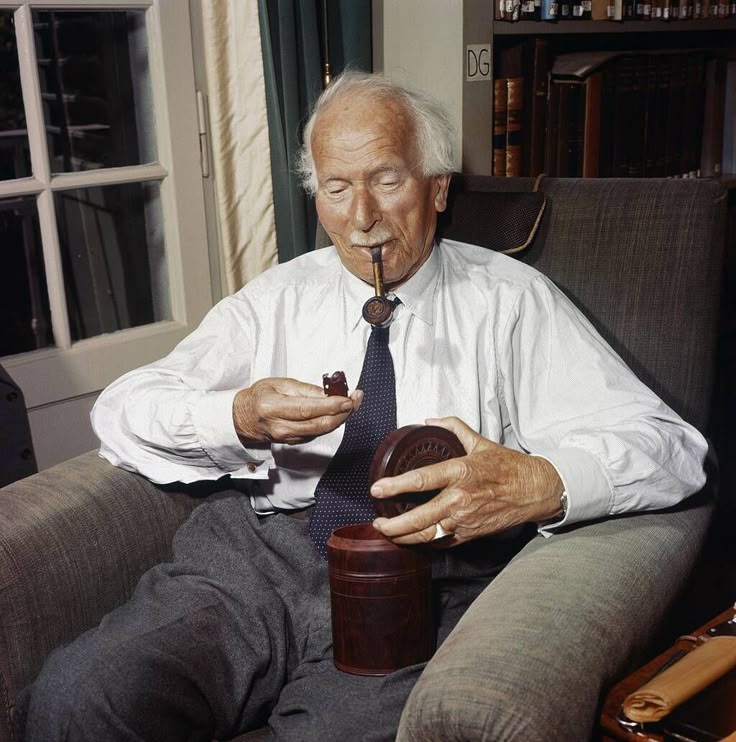
Carl Gustav Jung around 1960 in his house in Zurich. (Photo RUE DES ARCHIVES)

Here are some words by Carl Jung:

For example, I do not know for what reason the universe has come into being, and I shall never know. Therefore, I must drop this question as a scientific or intellectual problem. But if an idea about it is offered to meβ€”in dreams or in mythic traditionsβ€”I ought to take note of it. …They (The foreknowledge) may be in accord with reality, and then again they may not. I have, however, learned that the views I have been able to form based on such hints from the unconscious have been most rewarding.
Naturally, I am not going to write a book of revelations about them, but I will acknowledge that I have a β€œmyth” that encourages me to look deeper into this whole realm.
“Myths are the earliest form of science.”
When I speak of things after death, I am speaking out of inner prompting and can go no farther than to tell you dreams and myths related to this subject.
Naturally, one can contend from the start that myths and dreams concerning the continuity of life after death are merely compensating fantasies inherent in our naturesβ€”all life desires eternity. The only argument I can adduce in answer to this is the myth itself.

~Carl Jung, The Atlantic Monthly, December 1962, From On Life after Death by C.G. Jung, via Carl Jung Depth Psychology Site

Sending love and peace!

The image at the top is a striking piece of digital art titled “Chakra” by DeviantArt user paranormalilly32. 

Make Peace, No War; Is It Possible?!

Standard

Today, I can only articulate my perplexed reflections regarding this event, which I may have somewhat anticipated yet did not expect. I am referring to the conflict that commenced yesterday between Israel and Iran. I do not wish to convey any patriotic sentiment, as I do not possess such feelings; however, I still experience ambivalent emotions regarding the dismantling of the Islamic regime and my connection to my place of origin.
That is what Carl Jung called the “Collective Unconscious.”

As I once responded to a dear friend’s question regarding my feelings; I have never supported war, but when one resides in a country governed by such a regimeβ€”killing young and old of one’s own people without mercyβ€”and each day when venturing out onto the streets, uncertain if one will return alive, there is no other conclusion to draw!

via Lewis Lafontaine πŸ™

Carl Jung’s perspective on war is complex and nuanced. He viewed war as a reflection of deeper psychological processes in individuals and nations, rather than just a political clash. Jung believed the “shadow” – the darker aspects of the human psyche – significantly influences this, with nations projecting undesirable traits onto enemies. He warned against the dangers of mass psychology and unconscious forces overwhelming reason, which can lead to destruction.
Jung’s views on war extend beyond military tactics; they explore the psychological roots of conflict, highlighting self-awareness, the risks of unchecked unconscious forces, and how individuation fosters peace.

Recalling the phallus dream and brick games, Jung forms associations leading to his adult views on global devastation and “rivers of blood.” In autumn 1913, he sensed a sombre atmosphere, an oppression that appeared to emanate from external sources, as if something significant lingered in the air. He recalls how this feeling grew stronger over the months, eventually leading to a remarkable vision that took hold of him:

β€œI saw a monstrous flood covering all the northern and low-lying lands between the North Sea and the Alps. When it came to Switzerland, I saw that the mountains grew higher and higher to protect our country. I realised that a frightful catastrophe was in progress. I saw the mighty yellow waves, the floating rubble of civilisation, and the drowned bodies of uncounted thousands. Then the whole sea turned to blood.” Jung recalls several recurring dreams, regarding them as premonitions of world destruction leading up to the First World War.”

Anyway, I’ll just have to deal with it, just like so many others who have the same concerns. I truly hope this situation comes to a swift and favourable resolution, ultimately leading to a free and prosperous Iran.

An Innocent Little Mistake!

Standard
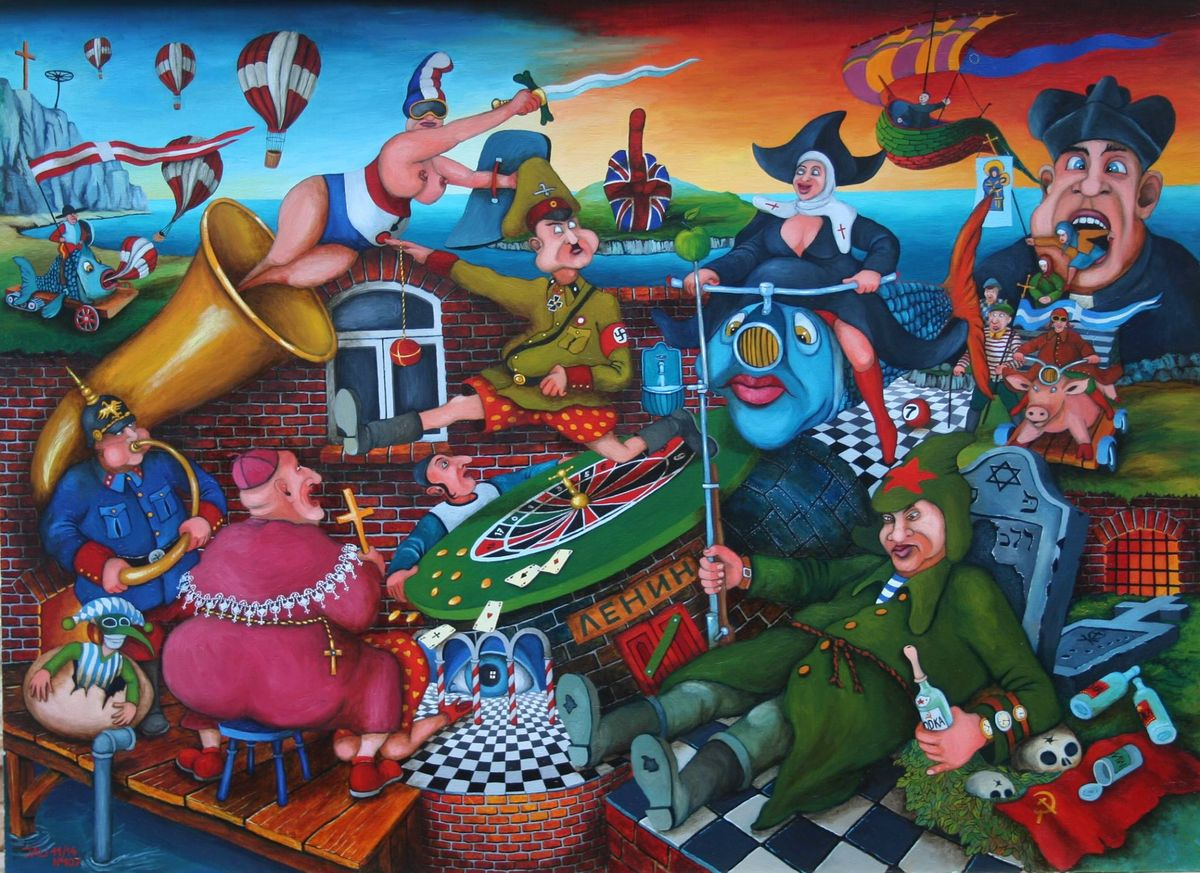
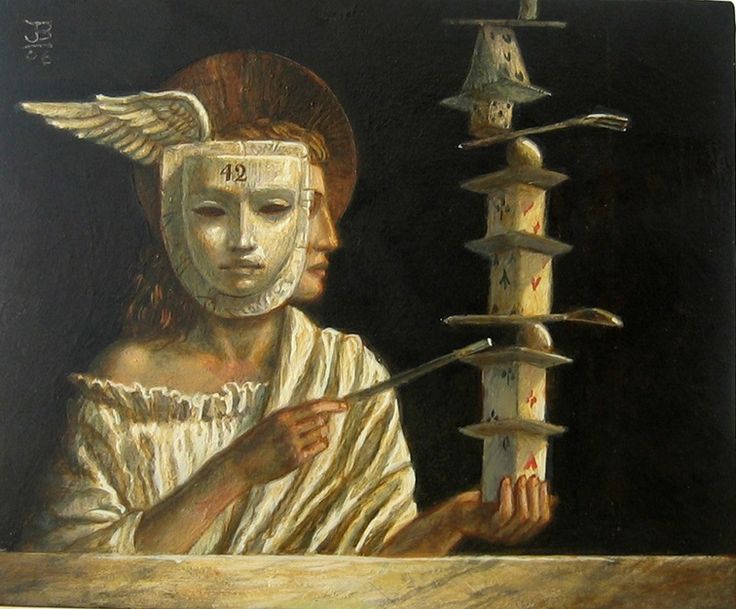
2007 The Card Trick by Jake Baddeley

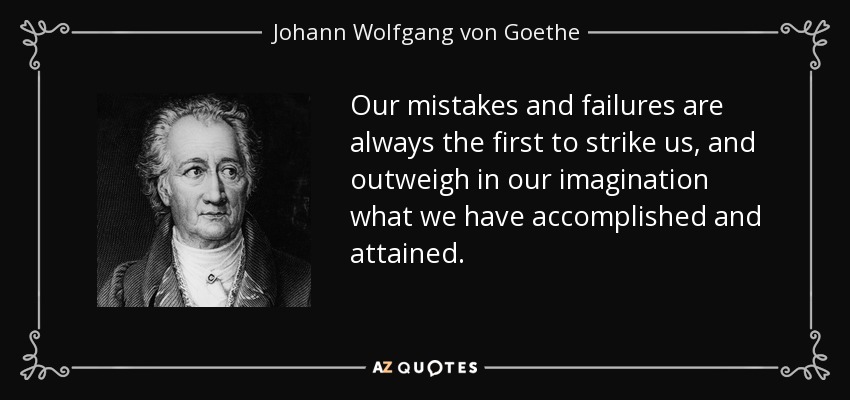
As I reflect on my past life, the passing years prompt me to recall memories, and I see how I wish to revisit specific moments to alter them or improve them. I have led an adventurous life (as you may recall from my series of posts about my memories), and I acknowledge that I have made numerous mistakes, which I deeply regret. However, with guidance from great thinkers, I have learned to view these mistakes from a different perspective: The Value of Experience!

It is a prevalent issue for people around the world to avoid making mistakes. I, myself, am one of those who strive for perfection, and I recognise that it is misguided!
Johann Wolfgang von Goethe says, “Geschlagener Quark macht breit, nicht fest!” (Beaten curd becomes broad, not strong!)

“If we look at the problems raised by Aristotle, we are astonished at his gift of observation. What incredible eyes the Greeks had for many things! Only they committed the mistake of being overhasty, of passing straightway from the phenomenon to the explanation of it, and thereby produced specific theories that are pretty inadequate. But this is the mistake of all time, and is still made in our own day.”

From Maxims & Reflections, Johann Wolfgang von Goethe; Science, 559

Additionally, Carl Gustav Jung reminds us that we can make mistakes and learn from them.

Whatever we look at, and however we look at it, we see only through our own eyes. For this reason, science is never made by one man but by many. The individual merely offers their contribution, and in this sense, I dare to speak only of my way of seeing things.
~Carl Jung, Modern man in Search of a Soul, p.84.

Plato proposed that absolute knowledge can be gained through acquaintance, meaning through intellectual insight into the otherworldly Forms. Jung shared a similar notion regarding acquaintance with the archetypes of the “unus mundus” (one world), representing the primordial, unified reality from which all things originate. Nevertheless, in contrast to Plato, Jung asserted that archetypes cannot be perceived directly. Instead, we can comprehend their psychic significance, gaining at least a hint of absolute knowledge.

I believe we can make mistakes, but after each one, we should take a step back and carefully examine how and where it happened, then try to approach the experience more thoughtfully. Experience teaches us more than thousands of books ever could!

Jung inspired individuals to engage with the world and savour life, rather than rely solely on theoretical knowledge from books. He regarded the unconscious mind as a treasure trove of experiences accessible through reflection and symbolic language. Ultimately, Jung’s work emphasises that while books and knowledge are valuable, they shouldn’t overshadow the importance of direct experience and self-reflection. Genuine growth and understanding flourish when we engage with our surroundings and explore our inner lives.

Sometimes a tree tells you more than can be read in books.
~ C.G. Jung; Letters Volume 1; Page 179.

Experience, not books, is what leads to understanding.
~Carl Jung, CW 12, Para 564

Thank you for reading; have a lovely holiday! πŸ™πŸ€—πŸŒΉπŸ’•

My (Carl Jung’s) Most Difficult Experiment [P. 1]

Standard

Regarding foresight, few individuals possess this ability, or perhaps it exists in everyone, yet most fail to recognise it. I knew some of my relatives, and one of my aunts had mastered it. She had seen ghosts in her large, old house, conversed with them, and could perceive events (in dreams) before they occurred. My brother Al also possessed such a gift, particularly in the final years of his life when he underwent surgery on his head to remove a tumour. I do not know if it is a gift, a curse, or a blessing; nonetheless, I would treasure that.

I, myself, have a small example: I had a dream in which one of my customers, an elderly woman I had driven to the doctor for many years but could no longer assist because she needed special transport, urgently called me to ask if I could pick her up and take her to her doctor. I wondered why I had dreamt of her after all this time. Two days after my dream, while driving a guest from her neighbourhood, she told me she recognised me as the person who had driven her friend from next door for a long time and asked if I knew she had passed away. I said no and asked when it had happened. She replied it was the night before last, the same night I had dreamt of her!

Dream analysis stands or falls with [the hypothesis of the unconscious]. Without it, the dream appears to be merely a freak of nature, a meaningless conglomerate of memory fragments left over from the day’s happenings.
~Carl Jung
“Modern Man in Search of a Soul”, p.2, Psychology Press

Now, let us read about one of the great minds in this field: Carl Gustav Jung. He was among the most sensitive and intuitive visionaries of all time. Here, he talks about his dreams, odd and extraordinary dreams. Once, he was even afraid that he had schizophrenia.

<Although it is from The Red Book, which everyone might have or may have even read, I believe many still do not notice the fineness in the “Introduction” at the beginning of the book, as I find it fascinating.>

From Carl Jung’s “The Red Book, Liber Novus: A Reader’s Edition,” by Sonu Shamdasani. (Introduction)

In 1912, Jung had some significant dreams that he did not understand. He gave particular importance to two of these, which, as he felt, showed the limitations of Freud’s conceptions of dreams. The first follows:

I was in a southern town, on a rising street with narrow half-landings. It was twelve o’clock midday–bright sunshine. An old Austrian customs guard or someone similar passes by me, lost in thought. Someone says, “That is one who cannot die. He died already 30 – 40 years ago but has not yet managed to decompose.”

I was very surprised. Here, a striking figure came, a knight of powerful build clad in yellowish armour. He looks solid and inscrutable, and nothing impresses him. On his back, he carries a red Maltese cross. He has continued to exist since the 12th century, and he takes the same route daily between 12 and 1 o’clock midday. No one marvelled at these two apparitions, but I was extremely surprised.

I hold back my interpretive skills. As regards the old Austrian, Freud occurred to me; as regards the knight, I myself.

Inside, a voice calls, “It is all empty and disgusting.” I must bear it. (Black Book 2, pp. 25-26)

Jung found this dream oppressive and bewildering, and Freud was unable to interpret it.

(In 1925, he gave the following interpretation to this dream: “The meaning of the dream lies in the principle of the ancestral figure: not the Austrian officer – obviously he stood for the Freudian theory – but the other, the Crusader, is an archetypal figure, a Christian symbol living for the twelfth century, a symbol that does not really live today, but on the other hand in not wholly dead either. It comes out of the time of Meister Eckhart, the time of the culture of the Knights, when many ideas blossomed, only to be killed again, but they are coming to life again now. However, when I had this dream, I did not know this interpretation” (Introduction to Jungian Psychology, p. 42).

Around half a year later, Jung had another dream:

I dreamt at that time (it was shortly after Christmas 1912) that I was sitting with my children in a marvellous and richly furnished castle apartment – an open columned hall – we were sitting at a round table, whose top was a marvellous dark green stone. Suddenly, a gull or a dove flew in and sprang lightly onto the table. I admonished the children to be quiet so they would not scare away the beautiful white bird. Suddenly, this bird turned into a child of eight years, a small blond child, and ran around playing with my children in the marvellous columned colonnades. Then, the child suddenly turned into the gull or dove. She said the following to me: “Only in the first hour of the night can I become human while the male dove is busy with the twelve dead.” With these words, the bird flew away, and I awoke. (Black Book 2, pp. 17-18)

In Black Book 2, Jung noted that it was this dream that made him decide to embark on a relationship with a woman he had met three years earlier (Toni Wolff, Ibid., p. 17). In 1925, he remarked that this dream “was the beginning of a conviction that the unconscious did not consist of inert material only, but that there was something living down there (Introduction to Jungian Psychology, p. 42). He added that he thought of the story of the Tabula Smaragdina (emerald tablet), the twelve apostles, the signs of the Zodiac, and so on, but that he “could make nothing out of the dream except that there was a tremendous animation of the unconscious. I knew no technique for getting to the bottom of this activity; all I could do was just wait, keep on living, and watch the fantasies.”

I include this footnote to highlight his insatiable greed and relentless pursuit to decipher the meaning behind his dream and how he developed the interpretation.

Ibid., pp. 40-41. E. A. Benner noted Jung’s comments on this dream: “At first, he thought ‘twelve dead men’ referred to the twelve days before Christmas, for that is the dark time of the year, when traditionally witches are about. To say ‘before Christmas’ is to say before the sun lives again, for Christmas day is at the turning point of the year when the sun’s birth was celebrated in the Mithraic religion… Only much later did he relate the dream to Hermes and the twelve doves” (Meeting with Jung: Conversations recorded by E.A. Brenner during the years 1946-1961 [London: Anchor Press,1982; ZΓΌrich, Daimon Verlag, 1985], p. 93). In 1951, in “The Psychological Aspects of the Kore”, Jung presented some material from Liber Novus (describing them all as part of a dream series) in an anonymous form (“case Z.”), tracing the transformations of the anima. He noted that this dream “shows the anima as a elflike, i.e., only partially human. She can just as well be a bird, which means that she may belong wholly to nature and can vanish (i.e., become unconscious) from the human sphere (i.e., consciousness)” (CW9, I, Β§ 371). See also Memories, pp. 195-96.

These dreams led him to analyse his childhood memories, but this did not resolve anything. He realised that he needed to recover the emotional tone of childhood. He recalled that as a child, he used to like to build houses and other structures, and he took this up again.

While he was engaged in this self-analytic activity, he continued to develop his theoretical work. At the Munich Psycho-Analytical Congress in September 1913, he spoke on psychological types. He argued that there were two basic movements of the libido: extraversion, in which the subject’s interest was oriented towards the outer world, and introversion, in which the subject’s interest was directed inward. Following from this, he posited two types of people, characterised by the predominance of one of these tendencies. The psychologies of Freud and Adler were examples of the fact that psychologies often took what was true of their type as generally valid. Hence, what was required was a psychology that did justice to both of these types (“On the question of psychological types,” CW 6).

Although this captivating story continues, I will share it in parts to facilitate understanding and enjoyment. Thank you for taking the time to read!

PS: In case someone interested, I will try to write about my new condition in a separate post. πŸ™πŸ’–

The Unconscious Mind!

Standard

Sorry, it’s me again! I intended to share a brief message on Facebook, and I thought, why not just do it on my site, too? So here it is: We must look deeply around us and think twice. I send you all immense gratitude and wish you a lovely weekend.πŸ˜πŸ€—πŸ’–πŸ™πŸ¦‹πŸŒΉ

Title image; Art by Andrew Ferez

From Collected Works of C.G. Jung, Volume 7: Two Essays in Analytical Psychology,

via Carl Jung Depth Psychology and Craig Nelson

I must recall at this point a serious misunderstanding to which my readers often succumb, and doctors most commonly.
They invariably assume, for reasons unknown, that I never write about anything except my method of treatment.
This is far from being the case. I write about psychology.
I must, therefore, expressly emphasize that my method of treatment does not consist in causing my patients to indulge in strange fantasies for
the purpose of changing their personality and other nonsense of that kind.
I merely put it on record that there are certain cases where such a development occurs, not because I force anyone to it, but because it springs from inner necessity.
For many of my patients, these things are and must remain double Dutch.
Indeed, even if it were possible for them to tread this path, it
would be a disastrously wrong turning, and I would be the first to hold them back.
The way of the transcendent function is an individual destiny.
But on no account should one imagine that this way is equivalent to the life of a psychic anchorite, to alienation from the world.
Quite the contrary, for such a way is possible and profitable only when the specific worldly tasks which these individuals set themselves are carried out in reality.
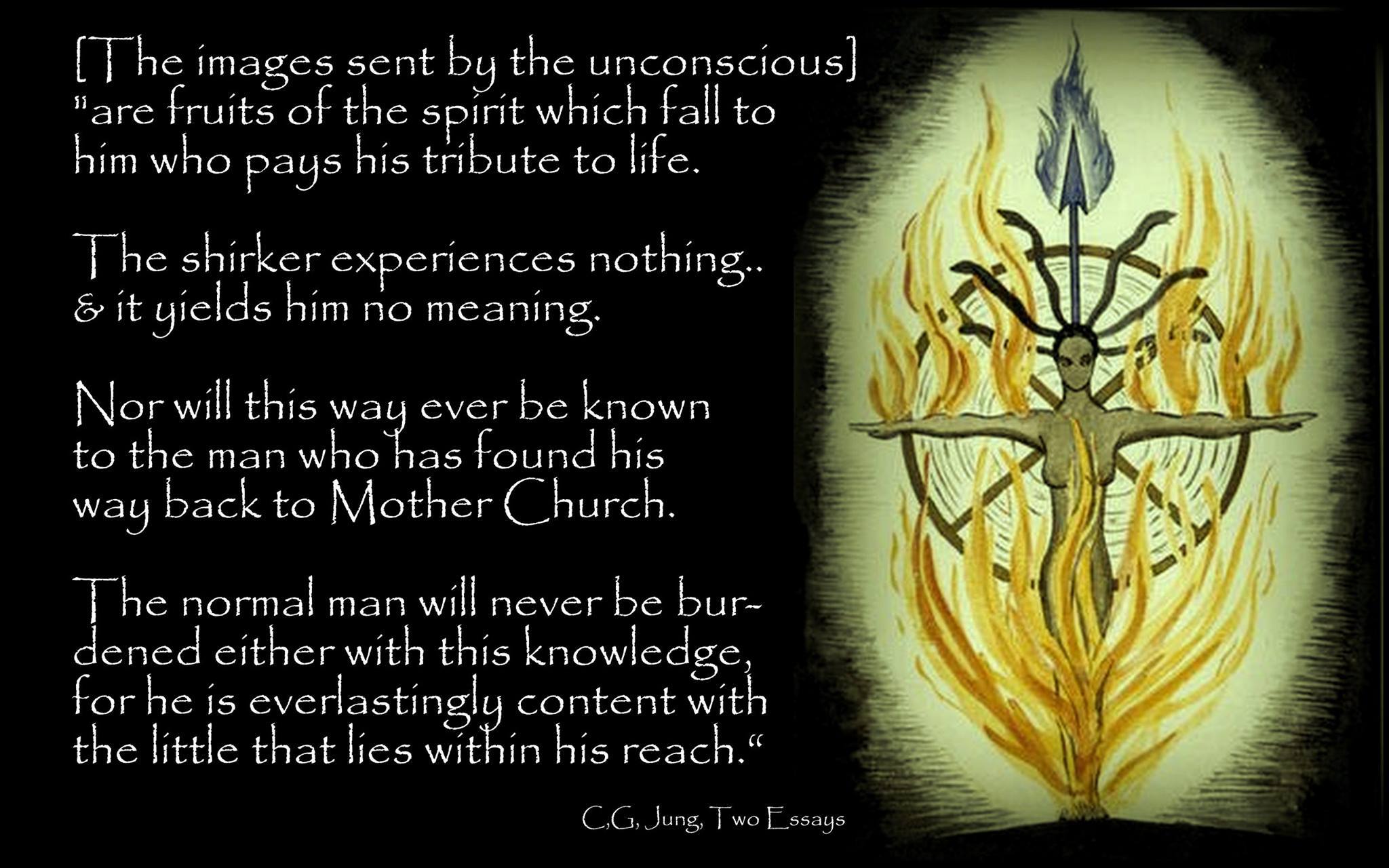
Fantasies are no substitute for living; they are fruits of the spirit which fall to him who pays his tribute to life.


The shirker experiences nothing but his own morbid fear, and it yields him no meaning.
Nor will this way ever be known to the man who has found his way back to Mother Church.
There is no doubt that the mysterium magnum is hidden in her forms, and in these, he can live his life sensibly.
Finally, the normal man will never be burdened, either, with this knowledge, for he is everlastingly content with the little that lies within his reach.
Wherefore I entreat my reader to understand that I write about things which actually happen and am not propounding methods of treatment.
~Carl Jung, CW 7, Pages 223-224

The Mystery Of β€œMana Personality” Part Seven

Standard

Translated from volumes published by Lorenz Jung based on the edition “Gesammelte Werke” dtv.de The Symbols of Transformation (1952) and Aion (1950)

Here, I present another aspect of “Manaβ€”Personality,” and honestly, I’m getting more and more excited to delve deeper and deeper into the subject! (The past episodes: 1, 2, 3, 4, 5, 6,)
In this part, Jung continues explaining the concept of Mana and its impact on our lives from childhood to adulthood. He describes our inner try of separation from our parents, the process of growing up within a religious context, and the acknowledgement of God. He also provides an excellent explanation of our attitudes and behaviours towards authority figures and those in power.

Individuation
The Mana Personality (P7)

By distinguishing the “I” from the archetype of the Mana Personality, one is now compelled – just as in the case of the anima – to make conscious those unconscious contents which are specific to the Mana Personality. Historically, the Mana Personality is always in possession of the secret name or of the special knowledge or the prerogative of a special action (quod licet Jovi, non licet bovi), in a word: of Individual Distinction. Becoming aware of the content that builds up the archetype of the Mana Personality means for the man the second and true liberation from the father, for the woman from the mother and thus the first feeling of her own individuality. This part of the process corresponds precisely to the intention of the concrete primitive initiations up to baptism, namely the separation from the >carnal< (or >animal<) parents and the rebirth >in novam infantiam<, into the state of immortality and spiritual childhood, as formulated by certain ancient mystery religions, including Christianity.

One may not identify with the Mana Personality, opting to view it as an extramundane ‘Father in Heaven’ embodying Absoluteness, which many find significant; if faith is achieved, this leads to an absolute dominance of the unconscious, causing the entire world to flow toward it.

The title image and this one by G R Z A ࿐

(Absolute means “detached”. To declare God to be absolute is to place him outside of all connection with man. Man cannot act on him, and he cannot act on man. Such a God would be a completely irrelevant thing. One can, therefore, only reasonably speak of a God who is relative to humans as is to God. The Christian conception of God as a “Father in heaven” expresses the relativity of God in exquisite form. Quite apart from the fact that man can make out less about God than an ant can about the contents of the British Museum, this urge to declare God absolute arises only from the fear that God might become ‘psychological’. That would, of course, be dangerous. An absolute God, on the other hand, is of no concern to us at all, whereas a “psychological” God would be real. This God could reach man. The Church seems to be a magical instrument to protect man from this eventuality, for it is said that “it is a fearful thing to fall into the hands of the living God”.)

The logical consequence of this is that only a miserable, inferior, useless and sin-laden bunch of people remains. As is well known, this solution has become a historical worldview. Since I am only moving on psychological ground here and have no inclination to dictate my eternal truths to the universe, I must critically note that if I push all the highest value onto the side of the unconscious and construct a summum bonum from it, I have found myself in the unpleasant position of also inventing a devil of equal weight and size who maintains the psychological balance of my summum bonum. But under no circumstances will my modesty allow me to identify myself with the devil. That would be too presumptuous and would also put me in unbearable opposition to my highest values. But I cannot afford that, given my moral deficit.

That I feed the hungry, that I forgive an insult, that I love my enemy in the name of Christ β€” all these are undoubtedly great virtues.
~C.G. Jung, Memories, Dreams, Reflections
Carl Jung Depth Psychology

For psychological reasons, I would, therefore, recommend not constructing a God from the archetype of the Mana Personality, that is, not making it concrete, because, in this way, I avoid projecting my values ​​and non-values ​​onto God and the devil, and, in this way I preserve my human dignity, my own specific weight, which I need so much in order not to become the unresisting plaything of unconscious powers. When you deal with the visible world, you have to be crazy to assume that you are the master of this world. Here, the principle of non-resistance to all superior factors is naturally followed up to a certain individual limit. At this point, even the most peaceful citizen becomes a bloody revolutionary. Our bowing to law and state is a recommendable model for our general attitude toward the collective unconscious. (>Give to Caesar what is Caesar’s, and to God what is God’s. <) Our bowing would not be difficult up to this point. But there are also factors in the world to which our conscience does not necessarily say yes, and we bow before them. Why? It is practically more beneficial than the opposite. Likewise, there are factors in the unconscious where we have to be nothing but clever. (>Do not resist evil. < >Make friends for yourselves in the huts of unjust mammon. < >The children of the world are cleverer than the children of light<, ergo: >Be wise as serpents and gentle as doves. <)

To be continued! πŸ’–πŸ™πŸ€—

The Mystery Of β€œMana Personality” Part Six

Standard

Translated from volumes published by Lorenz Jung based on the edition β€œGesammelte Werke” dtv.de The Symbols of Transformation (1952) and Aion (1950)

Continuing the concept of Mana-Personality, Dr. Jung advises us not to underestimate the unconscious mind and even offers a prescription for better managing this issue. (I dearly share here the last parts, 12345, if someone wants to check out!)πŸ™

As I read more from Dr. Jung, I find that the issues he discusses do not pertain to a specific time period; they are fundamental and timeless, as we can clearly observe them in the present.

So, I believe following his concepts can heal our ailing society. He did an excellent job of helping us understand our inner unknown.
Let’s read another chapter of this Mana riddle.

Individuation
The Mana PersonalityΒ (P6)

The Mana personality develops historically into a heroic figure and a god-man (according to popular belief, the highest Christian king could cure epilepsy with his Mana by laying on hands), whose earthly figure is the priest. The analysts can tell us something about how much the doctor is still a man-personality. Insofar as the “I” apparently draws the power belonging to the anima to itself, the ego becomes a mana personality. This development is an almost regular occurrence. I have never seen a more or less advanced development process of this kind where identification with the archetype of the Mana personality did not take place, at least temporarily. And it is the most natural thing in the world that should happen this way because not only you do expect it yourself, but everyone else expects it too. One can hardly help but admire oneself a little because one has seen deeper than others, and the others have such a need to find somewhere a tangible hero or a superior wise man, a leader and father, an unquestionable authority, that they are very willing to build temples and burn incense to even petty gods. It is not just the lamentable foolishness of the uncritical followers but a psychological law of nature that what was before will always be again. And this will always be the case as long as consciousness does not interrupt the naive concretization of the archetypes. I do not know whether it is desirable for consciousness to alter the eternal laws; I only know that it sometimes alters them and that this measure is a vital necessity for certain people, which, however, does not prevent them from placing themselves on the throne of the father in order to make the old rule come true once again. Indeed, it is difficult to see how one could escape the overwhelming power of the archetypes.

Johfra Bosschart Occult Surrealist

I don’t believe that one can escape this overwhelming power. One can only change one’s attitude towards it and thereby prevent oneself from naively falling into an archetype and then being forced to play a role at the expense of one’s humanity. Being obsessed with an archetype turns a person into a mere collective figure, a kind of Mask behind which humanity can no longer develop but instead increasingly atrophies. One must, therefore, be aware of the danger of falling prey to the dominant Mana personality. The danger is not only that one becomes the FatherMask oneself but also that one falls prey to this Mask if someone else wears it. In this sense, master and student are the same.

The dissolution of the anima means that one has gained insight into the driving forces of the unconscious, but not that we have rendered these forces ineffective ourselves. They can attack us again in a new form at any time. And they will inevitably do so again if there is a gap in the conscious attitude. Power stays against power. When the “I” assumes power over the unconscious, the unconscious reacts with a subtle attack, in this case, with the dominance of the Mana personality, whose enormous prestige captivates the “I”. The only way to protect oneself against this is to fully admit one’s own weakness in the face of the forces of the unconscious. In this way, we do not oppose the unconscious with power, and as a result, we do not provoke the unconscious either.

Illustration: Nikolai Zaitsev

It may sound strange to the reader when I speak of the unconscious, so to speak, in a personal way. I do not want to provoke condemnation by thinking of the unconscious as personal. The unconscious consists of natural processes that lie beyond the human-personal. Only our consciousness is >personal<. So when I talk about >provoking<, I don’t mean that the unconscious is somehow offended and – like the old gods – does something to someone out of jealousy or vengeance. I often mean something like a psychological diet error that upsets my digestion. The unconscious reacts automatically, like my stomach, which figuratively takes revenge on me. If I assume power over the unconscious, that is a psychological dietary error, an unsatisfactory attitude that is best avoided in the interest of one’s own well-being. My unpoetic comparison is, however, a little too mild considering the far-reaching and devastating moral effects of a disturbed unconscious. In this respect, I would prefer to speak of the vengeance of offended gods.

To be continued! πŸ’•πŸ––πŸ’–

The Mystery Of β€œMana Personality” Part Three

Standard

Translated from volumes published by Lorenz Jung based on the edition β€œGesammelte Werke” dtv.de The Symbols of Transformation (1952) and Aion (1950)

Mana-personality. A personified archetypal image of a supernatural force.

The Mana-personality is a dominant of the collective unconscious, the well-known archetype of the mighty man in the form of hero, chief, magician, medicine-man, saint, ruler of men and spirits, and the friend of God.[The Mana-Personality,” CW 7, par. 377.]

Mana is a Melanesian word referring to a bewitching or numinous quality in gods and sacred objects.

Historically, the Mana-Personality evolves into the hero and the godlike being, whose earthly form is the priest. How very much the doctor is still Mana is the whole plaint of the analyst! [Ibid., par. 389.]

Art by thecyclopssun

A Mana-Personality embodies this magical power. In individual psychology, Jung used it to describe the inflationary effect of assimilating autonomous unconscious contents, particularly those associated with anima and animus. (The text and the image are from Carl Jung’s Depth Psychology by my brilliant friend Lewis Lafontaine.)

I started with these specific sections of my friend’s website to better understand this enigmatic topic. Personally, I find Mana to be funny, attractive, amusing, intriguing, and, at the same time, very monstrous.

And now, after sharing parts one and two, I present part three, which is a short one so as not to bore you, or better to say, because of the preparations for my trip! I will be taking a two-week vacation, and the internet connection can be difficult on this trip. But after that, I promise to share a larger and more interesting part when I return!!πŸ’–

Individuation
The Mana Personality (P3)

In contrast, our pitifully limited “I”, if it possesses even a spark of self-knowledge, can only withdraw and quickly abandon any illusion of power and importance. It was an illusion: the “I” has not overcome the anima and, therefore, has not acquired its Mana. The consciousness has not become master of the unconscious, but the anima has lost its domineering presumption to the extent that the “I” has been able to come to terms with the unconscious. This conflict, however, was not a victory of consciousness over the unconscious but the establishment of a balance between the two worlds.

The ‘magician’ could only take possession of the “I” because the “I” dreamed of a victory over the anima. This was an attack, and every attack by the “I” would be followed by an attack by the unconscious.

>In a transformed figure
I exercise grim power. <
(Goethe: Faust II, Act 5, Scene 4, in Works in ten volumes, Vol. 4, 1961)

Faust surrounded by his Illustration, to Goethe’s Faust by Harry Clarke 1925

Therefore, if the “I” abandons its claim to victory, the obsession by the magician automatically ceases. But where does the Mana go? Who or what becomes Mana if even the magician can no longer perform magic? We now know that neither the conscious nor the unconscious has Mana, for it is certain that if the “I” does not claim power, then no obsession arises, which means that the unconscious has also lost its supremacy. In this state, the Mana must have fallen into the hands of Something that is conscious and unconscious, or neither conscious nor unconscious. This Something is the sought-after “centre” of the personality, that indescribable Something between the opposites, or the unifier of the opposites, or the result of the conflict, or the “achievement” of the energetic tension, the development of the personality, a most individual step forward, the next stage.

I do not expect the reader to follow the rapid overview of the whole problem in every detail. He should consider it a kind of exposition, the more detailed intellectual elaboration of which I will give in the following…

To be continued! I wish you all a great time.πŸ’–πŸ™πŸ’–πŸŒΉ

PS: As the World Wide Web chaos happened yesterday, I hope our flight stays intact!!πŸ˜πŸ˜…πŸ™