Keep Quiet, and Listen; Silence Speaks!

Standard

Last night
I begged the Wise One to tell me
the secret of the world.
Gently, gently, he whispered,
“Be quiet,
the secret cannot be spoken,
It is wrapped in silence.”

Rumi

I wonder if any of you, my dear friends, have noticed how this hurried pace of life is affecting us globally, with people rushing unconsciously, often unaware of their surroundings or the noise around them. It seems time is passing faster than it used to, and this perception isn’t related to age, contrary to some beliefs. In both modern and traditional contexts, we often overlook an essential aspect: silence. I particularly notice this when I step into the forest, pause, and listen quietly.

Silence holds significant value that is often overlooked in our noisy world. It creates a space for reflection, helping us process our thoughts and emotions without external distractions. During quiet moments, creativity can flourish, fostering deeper thinking and the development of new ideas. Additionally, silence can foster a sense of peace and calm. In a hectic environment, pausing to embrace silence can refresh the mind and spirit, ease stress, and sharpen decision-making. In conversations, silence can be powerful, as listening is a sign of intelligence. It enables thoughtful responses and promotes meaningful dialogue. By embracing silence, we can enhance our listening skills and better understand others. Ultimately, silence’s value is in its ability to connect us with ourselves and others, encouraging introspection and stronger relationships. Whether through meditation, nature, or solitude, embracing silence can enrich our lives in many ways.

After sharing a quote from Rumi, I would like to offer a poem by Pablo Neruda. I hope you enjoy them and might relish a moment of silence to cherish.

Keeping Quiet
By Pablo Neruda


Trans. Alastair Reid

Now we will count to twelve
And we will all keep still
for once on the face of the earth,
let’s not speak in any language;
let’s stop for a second,
and not move our arms so much.

It would be an exotic moment
without rush, without engines;
We would all be together
in a sudden strangeness.

Fishermen in the cold sea
would not harm whales
and the man gathering salt
would not look at his hurt hands.

Those who prepare for green wars,
wars with gas, wars with fire,
victories with no survivors,
would put on clean clothes
and walk about with their brothers
in the shade, doing nothing.

What I want should not be confused
with total inactivity.
Life is what it is about.
I want no truck with death.

If we were not so single-minded
about keeping our lives moving,
and for once could do nothing,
perhaps a huge silence
might interrupt this sadness
of never understanding ourselves
and of threatening ourselves
with death.
Perhaps the earth can teach us,
as when everything seems dead
and later proves to be alive.

Now I’ll count up to twelve.
And you keep quiet, and I will go.

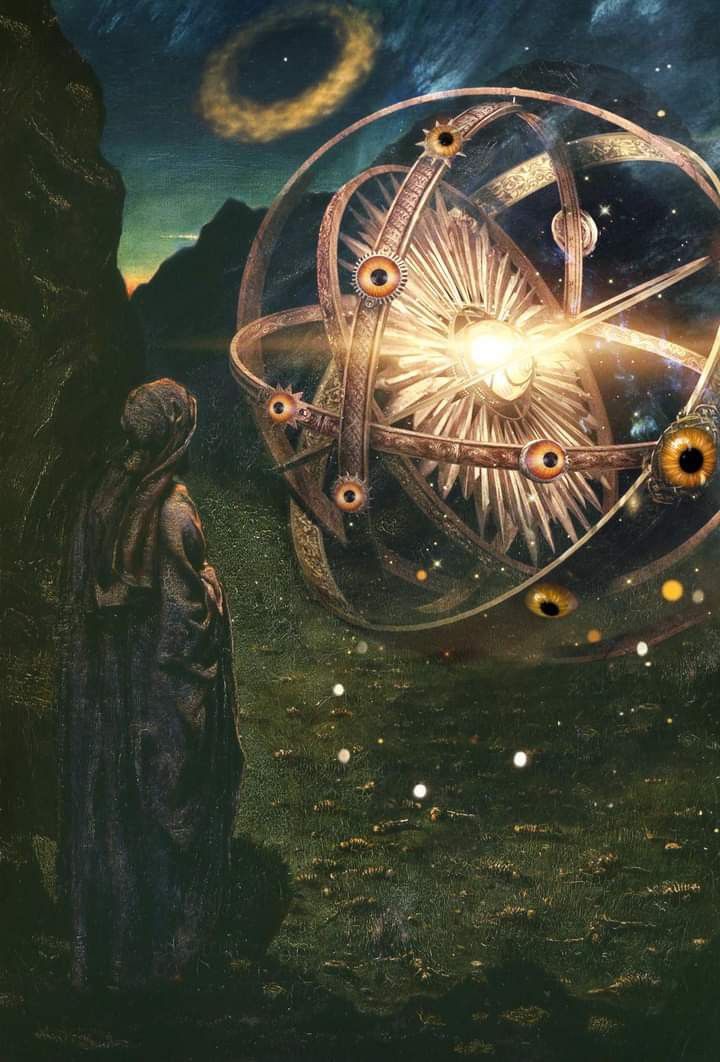
Title image: Dreamscapes and nightmares by the artist R.S. Connett.

Thank you. Peace and Love.

Changing The Level Since Eighteen Years, Yet Still Present!

Standard

It’s been around two weeks since my brother’s anniversary, and I am late this year. Was it the recent incidents in the Middle East, or exhaustion from continuously writing about death? I’m not sure. Yet, it wasn’t the forgetfulness; I still feel his presence, and it gives me strength.

I titled this post ‘Changing the Level…’ because it reflects Al’s interpretation of death. I also agree with him that since no Persephone has returned from Hades to describe it, we have the free will to accept our assumptions about the afterlife as we imagine them.

Let’s stop discussing death and speculating about the afterlife. This time, I want to share with you a story about him and his relationship with our father, especially his actual name, which he truly disliked. It’s pretty common for fathers and sons with similar genetic material to struggle to get along.

As I mentioned in my article a few weeks ago, our father was a devout Muslim with a strong emphasis on the mystical aspects of the faith. He loved the Arabic language, which he always regarded as one of the most perfect languages in the world. As a result, he gave us Arabic names. I was fortunate to have a name associated with an enchanting fairy tale. Unfortunately, Al’s name, inherited from our grandfather, is a genuine Arabic name: Abulhasan! (I also refer to a promise I made to a respected friend of mine, Resa.)

Things deteriorated further when he tried to abbreviate our names for calling. He knew that shortening Abulhassan to Abul sounded awful, so he picked two sounds he thought suited us: ‘Ala’ for me and ‘Aali’ for Al, both meaning “the best of all.” I was still lucky in this instance, but ‘Aali’ is technically an adjective meaning excellent—more appropriate as a source or descriptor than a proper name. This mistake led to trouble for Al; at school, he was fooled, teased, and bullied.

He carried this burdensome heritage throughout his life. After we escaped to the West, he became quite desperate about how friends called him. Most called him Ali, a plain, simple Arabic name, but close and smart friends called him McAllister, after the English footballer from Liverpool, his ever-beloved team. As a result, his name was shortened to McAll, then to All, or Al!
I do believe choosing names is a crucial decision for parents, and honestly, as Persians, we were not particularly enthusiastic about Arabic names.

In any case, he could have had greater success in life, especially as an author, if circumstances had been different, and I understand this well. We were neither of us fortunate! Still, he endured for 57 years, and I, with my worn-out body and suffering soul, seek to join him.

I dedicate this song to you, Al, because you introduced me to Emily Dickinson and Robert Frost; thank you!

Thank you for reading. 🙏💖

A Deeper Look into Our Sufferings Reflection!

Standard

Next week, I have my surgery appointment, and before I go under the surgeon’s knife, as the Germans say, I wanted to say “a short” goodbye. Since I know most of you are doing very well, as I receive your posts every day, every hour, you can send your positive thoughts towards my surgical table in between!

There are no words to describe the suffering and pain I endured, as I understand that one must experience it oneself to truly grasp its affliction. I hope that none of you experience that!
What I can say with certainty is that I have gained invaluable insights. I learned about my weaknesses and the extent of my power. I have discovered how low one can go and where the steps are to climb up.

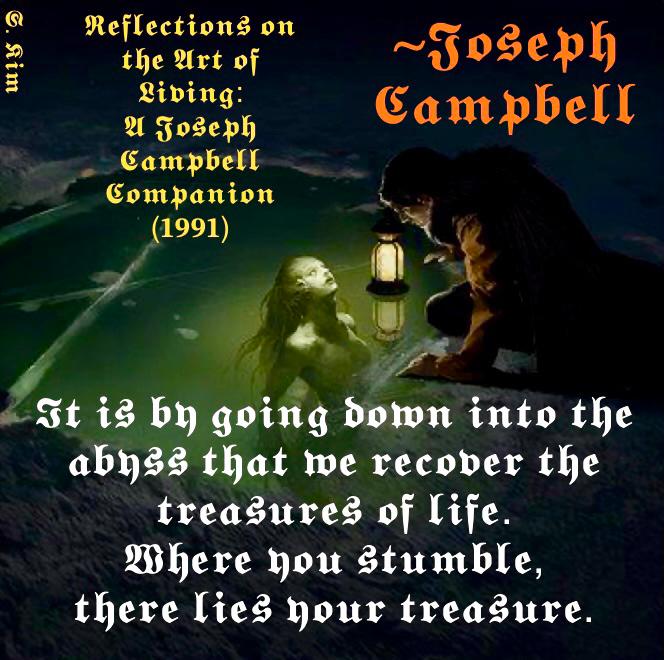
It is by going down into the abyss that we recover the treasure of life. Where you stumble, there lies your treasure.
~Joseph Campbell

I learned about my deep depression, where tiny fairies would converse with me. I’ve learned to remain resilient despite all challenges, echoing Ernest Hemingway’s words: “A man can be destroyed but not defeated.” Additionally, one of his characters, Harry Morgan, states in “To Have and Have Not”: “A man alone ain’t got no chance,” yet he persistently strives to do his best! Of course, I had support from my adorable wife, son, and a few friends. Nevertheless, during my most challenging times, it was ultimately up to me to endure that pain alone. I’m very stubborn about seeking help!

As I conclude my post, I would like to acknowledge my mentor, Dr. Jung, and his perspective on suffering:

via: Carljungdepthpsychologysite.blog With heartfelt thanks to my friend and teacher, Lewis Lafontaine.

Letters of C. G. Jung: Volume 2, 1951-1961

Dear Herr N., 28 April 1955

Your ideas bring you up against a general cultural problem, which is infinitely complicated.

What is true in one place is untrue in another.

“Suffering is the swiftest steed that bears you to perfection,” and the contrary is also true.

“Breaking in” can be discipline, and this is needed for the emotional chaos of man, though at the same time it can kill the living spirit, as we have seen only too often.

In my opinion, there is no magical word that could finally unravel this whole complex of questions; nor is there any method of thinking or living or acting which would eliminate suffering and unhappiness.

If a man’s life consists half of happiness and half of unhappiness, this is probably the optimum that can be reached, and it remains forever an unresolved question whether suffering is educative or demoralising.

In any case, it would be wrong to give oneself up to relativism and indifferentism.

Whatever can be bettered in a given place at a given time should certainly be done, for it would be sheer folly to do otherwise.

Man’s fate has always swung between day and night.

There is nothing we can do to change this.

Yours sincerely,

C.G. Jung ~Carl Jung, Letters Vol. II, Page 248.

I hope everyone enjoys a tranquil and relaxing time; take care and stay healthy. 🙏💖🌹

The Seed is the Word of God, and the Ground is Our Hearts. (Bible; Verse 14 & Verse 15)

Standard
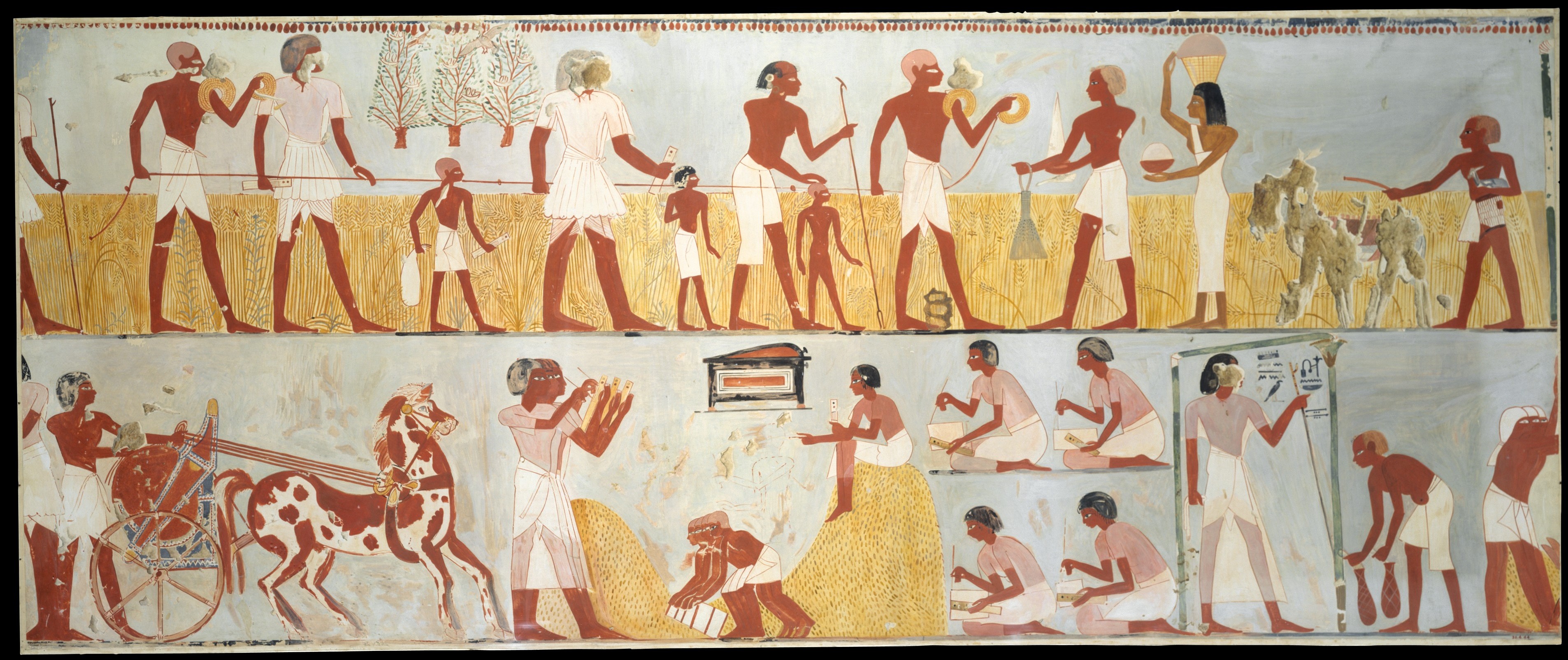
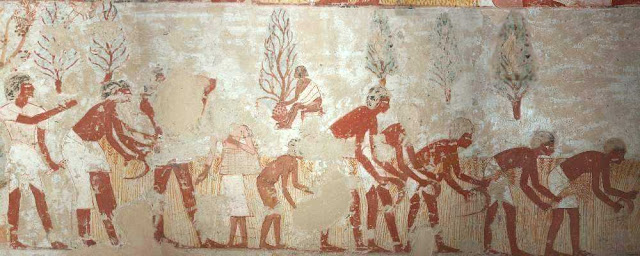
Charles K. Wilkinson Harvest Scenes, Tomb of Menna Twentieth Century; original New Kingdom The Metropolitan Museum of Art

And God said, “Behold, I have given you every plant yielding seed that is on the face of all the earth, and every tree with seed in its fruit. You shall have them for food. Genesis 1:29

Agathos Daimon, Osiris, Demeter, Neper, Abellio… All the gods have blessed human farming, but how old is our knowledge of agriculture?

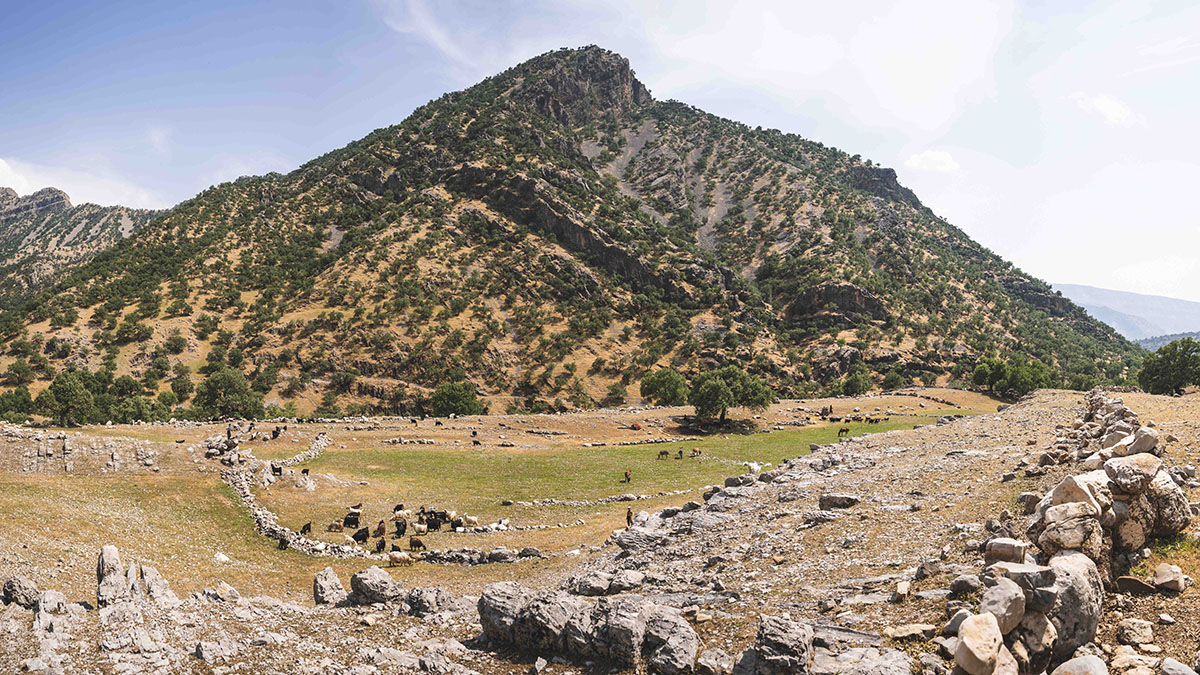
The Zagros Mountain range, located along the border between Iran and Iraq, was home to some of the world’s earliest farmers. Around 12,000 years ago, hunter-gatherer ancestors began experimenting with farming. Somewhere else, it says that Egyptians were among the first to practice agriculture on a large scale, starting in the pre-dynastic period from the end of the Paleolithic period into the Neolithic period, between around 10,000 BC and 4000 BC. This was made possible with the development of basin irrigation.

Neandertaler beim kochen!

However, this transition may have deeper historical roots. In “Neanderthals, Bandits, and Farmers,” author Tudge explains that agriculture was not abruptly invented 10,000 years ago; instead, it had already existed in a form he refers to as proto-farming or hobby farming for at least 30,000 years prior. This sheds light on the origins of the population explosion associated with the advent of agriculture.

The sequential art found on the walls of the tomb of Menna The Theban Tomb TT69

Let’s return to Egypt, where agriculture and harvesting have been essential practices since ancient times. Thanks to the unforgettable friend Marc Chartier and the dear and adorable Marie Grillot for presenting this excellent article.

Egypt: Harvesting information on harvests

via égyptophile

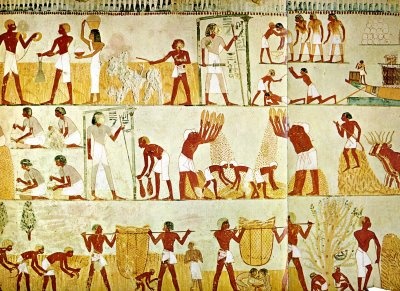
Tomb of Menna – photo Marie Grillot

In ancient Egypt, the harvest season (“chemo”) was a period of intense activity that kept agricultural workers busy for several weeks. When they were not enough for the task, mobile teams of reapers were added to them. Harvesting cereals began in Upper Egypt and progressed north to the Delta.

Administrative preambles marked the beginning of each harvest to check the equivalence between the result obtained and the forecasts: “When the ears of corn began to turn yellow,” writes Pierre Montet, “the peasant saw with apprehension the fields invaded by his natural enemies, his masters or the representatives of his masters, with a swarm of scribes, surveyors, employees and gendarmes who would first measure the fields. After that, the grains would be measured by the bushel, and one could get a very exact idea of ​​what the peasant would have to deliver, either to the agents of the treasury or to the administrators of a god such as Amon, who owned the best lands in the country.”

Tomb of Ounsou – photo The Louvre

The peasants used sickles with short handles and straight wooden blades in which flint teeth were embedded for their harvesting work. Later, this tool was replaced by a sickle with a curved metal blade. The harvester, leaning slightly forward, did not cut the stalks at ground level but as close as possible to the ears of corn, which he let fall to the ground. Women collected the ears of corn in baskets which, once complete, were carried to the end of the field, then from there, on the backs of donkeys or men, in large wicker baskets suspended from long sticks, were transported to the threshing floor.

The work had to be carried out quickly, often punctuated by the sound of a flute player. A supervisor was particularly attentive to the smooth running of operations, “watching over the grain.”

Tomb of Menna – photo Osirisnet.net

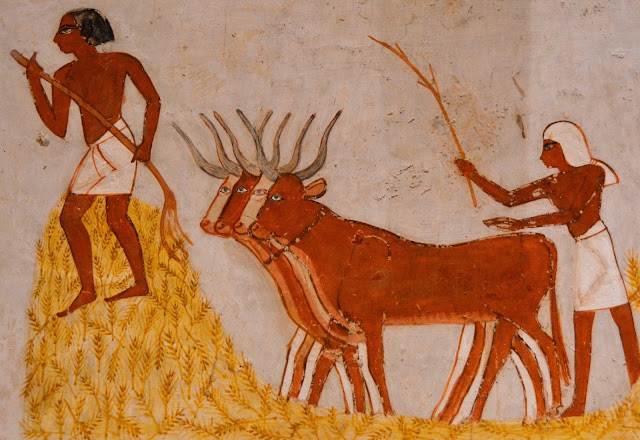
On the threshing floor, the harvested ears of corn were trampled to be threshed by oxen while the men used the flail to remove the grain and the pitchfork to separate the grain from the chaff. The final sequence was winnowing, often carried out by women, using hollowed-out ox hooves, curved pallets or wooden cups. The grain was finally stored in silos or warehouses, where scribes and controllers came to count the final product of the harvest. “The grains are cleaned,” Pierre Montet explains. “It is time for the scribes who come forward with everything they need to write and for the measurers who have taken their bushel. Woe to the peasant who has hidden part of his harvest or who, even in good faith, cannot give the lawyers everything that the field survey allows to be demanded. He is stretched out on the ground and beaten in rhythm, and worse misfortunes perhaps await him.”

The harvesters then had free rein to harvest for themselves, with the permission of the owners or managers, as much wheat or barley as they could gather in a day.

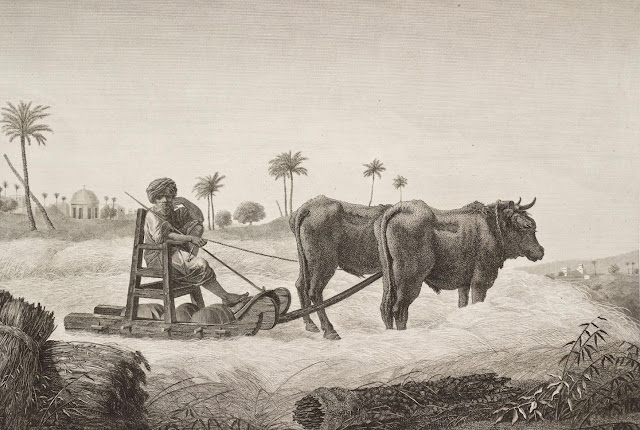
Looking back over the centuries, we note, from what Benoît de Maillet wrote in 1735 in his “Description of Egypt”, certain differences, but above all, a real continuity in peasant practices in the Nile Valley: “You would hardly forgive me if I forgot to tell you about harvest time and how it is done here. We regularly begin to work on the harvest at the end of April or in the first days of May. Then, we do not amuse ourselves by cutting the wheat, putting it in sheaves, and transporting it to places intended to preserve it for a long time in this way. The inhabitants of Egypt are more expeditious than all this. They begin by pulling up the grain and gathering it in the very middle of the fields in a space prepared to receive it. There, they gather it into a heap twenty to thirty feet in diameter, on which they first drive a few oxen to lower it. Then two oxen are yoked to a machine made in the form of a chair, furnished underneath with sharp stones, or eight or ten iron wheels threaded into a wooden axle. From this machine, a man seated there touches the oxen and makes several turns over this heap of barley or wheat until the wheels have cut the straw and separated the grain, which nevertheless remains with this chopped straw, which is kept for the cattle and serves as their oats. After this first method, the straw is separated from the grain and thrown lightly into the air with forks prepared for this purpose. Finally, there come sifters, who, with particular skill, separate the grain from the earth on the spot; after that, it is transported to granaries. This is how the harvest is carried out here, and this is all the trouble one has to collect the finest and best grain in the world.”

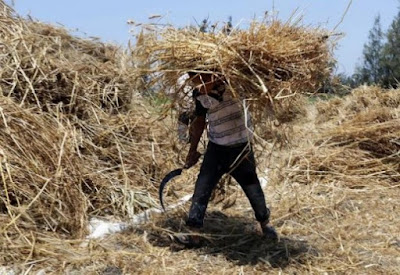
Photo Asma Waguth – Reuters

Two centuries later, the same observation: “[In Egypt], the wheat is cut with a primitive sickle; the ears are immediately tied into small sheaves, transported on camelback to the area where the grain will be threshed. This bare surface is usually set up near the fields. The sheaves are piled up there in large stacks.

The threshing machine, the ‘nôrag’, looks like a sledge. It is powered by oxen. Its wooden frame, on top of which sits the driver, supports solid iron wheels passed repeatedly over the wheat; they open the ears and separate the grain from the chaff. The detached stalks are collected, packed in net bags, and loaded onto donkeys’ backs. As for the grain, naturally mixed with straw, is piled up in heaps, ready to be winnowed. (…) Custom dictates that all harvesters are paid in kind. Lines of women and children can be seen returning from the fields carrying their wages on their heads. This custom goes back a long way and is observed to pay other people still.” (W.S. Blackman, Les fellahs de la Haute-Egypte, Payot, 1948)

It must be believed that in Egypt, perhaps more than elsewhere, agricultural practices and traditions span the centuries to the point of being almost timeless, even in their ritual side effects. In ancient Egypt, the beginning of the “chemo” season included the ceremony of the offering of the sheaf by the pharaoh: “presenting himself successively as protector and nourisher of Egypt” to the God Min, God of fertility, or other divinities such as Harsomtous.

Many centuries later, we read this account of another rite, certainly not directly linked to the pharaonic tradition, but no less important in popular “mythology”: “Before starting to cut the harvest, some villagers will pull out the most beautiful ears of corn by hand. They braid them according to a particular pattern, and the object thus formed, called the ‘bride of the grain’, ‘arûset el-qamh’, is used as a charm. One can hang one above the door of a house as a remedy against the evil eye; another will often take its place in the room containing the food provisions to ensure abundance.” (W.S. Blackman)

Sennedjem’s Tomb

Let us finally be guided to the Beyond of time, thanks to the symbolic richness of the tomb of Sennedjem (TT1) at Deir el-Medina in the fields of Ialou: “using a wooden sickle, the edge of which is encrusted with flint stones, Sennedjem, bent, cut the ears of corn very high. Thus, the straw will not be damaged by the trampling of the animals during threshing. Iyneferti (follows him) and collects the ears of corn, which she puts in a basket. We will notice in passing the size of the wheat stalks and the suggested immensity of the field that nothing limits. In the idyllic world of the Beyond, the harvests are always extraordinary.” (Osirisnet)

In these modern times, when Egypt is forced to buy wheat from foreign countries to meet the needs of its 90 million inhabitants, it is good to remember, as Benoît de Maillet wrote, that it produced “the most beautiful and best grain in the world.”

Marc Chartier

Sources :
Pierre Montet, Daily life in Egypt at the time of Ramses, Hachette, 1946 http://www.museum.agropolis.fr/pages/expos/egypte/fr/travaux/moisson.htm http://jfbradu.free.fr/egypte/SIXIEMES/agriculture/agriculture.html http://www.osirisnet.net/tombes/nobles/menna69/menna_02.htm

Published 11th May 2016 by Unknown