Sorry, it’s me again! I intended to share a brief message on Facebook, and I thought, why not just do it on my site, too? So here it is: We must look deeply around us and think twice. I send you all immense gratitude and wish you a lovely weekend.😁🤗💖🙏🦋🌹
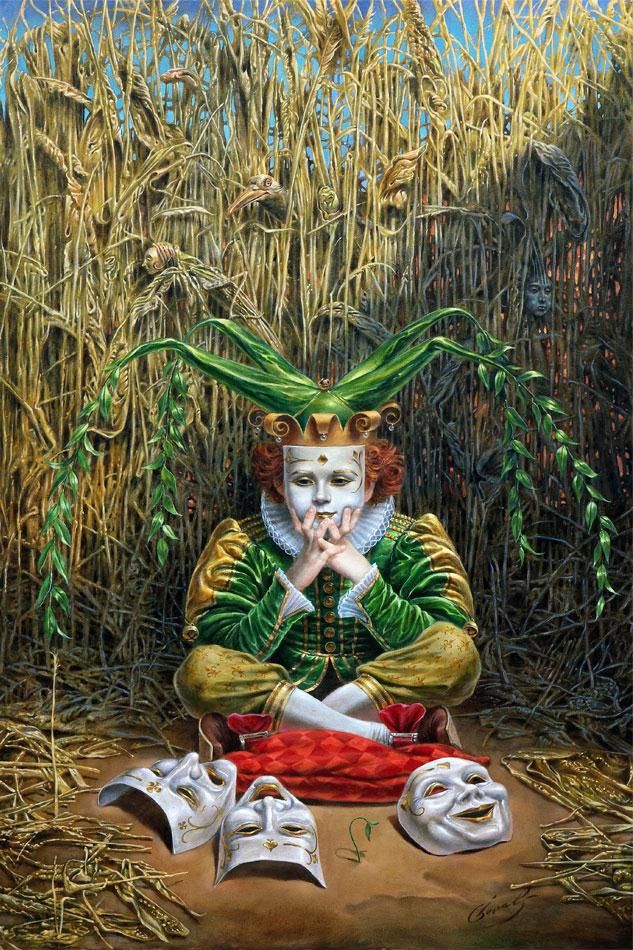
Title image; Art by Andrew Ferez
From Collected Works of C.G. Jung, Volume 7: Two Essays in Analytical Psychology,
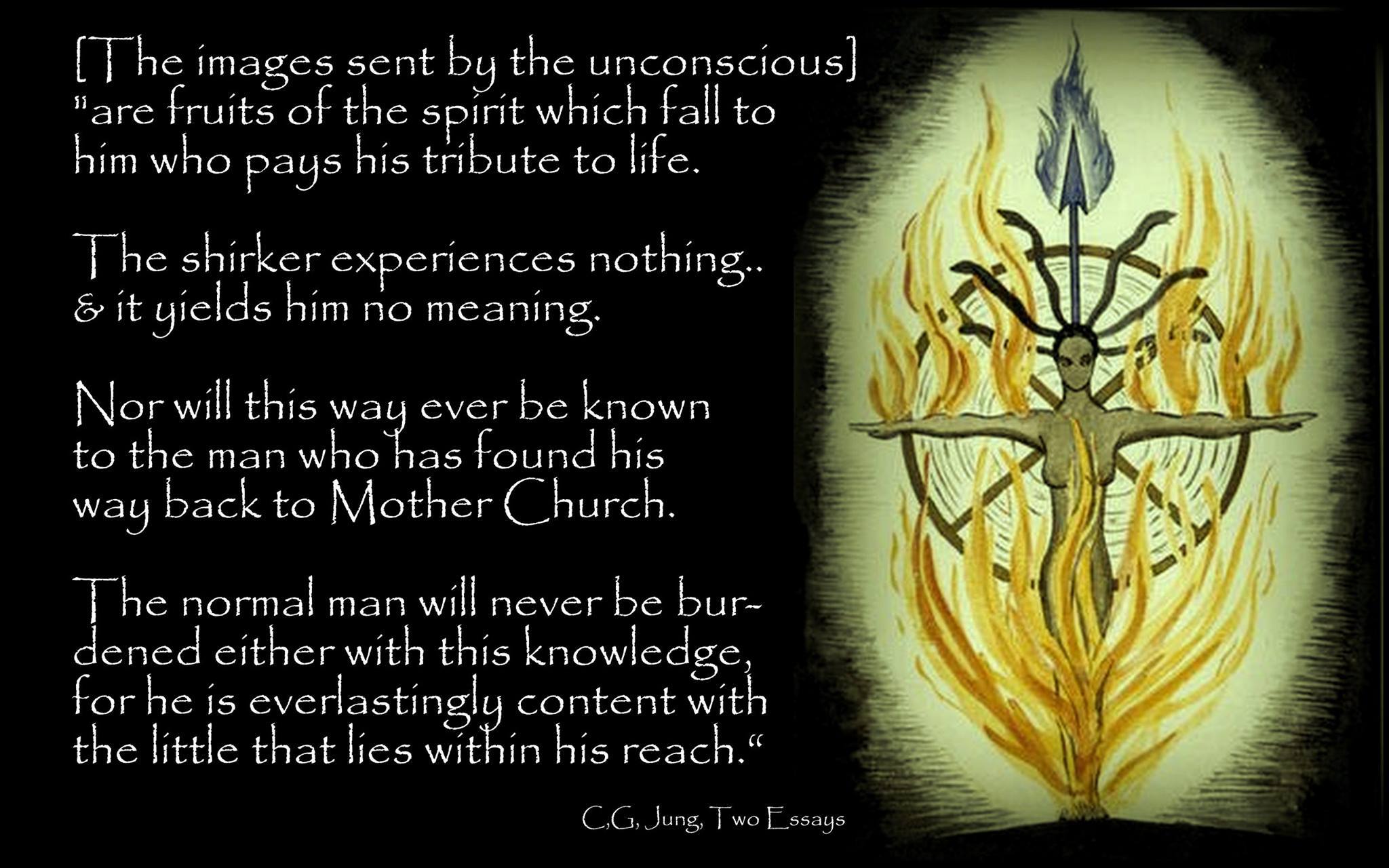
I must recall at this point a serious misunderstanding to which my readers often succumb, and doctors most commonly. They invariably assume, for reasons unknown, that I never write about anything except my method of treatment. This is far from being the case. I write about psychology. I must, therefore, expressly emphasize that my method of treatment does not consist in causing my patients to indulge in strange fantasies for the purpose of changing their personality and other nonsense of that kind. I merely put it on record that there are certain cases where such a development occurs, not because I force anyone to it, but because it springs from inner necessity. For many of my patients, these things are and must remain double Dutch. Indeed, even if it were possible for them to tread this path, it would be a disastrously wrong turning, and I would be the first to hold them back. The way of the transcendent function is an individual destiny. But on no account should one imagine that this way is equivalent to the life of a psychic anchorite, to alienation from the world. Quite the contrary, for such a way is possible and profitable only when the specific worldly tasks which these individuals set themselves are carried out in reality. Fantasies are no substitute for living; they are fruits of the spirit which fall to him who pays his tribute to life.
The shirker experiences nothing but his own morbid fear, and it yields him no meaning. Nor will this way ever be known to the man who has found his way back to Mother Church. There is no doubt that the mysterium magnum is hidden in her forms, and in these, he can live his life sensibly. Finally, the normal man will never be burdened, either, with this knowledge, for he is everlastingly content with the little that lies within his reach. Wherefore I entreat my reader to understand that I write about things which actually happen and am not propounding methods of treatment. ~Carl Jung, CW 7, Pages 223-224
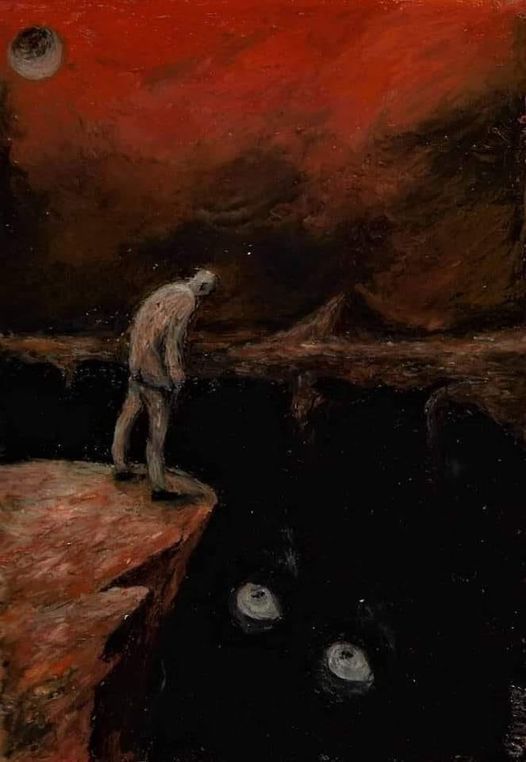
“Whoever fights with monsters should be careful not to become a monster himself. When you gaze long into an abyss, it also gazes into you.” ~Friedrich Nietzsche, Jenseits von Gut und Böse (1886) ch. 4, no. 146
Actually, I need to rest and post less frequently than before, but this short essay by adorable Laura London, an excellent Jungian expert at X (formerly Twitter), invigorated me. I couldn’t resist sharing it with you.
For many, contemplating and analyzing death is uncomfortable or even frightening. However, when we psychologically examine the world around us, we observe everything as dualistic, such as warm and cold, dark and light, love and hate, joy and grief… and, of course, life and death; neither can exist without the other!
There is no reason for many young people to think about death, except for some like me who are confronted with it by losing a part of their parent or both. However, as we reach a certain age, this challenge becomes unavoidable. Fear is not a solution, as we will inevitably confront the other side. Therefore, it is better to attempt to understand or envision it as much as possible. Reading this essay soothes the soul!
This quote from Jung is one of my favourites because it offers a breakthrough in our understanding of death.
Now, let’s read a tiny Colletti of Jung’s explanation on this issue, with heartfelt thanks to Laura London, which also included an introduction to an excellent book by Richard Wilhelm.
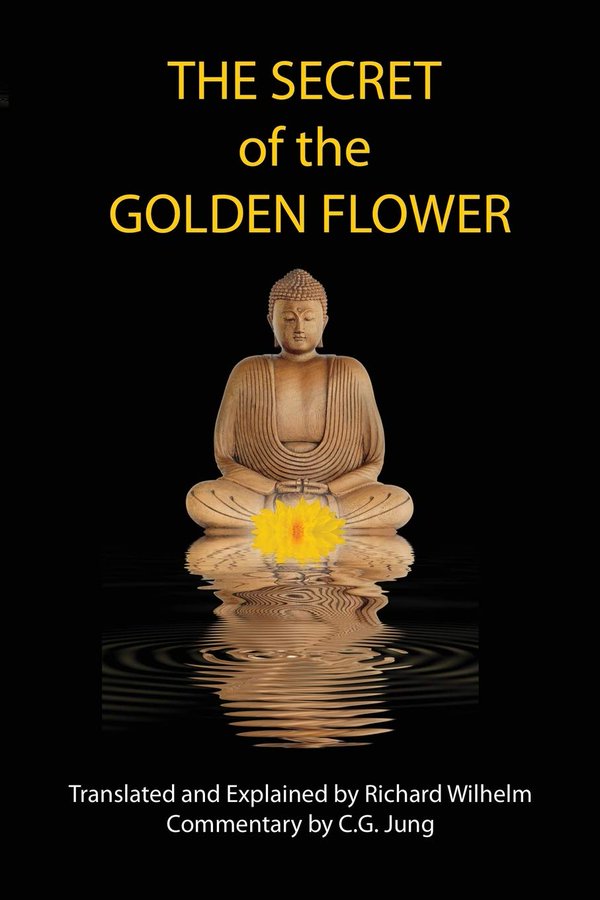
“From 1929 to 1934, #Jung presented his more mature thoughts about the mystery of death in three separate essays.⁵ In one of these essays, he stated that ‘anyone should draw the conclusion that the psyche, in its deepest reaches, participates in a form of existence beyond space and time, and thus partakes of what is inadequately and symbolically described as ‘eternity’’ [CW 8, par. 815]. Because of this, he also stated that as a doctor, I make every effort to strengthen the belief in immortality, especially with older patients … For … death is not an end but a goal, and life’s inclination towards death begins as soon as the meridian is passed’ [CW 13, par. 68]. Jung argued that the crisis of the second half of life is a sign that ‘nature prepares itself for death’ [CW 8, par. 808], hence, ‘it is hygienic … to discover in death a goal towards which one can strive’ [CW 8, par. 792], since ‘dying … has its onset long before actual death’ [CW 8, par. 809]. Jung concluded that ‘the #unconscious is all the more interested in how one dies; that is, whether the attitude of #consciousness is adjusted to dying or not’ [par. 809]. Death, then, became not only a goal for Jung but also a reality that could enrich life. Death begins before it happens, in midlife, so how one lives with death and how one approaches that goal became for Jung of paramount importance. In 1928, Jung received a copy of The Secret of the Golden Flower, a Chinese Taoist-alchemical text that, together with a dream he had which was set in Liverpool [Memories, Dreams, Reflections, pp. 220–223], confirmed to him that the goal of the #individuation process is the self, ‘the archetype of wholeness’ [CW 9ii, par. 351].”
⁵ “Commentary on ‘The Secret of the Golden Flower’” (1929); “The Stages of Life” (1930); “The Soul and Death” (1934).
~Luis Moris, Jungian psychoanalyst, “Jung’s Confrontation with Death: An Introduction, Confronting Death, pp. 7-8
🌼 You can watch my interview with Jungian psychoanalyst Luis Moris, editor of the book Confronting Death, in Episode 139 of Speaking of Jung.
Mythology (derived from the Greek word ‘mythos’, meaning ‘story’, and ‘logos’, meaning ‘word’) studies a culture’s sacred narratives or fables, known as myths. These stories explore various aspects of the human condition: good and evil, suffering, the origins of life, place names, cultural values, and beliefs regarding life, death, and deities. Myths reflect a culture’s values and beliefs. Mythology may also concentrate on specific collections of myths, whereas history examines significant past events and real individuals. Central characters in myths include gods, demigods, and supernatural beings. The earliest myths date back over 2,700 years, particularly in the works of the Greek poets Homer and Hesiod. Scholar Joseph Campbell defines four essential functions of myth: metaphysical, cosmological, sociological, and pedagogical.
“The wonder is that the characteristic efficacy to touch and inspire deep creative centres dwells in the smallest nursery fairy tale—as the flavour of the ocean is contained in a droplet or the whole mystery of life within the egg of a flea. Because the symbols of mythology are not manufactured, they cannot be ordered, invented, or permanently suppressed. They are spontaneous productions of the psyche, and each bear within it, undamaged, the germ power of its source.” -Joseph Campbell / From The Hero With A Thousand Faces
However, we can trace back to the ancient Assyrians, where we discover the epic of Gilgamesh (a form of the name derived from the earlier Sumerian form) and Enkidu. Honestly, whatever I know or feel passionate about that subject, I owe it to Al, my brother, who opened the mysterious gate for me to this fascinating world. We cannot overlook the allure of these stories, which not only expand our imagination but also impart a great deal of wisdom through their narratives. Thus, as Dr Jung emphasises here, possessing a myth is of considerable significance. There may even be some truth hidden within it; who knows?
(Parenthesis open) I have tried to write my usual “two posts,” though it has shown me that I do not quite fit as I usually do! I must confess that she, Resa, spurred me to work, for which I am very grateful. I also thank all my friends who attempted to support me, even if it sometimes sounded like Marie Antoinette’s supposedly quoted remark to the starving people of France: “If there is no bread, let them eat brioche!” Although there is no evidence that she actually said this. Also, I must rest. Nevertheless, I thank you all. (Parenthesis closed)!
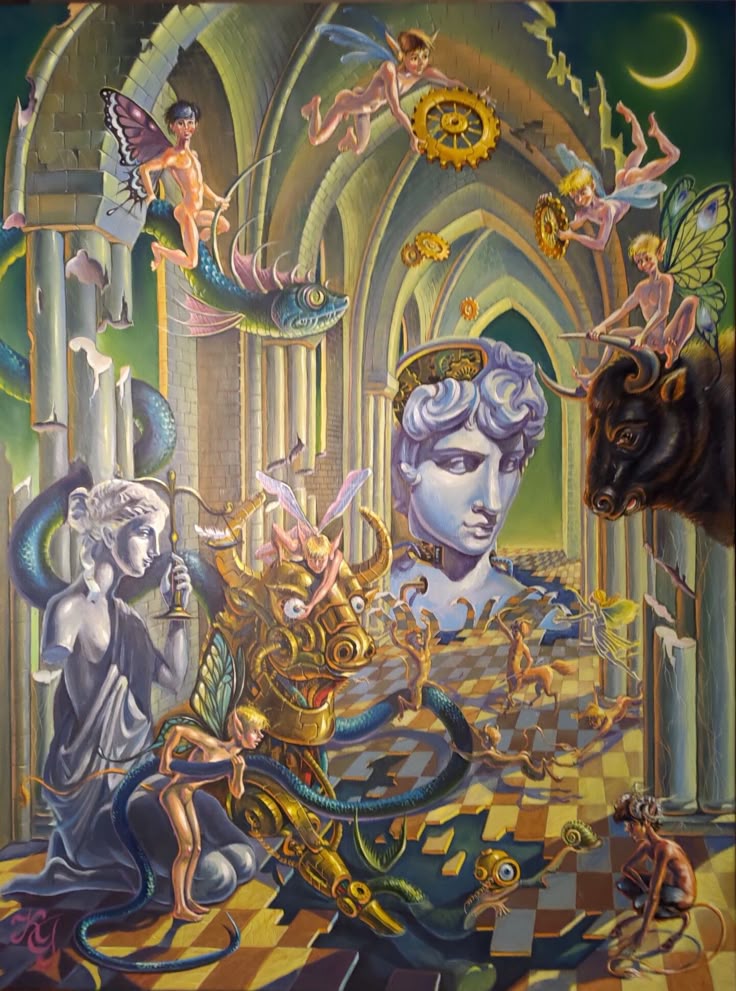
Painting (Oil) Original Artwork by Greg Known The Abducted Europe
I have selected an intriguing excerpt from the Red Book, Liber Novus, Introduction by Sonu Shamdasani, Reader’s Edition, to share. It illustrates the significance and necessity of having a myth for every individual. I have created a summary to keep it concise!
In 1908, Jung bought land by Lake Zürich in Küsnacht and built a house where he lived for life. In 1909, he resigned from Burghölzli to focus on his practice and research. His retirement coincided with a shift in interests toward methodology, folklore, and religion, leading to a vast private library. This research culminated in “Transformations and Symbols of the Libido,” published in two parts in 1911 and 1912, marking a return to his intellectual and cultural roots. He found this mythological work thrilling; in 1925, he reflected, “It seems to me I was living in an insane asylum of my own making. I went about with all these fantastic figures: centaurs, nymphs, satyrs, gods and goddesses, as though they were patients and I was analysing them. I read a Greek or a Negro myth as if a lunatic were telling me anamnesis. (Introduction to Jungian Psychology, p. 24). The late nineteenth century witnessed a surge in comparative religion and ethnopsychology scholarship, with primary texts being translated and examined, such as Max Müller’s “Sacred Books of the East,” which Jung owned, offering a global relativization of Christianity worldwide.
In Translations and Symbols of the Libido, Jung differentiated two types of thinking: directed and fantasy thinking. The former is verbal and logical, exemplified by science, while the latter is passive, associative, and imagistic, represented by mythology. Jung argued that the ancients lacked directed thinking, a modern development. Fantasy thinking occurs when directed thinking ceases. This work extensively studies fantasy thinking and the mythological themes present in contemporary dreams and fantasies. Jung linked the prehistoric, primitive, and child, suggesting that understanding adult fantasy thinking illuminates the thoughts of children, savages, and prehistoric people. (Jung, The Psychology of the Unconscious, CW B, s36. His 1952 revision clarifies this [Symbols of Transformation, CW 5, s29]. In this work, Jung synthesized 19th-century theories on memory, heredity, and the unconscious, proposing a phylogenetic layer of mythological images present in everyone. He viewed myths as symbols of libido, reflecting its movements, and used anthropology’s comparative method to analyze a wide range of myths, calling this “amplification.” He argued that typical myths correspond to ethnopsychological developments of complexes. Following Jacob Burckhardt, he referred to these as “primordial images” (Urbilder). One key myth, that of the hero, represents an individual’s journey to independence from the mother, with the incest motif symbolizing a desire to return to the mother for rebirth. Jung eventually hailed this discovery as the collective unconscious, though the term emerged later.
In a series of articles from 1912, Jung’s friend and colleague Alphonse Maeder argued that dreams had a function other than that of wish fulfilment, which was a balancing or compensatory function. Dreams were attempts to solve the individual’s moral conflicts. As such, they did not merely point to the past but also prepared the way for the future. Maeder was developing Flournoy‘s views of the subconscious creative imagination. Jung was working along similar lines and adopted Maeder’s positions. For Jung and Maeder, this alteration of the conception of the dream brought with it an alteration of all other phenomena associated with the unconscious.
In his preface to the 1952 revision of Transformations and Symbols of the Libido, Jung wrote that the work was written in 1911 when he was thirty-six: “The time is a critical one, for it makes the beginning of the second half of life, when a metanoia, a mental transformation, not infrequently occurs (CW 5, p. xxvi). He added that he was conscious of the loss of his collaboration with Freud and was indebted to the support of his wife. After completing the work, he realised the significance of what it meant to live without a myth. One without a myth “is like one uprooted, having no true link either with the past, or with the ancestral life which continues within him, or yet with contemporary human society (Ibid. p. xxix).
As he further describes it:
“I was driven to ask myself in all seriousness: “What is the myth you are living?” I found no answer to this question and had to admit that I was not living with a myth, or even in a myth, but rather in an uncertain cloud of theoretical possibilities, which I was beginning to regard with increasing distrust … So, in the most natural way, I took it upon myself to get to know “my” myth, and I regarded this as a task of tasks –for—so I told myself—how could I, when treating my patients, make due allowance for the personal factor, for my personal equation, which is yet so necessary for a knowledge of the other person, if I was unconscious of it?” (Ibid.)
The study of myth had revealed to Jung his mythlessness. He then undertook to get to know his myth, his “personal equation”. (Cf. Introduction to Jungian Psychology, p. 25) Thus, we see that Jung’s self-experimentation was, in part, a direct response to theoretical questions raised by his research, which culminated in Transformation and Symbols of the Libido.
PS: I will add a follow-up to this article in the future. 🙏💖

Translated from volumes published by Lorenz Jung based on the edition “Gesammelte Werke” dtv.de The Symbols of Transformation (1952) and Aion (1950)
via MagicShirtsDesigns
Greeting all! Today, I share the penultimate or the second to last episode of Dr. Jung’s extensive explanation of the mystery of Mana. This time, he speaks in a way that may simplify the meaning of Mana and its production, with examples that we might confront every day of life (indeed!) concerning religions, society, and private occurrences!
We all know how important and influential religion is in human life. There have been and still are wars caused by religions (as it is more apparent when people from the same tribe with the same roots and similar faith cruelly kill each other)! However, religions may not be the main perpetrators. The problem may lie deep in the dark corners of human nature.
Mana-Personality is one of these unknown forces that we must understand.
My God is a child, so wonder not that the spirit of this time in me is incensed to mockery and scorn. There will be no one who will laugh at me as I laughed at myself. ~Carl Jung, Liber Novus, Page 234.
You might remember that I actively assist my Iranian friends as they strive for freedom. However, I am feeling very pessimistic right now as I look at the situation and intricacy progression in the Middle East and see how the lobbyists in the West (i.e., the US, no matter if the next President will be Harris or Trump) are trying to take advantage of Iran’s future. Reading Jung helps me better understand the core of this issue and learn more.
I also learned something useful from my dear friend Luisa Zambrotta. (She has an excellent Website with many brilliant sequence stories you might not miss.) instead of numbering her stories one after another, she only uses the word “Previous” to help readers jump to the latest post if they want to. So I did it, too!🙏
The underlying scheme, the quaternio, i.e., the psychological equation of primordial dynamis (prima causa) with gods and their mythology, time and space, is a psychological problem of the first order.
So, let’s continue to delve further into the topic of Mana!
Individuation The Mana Personality (P8)
The Mana Personality is, on the one hand, a superior knower and, on the other hand, a superior wanter. By becoming aware of the content underlying this personality, we are able to deal with the fact that, on the one hand, we have learned something more than others and, on the other hand, we want something more than others. This unpleasant relationship with the gods is known to have struck poor Angelus Silesius so deeply that he returned headlong from his hyper-Protestantism, bypassing the now uncertain Lutheran stopover in the deepest womb of the black mother—unfortunately to the detriment of his lyrical talent and nervous health.
And yet Christ and, after him, Paul struggled with precisely these problems, which is still clearly evident from many traces. Meister Eckhart, Goethe in Faust, and Nietzsche in Zarathustra have brought this problem closer to us again. Goethe and Nietzsche try it with the idea of control, the former with the magician and ruthless man of will who takes on the devil, the latter with the master race and the superior wise man, without the devil and without God. According to Nietzsche, man stands alone, like himself, neurotic, financially supported, without God or the world. This is not an ideal possibility for a real person who has a family and has to pay taxes. Nothing can prove the reality of the world away; there is no miraculous way around it. Nothing can also prove the effect of the unconscious away. Or can the neurotic philosopher prove to us that he does not have a neurosis? He cannot even prove it to himself. Therefore, our souls stand between significant influences from within and without, and somehow, we must do justice to both. We can only do this according to our individual abilities. Therefore, we must reflect on ourselves, not on “what one should” but on what one can and what one must do. Thus, the dissolution of the Mana Personality through awareness of its contents naturally leads us back to ourselves as beings and living something that is kept between two world views and their darkness. Still, all the more clearly, it clamped in the perceived forces. This ‘something’ is alien to us and yet so close, completely our own and yet unknowable to us, a virtual centre of such a mysterious constitution that it can demand everything, kinship with animals and with gods, with crystals and stars, without surprising us, without even arousing our deformity. This something demands all of that, and we have nothing in our hands that we can reasonably oppose this demand, and it is even healing to hear this voice.
Art by Jeramondo Djeriandi (@djeriandi)
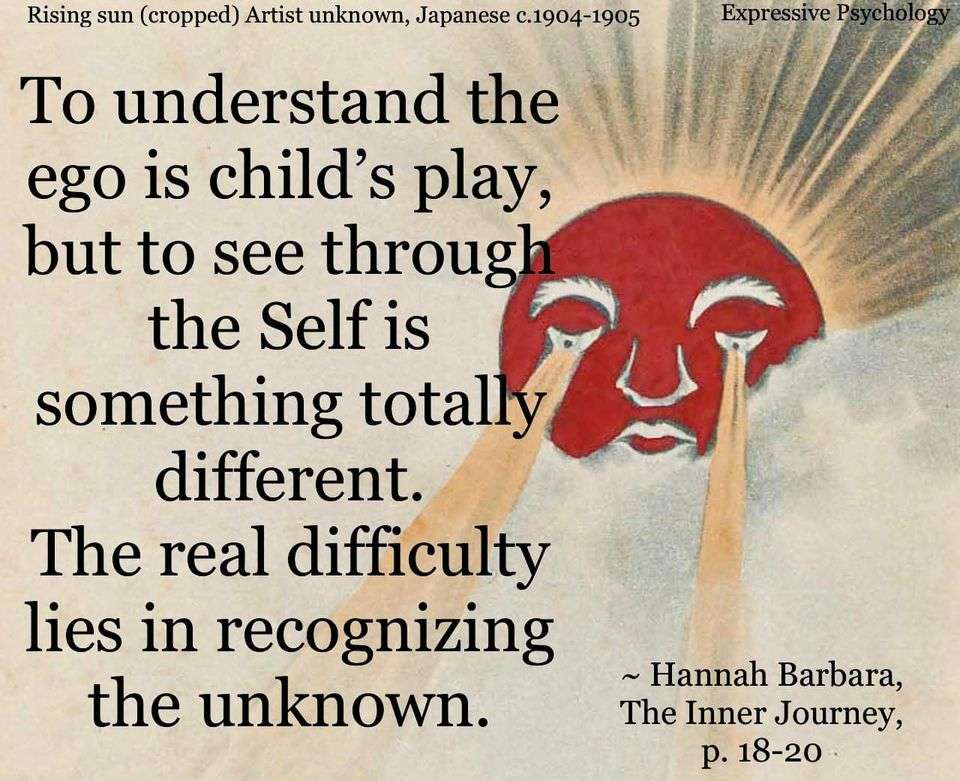
I have called this centre the Self. Intellectually, the Self is nothing but a psychological concept, a construct intended to express an entity that is unknowable to us and that we cannot grasp as such, for it is beyond our comprehension, as is clear from its definition. It might just as well be called the “God within us.” The beginnings of our whole psychic life seem to spring inextricably from this point, and all the highest and final goals seem to converge towards it. This paradox is inevitable, as it always is when we attempt to characterize something that lies beyond the power of our understanding.
I hope that it has become clear enough to the attentive reader that the Self has as much to do with the “I” as the sun has to do with the Earth. The two cannot be mixed up. Nor is it a question of the deification of man or the degradation of God. What lies beyond our human understanding is, in any case, inaccessible to it. When we use the concept of a god, we are simply formulating a certain psychological fact, namely the independence and superiority of specific psychic contents, which is expressed in their ability to thwart the will, to obsess (calm) the consciousness and to influence moods and actions. One might be outraged that an inexplicable mood, a nervous disorder or even an uncontrollable vice is in some way a manifestation of God. But it would be an irreplaceable loss for religious experience if such things, even terrible things, were artificially separated from the number of autonomous psychic contents. It is an apotropaic euphemism (a good thing for a bad thing, to avert its disfavour) to dismiss such things with a “nothing but” explanation. This would only repress them and, as a rule, would only result in a false advantage, a slightly modified illusion. The personality does not become enriched by this but rather impoverishes and becomes stagnant. What appears to be evil or at least senseless and worthless to today’s experience and knowledge can appear to be a source of the best to a higher level of expertise and knowledge, whereby everything naturally depends on the use one makes of one’s devils. Declaring it meaningless requires the personality of the shadow corresponding to it, and thus, it loses its form. The ‘living figure’ needs deep shadows to appear three-dimensional. Without the shadow, it remains a flat illusion of- or a more or less well-behaved child.
With this, I am alluding to a problem that is far more significant than the few simple words seem to express: Humanity is, for the most part, still psychologically in a state of childhood – a stage that cannot be skipped. The vast majority need authority, guidance and the law. This fact must not be overlooked. The Paulistic overcoming of the law is only possible for those who know how to put the soul in place of conscience. Very few are capable of this (>Many are called, but few are chosen.<), and these few only take this path out of inner compulsion, not to say necessity, for this path is as narrow as the edge of a knife.
Translated from volumes published by Lorenz Jung based on the edition “Gesammelte Werke” dtv.de The Symbols of Transformation (1952) and Aion (1950)
Here, I present another aspect of “Mana—Personality,” and honestly, I’m getting more and more excited to delve deeper and deeper into the subject! (The past episodes: 1, 2, 3, 4, 5, 6,) In this part, Jung continues explaining the concept of Mana and its impact on our lives from childhood to adulthood. He describes our inner try of separation from our parents, the process of growing up within a religious context, and the acknowledgement of God. He also provides an excellent explanation of our attitudes and behaviours towards authority figures and those in power.
By distinguishing the “I” from the archetype of the Mana Personality, one is now compelled – just as in the case of the anima – to make conscious those unconscious contents which are specific to the Mana Personality. Historically, the Mana Personality is always in possession of the secret name or of the special knowledge or the prerogative of a special action (quod licet Jovi, non licet bovi), in a word: of Individual Distinction. Becoming aware of the content that builds up the archetype of the Mana Personality means for the man the second and true liberation from the father, for the woman from the mother and thus the first feeling of her own individuality. This part of the process corresponds precisely to the intention of the concrete primitive initiations up to baptism, namely the separation from the >carnal< (or >animal<) parents and the rebirth >in novam infantiam<, into the state of immortality and spiritual childhood, as formulated by certain ancient mystery religions, including Christianity.
One may not identify with the Mana Personality, opting to view it as an extramundane ‘Father in Heaven’ embodying Absoluteness, which many find significant; if faith is achieved, this leads to an absolute dominance of the unconscious, causing the entire world to flow toward it.
(Absolute means “detached”. To declare God to be absolute is to place him outside of all connection with man. Man cannot act on him, and he cannot act on man. Such a God would be a completely irrelevant thing. One can, therefore, only reasonably speak of a God who is relative to humans as is to God. The Christian conception of God as a “Father in heaven” expresses the relativity of God in exquisite form. Quite apart from the fact that man can make out less about God than an ant can about the contents of the British Museum, this urge to declare God absolute arises only from the fear that God might become ‘psychological’. That would, of course, be dangerous. An absolute God, on the other hand, is of no concern to us at all, whereas a “psychological” God would be real. This God could reach man. The Church seems to be a magical instrument to protect man from this eventuality, for it is said that “it is a fearful thing to fall into the hands of the living God”.)
The logical consequence of this is that only a miserable, inferior, useless and sin-laden bunch of people remains. As is well known, this solution has become a historical worldview. Since I am only moving on psychological ground here and have no inclination to dictate my eternal truths to the universe, I must critically note that if I push all the highest value onto the side of the unconscious and construct a summum bonum from it, I have found myself in the unpleasant position of also inventing a devil of equal weight and size who maintains the psychological balance of my summum bonum. But under no circumstances will my modesty allow me to identify myself with the devil. That would be too presumptuous and would also put me in unbearable opposition to my highest values. But I cannot afford that, given my moral deficit.
That I feed the hungry, that I forgive an insult, that I love my enemy in the name of Christ — all these are undoubtedly great virtues. ~C.G. Jung, Memories, Dreams, Reflections Carl Jung Depth Psychology
For psychological reasons, I would, therefore, recommend not constructing a God from the archetype of the Mana Personality, that is, not making it concrete, because, in this way, I avoid projecting my values and non-values onto God and the devil, and, in this way I preserve my human dignity, my own specific weight, which I need so much in order not to become the unresisting plaything of unconscious powers. When you deal with the visible world, you have to be crazy to assume that you are the master of this world. Here, the principle of non-resistance to all superior factors is naturally followed up to a certain individual limit. At this point, even the most peaceful citizen becomes a bloody revolutionary. Our bowing to law and state is a recommendable model for our general attitude toward the collective unconscious. (>Give to Caesar what is Caesar’s, and to God what is God’s. <) Our bowing would not be difficult up to this point. But there are also factors in the world to which our conscience does not necessarily say yes, and we bow before them. Why? It is practically more beneficial than the opposite. Likewise, there are factors in the unconscious where we have to be nothing but clever. (>Do not resist evil. < >Make friends for yourselves in the huts of unjust mammon. < >The children of the world are cleverer than the children of light<, ergo: >Be wise as serpents and gentle as doves. <)
Translated from volumes published by Lorenz Jung based on the edition “Gesammelte Werke” dtv.de The Symbols of Transformation (1952) and Aion (1950)
Continuing the concept of Mana-Personality, Dr. Jung advises us not to underestimate the unconscious mind and even offers a prescription for better managing this issue. (I dearly share here the last parts, 1–2–3–4–5, if someone wants to check out!)🙏
As I read more from Dr. Jung, I find that the issues he discusses do not pertain to a specific time period; they are fundamental and timeless, as we can clearly observe them in the present.
So, I believe following his concepts can heal our ailing society. He did an excellent job of helping us understand our inner unknown. Let’s read another chapter of this Mana riddle.
Individuation The Mana Personality (P6)
The Mana personality develops historically into a heroic figure and a god-man (according to popular belief, the highest Christian king could cure epilepsy with his Mana by laying on hands), whose earthly figure is the priest. The analysts can tell us something about how much the doctor is still a man-personality. Insofar as the “I” apparently draws the power belonging to the anima to itself, the ego becomes a mana personality. This development is an almost regular occurrence. I have never seen a more or less advanced development process of this kind where identification with the archetype of the Mana personality did not take place, at least temporarily. And it is the most natural thing in the world that should happen this way because not only you do expect it yourself, but everyone else expects it too. One can hardly help but admire oneself a little because one has seen deeper than others, and the others have such a need to find somewhere a tangible hero or a superior wise man, a leader and father, an unquestionable authority, that they are very willing to build temples and burn incense to even petty gods. It is not just the lamentable foolishness of the uncritical followers but a psychological law of nature that what was before will always be again. And this will always be the case as long as consciousness does not interrupt the naive concretization of the archetypes. I do not know whether it is desirable for consciousness to alter the eternal laws; I only know that it sometimes alters them and that this measure is a vital necessity for certain people, which, however, does not prevent them from placing themselves on the throne of the father in order to make the old rule come true once again. Indeed, it is difficult to see how one could escape the overwhelming power of the archetypes.
Johfra Bosschart Occult Surrealist
I don’t believe that one can escape this overwhelming power. One can only change one’s attitude towards it and thereby prevent oneself from naively falling into an archetype and then being forced to play a role at the expense of one’s humanity. Being obsessed with an archetype turns a person into a mere collective figure, a kind of Mask behind which humanity can no longer develop but instead increasingly atrophies. One must, therefore, be aware of the danger of falling prey to the dominant Mana personality. The danger is not only that one becomes the FatherMask oneself but also that one falls prey to this Mask if someone else wears it. In this sense, master and student are the same.
The dissolution of the anima means that one has gained insight into the driving forces of the unconscious, but not that we have rendered these forces ineffective ourselves. They can attack us again in a new form at any time. And they will inevitably do so again if there is a gap in the conscious attitude. Power stays against power. When the “I” assumes power over the unconscious, the unconscious reacts with a subtle attack, in this case, with the dominance of the Mana personality, whose enormous prestige captivates the “I”. The only way to protect oneself against this is to fully admit one’s own weakness in the face of the forces of the unconscious. In this way, we do not oppose the unconscious with power, and as a result, we do not provoke the unconscious either.
Illustration: Nikolai Zaitsev
It may sound strange to the reader when I speak of the unconscious, so to speak, in a personal way. I do not want to provoke condemnation by thinking of the unconscious as personal. The unconscious consists of natural processes that lie beyond the human-personal. Only our consciousness is >personal<. So when I talk about >provoking<, I don’t mean that the unconscious is somehow offended and – like the old gods – does something to someone out of jealousy or vengeance. I often mean something like a psychological diet error that upsets my digestion. The unconscious reacts automatically, like my stomach, which figuratively takes revenge on me. If I assume power over the unconscious, that is a psychological dietary error, an unsatisfactory attitude that is best avoided in the interest of one’s own well-being. My unpoetic comparison is, however, a little too mild considering the far-reaching and devastating moral effects of a disturbed unconscious. In this respect, I would prefer to speak of the vengeance of offended gods.
Actually, at the beginning of the week, I planned another challenging task: translating a work from Carl Jung. Still, I did have to settle for a short article because my wife’s sister-in-law, whom I might have mentioned before with a tumour in her head spending her last days, has finally found salvation.
In the artist’s series of interesting environmental renditions, man and his creations are of the Earth. Nothing man-made cannot be swallowed by the mossy green land on which it rests. Sometimes, even man is part of the emerald landscape that engulfs and supports architecture and makes objects. So, is it a struggle to keep afloat or an agreement to work as one? Avramidis’ thought-provoking paintings will be on display as part of his first UK solo exhibition entitled Caretakers at Jacob’s Island Gallery through October 20, 2012.
Honestly, I am not a nature expert and know little about the names of plants or flowers. I don’t know if they ever know my name! However, I know my wife, Regina, is an expert; her highest enjoyment is walking between the flowers and the trees. Therefore, I suggested walking in a beautiful part of our town to try calming her sad heart (as I have enough experience with losing loved ones!). The city where we live is not a nice one at all, but a lot of green areas surround the environment.
So, in Ralph Waldo Emerson’s words, NaturNaturees a noble human need, namely the love for Beauty. The ancient Greeks called the world a word that means ornament, beauty.
Ralph G. Emerson referred to nature as the “Universal Being”; he believed there was a spiritual sense of the natural world around him. Depicting this sense of “Universal Being,” Emerson states, “The aspect of natureNatureevout.
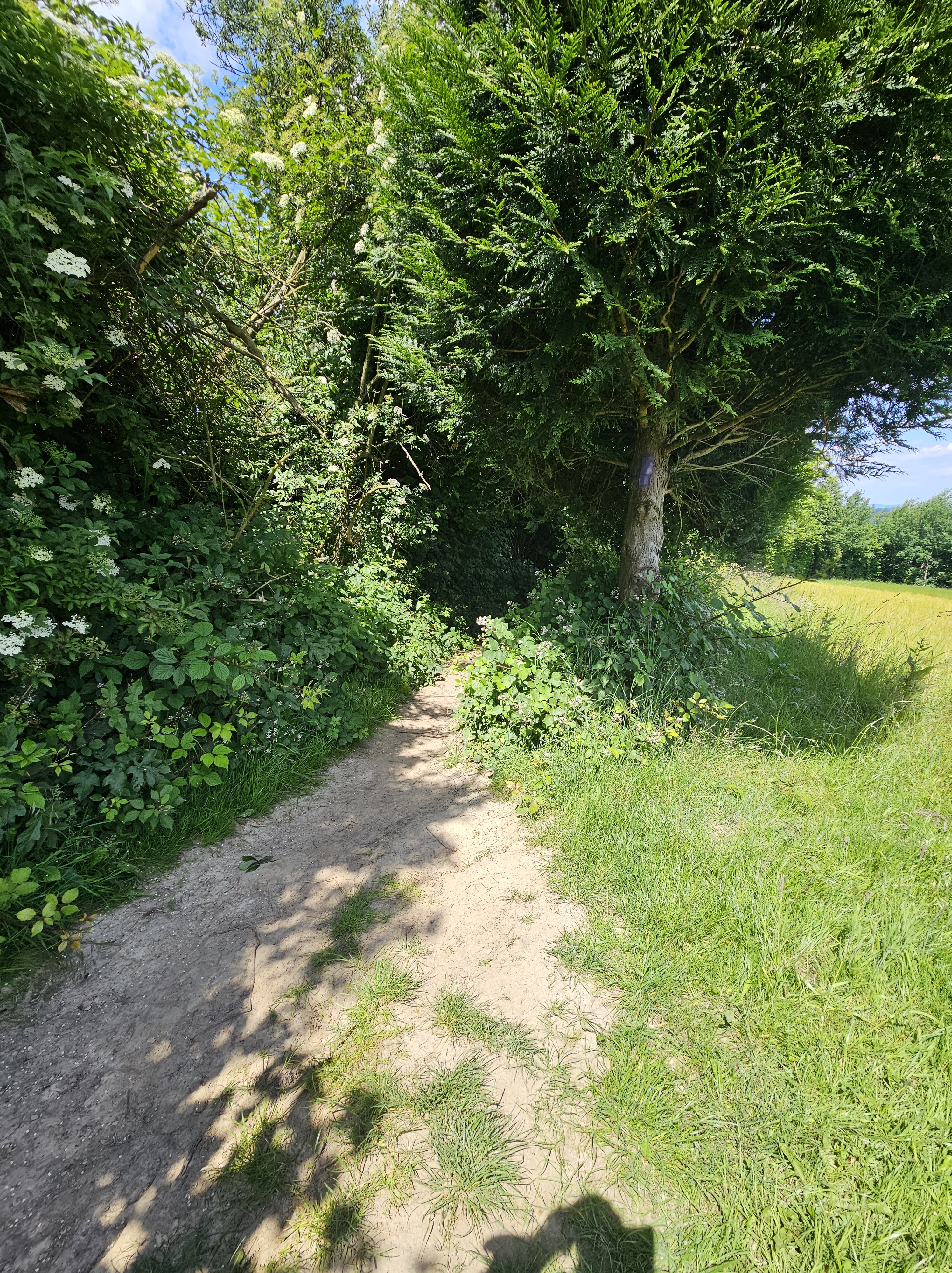
Anyway, this time, I have more pictures than words to share, and I think there is not much to say as the images speak for themselves. Here are the photos I took during our walk.
I believe there is no need to be a plant expert, as we are partly created by Mother Nature. Still, we must be aware of our essence and keep it safe as far as possible.
By the way, I got a message from WP that I have reached 1k followers! As I gratefully wonder how it could happen, I must confess that I am just happy that many of these friendly people don’t care about my humble posts or write comments; otherwise, I would be bushed!😜🙏💖
I laid awake for at least three hours last night! In fact, I fell asleep initially but woke up after about two hours, and my thoughts started working. It’s not the first time I’ve been lying awake more often lately. The reason is not any concern about private life; however, there are enough issues to consider, and not limited to my birthplace, Iran and its young freedom fighters; what worries me is the future of humanity as a whole. A theory develops in my head!
These days, I’m very busy with the world’s condition. I see how humanity is on a downward spiral and think about what could be the reason, and it forced me to theorize!
I see greed and hate. I see children suffering due to the thoughtlessness and mistakes of their parents, and politics makes it worse. While I might bite my tongue, I ask myself, is it not better to die as a child than to grow up and continue fighting? How can someone believe that peace can be achieved by bombarding a folk? How is it possible to forget one’s pain of losing the mother, father, or entire family? Those who sow hatred will reap vengeance!
I observe how people chase after happiness as it slips away, and I believe that our obsession with money, possessions, and accumulating more and more has caused us to lose sight of what truly matters – enjoying life. I believe that enjoyment lies in the limitation of having! As Lao Tzu said: Have little, and you will gain. Have much, and you will be confused.
The entire statement is instructive: Bend, and you will be whole. Curl, and you will be straight. Keep empty, and you will be filled. Grow old, and you will be renewed. Have little, and you will gain. Have much, and you will be confused. “Tao Te Ching: Chapter 22” by Lao Tzu
What we often forget is that the child in us never dies! I have previously shared some information on this topic (as it is part 4). In Part 1, I provided a translated summary of “The Archetype as a Past State.” Now, I would like to share Dr. Jung’s thesis on Child Archetypes: “The Function of the Archetype”, which may help us understand and awaken in adulthood. To begin with, I will provide a brief introduction to Archetypes.
(Archetypes are not myths themselves but rather components of myths due to their typical nature. They are present in myths, fairy tales, dreams, and even psychotic fantasy products. In an individual, archetypes appear as unreal manifestations of unconscious processes. In myths, they are traditional forms of mostly inestimable age. These myths are usually tribal, transmitted from generation to generation through retelling. The primitive mind state differs from the civilized one primarily in that consciousness is much less developed in extent and intensity. The spontaneity of the act of thinking lies in the unconscious.)
Carl Jung: The Integration of The Personality, P. 285
The Function of the Archetype (On the psychology of the child archetype (1940): In the Pantheon Akademische Verlagsanstallt, Amsterdam and Leipzig 1940, under the title “The Divine Child.)
The child motif not only represents something that has been and is long past but also something present. That means it is not just a remnant but a currently functioning system intended to meaningfully compensate for or correct the inevitable one-sidedness and extravagances of consciousness. The essence of consciousness is concentration on relatively few contents, which are, if possible, increased to a level of complete clarity. Consciousness has a necessary consequence and prerequisite, the exclusion of other contents that are currently equally capable of consciousness. This exclusion inevitably causes a certain one-sidedness in the content of consciousness. Since the differentiated consciousness of civilized people is now given an effective instrument for the practical implementation of its contents in the form of the dynamics of the will, the greater the development of the will, the greater the danger of straying into one-sidedness and of digressing into lawlessness and rootlessness.
On the one hand, this is the possibility of human freedom, but on the other hand, it is also the source of endless instinctual contradictions. Primitive humans are, therefore, characterized – from the point of view of instinct, like animals – by neophobia and attachment to tradition. To our liking, it is embarrassingly backward while we praise progress. On the one hand, our progressiveness makes many of the most beautiful wish fulfillments possible. Still, on the other hand, an equally gigantic Promethean debt accumulates, which from time to time requires repayment in the form of fateful catastrophes. How long has humanity dreamed of flying, and now we have already arrived at aerial bombardments! Today, people laugh at the Christian hope for the afterlife and often fall into chiliasms, which are a hundred times more unreasonable than the idea of a joyful afterlife! Differentiated consciousness is always threatened by uprooting, which is why compensation is required through the still-existing childhood state.
However, from the standpoint of progress, compensation symptoms are formulated in unflattering terms, such as inertia, backwardness, scepticism, nagging, conservatism, timidity, pettiness, etc. But insofar as humanity has a high degree of ability to get rid of its own foundations, it can also allow itself to be carried away uncritically by dangerous one-sidedness and even catastrophe. The retarding ideal is always more primitive, more natural (in a good or bad sense) and more “moral” insofar as it adheres faithfully to the traditional law. The progressive ideal is always more abstract, unnatural, and “immoral,” which requires disloyalty to tradition. Progress forced by will is always hard and cramped. Although backwardness is close to naturalness, it is constantly threatened by an embarrassing awakening. The older view was aware that progress is only possible ‘Deo Concedente’, with which it identifies itself through the possession of opposite consciousness and repeats the ancient >rites d’entrée et de sortie< to a higher level. But the more consciousness differentiates, the greater the danger of its separation from the root state. The complete separation occurs when the ‘Deo Concedente’ is forgotten. It is now a psychological principle that a part of the soul that has been split off from consciousness is only apparently inactivated, but in reality, leads to an obsession of the personality, whereby its objective is distorted in the sense of the part of the soul that has been split off. Suppose the childlike state of the collective soul is repressed to the point of complete exclusion. In that case, the unconscious content takes control of the conscious goal, whereby its realization is inhibited, falsified or even destroyed. However, viable progress only comes about through the cooperation of both. (Archetypen, dtv.)
Children are our fellowship for the future, and our responsibility is to leave a legacy that fosters their growth and development. Thank you for reading.🙏💖🙏
Egyptian civilization. Papyrus. Scene of creation. The sky-goddess Nut, covered with stars, is generated by Geb, the god of the earth. Reconstruction of a fresco from a tomb at Thebes, Valley of the Kings. Cairo, Istituto Del Papiro
As we all know, yesterday marked International Women’s Day, and many posts were published on this topic. I apologize for being late to the celebration; I was until now occupied with my grandson, Ilias! This is the first time I have decided to participate in this acknowledgement match, not just because of a lack of time but because I have some reservations about celebrating a cause on a single day and then forgetting about it for the rest of the year. Perhaps it’s true that those in charge choose to memorialize and celebrate under a specific title to alleviate their guilt instead of resolving the issues. However, I believe in using this special day to awaken their consciousness and galvanize them into action.
How well described Marion Woodman about the core of the issue.
via Petra Glimmdall 🙏💖
I have frequently written about women’s missing rights and opportunities in society, and I have noticed that progress is being made. A recent example is the approval of a new law by the French parliament to add the right to abortion to their constitution. Bravo! Viva France!
Liberté, Égalité, Fraternité:
The concept is that if we believe in the duality of everything: cold – warm, above – below, bright – dark, woman – man, etc. Then, they not only mutually prove each other’s existence but also complement each other’s evolution. To comprehend these concepts, we should ponder twice (as the Germans say: Nachdenken!). Coldness would hold no significance if we always had everything cold and were unaware of warmth. Similarly, if we were constantly surrounded by brightness without ever experiencing darkness, we would never be able to comprehend the value of brightness. And it would be the same about feminine and masculine: Anima & Animus.
C. G. Jung introduced terms to describe specific functions of the human “soul” and “mind” ( Anima and Animus, Latin). I have published a partitional post about this issue before. Anima names the feminine unconscious factor in a man, while animus applies to the corresponding masculine factor in a woman’s unconscious.
I believe these are suitable lessons that will make us aware of how to help each other along the difficult path towards achieving the goal or the Self. This is how we can help each other because without encountering the other side, we are incomplete!
However, I have to repeat myself sadly, of man’s blindness as his stupid vanity has damaged a perhaps brave new world!
The Red Book by C. G. Jung, Liber Primus fol. i(v)
As I continue to read Carl Jung’s book, The Red Book, I find myself wondering how his words are so relatable to me. They touch me deeply and feel familiar. I do not speak often and tend to keep to myself. However, I want to learn how to express myself more creatively using images. I long to see a sign of mercy that will give me hope and belief, even though I still wish to have visions like Jung had.
He conversed with the spirits, the spirit of the time, the spirit of depth, talking about the Supreme Meaning by the fact that he is laughter and worship; a bloody laughter and a bloody worship. A sacrificial blood binds the poles. Jung has his humanity for help: What solitude, he said, what a coldness of destruction you lay upon me when you speak such! Reflect on the destruction of being and the streams of blood from the terrible sacrifice that the depth demands (Referring to Jung’s vision). Dr Jung had visions which became a reality throughout his time. He was excited, not sure if schizophrenia was threatening him. However, every genius seems to have this ability, as my brother Al had it.
As we observe the world today, starting wars easily, bombing, and killing have become routine occurrences, it might not be necessary for us to have the kind of visions that Dr. Jung had in his time. However, his words hold significance since they reflect a deeper insight into the human psyche.
“But the spirit of the depths uttered: No one can or should halt sacrifice. Sacrifice is not destruction; sacrifice is the foundation stone of what is to come… “The mercy that happened to me gave me belief, hope, and sufficient daring not to resist the spirit of the depths further but so utter his words. But before I could pull myself together to really do it, I needed a visible sign that would show me that the spirit of the depths in me was, at the same time, the ruler of the depths of world affairs.
It happened in October 1813, when I was living alone on a journey. During the day, I was suddenly overcome by a vision in broad daylight: I saw a terrible flood that covered all the northern and low-lying lands between the North Sea and the Alps. It reached from England up to Russia and from the coast of the North Sea right up to the Alps. I saw yellow waves swimming through rubble and the death of countless thousands.
The vision lasted two hours; it confused me and made me ill. I was not able to interpret it. Two weeks passed, then the vision returned, still more violent than before, and an inner voice spoke: “”Look at it; it is completely real, and it will come to pass. You cannot doubt this.“” I wrestled again for two hours with this vision, but it held me fast. It left me exhausted and confused. And I thought my mind had gone crazy.
Jung discussed this vision on several occasions, stressing different details like in his 1925 seminar Introduction to Jungian Psychology (p. 44f), to Mircea Eliade, and Memories (pp. 199-200):
{Jung’s versions were frightening as he saw even a sea of blood over the northern lands. He explains: }
As a psychiatrist, I became worried, wondering if I was not on the way to “doing a schizophrenia,” as we said in the language of those days… I was just preparing a lecture on schizophrenia to be delivered at a congress in Aberdeen, and I kept saying to myself: “I’ll be speaking of myself! Very likely, I’ll go mad after reading out this paper.” The congress was to take place in July 1914 – exactly the same period when I saw myself in my three dreams voyaging on the Southern seas. On July 31st, immediately after my lecture, I learned from the newspapers that war had broken out. Finally, I understood. And when I disembarked in Holand on the next day, nobody was happier than I. Now, I was sure that no schizophrenia was threatening me. I understood that my dreams and my visions came to me from the subsoil of the collective unconscious. What remained for me to do now was to deepen and validate this discovery. And this is what I have been trying to do for forty years.
The fire from the egg in Carl Jung’s Red book
In the year 1914, in the month of June, at the beginning and end of the month, and at the beginning of July, I had the same dream three times: I was in a foreign land, and suddenly, overnight and right in the middle of the summer, a terrible cold descended from space. All seas and rivers were ice-locked, and every green living thing had frozen. The second dream was thoroughly similar to this. But the third dream at the beginning of July went as follows: I was in a remote English land. It was necessary that I return to my homeland with a fast ship as speedily as possible. I reached home quickly. In my homeland, I found that in the middle of summer, a terrible cold had fallen from space, which had turned every living thing into ice. There stood a leaf-bearing but fruitless tree, whose leaves had turned into sweet grapes full of healing juice through the working of the frost (like the ice wine). I picked some grapes and gave them to a great waiting throng.
[Draft: This was my dream. All my efforts to understand it were in vain. I laboured for days. Its impression, however, was powerful (p.9). Jung also recounted this dream in Memories].
Can we interpret the end of his dream, where sweet grapes are present, as a positive outcome of human madness? Who knows! Anyhow, hope dies last.🙏💖

Source: The Red Book by C. G. Jung, Liber Novus, A Reader’s Edition; Sonu Shamdasani
You must be logged in to post a comment.