Sehel, Anoukis of the island, the guardian of the “gateway to Nubia”

Standard

On the Isle of Sehel the stele “Famine”, discovered in 1889 by the American Egyptologist Charles Edwin Wilbour and other rocks bearing inscriptions

Hi dear friends, it’s again my lovely day; Saturday, and I have time again though, short but I’ll try to make the best of it 😉

Let’s begin with a reportage about a magnificent island of the magnificent Egypt 🙂 translated from French.

by Marc Chartier with thanks

Sehel, Anoukis of the island, the guardian of the “gateway to Nubia”

An amazing description of a marvellous island.by Marc Chartier with thanks (y) and always sincerely to Marie Grillot

https://egyptophile.blogspot.com/

Sehel Island, on the Nile, is located about 2 miles southwest of Aswan. One kilometre long and 500 meters wide, it is one of the largest islands of the first cataract. Auguste Mariette saw it, “strictly speaking only a mass of granite blocks crammed one on top of the other, the remains and witnesses of some geological convulsion whose date necessarily escapes history.” And the great French Egyptologist to continue, in his “Voyage in Upper Egypt” (1878): “In the time of the Pharaohs, the island of Sehel was the southernmost border of Egypt. It was on the island of Sehel that Egypt left when the one who came from the north, just as it was to the island of Beghe that one left Nubia when one came from the South. The intermediate territory had to be neutral. The island of Sehel was under the protection of the gods of Cataract who are Chnouphis, the goddess Sati and the goddess Anoukis. The proscynemes engraved on the rocks of the island of Sehel, either by the travellers who left Egypt to head south or by the travellers who arrived from Nubia and Sudan to head north, are very numerous. They consist of prayers to the gods of Cataract, with mentions often very valuable, from the point of view of the history of the characters who made them engrave. The most frequent is the twelfth, thirteenth, eighteenth and even nineteenth centuries. (…) While climbing on the rocks of the island of Séhel, it is not difficult to perceive, by turning towards the South, the whitish eddy of the rapids of Cataract, and even to hear the noise. We are indeed leaving Egypt; this famous Cataract, which has so much occupied the imagination of the ancients, is before us; one more step and we are entering Nubia. “
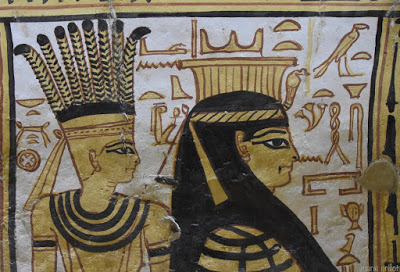
On the left, the Anuket goddess shown in grave Nakhtamon – TT335

Village Artisans – Deir el-Medina

Anoukis, one of the deities of the local triad, to whom a temple was dedicated on the island during the 12th dynasty, holds the role of “Mistress of (the island) of Séhel”, the gate of Nubia. If there is no indication that it originated in the confines of Egypt, one of its functions is nevertheless to keep the southern border of the country. However, adds Jean-Pierre Corteggiani, in “Ancient Egypt and its gods” (Fayard, 2007), its most important role is the one it shares with Satis in the flooding process, the complementary actions of each. of the two goddesses being defined according to the taste of the Egyptians for puns, by verbs related to their names. As a text from the temple of Edfu makes clear, if it is up to Satis, assimilated to Sothis, to bring up the beneficial flow, it is incumbent on Anoukis (Anouqis) the equally essential task of reducing it and allowing thus, after the removal of the flood, the sprouting seeds and vegetation grow on land released by the waters. “

The Isle of Sehel (3 km southwest of Aswan) is one of the largest islands of the First Cataract

Another celebrity of the island: the stele known as “Famine”, discovered in 1889 by the American Egyptologist Charles Edwin Wilbour (1833 – 1896). It is a rock, with a large transverse horizontal fault and another less marked crack at the lower level, on which has been engraved, on 32 columns, a text dated from the Ptolemaic period. This text is surmounted by a “box” where four characters are represented: on the left, King Djoser (Third Dynasty); on the right, the three deities of Sehel’s triad. He mentions, reads on the website of the “Project Rosette”, “a famine of 7 years due to a disturbance of the flood of the Nile under the reign of King Djoser. Some clues have led Egyptologists to think that the document could date from the beginning of the Old Kingdom; others, like Pascal Vernus, have put forward the hypothesis of a forgery elaborated by the priests of Khnum during the Ptolemaic period for reasons of propaganda. “
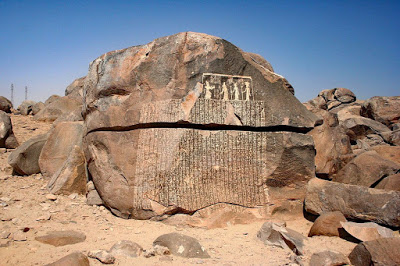
On the Isle of Sehel the stele “Famine”, discovered in 1889 by the American Egyptologist Charles Edwin Wilbour

For the French Egyptologist Paul Barguet (1915 – 2012), one of the translators of the stele, it dates from 187 BC. AD and would be a decree of Ptolemy V, “mentioning, in a pictorial form, the return to the crown of the southern provinces of Egypt and ensuring the country of calm and prosperity of yore”. “We will say a few words,” adds Paul Barguet, “about the famine that seems to be the very subject of our stele. Brugsch, in his book “Die Biblischen sieben Jahre der Hungersnot”, had brought together the seven years of scarcity mentioned in the Bible, the mention of seven years of famine given by the stele of Sehel. This rapprochement was quickly criticized, as purely factitious. However, if it is hazardous to say that one of the texts is only a reminder of the other, their approximation must not, however, be entirely rejected. A seven-year famine tradition is attested throughout the ancient Near East, not only in Egypt but also in Ugarit and Boghaz-Koi. This is a seven-year cycle of famine (and plenty), the figure seven probably not be taken literally, but simply signifying a significant number of years of famine whose succession may have appeared a divine manifestation, the famine being considered one of the worst catastrophes in the ancient East. In Sehel’s text, famine seems to be due more than to insufficient flooding of the Nile, to the fact that the Nile has come against the weather, either too early or too late. By taking possession of the cataract region, Ptolemy V could again control the “sources” of the Nile to Elephantine, and thus ensure, as it were, the waters of the river and their seasonal regularity. “(” The Stela from Famine to Sehel “, IFAO, 1953)

As famous as this stele is, it does not mean to conceal many other rocks engraved on the granite piles of the island. More than 500 inscriptions (including more than 300 to relate mainly to the Old Kingdom) have been noted, translated and commented by Annie Gasse and Vincent Rondot, in their book “The inscriptions of Séhel”, published by the IFAO in 2008. The editor of the book provides these details: “In Séhel, the Old Kingdom is particularly present, thanks to texts that are essentially alluding to the notables of the province. In the Middle Kingdom, it is mainly the Nubian expeditions of sovereigns, including Sesostris III, which are commemorated in the granite of the island. The most abundantly represented period is the New Kingdom. Then, under the aegis of the viceroys of Kouch, exchanges with Nubia intensify; the great cities of the Empire send important expeditions to Aswan to obtain the granite essential to the architectural work. The cult of the Neqet goddess, mistress of Sehel, develops so that a shrine attracts many famous pilgrims. The last epochs of Egyptian history, if they are quantitatively minority, are illustrated by some remarkable inscriptions in the first rank of which we must mention the stele of the Famine.
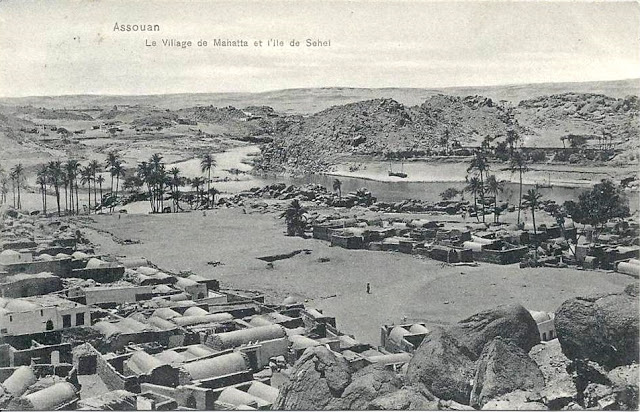
The Isle of Sehel (3 km southwest of Aswan) is one of the largest islands of the First Cataract

Alors that the inscriptions, the source of which today is the glory of the island of Sehel, while others have been taken over in the granite for tourists for the brand or the end of the legends in Nubie, where it is clear that modern tourists, who came up with an excellent idea of visiting the archaeological site, perhaps imitate their “illustres prédécesseurs”! Will it not be an indecisive step of sacrifice from petroglyphic messages of an insigne value for the sake of other graffiti autently disastrous? Marc Chartier

Haiku Yarn

Standard

In Poetry, we shall never part ❤

yassie's avataryaskhan

Tempest on the moon
Storms ripple tides;
My eyes share water
With the ocean and sea.

Stars dot the connect
Once upon a keyboard
Asterisk, ellipses
Breaking the silence.

I carpe diem
So much confusion
Searching for the perfect word--
In poetry we shall never part.

Bard broken
Eating my heart out
That is so self consuming:
The clock's moving hands.

Short on oxygen
Deforestation;
Human extinction
Dust to dust.

Playing hooky
Green behind the ears;
Wilful liberation
Ignoramus on roll-call.

Telepathy
My soul takes a breath
From your soul-
Rainbow's end.

Killer looks
Intrigued by
Your silence---
For your eyes only.

Sting
Song of the desert rose
Cactus dreams 
Of rain.....

View original post

Salut à toi Whitman !

Standard

I am a real Parisian,
I am a resident of Vienna, St. Petersburg, Berlin, Constantinople,
I’m from Adelaide, Sydney, Melbourne,
I am from London, Manchester, Bristol, Edinburgh, Limerick,
I am from Madrid, Cadiz, Barcelona, Oporto, Lyon, Brussels, Bernes, Frankfurt, Stuttgart, Turin, Florence.
I am at home in Moscow, Krakow, Warsaw, or north at Christiania or Stockholm, or in the Siberian Irkutsk, or some street of Iceland.

Ibonoco's avatarNews from Ibonoco

Je suis un vrai Parisien,
Je suis un habitant de Vienne, Saint-Pétersbourg, Berlin, Constantinople,
Je suis d’Adélaïde, Sydney, Melbourne,
Je suis de Londres, Manchester, Bristol, Edimbourg, Limerick,
Je suis de Madrid, Cadix, Barcelone, Oporto, Lyon, Bruxelles, Bernes, Francfort, Stuttgart, Turin, Florence.
Je suis chez moi à Moscou, Cracovie, Varsovie, ou au nord à Christiania ou Stockholm, ou dans la sibérienne Irkoutsk, ou quelque rue de l’Islande.

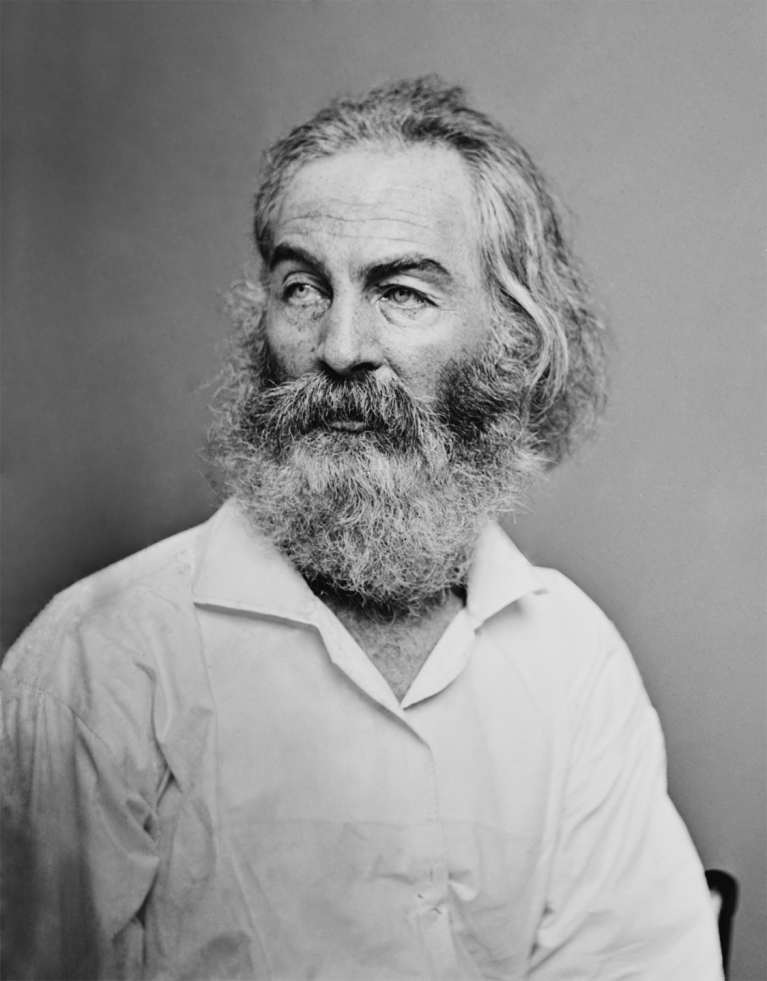
Walt Whitman (1819-1892) in Poésie involontaire et poésie intentionnelle, Paul Eluard (1895-1952), est un écrivain et poète américain.

View original post

Le singe et le lion

Standard

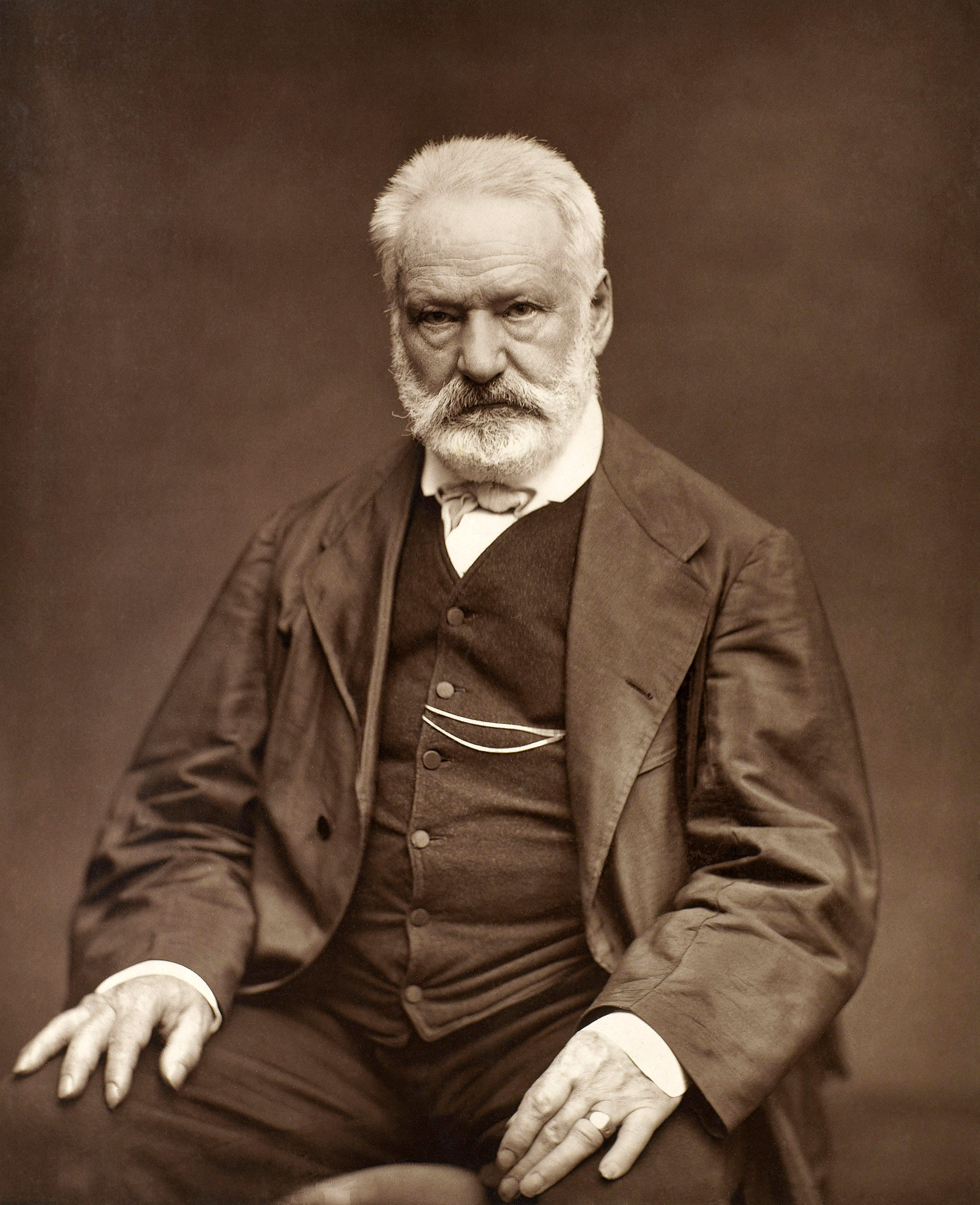
« Do not imitate anything or anyone. A lion that copies a lion becomes a monkey. » Victor Hugo

Ibonoco's avatarNews from Ibonoco

Victor_Hugo_by_Étienne_Carjat_1876_-_full.jpg

« N’imitez rien ni personne. Un lion qui copie un lion devient un singe. »

“Do not imitate anything or anyone. A lion that copies a lion becomes a monkey. »

Victor Hugo (1802 – 1885), est un poète, dramaturge, peintre, dessinateur, pamphlétaire et romancier français. Chef de file du romantisme, grand poète, il est aussi l’homme des grandes luttes de son temps : abolition de l’esclavage, celle de la peine de mort… Pair de France, député, sénateur, élu à l’Académie française en 1841, il meurt à l’âge de 83 ans ; la IIIème République lui fera des funérailles nationales. Victor Hugo sera inhumé au Panthéon.

View original post

Juno Goddess of Time

Standard

Nifty Buckles Folklore's avatarVal is a writer of enchanted tales, folklore and magic. Once chased by Vampire Pumpkins!

June is a glorious month! Spring is officially present and encroaching upon sultry summer. June is the month of rebirth, of nature after a long, frozen winter. June ushers in twittering song birds, a various array of fine green colored plants and trees, brilliant pinks, white and yellow blossoms. June is famous for of the pink Strawberry moon, also known as the Rose moon or Hot moon and the ushering in of the summer solstice.

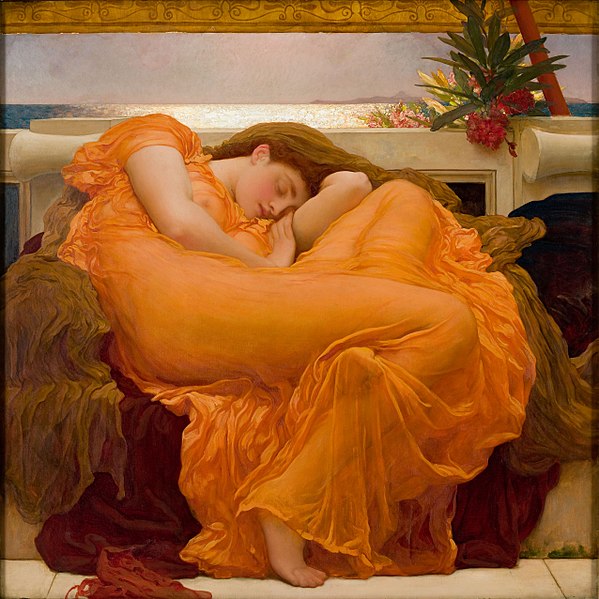
599px-Flaming_June,_by_Frederic_Lord_Leighton_(1830-1896)

Above: Flaming June, by Lord Leighton 1895 (public domain.)

June is the astrological month of Geminithe twins and after the twenty-first Cancer the crab.

The ancient goddess of time that resides over June is the pre-Roman goddess Juno, was an original Creator Goddess or Spirit. Juno is named in Aesop’s fable of Juno and the Peacock. This maternal goddess of fertility governs several phases of the feminine principal of life…

View original post 309 more words

Easter Folklore: France

Standard

Nifty Buckles Folklore's avatarVal is a writer of enchanted tales, folklore and magic. Once chased by Vampire Pumpkins!

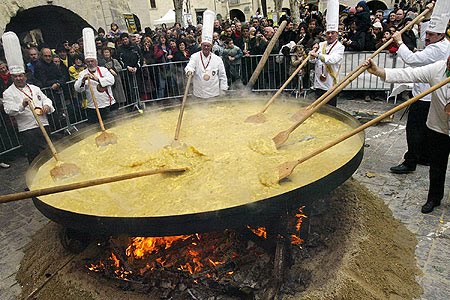
Each Easter Monday the petite town of Bessieres France (Haute Garonne)  implements their unique tradition beginning in 1973.  The town chefs carefully create a huge, tasty omelette, made from 15,000 eggs and its diameter is 4 metres! Fifty or so folks volunteer to crack all the eggs. This takes all about 90 minutes including cooking time for the omelette. The town’s folklore was based from a 19th century tale. Napoleon Bonaparte and his army stopped over at one of the Inns at Bessieres. The Inn keeper cooked up a delicious omelette for Napoleon Bonaparte while he was sojourning in Bessieres. He savoured the omelette so much that the whole town used all their eggs and cooked him a colossal omelette.

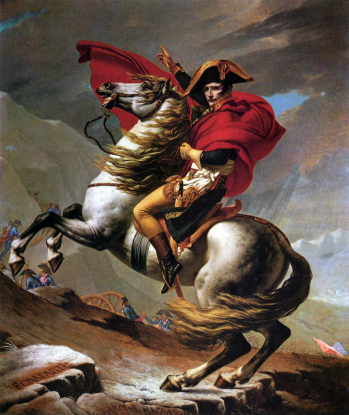
jacques-louis_david_-_napoleon_crossing_the_alps_-_kunsthistorisches_museum

Jacques-Louis David (1748-1825) Napoleon Crossing the Alps — Kunsthistorisches Museum in Public Domain

Source & Reference: https://www.omelettegeante.fr

View original post

How can you tell if another person, animal or thing is conscious? Try these 3 tests

Standard

A very interesting question. Do they have some? Or are we aware of our own? I don’t know if I have some 😀 but surely I would wish to have a “Consciousness-Ometer”!

here is an amazing research about that; Take a look, be honest, and be aware of your good “conscience” on your “consciousness” 😉

via https://theconversation.com/uk

Researchers have ideas how to probe consciousness in another. agsandrew/Shutterstock.com

Author: Tam Hunt Affiliate Guest in Psychology, University of California, Santa Barbara

How can you know that any animal, other human beings, or anything that seems conscious, isn’t just faking it? Does it enjoy an internal subjective experience, complete with sensations and emotions like hunger, joy, or sadness? After all, the only consciousness you can know with certainty is your own. Everything else is inference. The nature of consciousness makes it by necessity a wholly private affair.

These questions are more than philosophical. As intelligent digital assistants, self-driving cars and other robots start to proliferate, are these AIs actually conscious or just seem like it? Or what about patients in comas – how can doctors know with any certainty what kind of consciousness is or is not present, and prescribe treatment accordingly?

In my work, often with with psychologist Jonathan Schooler at the University of California, Santa Barbara, we’re developing a framework for thinking about the many different ways to possibly test for the presence of consciousness.

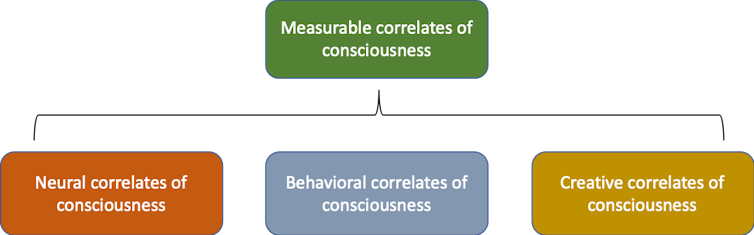
There is a small but growing field looking at how to assess the presence and even quantity of consciousness in various entities. I’ve divided possible tests into three broad categories that I call the measurable correlates of consciousness.

There are three types of ways to gauge consciousness.

You can look for brain activity that occurs at the same time as reported subjective states. Or you can look for physical actions that seem to be accompanied by subjective states. Finally, you can look for the products of consciousness, like artwork or music, or this article I’ve written, that can be separated from the entity that created them to infer the presence – or not – of consciousness.

Neural correlates of consciousness

Over the last two decades, scientists have proposed various ways to probe cognition and consciousness in unresponsive patients. In such cases, there aren’t any behaviors to observe or any creative products to assess.

You can check for the neural correlates of consciousness, though. What’s physically going on in the brain? Neuroimaging tools such as EEG, MEG, fMRI and transcranial magnetic stimulation (each with their own strengths and weaknesses), are able to provide information on activity happening within the brain even in coma and vegetative patients.

Cognitive neuroscientist Stanislas Dehaene has identified what he calls four signatures of consciousness – specific aspects of brain activity he deems necessary for normal consciousness. He focuses on what’s known as the “P3 wave” in the dorsolateral cortex – the part of the brain behind the top of your forehead – because it seems to correlate most reliably with normal conscious states. He also focuses on long-range synchronized electric fields between different parts of the brain as another key signature of consciousness.

In tests which look for these signals in vegetative and minimally conscious patients, Dehaene and his colleagues have successfully predicted which patients are most likely to regain more normal states of consciousness.

Sid Kouider, another cognitive neuroscientist, has examined infants in order to assess the likelihood that very young babies are conscious. He and his team looked for specific neural signatures that go along with subjective experience in adults. They looked specifically for a certain type of brain waves, similar to the P3 wave Dehaene focuses on, that are reliable indicators of consciousness in adults. They found clear analogs of the P3 wave in the brains of babies as young as five months old. Kouider concludes – unsurprisingly – that even young babies are very likely conscious in various complex ways, such as recognizing faces.

Behavioral correlates of consciousness

When considering potentially conscious entities that can’t communicate directly, and that won’t allow neuroscientific measurement tools on their head (if they even have heads), it’s possible to consider physical behaviors as clues for the presence and type of consciousness.

You know that a massive range of human behaviors are accompanied by conscious experience. So when you see similar behaviors in other animals or even non-animals, can you reasonably infer the presence of consciousness?

What’s going on in there? Maggie Villiger, CC BY-ND

For example, are cats conscious? Their brain architecture is a little different than humans’. They have very minimal prefrontal cortex, which some scientists think is the center of many higher-order activities of the human brain. But is a prefrontal cortex necessary for consciousness?

Cat behavior is complex and pretty easy to map onto human behavior in many ways. Cats purr, flex their toes and snuggle when petted, in similar ways to people demonstrating pleasure when physically stimulated – minus the purrs, of course. They meow loudly for food when hungry and stop meowing when fed. They demonstrate curiosity or fear about other cats or humans with various types of body language.

These and many other easily observable behaviors add up to convincing evidence for most people that cats are indeed conscious and have rich emotional lives. You can imagine looking for other familiar behaviors in a rat, or an ant or a plant – if you see things close enough to what you’d expect in conscious humans, you may credit the observed creature with a certain type of consciousness.

Creative correlates of consciousness

If, for whatever reason, you can’t examine neural or behavioral correlates of consciousness, maybe you can look to creative outputs for clues that would indicate consciousness.

For example, when examining ancient megalithic structures such as Stonehenge, or cave paintings created as far back as 65,000 years ago, is it reasonable to assume that their creators were conscious in ways similar to us? Most people would likely say yes. You know from experience that it would take high intelligence and consciousness to produce such items today, so reasonably conclude that our ancient ancestors had similar levels of consciousness.

What if explorers find obviously unnatural artifacts on Mars or elsewhere in the solar system? It will depend on the artifacts in question, but if astronauts were to find anything remotely similar to human dwellings or machinery that was clearly not human in origin, it would be reasonable to infer that the creators of these artifacts were also conscious.

Closer to home, artificial intelligence has produced some pretty impressive art – impressive enough to fetch over US$400,000 in a recent art auction. At what point do reasonable people conclude that creating art requires consciousness?

Researchers could conduct a kind of “artistic Turing Test”: ask study participants to consider various artworks and say which ones they conclude were probably created by a human. If AI artwork consistently fools people into thinking it was made by a person, is that good evidence to conclude that the AI is at least in some ways conscious? So far AI aren’t convincing most observers, but it’s reasonable to expect that they will be able to in the future.

Is a definitive test for consciousness on the horizon? Gorodenkoff/Shutterstock.com

Where’s my ‘consciousness-ometer’?

Can anyone get a definitive answer about the presence of consciousness, and how much? Unfortunately, the answer to both questions is no. There is not yet a “consciousness-ometer,” but various researchers, including Dehaene, have some ideas.

Neuroscientist Giulio Tononi and his colleagues like Christof Koch focus on what they call “integrated information” as a measure of consciousness. This theory suggests that anything that integrates at least one bit of information has at least a tiny amount of consciousness. A light diode, for example, contains just one bit of information and thus has a very limited type of consciousness. With just two possible states, on or off, however, it’s a rather uninteresting kind of consciousness.

In my work, my collaborators and I share this “panpsychist” foundation. We accept as a working hypothesis that any physical system has some associated consciousness, however small it may be in the vast majority of cases.

Rather than integrated information as the key measure of consciousness, however, we focus on resonance and synchronization and the degree to which parts of a whole resonate at the same or similar frequencies. Resonance in the case of the human brain generally means shared electric field oscillation rates, such as gamma band synchrony (40-120 Hertz).

Our consciousness-ometer would then look at the degree of shared resonance and resulting information flows as the measure of consciousness. Humans and other mammals enjoy a particularly rich kind of consciousness, because there are many levels of pervasive shared synchronization throughout the brain, nervous system and body.

Tests for consciousness are still in their infancy. But this field of study is undergoing a renaissance because the study of consciousness more generally has finally become a respectable scientific pursuit. Before too long it may be possible to measure just how much consciousness is present in various entities – including in you and me.

Deep knowledge, daily. Sign up for The Conversation’s newsletter. ]