A Case For “Sick” Personalities!

Standard
Land of Forgotten Dreams: By Leszek Kostuj

I must confess I am sick! Actually, I should have taken sick leave by you all (just the same as I usually do at work😁) and apologize to you for my absence this weekend, but I didn’t believe the cold I got last Sunday would take up all my energy throughout the week! That’s why I gathered all I had to do my ritual habit to make it well. Though my second post is just a video clip of a man, it is a great man we urgently need in today’s world, which is such a mess!

As I always believe that we need to accept our own darkness and try to understand it, we might hope to have a better world. I think it is better if the master takes the words:
Wishing you all a good health!🙏💖

The Seed is the Word of God, and the Ground is Our Hearts. (Bible; Verse 14 & Verse 15)

Standard
Charles K. Wilkinson Harvest Scenes, Tomb of Menna Twentieth Century; original New Kingdom The Metropolitan Museum of Art

And God said, “Behold, I have given you every plant yielding seed that is on the face of all the earth, and every tree with seed in its fruit. You shall have them for food. Genesis 1:29

Agathos Daimon, Osiris, Demeter, Neper, Abellio… All the gods have blessed human farming, but how old is our knowledge of agriculture?

The Zagros Mountain range, located along the border between Iran and Iraq, was home to some of the world’s earliest farmers. Around 12,000 years ago, hunter-gatherer ancestors began experimenting with farming. Somewhere else, it says that Egyptians were among the first to practice agriculture on a large scale, starting in the pre-dynastic period from the end of the Paleolithic period into the Neolithic period, between around 10,000 BC and 4000 BC. This was made possible with the development of basin irrigation.

Neandertaler beim kochen!

However, this transition may have deeper historical roots. In “Neanderthals, Bandits, and Farmers,” author Tudge explains that agriculture was not abruptly invented 10,000 years ago; instead, it had already existed in a form he refers to as proto-farming or hobby farming for at least 30,000 years prior. This sheds light on the origins of the population explosion associated with the advent of agriculture.

The sequential art found on the walls of the tomb of Menna The Theban Tomb TT69

Let’s return to Egypt, where agriculture and harvesting have been essential practices since ancient times. Thanks to the unforgettable friend Marc Chartier and the dear and adorable Marie Grillot for presenting this excellent article.

Egypt: Harvesting information on harvests

via égyptophile

Tomb of Menna – photo Marie Grillot

In ancient Egypt, the harvest season (“chemo”) was a period of intense activity that kept agricultural workers busy for several weeks. When they were not enough for the task, mobile teams of reapers were added to them. Harvesting cereals began in Upper Egypt and progressed north to the Delta.

Administrative preambles marked the beginning of each harvest to check the equivalence between the result obtained and the forecasts: “When the ears of corn began to turn yellow,” writes Pierre Montet, “the peasant saw with apprehension the fields invaded by his natural enemies, his masters or the representatives of his masters, with a swarm of scribes, surveyors, employees and gendarmes who would first measure the fields. After that, the grains would be measured by the bushel, and one could get a very exact idea of ​​what the peasant would have to deliver, either to the agents of the treasury or to the administrators of a god such as Amon, who owned the best lands in the country.”

Tomb of Ounsou – photo The Louvre

The peasants used sickles with short handles and straight wooden blades in which flint teeth were embedded for their harvesting work. Later, this tool was replaced by a sickle with a curved metal blade. The harvester, leaning slightly forward, did not cut the stalks at ground level but as close as possible to the ears of corn, which he let fall to the ground. Women collected the ears of corn in baskets which, once complete, were carried to the end of the field, then from there, on the backs of donkeys or men, in large wicker baskets suspended from long sticks, were transported to the threshing floor.

The work had to be carried out quickly, often punctuated by the sound of a flute player. A supervisor was particularly attentive to the smooth running of operations, “watching over the grain.”

Tomb of Menna – photo Osirisnet.net

On the threshing floor, the harvested ears of corn were trampled to be threshed by oxen while the men used the flail to remove the grain and the pitchfork to separate the grain from the chaff. The final sequence was winnowing, often carried out by women, using hollowed-out ox hooves, curved pallets or wooden cups. The grain was finally stored in silos or warehouses, where scribes and controllers came to count the final product of the harvest. “The grains are cleaned,” Pierre Montet explains. “It is time for the scribes who come forward with everything they need to write and for the measurers who have taken their bushel. Woe to the peasant who has hidden part of his harvest or who, even in good faith, cannot give the lawyers everything that the field survey allows to be demanded. He is stretched out on the ground and beaten in rhythm, and worse misfortunes perhaps await him.”

The harvesters then had free rein to harvest for themselves, with the permission of the owners or managers, as much wheat or barley as they could gather in a day.

Looking back over the centuries, we note, from what Benoît de Maillet wrote in 1735 in his “Description of Egypt”, certain differences, but above all, a real continuity in peasant practices in the Nile Valley: “You would hardly forgive me if I forgot to tell you about harvest time and how it is done here. We regularly begin to work on the harvest at the end of April or in the first days of May. Then, we do not amuse ourselves by cutting the wheat, putting it in sheaves, and transporting it to places intended to preserve it for a long time in this way. The inhabitants of Egypt are more expeditious than all this. They begin by pulling up the grain and gathering it in the very middle of the fields in a space prepared to receive it. There, they gather it into a heap twenty to thirty feet in diameter, on which they first drive a few oxen to lower it. Then two oxen are yoked to a machine made in the form of a chair, furnished underneath with sharp stones, or eight or ten iron wheels threaded into a wooden axle. From this machine, a man seated there touches the oxen and makes several turns over this heap of barley or wheat until the wheels have cut the straw and separated the grain, which nevertheless remains with this chopped straw, which is kept for the cattle and serves as their oats. After this first method, the straw is separated from the grain and thrown lightly into the air with forks prepared for this purpose. Finally, there come sifters, who, with particular skill, separate the grain from the earth on the spot; after that, it is transported to granaries. This is how the harvest is carried out here, and this is all the trouble one has to collect the finest and best grain in the world.”

Photo Asma Waguth – Reuters

Two centuries later, the same observation: “[In Egypt], the wheat is cut with a primitive sickle; the ears are immediately tied into small sheaves, transported on camelback to the area where the grain will be threshed. This bare surface is usually set up near the fields. The sheaves are piled up there in large stacks.

The threshing machine, the ‘nôrag’, looks like a sledge. It is powered by oxen. Its wooden frame, on top of which sits the driver, supports solid iron wheels passed repeatedly over the wheat; they open the ears and separate the grain from the chaff. The detached stalks are collected, packed in net bags, and loaded onto donkeys’ backs. As for the grain, naturally mixed with straw, is piled up in heaps, ready to be winnowed. (…) Custom dictates that all harvesters are paid in kind. Lines of women and children can be seen returning from the fields carrying their wages on their heads. This custom goes back a long way and is observed to pay other people still.” (W.S. Blackman, Les fellahs de la Haute-Egypte, Payot, 1948)

It must be believed that in Egypt, perhaps more than elsewhere, agricultural practices and traditions span the centuries to the point of being almost timeless, even in their ritual side effects. In ancient Egypt, the beginning of the “chemo” season included the ceremony of the offering of the sheaf by the pharaoh: “presenting himself successively as protector and nourisher of Egypt” to the God Min, God of fertility, or other divinities such as Harsomtous.

Many centuries later, we read this account of another rite, certainly not directly linked to the pharaonic tradition, but no less important in popular “mythology”: “Before starting to cut the harvest, some villagers will pull out the most beautiful ears of corn by hand. They braid them according to a particular pattern, and the object thus formed, called the ‘bride of the grain’, ‘arûset el-qamh’, is used as a charm. One can hang one above the door of a house as a remedy against the evil eye; another will often take its place in the room containing the food provisions to ensure abundance.” (W.S. Blackman)

Sennedjem’s Tomb

Let us finally be guided to the Beyond of time, thanks to the symbolic richness of the tomb of Sennedjem (TT1) at Deir el-Medina in the fields of Ialou: “using a wooden sickle, the edge of which is encrusted with flint stones, Sennedjem, bent, cut the ears of corn very high. Thus, the straw will not be damaged by the trampling of the animals during threshing. Iyneferti (follows him) and collects the ears of corn, which she puts in a basket. We will notice in passing the size of the wheat stalks and the suggested immensity of the field that nothing limits. In the idyllic world of the Beyond, the harvests are always extraordinary.” (Osirisnet)

In these modern times, when Egypt is forced to buy wheat from foreign countries to meet the needs of its 90 million inhabitants, it is good to remember, as Benoît de Maillet wrote, that it produced “the most beautiful and best grain in the world.”

Marc Chartier

Sources :
Pierre Montet, Daily life in Egypt at the time of Ramses, Hachette, 1946 http://www.museum.agropolis.fr/pages/expos/egypte/fr/travaux/moisson.htm http://jfbradu.free.fr/egypte/SIXIEMES/agriculture/agriculture.html http://www.osirisnet.net/tombes/nobles/menna69/menna_02.htm

Published 11th May 2016 by Unknown

Let Us Comprehend!

Standard
Whatever you shot me, it left no scar; it sprouted!

Many events are happening worldwide, but most are disheartening: millions of refugees, wars, hunger, uncertainty, and executions. However, I want to focus on the last one and have to, again, urge the world to put an end to it. It appears there is a systematic plan to eliminate the young—those full of hopes, dreams, and potential. They represent the future of Iran, brimming with creativity and energy, and they are at risk of being destroyed.

via Euronews

I don’t want to hurt my friends, but it appears that a brutal regime in the Middle East aims to massacre the youth and destroy the wealth of ancient and precious folk and their country!

Iran-hair, via Ruth Millington: ‘For my brave Iranian sisters’ by r0yart @_r0yart

The Islamic Regime searches for them on purpose to get them, jail them, and execute them. Prisons, including special facilities for political prisoners, are present in the political history of many countries. In Iran, one such prison is known as Evin. It should have been demolished after the fall of the Shah; however, the mullahs found it to be much more advantageous for their purposes.

Woman-Life-Freedom- via Amnesty International

I have often mentioned that global superpowers benefit from having a chaotic regime or a wild dog in that region, like the Mullah Regime. They maintain control over those countries through fear, hoping that the West will take action against this threat. But how long should it go until no common sense remains there? And then, Westerpower engages another favourite doll to work with?!

Azadeh’ [Ah-Z-ah-d eh] (Persian: آزاده) ‘Meaning: She who is Free’ by Luna @lunaleonis

I believe you are as muddled as I am; what can we do?
I just shout to the world: Stop this terrifying terror against humanity and our outstanding youth!

We might only keep praying for the lives of those who want their right to live, which is their inalienable right. The right to live in freedom!

‘Cut it out’ by Marco Melgrati @Melgratillustr

Last week, I came across this song by Joan Baez and found it so pertinent to the topic because she always sang for the people who fought for their rights. #Woman_Life_Freedom!💖✊🙏

“There But For Fortune”

Joan Baez

Show me the prison, show me the jail
Show me the prisoner whose life has gone stale
And I’ll show you a young (wo)man
With so many reasons why
And there but for fortune, go you or I…

Show me the alley, show me the train
Show me the hobo who sleeps out in the rain
And I’ll show you a young (wo)man
With so many reasons why
And there but for fortune, go you or I, mm, mm

Show me the whiskey, stains on the floor
Show me the drunkard as he stumbles out the door
And I’ll show you a young (wo)man
With so many reasons why
And there but for fortune go you or I…

Show me the country where the bombs had to fall
Show me the ruins of the buildings, once so tall
And I’ll show you a young land
With so many reasons why
And there but for fortune go you and I, you and I.

The Mystery Of “Mana Personality” Part Nine

Standard

Translated from volumes published by Lorenz Jung based on the edition “Gesammelte Werke” dtv.de The Symbols of Transformation (1952) and Aion (1950)

Today, I share the final part of the translation of Mana-Personality. It was full of joy for me to learn more and even better from his works because I had to read them word by word to achieve an understandable translation. I hope it was the same for you.

We often wonder why there are so many injustices, differences, and failures in human progress (decline?). Is God flawed? Dr. Jung suggests that God must be imperfect; otherwise, we cannot reach Him.

In the figure of the divine hero, God himself wrestles with his own imperfect, suffering, living creation; he even takes its suffering condition upon himself and, by this sacrificial act, accomplishes the opus magnum of salvation and victory over death.

Credit Text and Image Carl Jung Depth Psychology 🙏

He, instead, talks about the importance of the Self and Individuality.

He personally also admits that his explanation is sensitive to experiences that some may not have practised. He emphasizes:

I am deeply aware that in this work, I have not made any ordinary demands on the understanding of my reader. I have made every effort to smooth the path to understanding. Still, I have not been able to remove one great difficulty, namely the fact that the experiences underlying my explanations are probably unknown to most people and, therefore, strange...

Still, he tries to enlighten us on the matter based on his experiences.

Image credit Carl Jung Depth Psychology

Previous

Now, let’s move on to the final chords:

Individuation
The Mana Personality (P9)

The conception of God as an autonomous, psychological content makes God a moral problem – and that is, admittedly, very uncomfortable. But if this problem does not exist, then God is not real either because he does not intervene in our lives anywhere. Then, he is a historical conceptual bogeyman or a philosophical sentimentality.

If we leave the idea of ​​a “divine” out of the equation and speak only of autonomous contents, we may remain intellectually and empirically correct, but we thereby conceal a note that psychologically cannot be missed. If we use the idea of ​​a “divine”, we are thereby aptly expressing the peculiar way in which we experience the effects of autonomous content. We can also use the term “demonic” as long as we do not imply that we have reserved a concrete God somewhere who completely corresponds to our wishes and ideas. However, our intellectual sleight of hand tricks do not help us to create a being according to our wishes in reality, just as the world does not adapt to our expectations. If we, therefore, attribute the effects of autonomous contents with the attribute “divine”, we thereby acknowledge their relative superiority. And this superior is the power that has forced a man of all ages to think of the most unthinkable things and to inflict the greatest suffering on himself in order to do justice to those effects. This power is as real as hunger and fear of death.

The Self could be characterized as a kind of compensation for the conflict between inside and outside. This formulation may not be a lousy fit insofar as the Self has the character of something that is a result, an achieved goal, something that has only gradually come about and has become possible through much effort. Thus, the Self is also the goal of life, for it is the complete expression of the combination of destinies that we call the individual, and not just of the individual human being, but of a whole group in which one completes the other to form the complete picture.

With the sensation of the Self as something irrational, indefinable, to which the ego is not opposed and not subject, but rather attached and around which it rotates, as the earth rotates around the sun, the goal of individuation is achieved. I use the word “sensation” to describe the perceptual character of the relationship between “I” and Self. There is nothing recognizable in this respect because we are unable to say anything about the contents of the Self. The “I” is the only content of the Self that we know. The individualized “I” perceives itself as the object of an unknown and superior subject. It seems to me that the psychological statement reaches its extreme end here because the idea of ​​a Self is in and of itself a transcendent postulate that can be justified psychologically but cannot be proven scientifically. The step beyond science is an absolute requirement of the psychological development described here because, without this postulate, I could not adequately formulate the empirically occurring psychological processes. The Self, therefore, claims at least the value of a hypothesis corresponding to that of the atomic structure. And – should we still be enclosed in an image here – then it is something overwhelmingly alive, the interpretation of which is beyond my capabilities. I do not doubt that it is an image, but one in which we are still contained.

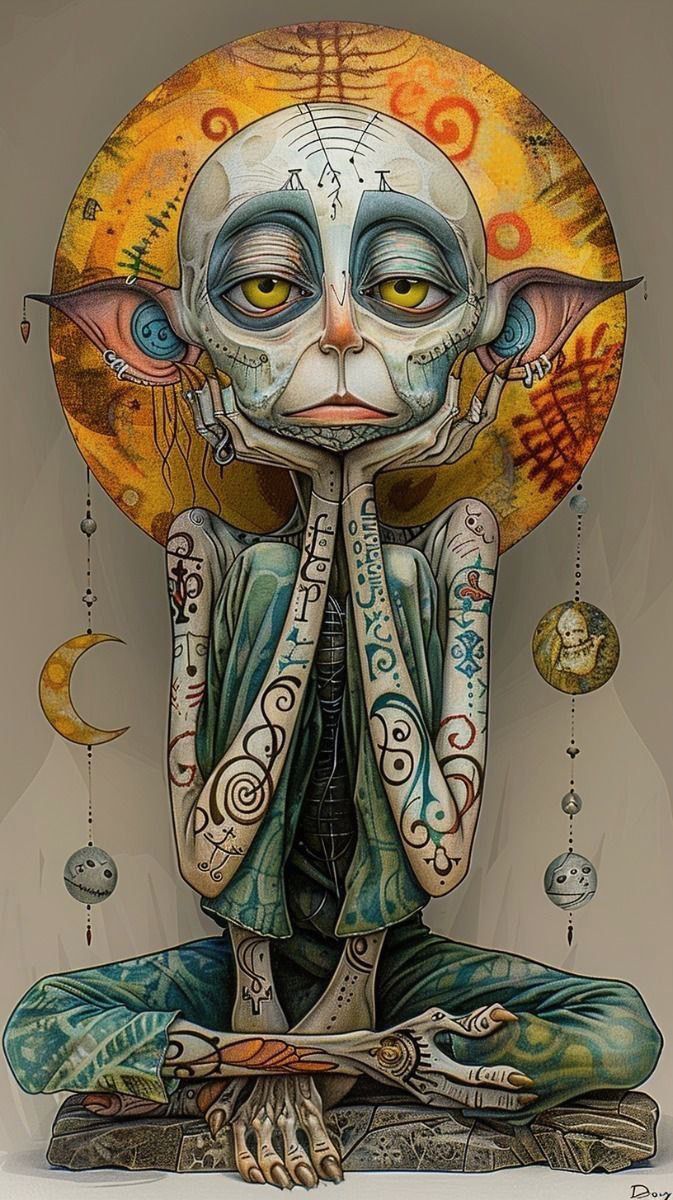
Youri Ivanov _ DIGITAL GRAPHIC ART _ SD World 141

I am deeply aware that in this work, I have not made any ordinary demands on the understanding of my reader. I have made every effort to smooth the path to understanding. Still, I have not been able to remove one great difficulty, namely the fact that the experiences underlying my explanations are probably unknown to most people and, therefore, strange. As a result, I cannot expect my readers to follow all of my conclusions. Although every author naturally enjoys understanding their audience, interpreting my observations is less important to me than pointing out a broad area of ​​experience that has hardly been explored, which I would like to make accessible to many through this book. In this area, which has been so obscure up to now, it seems to me that the answers are recumbent to many puzzles that the psychology of consciousness has never even come close to solving. I do not wish to claim under any circumstances to have formulated these answers definitively. I am, therefore, quite content if my paper can be regarded as a tentative attempt at an answer.

I sincerely appreciate your support and interest. Thank you!🤗🙏💖

The title image: Maiden Voyage of the Airship Falcon” by Alexei Gurl

Why Do We Need A Hero!?

Standard
From ART GALLERY KIKOOYOU STILL LIFE

This question has been lingering in my mind for many years, but now it is more emphatic and clear before my eyes. It has also particularly stressed my mind since I have been trying to help young people in Iran and how some of them (especially those who are not inside Iran but in Western countries) are waiting for someone to come and help them drop down the Mullahs regime.

Besides that, I noticed it not only in Iran but in the West, even in the USA, as many people are looking for a rescuer to bring them and their country to the top!

Apart from the monarchists’ opposition, who wished to see the king back on the throne, most people genuinely tried to help free Iran. However, I noticed they struggled to communicate and engage in discussion. It’s understandable, given how long they’ve lived under a dictatorship—one must learn democracy! We should realize that if someone has different opinions from ours, they are not our enemy. In fact, differing viewpoints can provide valuable perspectives on an issue.
I made an effort to help them understand this concept, though it wasn’t easy. It’s interesting to compare this situation to the current state in the U.S., where one candidate calls another an enemy. I often heard Mr. Trump say in his speeches, “Don’t trust the other side; they are against you and your fortune,” referring to the Democrats as enemies. This rhetoric reminds me of the Shah’s regime, where anyone opposing the Shah was considered an enemy of the people and the country. We see similar behaviour in the Islamic regime today.

I think the readers of my blog already know about my point of view on the behaviour of the world superpower and their lobbyism towards the Third World, especially Iran and my complaint about their trading with the Mullah’s regime. Therefore, I don’t need to emphasize my belief in their corruption. Still, I wonder how some people could choose an alternative like Donald Trump. We might think there are always idiots in the world, but I even see some intellectuals whom I know and value are in between (like great writers in WordPress or on Facebook, whom I appreciate much) and whose reactions are focused on the absurdity and corruption of the current rulers. Haven’t we experienced so often that changing rulers does not affect improving the problems in the world? But should we believe here comes the superman?!! This wish has existed since eternity and will remain as a wish forever!

Surreal paintings by Italian artist Paolo Uberti (born 1968).

I don’t have anything against anyone. I believe a person is not very important, but the system behind runs the wheels of the world order, not any specific person. The USA is a superpower and has a significant influence on the world. You may think of a conspiracy, but I tell you, I have my own. However, I believe that the president of the US does not seem to have as much power as he seems to have. There is a system of the New World Order, which controls everything happening throughout the world.

By the way, Mr Trump is a believer and a religious man. Is he the new last prophet?

“A tyrant must put on the appearance of uncommon devotion to religion. Subjects are less apprehensive of illegal treatment from a ruler they consider god-fearing and pious.”
Aristotle, Politics by Aristotle

Now, back to Trump. I myself had not heard his name in world politics until he ran for president in 2016. I might be nobody, but here is his political career via Wikimedia:

Political career

Further information: Political career of Donald Trump

Donald Trump shakes hands with Bill Clinton in a lobby; Trump is speaking and Clinton is smiling, and both are wearing suits.
Trump and President Bill Clinton, June 2000

Trump registered as a Republican in 1987; a member of the Independence Party, the New York state affiliate of the Reform Party, in 1999; a Democrat in 2001; a Republican in 2009; unaffiliated in 2011; and a Republican in 2012.

In 1987, Trump placed full-page advertisements in three major newspapers expressing his views on foreign policy and how to eliminate the federal budget deficit. In 1988, he approached Lee Atwater, asking to be put into consideration to be Republican nominee George H. W. Bush‘s running mate. Bush found the request “strange and unbelievable”.

Presidential campaigns (2000–2016)

Trump was a candidate in the 2000 Reform Party presidential primaries for three months but withdrew from the race in February 2000.

Trump, leaning heavily onto a lectern, with his mouth open mid-speech and a woman clapping politely next to him
Trump speaking at CPAC 2011

In 2011, Trump speculated about running against President Barack Obama in the 2012 election. He appeared first at the Conservative Political Action Conference (CPAC) in February 2011 and gave speeches in early primary states. In May 2011, he announced he would not run. Trump’s presidential ambitions were generally not taken seriously at the time. Actually, he wasn’t taken seriously. Even at the beginning of the 2016 election, he looked like a jock! But the keyword he used permanently, “I make America great again”, had worked on the mass!

I have heard there is a movie called The Apprentice, which faced many challenges and required significant effort to reach the screen, but it has finally been released. This biographical drama explores Donald Trump’s career as a real estate businessman in New York during the 1970s and 1980s, along with his relationship with attorney Roy Cohn. The film is directed by Ali Abbasi and written by Gabriel Sherman. It features Sebastian Stan as Trump, Jeremy Strong as Cohn, Martin Donovan as Trump’s father, Fred, and Maria Bakalova as Trump’s first wife, Ivana. I believe it is worth watching, not only because the director is an Iranian-Danish filmmaker!😉😅


“So, that’s why (I want to reiterate that I have nothing against any person, and my opposition remains to the Democratic Party due to their longstanding dealings with Iran), how could Donald Trump be an idealist capable of bringing peace, happiness, and freedom to all of humanity or at least to Americans?” He was born a millionaire and has done business throughout his whole life! For me, he can never be trusted; I would rather be confronted with corrupt rulers, which I can handle!!

Ethics and Power Navigating the Complexities of Political Behavior_ (political cartoons)

Now, let’s focus on the main issue: the longing for a redeemer, saviour, or hero. Throughout human history, people have gazed at the sky and anticipated the arrival of a Messiah. Consider the three major religions: Jews (still awaiting), Christians (experienced once and now awaiting his return), and Muslims (Shiites) anticipating the arrival of the twelfth Imam, Mehdi.
I simply wonder where we stand as individuals. The world problem is an individual problem! (Taken from my adorable teacher and friend Jean Raffa)

Dr Jung in Carl Jung Letters Volume 1 (It was Brigitta of Sweden (1303 -1373) who helped me to gain insight.) Says:

It is, therefore, better not to “understand” people who might be heroes because the same fate might befall oneself.
One can be destroyed by them.
In wanting to understand, ethical and human as it sounds, there lurks the devil’s will, which, though not at first perceptible to me, is perceptible to the other.
Understanding is a fearfully binding power, at times a veritable murder of the soul as soon as it flattens out vitally important differences.
The core of the individual is a mystery of life, which is snuffed out when it is “grasped.”
[UNSIGNED] ~Carl Jung, Letters Vol. 1, Pages 31-32
Text credit by Carl Jung Depth Psychology

Anyway, I shared my opinion, hoping that it offended no one! On the other hand, the idea of seeing a woman, Kamala Harris, as the first female president is appealing, although Barack Obama, representing Black Americans, didn’t achieve everything we had hoped for!

I want to express my heartfelt thanks and best wishes to all my friends. I hope our paths will lead us to a fair and just goal. I appreciate your support.🙏💖🌹

The Riddles of Ancient Egypt Continue fascinatingly as an Eternal Mystery!

Standard

In ancient Egypt, there were eleven pharaohs named Ramesses, one of whom was Ramses II, known as The Great. This title likely stemmed from his lengthy reign of 66 years and his famous association with Moses.

Ramses II
Photo by konde on flickr
|Detail from a relief. King Ramses II, among the gods, the relief comes from the small temple built by King Ramses II at Abydos. In the relief, Ramesses II is crowned by the goddess Nekhbet in the form of a vulture. And Ramses II is introduced with the gods. 19th Dynasty, Abydos B 10, B 11, B 12, B 13, B 14. Louvre Museum

Perhaps his secrets are boundless and still awaiting discovery. We gain a deeper understanding of these mysteries thanks to Frédéric Payraudeau and the insightful interview by the brilliant Marie Grillot.🙏💖

Another view of the facade of the Great Temple of the Bringing the past into focus and making it relatable for all!

“Image credit at the top: A relief of Ramesses II from Memphis showing him capturing enemies: a Nubian, a Libyan and a Syrian, c. 1250 BC. Cairo Museum. (CC BY-SA 4.0, Wikipedia)”

Frédéric Payraudeau’s research reveals the existence of a granite sarcophagus of Ramesses II

via égyptophile

Frédéric Payraudeau, Egyptologist (photographed here by G.Lenzo in the tomb of Osorkon II in Tanis), identified in 2024
this fragment of granite sarcophagus (in the centre – photo Kévin Cahail) was found in Abydos in 2009
as belonging to the original sarcophagus of Ramses II
on the right, a relief of a monument representing Ramses II located in Tanis

Of the funerary equipment of Ramses II, we are incredibly familiar with the anthropoid coffin made of cedar wood (Cairo Museum – JE 26214 – CG 61020), found in the Royal Cachette of Deir el-Bahari (DB 320) in 1871/1881 which, although having preserved its mummy, did not belong to him… It is less well known that hundreds of fragments of his calcite sarcophagus, smashed by looters, were found in his tomb in the Valley of the Kings (KV 7) by Christian Leblanc, revealing that he had benefited from the same type of sarcophagus as his father Sety I (exhibited at Sir John Soane’s Museum in London)… In recent months, thanks to the acuity of the research carried out by the Egyptologist Frédéric Payraudeau, we have discovered that the man who reigned over the Dual Country for 66 years possessed a granite sarcophagus in which the calcite one must have been placed. A new “approach” to the royal burials of the early Ramesside era is emerging as a new page of post-Rameside history, with its reuses, can be read in palimpsests…

Anthropoid coffin made of cedar wood in which the mummy of Ramses II was reburied in the 21st dynasty
Found in the Royal Cachette of Deir el-Bahari (DB 320), discovered in 1871 by the Abd el-Rassoul Family
and “rediscovered” in 1881 by the Antiquities Department – registered at the Egyptian Museum in Cairo – JE 26214

MG-EA: Frédéric Payraudeau, Egyptologists produce numerous scientific studies each year. How did you become interested in the one concerning a fragment of a granite sarcophagus, 1.70 m long and 8 cm thick, discovered in 2009 by the Egyptian archaeologist Ayman Damrani in the paving of a Coptic monastery in Abydos?

FP: It turns out that this large sarcophagus fragment was reused by the high priest of Amun Menkheperre of the 21st Dynasty, a period that has been at the heart of my research on the Third Intermediate Period for a long time. So, I naturally became interested in the article publishing the monument in 2017. It was in itself a great discovery, indicating in particular that the tomb of the high priest must be in Abydos.

Frédéric Payraudeau, Egyptologist, identified in 2024 this fragment of granite sarcophagus
Found in Abydos in 2009, as belonging to the original sarcophagus of Ramses II – Photo Kévin Cahail

MG-EA: Was it the type of hieroglyphic inscriptions, the presence of a cartouche, or the quality of the material that caught your attention? And, since you had never had this fragment in your hands, what elements could you work on? What was your study approach?

FP: The piece was fascinating and of such quality that it necessarily belonged to the elite, as my Egyptian and American colleagues had seen, but I was not satisfied with the reading of the texts. It must be said that engraving on granite when poorly preserved, is very difficult to understand when there is a superposition of texts. I worked first on the photos of the article itself, then, to eliminate any uncertainty, on working photographs that Kevin Cahail very kindly sent me. The engraving of the cartouche first was then sure, and the reading of the coronation name of Ramses II followed.

Photo of the cartouche engraved on the fragment of the sarcophagus (by Kevin Cahail)
Drawing of the cartouche of Ramses II overprinted with the name of the high priest Menkheperrê (by Frédéric Payraudeau)

MG-EA: This sarcophagus was reused by the high priest Menkheperrê during the 21st dynasty. Is his “biography” well documented?

FP: The high priest Menkheperrê is a well-known character. In the second half of the 11th century BC, he was the pontiff of Amon and general-in-chief of Upper Egypt for almost half a century under the reign of his brother Psusennes, the pharaoh in Tanis. In Karnak, he notably restored the temple enclosure.

Frédéric Payraudeau, Egyptologist, identified in 2024 this fragment of granite sarcophagus found in Abydos in 2009 as belonging to the original sarcophagus of Ramses II – photo Kévin Cahail

MG-EA: At the end of the Ramesside period marked by the pillaging of the tombs of the Valley of the Kings, the high priests of Amun restored and then sheltered the royal mummies in hiding places to protect them… Can we imagine that, a century later, their successors came to “help themselves” to the funerary furniture that remained “in situ”? Why and how did they come to reuse certain sarcophagi, even if it was far from their burial place (and in Tanis, do you know anything about it)?

It is much worse than that: the high priests organized part of the looting of the necropolis. Thefts by bands of looters from the ordinary people were a pretext for intervening at the very end of the reign of Ramses XI in the Valley of the Kings. The desire to protect the royal mummies went hand in hand with appropriating the treasures that had not yet been looted. The workers of Deir el-Medina, whose ancestral role was to dig and decorate the royal tombs, saw their activities reoriented towards exploiting the riches of the Valley of the Kings. We still have traces of this just before the pontificate of Menkheperrê, under his other brother Masaharta, who sent a team to the Valley “to look for gold for the high priest”. By the time Menkheperre’s teams came to recover the sarcophagus of Ramesses II and one of those of Merenptah for himself and Psusennes, these two tombs had already been emptied mainly by the previous high priests. The appropriation of these prestigious objects, whose names of the first owners were not entirely erased, was a way of connecting with this prestigious past. This craze for the Ramesside period is also visible in Tanis, where the city was built, at the same time, using materials taken from the abandoned Piramesses.

The lid of the sarcophagus of Merenptah – pink granite – 19th dynasty
reused for Psusennes I – 21st dynasty – found in his tomb in Tanis (NRT III) by Pierre Montet in February 1940 – Egyptian Museum, Cairo – JE 87297.2

MG-EA: Ramses II himself had “reused” many statues, engraving his name and correcting the features of his predecessors… His sarcophagus, taken from the “gold chamber” of his tomb, was thus “reused” 200 years after he died for a high priest… And then a fragment was found in a Coptic place of worship: history repeats itself, or even perpetuates itself?

FP: Ancient Egypt extensively practised reuse, not only for economic but often also for cultural or political reasons. Should we recall that most of Tutankhamun’s treasures, including the famous golden mask, previously belonged to the queen who preceded him on the throne? According to their module, the columns in the eastern sector of Tanis date from the Old Kingdom. They were reused by Ramses II in a sanctuary of Piramses, then transported to Tanis and re-engraved under Osorkon II before being moved to where we admire them today in the Late Period or after. So, yes, we would be wrong to think that ancient objects only had one life.

Marie Grillot performed and released the interview for Egypt-news and Egyptophile.

Frédéric Payraudeau is an Egyptologist, lecturer at Sorbonne University, director of the French Mission of the Excavations of Tanis (MFFT)* and vice-president of the French Society of Egyptology. He is the author of numerous works, including “L’Egypte et la vallée du Nil. Tome 3: Les époques tardives …”, published by PUF

We sincerely thank him for agreeing to dedicate this interview to us despite his schedule and the start of the new mission in Tanis.

A Travelogue to an Extraneous, Though Familiar Country; An Addition (The Prayers!)

Standard

Serbia and its Pride! The Second Attitude!

The Temple of Saint Sava

As promised in the first post, this is the second report on our summer trip to Serbia. It is also about time because the next trip is already underway; early on Sunday, we fly to Lanzarote for a week!

Although it is typical in every sanctuary to use gold to attract more affection from people, with this wealth, I would have many other valuable ideas to win those people’s hearts!

However, the wall paintings are fascinating.

And some of beautiful nature:

And the beautiful horizon!

As mentioned above, I am off the board until next Sunday if we ever want to return home!!😉😂 Also, You are free of me! See you the weekend after next. I hope you all have a lovely and prosperous time. Thank you all for being with me.🙏🤗💖

The Mystery Of “Mana Personality” Part Eight

Standard

Translated from volumes published by Lorenz Jung based on the edition “Gesammelte Werke” dtv.de The Symbols of Transformation (1952) and Aion (1950)

via MagicShirtsDesigns

Greeting all! Today, I share the penultimate or the second to last episode of Dr. Jung’s extensive explanation of the mystery of Mana.
This time, he speaks in a way that may simplify the meaning of Mana and its production, with examples that we might confront every day of life (indeed!) concerning religions, society, and private occurrences!

We all know how important and influential religion is in human life. There have been and still are wars caused by religions (as it is more apparent when people from the same tribe with the same roots and similar faith cruelly kill each other)! However, religions may not be the main perpetrators. The problem may lie deep in the dark corners of human nature.

Mana-Personality is one of these unknown forces that we must understand.

My God is a child, so wonder not that the spirit of this time in me is incensed to mockery and scorn. There will be no one who will laugh at me as I laughed at myself. ~Carl Jung, Liber Novus, Page 234.

Illustration: thecyclopssun

You might remember that I actively assist my Iranian friends as they strive for freedom. However, I am feeling very pessimistic right now as I look at the situation and intricacy progression in the Middle East and see how the lobbyists in the West (i.e., the US, no matter if the next President will be Harris or Trump) are trying to take advantage of Iran’s future. Reading Jung helps me better understand the core of this issue and learn more.

I also learned something useful from my dear friend Luisa Zambrotta. (She has an excellent Website with many brilliant sequence stories you might not miss.) instead of numbering her stories one after another, she only uses the word “Previous” to help readers jump to the latest post if they want to. So I did it, too!🙏

The underlying scheme, the quaternio, i.e., the psychological equation of primordial dynamis (prima causa) with gods and their mythology, time and space, is a psychological problem of the first order.

So, let’s continue to delve further into the topic of Mana!

Individuation
The Mana Personality (P8)

The Mana Personality is, on the one hand, a superior knower and, on the other hand, a superior wanter. By becoming aware of the content underlying this personality, we are able to deal with the fact that, on the one hand, we have learned something more than others and, on the other hand, we want something more than others. This unpleasant relationship with the gods is known to have struck poor Angelus Silesius so deeply that he returned headlong from his hyper-Protestantism, bypassing the now uncertain Lutheran stopover in the deepest womb of the black mother—unfortunately to the detriment of his lyrical talent and nervous health.

And yet Christ and, after him, Paul struggled with precisely these problems, which is still clearly evident from many traces. Meister Eckhart, Goethe in Faust, and Nietzsche in Zarathustra have brought this problem closer to us again. Goethe and Nietzsche try it with the idea of ​​control, the former with the magician and ruthless man of will who takes on the devil, the latter with the master race and the superior wise man, without the devil and without God. According to Nietzsche, man stands alone, like himself, neurotic, financially supported, without God or the world. This is not an ideal possibility for a real person who has a family and has to pay taxes. Nothing can prove the reality of the world away; there is no miraculous way around it. Nothing can also prove the effect of the unconscious away. Or can the neurotic philosopher prove to us that he does not have a neurosis? He cannot even prove it to himself. Therefore, our souls stand between significant influences from within and without, and somehow, we must do justice to both. We can only do this according to our individual abilities. Therefore, we must reflect on ourselves, not on “what one should” but on what one can and what one must do. Thus, the dissolution of the Mana Personality through awareness of its contents naturally leads us back to ourselves as beings and living something that is kept between two world views and their darkness. Still, all the more clearly, it clamped in the perceived forces. This ‘something’ is alien to us and yet so close, completely our own and yet unknowable to us, a virtual centre of such a mysterious constitution that it can demand everything, kinship with animals and with gods, with crystals and stars, without surprising us, without even arousing our deformity. This something demands all of that, and we have nothing in our hands that we can reasonably oppose this demand, and it is even healing to hear this voice.

Art by Jeramondo Djeriandi (@djeriandi)

I have called this centre the Self. Intellectually, the Self is nothing but a psychological concept, a construct intended to express an entity that is unknowable to us and that we cannot grasp as such, for it is beyond our comprehension, as is clear from its definition. It might just as well be called the “God within us.” The beginnings of our whole psychic life seem to spring inextricably from this point, and all the highest and final goals seem to converge towards it. This paradox is inevitable, as it always is when we attempt to characterize something that lies beyond the power of our understanding.

I hope that it has become clear enough to the attentive reader that the Self has as much to do with the “I” as the sun has to do with the Earth. The two cannot be mixed up. Nor is it a question of the deification of man or the degradation of God. What lies beyond our human understanding is, in any case, inaccessible to it. When we use the concept of a god, we are simply formulating a certain psychological fact, namely the independence and superiority of specific psychic contents, which is expressed in their ability to thwart the will, to obsess (calm) the consciousness and to influence moods and actions. One might be outraged that an inexplicable mood, a nervous disorder or even an uncontrollable vice is in some way a manifestation of God. But it would be an irreplaceable loss for religious experience if such things, even terrible things, were artificially separated from the number of autonomous psychic contents. It is an apotropaic euphemism (a good thing for a bad thing, to avert its disfavour) to dismiss such things with a “nothing but” explanation. This would only repress them and, as a rule, would only result in a false advantage, a slightly modified illusion. The personality does not become enriched by this but rather impoverishes and becomes stagnant. What appears to be evil or at least senseless and worthless to today’s experience and knowledge can appear to be a source of the best to a higher level of expertise and knowledge, whereby everything naturally depends on the use one makes of one’s devils. Declaring it meaningless requires the personality of the shadow corresponding to it, and thus, it loses its form. The ‘living figure’ needs deep shadows to appear three-dimensional. Without the shadow, it remains a flat illusion of- or a more or less well-behaved child.

With this, I am alluding to a problem that is far more significant than the few simple words seem to express: Humanity is, for the most part, still psychologically in a state of childhood – a stage that cannot be skipped. The vast majority need authority, guidance and the law. This fact must not be overlooked. The Paulistic overcoming of the law is only possible for those who know how to put the soul in place of conscience. Very few are capable of this (>Many are called, but few are chosen.<), and these few only take this path out of inner compulsion, not to say necessity, for this path is as narrow as the edge of a knife.

To be continued! 🤗🙏💖

The Way We Go!

Standard
The Dance of the Bacchants, by Charles Gleyre and Friedrich Nietzsche (Artwork: Mark Rothko)

Recently, I read a post on FB from a good friend, Scott D. Smith, about how we might have to get through Nietzsche to understand Dr. Jung better! I agree totally; though Dr. Jung’s works are not philosophical but psychological, Nietzsche has an immense influence on Jung’s doctrine work and his psychological analysis in general.

Nietzsche admired Greece and Greek mythology, often quoting Schopenhauer and using Hegelian ideas to discuss art. He connected ancient Greek tragedy with Richard Wagner’s opera. Let’s see what he meant by Dionysian.

Dionysus, the Greek god of wine and music, is associated with the Dionysian, a state of self-forgetting where individuals unite with others and nature. According to Nietzsche, the Apollonian and the Dionysian are essential to art creation. Dionysian art, particularly music, represents madness and drunkenness, appealing to primal human desires and mystical unity with nature.
In “The Birth of Tragedy” (1872), Nietzsche introduced the terms Apollonian and Dionysian to describe contrasting forces in art. The Apollonian represents a calm, rational art, while the Dionysian embodies intense emotion and ecstasy. Nietzsche believed these forces could come together to create a unique art form, as seen in the Greek tragedies of Aeschylus and Sophocles.

“The saying Yes to life even in its strangest and hardest problems; the will to life, rejoicing over its inexhaustibility even in the very sacrifice of its highest types – that is what I call Dionysian.”

Charles Gleyre La Danse des bacchantes. Wikimedia
The Dance of the Bacchantes, the last painting by Gleyre exhibited publicly in Paris (at the Salon of 1849)

I believe his thoughts are timeless, as humans almost permanently experience the same failures based on ignorance. Here he speaks:

“Now we see the struggle, pain, the destruction of appearances as necessary because
of the abundance of countless forms pressing into life because of the boundless
fecundity of the world will…That primal Dionysian delight experienced even in
the presence of pain is common to music and tragic myth.”
“Dionysian art wants to convince us of the eternal delight of existence… Now
struggle, pain, and destruction… are seen as necessary…Despite terror and pity
we rejoice in living not as individuals but as part of the life force with whose
procreative lust, we have become one.”
“the world is becoming and perishing, creation and destruction, without any
moral content, in eternal innocence.”
“Now, sure of united victory,
We celebrate the feast of feasts:
Friend Zarathustra has come, the guest of guests!
Now the world is full of laughter, the gruesome curtain is rent,
The wedding day has come for light and darkness.”
Nietzsche: Disciple of Dionysus

Sometimes, our strengths push us so far that we can no longer bear our weaknesses and decline from them.

Of course, we happen to predict this way out, but we can’t change anything. And then we become cruel in that which we ought to guard within ourselves, and our greatness makes us barbarous.

This experience, which we are ultimately forced to pay for with our lives, symbolizes bad people’s effect on others and their time.

With the best they possess—they have within themselves—with that which only they can accomplish, they destroy too many weak, uncertain, unformed, and hesitant beings with the best they have and thus become harmful.

And it can even happen that they do nothing but cause harm because this oldest part of themselves is suddenly emptied, so to speak, only by beings who suffocate their logic and individuality in a glass of strong drink.

And they get drunk to such a point that they can’t help but break their whole body – hands, legs – in all the ways that their drunkenness will lead them.

Source: kwize

‘Man is evil‘ – all the wisest have told me that to comfort me. Ah, if only it were still true today! For evil is man’s best strength. ‘Man must become better and more evil’ – thus, I teach. The most evil is necessary for the “Übermensch’s” best. It may have been good for that preacher of the little people to suffer and be burdened by man’s sin. But I rejoice in great sin as my great consolation. – But such things are not said for long ears. Neither does every word suit every mouth. These are subtle, remote things: sheep’s hooves should not reach for them!” Thus Spoke Zarathustra:

Let us think of the idea in its most terrible form: “existence as it is, without meaning or purpose, but inevitably returning, without a finale into nothingness: ‘the eternal return’. That is the extreme form of nihilism: nothingness (the ‘senseless’) eternal!”

And here, I add one of his poems, Last Will, translated from German.

Last Will

To die thus,
as I once saw him die -,
the friend who cast divine lightning and glances
into my dark youth.
Mutinous and deep,
a dancer in battle -,
the most cheerful among warriors,
the most difficult among victors,
Fate resting upon his doom, hard, thoughtful, premeditated –
trembling that he had won,
rejoicing that he had won while dying –
commanding as he died-
and he commanded that man should destroyed…
To die thus,
as I once saw him die:
Victorious, Destroying…

Thank you, as always, for your presence and stopping by. Have a peaceful weekend, everybody.🙏💖✌

The Giant Colossi of Pharaoh Amenhotep III Facing the Rising Sun!

Standard

As the Greek geographer, Strabo might mean these giant volumes were singing or speaking, or, as Tacitus says, like the “sound of a human voice,” or as Pausanias evokes, the sound of “a string of a cithara or lyre that breaks.” In any case, Memnon greets each morning, at sunrise, the appearance of Eos (Dawn), his mother.

Colossi-of-Memnon-Egypt-Tours-Portal-1

The Colossi of Memnon are two massive stone statues of the Pharaoh Amenhotep III, standing in front of the ruined Mortuary Temple of Amenhotep III, the largest temple in the Theban Necropolis. Via Wik.

Now, let’s delve into the captivating tale of these two enormous statues with sincere gratitude to Marie Grillot and the late beloved Marc Chartier.🙏💖🙏💖

It was at the time when Memnon sang…

These two colossi of Amenhotep III stood in front of the 1st pylon
of his temple of millions of years, the Amenophium, on the west bank of Thebes.
“The Colossus of Memnon” is the one in the north (on the right); it was the only one to sing in antiquity
Photochrome “The Colossi of Memnon”, Photoglob Zurich, circa 1897

via égyptophile

What is called “The Colossi of Memnon” are more “rightly” two monumental stone statues (between 17 and 20 m high) representing Amenhotep III, seated on his throne, facing the rising sun. They stood on the forecourt of his temple of millions of years, the “Amenophium”, on either side of the door of the first pylon. Masterfully designed by the great architect Amenhotep, son of Hapu, it was, in the middle of the 18th dynasty, the richest and largest cult complex on the West Bank.

“Nebmaâtrê” personally describes: “He made it as a monument for his father Amon, Master of the Thrones of the Two Lands. A splendid temple was made for him on the west bank of Thebes, a fortress of eternity forever, of beautiful white sandstone. Entirely covered with gold, its pavement is adorned with silver, all its doors are of electrum, built very wide, and great and perfect forever” …

Statue of Amenhotep, son of Hapu, architect of the temple of millions of years of Amenhotep III, the Amenophium, on the west bank of Thebes Luxor Museum – JE 44862

But… “sic transit gloria mundi”… Having fallen into decline and then abandonment around the 20th dynasty, its splendour has gone… Its walls and pylons of raw bricks have crumbled while its stones were reused for other buildings. The processional avenue and the surrounding fence have disappeared, the columns have collapsed, the statues have been mutilated, hammered, thrown to the ground or recovered by successors… In 27 BC, a terrible earthquake painfully weakened it, and the impact of the Nile floods was devastating. The pillaging of the 19th century, the rise of the water table and the fire of 1996 dealt it the final blows of grace…

The plain of Thebes during the flooding of the Nile, 1900, Jean-Léon Gérôme, Inv. 2015-029
© Musée cantonal des Beaux-Arts de Lausanne

Its glorious past survived only through the presence of these two badly damaged statues for centuries. Only the northern one (on the right) will be—and must be—identified as THE “Colossus of Memnon.”

In antiquity, it was the most degraded of the two, the most cracked, and it is, in a certain way, this “sad state” that will earn it a celebrity will transcend borders… Eclipsing Amenhotep III, the sun pharaoh, the “Memnon” singing in the early morning will become a myth, a divinity!

The Colossus of Memnon, 1857, Jean-Léon Gérôme, Private collection

Indeed, the Greek geographer Strabo (64 BC—between 21 and 25 AD) notes that, according to a local legend, the statue begins to “sing” at sunrise. He also certifies having heard the phenomenon himself without being able to specify the cause. The sound is like “a noise similar to that produced by a small sharp blow.”

Other testimonies of this phenomenon, very often “immortalized” by graffiti on the monument, will multiply, as diverse as the human imagination can be inventive but concordant on the same observation: the colossus “speaks” or “sings.” Tacitus speaks of the “sound of a human voice,” and Pausanias evokes the sound of “a string of a cithara or lyre that breaks.” Memnon greets each morning, at sunrise, the appearance of Eos (Dawn), his mother.

Graffiti on one of the legs of the “colossus of Memnon” (the northern one, on the right). He was the only one to sing in antiquity.
These two colossi of Amenhotep III stood in front of the 1st pylon
of his temple of millions of years, the Amenophium, on the west bank of Thebes.

Some scholars of the Egyptian Campaign will take note of these various testimonies, privileging reason over fabrication to thwart certain stratagems and the “charlatanism of the priests” intended to feed popular credulity. “It must be noted, in general, that the statue of Memnon has been spoken, with more emphasis, the further away one has moved from the primitive institution of the cult rendered to it. Whatever the nature of the sound coming from the shattered colossus, one cannot doubt that it is the result of a pious fraud. One could indulge here in a host of conjectures, all equally probable, on the mechanism that the priests of Egypt used to produce it…” (Jean-Baptiste Prosper Jollois, Édouard de Villiers du Terrage).

Thebes. The Colossi called “of Memnon”, a drawing by Dominique Vivant Denon
published in “Journey in Lower and Upper Egypt”, Paris, 1802

In the name of an “objective” science, insensitive to the impulses of popular beliefs, Jean-Antoine Letronne, member of the Committee of Historical and Scientific Works, devoted an entire study to the “vocal statue of Memnon”…

As for Baron Taylor, he wrote in 1839 with a certain clarity that “all that is mysterious in the sounds of the statue of Memnon could well have been only a simple effect of the action of the sun on the stone”…

The Colossi of Memnon, at Thebes, during the Inundation, 19th century
(The Colossi of Memnon, at Thebes, during the Inundation, 19th century), lithograph by David Roberts

In 1840, in the chapter of his “General Overview of Egypt” devoted to minerals, Antoine Barthélémy Clot-Bey provided the following geological explanation: “The agatiferous siliceous breccia of Syene is a stone which is also of great interest. The statue of Memnon, so famous in antiquity, was carved from this type of breccia to the composition of which it doubtless owed the marvellous property which it enjoyed, of making harmonious sounds at sunrise”… This interpretation seems plausible, even if the provenance of the stone remains uncertain… According to Jean-François Champollion, they were “each formed from a single block of breccia sandstone, transported from the quarries of the Upper Thebaid (editor’s note: southern part of the Thebaid), and placed on immense bases of the same material”… But, according to Kent Weeks, the two statues “were sculpted in a beautiful orthoquartzite, a tough stone and very difficult to engrave, brought by boat from the nearby quarries of Heliopolis 700 km to the north (editor’s note: namely Gebel el-Ahmar), or from a quarry in the south – there is no certainty on this matter. Egyptologists believe this stone was chosen because of its red colour, associated with solar worship”.

Colossi of Memnon, 1840, Charles Gleyre
Cantonal Museum of Fine Arts, Lausanne.

At the very beginning of the 3rd century, the colossus fell silent. We owe its silence to Septimius Severus, who “before the end of his journey in Egypt in the autumn of 200, wished to see the memorable Memnon and, to restore its dignity, decreed its restoration”. Several courses of blocks gave shape to the torso on which the head was placed… but “From then on, it must be believed that the ‘song’ of the son of the Dawn was never heard again. Nevertheless, his mythical fame crossed the centuries” specifies Christian Leblanc in “Le Bel Occident”…

From this long and incredible story and the various interpretations it has given rise to, there is one note on which we can only agree: the colossus who sang… has made a lot of people talk about him while associating his “twin” with his fame…

These two colossi of Amenhotep III stood in front of the 1st pylon
of his temple of millions of years, the Amenophium, on the west bank of Thebes.
“The Colossus of Memnon” is the one in the north (on the right); it was the only one to sing in antiquity.

Since 1998, a multidisciplinary European-Egyptian team has been working in Kom el-Hettan on “The Colossi of Memnon and Amenhotep III temple conservation project”. Led by the extraordinary Egyptologist Hourig Sourouzian, it deploys its expertise, know-how and energy to restore this temple’s dignity and grandeur. The different sectors of the Amenophium are identified, the pavements reappear, the bases of the columns are cleared, dozens of Sekhmet emerge from the ground, and the royal statues are reassembled…

Thus, It is pleasant to think that if Memnon were to feel the desire to sing again, it could only be a hymn of recognition for his rebirth!

Marie Grillot & Marc Chartier

Sources:

Jean Baptiste Prosper Jollois, Édouard de Villiers du Terrage, René Edouard Devilliers du Terrage, Description générale de Thèbes : contenant une exposition détaillée de l’état actuel de ses ruines, et suivie de recherches critiques sur l’histoire et sur l’étendue de cette première capitale de l’Égypte, 1813 Jean-François Champollion, Lettres écrites d’Égypte et de Nubie en 1828 et 1829, (16e lettre), Paris, 1833 Jean Antoine Letronne, La statue vocale de Memnon considérée dans ses rapports avec l’Égypte et la Grèce – étude historique faisant suite aux recherches pour servir à l’histoire de l’Égypte pendant la domination des Grecs et des Romains, Imprimerie Royale, Paris, 1833 https://books.google.fr/books?id=k26BIIn7C5UC&printsec=frontcover&hl=fr&source=gbs_ge_summary_r&cad=0#v=onepage&q&f=false Baron Taylor, Louis Reybaud, Syria, Egypt, Palestine and Judea considered under their historical and archaeological aspect…, Paris, 1838 https://gallica.bnf.fr/ark:/12148/bpt6k1040108x.image Antoine Barthélémy Clot-Bey, General overview of Egypt, Fortin Masson et Cie Libraires Editeurs, Paris, 1840 http://www.lacabalesta.it/biblioteca/ClotBey/AperGenEgypte/clotbey1_02.html#nat_01 Jean-Antoine Lettrone, Collection of Greek and Latin inscriptions of Egypt, Royal Printing Office, 1842
André and Étienne Bernand, Greek and Latin inscriptions of the Colossus of Memnon, IFAO, Cairo, 1960
André Bernand, The singing statues of Amenhotep III, Clio, 2001 https://www.clio.fr/BIBLIOTHEQUE/pdf/pdf_les_statues_chantantes_damenophis_iii.pdf Amenophis III, the sun pharaoh, Réunion des musées nationaux, 1993
Kent Weeks, Illustrated Guide Luxor, tombs, temples and museums, White Star Publishers, 2005
Galand David, The song of the statue: the myth of Memnon in the 19th century, Loxias 22, 2008 http://revel.unice.fr/loxias/index.html?id=2439. Christian Leblanc, Angelo Sesana, The Beautiful West of Thebes Imentet Neferet, From the Pharaonic era to modern times – A history revealed by toponymy, L’Harmattan, 2022
The colossi of Memnon and Amenhotep III temple conservation project – Hourig Sourouzian, articles available on Academia https://independent.academia.edu/HourigSourouzian