I have never thought that as a retired man being so busy as I haven’t been before. That is and means being a grandpa!
Oh yes; excitement is the order of these days, the first; queen Mila is on our board; with grandma & pa because the second one; the king (or the Lord on the side of the queen, the name has not been chosen yet) is on the way to step (or shout out) on this earth.
so then it’s announced many sleepless nights and heart-beats, till all gonna be well. we can just hope.
PS: Since last Saturday, I am writing (trying 😛) to finish these some words but I have a feeling that I’m getting old(er)! today I (thought) I have an appointment with my gum surgery to finish my implant but it came out that I have messed up the day and the appointment was yesterday 😮😩
I was shocked when I found it out and now try not to become depressed.
Anyway, I try to give my best. Have a good rest of the week and stay safe dear friends🙏💖✌
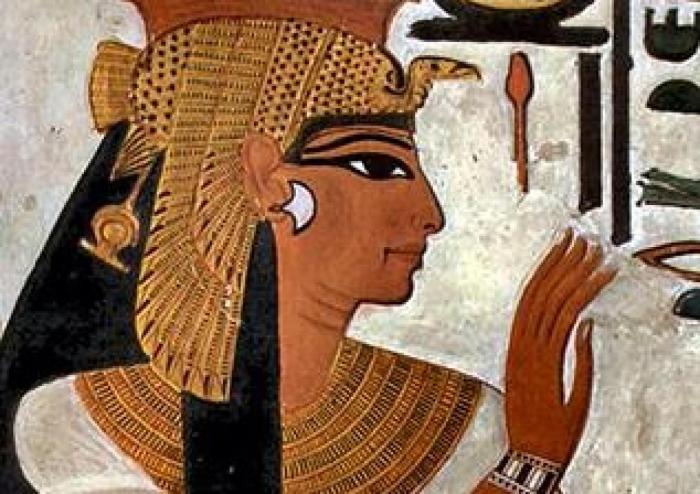
The “Nefer” (Good, Beauty, Pleasant, Well) is a prefix which had been used several times for the Egyptian queens, therefore, we must not mix them together. There are many beautiful Queens in ancient Egypt; “Queen Nefertari—not to be confused with Nefertiti, the powerful queen who ruled alongside her husband, King Akhenaten, in the mid-14th century B.C.—was the first and favoured wife of Ramses II, the warrior pharaoh who reigned from 1290 to 1224 B.C., during the early 19th dynasty.” https://www.history.com/news/archaeologists-identify-mummified-legs-as-queen-nefertaris
Here is another great article by Marie Grillot about finding a fetching artefact, among the others, the Pillar-djed amulet. 🙏💖🙏
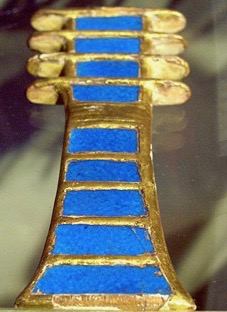
Pillar-djed amulet Wood covered with cloisonne gold leaf, with glass paste inlay – New Empire – 19th dynasty From the Tomb of Nefertari – QV / VdR 66 – discovered in 1904 by the Archaeological Mission of the Museum of Turin directed by Ernesto Schiaparelli and Francesco Ballerini Egyptian Museum of Turin – S. 5163
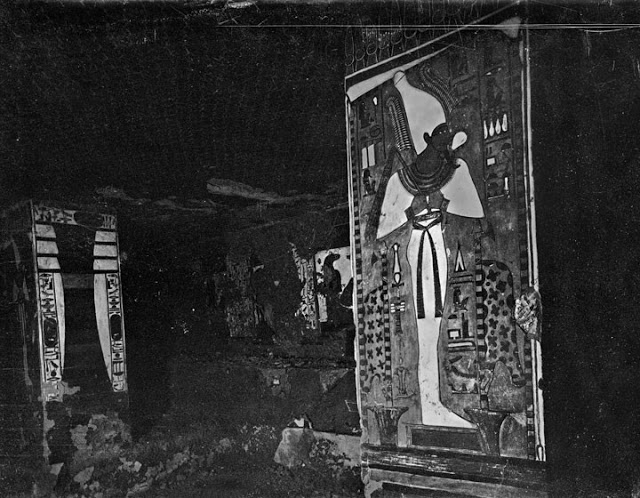
It is to the Archaeological Mission of the Museum of Turin, directed by Ernesto Schiaparelli and Francesco Ballerini, that we owe, in 1904, the discovery of the tomb of Nefertari, great wife of the pharaoh Ramses II; dazzlingly beautiful, it was adorned with eloquent titles. But the door which was to protect the abode of eternity – referenced QV / VdR 66 – from that which at Court was called “The most beautiful of all” had been opened, a sign of pillage from antiquity.
The tomb of Nefertari (QV / VdR 66) during its discovery by Ernesto Schiaparelli and Francesco Ballerini of the Archaeological Mission of the Museum of Turin, in 1904
“Cuttings had slipped, entered the first room and this filling almost reached the ceiling,” notes Schiaparelli. The ground of the tomb is entirely covered with solidified mud… Of the fabulous and royal treasure which it must have sheltered, there remain only “rare objects, in the middle of torn shrouds, everything showed to what extent the rape and the rampage had been systematic “. The looters left only “scarabs, fragments of the cover of the granite sarcophagus, and fragments of a coffin cover in gilded wood. Thirty “chaouabtis “(or ” shaouabtis “, ” chabtis “, “shabtis)., many shards of pottery … One of the niches kept for the magic bricks in the funerary chamber contained the partitioned wooden pillar-djed with an inlay of glass paste which had, one day, decorated the brick. It is inscribed in the name of Queen Nefertari… Finally to finish, humble but moving object abandoned by the looters, a pair of rope sandals… “
Pillar-djed amulet Wood covered with cloisonne gold leaf, with glass paste inlay – New Empire – 19th dynasty From the Tomb of Nefertari – QV / VdR 66 – discovered in 1904 by the Archaeological Mission of the Museum of Turin directed by Ernesto Schiaparelli and Francesco Ballerini Egyptian Museum of Turin – S. 5163
In “Nefertari, For Whom The Sun Rises”, Valeria Ornano describes the queen’s djed amulet as follows: “The front of the wooden object is 13 centimetres long and is covered with gold leaf with inlays in the blue glassy paste, while the back is painted yellow with red decorations and bears a touching engraving: “Osiris, the great royal wife, his beloved, just like Re”. It is quite possible that the other three niches contained similar objects, possibly related to Isis as she is depicted on the walls of the same tomb. These amulets were used to provide magical protection for Nefertari during his regeneration. “
Djed painted on one of the pillars of the sarcophagus room of the tomb of Nefertari (QV / VdR 66) discovered by Ernesto Schiaparelli and Francesco Ballerini (Archaeological Mission of the Museum of Turin) in 1904
The pillar-djed, symbol of stability is the Osirian amulet par excellence. In “Ancient Egypt and its gods”, Jean-Pierre Corteggiani devotes a long development to him, here is a short extract: “this pillar with the foot as flared as the head, surmounted above multiple ligatures, by four elements dishes which seem to fit one inside the other, was assimilated to the backbone of Osiris: this is what the ‘Formula of the pillar-djed in gold’ indicates… of chapter 155 of the Book of the Dead where it is specified that any deceased buried with this amulet suspended from the neck by sycamore fibre is guaranteed to be ‘an eminent blessed in the empire of the dead’ and this is what makes it a symbol conferring stability and duration, notions expressed in Egyptian by the corresponding hieroglyphic sign. “
Pillar-djed amulet Wood covered with cloisonne gold leaf, with glass paste inlay – New Empire – 19th dynasty From the Tomb of Nefertari – QV / VdR 66 – discovered in 1904 by the Archaeological Mission of the Museum of Turin directed by Ernesto Schiaparelli and Francesco Ballerini Egyptian Museum of Turin – S. 5163
The Guide to the Museo Egizio in Turin, where the Nefertari pillar-djed is exhibited under the reference S. 5163, specifies that this is: “the only survivor of the four amulets linked to what we call the ‘magic bricks’, ritually arranged at the four corners of the golden room to protect the deceased “.
In BIFAO 112, Elka Koleva-Ivanov studies this funeral ritual of “magic bricks” or “sacred bricks” linked to Osiris: “According to chapter 137A of the Book of the Dead, on the western brick must be placed a pillar-djed which is an Osirian object and on the eastern brick, the figurine of Anubis which is closely associated with the protection of the dead god. Similarly, according to this text, the magic brick must be made in sjn wȝḏ, which designates the raw clay, but also green clay, the Osirian colour par excellence “; the other two bricks being: “to the south – the one with the torch and to the north – the brick carrying the mummy figurine”.
Remains of the funeral furniture of Queen Nefertari from her grave (QV / VdR 66) discovery by Ernesto Schiaparelli and Francesco Ballerini of the Archaeological Mission of the Museum of Turin, in 1904 exhibited at the Turin Museum
It is clear that the bricks did not succeed in preserving the queen … In his “Nefertari the Lover of Mut”, Christian Leblanc returns to the desecration of the tomb: “The burial unsealed by looters was not burnt down, but the queen’s funeral furniture was largely taken away. The open pink granite sarcophagus allowed thieves to get their hands on the most precious objects: gold and gilded coffins, jewellery and amulets, which were easily transformable or exchangeable on the market where large traffic arises. The chests, baskets, chairs and beds which had to appear among the pieces of equipment put at the disposal of the sovereign in her eternal home, were undoubtedly dismantled then recovered, along with the contents of the jars and containers. “
Nefertari represented in his tomb – Valley of the Queens – QV / VdR 66 discovery by Ernesto Schiaparelli and Francesco Ballerini of the Archaeological Mission of the Museum of Turin in 1904
As for Nefertari whose representations, whether painted or of stone, delight our eyes, it is infinitely sad to report that, of his mummy, only the two knees have been found. After the plundering at the end of the New Kingdom, was it restored and sheltered in a royal hiding place, similar to the DB 320? If that were the case, hope would then be allowed to see the beautiful sovereign one day …
Nefertari, ‘the beloved de Mut’ Christian Leblanc, Editions du Rocher 1999The queens of the Nile. Library Rarities, Christian Leblanc, Paris, 2009Nefertari, For Whom The Sun Rises, Valeria OrnanoOsiris and sacred bricks BIFAO 112 (2012), p. 215-224 Elka Koleva-Ivanovhttps://www.ifao.egnet.net/bifao/112/15/
12 Egyptian queens who changed history, Pierre TalletThe secret discoveries, Christiane Desroches-Noblecourt Editions Telemachus, 2006The great nubiade or the journey of a Egyptologist Christiane Desroches-Noblecourt, Stock 1992
Nefertari, also known as Nefertari Meritmut, was an Egyptian queen and the first of the Great Royal Wives of Ramesses the Great. Nefertari means ‘beautiful companion’ and Meritmut means ‘Beloved of [the goddess] Mut’. She is one of the best known Egyptian queens, next to Cleopatra, Nefertiti, and Hatshepsut. Wikipediahttps://g.co/kgs/SaKbEz
An Enlargement of a Photograph… or an Enlargement of Mind.
Hi dear friends. I hope you’re all good and well and tuned. Oops! It looks like I’m writing a letter to you 😁 Of course, I have no intention of writing a letter, I’m just a little confused, It seems I am doing mostly something else as I have thought to want to do!!
It might be also caused by a problem, which I have got since a week ago about my limited action on the WP.
You know; I must confess that I am as a guest-writer here, it means that I use this site in no charge. It is, of course, a very kind act by the WP to let me and the same as me, to be allowed to work and write their thoughts without paying and it is as it expected, limited version.
Therefore, and at the same time surprisingly, the warning comes to tell that; you have reached your limit! And of course, I respectfully accept it (with considering deleting some old posts as suggested)
Anyway, what can one expect from an old poor retired man? Nothing I think, just forgiveness and let him do calm his soul by sharing it with you good friends. 🙏💖
Now let’s go in the very past; from the time as life has begun, I would it recall; The end of ’60s. And with this old but very interesting movie; the Blow-up by Michelangelo Antonioni http://Search Results Web results Michelangelo Antonioni – Wikipedia and his first English-speaking movie.
I have watched this last weekend, after about forty-five years, oh yes; I have seen it in Iran those days though it was censored partly but anyhow it was an unbelievable occasion to see it! In fact, there were many opportunities in Shah’s time to do, one should only know that!
Now on this movie; of course, Antonioni is famous enough as a great movie-maker and he has made a lot of fascinating pieces in the history of cinema, but in this one, he has a message which he shows it at the end of the movie; fully noticed; the enlargement of the mind.
A miniature of Nizami‘s narrative poem. Layla and Majnun meet for the last time before their deaths. Both have fainted and Majnun’s elderly messenger attempts to revive Layla while wild animals protect the pair from unwelcome intruders. Late 16th-century illustration. via Wikipedia,
Layla and Majnun is a very old Persian story about two unfortunate lovers as in this video will be explained; it might be compared with W. Shakespeare’s drama Romeo and Juliet. But it seems that it is a never-ending story, it works itself out into the modern times. 😉🤗
The story of Eric Clapton and “Layla” has always bothered me because to understand it is to understand how fallible and crazed any of us can be when it comes to love. We understand that our rock gods are human, but there’s something about Clapton falling in love with the wife (Pattie Boyd) of one of his best mates (George Harrison, a freakin’ Beatle, man!) and then writing a whole album about it, that is just unsettling. Is this something tawdry writ epic? Or is this something epic that has the wafting aroma of tawdriness?
Polyphonic takes on the behind the scenes story of this rock masterpiece and rewinds several centuries to the source of Layla’s name: “Layla and Majnun,” a romantic poem from 12th century Persian poet Niẓāmi Ganjavi based on an actual woman from the 6th Century who drove her poet paramour mad. Lord Byron called the tragic poem “The Romeo and Juliet of the East,” as unrequited love leaves both Majnun and Layla dead after the latter’s father forbids her to be with the poet.
Eric Clapton heard of the poem from his Sufi friend Abdalqadir as-Sufi (formerly Ian Dallas), and so when he wrote a slow ballad about his unrequited love for Patti, “Layla” made perfect sense as a name.
The song might have stayed a ballad–think of Clapton’s slowed down version from his MTV “Unplugged” special–if it wasn’t for Duane Allman of the Allman Brothers. The two had yet to meet, but were aware of each other. Allman had grabbed Clapton’s attention with his fiery solo work at the end of Wilson Pickett’s cover of “Hey Jude”:
When Clapton and Allman did meet, the two set to jamming and Allman made the history-changing decision to speed up Clapton’s ballad and use a riff taken from Albert King. “Layla” was born. Allman’s bottleneck slide style met Clapton’s string bending, and the track is a conversation between the two, where no words are needed.
“It’s in the tip of their fingers,” says engineer Tom Dowd, listening to the isolated tracks in the video below. “It’s not in a knob, it’s not in how loud they play, it’s touch.
Over this, Clapton delivers his desperate lyrics, sung by a man at his wits end, much like Majnun of the poem.
And then, that coda, which takes up half the song. Drummer Jim Gordon was working on the piano piece for a solo album in secret. When Clapton discovered Gordon was recording on the sly, he wasn’t angry. Instead he insisted it be added to the end of the rocking first half. The song is a perfect balance between frantic rock and romantic ballad.
But in the real world, “Layla” didn’t do the job. Clapton played the album for Pattie Boyd three weeks later, and though she understood its beauty, Boyd was embarrassed by its message.
“I couldn’t believe I was the inspiration for putting this together,” she said in an interview. “I didn’t want this to happen.” She was also mortified thinking that everybody would know exactly who “Layla” was about.
“It didn’t work,” Clapton recalled. “It was all for nothing.”
The song was a flop in the charts, especially as it was cut in half for the single. It would find its audience three years later when the full version appeared on both a Clapton anthology and a best of collection of Duane Allman’s work. Finally it rocketed up the charts, and it’s kind of stayed in classic rock playlists ever since.
And as for Boyd, she actually did leave George Harrison in 1974 to marry Clapton in 1979, a marriage that lasted 10 years. Not all marriages last. The original flame dies out. It’s just that, in “Layla”‘s case, the flame is there every time the needle drops into the groove.
To put it bluntly, I am a totally introvert! Really, I tell you; I am at home from May 1st, the time when I become retired since then I have been just one time out in the city for buying my stuff which I normally needed and never again. And I feel good!! 😉😁
Though we can’t avoid of Psychology transference and Unio Mystica, that comes actually from my birth region, means to me; a union between Ego and my soul, between Anima and Animus; and with the help of my intuition, I will get to know my collective unconscious.
Ego and its thinking function questioning the Cosmic Sea : …” immortality cannot be the object of experience, hence there is no argument either for or against. But immortality as an experience of feeling is rather different. A feeling is as indisputable a reality as the existence of an idea, and can be experienced to exactly the same degree. On many occasions I have observed that the spontaneous manifestations of the Self, i.e., the appearance of certain symbols relating thereto, bring with them something of the timelessness of the unconscious which expresses itself in a feeling of eternity or immortality. Such experiences can be extraordinarily impressive… [The] paradox, however, offers the possibility of an intuitive and emotional experience, because the unity of the Self, unknowable and incomprehensible, irradiates even the sphere of our discriminating, and hence divided, consciousness, and, like all unconscious contents, does so with very powerful effects. This inner unity, or experience of unity, is expressed most forcibly by the mystics in the idea of the unio mystica , and above all in the philosophies and religions of India, in Chinese Taoism, and in the Zen Buddhism of Japan. From the point of view of psychology, the names we give to the Self are quite irrelevant, and so is the question of whether or not it is “real.” Its psychological reality is enough for all practical purposes. The intellect is incapable of knowing anything beyond that anyway, and therefore its Pilate-like questionings are devoid of meaning.” C.G. Jung, Psychology of the Transference
I’m trying to share this post since last Wednesday but WP tells me permanently that my limit is overfilled! Let me try it again 😉
Anyway, Here is a clip in which these two great dancers shows that being aged is not a matter at all.
There is something about being a pensioner!! 😮🤤
It’s nice to see that somebody sent me this video to give me a kick, and it works 😉😂👇👇🙏💖
The last days I am doing mostly Household work! Sometimes it is really surprising to see something that you haven’t seen so long time but still there waiting!! 😳😊 Have a nice Sunday and a good week ahead 👍💖🤗
The paintings of contemporary Italian artist Agostino Arrivabene are grounded in the techniques of the Old Masters and inhabit the timeless realm of dreams and mythological, religious archetypes. Against a backdrop of either luminous darkness or apocalyptic landscape, figures that have haunted the collective unconscious for centuries or longer, Orpheus, Lucifer, Elizabeth Bathory, Persephone, enact sacred ritual dramas. Among the memento mori lie the possibility of transformation and metamorphosis; an actualisation of becoming.
Arrivabene cites as influences the Symbolist Gustave Moreau, the master of the Northern Renaissance Albrecht Dürer and the Neo-Baroque/Kitsch artist Odd Nerdrum. Also discernible are traces of Max Ernst’s eroding mineral frottage derived inscapes, Giger‘s spectacular visceral transfigurations and Blake‘s sheer burning visionary intensity. In keeping with the Symbolist tendency towards drawing inspiration from literature elements of Ovid, Dante and Giordano Bruno are included within the occult and occasionally infernal worlds…
How long had we been looking forward to May 4th, the day of the lockdown ease in Italy? Two months. A long time indeed. What shall I remember most of this period? The singing on the balcony every evening at 6.00pm right after watching the daily bulletin of Covid-19 victims or the frightening number on my scale as the result the absurd amount of food I have swallowed in these months, mostly carbs – and I can distictly see them all deposited right here 😱- ? Now that I am thinking about it, I have to say that my time has been spent in the company of screens mostly, whether it was that for smart working/on line lessons or the tv screen. I have watched the 200 and more episodes of “How I met your mother” (brilliant), four seasons of “How to get away with murder” (super), “Unorthodox”(great), 3 seasons…
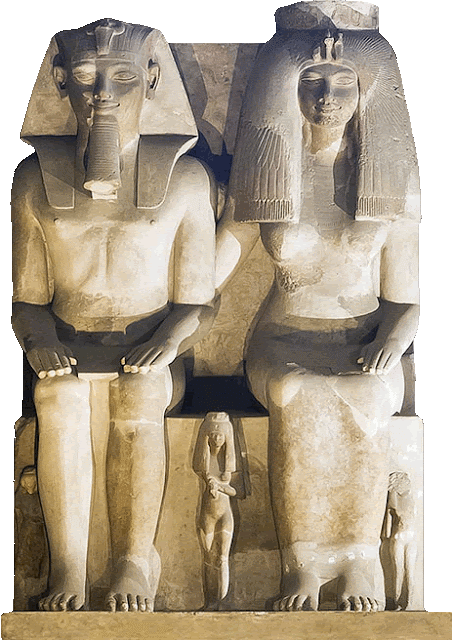
Statuary group of Amenhotep III and Queen Tiy Cairo Egyptian Museum – ref. GM 610
Here they are; The godlike giants of ancient Egypt and how the mortal man had to gather all pieces together!! A fascinating description of the heritage from one of the greatest mystery of our past.
“”Amenhotep III and his wife Tiyi are seated side by side and, being very “singular”, the queen has been represented in the same size as pharaoh. This attests to the importance she had acquired, not only on a personal level but also at the “political” level.””
The “new” Museum of Egyptian Antiquities “in Kasr-el-Nile Tahrir Square, a building in the Western neoclassical style, was officially inaugurated on November 15, 1902, by the Khedive Abbas Hilmi.
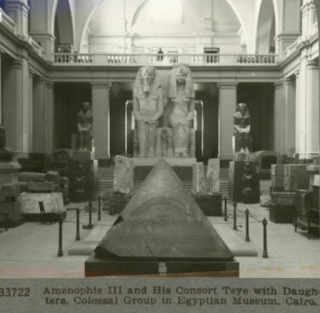
Gaston Maspero managed to publish the first version of the Visitor’s Guide at the Cairo Museum in due course. He takes care to specify that its development is not yet finished and that, in particular, “the decor of the central atrium is not complete. This is where the heaviest and largest must appear of our monuments, the colossi from various points in Egypt, the fragments of obelisks, the pyramids, but many of these heavy pieces have not yet arrived in Cairo and they are waiting among the ruins for the Service to have the necessary resources to remove them ”…
Four years later, in letters addressed to his wife Louise, dated June 21 and June 28, 1908, respectively, Maspero thus mentions the installation of the statuary group of Amenhotep III and Tiyi (reference: GM 610) who sits enthroned – for almost 110 years now – in the central atrium: “Tomorrow, we are setting up the feet of the colossal group in the Central Atrium: This will be the last novelty for this year.” Then a week later: “Fortunately, work is progressing, and I think that the colossus can be finished before my departure. He went up to the knees, and now we’re going to attack the bodies and the heads. Brugsch and Daressy declare that he will not be well, that he is in too many pieces: we let them say and we go ahead, a little later, they will tell that they had the idea, that ‘they wanted to do everything, but Barsanti and I spoiled the work by mixing it up. It’s always the same comedy. “
Statuary group of Amenhotep III, Queen Tiye and three of their daughters Cairo Egyptian Museum – ref. GM 610
We can well imagine the atmosphere in which was “reassembled this group of more than 7 m high, magnificently sculpted in limestone”. And if the business was certainly very complicated, we can only recognize its success!
This group, as been discovered very damaged, comes from the west bank of Thebes: its – or theirs – “discoverer (s)” as well as the place of its discovery are thus indicated to us.
In an article published in 2011, in ASAE n ° 85, Zahi Hawass, Abdel Ghaffar Wagdy and Mohamed Abdel Badea write “that it was found in Medinet Habu, near the Roman court, in 1859 by Auguste Mariette. When it was discovered many parts of the statue were missing and it was restored by filling in the gaps. “
Gaston Maspero said that it had been “discovered by Daressy in 1892, during the clearing of the temple of Medinet Habu” and that it was, on his orders, “brought to the Museum piece by piece by Daressy and by Baraize, from 1906 to 1908 “.
Temples of Thebes indication of where was found the statuary group of Amenhotep III and Tiye
As for the interpretation of David O’Connor and Eric H. Cline, in their book Amenhotep III: Perspectives on His Reign, it is very interesting because it parallels the context of current and “ancient” locations: “A double statue colossal limestone was found in the fields opposite the funerary temple of Aï – Horemheb (immediately north of Medinet Habou, probably the site of the great south door of the mortuary complex of Amenhotep). ”
Amenhotep III and his wife Tiyi are seated side by side and, being very “singular”, the queen has been represented in the same size as pharaoh. This attests to the importance she had acquired, not only on a personal level but also at the “political” level.
Tiyi was the daughter of Youya and Touya whom Pierre Tallet presents as follows: “Youya was originally from Akhmim in Middle Egypt and bore the titles of director of the royal stables and of the divine father; her mother Touya was “royal ornament” and singer of Amun “.
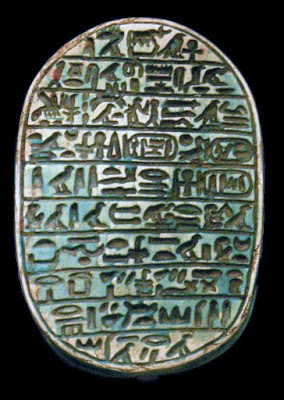
Memorial Beetle marriage of Amenhotep III and Tiye – Louvre Museum – 787 N
“The arrangements” for the marriage of Amenhotep III and Tiyi – which occurred in year II of the reign of the pharaoh – were inscribed on “a series of commemorative scarabs”.The titles which her parents gave her are numerous: “Noble Lady”, “Great Favorite”, “Great Royal Bride”, “Sovereign of the Two Lands”, “Who fills the palace with love”,… She was an influential sovereign, not only during the reign of her husband but also during that of her son, Amenophis IV – Akhenaton.
She wears a heavy and voluminous wig on which is placed a crown, a simple mortar. On its forehead are erected Ureus, symbolizing the double country. Her full face is serene, “the high cheekbones, almond-shaped eyes and curved eyebrows are typical of the period”. Her lips are well-drawn and hemmed. She is wearing a long, form-fitting dress that delicately sculpts her chest and reveals her thin waist. Her left-hand lies flat on her thigh while with her right arm she tenderly embraces her husband. Her thick feet are bare.
Statuary group of Amenhotep III, Queen Tiye and three of their daughters Cairo Egyptian Museum – ref. GM 610
Amenhotep III is capped with uraeus nemes. Her face – perfectly symmetrical – seems to be imbued with quiet strength. The cheeks are full, the almond-shaped eyes are surmounted by marked eyebrows. The nose is of an ideal proportion with slightly flat nostrils. The mouth with hemmed lips is sensual. The ears are worked with care. The false beard is streaked with horizontal bands sculpted in relief and leaves slightly flared.
Statuary group of Amenhotep III, Queen Tiye and three of their daughters Cairo Egyptian Museum – ref. GM 610
The couple is pictured with three of their daughters. They take place, standing, on the front of the seat, along the legs of their parents: one on the left, the other on the right and best preserved in the centre. The princesses “Henouttaneb, Nebetah and the third whose name is lost” are very small but they bring tenderness and “humanity” to this colossal group…
Thanks to them, this representation of the royal couple, frozen in their functions, also suggests a family story…
Amenhotep III et Tiyi du Musée du Caire : plus qu’une statue colossale, un groupe familial ! › Groupe statuaire d’Amenhotep III et de la reine Tiyi Musée égyptien du Caire – réf. GM 610 Le “nouveau” Musée des Antiqu…
The Epic of Gilgamesh is an epic poem from ancient Mesopotamia that is often regarded as the earliest surviving great work of literature and the second oldest religious text, after the Pyramid Texts. Wikipedia















 Lucifero-Agostino Arrivabene 1997




 lampmagician
You must be logged in to post a comment.