A stele dedicated to the Boukhis bull by Ptolemy V

Standard
Stele dedicated to the Boukhis bull by Ptolemy V – painted and gilded limestone – Ptolemaic period – Reign of Ptolemy V – year 25 – 181 BC. J.-C.
discovered during excavations funded by Sir Robert Mond
and conducted by the Egypt Exploration Society in 1929-30, in the Bucheum d’Arment (Hermonthis)
Egyptian Museum in Cairo – JE 54313 (museum photo)

It is another fascinating Stele of the history of Egypt, of all human history. and I promise that it’s the last one… this year! 😉 With as always great thanks to Marie Grilott for her brilliant description. Happy holidays and a much better new year.🙏💖

via https://egyptophile.blogspot.com/ By http://Marie Grillot from French.

This stele, in painted and gilded limestone, is 72 cm high, 50 cm wide and 14 cm thick. Dated from the Ptolemaic period, it is arched in shape. As Auguste Mariette specified: “Until the XIth Dynasty, the stelae were quadrangular … But from the XIth Dynasty, the stele took the form that it only abandoned on rare occasions. It was rounded off by above as if it were intended to recall the curvature of the sky or that of the lids of sarcophagi “. It also explained its symbolic design: “The top of the stele is supposed to lose itself in the sky. As we descend downwards, we approach the earth. In other words, the stele is divided into three areas. “.

This “Stele dedicated by Ptolemy V to the Boukhis bull” reveals a particularly rich and harmonious chromatic palette combined with very interesting iconography. Its registers are declined differently, but the central part having, it seems, received the greatest attention.

Stele dedicated to the Boukhis bull by Ptolemy V – painted and gilded limestone – Ptolemaic period – Reign of Ptolemy V – year 25 – 181 BC. J.-C.
discovered during excavations funded by Sir Robert Mond
and conducted by the Egypt Exploration Society, in 1929-30, in the Bucheum d’Arment (Hermonthis)
Egyptian Museum in Cairo – JE 54313

The hanger is dominated by a winged sun disk which completely conforms to its shape. Just below is reproduced a composition rich in “symbolism” and symmetry. “In the center of the scene is a scarab supported by a djed pillar flanked by two snakes facing each other and capped with the solar disk; these uraei are surrounded by vertical inscriptions evoking the ‘Great god of Behedet, with multicolored feathers'” analysis Rosanna Pirelli in “The treasures of the Egyptian Museum”. On either side is a seated Anubis, treated hastily; preceded by an emblem and vertical lines of hieroglyphics, he carries a flagellum.

The central part is divided into two “sections”, the most important is linked to the divinity to which the stele is dedicated: the Boukhis bull. He is represented with great precision with precise respect for his anatomy, perfectly reproducing his muscles and his power. Between its horns is placed “its” crown composed of a solar disk with two uraei surmounted by two high feathers: “The bull identified with Ré, bears the epithets ‘living soul’ and ‘herald of Ré'” specify Mohamed Saleh and Hourig Sourouzian (Official Catalog Egyptian Museum in Cairo).

Stele dedicated to the Boukhis bull by Ptolemy V – painted and gilded limestone – Ptolemaic period – Reign of Ptolemy V – year 25 – 181 BC. J.-C.
discovered during excavations funded by Sir Robert Mond
and conducted by the Egypt Exploration Society, in 1929-30, in the Bucheum d’Arment (Hermonthis)
Egyptian Museum in Cairo – JE 54313

His dress, which we imagine soft and lustrous, is painted in gold and the whole stands out against an incredibly bright blue background, offering a striking contrast between the two colors.

“Behind the bull, Montu appears in his usual falcon form, as he was worshipped in Thebes. Opening its wings, the falcon grips a fan and the ring of duration. Associated with Rè-Harakhty, Montou is qualified of ‘great god, Lord of the On of the South’, that is to say, Thebes “(Mohamed Saleh and Hourig Sourouzian). Facing the bull is Pharaoh, in the attitude of walking, left leg forward. Richly dressed and adorned, his body is treated in ocher-red colour. “In front of the altar, King Ptolemy V, standing, offers the sign of the field (Sekbet) to the Boukhis bull. Wearing the blue crown, he wears a ceremonial loincloth with a rigid lap and a bustier; bracelets and a golden necklace adorn his arms, wrists and neck. The seven columns of hieroglyphics carved above the pharaoh mention the names of the god Bukhis, king Ptolemy, his wife Cleopatra and again quote the sun god, Lord of Behedet. A formula of protection and formula of the offering are inscribed, respectively, behind and in front of the pharaoh, “explains Rosanna Pirelli.
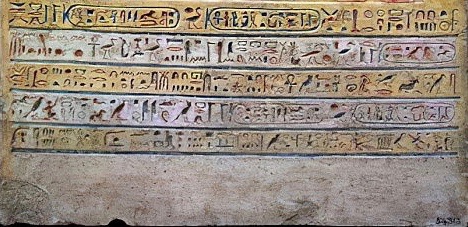
Stele dedicated to the Boukhis bull by Ptolemy V – painted and gilded limestone – Ptolemaic period – Reign of Ptolemy V – year 25 – 181 BC. J.-C.
discovered during excavations funded by Sir Robert Mond
and conducted by the Egypt Exploration Society, in 1929-30, in the Bucheum d’Arment (Hermonthis)
Egyptian Museum in Cairo – JE 54313

The lower part of the stele is mostly inscribed. “At the bottom of the stele, a text of five lines, which gives very precise dates, tells us that the Boukhis, who died in the twenty-fifth year of the reign of Ptolemy V and of Cleopatra I, was born in the year 11, and that the duration of his life had been fourteen years ten months and twenty-four days. In fact, this last statement is false: it is easy to redo the calculation oneself and to find that the bull in question did not live only thirteen years ten months and twenty-eight days “analyzes with relevance Jean-Pierre Corteggiani.

The image of the bull, a robust, belligerent, invincible animal endowed with great sexual vigour, was “endorsed” by the pharaohs who did not hesitate to call themselves a “powerful bull”. Thus, as Isabelle Franco specifies: “particular bulls were chosen to become the terrestrial receptacle of certain gods”.

In Memphis, people worshipped Apis, the sacred animal of Ptah; Mnevis, him, was the solar bull of Heliopolis, while the Theban region honoured the Boukhis bull. The sacred animal of the “palladium of Thebes”, it was venerated in the sanctuaries of Tod, Medamoud and Ermant (Hermonthis), as a manifestation of the god Montu.

The selection of the bull by the priests responded to very precise characteristics: it must have a black head and the rest of the coat white. Thus, indicates Dominique Valbelle: “Macrobe (Saturnalia, I, 21) describes it thus: ‘In the town of Hermonthis (Armant), in a magnificent temple of Apollo, they worship a bull, named Bacis, consecrated to the sun and remarkable for the wonderful properties inherent in the nature of the sun. For it is said that its colours change every hour and it is said that its coat is the opposite of that of other animals. That is why it is considered in a way like an image of the sun shining away from the sky.

Aerial view of the Bucheum d’Erment published in
“The Bucheum. Vol. I” edited by HW Fairman – MOND Robert – MYERS Oliver H.

This bull, the object of true worship, lived in a “sacred stable” and was especially honoured during the processions of the Valley Festival. At his death, he was mummified and his funeral followed a very precise ritual. To the Seraphim of Memphis corresponded, to Ermant, the Bucheum which was active in the XXXth dynasty in Roman times. These large basements housed the burials of bulls, surrounded in particular by commemorative stelae…

Excavations financed by Sir Robert Mond and carried out by the Egypt Exploration Society, 1929-30
in the Bucheum d’Arment (Hermonthis) – photo EES

The excavations carried out at Erment in 1926 by the Egypt Exploration Society benefited from the financial support of the patron Robert Ludwig Mond. They allowed the discovery of the Bucheum in 1929-1930 and, it is in its ruins that this stele dated to the year 25 of Ptolemy V was found. It has been recorded at the Egyptian Museum in Cairo under the reference: JE 54313.

Marie Grillot

Sources:

Visitor’s guide to the Boulaq museum, Gaston Maspero, 1883 http://gallica.bnf.fr/ark:/12148/bpt6k141741b.r=gaston+maspero.langFR

Official catalogue Egyptian Museum of Cairo, Mohamed Saleh, Hourig Sourouzian, Verlag Philippe von Zabern, 1997

Treasures of Egypt – The Wonders of the Egyptian Museum in Cairo, Francesco Tiradritti

The Egypt of the Pharaohs at the Cairo Museum, Jean-Pierre Corteggiani

Ancient Egypt and its gods, Jean-Pierre Corteggiani, 2007

Dictionary of Egyptian Mythology, Isabelle Franco, 2013

The Bucheum. Flight. I: The history and archaeology of the site. Flight. II: The inscriptions. Flight. III: The plates (complete set). With chapters by TJC Baly, DB Harden, JW Jackson, G. Mattha, and Alan E. Shorter and the hieroglyphic inscriptions edited by HW Fairman

MOND Robert – MYERS Oliver H. https://www.meretsegerbooks.com/pages/books/M1128d/mond-robert-myers-oliver-h/the-bucheum-vol-i-the-history-and-archaeology-of-the-site-vol-ii-the-inscriptions-vol-iii-the-plates Armant: the sacred bull catacombs https://www.ees.ac.uk/armant-the-sacred-bull-catacombs

Cows, oxen and bulls – Site osirisnet.net

https://www.osirisnet.net/docu/veaux/veaux.htm

Valbelle Dominique. The metamorphoses of a divine hypostasis in Egypt. In: Review of the history of religions, tome 209, n ° 1, 1992. pp. 3-21; https://www.persee.fr/doc/rhr_0035-1423_1992_num_209_1_1625

Ancient polytheisms – Religion of ancient Egypt – Conferences of the year 2012-2013 – EPHE – Conference by Christiane Zivie-Coche https://journals.openedition.org/asr/1223?fbclid=IwAR0jwlZpPFVbQGpZCQONlBij2PJ_qIhe9QaGffXDnJyaYwJ6qyh8KIWPiNg#tocto2n2

To You, with a lot of Loving Wishes

Standard

With a little delay but hopefully not too late!
I would like to publish my wishes to you yesterday, but I had no time for that! Though I stunned to see how some friends write and post their stories, one after another, and I’d only say; Wow! I know, I need definitely some practices. 😁 I have my reasons for sure.

It is, of course, one of the reasons!

We put up the Christmas tree almost every year. In the past, because of our son, and now for our grandchildren.

Mila is helping me not to get crazy!

The reason for the stress in this year is Corona (what else?), which does not allow us to celebrate in huge numbers, therefore, the family of my wife ( I have no one from my side!) who also is not some few, has planned to divide into some groups to meet in different days (and of course no waiver has been allowed) it meant to me; everyday business!

I didn’t find my red wardrobe 😉🎅😅

Anyway, I hope you have a good time and wish you all peace and health and some leisurely holidays. 💖💕🌹

Le Satyricon

Standard
Image may contain: 1 person, outdoor
Georges Antoine Rochegrosse (1859-1938), “Le Satyricon” by Gaius Petronius, 1910

I have coincidentally seen this picture in media and was fascinated. Not only because of the amazing effect on me but also it reminded me of one of the greatest movies of all time: Fellini’s Satyricon.

Georges Antoine Rochegrosse is a French painter. Whom I didn’t know how fascinating one he was.

And Gaius (or Titus) Petronius Arbiter, was a Roman courtier during the reign of Nero. He is generally the one who was probably the author of the Satyricon, a satirical novel, which was written during the Neronian era. The Satyricon, or Satyricon liber, is a Latin work of fiction in a mixture of prose and verse. And as we know, the word Satire comes from this.

<p value="<amp-fit-text layout="fixed-height" min-font-size="6" max-font-size="72" height="80">When I saw this picture I was fully surprised how similarity fits with the actor: Max Born as Giton, and I've been more astounded when I found out that this "young boy" as I'd presumed, is really three years older than me!When I saw this picture I was fully surprised how similarity fits with the actor: Max Born as Giton, and I’ve been more astounded when I found out that this “young boy” as I’d presumed, is really three years older than me!

Federico Fellini was and is one of the greatest film-makers in the world and also one of the geniuses who changed my view in the way of seeing things.

I can remember well when Al and I with two other close friends; Bijan and Nasser (they were a pair: Bijan’s a Bi and Nasser was too young to decide!) who had studied in the College of Beautiful Arts with me, after spending our crazy nights together, as the young boys always do, we had to get off out of bed early in the morning to run to catch the bus for being on time into the cinemas, to see such of these movies in the Film Festivals, which were running once in a while in Tehran.

Those days in the early 70s, there were no videos or cartridges to see the beloved and special art-movies. We had only this opportunity to see such Masterpieces. In the Shah’s time, it was possible. Though, the traces of the scissors of the censorship were visible here and there.

We’ve watched this and the other such as “Art-Movies” so often it was possible; so long as they were running on the big screen every time. And every time we’ve enjoyed more. And Federico Fellini’s Cinecittà was not only a Film Studio for us, but it was also a world, to dream and let it be dreaming.

Finally, something for the background.

A clip from “Ciao, Federico” in which young Max Born, dressed for his role as Giton in Satyricon, sings the Bob Dylan song, Don’t Think Twice, It’s All Right”

And for the fans.

Sources:

http://Georges-Antoine Rochegrosse – Wikipedia

https://en.wikipedia.org/wiki/Petronius

http://Fellini Satyricon

Valentine Cameron Prinsep

Standard
‘Self-Portrait’ (1883) by Valentine Cameron Prinsep

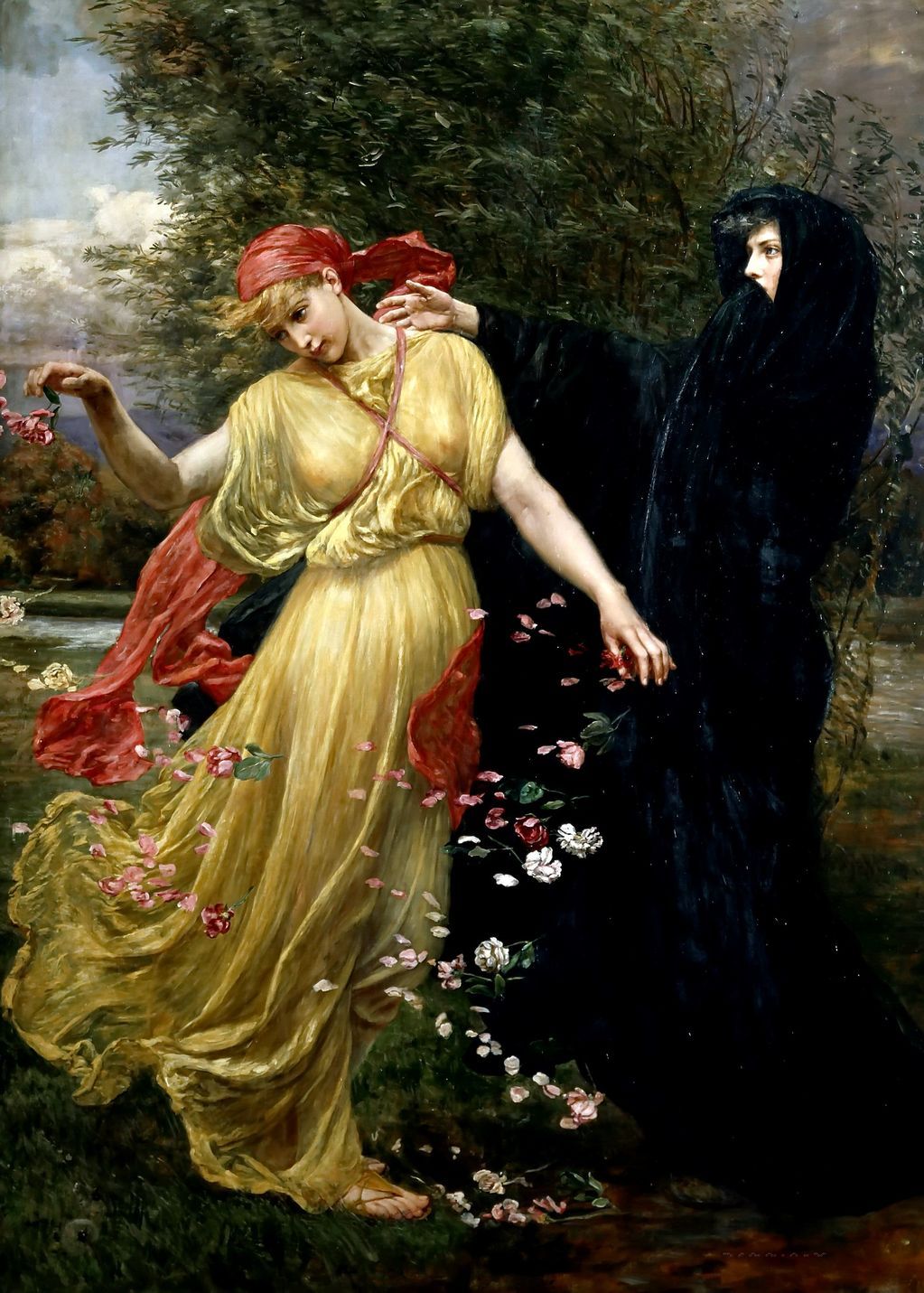
Today, I want to present an amazing and sensational painter; Valentine Cameron Prinsep, under “The Sensual Pre-Raphaelite Art”

At the First Touch of Winter, Summer Fades Away (1897)

The reason is obviously clear when we have a glimpse of his Masterworks. When I, first saw occasionally this painting (s. o.) in the Media with its description, it blew my mind. Of course it seems that I was not alone: our adorable la gentildonna luisa zambrotta (WORDS AND MUSIC AND STORIES) got the same feeling and composed a poem on this seasons substitution: (translated from Italy.🙏💖)

Chills
of cold
of the morning,
darkness
that falls
quickly,
here
the touch
of Winter
drives out
a Summer
helpless.

Valentine Cameron “Val” Prinsep RA (14 February 1838 / 11 November 1904) was a British painter of the Pre-Raphaelite school. Born in Calcutta, India, he was the second child of Henry Thoby Prinsep, a civil servant of the British Raj. Prinsep travelled in 1856–57 to Helicarnassus (now Bodrum Turkey) for Sir Charles Thomas Newton’s excavation of the ruins.

Il-Barbagianni-The-Owl-1863-

Valentine Cameron Prinsep has a high profile, not only for having been contemporary (and close friend) of big names in the Pre-Raphaelist movement, but also for having been a remarkable artist within said movement himself.

I think there is not a word needed, let’s enjoy some of his great paintings.

The-Gamekeepers-Daughter-1875-
Museum of Croydon; (c) Croydon Art Collection; Supplied by The Public Catalogue Foundation
The-First-Awakening-of-Eve
CH1762042; Private Collection; Photo © Christie’s Images; out of copyright
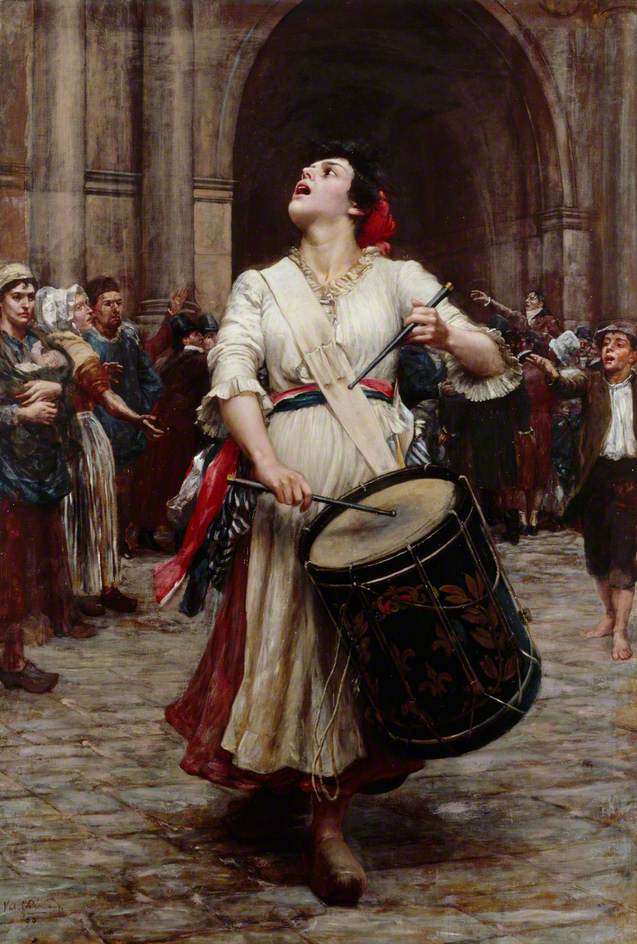
La-Revolution-1896-
(c) Royal Academy of Arts; Supplied by The Public Catalogue Foundation
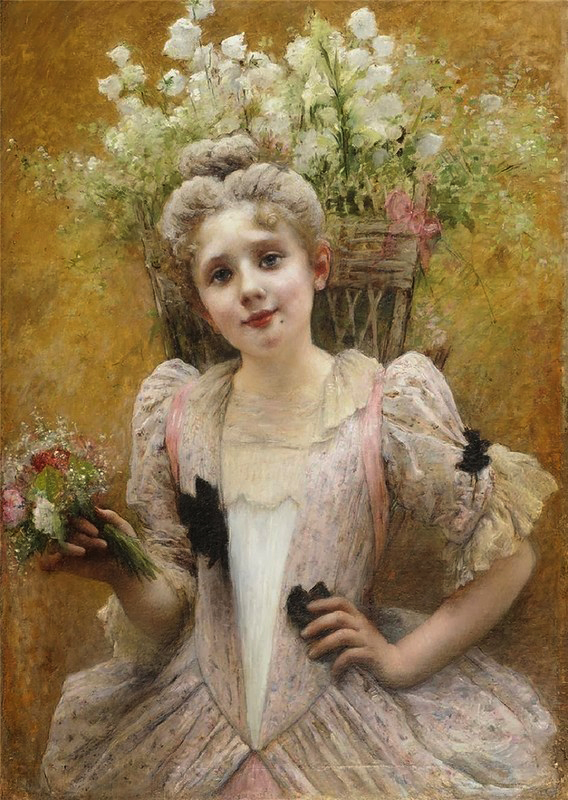
The-Flower-Seller
At-the-Golden-Gate-1882-
(c) Manchester City Galleries; Supplied by The Public Catalogue Foundation
Death-of-Siward-The-Strong-1890
(c) Southwark Art Collection; Supplied by The Public Catalogue Foundation
Medea-the-Sorceress-1880
(c) Southwark Art Collection; Supplied by The Public Catalogue Foundation
<p value="<amp-fit-text layout="fixed-height" min-font-size="6" max-font-size="72" height="80"> Source: <a href="http://www.renegadetribune.com/the-sensual-pre-raphaelite-art-of-valentine-cameron-prinsep/?fbclid=IwAR02AD72TWDX33Qeue41dOn-_-_nE8qIYfdzL7RtJQTbRoOCHW5XNTLGPQc">http://www.renegadetribune.com/the-sensual-pre-raphaelite-art-of-valentine-cameron-prinsep/?fbclid=IwAR02AD72TWDX33Qeue41dOn-_-_nE8qIYfdzL7RtJQTbRoOCHW5XNTLGPQc</a&gt; Source: http://www.renegadetribune.com/the-sensual-pre-raphaelite-art-of-valentine-cameron-prinsep/?fbclid=IwAR02AD72TWDX33Qeue41dOn-_-_nE8qIYfdzL7RtJQTbRoOCHW5XNTLGPQc

The House of Wisdom contained so many books that the Tigris River turned black from ink when they were destroyed

Standard
The House of Wisdom: Baghdad's Intellectual Powerhouse - 1001 Inventions
http://1001 Inventions

It seems that whenever we look back at our history, we can observe the glorious times; so-called Golden Age, and also inglorious times; so-called Dark Age. Most of the latter comes not only because of the religions but of human’s short-sighted, the prejudice and bigotry (fanaticism). In the western countries is the famous Middle Age but it could, more or less, be rescued from annihilation (Renaissance) though, the catastrophe which took part in the orient is not known so well. What we will read here, is the outcoming of the destruction of a worthy culture which all are results of the mentioned reasons above and unfortunately, it is still continual!

It’s really fascinating, how in Orient there was so much knowledge on the way and how much higher it could go and yet, and how sad it is that they mostly were vanished in Tigris.

By SearchingTheMeaningOfLife with thanks 🙏🙏 from Greek.

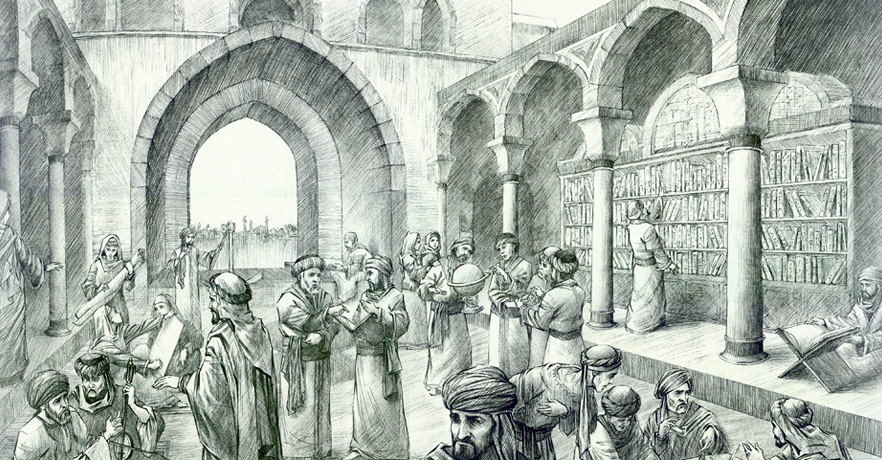
Scholars in the Library, Baghdad 1237 – source

In the 9th century AD, during the Abbasid period, there was the House of Wisdom in Baghdad, a library and a translation house. The library contained manuscripts of mathematics, astronomy, various sciences, medicine and philosophy from Persia, India and Greece. It also had astronomical observatories, chemistry and alchemy laboratories, and a science study centre.

The House was created by the Abbasid caliphs Harun al Rashid and his son al-Mamun. Al-Rashid began collecting books in Damascus, Syria – when Damascus was the capital of the Umayyad Caliphate at the same time. With this collection, al-Rashid opened a library and named it “Bayt al-Hikma” which in Arabic means “Wisdom Bookstore”.

Thirsty for the science, philosophy, and knowledge of the world, al-Rashid, and later his son al-Mamun, hired Persian and Christian scholars to translate the works into Arabic to develop new knowledge. The library contained works on medicine, alchemy, physics, mathematics, astrology, geography, mapping, zoology, philosophy and other sciences.

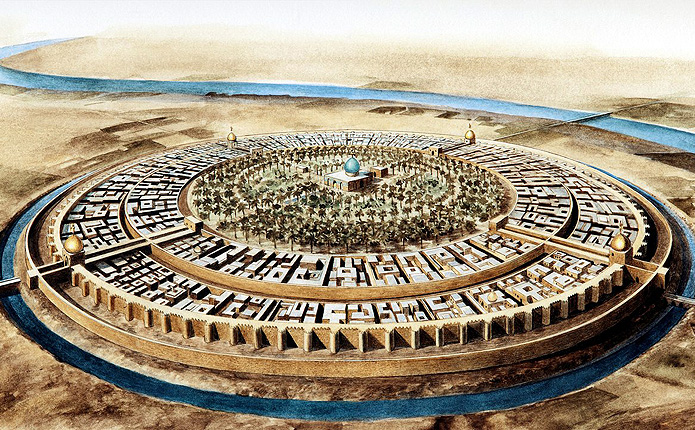
In 750 the Umayyad dynasty was replaced by the Abbasid dynasty. In 762, the second Abbasid caliph al-Mansour built Baghdad and made it his capital. Baghdad was a great location for a stable shopping and spiritual centre. Al-Amin succeeded al-Rashid’s father and continued the tradition of translating texts from Greek, Chinese, Sanskrit, Persian and Syriac.

The House of Wisdom: Baghdad's Intellectual Powerhouse - 1001 Inventions
http://1001 Inventions The circular city of Baghdad

The entire collection of books was transferred to Baghdad, where the same library was established, only this time in a huge palace. Everyone had access to it and everyone could be trained there. The library and its work were supported by everyone, even merchants and the military. Anyone could bring some innovation or a new document. The main activity was the translation of the texts into Arabic, but it was also used for the study. Many engineers and architects in large constructions came from the House of Wisdom. It was the academic centre of the Islamic world.

During al-Mamun’s reign, huge sums of money had been invested in the library and teaching. He personally organized groups of scholars to do research projects to satisfy his personal intellectual needs. Some of his personal works were the mapping of the world, the confirmation of the data of Almagest (the largest and most important astronomical book of Antiquity, whose authority was preserved until the 16th century) and the calculation of the actual size of the Earth. He also participated in excavations in the pyramids of Giza and encouraged scholars to study Egyptology.

The work of the House of Wisdom continued at the same pace during the reigns of the successors of al-Mamun, al-Mutasim, and his son al-Wathik, but declined significantly when al-Mutawakil became caliph, who did have not interested in science and suspended all scientific work carried out in the House of Wisdom. He promoted a more literal interpretation of the Qur’an and Hadith and believed that Greek philosophy was anti-Islamic.

Siege of Baghdad (1258) - Wikipedia
http://Wikipedia
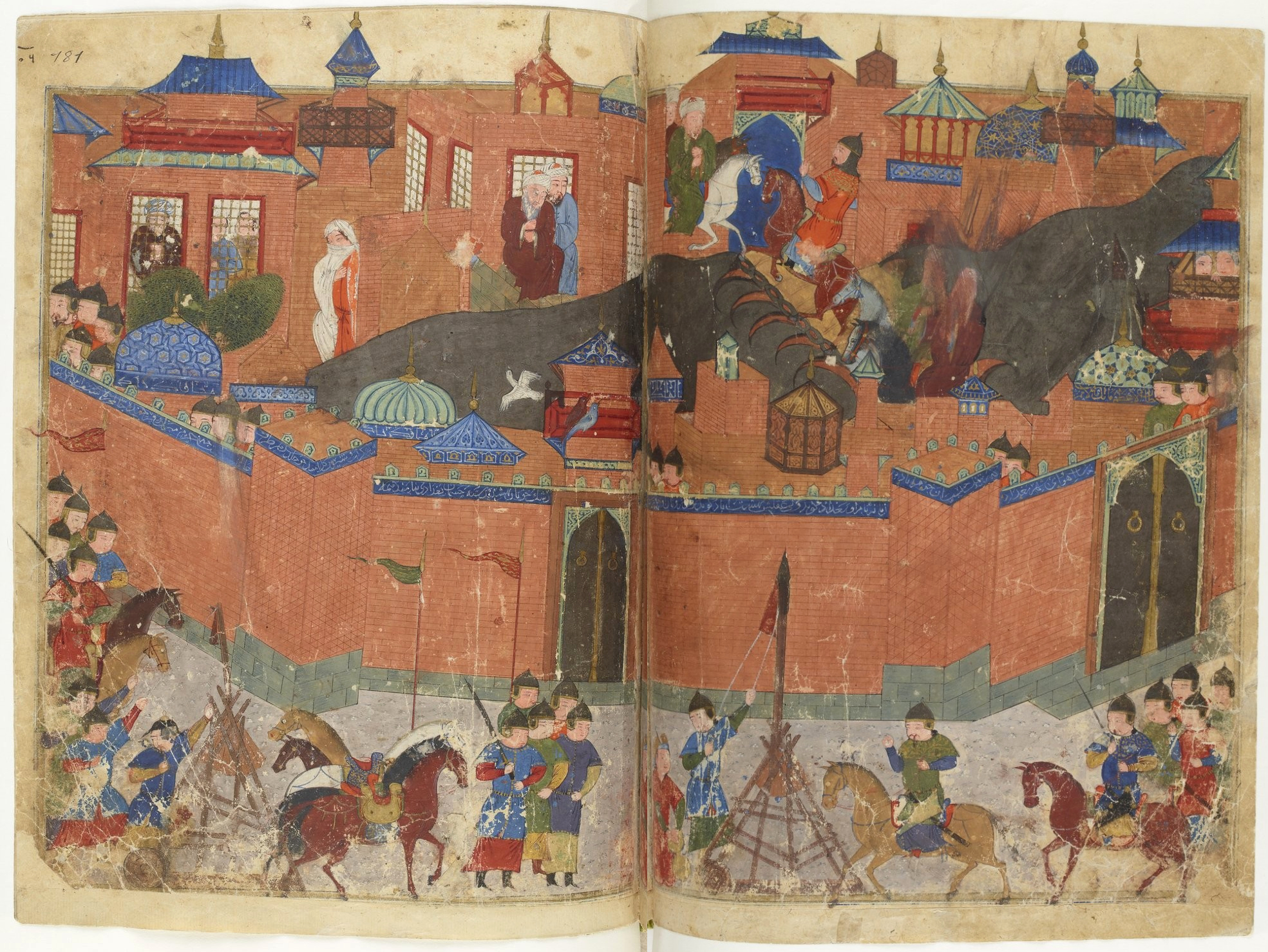
The siege of Baghdad by Ulaghu Khan – source

The character of the library has changed completely. Instead of translations by scientists and philosophers, only disciplines related to Islam were translated and taught. In 1258, the city was looted and destroyed by the Mongols of the Ulagan Khan army. Along with the House of Wisdom.

Although, the Persian scholar and prolific writer Nasir al-Din al-Tusi; (he was an architect, astronomer, biologist, chemist, mathematician, philosopher, physician, physicist, scientist and theologian) managed to save about 400,000 manuscripts which he transported to Mara before the siege. The rest of the books had were thrown into the Tigris River. How so many books were destroyed is not known, but it is written that the river is blackened by their ink.

source: https://3otiko.blogspot.com /

A “votive ear stele” for Amon to hear Bay’s pleas

Standard

Stele again? Yes! They all always fascinating me, the messages from our past in a beautiful shape. Here is another one. It says about an offer of the ear to be heard by God Amon-Re.

Let’s read this brilliant description by my adorable friend, Marie Grillot , to know more.

By http://Marie Grillot via https://egyptophile.blogspot.com/ from French.

This small painted limestone stele – barely 25 cm high and 14 wide – is dated to the Ramesside period. Arched in shape, it is made up of three “registers”.

Detail of the small votive eared stele dedicated by Bay to Amon
painted limestone – New Kingdom – XIV – XXth Dynasty circa 1200 BC. J.-C.
discovered in 1912 in the enclosure of the temple of Hathor in Deir el-Medineh
during work carried out by Émile Baraize for the Egyptian Antiquities Service
Egyptian Museum in Cairo – JE 43566

The upper part occupies the entire hanger. There is, in the centre, a small table of offerings on which is placed an ewer, the most appropriate word would perhaps be “aquamanile” because the water is intended for a liturgical ritual. In perfect symmetry, on either side, two rams in all identical points face each other. They are a representation of the Theban god “Amon-Re, the good ram”. Standing, majestic, in the attitude of walking, they are “capped” with two high feathers at the base of which is the solar disk and the uraeus usual in Amon. They are treated in a fairly neutral colour of beige, which is highlighted by the red-brown lines defining the contours of their silhouette and animated by the green of the “plastron”, the horns and the hooves.

The scene takes place on a mat which delimits the “vignette”.

Detail of the small votive eared stele dedicated by Bay to Amon
painted limestone – New Kingdom – XIV – XXth Dynasty circa 1200 BC. J.-C.
discovered in 1912 in the enclosure of the temple of Hathor in Deir el-Medineh
during work carried out by Émile Baraize for the Egyptian Antiquities Service
Egyptian Museum in Cairo – JE 43566

The lower register is split vertically into two equal parts.

On the left is the dedicatee of the stele: “Bay is represented, the devoted, whose title ‘servant at the seat of Truth’, identifies him with one of the workers who, during the New Kingdom, were responsible for the realization of the royal tombs. The hieroglyphic text above his head indicates his name as well as his function and describes the gesture of Bay, kneeling and the raised hands, which is that of ‘showing his adoration to Amon-Re’ “.

Detail of the small votive eared stele dedicated by Bay to Amon
painted limestone – New Kingdom – XIV – XXth Dynasty circa 1200 BC. J.-C.
discovered in 1912 in the enclosure of the temple of Hathor in Deir el-Medineh
during work carried out by Émile Baraize for the Egyptian Antiquities Service
Egyptian Museum in Cairo – JE 43566

Her face is lit by a large almond-shaped eye surrounded by kohol. Her hair is black and curly, and her slim body is painted in red ocher. He is dressed in a simple pleated white linen loincloth and wears, as only “ornament”, a large dark-coloured collar.

He is praying in front of what makes up the third “section” of the stele: three pairs of ears, each of a different colour. In “The treasures of the Cairo Museum”, Francesco Tiradritti gives this very interesting interpretation: “The different colours of the ears probably refer to three aspects of Amon-Re, a God, thus linked to air and humidity (blue ), sun (yellow), vegetation, and, therefore, earth and water (green) “.

Detail of the small votive eared stele dedicated by Bay to Amon
painted limestone – New Kingdom – XIV – XXth Dynasty circa 1200 BC. J.-C.
discovered in 1912 in the enclosure of the temple of Hathor in Deir el-Medineh during work carried out by Émile Baraize for the Antiquities Service of Egypt
Egyptian Museum in Cairo – JE 43566

These “votive ear steles” appeared in the 18th Dynasty: they allowed the “common people” to communicate with the gods directly, to make them hear their grievances, their pleas. In “The artists of pharaoh” Matilde Borla specifies that: “The practice of offering to the deity a stele decorated with one or more ears – or models of ears – is quite common in the New Kingdom, from Memphis to Thebes, but also in Sérabit el-Khadim, in Sinai. The availability of the god to listen to the prayer of the man, directly, without an intermediary “.

Small votive stele with ears dedicated by Bay to Amon
painted limestone – New Kingdom – XIV – XXth Dynasty circa 1200 BC. J.-C.
discovered in 1912 in the enclosure of the temple of Hathor in Deir el-Medineh
during work carried out by Émile Baraize for the Egyptian Antiquities Service – Egyptian Museum in Cairo – JE 43566
published here in: “Deir el-Medina Stelae and Other Inscribed Objects Catalog General Egyptian Museum in Cairo”, Jose M. Galan, Gema Menendez, 2018

Thus, under the XIXth dynasty, Bay which was, as indicated by the hieroglyphic inscription servant the “Place of Truth in the West of Thebes” – the Set Maât her imenty Ouaset of antiquity, the “Deir el-Medineh of today – wanted to “have the ear” of the god he worshipped. To come to his aid, he shaped, or had this stele shaped, to “materialize”, make concrete, his “prayer”.

“Set Maât her imenty Ouaset” – the “Place of Truth in the West of Thebes”
from antiquity is today village of Deir el-Medineh

Founded at the beginning of the 18th dynasty during the reign of Thutmose I, the artisan community lived in this village nestled in the hollow of a valley in the Theban mountains. Extended and enlarged several times, notably during the reigns of Thutmose III and the early Ramessids, it was surrounded by high walls. For nearly 500 years, “between 40 and 120 homes” lived there in stone houses covered with a palm-leaf roof, which also had a necropolis and places of worship. If there were shrines dedicated to other deities, including Ptah and Meretseger, the temple that was erected, from the Thutmose period in the northern part, was dedicated to the goddess Hathor.

It was in 1912, during the clearing of this monument, commissioned by Auguste Mariette, and led by one of the directors of the work of the Antiquities Department, Emile Baraize, that the stele was discovered.

Early 20th century postcard representing the temple of Hathor in Deir-el-Medineh
“Set Maât her imenty Ouaset” – the “Place of Truth in the West of Thebes” of antiquity

In his “Report of the work carried out at Deir-el-Medineh”, published in volume 13 of the “Annals of the Service of Antiquities”, he describes with precision the catastrophic state in which the temple was located. “The dilapidated state of the temple did not fail to inspire some apprehension. It was the same in the temple for the slabs forming the ceiling which, already split, rested on broken architraves” …

Small votive stele with ears dedicated by Bay to Amon
painted limestone – New Kingdom – XIV – XXth Dynasty circa 1200 BC. J.-C.
discovered in 1912 in the enclosure of the temple of Hathor in Deir el-Medineh
during work carried out by Émile Baraize for the Egyptian Antiquities Service
Egyptian Museum in Cairo – JE 43566

After drawing up this inventory and defining the safeguard and restoration plan, consolidation work began on November 15, 1912. Emile Baraize explains in detail the problems he encountered and the techniques used to solve them. On page 21, he begins the “List of main objects found during clearing”. This stele appears there in n ° 3, under its registration reference at the Cairo Museum (JE) 43566 with the following description: “Small painted stele: 1 horizontal register, 2 vertical; horizontal register, two rams. 1 vertical register, the deceased kneeling; 2nd vertical register, six ears. Colors are well preserved “.

Marie Grillot

Sources:

Egyptian Museum in Cairo

http://www.globalegyptianmuseum.org/record.aspx?id=14909

Deir el-Medina Stelae and Other Inscribed Objects. Catalog General Egyptian Museum in Cairo, Jose M. Galan, Gema Menendez, 2018

https://www.academia.edu/42383849/Deir_el_Medina_Stelae_and_Other_Inscribed_Objects_Catalogue_General_Egyptian_Museum_in_Cairo

Official catalog Egyptian Museum of Cairo, Mohamed Saleh, Hourig Sourouzian, Verlag Philippe von Zabern, 1997

Treasures of Egypt – The Wonders of the Egyptian Museum in Cairo, Francesco Tiradritti

Ancient Egypt and its gods, Jean-Pierre Corteggiani, 2007

Dictionary of Egyptian Mythology, Isabelle Franco, 2013

Pharaoh’s Artists, Louvre, RMN, 2002

Report of the work carried out in Deir-el-Medineh by Mr. Emile Baraize, volume 13 “Annales du Service des antiquités”, IFAO, Cairo, 1914

https://archive.org/details/annalesduservice13egypuoft

Happy Birthday dear Al.

Standard
Happy Birthday my soul 💖
The photographer had to snap his fingers to get his notice.

The birthday is always an especial day. though I know and you, who read my posts know too, that in almost every article I wrote, my brother Al accompanied me and his presence has been evident and always helpful. But the day of birth is worthy because we can be thankful for having our beloved ones into this world and by our side. I believe that it’ll ever be.

He is always in my every-day life and almost permanently with me in my posts. I can never take a step without him. But, his anniversary is for me a special day, and this time he’d be 68 years old. This number is an important number for us (the peoples from that period): a number for the beginning of an era: peace, freedom, and love. A movement that looking forward to such events like Woodstock with Jimi Hendrix, Joan Baez, Crosby/Still/ Nash and Young… The flowers generation.

And in this case, my lovely brother has an unaging birthday. Because this era is an endless time: love and peace forever. He will never get older, isn’t it fantastic?

Al, Mum and me; We had blond hair at that age which was somehow strange.

Another point is that his birthday is after the day in which John Lennon has been shot dead. It’s for me a mixture of sadness and happiness and I must combine both. This is, as we might call, the game of fate.

Though, when I look through the past, there are a lot of similarities between Al and John. They were both in love with their mothers, had an unusual and unique way of life, and solitary. Therefore, I share this unique song by John again, not only because of that was one of Al’s beloved songs, but also because of its other title: Nothing Gonna Change my World. They both were convinced of this.

As you notice, I was often posting these latest days. Yes; there were many themes which have laid in my heart. Thank you for your commiseration. 🙏💖🙏

Why…?!

Standard
Yada Yada Yada | Business News | John lennon, Citation john lennon, John  lenon
http://Pinterest

Today as we all know, is the day in which 40 years ago, John Lennon has been shot dead. I have titled my post as; “Why”, because, as we also know, there have many assassinations been taken part in (political) history and many famous and mostly good people were killed, but, all of these happenings have some justification though, all of which are sad excuses. But I still can’t understand why John Lennon.

65 John Lennon Quotes On Peace, Love and Life (2020)
http://Everyday Power

They say the culprit was not in a normal condition which in my opinion, is bullshit! To shoot a peaceful man, who has always said and sung about love and peace, a certain determination must be needed which would bring someone to do this. This man was aware of what he’d done. Oh sad, sad, sad, it a sad world!

John Lennon quote | John lennon quotes, World peace quotes, John lennon
http://Pinterest

The only joy is the remaining of his words and songs about peace and love. John, you are always in our hearts.

“Across The Universe”
(“Let It Be” Version)

Words are flowing out like endless rain into a paper cup
They slither while they pass, they slip away across the universe
Pools of sorrow waves of joy are drifting through my opened mind
Possessing and caressing me

Jai guru deva om
Nothing’s gonna change my world

Images of broken light which dance before me like a million eyes
They call me on and on across the universe
Thoughts meander like a restless wind
Inside a letter box they
Tumble blindly as they make their way
Across the universe

Jai guru deva om
Nothing’s gonna change my world

Sounds of laughter shades of life are ringing
Through my open ears inciting and inviting me
Limitless undying love which shines around me like a million suns
And calls me on and on across the universe

Jai guru deva om
Nothing’s gonna change my world

Jai guru deva
Jai guru deva
Jai guru deva
Jai guru deva
Jai guru deva
Jai guru deva…

“Jai Guru Deva Om” is a mantra in Sanskrit used in meditations. “Guru Dev” is another name of Swami Brahmananda Saraswati, who was the teacher of Maharishi Mahesh Yogi, who—in turn—was the guru to The Beatles.

FIFTY+ YEARS LONELINESS V (P3)

Standard

Turn on, Tune in, Drop out! This World is not enough!

Honestly, the idea to write these memories was because I wanted to talk about the effect of psychedelic drugs on our unconsciousness. I have already had the idea a long time ago to write about this period of my life, but I was not sure if I should or even could talk about it. Of course not because I am shy or afraid doing so; it is just because of society, whether they understand correctly. I have once or twice shared my thought with some people about this issue and noticed how they reacted; they believed I’m making advertisements on this theme. No, it’s not my intention!

Anyway, I have developed myself in my way of making music, I got a big set of drums and began to play as a professional, and Al and I put our differences aside. There’s a friend of mine who played the guitars and we had got many performances together, within music bands or even alone as a duo on the stage. We had a lot of fun those days, and the only drug we have used was hash or marijuana. Those were the days

But my musical career has not lasted so long because our mother became sick and the diagnosis was blood cancer. And it took only some months, till she left us. I was in my highest hippy times those days, and it broke my heart, but on the other hand, this brought Al and me closer to each other.

The door had been opened and we were being involved in many kinds of drugs which I’d call this “our common riots”. That was after we’d lost our mother and we wanted to hide in our hut; hide from family and the world, and just wanted being left alone. Among the drugs there were some dangerous ones which were unavoidable; like the opium or the heroin, that I’d say, we were lucky to get rid of them, of course, we had needed for it many years. In between, we had also experienced the LSD, this one I’d never regret. It helped us to get a wider vision towards life, and death. In my opinion, it can still be used as a medical solution for many different psychedelics disease.

Some people may think that we don’t need any kind of drugs to reach out to the inner mind. I met many people to discuss this theme. One of them was a Shamanist, who told me that she had never needed such a substance (like Ayahuasca) to get to the other side, it only required dancing with special music. She said that she could convince me if I would join her once. I liked the idea, we met in her apartment and danced almost through the night. It was a very nice and unforgettable experience for me and in the end, we had wonderful sex. Although, what I meant was another kind of trips to reach out the inner soul. And it needs drugs but, a well made and professional.

Another example: when I was busy in my full job, I had a customer, a psychologist, every time that she was in my car, we had talked on our way about people and the world, in-between, we became so much closer than we have also talked about our pasts, losses, and the experiences in our youth. I told her about ours (Al’s and mine) addictions time, and she told me about her sister’s (she had nothing to do with drugs herself), but when I told her about our experiences on LSD and the famous Dr Timothy Leary’s ideas, she became very sad, I was surprised and wanted to know the reason why. She raised her wet eyes towards me and said; no! His idea killed my sister, she followed him blindly and finally committed suicide! Of course, it was like a shock for me and I couldn’t say a word anymore though, I am still convinced that it is not the fault of this or that ideas, it is the comprehension of the ideas and the way how to use them.

John Lennon insisted that his song; Lucy in the Sky with Diamonds is not about LSD, though I think there’s something in it!

Al and I had about nine times practice on LSD, the beginning was the enjoyment of the lights and the music. We have comprehended that sometimes we might not be aware of how deeply we would feel the arts when we looked at like a painting or listen to a song. And when we’ve reached the eighth or ninth time, we could even separate our souls from our bodies. (It was winter and I was able to let the cold pass by me like an object!) We have found out the connection between them, and finally, understood the power of our souls. Sorry, It is very hard for me to explain or put in the word.

As you might notice, the quotation which I’ve written under the title of my blog; “Turn on, Tune in, Drop out”, is from Timothy Leary. Timothy Francis Leary was an American psychologist and writer known for his strong advocacy of psychedelic drugs. Evaluations of Leary are polarized, ranging from bold oracle to publicity hound. He was “a hero of American consciousness”, according to Allen Ginsberg, and Tom Robbins called him a “brave neuronaut”. Wikipedia

We always have urged people: Don’t take LSD unless you are very well prepared, unless you are specifically prepared to go out of your mind. Don’t take it unless you have someone that’s very experienced with you to guide you through it. And don’t take it unless you are ready to have your perspective on yourself and your life radically changed, because you’re gonna be a different person, and you should be ready to face this possibility. CBC Documentary: How To Go Out of Your Mind: The LSD Crisis (1966)

http://Biography

He had not got as famous to reach the whole world; we didn’t know him in Iran those days until we heard this song by Moody Blues Album: Legend Of Mind

Actually, the main goal belongs to Albert Hofmann, who discovered or better to say the invented the LSD.

Albert Hofmann was a Swiss chemist known best for being the first known person to synthesize, ingest, and learn of the psychedelic effects of lysergic acid diethylamide. Hofmann was also the first person to isolate, synthesize, and name the principal psychedelic mushroom compounds psilocybin and psilocin. Wikipedia

I hope this long story did not bother or anger you because it does seem like an advertisement for drugs! I have just written about my experiences and over that my opinion. I wish you all Love & peace and be safe. I end this trilogy with another quotation of Terence Mckenna; I think he doesn’t need to be introduced.

It might be unnecessary to note that today it will be only one post from me. I’ve got an operation on my forehead on Thursday, to rid a big pimple and I am a bit tired. I look just like a boxer after his fight who is waiting to hear the result! Though, there’s no way means you will pass me by; The riot keeps going…

The end of 80s in Cologne; a vagabond musician.
hallucinogenic mushrooms
Two doses of psilocybin, the active ingredient in hallucinogenic mushrooms, eased people’s depression symptoms, researchers found.ALEXANDER_VOLKOV/ISTOCK/GETTY IMAGES PLUS
https://www.sciencenews.org/article/psilocybin-treat-depression-mushrooms-psychedelic

https://www.sciencenews.org/article/psilocybin-treat-depression-mushrooms-psychedelic

https://en.wikiquote.org/wiki/Timothy_Leary

https://en.wikipedia.org/wiki/Albert_Hofmann

Happy Birthday Woody Allen.

Standard
https://en.m.wikipedia.org/wiki/Woody_Allen

Today is the 85th anniversary of a genius in the matter of the filmmakers.

He surely belongs to one of the promoters of comedy movies with a touch of intelligence.

He might not be as popular with some people as it used to be at the time, because of some rumours, but I consider him as a great director and filmmaker in the history of films.

His some of Masterworks: Manhattan, Annie Hall, Hannah and her Sisters, the Purple Rose of Cairo, Vicky Cristina Barcelona, Radio Days, Crimes and Misdemeanors, Stardust Memories…. etc, etc

And he’s also a great writer, let’s have some of his quotes:

The heart wants what it wants. There’s no logic.                

If you want to make God laugh, tell him about your plans.

Life is divided into the horrible and the miserable.

Tradition is the illusion of permanence.                           

Not only is there no God, but try getting a plumber on weekends.                                                                                

It’s not that I’m afraid to die, I just don’t want to be there when it happens.                                                                    

My one regret in life is that I am not someone else.        Life is full of misery, loneliness, and suffering – and it’s all over much too soon.                                                               

I’d never join a club that would allow a person like me to become a member.

I love all of his movies though, one of them lies on my heart: Radio Days: I can remember well how we as children, have listened to the radio so agitated, there weren’t any TVs yet! I think that the radios have inspired a lot of imagination.

Amarcord; I remember!