According to the Germans, it is an Extrablatt (by a special newspaper edition)! Because tomorrow we are going to Berlin for a few days, mainly to realize my three-year-old appointments with US Embassy for my visa. Actually, as a German, it’s no problem getting the visa for us via ESTA (my wife already got it), but I was born in Iran, which makes a problem! Therefore, I must do a personal interview to prove if I am qualified for it.
Anyway, it is a long story (if someone might remember that) about my attempt to fly to the USA in early 2020 to visit my brother-in-law and his daughters after almost forty years. But as you can guess, it’s all cancelled plus many further appointments. Now it looks like it will take place.
So! But as it’s not the weekend (my brain is still raw!🥴) and human is a creature of habit, I’ll make it easier for myself and bring some lovely tweets from my Twitter stall. May the force be with you and your finger crossed (for me?😁 ) until we overwhelm all the problems. Take care. 🙏🥰💖🙏🤗
Al, Me, our Close Encounters of the Second Kind, and Dr C.G.Jung! Part 3 (Including odd Visions, Dreams and Concepts. Abduction!?!)
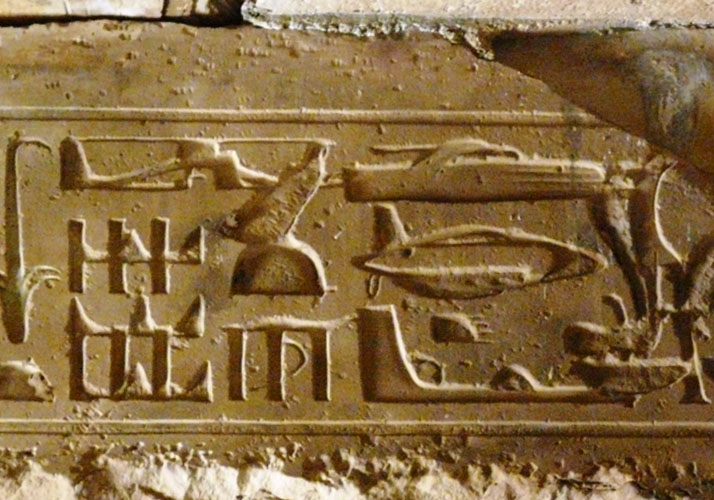
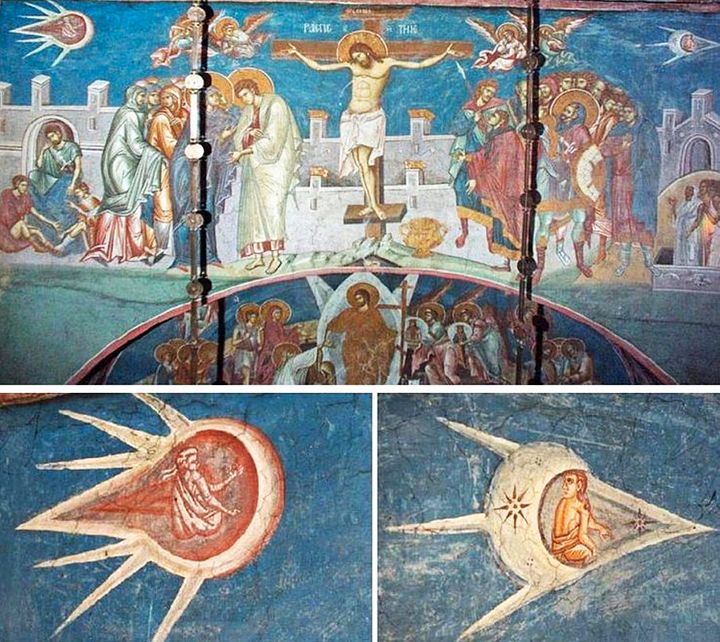
The 3,000-years-old hieroglyphs found in Seti I’s temple in Abydos, Egypt, are said to depict nothing less than a helicopter, plane and futuristic aircraft among the usual insects, symbols and snakes. Kortizes
In this third part, I want to tell you about the after-effects on us (at least on me) of our experience that night. (here & here are the last parts if one hasn’t read them yet.🙏) These after-effects, what I mean, are the dreams and some spectacular visions which I had.
But first, let’s have a look at our past (historical and religious). We see these Sagas talking about the Gods and Goddesses coming from above (the sky) down to the Earth. I can remember well once I asked my Mum; why when we pray, we hold our hands towards the sky and look there up? She answered; because the Earth is full of sin and filth, and the sky is pure and innocent. I don’t know if she found it out herself or picked it up somewhere, but in any case, it convinced me.
“In the threatening situation of the world today, when people are beginning to see that everything is at stake, the projection-creating fantasy soars beyond the realm of earthly organizations and powers into the heavens, into interstellar space, where the rulers of human fate, the gods, once had their abode in the planets… Even people who would never have thought that a religious problem could be a serious matter that concerned them personally are beginning to ask themselves fundamental questions. Under these circumstances, it would not be surprising at all if those sections of the community who ask themselves nothing were visited by `visions,’ by a widespread myth seriously believed in by some and rejected as absurd by others.”–C. G. Jung, in Flying Saucers?
After our encounter that very night, I’ve begun having dreams whenever I took a nap. These naps are common to the addicted people currently in a hangover state. Unfortunately, I can only remember two of them; 1- I dreamed that Al and I were lying on our couch looking TV. Suddenly I noticed the ground beside me was digging out, and a coffin came out of the Earth. My heart was beating fast, and I saw a sign like a cross on the top of the casket. Then, the cover slipped aside; as I eagerly looked inside, I woke up!
2- I dreamed about that night of our encounter on the roof. That was actually the continuation of that moment when the ship stood directly above our heads. In my dream, it hovered a while and came down in front of us, and a gate (a big door) opened, and some small creatures (typical aliens) came out of it. They walked nearer, took Al over their hands, and carried him into the ship. Then everything turned white in front of my eyes; I couldn’t see anything, only white and I woke up! We didn’t talk so much about these dreams. Al has always been a good dreams interpreter, but he kept silent about these too.
When we came to Germany, an issue caught us up in the early 90s: Abduction. Although this is an old issue, it became famous in the early 60s, with the Betty and Barney Hill abduction generating widespread publicity. I don’t want to get into the details and cause a long read. I just want to mention that it became trendy in the 70s and 80s through many books with hypnotized Inhalt and many movies on this topic. And as Al and I were in the free world, we began immediately to deal with this topic.
There were many books to read, and we’ve got most of them, among others; Whitley Strieber, David M. Jacobs, Budd Hopkins, Raymond E. Fowler, and John E. Mack, whom we have met personally in the Bern, Switzerland, in a three-day seminar on this issue. Hopkins, Jacobs and Mack’s accounts of alien abduction became a prominent aspect of ufology under Dr Jung’s thesis on psychological experiments. . Of course, one must mention that one of the organizations was Erich von Däniken.
In this seminar was that we had an opportunity to talk to Dr Mack; That was the second day, late afternoon, when Al and I sat at one of the tables, suddenly we saw him with his secretary standing near our table and looking confused, saying; who is here English speaking?! Al raised his hand, and he ran to us at once and said, thank goodness, here all are speaking German!
Anyway, we began to talk, and as he asked about our experiences, we told him our stories and then I told him about my dream of this. He laughed and said, you are who was brought to the ship and not your brother!
Dr Mack was a wonderful, friendly and intellectual man who enthusiastically worked with many people who had abduction experiences (abductees) and tried to help them with hypnotizing to solve their trauma. Unfortunately, On Monday, September 27, 2004, he died in London after a (dubious) car crash, and many questions remain unanswered.
Almost affected, only the lips in my vision were narrower. Dreamstime.com
In the coming years, I had many visions like seeing shadows and hearing voices, especially on the nights when I slept; someone called my name so loudly that I woke up! But one of them is so weird that I must write here: it was one or two years before my brother Al left this Earth; I say it because I have a strange feeling that it has something to do with that. I was swamped with my work those days, and I remember I was exhausted and wanted to sleep. When I lay down on my bed and closed m eyes, I saw a face in front of me, inside my eyelid! It was so clear that I shockingly opened my eyes. I looked around and wondered what it was? I closed my eyes but saw it again, as it never faded. I opened my eyes somehow terrifyingly. Shortly said, I did it several times, and with every closing of my eyes, it was clearly present. Finally, I gave up and stared into my eyelids at this face; it was somehow feminine according to my feeling, and she was so real. My heart was beating faster as we were looking straight at each other. She had a round naked head and big beautiful eyes; after a while, she slowly closed her eyes as if telling me: everything would be alright, considerable suffering would come, but everything would be okay! And I went into a deep sleep.
In any case, these all are weird and inexplicable to me. Maybe someday, somewhere, I will find the answer somehow.
The strange thing about these kidnappings is that those affected have the same signage from these aliens worldwide. I don’t know if I was kidnapped or not; maybe you are too. In any case, these memories stay with me. Let’s see; perhaps the truth will show itself in the future. 😉🤗🙏💖
… Wisdom is not communicable. Wisdom, which a sage tries to impart, always sounds like folly… Knowledge can be imparted, but Wisdom cannot. You can find it, live it, be carried by it, work miracles with it, but you can’t say it or teach it.
Hermann (Karl) Hesse was a German-Swiss poet, novelist, and painter. He’s famous primarily as a poet, though he was a sensitive observer of nature and the meaning of the existence of all creations. His best-known works include Demian, Steppenwolf, Siddhartha, and The Glass Bead Game, exploring an individual’s search for authenticity, self-knowledge and spirituality. Here I present a poem from one of his famous books, Siddhartha. It’s an Indian Poem, a 1922 novel that deals with the spiritual journey of self-discovery of a man named Siddhartha during the Gautama Buddha.
Once, he told her: You are like me; you are different from all people. You are Kamala, nothing else, and there is peace inside you, a refuge where you can retire at any moment and feel warmth, just as I do. Few people have this ability, and yet everyone could acquire it. Not all people are smart, Kamala said. No, said Sindharta, this is not it. Kamaswami is as bright as I am, but he can not find refuge in himself. Others may or may not have young children in mind. For most people, Kamala is like a leaf that falls, that the wind picks it up, swirls for a while and then soars and clumps to the ground. But few others are like the stars that follow a fixed orbit, and the wind does not reach them because the orbit and the law that follow are inside them. Hermann Hesse, Siddhartha
And all these together, all voices, all goals, all longing, all suffering, all desire, all good & bad, all these together was the world. All these together was the flow of events, was the music of life. Hermann Esse, Siddhartha Pinterest
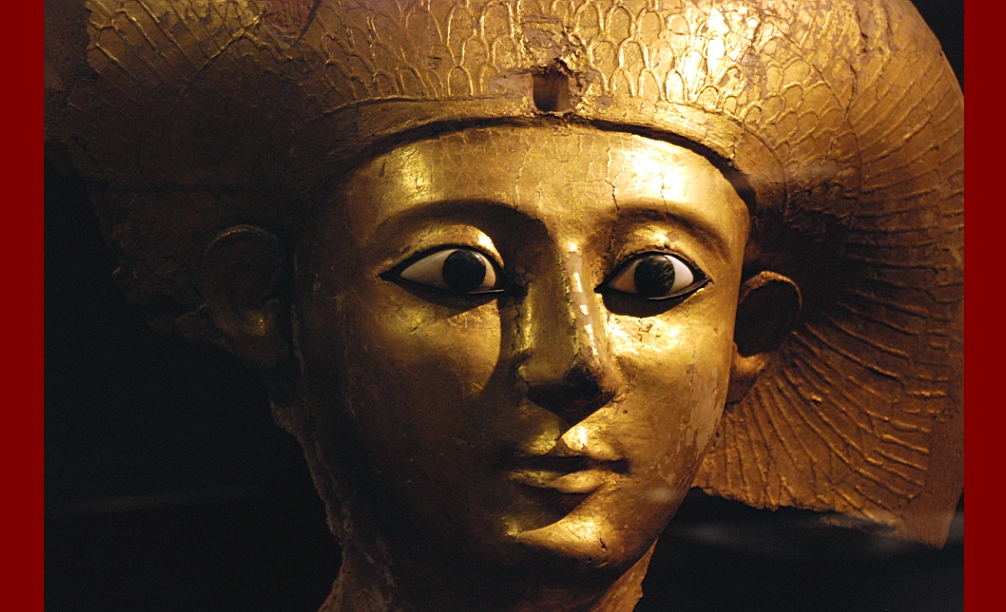
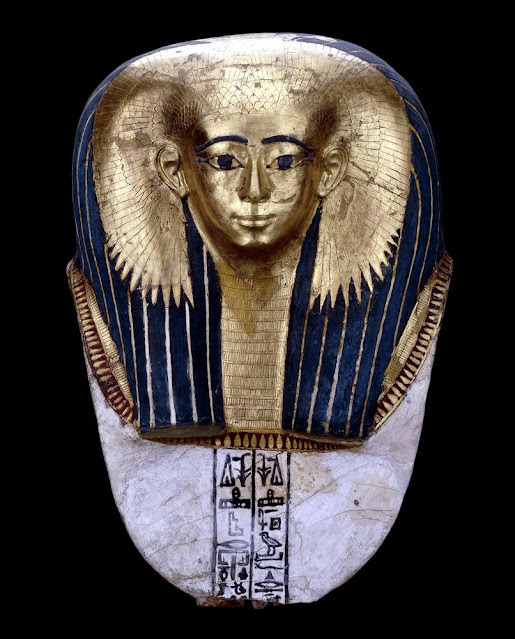
Another Queen or a Goddess of magic Egypt! The name of the Satdjehuti occurs once on the Turin shroud of the “king’s daughter” Ahmose (Turin 63001) from her tomb QV47 in the Valley of the Queens and once with the nickname “Satibu” on her coffin mask (ÄS 7163). On the coffin mask, she is titled as “king’s daughter” and “king’s sister” and on the shroud additionally as “king’s wife”. Both are very likely the same person. (Alfred Grimm, Sylvia Schoske: Im Zeichen des Mondes, 1999, S. 41) de. Wikipedia. org
Sitdjehuti (or Satdjehuti; “Daughter of Thoth“) was a princess and Queen of the late Seventeenth Dynasty of Egypt. She was one of the daughters of Pharaoh Senakhtenre Ahmose and Queen Tetisheri. She was the wife of her brother Seqenenre Tao and was the mother of Princess Ahmose. Ahmose is called the King’s Daughter and Queen’s Sister.
Sitdjehuti’s mummy was discovered around 1820, along with its coffin, golden mask, a heart scarab, and linens donated by her niece Queen Ahmose-Nefertari. The linen is inscribed with the text:
Given in favour of the god’s wife, king’s wife and king’s mother Ahmose Nefertari may she live, so Satdjehuty.
Satdjehuti’s coffin lid is now held in Munich, while her funerary mask is located in the British Museum (EA 29770).
As humans, it is always challenging to illustrate divine beauty. However, the artisans in old Egypt tried to make it possible. Here is another brilliant description by the adorable Dame and friend of mine,Marie Grillot. 🙏💖
The mask of Satdjehuty, a “relative” of Ahmes-Nefertari …
This magnificent mummy mask is in the image of Satdjehuty, a lady – or young girl – who lived in Thebes at the beginning of the 18th dynasty. She was from high society, and it could be that she evolved at court, in the close entourage of Queen Ahmes-Nefertari… This would tend to justify the delicate craftsmanship and the richness of this mask which was placed on her mummy…
33 cm high, it is made of cardboard, and its upper part is mainly covered with gold leaf.
The face is perfectly symmetrical with beautiful almond eyes. Surrounded by black, they are extended by a fine make-up line and surmounted by delicate eyebrows that respond to them… The enigmatic and mysterious gaze seems fascinated by the eternity to come…
The nose is nicely shaped, and the mouth with closed lips shows slight dimples at the corners.
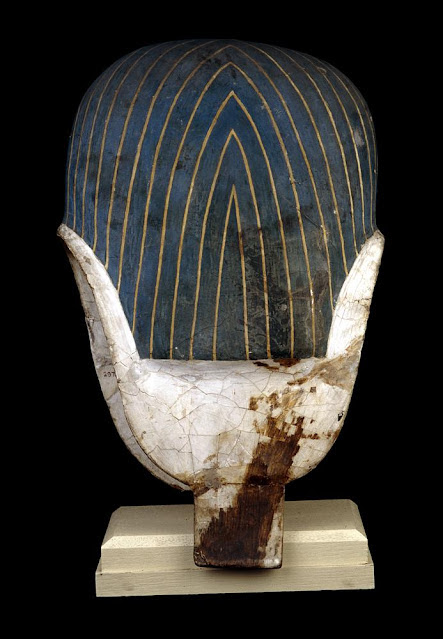
The lady wears a heavy wig painted in lapis lazuli blue and streaked with fine vertical gold-coloured lines… A headdress, which resembles a vulture’s skin worn by queens, covers her in an imposing and dazzling decoration of feathers…
The vast and rich usekh necklace that adorns his neck, with its succession of rows of pearls rendered by fine incisions, is also made of gold…
In ancient Egypt, gold was charged with powers: unalterable, it was likened to the flesh of the gods, and it also had to ensure the protection of the deceased.
The lapis lazuli (Khesebedj) to which the wig’s colour is assimilated was reputed to be the stone in which the hair of the gods was made: as a result, it too was adorned with virtues. As for the golden headdress which covers it, it is thus analysed by Edna R. Russmann: “The wings are examples of protective symbolism which, like the feather motifs on many anthropoid coffins of the XVII and early Eighteenth Dynasty, evoke the tutelage of Isis and other deities”. For Nigel Strudwick: “The feather effect of the winged headdress of this mask is perhaps associated with the so-called rishi-type coffin popular in Thebes at the very end of the Second Intermediate Period and the beginning of the New Kingdom”.
Under the last drop-shaped row of the necklace, the mask panel is rounded and light in colour. In the centre, two columns of hieroglyphs stand out, inscribed in black, mentioning “funerary offerings to Osiris and Anubis”. The name of the deceased, which should have been mentioned below, is unfortunately lost… How then could this mask have been attributed to Satdjehuty? Here is John Taylor’s answer: “The owner’s identity was established from several large pieces of fine linen buried with her. These bear inscriptions in ink, giving her name and the indication that she was ‘a praised’ of Queen Ahmose Nefertari, the wife of King Ahmose I. Satdjehuty may have been a privileged member of the Queen’s entourage and, through this association, may have received the privilege of an exceptionally well-laid-out burial”.
The mask arrived at the British Museum in 1880 by acquisition from Morten & Son along with other pieces of the exact origin. It came from the collection of Samuel Hull of Uxbridge. “The mask, along with other objects, had probably been obtained by Samuel Hull’s brother, John Fowler Hull (1801-1825) when he visited Egypt in 1824 (as noted by fellow traveller John Madox )” specifies the museum where the mask is exhibited under the reference EA29770.
Just a short prologue! We have had some guests in the last few days, and I was almost off the web. And honestly, I am baffled about where I was or have been and what I wanted to do!! Anyhow, let’s try what I promise to do. 😜😂
This topic is not young, even though older than our history. But it’s been tabu mainly in the whole world. Of course, it is no wonder. Controlling the people is all through religion, and this issue doesn’t fit any religion.
Al and I have watched dearly every mysterious movie and TV series those days. I still do it and remember one of the episodes very well;. However, I am not sure it ran in which season, maybe it was one of the Twilight Zone; anyway, in this one, the story was about a spaceship which, in its travelling through space, found a meteorite on which some species lived, and it’s found out that it was going to explode. The peoples on the ship were advanced, but the inhabitants of the meteorite were primitive. Therefore, they never believed it after hearing it; they said it was nonsense: this “planet where we live” is the whole world, and nothing else exists.
I have kept this episode in my mind because I have compared it with us humans on our planet Earth. I think it is indeed a topic which has a lot to do with our psyche. We are made by nature, but there is also something else in our brains.
Here is a letter that Dr Jung wrote after asking for his opinion on this topic and his book.
Mr Harrison of the New Republic requested Jung to submit an article on UFOs in anticipation of this book. The letter reads:
“The problem of the Ufos is, as you rightly say, a very fascinating one, but it is as puzzling as it is fascinating; since, despite all observations I know of, there is no certainty about their very nature. On the other side, an overwhelming material points to their legendary or mythological aspect. As a matter of fact, the psychological aspect is so impressive that one must almost regret that the Ufos seem real after all. I have followed up on the literature as much as possible, and it looks to me as if something were seen and even confirmed by radar, but nobody knows exactly what is seen. In consideration of the psychological aspect of the phenomenon, I have written a booklet about it, which is soon to appear. It is also in the process of being translated into English. Unfortunately being occupied with other tasks I am unable to meet your proposition. Being somewhat old, I have to economize my energies.
Very sincerely yours.
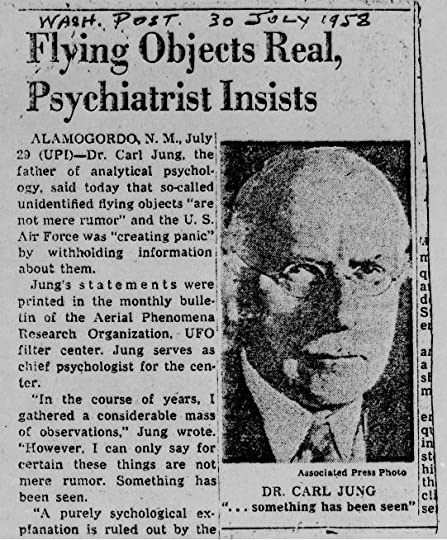
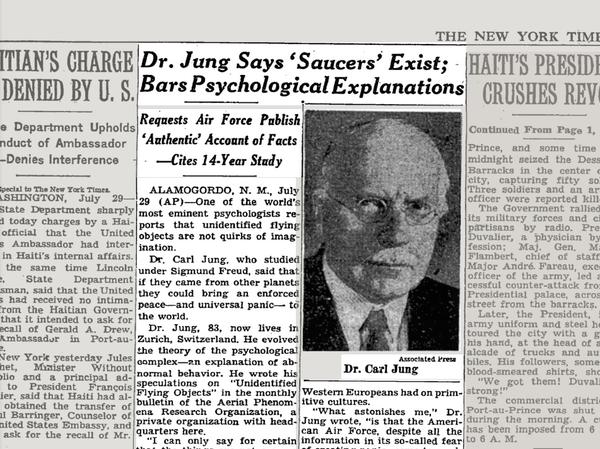
As indicated in the letter, although he was primarily interested in psychology, Jung had also done extensive research into whether or not the mythology was based on a physical phenomenon. In 1955 he submitted an article to a British UFO magazine called the Flying Saucer Review, in which he stated:
In the course of years, I have gathered together a considerable mass of observations, including reports by two eyewitnesses known to me personally (I have never seen anything!). I have also read about the question. However, I can only say that these things are not mere rumours: something has been seen.
Now let’s go back to my memory about our case; We used to sit in the sitting room separated from the outer world, listening to the radio “Rahe Shab” (the way into the night) all through the night and smoking our drugs. On one of these nights, a special event happened that became worldwide famous!
It was a lovely warm summer night, and we were smoking and listening to our favourite program in which also people could call and say something from their thought and talk to the moderator. Suddenly the moderator said; sorry! There is a woman on the phone crying with fear. She explains that it’s a giant flying subject above her house shining in different colours. She is afraid and calls for help!! Al and I, without hesitation, rushed to the roof. There was nothing to see! We’d waited and looked around into the sky. Al said; come on! Let’s get downstairs. But I was not satisfied and told him that I’d stay a little. Al said; Okay, but you must warn me if you see something. I suggested I’d throw some pebbles through the light shaft if I mentioned something.
We did so, he got back down, and I kept watching the sky, watching and watching excitedly. At first, nothing happened, but suddenly, when I was somehow tiredly wandering my eyes through the sky, I noticed a small round lightmoving from west to the east on the horizon from far away. It’s an aeroplane, I thought at first. It flew and flew, there was a long tower on its way, and the subject naturally vanished behind. And after a while, it appeared on the other side. I thought, you see! It’s an aeroplane! But it was crazy! After she flew a bit, she stopped standing still and flew backwards! That must be a helicopter, I’d thought. But, when it vanished behind the same tower again, it didn’t appear on the other side! There I immediately threw some pebbles through the shaft. I think that Al was waiting impatiently because he rushed up at once! In between, the flying object came back, from behind the tower towards the east to the same direction which it disappeared, and began to play like a flash; once it was on the left side of the tower and once it was on the right side of it, like snapping your fingers, right, left, right, left. When Al came through the roof door, I’d automatically point to the horizon I was watching it.
God is only my eyewitness; there was an explosion of lights towards us!! I have a creepy feeling even now as I’m writing these! It was like a firework, exploded soundlessly in many small lights sparkling in the sky. Al just said; wow!! And we’d kept looking in this direction; there, we’d noticed a single light moving northwards toward us. It was moving slowly and getting bigger and bigger. Al and I stoned, watching it as it came nearer and nearer; suddenly, Al said, as he ran to the door; come on, Ala, we must hide from its ray! I could understand what he’d meant. It referred to the Spielberg film (The Close Encounter of The Third Kind) because the radiation has left marks on the skin in that movie. However, I remained there, even when it flew nearer and nearer; I began to shout and wave my arms towards it; halo, hear, come!! It flew actually nearer, almost directly above us, and then stopped! It had a round shape and was in colour changing between red and orange. Al, standing at the door looking at this, I, jumping and shouting at it; please just come nearer! But, it stood still. I’d never know how long it lasted; in my memory, I felt it just a minute, then it flew diagonally; straight towards the south with an incredible speed and Wushhh…it vanished! We waited for a while, staring toward the horizon patiently and shocked. After a while, Al said that we’d get back downstairs; I said; he could do that and prepare the things; I’d come along later; he agreed and went downstairs. I stood awhile until I’d got tired too. There was nothing more to see. And as it was almost dawn, I went downstairs too.
On the radio, the subject was still on the air. There were many phone calls from people who were afraid or excited about the event. The moderator began to narrate about the famous movie; Odyssey 2000, but his shift work had ended, and it began the day program, but strangely there was no more talk about the last night’s event! It was bizarre, we thought, but as I know it yet, it had become a secret file of the CIA! Later I read in the newspapers that on this very night, two military jet plains of the Iranian Royal Airport flew to the sky to investigate the matter, but they couldn’t get near the object. When they’d tried, their devices broke down!! Anyway, this issue vanished from the radio talk immediately, and they just continued as if nothing had happened at all.
And yet, all of a sudden, after so many years, the US congress had found an interest in this topic! We can only wait and look at what will happen next. And I try to push the share button to see what happens next! PS: I will write a third part about the aftereffects of this event. Hoopla hoopla!
First, I would like to note a point that is hovering in my mind these days. I am a long-time member of WP, and I began reblogging my favourite articles. (I didn’t know what else should I do!) Then I dared to write one by myself as a nobody (I’ve even written an article under this title) and was humbly thankful for your dear support. Now, I want to remind you that I am still the “the humble man, as I ever have been”! One might say: look at this naughty boy; he got so cheeky! No, I am not. I might have been too young to be considered a professional, but I am too old to be a newcomer. I only found the courage to search for my past life and what I’ve learned in my backhead until I found my style. I have always renounced my ability, and I have tried to help Al succeed in his writing goal for the whole of my life. However, I stress that it would not be possible for me without your support. 🙏💖🙏
———————————————————————
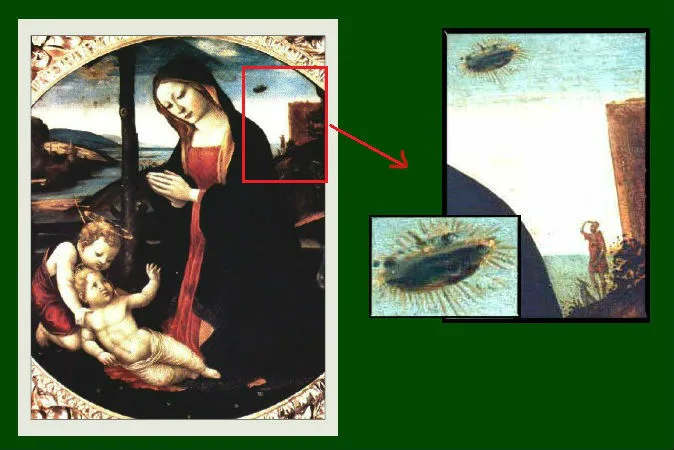
As we all might have heard about the UFO (unknown or unidentified flying objects), and these days the US Congress has (finally) begun to investigate for clarifications. Therefore, I thought it could be a chance to call up my memories and talk about our (Al’s and mine) experience on this subject.
Al and I were attracted to this subject at the end of the sixties to early seventies. We were young, though, but we followed this topic worldwide in the newspapers and other media. It was a hot issue, and we enthusiastically read all of them. Everywhere we looked in the sky, we saw some unknown flying object hovering somewhere, which we laughed at unbelievingly! Then, there came a movie, “The Movie”: Close Encounters of the Third Kind, by Steven Spielberg. It was a confirmation fully for us to take it seriously.
At the same time. We engaged with Sigmund Freud and his psychological themes, though Al was not so happy with his dogmatic conclusions. One day he came to me with a newspaper and said; look! In principle, there is a new wave in psychology, and its name is Carl Gustave Jung. I took the paper and read the article; it was about the UFOs in the fifties and sixties with a short reference to a famous psychologist named Carl Jung. From that time, we became Jungian.
Jung’s primary concern in Flying Saucers is not with the reality or unreality of UFOs but with their psychic aspect. Rather than speculate about their possible nature and extraterrestrial origin as alleged spacecraft, he asks what it may signify that these phenomena, whether real or imagined, are seen in such numbers just at a time when humankind is menaced as never before in history. The UFOs represent, in Jung’s phrase, ‘a modern myth.’
Dr Jung speaks of the helplessness of humans, and his theory to connect this issue (UFOs) with the psyche of humankind is fascinating. You know, I am a so-called Treky! I mean a great fan of the whole series of Star Trek. We watched them in those days in Iran, the old generation, and here in Germany, the new generation, and all the movies. I just want to say that the dream of humans to be able to travel in space and discover other planets and other species is fair and righteous, but should I reveal how I think about this? I believe this will remain like a dream! Sorry, but I think we humans are too earthy to be able to travel far up the Earth. Travelling with this flesh and blood across the galaxy at the speed of light? Inconceivable! We indeed hear now and then about the trip to Mars and how to take meals and other stuff to survive this long travel. it sounds like we must take the Earth along with us! I like the ideas about the Klingons and the Vulcans or the Romulans, but I never believe that such a creature like us in this form exists in the galaxies. I do think that we are not the only species in the whole world or worlds, and there is some life up there, but not in this primitive shape as we are! But these all are fascinating.
Anyway, it was in the second half of the seventies, and in Iran, the political agitation and dissatisfaction against the Shah’s regime were on the march. Of course, Al and I were against Shah’s dictatorship, but this revolution had an Islamic smell which we didn’t like! On the other hand, we were deep in our addiction time, and as we were in solitude anyhow, we kept ourselves inside our world.
Oh yes, we had a five-years practice being addicted to heroin. It has its own story, which I will tell one day, but this, in any case, has wholly isolated us from society. But the story about our close encounter comes soon, in part two, of course, as I see this article is already long enough. I will try it next weekend; we will get some friends to visit us on Thursday, and I must see how it goes. Have a lovely weekend, dear friends and “Live Long and Prosper” 🤗🙏💖🦋
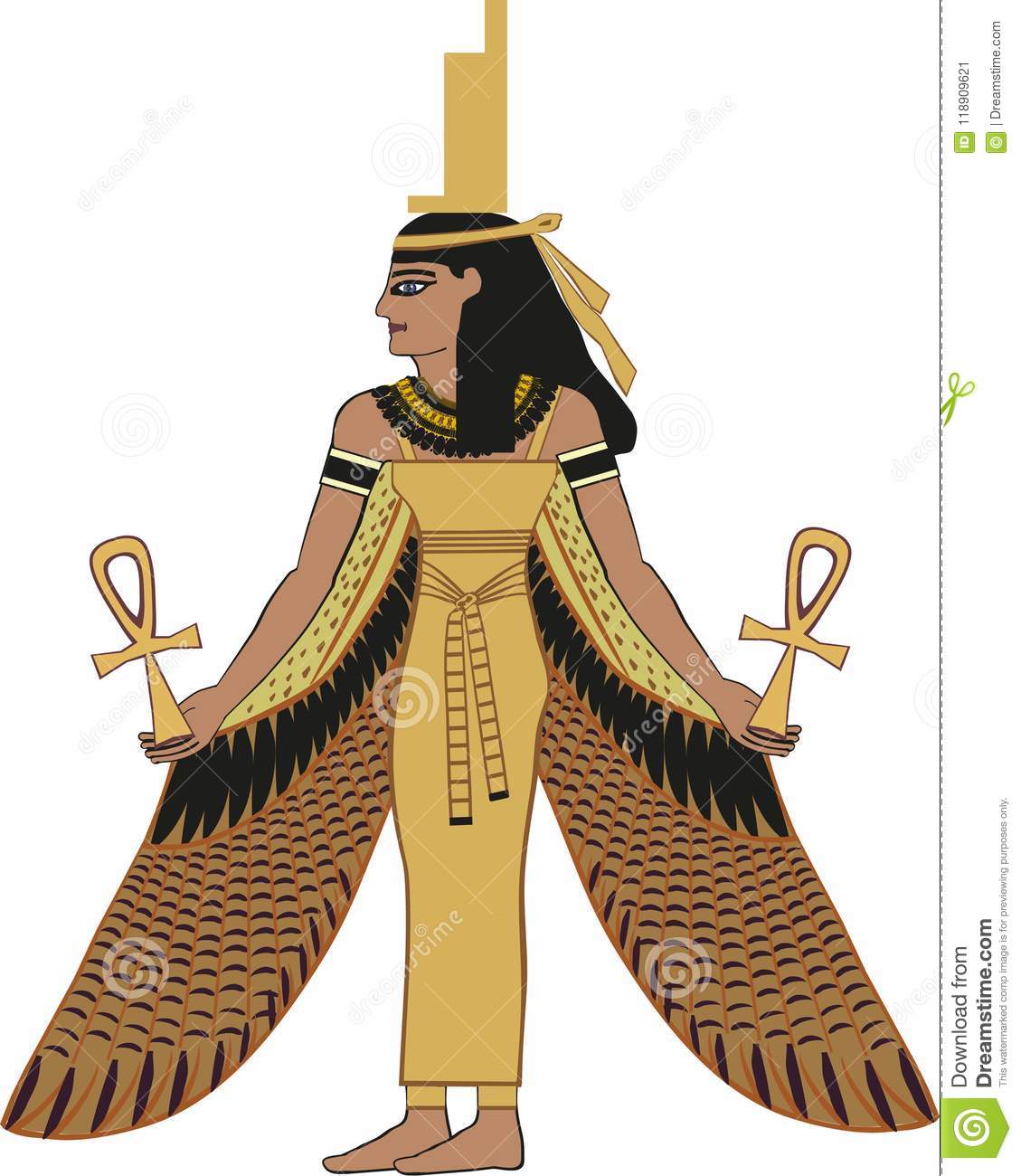
Herodotus, a Greek who wrote about Egypt in the fifth century BCE, likened Isis to Demeter, whose mythical search for her daughter Persephone resembled Isis’s search for Osiris. Even with the Egyptian tradition, Isis was associated with other goddesses like Hathor, from the old kingdom, or even older like Renenutet and Beset (the partner of the god Bes)
Goddess Isis or Hethor Old natural Papyrus from Egypt iStock
The importance we might notice here is the emphasis role of the feminine in the old deities. They mostly appear with equal power and rights, if not overhanding the masculine gods. For example Inanna or Ishtar, Kali, Hecate, Mitra (or Mithra imaged in both; masculine and feminine), etc.
Here is another story of saving such a treasure by artisans for the future by Marie Grillot with heartfelt thanks. 🙏💖
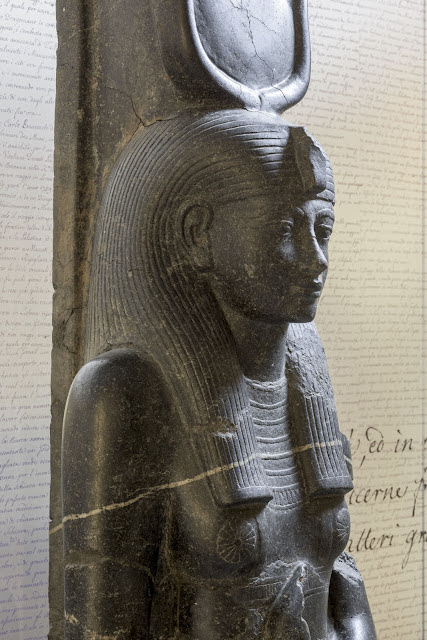
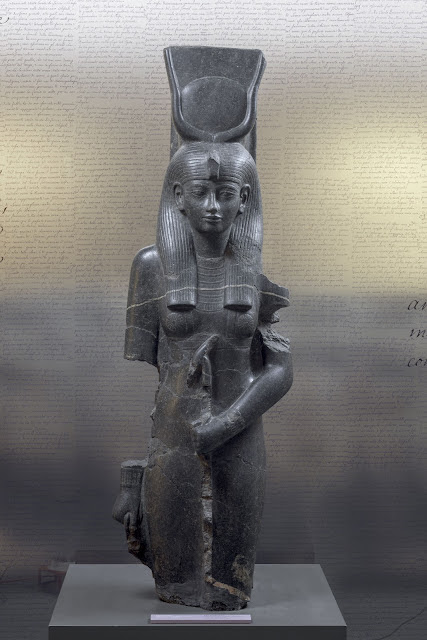
Statue of a female deity Hathor or Isis, known as “Isis of Coptos” – granodiorite – 18th dynasty – the reign of Amenhotep III Egyptian Museum of Turin – Cat. 694 (by acquisition from the Collection of Vitaliano Donati) – museum photo
At the height of 1.53 m, this statue of a female deity is unfortunately deprived of its lower part… But what we are given to see is of touching beauty… Sensuality and softness of the face, femininity and perfection of the body, everything is combined in a totally accomplished elegance and harmony!
This statue is generally attributed to Isis or Hathor, even if Jacques Vandier considers that: “The goddess of Turin, who has always been made, because of her hairstyle, a Hathor, is rather a goddess Mut, this one often wearing, in place of the pschent, the disc and the horns of Hathor”. Some also see it as a representation of the wife of Amenhotep III, Queen Tiyi…
Statue of a female deity Hathor or Isis, known as “Isis of Coptos” – granodiorite – 18th dynasty – the reign of Amenhotep III
Egyptian Museum of Turin – Cat. 694 (by acquisition from the Collection of Vitaliano Donati) – museum photo
The Hathoric crown – cow horns enclosing the solar disk – is placed on her tripartite wig. Adorned with a frontal uraeus, it exposes the ears and surrounds the face with perfect symmetry… For Eleni Vassilika: “Hathor’s features are typical of the style of Amenhotep III, father of the heretical king Akhenaten who, during his reign, suppressed the pantheon of traditional deities (Amarna period). In the shape of a drop, the face of the goddess is very much in the style of Amenophis III, especially that of his wife, Queen Teye. The design of the prominent ribbon-shaped eyebrows, the inner corner of the almond-shaped eyes also circled, and the fleshy lips under the well-defined nasal septum are typical characteristics of this reign”…
Around her neck hangs a delightful usekh necklace, delicately incised, with several rows of pearls, the last of which is in the form of drops.
Statue of a female deity Hathor or Isis, known as “Isis of Coptos” – granodiorite – 18th dynasty – the reign of Amenhotep III
Egyptian Museum of Turin – Cat. 694 (by acquisition from the Collection of Vitaliano Donati) – museum photo
Her dress, which begins under the chest with a braid enhanced with vertical bands, is held by thin straps. Her round breasts are adorned with a floral decoration, which resembles a rosette, a detail which recalls certain statues of Sekhmet from the same period.
Her left arm, hanging along the body, was amputated at the elbow, but the hand, enclosing an ankh sign, survived. The right arm, damaged, is unscathed only from the elbow. It is slightly bent and brought under the navel where the fist firmly holds a sceptre ouas. Her presence makes Eleni Vassilika react as follows: “It is surprising that the goddess holds a sceptre of ouas power (normally the prerogative of male deities), instead of the floral Wadjet sceptre, usually reserved for goddesses”.
Statue of a female deity Hathor or Isis, known as “Isis of Coptos” – granodiorite – 18th dynasty – the reign of Amenhotep III
Egyptian Museum of Turin – Cat. 694 (by acquisition from the Collection dee Vitaliano Donati) – museum photo
This statue was acquired in 1759 in Upper Egypt, at Coptos (the ancient Gebtou) – where there was a temple dedicated to Min – by Vitaliano Donati. Charles-Emmanuel III of Savoy had commissioned this professor of botany at the Royal Turinese University to search for antiquities. He undertook a long journey that took him to Egypt, Palestine, Syria and then on the road to India… from which, unfortunately, he did not return. However, a few pieces from the collection he had built up were able to be recovered by the Turin museum… This statue – registered under the reference Cat.694 – is one of the most remarkable!
Let’s deviate from heavy terms and back to the “(un)bearable” lightness of being and looking at that beautiful trip to the edge of the Mediterranean.
Of course, I must admit that Mallorca is one of the most beautiful islands in the world. I might just be allowed to wish for some celsius higher in that time of our vacation. It was chilly, and as I am a sun-born child, I would like at least 25′ degrees to spend my holidays, but it came not over 17′ degrees! Yes, I am sensitive. 😉
Here it’s me, trying to gather together myself, making a compromise with the situation. 🤓
However, we made the best of it; we reserved a rental car upon our arrival at the hotel for four days and did a review touristically trip out of it. Also, we were on the way every day. We wanted first to travel by a famous old train, which should run towards the north. Still, after two days of trying to get the ticket (we have been attempting through the sales counter), we finally found out that it should only be possible in a digital way: we are too old to be digitalized!




But we had a car; therefore, let the gas pedal speaks, and the cathedrals are calling;

That is the Cathedral in Palma, the capital city of Mallorca. We were not inside (a crowd waiting for the entry ticket!) There were some other cathedrals to go inside much easier. 😉😎
So that’s it; I’m still waiting for my wife’s pictures! Have a lovely weekend, everybody. ✌🌺🙏💖🙏
The masks: I use them indeed in the whole of my life, not like the people of their adult age after they lost their childish innocence. I had learned it when I was a child; I had learned to look the way people wanted to see me, to make them happy! It may be the trauma in my childhood that caused it. However, it caused that I needed time to find my real personality, my real I.
This subject got clear in my mind when my brother Al brought it into our regular meetings with friends. I remember well those days; we had regular psychological meetings (with Al and me, in our apartment) with friends, with a bit of vodka included! Al has put in this theme about masks in one of them. I don’t know where he had this from, although I could bet that he got it from Dr Jung. Anyway, it was a surprise and, at the same time, a fascinating issue for us to talk about. Masks are something we use every day without being aware of it.
He claimed that we even have many different masks in different situations. Of course, at first, our young friends refused to wear any masks, or better to say, they didn’t want to believe they were doing it. But Al, after asking some questions (in the Socratic method!), we all had to admit that we do use it.
I believe and am convinced that this issue is significant and will help us know our inner behaviours; I always thought it was good to observe myself from above! Here I should reference Dr Jung again to understand the subject better. We will understand how the man can unconsciously make a fool of himself and cause suffering to women. Of course, it is an extended argumentation; I have tried to shorten it. 💖
————————————————————————–
Translated from “Die Beziehungen Zwischen Dem Ich Und Dem Unbewussten” (The Relations Between The I And The Unconscious) C.G. Jung; Individuation, Anima & Animus. “Anima, animus and the role of man!“
There is an inherited collective image of the woman in man’s subconscious, with the help of which he grasps the essence of the woman. This inherited image is the third primary source of the soul’s femininity.
In the Eastern perspective, the concept of the anima, as we have presented it here, is missing, and logically the concept of a persona is also missing. This is by no means accidental because, as I indicated above, there is a compensatory relationship between persona and anima.
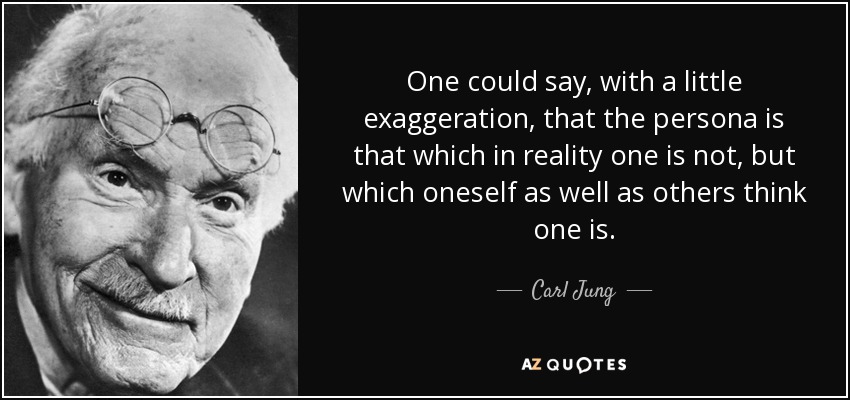
The persona is an intricate system of relationships between the individual consciousness and society, suitably a kind of mask designed on the one hand to make a particular impression on others and, on the other hand, to conceal the true nature of the individual. The latter is superfluous and can only be asserted by someone who is so identical to his persona that he no longer knows himself, and the former is unnecessary and can only be imagined by someone unaware of the true nature of his fellow human beings. Society expects, yes, it must expect every individual to play the role intended for him as ultimately as possible so that someone who is a pastor not only objectively carries out his official functions but also otherwise at all times and under all circumstances, the role of the pastors play without hesitation. The firm requires this as a form of security; each must stand in his place; one is a shoemaker, the other is a poet. He is not expected to be both. It’s also not advisable to be both because that would be a bit spooky. Such a person would be “different” from other people and not entirely reliable. In the academic world, he would be a “dilettante”, politically an “unpredictable” figure, religiously a “freethinker”; in short, he would be suspected of being unreliable and inadmissible, for the society is convinced that only the shoemaker, who is not a poet, is to provide expertly correct shoes. The unambiguousness of the personal appearance is a practically important thing; the average person known to the society must already have his head on one thing to be able to accomplish something worthwhile, two of which would be too much for him.
Our law firm is undoubtedly attuned to such ideals. It’s no wonder, then, that anyone who wants to achieve anything needs to keep these expectations in mind. Of course, as an individual, no one could fully live up to these expectations, so the construction of an artificial personality becomes an unavoidable necessity.
The demands of decency and good manners do the rest to motivate a wholesome mask. Behind the mask then arises what is called >private life<. This well-known separation of consciousness into two often ridiculously different figures is a drastic psychological operation that cannot remain without consequences for the unconscious. The construction of a collectively appropriate persona involves a tremendous concession to the outside world, true self-sacrifice that forces the ego straight into identification with the persona so that there really are people who believe they are what they represent.
The soullessness of such an attitude is only apparent, for the unconscious will under no circumstances endure such a shift in a heavy emphasis. Looking critically at such cases, we discover that the excellent mask is internally compensated by a private life. The pious Drummond once complained that ‘bad temper is the vice of the pious’. Of course, whoever builds up a positive persona reaps an irritable mood. Bismarck had hysterical fits of crying, Wagner a correspondence about silk dressing gowns, Nietzsche wrote letters to a “dear lama,” Goethe had conversations with Eckermann, and so on. But there are more sophisticated things than the banal “lapses” of the heroes. I once acquainted a venerable man – one could without difficulty call him a saint – I walked about him for three days. I could nowhere discover the inadmissibility of the mortal in him. My sense of inferiority was becoming threatening, and I was already beginning to think seriously about improving myself. But on the fourth day, his wife consulted me… Nothing similar has happened to me since then. But I learned from this that someone who becomes one with his persona can let his wife represent everything disturbing without the latter noticing, but she pays for her self-sacrifice with a severe neurosis.
I might look forward to sharing another part of this fascinating book. Thank you for being there. 🙏💖🙏
You undoubtedly know that I have a particular love for Dr Jung, though you might wonder why I write from him now more often. That is because, on Facebook, I have recently, by some adorable friends, been upgraded! It might be not such great news, but at least it is a great encouragement for me to work it out. Of course, I have also noticed that it is not an as easy job!
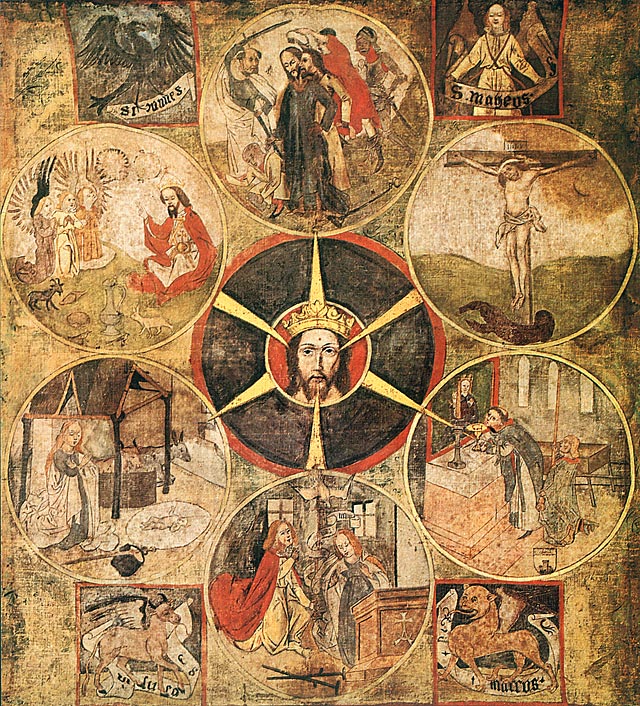
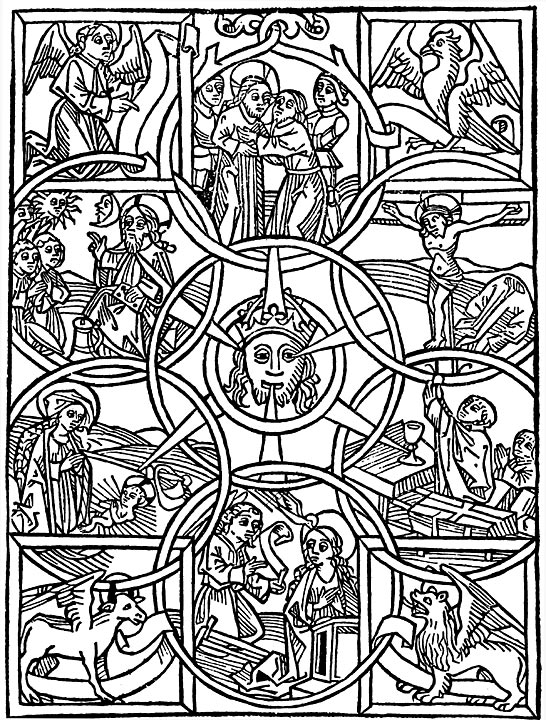
The illustration above is a version that Brother Niklaus von Flüe had to have seen and got the image on the wall of his cell. “”The prototype of a mystic across religious-denominational divisions. Brother Klaus is “the only outstanding Swiss mystic by the grace of God, who had unorthodox primal visions and was able to look unperturbed into the depths of that divine soul, which still contains all denominations of mankind separated by dogmatics united in a symbolic archetype””. C.G. Jung: Brother Klaus. In: Neue Schweizer Rundschau, Neue Serie I/4 (1933), quoted from: On the Psychology of Eastern and Western Religion, Collected Works 11, § 487.
Jung said: “‘God’ is a primal experience of man, and from time immemorial, mankind has made an incredible effort to represent this incomprehensible experience, to assimilate it, through interpretation, through speculation and through dogma, or to deny it”. (C.G. Jung: Brother Klaus. Quoted from: Collected Works, 11, § 480.)
And Dr Jung, as he himself was an extraordinary visioner, mentioned this in his book, “Archetypes.” (Archetypen) He wrote:
What is meant by the archetype is clearly stated by its relation to myth, secret doctrine, and fairy tales just explained. On the other hand, things get more complicated if we try to understand psychologically what an archetype is. Research into myths has always been content with solar, lunar, meteorological, vegetation and other auxiliary ideas. The fact that myths are primarily psychological manifestations that represent the soul’s essence has hardly been accepted up to now.
Why is psychology the very youngest of the empirical sciences? Why hasn’t one discovered the unconscious long ago and raised its treasure trove of eternal images? Relatively simply not because we had a religious formula for all things of the soul that is far more beautiful and comprehensive than direct experience. If the Christian world’s vision has faded for many, the symbolic treasure troves of the East are still full of miracles, which can nourish the desire to look around, and at new clothes for a long time to come. Moreover, these images – be they Christian or Buddhist or anything else – are beautiful, mysterious and foreboding. Admittedly, the more familiar they are to us, the more frequent use has worn them down so that only their banal externality has remained in its almost meaningless paradox. The mystery of the virgin birth, or the Homoousian of the son with the father, or the trinity that is not a triad, no longer inspires philosophical imagination. They have become mere objects of belief. It is not surprising, therefore, if the religious need, the pious mind, and the philosophical speculation of the educated European should be drawn to the symbols of the East, to the grandiose conceptions of divinity in India, and to the abysses of Taoist philosophy in China, as the mind and spirit once were the spirit of ancient man has been caught up in Christian ideas. There are many who first gave themselves over to the influence of the Christian symbol until they became entangled in Kierkegaardian (Kierkegaard) neurosis, or until their relationship to God, as a result of an increasing impoverishment of symbolism, developed into an intolerably acute “I-Thou” relationship, then to succumb to the magic of the fresh strangeness of Eastern symbols.
It is not enough for the primitive to see the sunrise and set. Still, this external observation must at the same time also be a mental event, i.e. the sun in its transformation must represent the fate of a god or hero who, basically, is nowhere dwells differently than in the human soul…
What I mean is probably best illustrated with the example of a Swiss mystic and hermit, the recently canonised Brother Niklaus von Flüe. Probably his most important experience was the so-called Trinity Vision, which engaged him so much that he painted it or had let it paint on the wall of his cell.
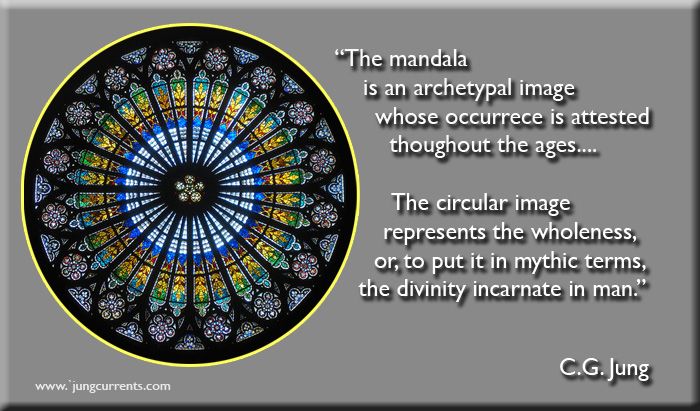
The vision is depicted in a contemporary painting preserved in the parish church of Sachseln: It is a mandala divided into six, the centre of which is the crowned face of God. We know that Brother Klaus used the illustrated booklet of a German mystic to research the nature of his vision and tried to bring his primal experience into a form he could understand. He dealt with that for years. This is what I refer to as >editing< the icon. His reflections on the nature of the vision, influenced by the mystical diagrams of his guide, necessarily led to the conclusion that he must have seen the Holy Trinity himself, that is, the >summum bonum<, eternal love itself. The clarified representation in Sachseln also corresponds to this.
That is an abstract or summary of C. G. Jung; “Archetypen; Urbilder und Wirkkräfte des Kollektiven Unbewussten. (Archetypes; archetypes and influential forces of the collective unconscious.)





































 lampmagician


You must be logged in to post a comment.