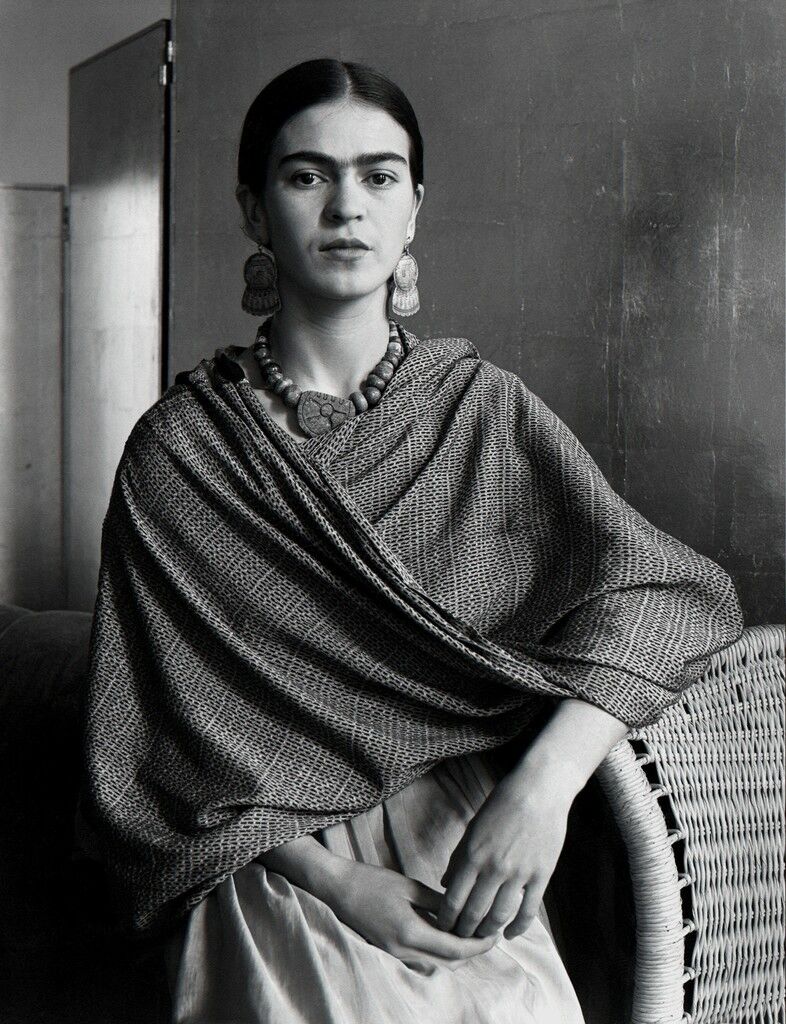
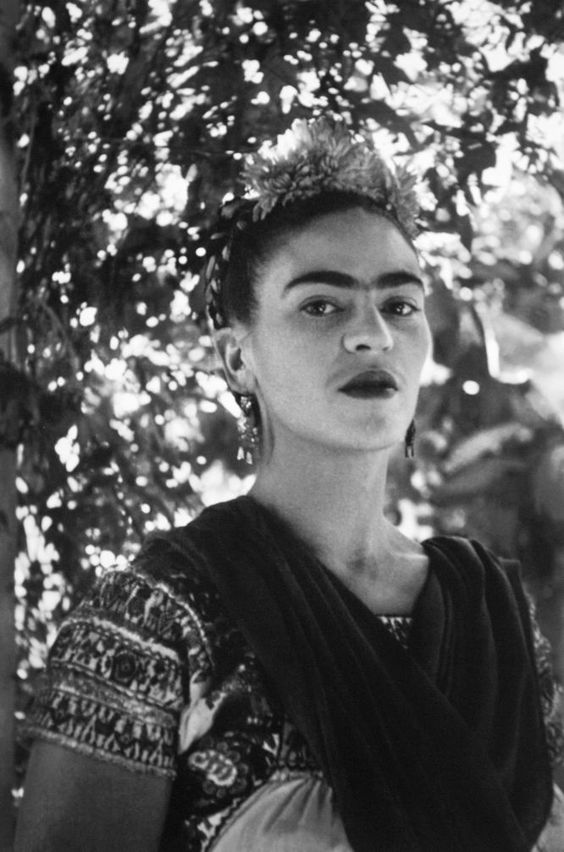
Honestly, I intended to make another post about this genius woman some months ago, but I haven’t had the chance. And about some weeks ago, I saw an excellent post by Symbol Reader, who wrote a Marvelous article on Kahlo, Frida Kahlo’s Symbolism of Life, and I say that it is a highly recommended read.
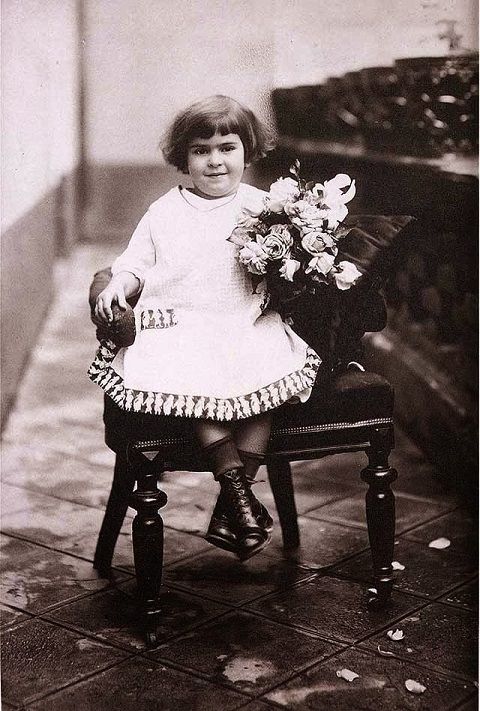
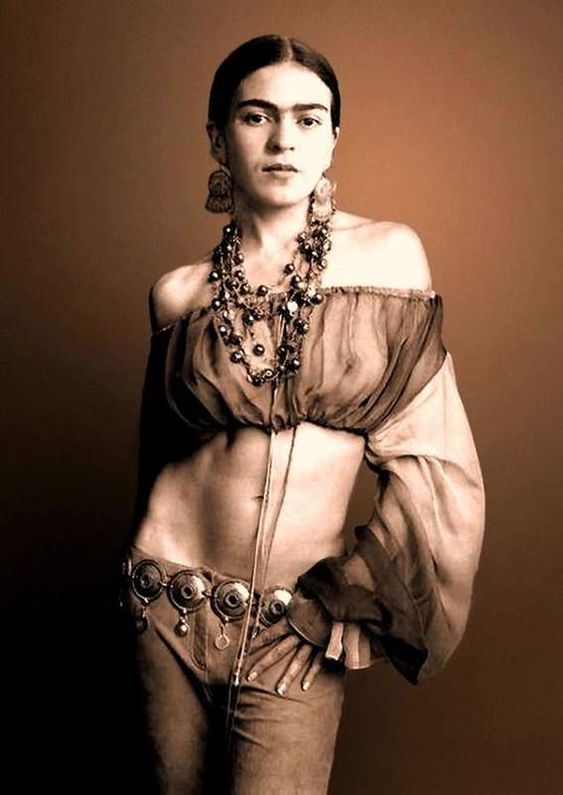
And now, under the motto: what to do now? I did decide to prize this fascinating artist with some pics in B&W with a few words about her. Although I’m doing this post in between a lot of stress (two full days of work and caring for grandkids, because my son and daughter-in-law and my wife all have to work every day!) Therefore, please forgive me if any mistake happens.
“Kahlo” redirects here. For the surname, see Kahlo (surname).
In this Spanish name, the first or paternal surname is Kahlo and the second or maternal family name is Calderón. Born to a German father and a mestiza mother, Kahlo spent most of her childhood and adult life at La Casa Azul, her family home in Coyoacán – now publicly accessible as the Frida Kahlo Museum. Although she was disabled by polio as a child, Kahlo had been a promising student headed for medical school until she suffered a bus accident at the age of 18, which caused her lifelong pain and medical problems. During her recovery, she returned to her childhood interest in art with the idea of becoming an artist. Wikipedia
Back in Mexico City, Kahlo and Rivera moved into a new house in the wealthy neighbourhood of San Ángel. Commissioned from Le Corbusier‘s student Juan O’Gorman, it consisted of two sections joined by a bridge; Kahlo’s was painted blue and Rivera’s pink and white. The bohemian residence became an important meeting place for artists and political activists from Mexico and abroad.
She was again experiencing health problems – undergoing an appendectomy, two abortions, and the amputation of gangrenous toes – and her marriage to Rivera had become strained. He was not happy to be back in Mexico and blamed Kahlo for their return. While he had been unfaithful to her before, he now embarked on an affair with her younger sister Cristina, which deeply hurt Kahlo’s feelings. After discovering it in early 1935, she moved to an apartment in central Mexico City and considered divorcing him. She also had an affair of her own with American artist Isamu Noguchi.
Kahlo reconciled with Rivera and Cristina later in 1935 and moved back to San Ángel. She became a loving aunt to Cristina’s children, Isolda and Antonio. Despite the reconciliation, both Rivera and Kahlo continued their infidelities. She also resumed her political activities in 1936, joining the Fourth International and becoming a founding member of a solidarity committee to provide aid to the Republicans in the Spanish Civil War. She and Rivera successfully petitioned the Mexican government to grant asylum to former Soviet leader Leon Trotsky. They offered La Casa Azul for him and his wife Natalia Sedova as a resident. The couple lived there from January 1937 until April 1939, with Kahlo and Trotsky becoming good friends and having a brief affair.
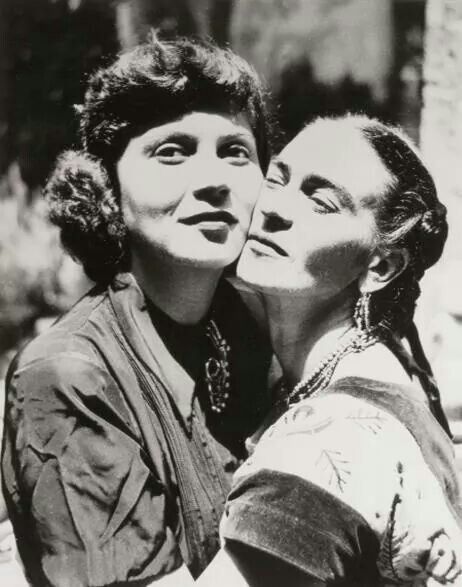
Frida was totally an LGBTQ icon! As described by the late singer, her relationship with singer Chavela Vargas was so beautiful. But unfortunately, it wasn’t until her death that others began to recognize her as a queer icon. Here.
In 1938, the Rivera Kahlo couple accommodated André Breton, leader of the surrealist movement, in their home. He and his wife, Jacqueline Lamba, escaped the Nazi occupation of France. Lamba and Kahlo were very close friends, and there are rumours that they were also lovers.
She was and still will be a fantastic artist, full of life, despite her short life.
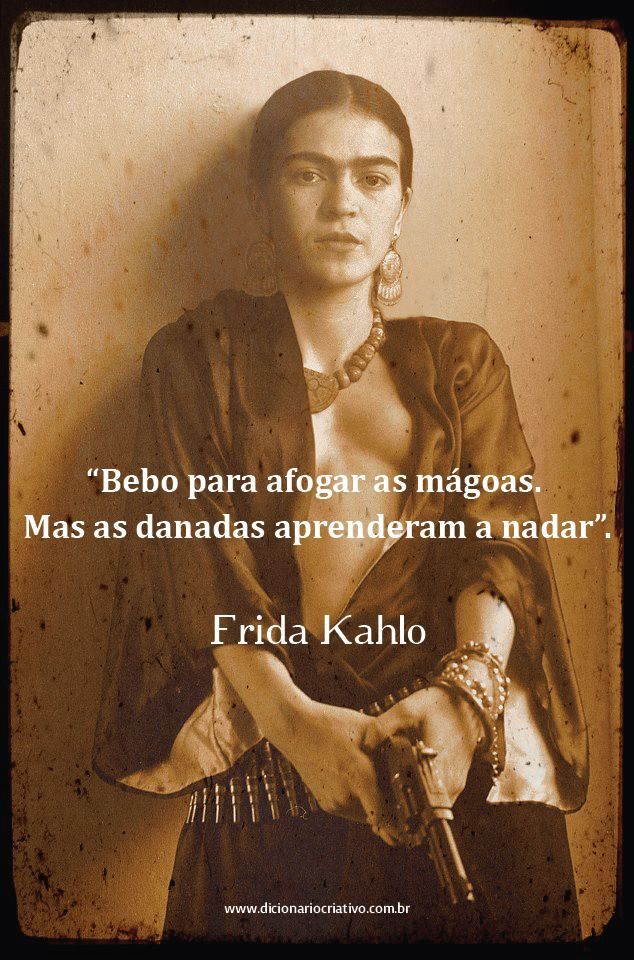
I drink to drown out magicians. more so damaged we will learn to swim
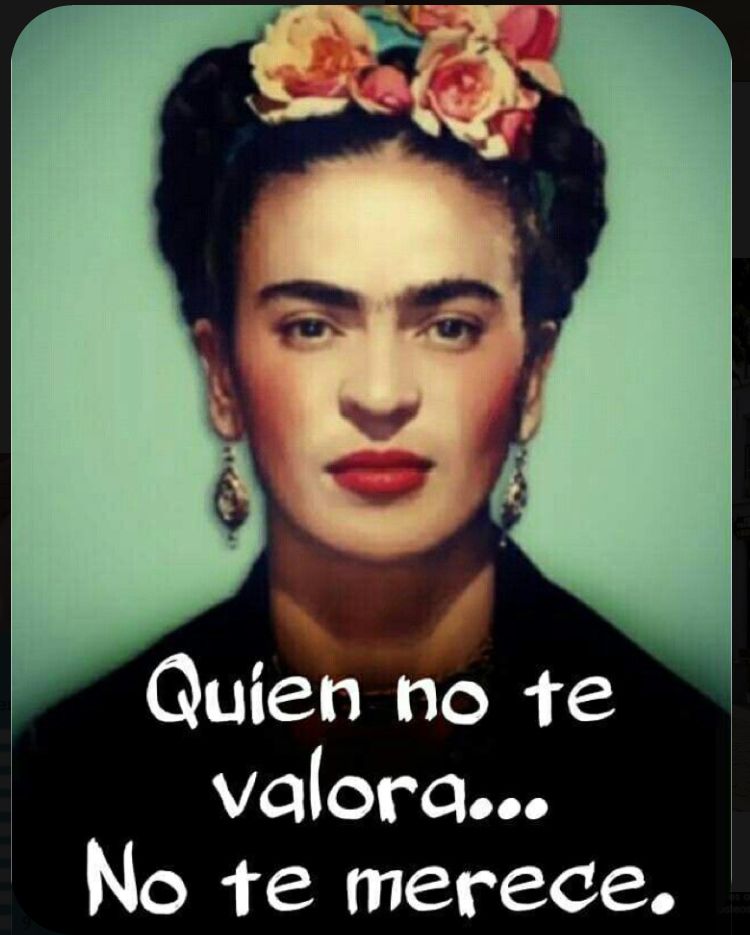
I don’t want you to think like me… Just thinklove has a limit; it’s called dignitylove me crazy because lines wouldn’t know how to loveWho does not appreciate you don’t deserve you
Now I must get into clothes and run (or drive!) to my brother-in-law’s sixtieth birthday southwest of our province. Have a lovely and peaceful weekend, friends. 😜🙏🙏💖💖😘😘
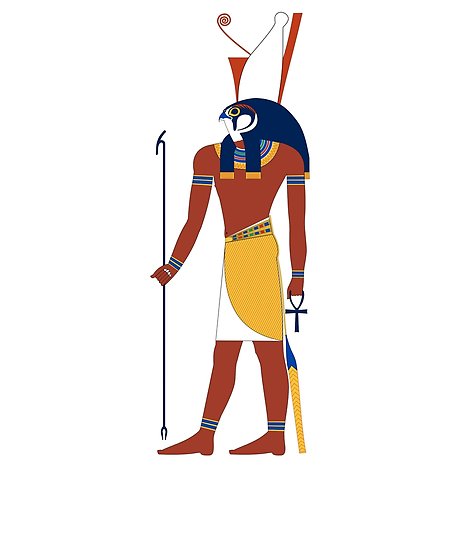
Horus, the falcon-headed god, is a familiar ancient Egyptian god. He has become one of Egypt’s most commonly used symbols, seen on Egyptian aeroplanes and on hotels and restaurants throughout the land.
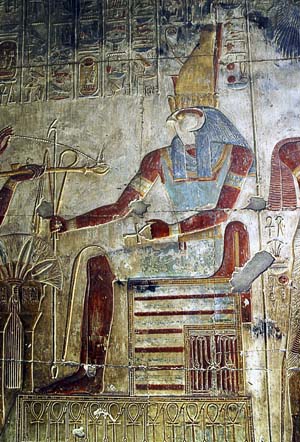
Horus is the son of Osiris and Isis, the divine child of the holy family triad. He is one of many gods associated with the falcon. His name means “he who is above” and “he who is distant”. The falcon had been worshipped from the earliest times as a cosmic deity whose body represents the heavens and whose eyes represent the sun and the moon. Horus is depicted as a falcon wearing a crown with a cobra or the Double Crown of Egypt. The hooded cobra (uraeus), which the gods and pharaohs wore on their foreheads, symbolizes light and royalty. It is there to protect the person from harm. via
And here is a stunning modern version of Goddess Isis.
Depictions of the goddess Isis, such as on this ornamental breastplate found in the tomb, were modern-looking, her bobbed hair and shift dress chiming with the 1920s modern girl. BBC
What did the falcon represent in ancient Egypt?
The living king of Egypt was identified as an earthly Horus, and from the late Predynastic Period (c. 3100 BCE), the king bore a memorable royal “Horus name.” As the sacred animal of Horus, the falcon came to symbolize divine kingship, as the king was the earthly representation of Horus. Here.
Here, we read an excellent description of this magnificent divine work of god’s image. By Marie Grillot 🙏💖🙏
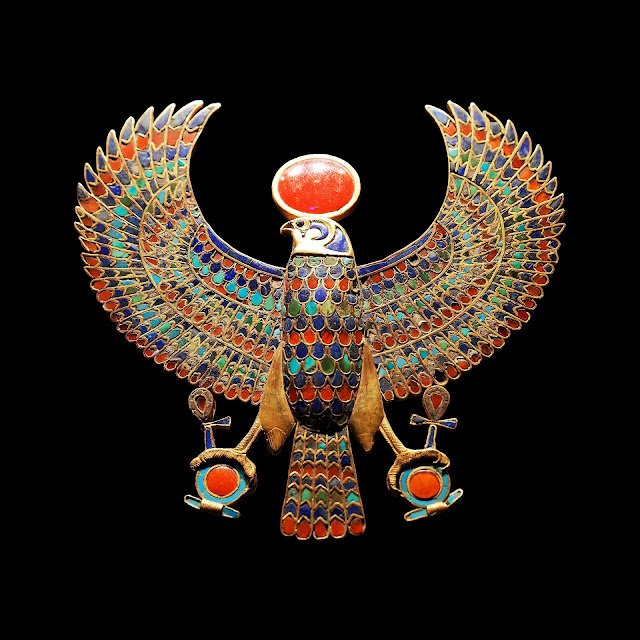
Falcon holding shen sign surmounted by ankh sign – gold, lapis lazuli, turquoise, carnelian, light blue glass Provenance: tomb of Tutankhamen (KV 62) was discovered in November 1922 by Lord Carnarvon and Howard Carter Housing 267-m(1) JE 61893 – GEM 31969
In bright and shimmering polychromy, the falcon, represented in full flight, spreads its wings. Curved upwards, they thus offer, in an elegant symmetry, perfect protection for the deceased.
The cloisonné technique – which here achieves a degree of excellence – enabled the 18th dynasty goldsmith who made this incredible pectoral to combine an enchantment of semi-precious stones, perfectly rendering the texture and composition of the plumage. Gold, lapis lazuli, turquoise, carnelian, or even light blue glass realistically reproduce the location of the primary and secondary flight feathers and the contour feathers and those of the tail. “It has partitions which are so tightly fitted with blue and red glass that it has been suggested that they represent the first example of true enamelling from Egypt”, analyzes Carol Andrews in “Ancient Egyptian Jewelry”.
Falcon holding shen sign surmounted by ankh sign – gold, lapis lazuli, turquoise, carnelian, light blue glass Provenance: tomb of Tutankhamun (KV 62) was discovered in November 1922 by Lord Carnarvon and Howard Carter Housing 267-m(1) JE 61893 – GEM 31969
The falcon’s head, seen in profile, is in solid gold. The hooked beak, the nape of the neck and the decorative motif on the cheek are underlined by inlays of dark glass paste. The round eye, embellished with a drip edge, is in obsidian.
“A large solar disk of carnelian, surrounded by a ring of gold, surmounts the head of the raptor, which therefore appears, by virtue of this attribute, as the symbol of the composite solar deity Re-Horakhty”. The legs of the falcon, entirely in gold, are terminated by talons that hold the shen rings, symbols of eternity, and the emblems of ankh life, guaranteeing the deceased sovereign, eternal life in the Beyond. The reverse of the jewel, entirely in gold, is decorated with delicate carvings that reproduce the place’s decor. The pendant was no doubt hung around the neck using a cord which was threaded through the four eyelets on the reverse,” specifies Silvia Einaudi in “The wonders of the Egyptian Museum in Cairo”.
In his book “Tutankhamun, life, death and discovery of a pharaoh”, Nicholas Reeves observes that: “Tutankhamun was buried with many more jewels and amulets than Carter discovered on the mummy, and Judging by ancient inscriptions cataloguing the contents of the jewellery boxes, the tomb robbers seized many of the most valuable pieces. By Carter’s estimate, at least sixty per cent of the finest ‘unattached’ jewellery was gone. Those that remained – more than two hundred, including twenty precious metal pectoral elements and five counterweights – did however not insignificantly expand, both in quality and quantity, the range of antique jewellery known at the time”.
This rigid pectoral, with a maximum height of 11.70 cm and a maximum width of 12.60 cm, was found in the “treasure room”. This room was officially opened on February 17, 1923, almost three months after discovering the tomb by Lord Carnarvon and Howard Carter.
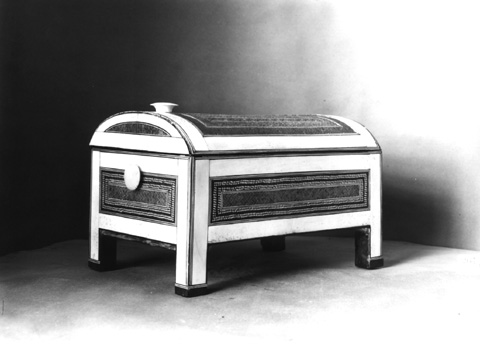
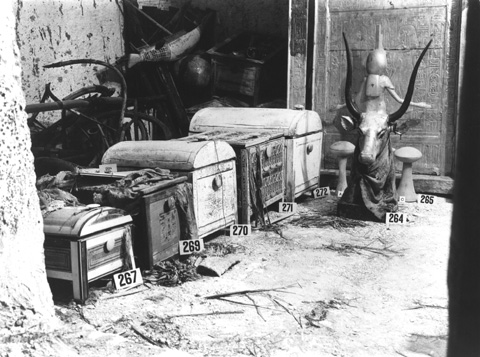
It was placed in a delightful casket of ivory and ebony. On its domed lid was an inscription that Howard Carter had difficulty interpreting. He consulted, in August 1927, Alan J. Gardiner, who felt that it might be read as: “Jewels of gold for the procession made in the bed-chamber (i.e. the burial chamber) of Neb- Kheperou-Rê”… The casket did indeed contain numerous adornments of the king, for which Alfred Lucas considered that: “There was sufficient evidence to show that the jewels were originally tied in linen and sealed”.
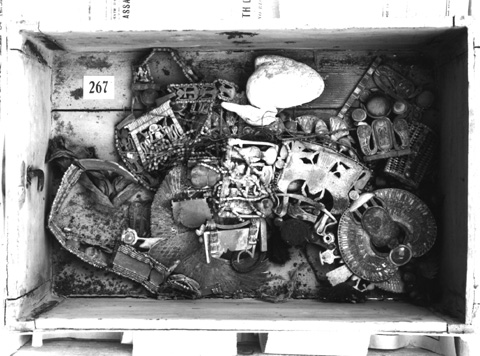
Placed on the ground, in front and to the left of the gilded wooden naos protected by the four goddesses, it is easily identifiable in Harry Burton’s photos. Numbered “267” by Howard Carter, the various jewels inside received this number followed by a letter. Thus, this pectoral was referenced Carter 267-m(1).
It was then registered in the Cairo Museum Entry Journal, and its new Grand Egyptian Museum listing is GEM 31969.
It seems important to add two pieces of information. Carol Andrews indeed reports that it “shows signs of wear”, indicating that the young king wore it. Was this one of the symbols of his coronation? On the other hand, a very similar pectoral (256uuu-1) was found on the royal mummy, hanging on a heavy gold chain fitted with a heart-shaped counterweight. It is almost identical in construction, it undoubtedly comes from the same workshop, and the falcon is there, represented from the front and without the “ankh” signs…
Tutankhamun and his time, Petit Palais, Paris, February-July 17, 1967, Catalog by Christiane Desroches-Noblecourt, Ministry of State for Cultural Affairs
Life and Death of a Pharaoh, Christiane Desroches-Noblecourt, Hachette, 1963
Tutankhamun, life, death and discovery of a pharaoh, Nicholas Reeves, Editions Errance
Tutankhamun: his tomb and its treasures, IES Edwards, The Metropolitan Museum of Art, 1977
These days, many things have been happening around that I feel baffled! First, we got infected, then recovered and now the unexpected war. At first, thank goodness that we have all (the family) got through with this virus, and everybody is Okay. (although when I strain my body, I feel a little exhausted now and then, showing how this virus is effective, with its subsequent trace.
And now, we have war, again, in Europe. As I look through history, I see how the nations were hungry to wage war for pride or even fun in the last centuries. But after WWII, the hunger for wars have the leaders of the countries and not the people. President Putin wants to have the same territory (like the great USSR) as North America wanted once to have when looking towards the South. As anybody might remember, all the countries’ leaders in the South of America were like puppets and corrupt. They were all organized by the US government to come into power and serve them. The breakthrough came from Cuba and with Fidel Castro. And practising freedom came one after another in the neighbourhood. But the USA had never attended to attack the Souther countries or made any war. President Putin had done it, though, and we can notice how desperate he is.
When in the 90s, the Ukrainians were demonstrating for their freedom in their Maidan, wasn’t it better that Europe not only sat and watched the procedure but helped them to get what they wanted? Wasn’t that a failure which we can see now the result? In any case, we are now where we shouldn’t be or didn’t want to be, and we can only hope something sensible comes up in the minds of those in charge.
Anyway, let us look at something beautiful, natural, Nature! Yes, Nature is innocent and maybe a place for us to run away from the meanness of the human for a moment.





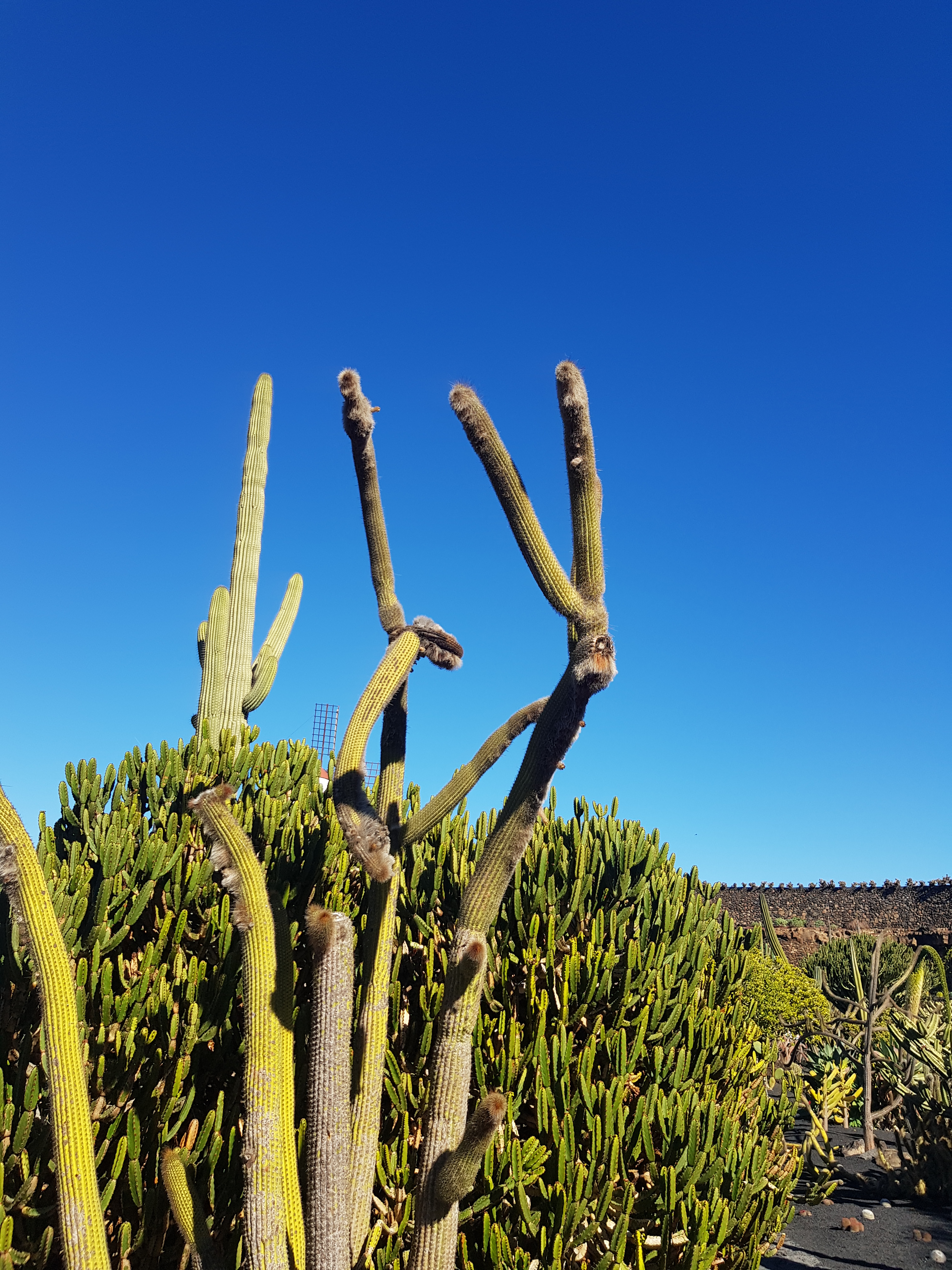
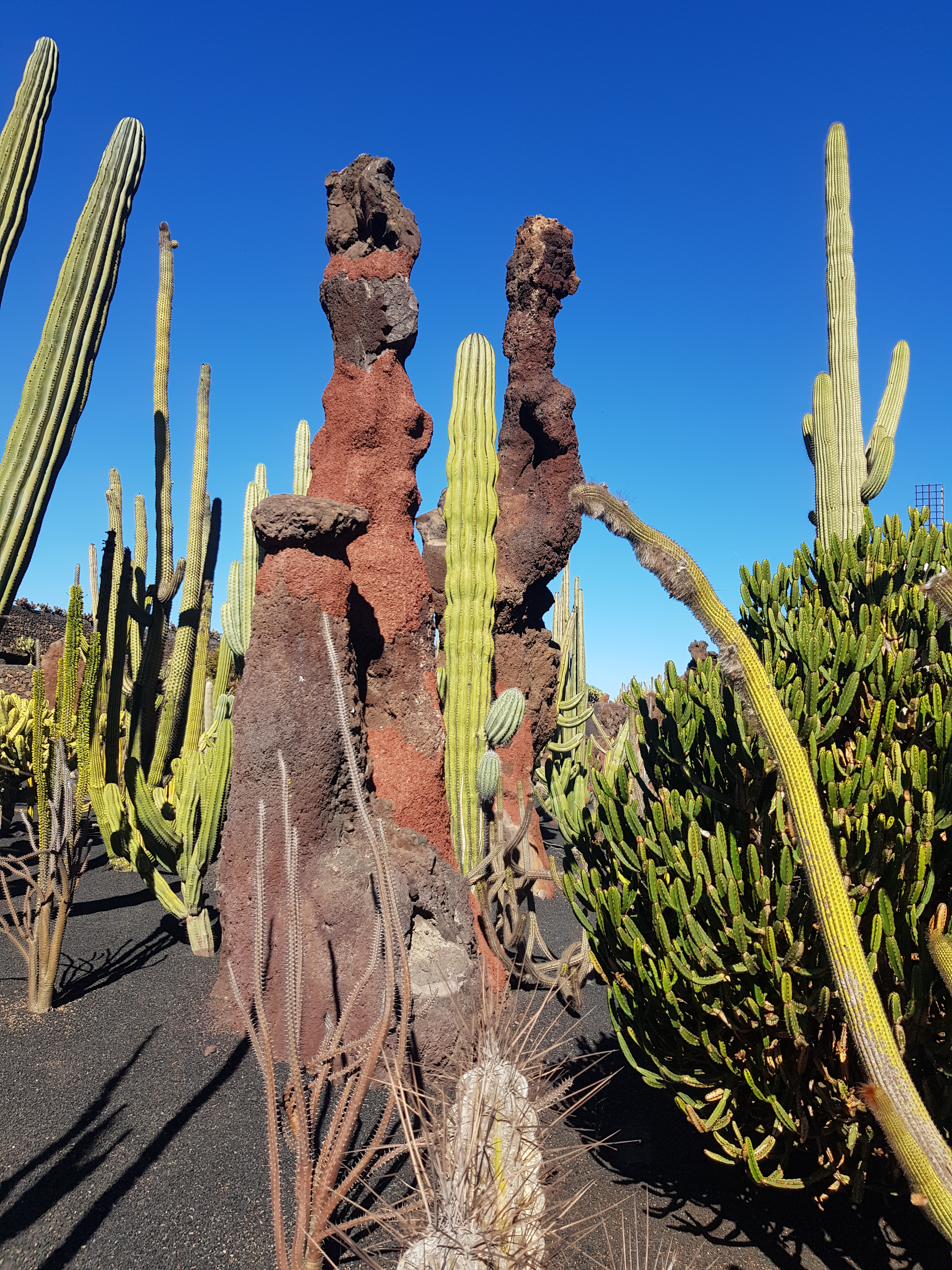
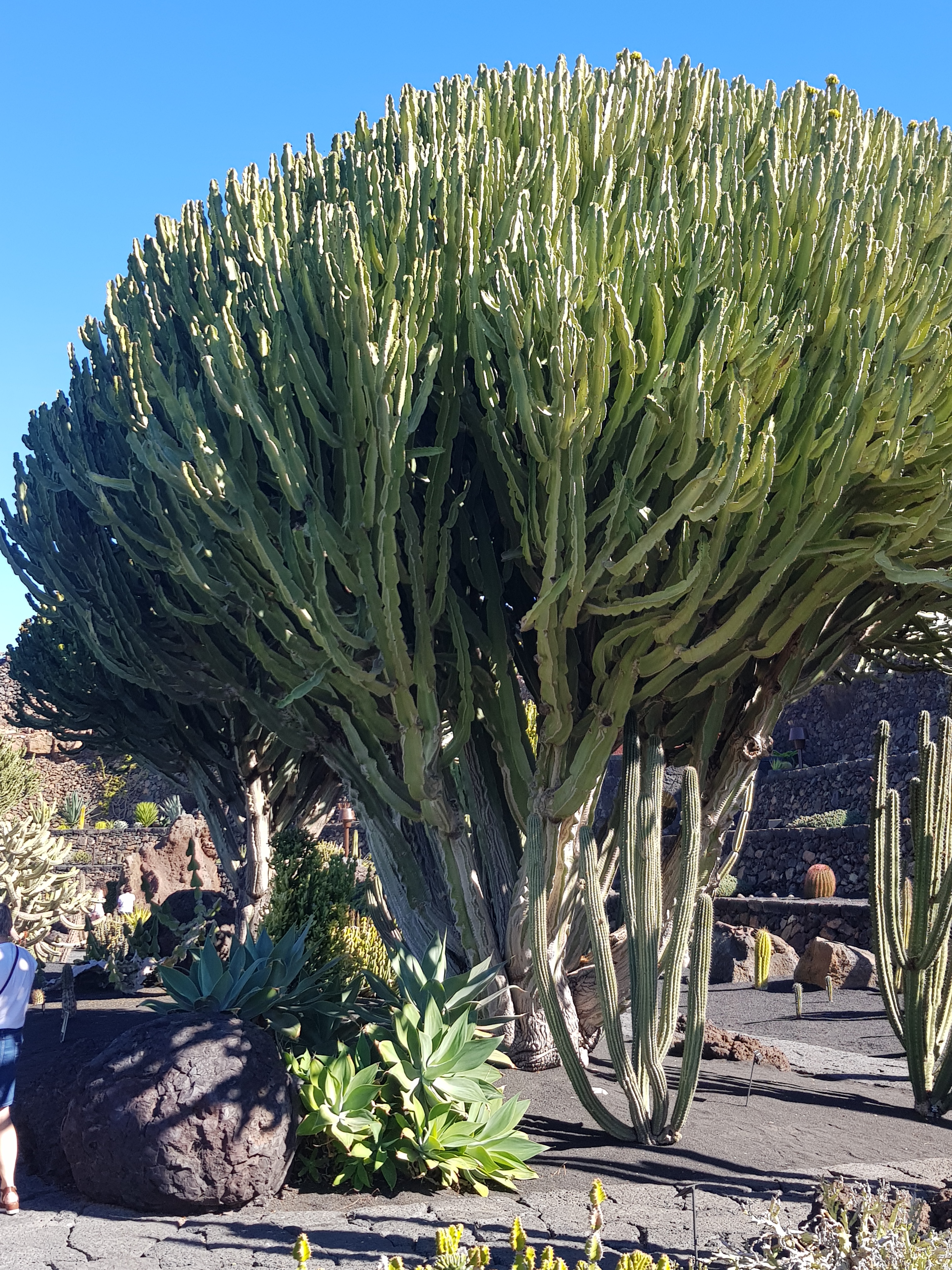
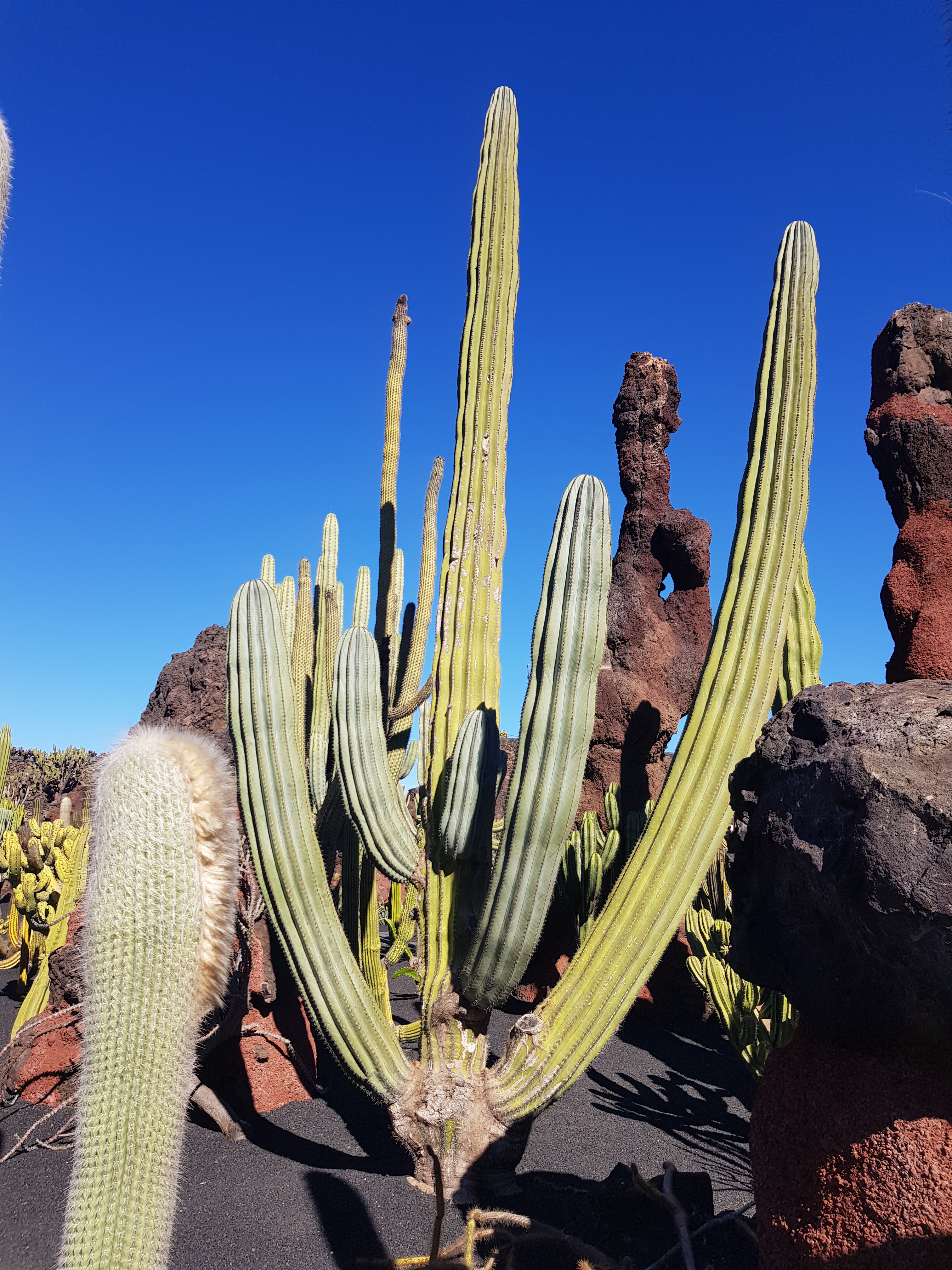
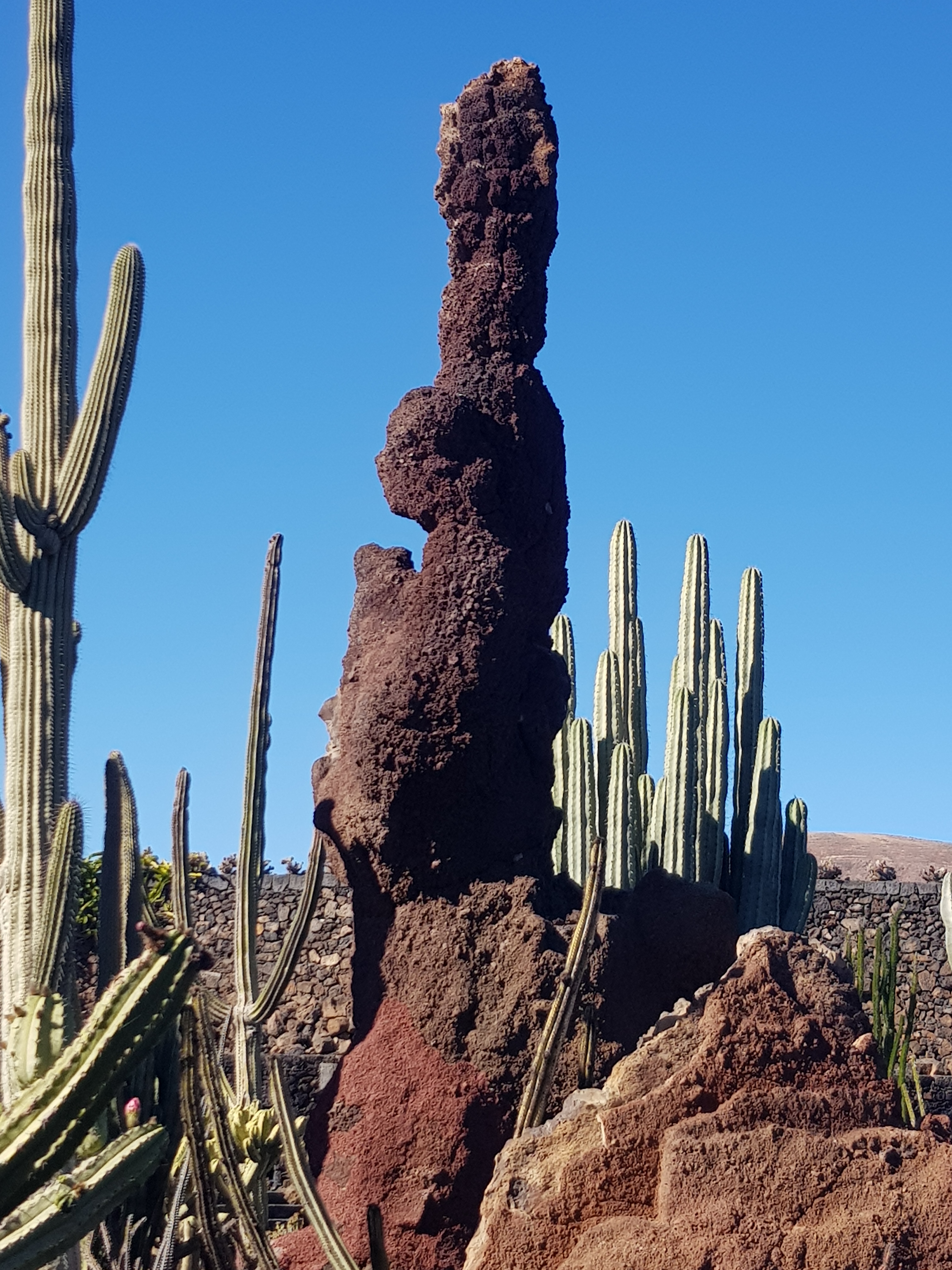
Here is a cactus park in Lanzarote. Amazing and fascinating.
And of course some special by my adorable lady:



With the palm trees all over our sight.
I have to add here that, as we are likely healthy, that’s why a lot come to us: some round birthdays: This Saturday a 40, in the North (Bremen city) next weekend a 60 on the other side towards South: Hagen city! Maybe to be ill is sometimes better! Have a lovely and peaceful weekend, everybody.
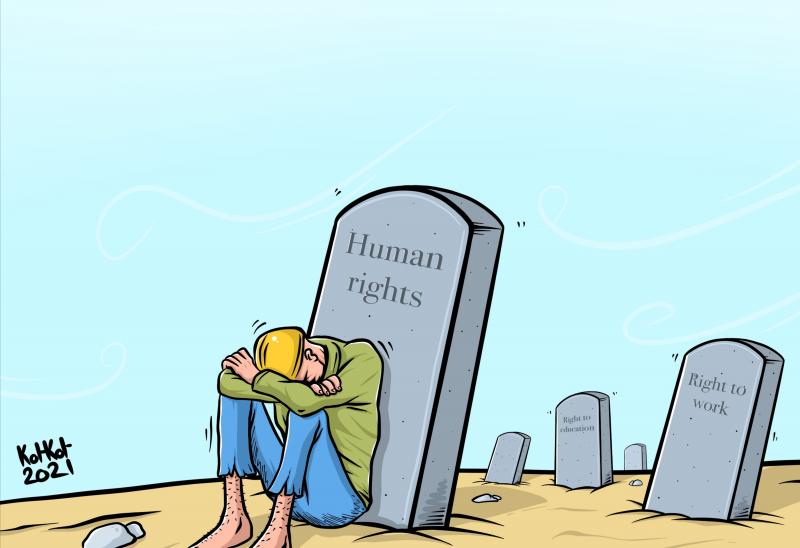
I beg your pardon, but there is no other way, it is heavy on my heart! Have patience and mercy!
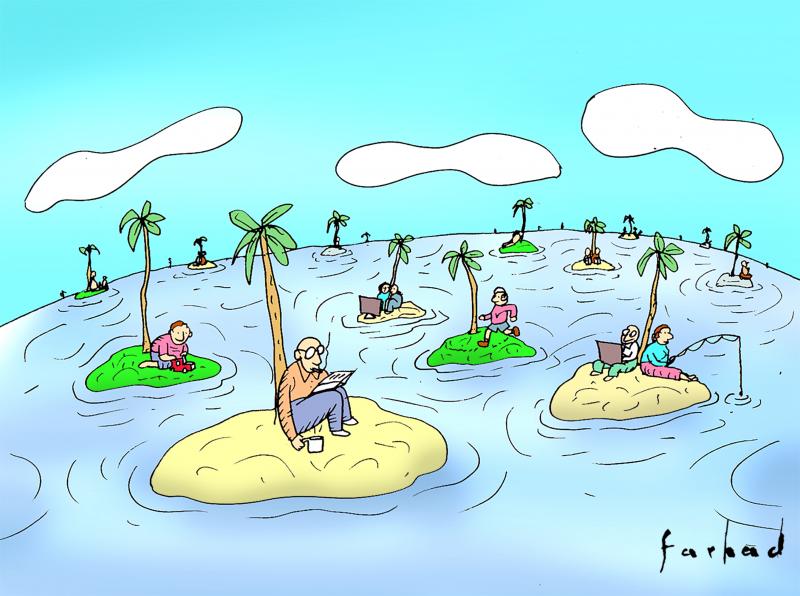
Oh yes! I’m still alive and back to being normal (at least I’m trying), and I’m still full of disappointment and disgust. I actually enjoyed these days being isolated; I think I can live in quarantine forever and ever. I am very content with my solitude. Anyway, naturally and as usual, I have my old professional curiosity, and looked all the time what do people do? And I keep wondering what’s going on with the free folk of the West. I run away from a dictatorial country with many hopes of finding the individual here in the West; some personality with own ideas and free from announcements from above. But what do I see; the mass, the majority! I learned in a dictatorship that democracy means to protect minorities. Otherwise, in Iran or Turkey or Russia or China, the majority always is the measure, and a minority have to shut up!
I was recently watching the news on German television, and suddenly I saw a report about #Canada, and I said; wow, finally we see something about #Canada. But WAF; the essay wanted to show how a few apostates (they have argued that most #Canadian people are vaccinated, so this small group is a small cheeky minority who must be taught the order.) make noises. The excellent police will soon all sweep away! You might imagine what I felt at that moment: I am not in Belarus or Azarbayjan or Iran? Or elsewhere, I am in Germany, with freedom of the press!?!”
Hundreds of Police Officers Are Armed With Wooden Batons To Deal With the Peaceful Protesters in Ottawa pic.twitter.com/RddXqrVFKa
Some of you might not notice what happens right now in #Canada; it is typical; what should we do with that? We live elsewhere in our beautiful country! Here is everything OK! But it is all about Democracy, not only for the #Canadians but for all of us.
Now, our saviours, heroes, chosen ones, and governments (in Germany) want to dedicate a little bit of freedom to us, albeit a little bit that we children don’t get cheeky. For example, I am recovered from the virus, and as a convalescent, I should only have freedom of movement for three months, they said. However, it came out that the parliamentarians have six months free! ( somehow, the free press had still little to say;) Well, they may be something special.?! In any case, when that came out, they accepted that it is not correct! And gave me, and the other like me, the same period of six months of free movement. Do you think that we should laugh at this shit game? Maybe we can, but the small bisinesses who have gone broke by these lockdowns can’t laugh.
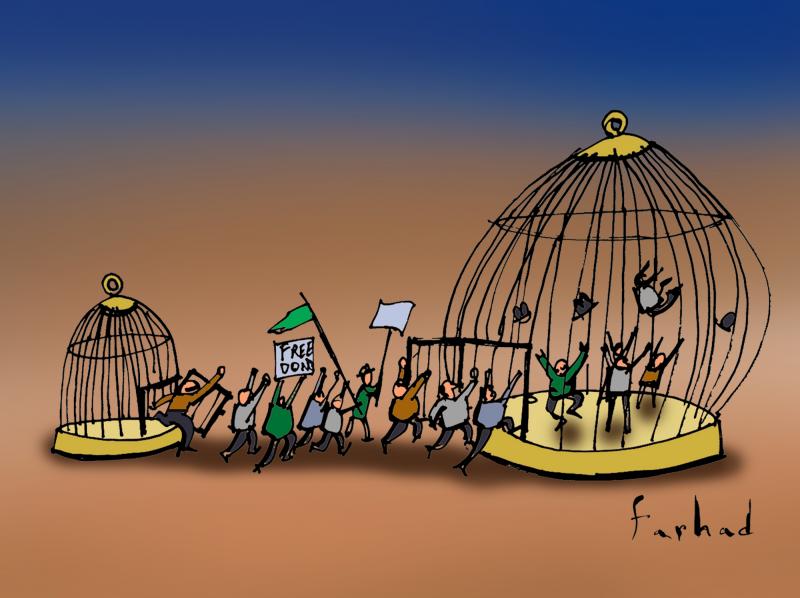
Farhad Foroutanian Go freedom go! One of the highest ideals in life is freedom, but sometimes people lose sight of this goal and end up only exchanging a smaller cage for a slightly larger one
Let’s be honest, if you’re at all interested in the freedom of the people in the World. You watch the reports on tv how in China or Myanmar or Russia or Belarus, human rights are being trampled underfoot, and everyone who resists it is being granted on praised in the west and bestowed with great prizes. But there is no talk about Iran? In Iran, the mullahs mercilessly drag every sixteen or seventeen-year-old child into prison, torture them and ignore the crying mothers out there in front of the prison walls? We don’t hear anything about it here in the western countries because it’s going great with bargaining and negotiation with Iran. The other countries are politically in favour to be in the critics, but the Mullahs aren’t that bad?! Never!!!
In truth, I’m fed up with the talk of Democracy. This is not the Democracy that I fought for all my life. Although, I don’t give up, as you see: No energy but still alive! I may have not so much time, but I can’t let it be; the blood which was shed for is much worth. We MUST think twice!
What I believe at the time, it is just laugh! Indeed:
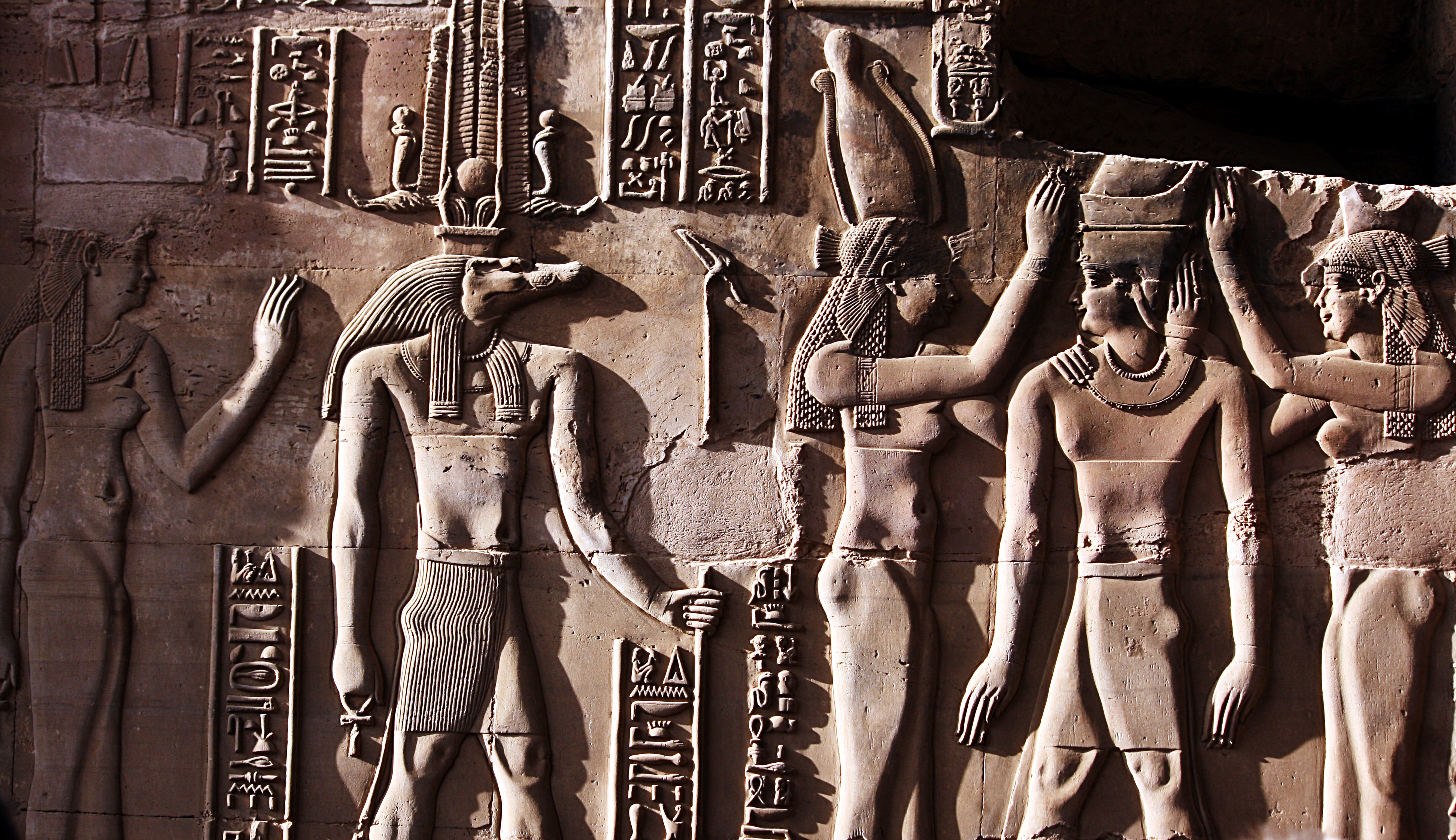
By Hedwig Storch This relief from the Temple of Kom Ombo shows Sobek with typical attributes of kingship, including a was-sceptre and royal kilt. The ankh in his hand represents his role as an Osirian healer, and his crown is a solar crown associated with one of the many forms of Ra.
Sobek (also called Sebek) was an ancient Egyptian deity with a complex and elastic history and nature. He is associated with the Nile crocodile or the West African crocodile and is represented either in its form or as a human with a crocodile head. Wikipedia
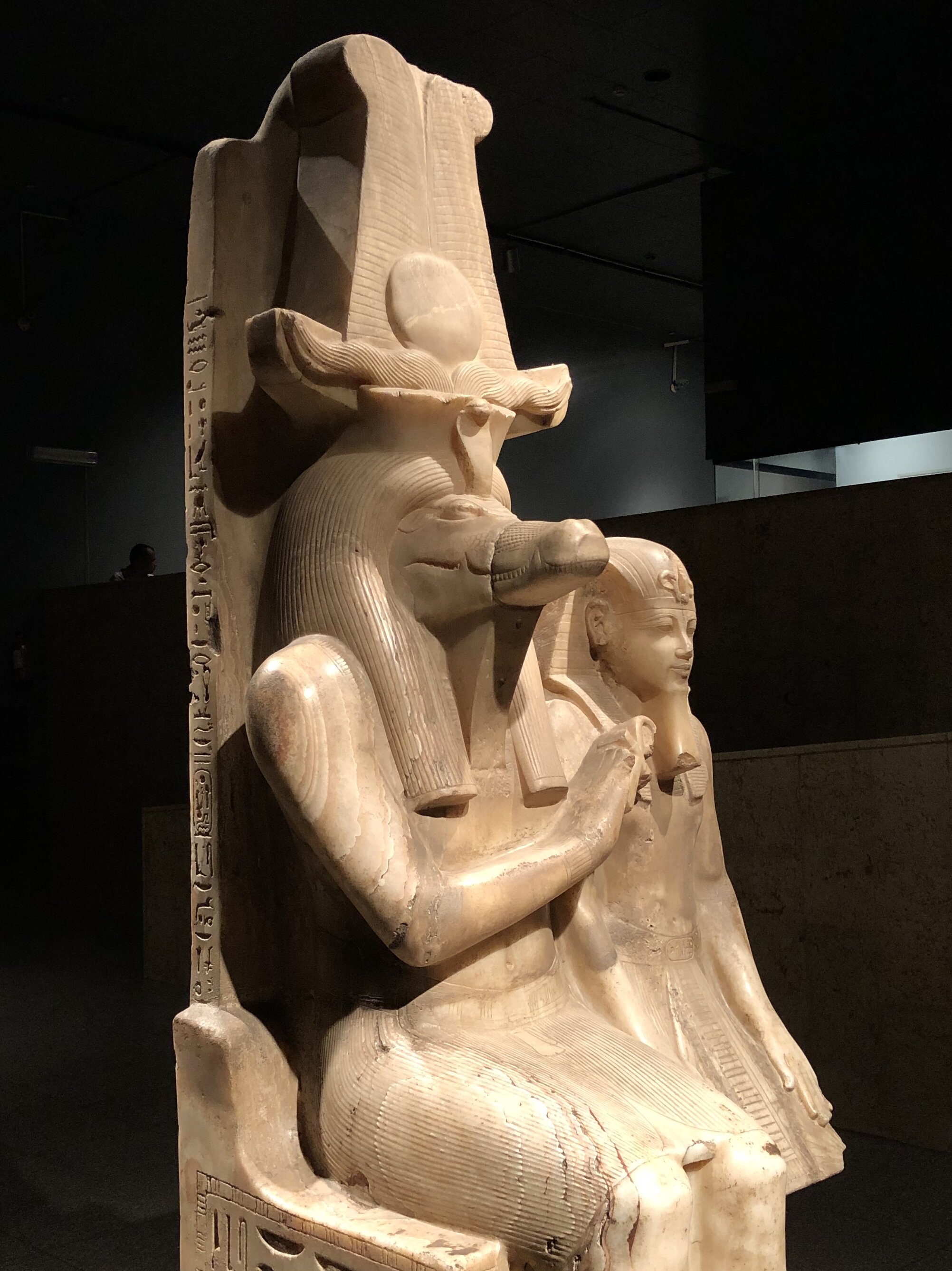
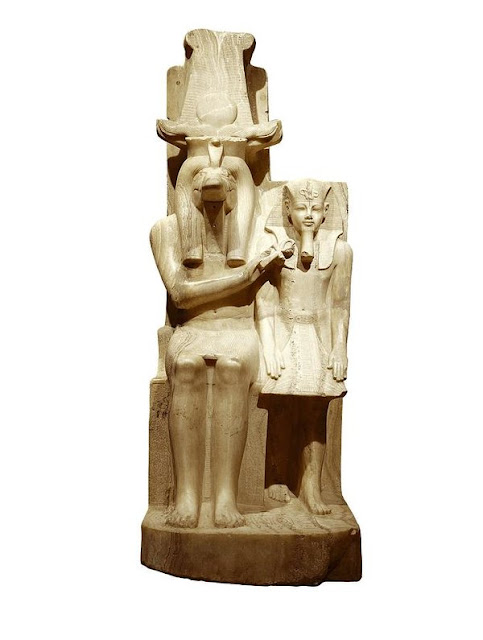
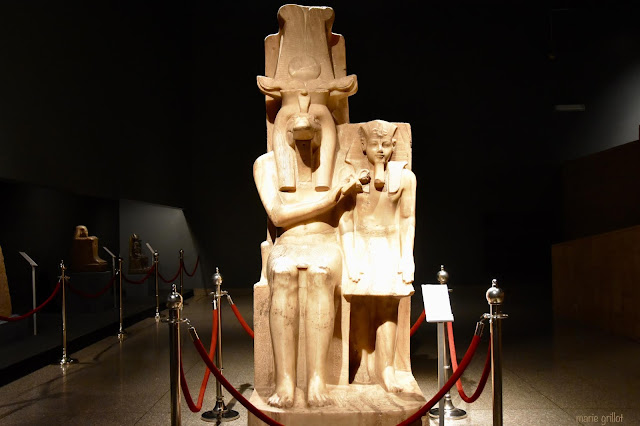
Amenhotep III and Sobek – calcite – 18th dynasty – statue discovered in 1966 (1967?) in the temple of the crocodile god Sobek-Ra, lord of Sumenu in Dahamsha Luxor Museum – Inventory number: Luxor J.155.
This incredible statue was discovered entirely by chance in 1966 by workers carrying out the earthworks of a canal in Al-Mahamid Qibly, fifteen kilometres south of Armant. The location turned out to be a temple dedicated to the “crocodile god Sobek-Ra, lord of Sumenu”. The excavations that were subsequently carried out brought to light “part of a paved courtyard, a door facing east, a large number of private stelae and votive statues dating from the reign of Amenhotep III; as well as an enigmatic chamber, filled with water, which turned out to contain this great dyad of Amenhotep III and Sobek-Ra, usurped by Ramesses II” (“Amenhotep III: Perspectives on His Reign”, David O’Connor, Eric H. Cline ).
Other sources place the discovery on July 27, 1967, in the temple of Sobek in Dahamsha, or trace its precise location in a slightly different way: “in a well-closed by a slab of sandstone. The slab was sliding on two bronze wheels” ( Ancient Egypt and Archeology Web Site).
The statuary group, 256.5 cm high, is carved from a single block of what is commonly called “alabaster”. But, in work cited as a reference, Agnès Cabrol quoting Professor Claude Traunecker, specifies that “we prefer the term ‘calcite’ to that more common ‘alabaster’ because it corresponds better to the nature of the material which is used in Egypt; calcium carbonate (not calcium sulphate, which is true alabaster)”. The block used here could come from the Hatnoub quarry in Middle Egypt.
Amenhotep III and Sobek – calcite – 18th dynasty – statue discovered in 1966 (1967?) in the temple of the crocodile god Sobek-Ra, lord of Sumenu in Dahamsha Luxor Museum – Inventory number: Luxor J.155.
As soft as luminous, its white colour is sublimated by the veins that cross the stone. Its texture and grain allow it to be polished to perfection, so “this luxury rock, prized by kings and gods, was used in architecture, statuary and funerary furniture”.
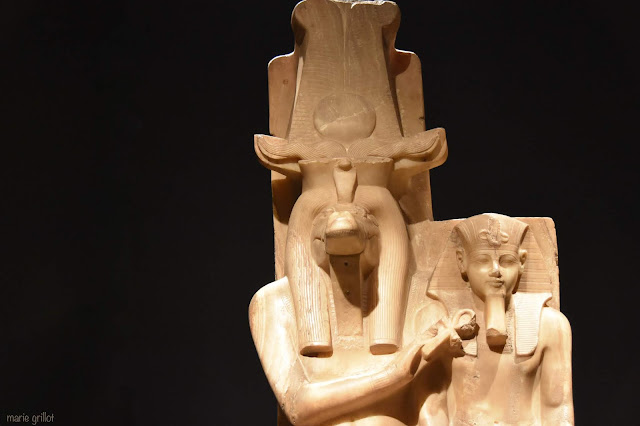
In this representation: “The iconography of the two figures is classic and traditional. The fearsome god Sobek is seated on the right, on a throne whose sides are covered with hieroglyphic inscriptions. He is represented in his usual anthropomorphic form, with a crocodile head”.
In her “Dictionary of Egyptian Mythology”, Isabelle Franco tells us that “Sobek (Soukhos)” was the “god of waters and fertility manifesting in a crocodile. He ended up being considered a primordial god, fighting the enemies of the divine order”; hence the importance of this “close image” with Pharaoh!
His tripartite wig, adorned with a central uraeus, is surmounted by a modius on which rests an Atef crown. It comprises horizontal ram horns, a sun disk and two tall feathers.
Amenhotep III and Sobek – calcite – 18th dynasty – statue discovered in 1966 (1967?) in the temple of the crocodile god Sobek-Ra, lord of Sumenu in Dahamsha Luxor Museum – Inventory number: Luxor J.155.
In “Ancient Egypt and its Gods”, Jean-Pierre Corteggiani reminds us that whatever Sobek looks like, “he may have no crown, or wear either a simple solar disk or one or the other of the divine hairstyles combining the usual elements which constitute these: one of the most frequent is formed of a mortar surmounted by the solar disk and two ostrich feathers – or two remiges – to which are often added a pair of ram’s horns (and sometimes two uraei that frame the whole)”.
He wears a necklace-usekh and a large bracelet. His body, well proportioned, is dressed in a simple loincloth, short and pleated. His legs are powerful, and his feet are bare.
His right arm is bent under his chest as his forearm is extended in the direction of the Pharaoh. The ankh cross he holds in his hand and carries towards him is meant to breathe life into him: “with the ankh symbol of life, he intends to ‘revive’ Amenhotep III”.
Amenhotep III and Sobek – calcite – 18th dynasty – statue discovered in 1966 (1967?) in the temple of the crocodile god Sobek-Ra, lord of Sumenu in Dahamsha Luxor Museum – Inventory number: Luxor J.155.
The Pharaoh, whose size is smaller, is represented young, in the attitude of walking. “The composition, the quality of the engraving and the surface of the stone make the portrait of the king ineffably soft, human and almost vulnerable compared to the monstrous reptilian”.
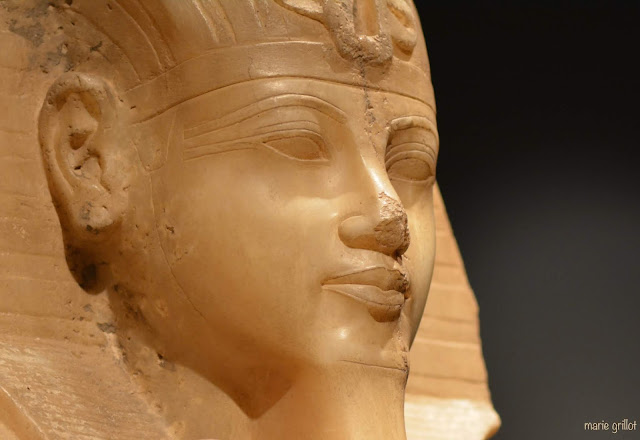
He is wearing the pleated nemes held on the forehead by a headband on which the protective frontal uraeus is fixed. “The alternating stripes of the nemes are left raw as if to hold gesso and gilding, perhaps in contrast to the other stripes of blue colour”.
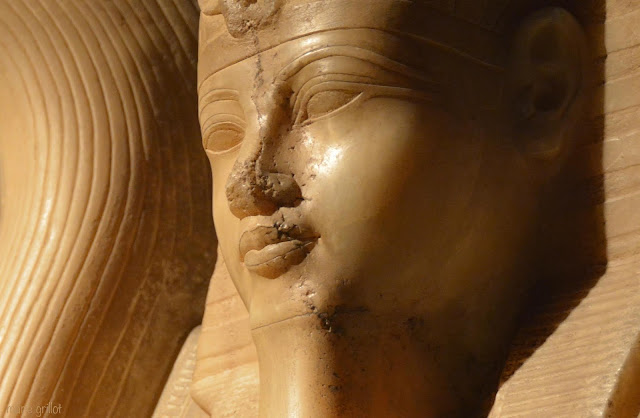
His face with full cheeks is of perfect symmetry. His almond-shaped eyes are elongated with a line of blush, flat and rectangular, the thin eyebrows which surmount them follow their exact shape.
Amenhotep III and Sobek – calcite – 18th dynasty – statue discovered in 1966 (1967?) in the temple of the crocodile god Sobek-Ra, lord of Sumenu in Dahamsha Luxor Museum – Inventory number: Luxor J.155.
The nose with delicate nostrils has suffered slightly. The mouth is sensual, with hemmed lips surrounded by a thin line accentuating its relief.
The chin is adorned with a fake beard, slightly flared, attached by an apparent jugular. His neck is adorned with a necklace-usekh.
The body of ideal stature is perfectly modelled. His arms are held along the body while the outstretched forearms rest on the short loincloth with the hands flat. The garment is owned by a wide belt with an under-umbilical buckle on which a cartouche is engraved.
It is that of Ramses II who usurped this statue and “made the name of Amenhotep III disappear from the front of the throne of Sobek, and added his own inscriptions on the base, on the king’s belt, on the right side of the throne and on the back and sides of the dorsal slab”…
Amenhotep III and Sobek – calcite – 18th dynasty – statue discovered in 1966 (1967?) in the temple of the crocodile god Sobek-Ra, lord of Sumenu in Dahamsha Luxor Museum – Inventory number: Luxor J.155.
This work is, without question, that of a highly gifted and talented sculptor: it is one of the most emblematic pieces of the Louqsor museum where it is exhibited under the inventory number: Louxor J.155.
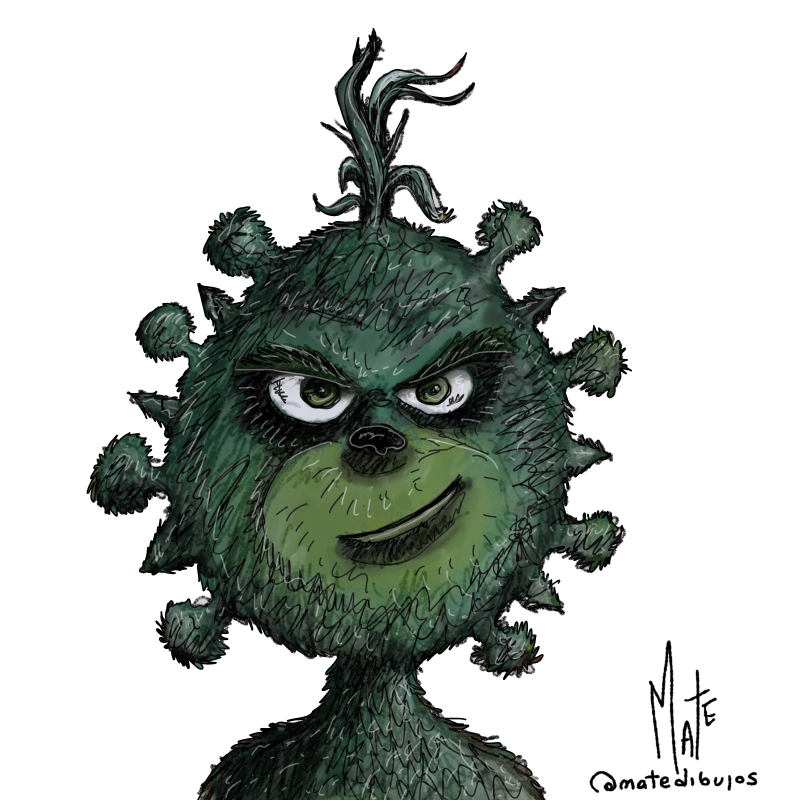
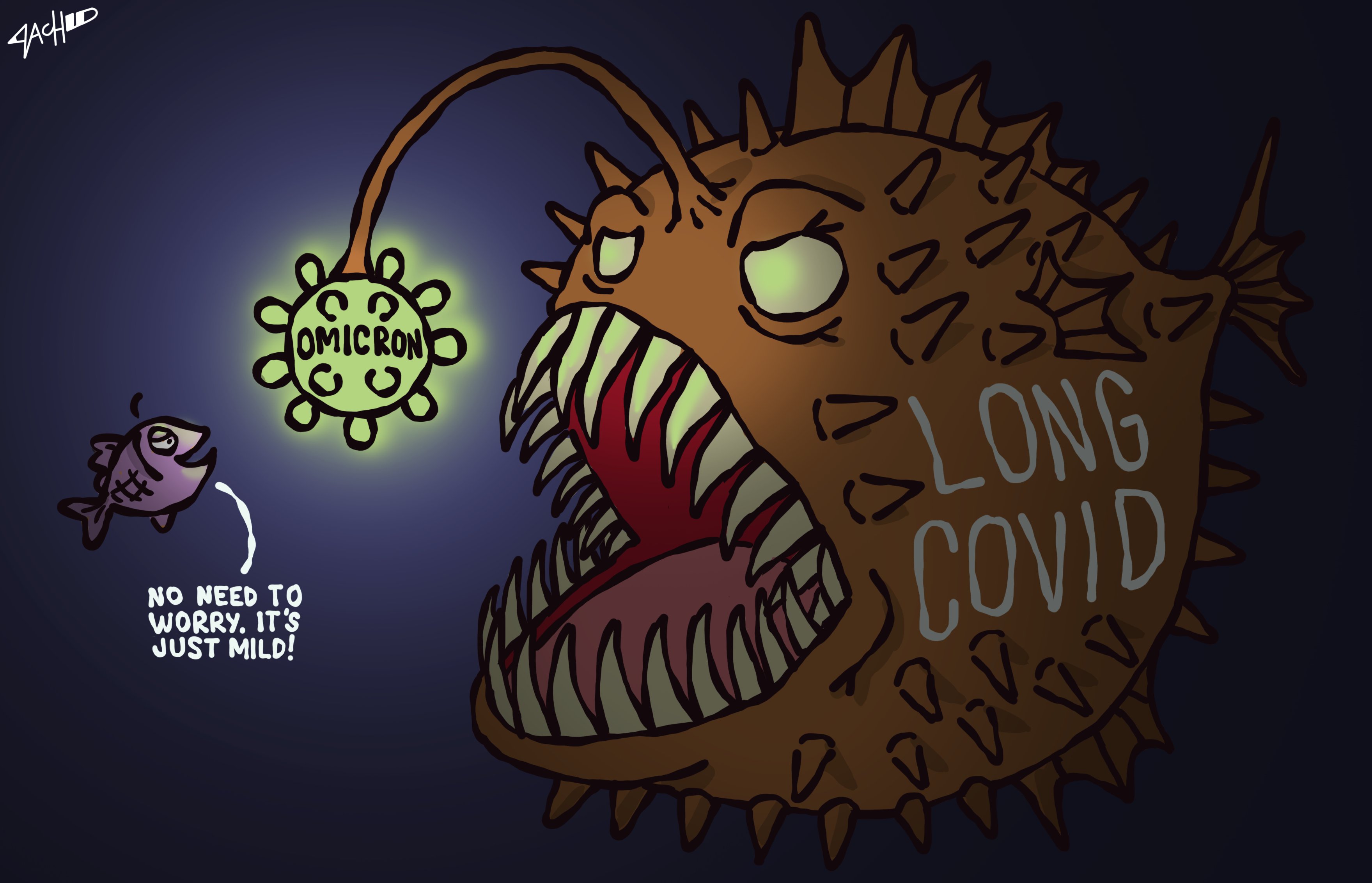
Hi friends! I wasn’t supposed to be here this weekend, but the omicron’s fast train overtook us, and now we’ll all be his! First, our son, Raphael, got it, and then it was our turn. On the other hand, I have heard my brother-in-law and his wife are infected, too, despite their vaccinations and boosters.
In any case, it seems that there is no escape, and we have to confront this beast. As the Master tells these good words:
You might ask how is it with me and Regina and how we feel; I would say as I write this post, I am totally exhausted and have some muscles and bones aching, and my wife feels weak, but otherwise, she doesn’t have much pain, maybe because I wasn’t a good boy and worked eleven hours on Thursday. Anyway, I can’t concentrate my thoughts on writing an article. This one is just a draft I tinkered, and now I’m done!
It seems that we will have a long way to get rid of this. I can only say that my feeling as an infected person is very similar to flu effects. What if we leave the fear and let all usually goes! Take care and stay strong, my dear friends. 💖🙏🤗🙏💖🌹
Stoicism. I have been practising this throughout my life, without knowing what it is! Oh yes, since my childhood, I have learned how to hide my feelings (pains) towards others and keep emotionless and not bother someone. Being logical was and still is my motto. And now, as I get to know Seneca and his Stoicism, I find it interesting to compare him with myself. Of course, there is a slight difference in between; I kept all my emotions only not to hurt others, but Seneca talks about self-love and that one should take care of oneself that I had never cared about myself.
Seneca’s words were so brief yet concise and rich in depth and meaning, albeit here I ask myself what he’d mean: if suffering is an image that doesn’t exist in reality? Or whatever is the definition of reality?!
The orator and philosopher Lucius Anne of Seneca (4 BC-65) is a unique case in the history of philosophy. His life works and death collide with each other creating a controversial personality of a philosopher. He was one of the wealthiest philosophers, as, despite being a Stoic, he acquired wealth (300 million interest-bearing loans in the provinces of Italy and the regions of the Roman Empire), taking advantage of his position in the court of Emperor Nero, of which he was a member. But Nero was not only his student but also his killer. In 65, he ordered the death of Seneca, at the same time giving him a choice to commit suicide, which the philosopher followed.
However, his writings are undoubtedly philosophical texts worthy of an orator who remained in history as one of the most important Stoic philosophers, between the emperor Marcus Aurelius and the enslaved person Acquired. His moral essay “On the Shortness of Life” (De Brevitate Vitae), a letter addressed to his father-in-law Paulinus, is one of his best-known works in which he rhetorically exhorts the reader of Nero’s time (but also of today). ) to evaluate his time: “Remember and think, whenever you had a specific plan in your life, how few days you spent as you had planned them, how many times you were really available for yourself when your face had its natural expression when your mind was restless, what work have you completed in such a long life, how many were the ones who took a part of your life when you did not yet know what you were missing, how much of your life you spent in pointless sorrow, in silly joy, in greedy desire, in conventional discussions and, finally, how little part of it you are left with yourself; and then you will understand that you are dying long before your time “. (Seneca, On the Shortness of Life, III) The most valuable thing one has is one’s time. Seneca places time before us and urges us to seize it before it is too late. Our time is our life. And yet, how many of us, from the time of Seneca until today, do not take it for granted? But, as we waste our time, we shorten our lives. This is an awareness that comes with ageing when it is too late. Why is this happening;
Seneca addresses all of us: “And what is the cause of this phenomenon? The reason is that you live as if you were going to live forever, without ever thinking about how fragile you are and without ever noticing how much time from your life has already been lost. “You waste your time as if you were drawing from a complete and abundant legacy, and all this when the day you give to a person or thing could be the last day of your life.” (III)
Memento Mori. Remember that you will die. The Stoic reminder of our mortality is the only one that offers the consciousness of life that we must live every day. Because every day is precious, not just the last. We understand life with death. “How late is it to start living only when our life necessarily ends!” (III)
People, arrogant towards time, think that they will live forever and wait for the days to pass, always planning for tomorrow or reminiscing about yesterday. But life is now.
By giving value to our time, we provide value to our lives. And it ceases to be short.
Writes Dr Elsa Nikolaidou teaches Philosophy at Med High School.
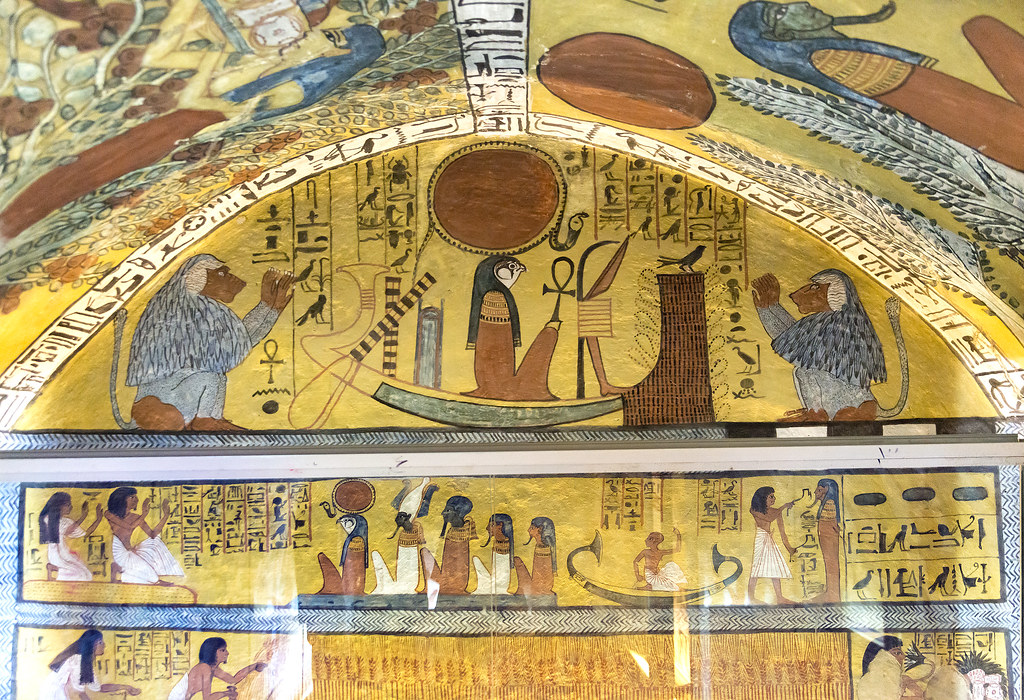
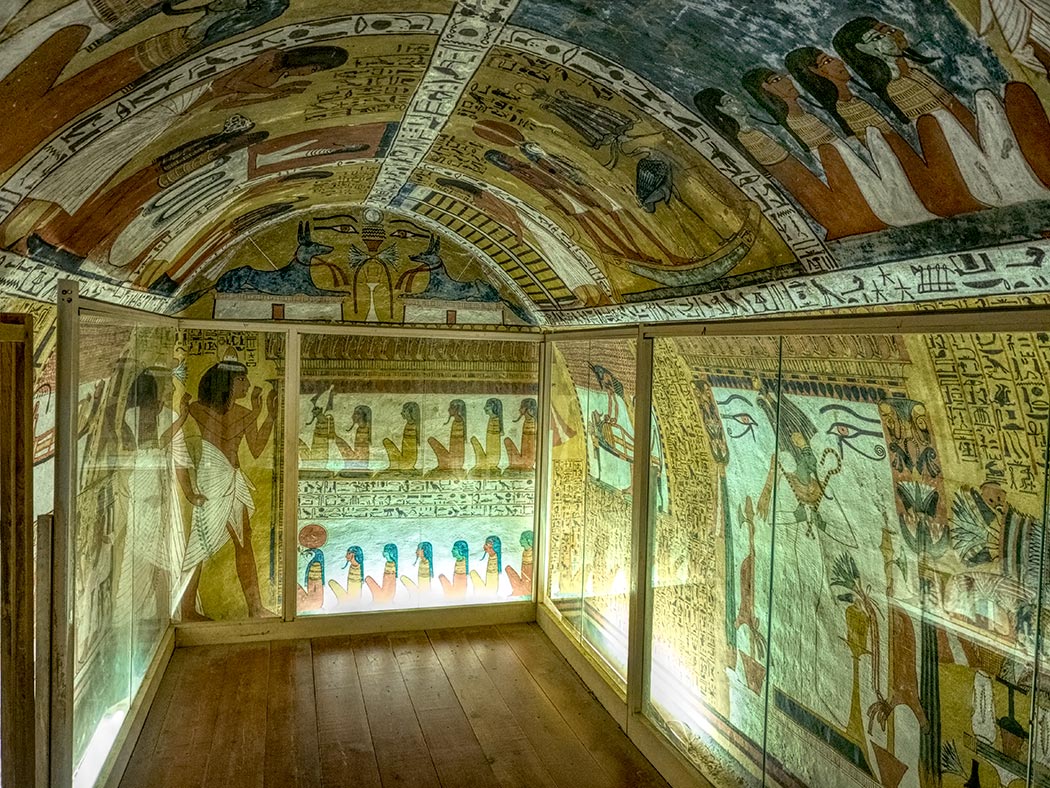
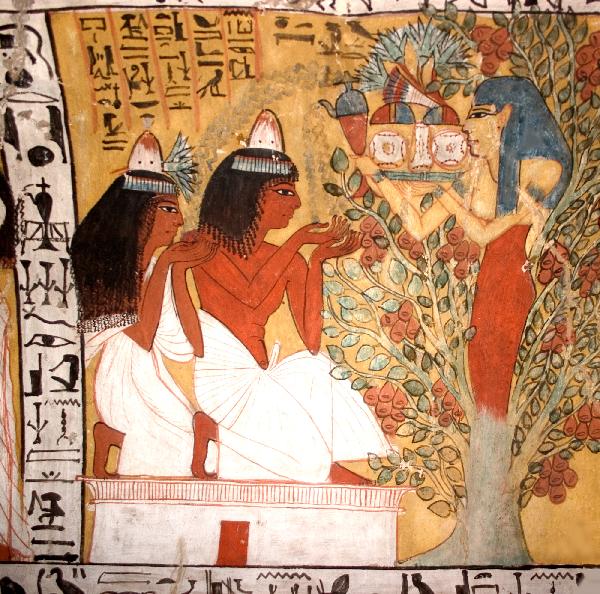
Fascinating! Isn’t it? The Tomb of Sennedjem is one of the most precious artworks ever in the history of mankind. There is not only to see this magnificent painting, but we read history and learn the wisdom of our past.
Sennedjem was an Ancient Egyptian artisan. Sennedjem lived in Set Maat (translated as “The Place of Truth”), contemporary Deir el-Medina, on the west bank of the Nile, opposite Thebes, during the reigns of Seti I and Ramesses II. Sennedjem had the title “Servant in the Place of Truth“. He was buried with his wife, Lyneferti, and his family in a Tomb in the village necropolis. His Tomb was discovered on January 31, 1886. When Sennedjem’s Tomb was found, there was traditional furniture from his home, including a stool and a bed, which he actually used when he was alive.
His titles included Servant in “the Place of Truth”, meaning that he worked on excavating and decorating the nearby royaltombs. Wikipedia
Sennedjem and his wife Lyneferti represented on the walls of their Tomb – TT 1- Deir el-Medineh. Discovered by Salam-Abou-Douy de Gournah and by the Service des Antiquités in January-February 1886 Dad and Me Love History
Sennedjem was, under the 19th dynasty, one of the servants of the “Set Maât her imenty Ouaset” (“the Place of Truth to the west of Thebes”). A mason by trade, he belonged to the community of craftsmen dedicated to digging and decorating the eternal dwellings of the Valley of the Kings and the Valley of the Queens.
His Tomb (TT 1) was discovered in January 1886 by “gournawis”. In “Hidden Treasures of Egypt”, Zahi Hawass recounts the circumstances as follows: “In 1886, Salam Abu Duhi, a villager from Gournah was awarded a concession in an area of Deir el-Medina close to his home. After only a few days of excavation, Salam and three of his friends made a spectacular discovery. At the bottom of a still new burial shaft, they found a wooden door whose ancient seals were intact. Salam immediately notified Maspero, who happened to be in Luxor for his annual inspection visit”.
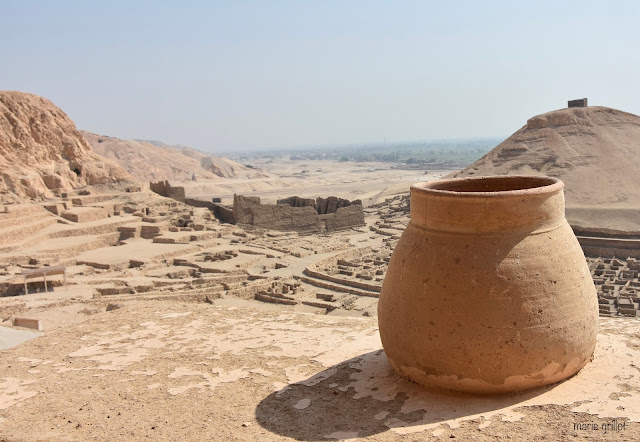
“Set Maât her imenty Ouaset” (“the Place of Truth west of Thebes”) Current view of the “craftsmen’s village”, today called Deir el-Medineh
La correspondance de Gaston Maspero à son épouse Louise (Gaston Maspero – Lettres d’Egypte) nous permet de revivre “à l’instant t” l’extraordinaire aventure … Ainsi écrit-il le 2 février 1886 : “On vient me chercher pour aller à la montagne : une tombe à laquelle nous travaillions depuis huit jours a été enfin ouverte. She is virgin ! It is a tomb of the 20th dynasty: the wooden door is still in place, and eleven mummies have already been counted. It’s a big find. I probably won’t have time to write before the mail boat leaves, because I don’t think we can be back before ten o’clock in the evening.”
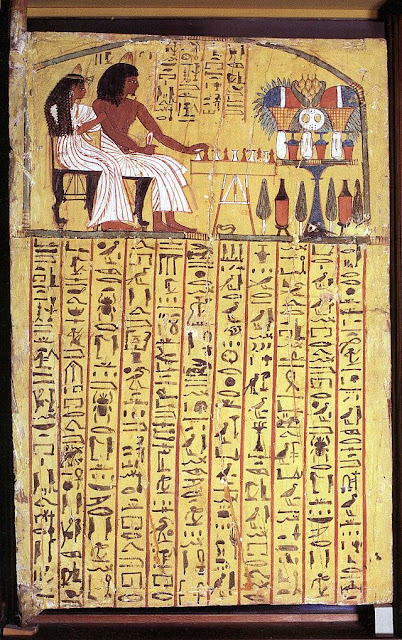
Door to the Tomb of Sennedjem – stuccoed and painted wood
From Deir el-Medina (TT 1)
Discovered by Salam-Abou-Douy de Gournah and by the Antiquities Service in January-February 1886
Diary of Entrances to the Egyptian Museum in Cairo – JE 27303
He continues his story on February 3: “The vault is about 5 m long by 3 wide. It is vaulted, with a shallow vault and painted in the brightest colours; unfortunately, the paintings and the texts are only extracted. It was filled to the top with coffins and objects: eight adult mummies, two-child mummies, a family of those cemetery priests I told you about in the letters I wrote from Turin in 1880 (?) The mummies are superb, in a beautiful red varnish with elegant representations, but they are only the least exciting part of the find. You know that the mummies were carried to the Tomb on sledges, held by men or drawn by oxen. Our Tomb contains two of these complete sledges: first the floor, with the rings intended to pass the sticks, when one wanted to carry, then the movable panels of the catafalque in which one locked the coffin, then the lid in cornice… and c This is how we will exhibit everything at the Boulaq Museum. Alongside this, the complete furniture: eight large canopic boxes, around forty small funerary statuette boxes, around a hundred charming limestone figurines, around twenty painted earthenware vases, a new bed different for the shape of the first two,… In addition, a beautiful armchair with canvas bottom imitating the tapestry; two stools with canvas bottom imitating red leather, a folding chair, bouquets of flowers, a cubit, an ostracon containing a very curious, although concise, historical novel. Insinger and Toda photographed the magnesium chamber and will photograph some of the objects”…
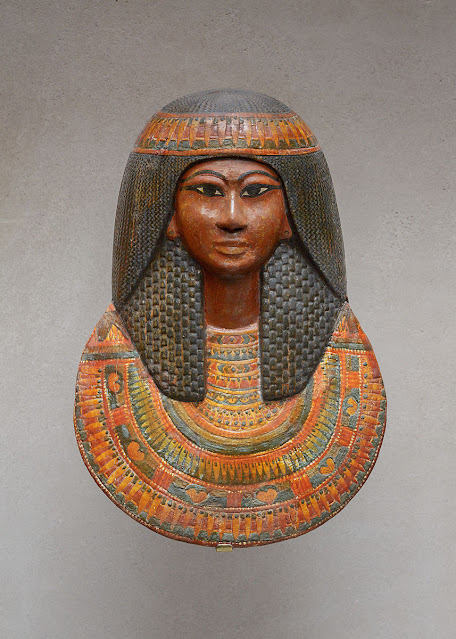
The mummy mask of Khonsu, son of Sennedjem
from the Tomb of Sennedjem – TT1 – Deir el-Medineh discovered in 1886
Exhibited at the Metropolitan Museum of Art New York – Accession Number: 86.1.4
Jan Herman Insinger is a Dutch banker who came to Luxor to benefit from a climate that could soothe his tuberculosis. He lives aboard his dahabieh “Meermin” (“The Mermaid”) and will soon have a somewhat “flashy” castle built on the banks of the Nile. Having become close to Maspero, he offers him, during his inspections, his services as a photographer.
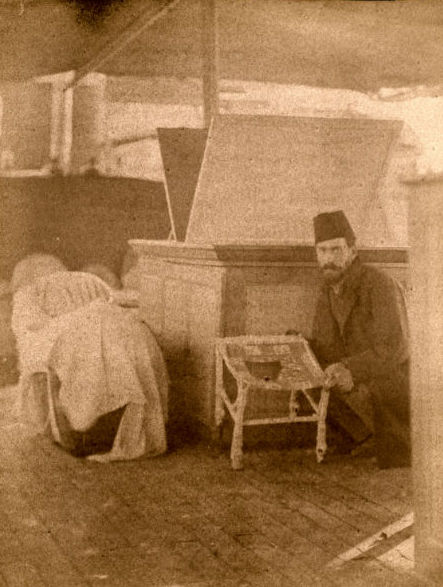
Eduard Toda, with objects from the Tomb of Sennedjem
on the boat “Boulaq” en route to Cairo (1886)
Toda Fund Library Víctor Balaguer Museum (Vilanova)
As for Eduard Toda i Güell, Consul General of Spain in Egypt from 1884 to 1886, a genuine friendship and trust bound him to Maspero, which led him to entrust him with significant responsibilities within the archaeological mission. This is how he was at his side during the event that we are reporting. Which is described by Jules Daressy as: “one of the most interesting events in the history of excavations in Egypt”. Better still, the diplomat-archaeologist was given, by the Director of Antiquities, called to another excavation site, the “immediate responsibility” for clearing the Tomb.
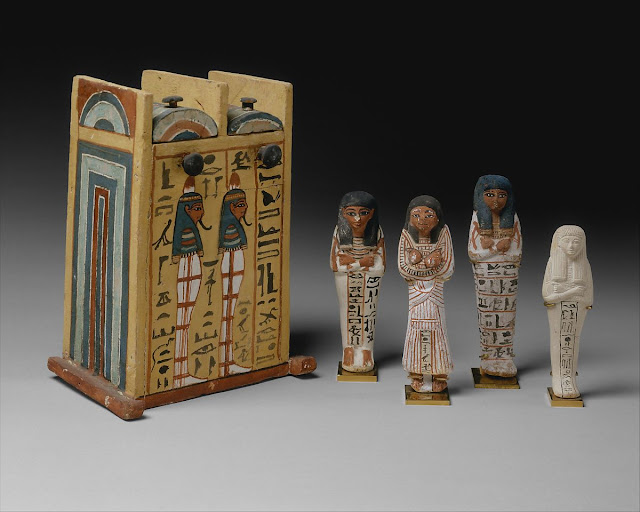
Box with ushabtis and ushabtis from the tomb of Sennedjem – TT1 – Deir el-Medineh discovered in 1886 Exhibited at the Metropolitan Museum of Art New York – Accession Number: 86.114
The “discoverers” were “compensated” according to the terms specified by Gaston Maspero: “It goes without saying that we bought from the fellahs the half that was theirs: it cost us 46 guineas, and it is suitable for the museum, the sale of the mummies and superfluous objects will bring us at least 60 guineas, perhaps eighty which will pass to the excavations of Luxor and the Sphinx. Therefore, it will have been a good business in every way, from a scientific point of view, since it gave us monuments of which we had no specimen. And good from a financial point of view, since not only will the objects end up costing us nothing! But that we will have earned enough money to carry out new excavations”.
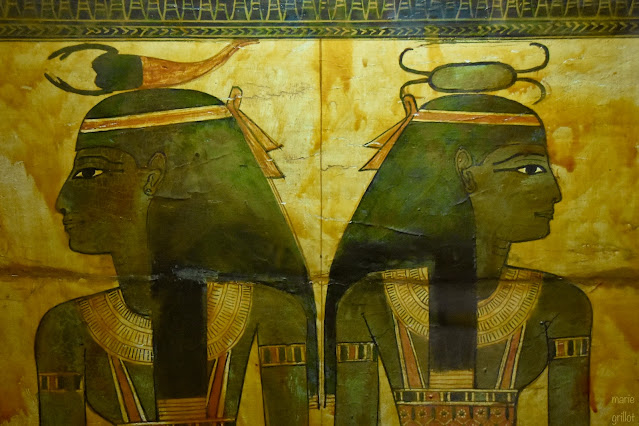
The Goddesses Selket and Neith depicted on the sarcophagus of Khonsu found in the Tomb of his father Sennedjem (TT 1) – Deir el-Medina discovered by Salam-Abou-Douy de Gournah and by the Service des Antiquités in January-February 1886 Cairo Museum Entry Diary – JE 27302
In the “Bulletin of the French Society of Egyptology” – 1988, Josep Padro reports: “In three days and with seven workers, (Toda) completely excavated the tomb and carried out the transfer of its contents onboard the ‘Boulaq’, the ship of the Antiquities Service. Once the transfer was complete, (he) drew up the inventory of the funerary furniture on the boat, with the objects collected and the mummies under his eyes. Toda also took 15 photos himself in the Tomb, with the technical assistance of Insinger, from which the plates illustrating his memoir were engraved, and he copied and translated the hieroglyphic texts with the help of Bouriant”.
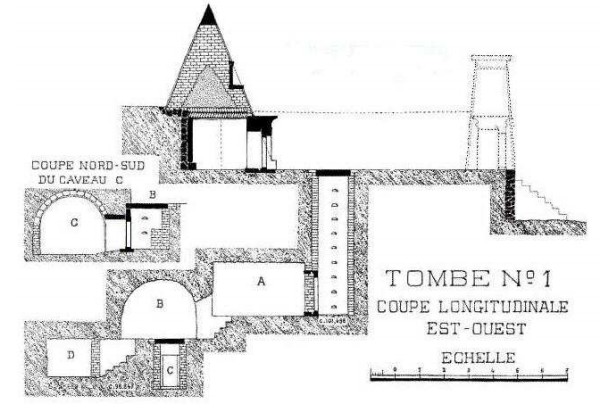
Plan of the tomb of Sennedjem by Bernard Bruyère – Deir el-Medineh (TT 1) Discovered by Salam-Abou-Douy de Gournah and by the Antiquities Service in January-February 1886
According to Bernard Bruyère: “Tomb No. 1 is not only one of the finest and best-preserved in Thebes; it is, moreover, a perfect, complete and typical example of a large family tomb comprising the four components regulars, the courtyard and the chapels accessible to the living, the well and the vault reserved for the dead”.
Sennedjem in adoration before the falcon-headed Horus, followed by two of Horus’ four sons, Amsit and Hapy scene from the tomb of Sennedjem (TT 1) – Deir el-Medina – discovered by Salam-Abou-Douy de Gournah and by the Service des Antiquités in January-February 1886 Flickr
I couldn’t gather my mind together as I tried to write my second post today. Although I have some subjects to work on, the pressure (you might remember what I’m talking about!?) confuses me. Therefore, I decided just to confabulate about the maze!
Yes! As I wrote about my social and political issues in the last months and expressed my position, it’s getting worse. Everything is so muddled up that I wonder who is who and what is what!
I don’t want to begin bitching again ( it looks like I’m going to do it!) But if you look at the happening worldwide, there are such unbelievable events. For example, in Germany, the brand new health minister does the same dung as his predecessor and says; We can’t control the Omicron, but we hold the circulation. However, the small business owners go bankrupt one by one. Although we see in England and Irland, the bans lifted slowly but surely, and Denmark goes along next.
I was always interested in getting the news from every corner and any source in the world. It has been a habit since my time working as a journalist. And even Harrison Ford is in the same opinion as me. He once said: <I read many different newspapers because they all report differently, then I make an overall picture of everything that happens.> Therefore, I see how the US government challenges putting mandates in different enterprises and their workers although in their neighbourhood; Canada, the Convoy of Freedom, is rolling on; however, we see and hear nothing in the popular news!
Meet the truckers: The men and women of the Freedom Convoy 2022 msn.com
The Canadian prime minister, Justin Trudeau, once said that the unvaccinated people are Nazis! Now we can watch these people marching peacefully and mixed up two times vaccinated, unvaccinated, and even with boosters all there! Oh yeah, freedom has no categories.
I think that the Prime Minister has exceeded its limit. Here in Germany, we have a political party inclined to the rights; (Neo Nazist) named AFD. They abused the protests of unvaccinated for their profits. But there is a difference, and thank goodness, the German government knows to put a discrepancy in between. They just advise the good protesters to distance themselves from the wrong people!
I know it could be easier to accept all things coming from above, close your eyes, and enjoy the “nice” life. But it is apparently hard for me to do it. Let’s look forward to what will happen next. Freedom also needs patience, as I have learned it my whole life.
Here is an excellent article thereabout. Have a lovely weekend, everybody. 💖
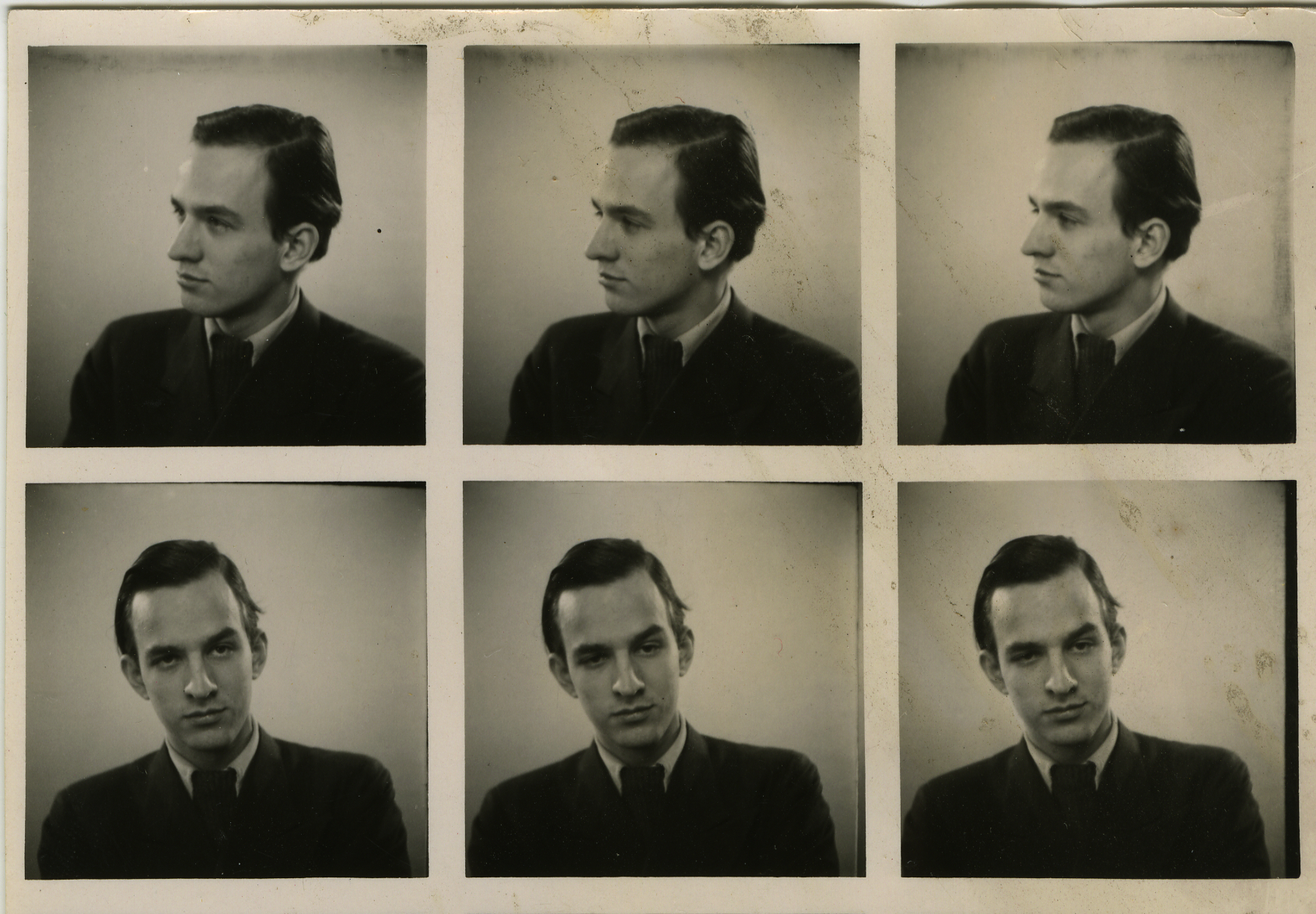
Today, I would like to look back again at one of my favourite artists and filmmakers, Ingmar Bergman. With the help of an excellent article from the site: About Bergman. On this well-done site, we can find everything we want to know!
I have always become stunned by how Bergman began his movies. I think he had permanently tried to dig inside the soul of humans, ours, to reflect.
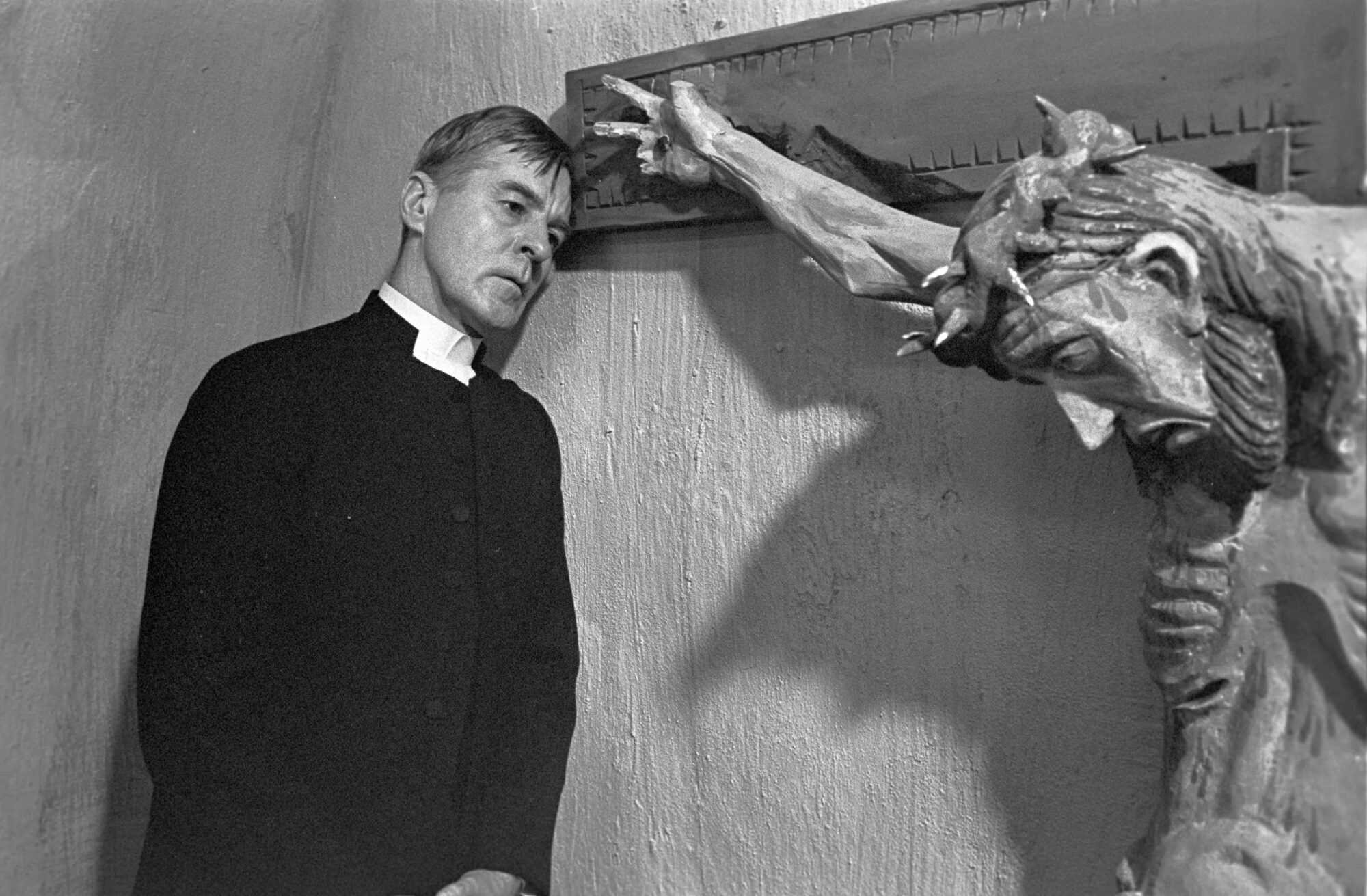
For example, in his movie; Winter Light from 1962, it begins so: In the final moments of Pastor Tomas Ericsson’s noon service, only a handful of people are in attendance, including fisherman Jonas Persson and his pregnant wife Karin, and Tomas’s ex-mistress, the atheist Märta. After the service, though coming down with a cold, Tomas prepares for his three o’clock service in another town. Before he leaves, however, the Perssons arrive to speak to him. Jonas has become morose after hearing that China is developing an Atomic bomb, and the children are starving!
PS: Sorry, it is only possible to watch it on YouTube, though it is worth seeing it. 🙏
Or in the movie: “Through a Glass Darkly“, the scene begins with a happy, playful family who celebrates in the garden, and suddenly one (the father) goes into the house, gets into the sitting room and weeps terribly.
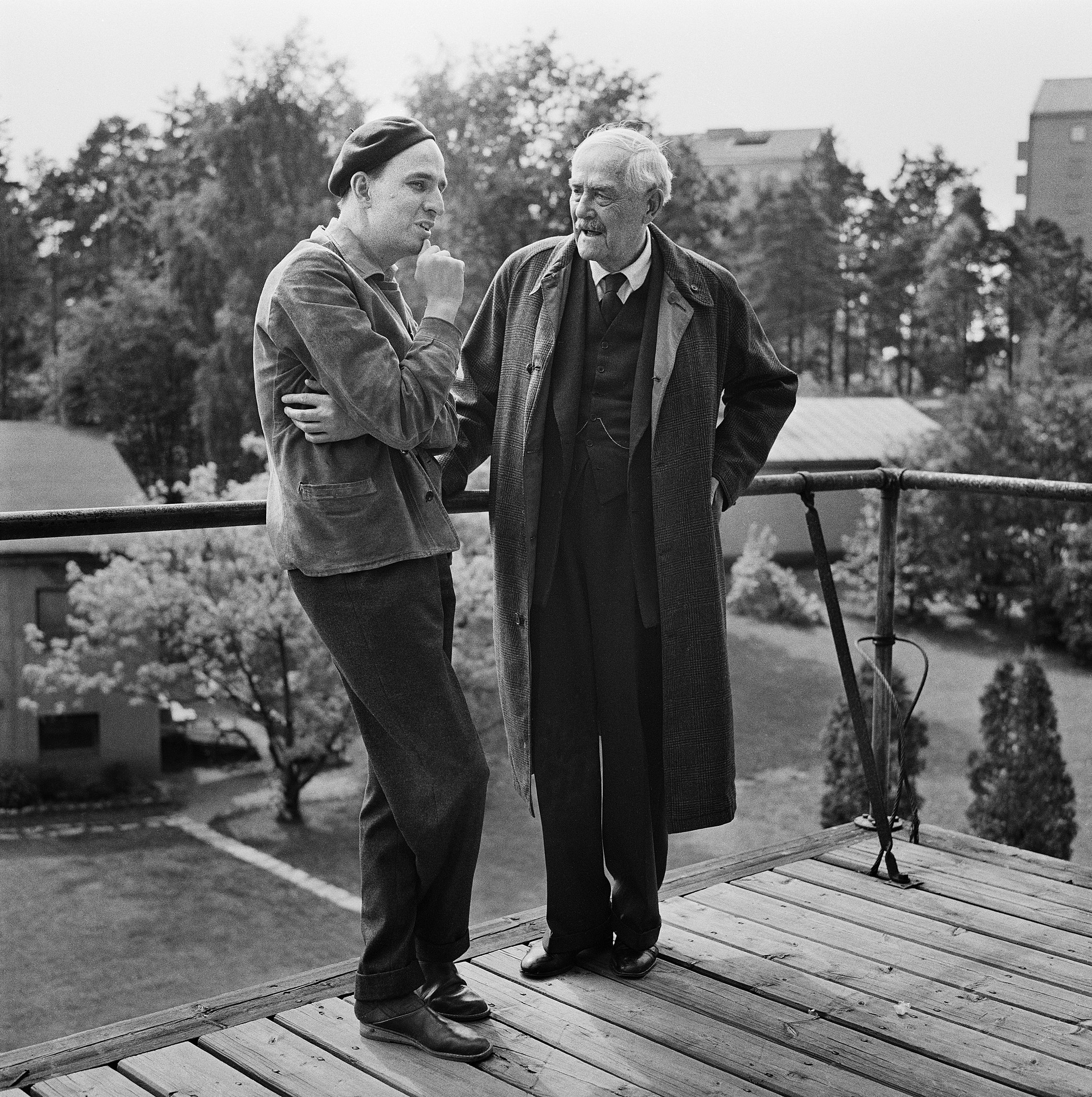
His other work and in my opinion; one of his masterworks, Wild Strawberries, it begins with a dream of an aged professor (played by Victor Sjöström, one of the pioneers in cinema) who has a lot of corners and edges in his life to confront with. Interestingly, when the great artists share their memories in their works, they mostly are well accomplished—for example, Woody Allen’s Radio Days or Federico Fellini’s Amarcord.
Please let me once again share this fascinating dream scene with an excellent narration about this dream. PS(2): My efforts to find some scenes to share it seem only this way; watching on YouTube! Thanks for your understanding. 🙏😁
Following the books, the movies have significantly influenced my life. Of course, I am talking about the good ones! They have taught me much and expanded my view of life towards the world. And Ingmar Bergman is one of them. Here is a part of the article about his life. Thank you for being here. 🙏💖🙏
Ernst Ingmar Bergman, born on the 14th of July, 1918 in Uppsala, died on the 30th of July, 2007 on Fårö, was a Swedish film and theatre director, writer, theatre manager dramatist and author. Ingmar Bergman wrote or directed more than 60 films and 170 theatrical productions and authored over a hundred books and articles. Among his best-known works are the films The Seventh Seal, Wild Strawberries and Persona, as well as his autobiography The Magic Lantern.
Shakespeare, Molière, Ibsen, and Strindberg were all enormously essential influences on Bergman, not only in his theatrical work but indeed the entirety of his artistic career.
Bergman’s films are set almost exclusively in Sweden, and starting with 1961’s Through a Glass Darkly, they were filmed primarily on the small island of Fårö, northeast of Gotland. The international reception of Bergman’s films reflects a not inconsiderable fascination with a Scandinavian exoticism: inscrutable language, primaeval nature and flaxen-haired women. In Bergman’s films, the depiction of nudity and “natural” sexuality contributed to their success.
Looking over Bergman’s career, another hallmark of his work for stage and film is the recurrent company of loyal collaborators. Some notable examples from this ensemble include the cinematographer Sven Nykvist, the actors: Max von Sydow, Liv Ullmann and Bibi Andersson, and the costume designer Mago.
The relationship between the artist’s life and works (despite the tendency of biographical analyses to fall victim to the cult of genius) is in the case of Ingmar Bergman as inextricably tangled as it is compelling. In countless interviews and artistic representations, and especially in The Magic Lantern, Bergman repeatedly referred to his childhood and its importance for his artistic vision. A number of his relatives were also creative colleagues. Here


























 lampmagician


You must be logged in to post a comment.