Alessandro Ricci, A Master of Imitation Divine

Standard

A silent artist! Alessandro Ricci was a master of imitation of divinity like the craftsmen artisans, even though he had an inner connection to the Gods and Goddesses of Egypt to paint them. Although, he didn’t care to make himself as famous as he had earned.

Because of his unconcern, we find all of his works under the names of Belzoni, Ricci!

Anyway, here is another marvellous work of Marie Grillot to read. 🙏💖🙏

Alessandro Ricci, Doctor-Draughtsman, from Belzoni to Séthi, Bankes to Champollion…

https://egyptophile.blogspot.com/2020/03/alessandro-ricci-medecin-dessinateur-de.html

via; https://egyptophile.blogspot.com/

Giovanni Belzoni / Alessandro Ricci Seti I before Isis and Anubis, c. 1821
© Bristol Culture: Bristol Museums and Art Gallery

In July 1827, the outline of the Franco-Tuscan expedition to Egypt took shape. This project will receive the consent of King Charles X and the Grand Duke of Tuscany, with the well-defined missions of visiting the monuments of ancient Egypt and buying objects for the royal collections.

Around Jean-François Champollion and Ippolito Rosellini are grouped: “scholars and technicians both French and Italian”. This is how the French team brings together Antoine Bibent, architect; Nestor L’Hôte, Alexandre Duchesne, Pierre Lehoux, Edouard Bertin fils, designers and painters as well as Charles Lenormant, inspector of fine arts.

it is made up of the Tuscan team as follows: the designer Salvador Cherubini, the naturalist Raddi and his trainer Galastri, and the painter Angelelli… And a doctor – draftsman: Alessandro Ricci.

The members of the Franco-Tuscan Expedition gathered around Jean-François Champollion
and Ippolito Rosellini in the ruins of Thebes
Painting by Giuseppe Angelilli (Archaeological Museum of Florence)
Alessandro Ricci is represented on the left, in profile and from behind

The presence of Alessandro Ricci, “born in Siena of a Florentine father,” a stonemason, is a real blessing for the expedition! Indeed: “apart from his medical profession, Ricci possessed a remarkable quality as a draughtsman, archaeologist and writer; he also had the adventurous ingenuity and the desire for new things which led him to travel”.

His date of birth remains uncertain; if 1795 maybe sometimes announced. This can in no way agree with certain writings presenting him as the expedition veteran “with his forty-five years”; it should be remembered that Jean-François Champollion had “37 and his collaborators, on average, 10 less”.

If he is probably one of the oldest, he is undoubtedly one of those who knows Egypt the best, having travelled through it several times. “Doctor Ricci, an old regular in the country, who thought of the necessary, made all the essential provisions for our trip to Upper Egypt”, relates Jean-François Champollion.

Alessandro Ricci seems to have arrived in Egypt in 1817. After a year devoted exclusively to practising medicine – which he had studied in Siena – he was contacted by Giovanni Battista Belzoni, but this time for his talents as an artist.

A priest, Seti with Ptah-Sokaris, Seti with Geb and a representation of the soul of Nekhen
Watercolor of the tomb of Seti I by Alessandro Ricci for Giovanni Belzoni
(© Bristol City Museum & Art Galleries).

Indeed, on October 18, 1817, the Giant of Padua discovered the tomb of Seti I and wished to make a complete statement to publish the plates and drawings and organise an exhibition in London. “I had engaged Signor Ricci, a young man from Italy, very skilled in drawing, and who, with a little practice, became perfect in his imitations of hieroglyphs. He was to begin the drawings of the tomb on his arrival in Thebes .”

Illustration representing the exhibition on the tomb of Seti I,
organised by Giovanni Belzoni, inaugurated in London on May 1, 1821
GEO 005

Thus: “from February to March, Ricci worked alone in the tomb to copy as many reliefs as possible. On May 10, Belzoni found him in the Valley of the Kings. He was amazed by the work carried out by this artistic doctor, decidedly very talented: most of the large mural paintings of the tomb of Apis (ed.: this was the name then given to KV 17 because its “owner” had not yet been identified) had already been copied, and he was waiting for Giambattista and his cargo of beeswax to take the impressions of all the bas-reliefs. Both camping in this hypogeum, they devoted the whole summer of 1818 to this exhausting task”.

The result was admirable, but it required a lot of skill and patience: “The most challenging thing was to take impressions of the figures without damaging the colours with which they were coated. In counting the life-size figures, I found all one hundred and eighty-two. As for the figures from one to three feet high, I have not counted them, but there could hardly have been less than eight hundred. There were in this tomb about two thousand figures. Hieroglyphics, whose size varied from one to six inches; I copied them all faithfully, with their colours.

It seems that this work is finally finished, the taste for adventure embraces them again… Thus: “After carefully storing drawings and wax prints at the bottom of the tomb, closing the entrance to it with a solid wooden door and left behind a trusted guard, Belzoni and Ricci loaded a boat full of antiquities, which they sent to Cairo. an expedition in the deserts bordering the Red Sea, in search of the ancient city of Berenike…”

Personalities who “counted” in the “Egyptian” life of Alessandro Ricci:
Giovanni Belzoni, Henry Salt, Sir William John Bankes, Jean-Francois Champollion

At the end of 1818, Ricci was contacted by Sir William John Bankes. As brilliant as he was eccentric, this English aristocrat made a study trip to Egypt with his secretary, Henri William Beechey. The British consul Henry Salt brings him his precious support and presence: “Going up the Nile with the English consul and Baron Sack, (a learned Prussian naturalist and chamberlain to King Frederick-William II, Bankes), was preparing to continue his survey work until ‘ in Nubia. He had hired Doctor Ricci and the young Frenchman Linant de Bellefonds as designers.”

Thus, the draftsmen identify all the monuments leaving invaluable testimonies, constituting data of capital importance for Egyptology. Not only are their drawings beautiful and of high artistic quality, but they are exceptionally well “informed”. They provide precise information on the state of the monuments, their orientation, and their dimensions.

Among their sheets, there are also a large number of epigraphic records… In 1822, Ricci will be – like Linant de Bellefonds -asked for a new “expedition” of the aristocrat who wishes, this time, to join Dongola, enter Meroe, and why not, go in search of the sources of the Nile…

Alessandro Ricci, who had had the good fortune to “save Ibrahim-Pasha (son of Pasha Mohammad-Ali) from dysentery”, returned to Italy as a rich man. He settled in Florence and exhibited his collection of Egyptian antiquities in his home… This is how Champollion met him and asked him for the Franco-Tuscan expedition. In 1829, a scorpion sting forced him to interrupt his work…

“This injury later led to paralysis and dementia.” Alessandro Ricci died in Florence on January 11, 1834.

Portrait of Alessandro Ricci in the painting by Giuseppe Angelilli (Archaeological Museum of Florence)
representing the members of the Franco-Tuscan Expedition
Portrait of Pharaoh Seti I in his tomb in the Valley of the Kings, reproduced by Alessandro Ricci

After the story of such a remarkable life, in the face of so much experience, skills, and adventures, one cannot help but wonder why “signor Ricci” has remained so little known… He did not sign his drawings so well that they have sometimes been attributed to Belzoni…. In contrast, even without having a trained eye when comparing the drawings of the tomb of Seti, one quickly distinguishes those of Belzoni from those due to the immense talent of Ricci… Did he prefer discretion? Did he want to stay in the shadows? The fact that on Angelelli’s painting representing the members of the Franco-Tuscan expedition, he is on the left, in profile and… from behind, is perhaps part of the answer.

Marie Grillot

Sources:

Travels in Egypt and Nubia, G. Belzoni
The harvest of the gods – The great adventure of Egyptology, Jean-Jacques Fiechter http://Letters of Champollion the Younger collected and annotated by H. Hartleben Volume 1, Letters are written from Italy, Paris, Ernest Leroux Publisher, 1909

Pharaoh: Reborn Exhibition in Bristol (Considerations on Belzoni and Ricci)

“Ricci, Alessandro” (astene)
“Ricci, Alessandro”, by Federico Tognoni
ancient-Egypt. co

A Treasure House of Egyptology. The Catalogue of William John Bankes’ Egyptian Portfolio A Treasure House of Egyptology. The Catalogue of William John Bankes’ Egyptian Portfolio  (1815-1822)

Viaggi del dottore Alessandro Ricci di Siena fatti negli anni 1818, 1819, 1820, 1821, 1822 in Nubia, al Tempio di Giove Ammone, al Monte Sinai, e al Sennar“, Edizione critica e commento”The great Belzoni“, by John H Taylor
Travellers in Egypt, Paul Starkey, Janet Starkey, I.B.Tauris “William John Bankes (1786-1855) – Egyptologist and friend of Lord Byron“, by Rachel Knowles

William John Bankes’ collection of drawings and manuscripts relating to ancient Nubia

The History of Parliament: the House of Commons 1820-1832, ed. D.R. Fisher, 2009
. Fisher, 2009

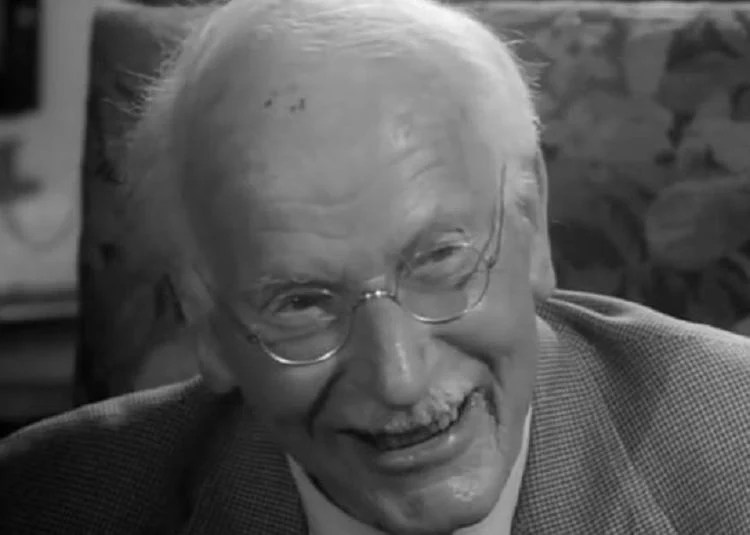
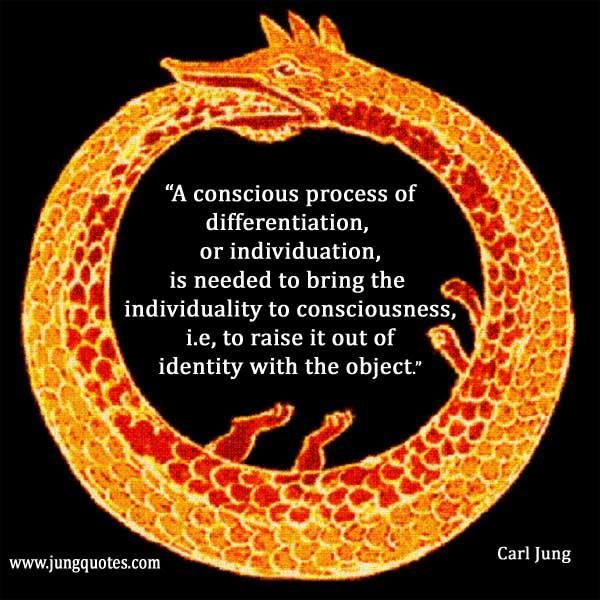
“In all chaos, there is a cosmos; in all disorder, a secret order!” Carl Gustav Jung

Standard

Just a comeback announcement, if one of you dears has ever noticed my absence, you can now compare me with this cartoon!? We arrived yesterday evening, and until now, I am trying to gather my thoughts to find out where I am! Oh yes, belong to the Earth but all over a foreigner. Anyway, with a heartfelt hello, I share my littleness with some help from Master Dr Jung.:

The unconscious is not a demonic monster but a morally, aesthetically and intellectually indifferent natural being. It only becomes hazardous when our conscious attitude towards it is hopelessly wrong. To the extent that we repress, the dangerousness of the unconscious increases. But at the moment when the patient begins to assimilate the unconscious contents, the dangerousness of the unconscious also decreases. The personality dissociation, the anxious separation of day and night, ends with progressive assimilation. What my critic fears, namely the overpowering of consciousness by the unconscious, is most likely to occur when the unconscious is prevented from living through repression, wrong interpretation and devaluation. C.G.Jung

Die praktische Verwendbarkeit der Traumanalyse (1931)

from “Traum und Traumdeutung”

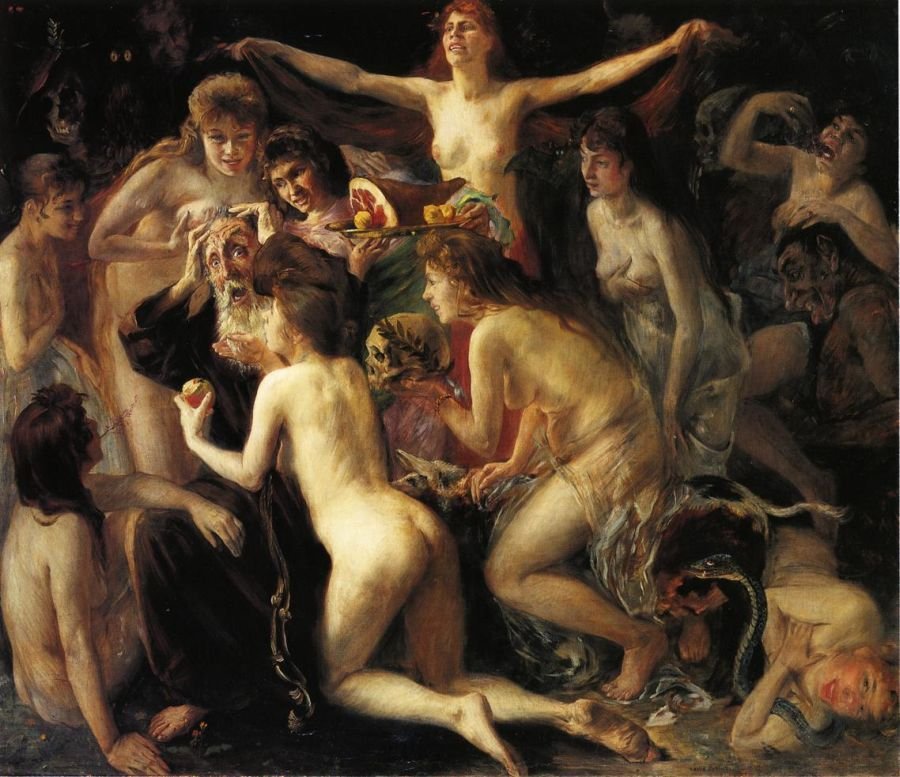
Image: Art Gallery of Ontario.

Mephistopheles fly over the city; from Goethe’s Faust

Have a lovely WE, everybody. Have a great and wonderful Easter fiesta until we meet again… 💖🙏💖🙏🤗

Externsteine. A Striking Rock Formation in the Teutoburg Forest.

Standard

The Externsteine are a striking sandstone rock formation in the Teutoburg Forest (Teutoburger Wald) and, as such, an outstanding natural attraction in Germany, which is a protected natural and cultural monument. The Wiembecketeich and a park-like area surround the rocks. The Externsteine are located in the area near the town of Horn-Bad Meinberg in the district of Lippe in North Rhine-Westphalia. Unique cultural and historical significance is ascribed to them.

Last Sunday, we took a tour to see these giant stones. Nature constantly shows her superiority again. And we went there to share in this fascination.

Around 70 to 100 million years old, this natural monument still puzzles scientists today and is considered the Teutoburg Forest’s giant magnet for visitors. The name “Externsteine” probably comes from the magpies (Elstern, in German), as many of these birds used to be found here.

It might be a landing place for the Goddesses and Gods of Olymp to take a rest?! Nobody knows.

The relief measures 4.8 m high by 3.7 m wide.

Interestingly, this relief is not a stone engraving but made of other materials and set on stone. It is for sure that Christianity wanted to participate in this magnificent Nature formation. Rumours are saying that the legs have been taken away to show the suffering of the act. However, let’s read the description:

“It is divided into three parts or registers. The largest central register shows the Descent from the Cross scene itself. At the centre is the cross; to the right is a figure identified as Nicodemus. The legs of this figure have been lost since at least the 17th century, but it is shown at an elevated position, aiding in the recovery of Jesus’ body from the cross. The figure was standing on a supporting structure (identified either as a plant bent by Nicodemus’ weight or as a chair). Nicodemus lowers the body of Jesus towards Joseph of Arimathea, who is standing to the left of the cross. To the left of Joseph is the figure of Mary, Mother of Jesus (the head of this figure has been lost), with her hand supporting the head of her son’s corpse. Opposite Mary, on the right side of the scene, is John the Apostle, holding a book.

The upper register shows the torso of the ascended Christ wearing a cross halo and a victory flag. The figure holds a small representation of a human figure with raised hands alongside the flag. Anthropomorphic representations of the Sun and Moon are shown to the left and right, holding drapes.

The lower register shows two kneeling figures, a naked bearded man and a clothed figure of undetermined sex, both of them caught in the coils of the neck and tail of a two-legged, winged dragon. These figures were variously identified as Adam and Eve (representing the fallen state of man in general) or as a Saxon warrior and priest. (With some help from Wikipedia).”

Anyway, it was a fascinating observation of the wonder of Mother Nature.

With a greeting by a crocodile in the beginning!

With these last pictures, I wish you all a lovely weekend, and I only mention that we will probably be in Mallorca next weekend if everything goes well. Let’s see! 🙏💖🤗💖🙏🌹

(Die Externsteine  SandsteinFelsformation im Teutoburger Wald und als solche eine herausragende Natursehenswürdigkeit Deutschlands, die unter Natur- und Kulturdenkmalschutz steht. Die Felsen sind vom Wiembecketeich und von einer parkartigen Anlage umgeben. Die Externsteine liegen im Gebiet der Stadt Horn-Bad Meinberg im Kreis Lippe in Nordrhein-Westfalen. Ihnen werden besondere kulturgeschichtliche Bedeutungen zugeschrieben. https://de.wikipedia.org/wiki/Externsteine)

The Craftsmen from Ancient Egypt; The Creator of the Divine Arts.

Standard

We have seen a lot of such beautiful paintings as we willingly followed the fascinating history of the magic mythos of Egypt. And we might have never thought about how they have been made. In ancient Egypt, some true original artisans did practise these magnificent arts in their artisanship. They were experts and aware of their incredible skills.

Of course, these treasures did not remain intact, so the artisans of our times had to reconstruct them; we could call them all: Their “own” dwellings of eternity!

Here we read an article about a part of this operation with great thanks to Marie Grillot in companion with Ayman Amer. 🙏

via égyptophile

Pharaoh’s craftsmen and their “own” dwellings of eternity: Minister Khaled El-Enany inaugurates three new tombs in Deir el-Medina

Tomb I 218 – Revised – Photo Ayman Amer.

On March 30, 2016, during his first visit to the west bank of Luxor as Minister of Antiquities, Khaled el-Enany came to Deir el-Medina to see the progress of the restoration and development of three tombs to be opened to the public.

The Minister stayed on the site for more than an hour – Photo Ayman Amer.

The Antiquities Department has carried out the final fittings and fittings needed to welcome visitors; the Minister was able to proceed, on May 13, with their official inauguration. He was accompanied by many personalities, including Dr Mahmoud Afify, head of the Egyptian Antiquities Sector, Mostafa al Saghir, chief inspector of Antiquities on the west bank of Louqsor, … but also two officials from the Louvre museum, Jean- Luc Martinez, president and director, and Vincent Rondot, from the Department of Egyptian Antiquities.

In his speech, he specified that the restoration of the tombs of Deir El-Medina was implemented with the collaboration of the French Institute of Oriental Studies (IFAO). He also pointed out that: “The opening of these tombs is part of the efforts of the Ministry of Antiquities to protect the heritage of Egypt and to open new archaeological sites to promote tourism”.

And, it is under a crushing sun that he has, in a certain way, given new life to the dwellings of the eternity of three servants of the “Place of Truth”.

In antiquity, Deir el-Medineh was called Set Maât (the “Place of Truth”): the craftsmen lived who worked on digging and decorating the eternal abodes of the Valley of the Kings the Valley of the Queens. In his Necropolis, so far, only four tombs have been opened: Sennedjem (TT 1), Inerkhau (TT 359), Pached (TT 3) and Irinefer (TT 290).

2 photos of today: TT218 – Amennakht
en bas à g. : TT 219 – Nebenmaat
en bas à dr. : TT 220 – Khaemter photos © Ayman Amer (IFAO)

It is now possible to visit TT 218 – tomb of Amennakh, TT 219 – tomb of Nebenmaat and TT 220 – tomb of Khaemter. Located in the western Necropolis and found by Bernard Bruyère in 1928, they date from the 19th dynasty, the reign of Ramses II). Contiguous, they belong to members of the same family: “Amennakht, his son Nebenmaât and his grandson Khaemter thus have three vaults benefiting from common areas and three adjoining surface chapels (TT 218-219-220).” (osirisnet.net)

TT 218 – photo by the Ministry of Antiquities

The tomb of Amennakht – TT 218 – “servant of the Place de Vérité” has 2 vaults. It is of the “polychrome” type, and its rich iconography has retained its beautiful colours. There are stunning scenes mainly of adoration, offerings or funeral rites. On one of the eardrums, the celestial cow ‘meh-urit’, also called ‘the eye of Re’, appears in the form of the goddess Hathor, the mistress of the Amanti, with a falcon in front of her. Below, on each side, scenes declined under a doum palm tree. On one side, the deceased, dressed in a pleated white loincloth, is kneeling under a very lavish palm tree, drinking blue water from a basin. Behind him, with her back to him, a woman, beautifully dressed in pleated white linen, adorned with a necklace and bracelets, stands with her arms raised in adoration. On the other side, two women with long curly brown hair are under a much more delicate, almost “feminine” palm tree; the deceased’s wife is kneeling while her daughter is standing in adoration. The vertical text bands are written in black and stand out against an ocher background.

Another exciting scene represents Osiris seated with a falcon behind him and the ‘udjat’ eye emerging from the Theban mountain carrying a brazier. Below, a very well composed scene brings together three members of the deceased’s family in adoration. And finally, a very touching scene where Anubis has his two hands resting on the mummy, sleeping on a mummification bed. She is protected at the feet by Isis and at the head level by Nephthys, who are represented in the form of two kites. “Why did you choose these birds of prey as an icon of the goddesses? Perhaps because their stridulations recall the oriental laments which, punctuated by shrill cries, were bound to accompany funeral wakes. Following the well-known Osirian myth, the sisters watch over the deceased, new Osiris, as they watch over their brother (and husband for one, lover for the other) dead Osiris. (Thierry Benderitter – osirisnet.net).

TT 219 – photo Ayman Amer

The tomb of Nebenmaât – TT 219 – combines a polychrome chapel with a monochrome vault and is thus the first of this type to be opened. Bernard Bruyère, the ‘great discoverer’ of Deir el-Medineh, defines this type of tomb as follows: Medineh, in which the silhouettes that adorn the walls are made in yellow ocher on a white background, while the use of black and red is restricted to the outline of the representations, to the internal detail of the figures and objects and the layout of the hieroglyphic inscriptions .” Its walls offer beautiful scenes. Among them is the ritual opening of the mouth, which is different from those found in other tombs in the village. Anubis is leaning over the mummy, which rests on a mummification bed. Under the layer are a series of exquisite vases and a: “mirror with a handle, symbol of Hathoric beauty, intended to stimulate the reproductive ardours of the deceased”. The text strips are black on a white background. The scene is surmounted by a beautiful kneeling goddess Isis, who extends her protective wings and whose waist is deliciously and doubly girded with a red ribbon whose sides fall to the ground.

TT 220 – photo Ayman Amer

The tomb of Khaemter – TT 220 is monochrome and in less good condition, with particular significant gaps on the walls and the ceiling. On one of the eardrums, an exciting and perfectly symmetrical scene: two Anubis whose heads are partly missing, their necks surrounded by a cloth, face each other. In the centre, a pot surmounted by the three wavy lines standing for “Nun” (the primordial ocean from which the world came out), itself surmounted by the sign ‘shen’, the symbol of eternity. Below, occupying about a quarter of the wall is a curious Djed pillar. It is provided with two arms carrying vases which pour water while inside his elbow(s) a beautiful cross of life ‘ankh’ is hung. On the other part of the wall, the deceased (in Osiris) is seated, standing behind him, the goddess Isis. They are facing a table carrying food.

The village of Deir el-Medinah – photos Marie Grillot and Ayman Amer.

These three tombs offer us a new insight into the expression and sensitivity of the craftsmen – artists – of the Place de Vérité. No doubt they will delight the eyes of visitors… just as the tomb of Djehouty will not fail to do. (TT 110), opened that same day in the Necropolis of Sheikh Abd El-Gournah.

Marie Grillot & Ayman Amer (IFAO)

Bertrand Russell. A People’s Philosopher.

Standard

There was the time, the 50s and the 60s, with warrior youths who knew what they wanted: freedom! Within the mass of demos in which were (primarily) individuals, there were famous philosophers like Sartre and Russell among them. Russell has participated in these marches for rights and freedom, even in his aged years. I remember how I was surprised when I saw this older adult with his silvery-white hair marching in the first row along with many young people. I watched it on the TV; It was such an extra evet that the Persian Shah regime couldn’t censor this.

Seamen’s strike 1966. Bertrand Russell and Peace Foundation with striking Seamen, Trafalgar Square London. Ralph Schoenman (L)
Report digital

What years they were, those years. I am sure some of the friends here from my generation know what I am talking about; The years of excitement, innocent, and courage.

Here is about Liberalism, in which Russell found a solution to avoid chaos. That was a good idea, but that was! Those days after WWII, people were tired of war and looking for answers to social problems, tried many different ways. But these ways became extreme. It is always conceivable that the morale of social breakdown after any war. We can see and read in human history that the idea of Liberalism was the best way to achieve the goal. But now, it has become a way for political lobbyism, abusage and jobbery by all political parties. Gerhard Schröder’s calm hand with his politics of the middle! He is a member of SPD (Social Democratic Party) and was Chancellor of Germany for a while. The SPD was once an actual “social democratic” party, but after Schroder won the election in 1998, he had changed many social agendas of the party and had followed the idea of Liberalism; he called it “the politic of the middle” and enjoyed lobbyism until now that he is one of best friends Putin’s! I want to say that the pure ideas, either ultras or decent ones like Liberalism, are now all mixed up (as I see in the world politic, especially in Germany). It is a pity to see how they all wasted and trashed in a world of money-makers.

Now back to this great thinker; he had ten, not “commands” for sure, but suggestions, to free the minds and use the thoughts for a better world:

Bertrand Russell’s Ten Commandments for Living in a Healthy Democracy

russell rules 2

Image by J. F. Horrabin, via Wikimedia Commons

Bertrand Russell saw the history of civilization as being shaped by an unfortunate oscillation between two opposing evils: tyranny and anarchy, each of which contains the seed of the other. Russell maintained that the best course for steering clear of either one is Liberalism.

“The doctrine of liberalism is an attempt to escape from this endless oscillation,” writes Russell in A History of Western Philosophy. “The essence of liberalism is an attempt to secure a social order not based on irrational dogma [a feature of tyranny], and insuring stability [which anarchy undermines] without involving more restraints than are necessary for the preservation of the community.”

In 1951 Russell published an article in The New York Times Magazine, “The Best Answer to Fanaticism–Liberalism,” with the subtitle: “Its calm search for truth, viewed as dangerous in many places, remains the hope of humanity.” In the article, Russell writes that “Liberalism is not so much a creed as a disposition. It is, indeed, opposed to creeds.” He continues:

But the liberal attitude does not say that you should oppose authority. It says only that you should be free to oppose authority, which is quite a different thing. The essence of the liberal outlook in the intellectual sphere is a belief that unbiased discussion is useful and that men should be free to question anything if they can support their questioning with solid arguments. The opposite view, maintained by those who cannot be called liberals, is that the truth is already known and that questioning it is necessarily subversive.

Russell criticizes the radicals who would advocate change at any cost. Echoing the philosopher John Locke, who had a profound influence on the authors of the Declaration of Independence and the U.S. Constitution, Russell writes:

The teacher who urges doctrines subversive to existing authority does not, if he is a liberal, advocate the establishment of a new authority even more tyrannical than the old. He advocates certain limits to the exercise of authority, and he wishes these limits to be observed not only when the authority would support a creed with which he disagrees but also when it would support one with which he is in complete agreement. I am, for my part, a believer in democracy, but I do not like a regime that makes belief in democracy compulsory.

Russell concludes the New York Times piece by offering a “new decalogue” with advice on how to live one’s life in the spirit of Liberalism. “The Ten Commandments that, as a teacher, I should wish to promulgate, might be set forth as follows,” he says:

1: Do not feel absolutely certain of anything.

2: Do not think it worthwhile to produce belief by concealing evidence, for the evidence is sure to come to light.

3: Never try to discourage thinking, for you are sure to succeed.

4: When you meet with opposition, even if it should be from your husband or your children, endeavour to overcome it by argument and not by authority, for a victory dependent upon authority is unreal and illusory.

5: Have no respect for the authority of others, for there are always contrary authorities to be found.

6: Do not use power to suppress opinions you think pernicious, for if you do, the opinions will suppress you.

7: Do not fear to be eccentric in opinion, for every opinion now accepted was once eccentric.

8: Find more pleasure in intelligent dissent than in passive agreement, for if you value intelligence as you should, the former implies a more profound understanding than the latter.

9: Be scrupulously truthful, even when the truth is inconvenient, for it is more inconvenient when you try to conceal it.

10. Do not feel envious of the happiness of those who live in a fool’s paradise, for only a fool will think that it is happiness.

Wise words, then. Wise words now.

I know how dry it is to talk about politics! So, let’s enjoy a beautiful song from back then. 😉🤗🙏💖

Sources:

https://www.openculture.com/2021/11/bertrand-russells-ten-commandments-for-living-in-a-healthy-democracy.html

https://en.wikipedia.org/wiki/Bertrand_Russell

A TRIP IN THE CANARY ISLANDS (LANZAROTE) P4 & Finie. A Mixed-Up!

Standard

A short foreword; It was an exhausting night! Our grandson, Ilias, spent last night with us. It may sound usual, but it was the first time he slept outside of the home and his mother’s arm. Our son Raphael wanted it because he wanted a breakthrough with that, and in the whole family, we were the only ones to take this challenging task!

My name is Ilias. 💖

Anyway, waking up hourly and trying to calm him was our changing duty, though I was scared of worse! We can be proud of this, and I am somehow awake to say some words more today. 😉🤓

Let’s make a final travel report from the last trip to Lanzarote because there may come a new one!😁

In the cities:

Here are some by Regina;

In between, we took a trip to the other side of the island to see more waves. Because where we lived, the sea was much calmer than the east part.

Here I have tried to make it live!

And we say cheers till the next trip! 🤗🙏💖

A Solitary Man remains Lonely Even in a Mass! (A short Story of my new Family and Me) P2!

Standard

I love my solitude. Even when I lived along with my mother and brother Al, I was always alone. We were all three alone in our lives: my mother in her dreams, Al in his world, and me in the search for the meaning of my existence. Therefore, I always tried to avoid the mass. You can imagine then how hard it could be for me to participate in such an assembly. But sometimes it must be, and it should be done! Now let’s back to the story; (here is the first part.)

With my Tall Loving Friend!

As Dr Jung assy this, and I agree with it, there is no doubt that we all humans or (hu-wo-man!) carry the masculine and the feminine within us. It is inevitable and valuable at the same time because we can better understand the so-called opposite sex! But sometimes, it’s hard for some people, especially men, to accept that.

Last summer, we were invited to Regina’s sister’s sixtieth birthday. They live in Hagen, a city southwest of our province. That was lovely summer weather, and we were in the garden. Eating and drinking (boozing!), dancing, all the usual concepts. Later in the evening, a man, relatively tall, began to talk to me about the way he’d like to drink and his most beloved one: beer! I said; mine would be whisky and wine. He, named Mathias, was enthusiastic, and a long conversation ensued. Long story short, I noticed that as he drank more and more, he enjoyed our talk, but it wasn’t enjoyable anymore for me. I have tried to escape via dancing or running towards WC!

Anyway, it became late, and we left the party. I was happy to see that Mathias, my compulsive friend, was so drunk that he didn’t notice my departure.

Last weekend, as you might remember, I have mentioned that I had to go for a sixty anniversary, and that was my brother-in-law who had a birthday. You can guess who I met there, Mathias! Of course, I tried to ignore him or stay away from him as much as possible, but I failed because he kept staring at me ( like a lover!), signalling and even sending the birthday boy, my brother-in-law, to ask me what was wrong! I felt that I must talk to him, out of courtesy at least, and told him that I am sometimes not in the mood to talk. He accepted somehow, and I withdrew to my place. But it didn’t last half an hour before he came to me and asked if I’d mentioned last time I drink Jack Daniel’s most? He’d like to get it for me. With coke? He asked. I said; never! I drink it pure. 😉

Honestly, I had one or two glasses of beer, and I wanted to try to get some whiskey, but the party was in a restaurant, and as I expected, the host has had blocked all the expensive drinks, what else! Therefore, I told Mathias that I had already asked for that and they didn’t have it. He looked at me unbelievingly, and went away, and after a while, he came back with a glass of whisky in his hand, offering me.

He ignored my surprised face and said; here, it is for your whim! I thankfully took it, and I knew the price; I must go to his table with him and chat endlessly. There I had got the feeling that he is a Bisexual. He was married, you know, and his wife was also present. I know the strong anima side of me. Therefore, I had often encountered bisexual men, but this side of me is lesbian, as I might mention before. No interest in men! I had to disappoint them always. But his interest in me and his emotions, full of love and intimacy, got higher and hotter with every glass of beer! I don’t know if he was aware of his behaviour, or even my guess was correct? Her wife was standing beside me and was halfway exciting listening. However, he wanted to know what I was doing every day at home. I answered, doing different things, writing some stories now and then. He believed in my talent immediately and wanted to know how much I earned?! Nothing! I backed, and he was shocked totally.

To answer his “why?” I said that I am too bloody for making business. I make it a hobby, and it is good so. He didn’t believe it and said; listen! I am a businessman, and I know you are a talented person(?!). Please do it, try it to earn money! Anyway, long story short, again, I promised to try it, though I know I am not the one.

In any case, It was not so cheap for him because I had some more whiskey in the jars to drink, and there played some lovely music as I could make a short escape in the meantime. In the end, as we divided, I was happy, and he was somehow satisfied. It was definitely, an exhausted but amusing encounter. And as I can be sure, it will repeat itself in the future, thank goodness not so often, though!

As you have seen above, along with my notes, I add some quotes from Dr Jung to show the importance of awareness that we have both sides in us. Interestingly, it is easier for women to understand and accept it, but for men, it is hard doing this. Maybe because of this famous macho feeling!

In the end, I share this song from the time of my youth for freedom and peace for all mankind. Have a peaceful weekend, my friends.

Ankh, a Divine Symbol; “The Key of Life.”

Standard

The ankh or key of life is an ancient Egyptian hieroglyphic symbol used in Egyptian art and writing to represent the word for “life” and, by extension, as a symbol of life itself. The ankh has a cross shape but a teardrop-shaped loop in place of a vertical upper bar. Although many hypotheses have been proposed, the symbol’s origins are unknown. It was used in writing as a triliteral sign, representing a sequence of three consonants, Ꜥ-n-ḫ. This sequence was found in several Egyptian words, including the words meaning “mirror”, “floral bouquet”, and “life”.

The god Horus offers life to the king, Ramesses II. By Tangopaso

However, the most agreed-upon, possibly “official” meaning of the Ankh symbol is “life.” It is also translated as “breath of life” and can be referred to as the “key of life.” Like many other civilizations, the Egyptians had a very developed idea of an afterlife.

Ankh-shaped mirror case from the tomb of Tutankhamun. By Nachbarnebenan

Here it is; A brilliant description of the almost tragic discovery by Marie Grillot, with heartfelt thanks.

An Ankh Sign from the Abode of the Eternity of Amenhotep II

via https://egyptophile.blogspot.com/

Ankh sign – blue enamel – XXVIII Dynasty – Egyptian Museum in Cairo – CG 24348 – JE 32491
and, right, bottom centre, among others from the tomb of Amenhotep II (KV 35)
discovered in March 1898 by Victor Loret in the Valley of the Kings

In February 1898, Victor Loret continued his excavations in the Valley of the Kings. While he has just discovered the tomb of Tuthmosis III: “he is interested in the second unexplored zone of the Valley. He practised several soundings in the cliff overhanging the tomb n° 12, but without results. He then put his workers to work at the foot of the rock under the plumb of the terrace. At the beginning of March, he acquired the certainty that he was approaching the goal.” (John Romer, The Valley of the Kings).

His workers then discovered in the rubble an ushabti: “in the name of Amenhotep II, the son of Thutmose III whose tomb he had just opened. As many objects belonging to Amenophis II had invaded the markets of Egypt and Europe, he could not expect to find the monument intact.

Ankh sign – blue enamel – XXVIII Dynasty – Egyptian Museum in Cairo – CG 24348 – JE 32491

and, right, bottom centre, among others from the tomb of Amenhotep II (KV 35)

discovered in March 1898 by Victor Loret in the Valley of the Kings

Certainly, the tomb has indeed been looted, but, despite this, the discovery will exceed anything he could imagine! This was not only the pharaoh’s eternal home, with his mummy, but it also contained a “hiding place”. In this KV 35 – which will also be called the “second hiding place” to dissociate it from the “first”, the DB320 – rested 17 royal mummies. They had been sheltered from burial rapists during the turbulent times that shook the city of Thebes around 1100 BC. (21st Dynasty).

Here were gathered an Areopagus of pharaohs, including Tuthmosis IV, Amenhotep III, Merenptah, Seti II, Siptah, Ramses IV, Ramses V, Ramses VI, and probably Setnakht. It also housed female mummies, including that of the “Young Lady (KV35YL), which is undoubtedly that of Nefertiti” (Marc Gabolde) and that of an “elder woman” who “could be the remains of Queen Tiyi”.

Original page of Victor Loret’s excavation notebook – Tomb of Amenophis II part 4

March 28, 1898 – Egyptology Archives of the University of Milan – Loret Fund

The funerary material delivered by this tomb is significant: accessories, clothing, food, jewellery, models, sculptures, statues, written documents, boats, etc. The floor of the burial chamber: “disappeared under a thick layer of broken objects, funerary statuettes in wood and alabaster, pottery, vases, garlands…”. Gaston Maspero’s story is just as uplifting. It confirms what he says: “The ground was hidden by a litter of debris, wooden statuettes of the king and various deities, ushabtis, crawling crosses, and a djed pillar of wood and blue earthenware, and a thousand other objects.”

These are more than: “two thousand pieces which removed from the monument, some were shattered into a thousand fragments; of many of them, only tiny pieces remained”.

In his highly documented study “Development of the burial assemblage of the Eighteenth dynasty Royal Tombs”, Nozomu Kawai lists the amulets that accompanied Pharaoh Amenhotep II: “22 earthenware ankh crosses, an earthenware was-sceptre, 100 earthenware fruit symbols, 19 earthenware serpent heads, 39 ankh crosses and 36 wooden Djed pillars. Ritual objects from the same tomb include 11 staffs earthenware with wedjat eyes, wooden boomerangs, ‘snake sticks’ and wooden axes called ‘nw’.”

Ankh sign – blue enamel – XXVIII Dynasty
Provenance: The tomb of Amenhotep II (KV 35) discovered in March 1898 by Victor Loret
Registered in the Diary of Entries of the Egyptian Museum in Cairo JE 32491 and in the General Catalog CG 24348

This ankh cross in deep blue glazed earthenware is one of the most beautiful of those found in the hypogeum. Slender, elegant and fragile, with a very original “cutout” in the “branches”, it is 42 cm high, and its width is 21 cm.

It is referenced CG 24348 (JE 32491) and, in the “General Catalog of Egyptian Antiquities of the Cairo Museum – Excavations of the Valley of the Kings (1898-1899)”, Georges Daressy describes it as follows: “Sign of life in blue enamelled clay, broken in antiquity into nine pieces. The two pieces constituting the handle were in contact with fat which soaked them and made the enamel appear green. The section of the branches is rectangular or square. Both sides are decorated with darker lines because the enamel is thicker on these lines engraved under the glaze. There are two lines on the foot and at the ends of the branches. There is only one on the handle and a series of vertical lines in the middle of the transverse component. The enamel of beautiful colour, but poorly cooked, showing traces of adhesion, bubbles and cracks.”

Present from the earliest antiquity, the ankh is undoubtedly the most famous Sign of pharaonic Egypt. It is, in fact, the hieroglyphic Sign which signifies life, which makes it a “must-have” of the iconography of Egyptian antiquity.

Ankh sign – blue enamel – XXVIII Dynasty
Provenance: The tomb of Amenhotep II (KV 35) discovered in March 1898 by Victor Loret
Registered in the Diary of Entries of the Egyptian Museum in Cairo JE 32491 and in the General Catalog CG 24348

The ankh is often called the cross of life or the ansate cross. It is found as an amulet, but it is just as present on the walls of tombs, temples, on the walls of sarcophagi, or even in statuary. Gods and Goddesses hold it in their hands or hold it out to the deceased to bring him back to life. In an article published in the BIFAO 11 of 1911, Gustave Jéquier specifies: “It is a divine attribute, an insignia that the Gods and Goddesses always hold in hand by the loop. Although direct descendant and successor of the gods, the king is not yet equal as long as he reigns over the earth. Thus, he is not entitled to wear the ankh and only wears this insignia in certain religious ceremonies. where he officiates as a God.”

A goddess hands the ankh (surrounded by two “ouas” sceptres) to Pharaoh Seti I in his temple of Abydos.

Isabelle Franco indicates that: “the Texts of the Sarcophagi recall that life can be assimilated to Shou, the vital breath coming from the sun. By extension, all the gods, as instruments of creation, can give life-like Re”.

As for Jean-Pierre Corteggiani, in his dictionary “Ancient Egypt and its Gods”, he sheds light on this Sign: “The exact nature of the sign-ankh improperly called cross ansée key or cross of life. Because its shape of T surmounted by a loop allowed the Copts to reinterpret it as a form Egyptian cross of Christ in the first centuries of the Christian era, it has given rise to many hypotheses. Some refused to see a real object in it; others wanted to recognize the sandal’s straps, the buckle surrounding the ankle; others still understood it as a penis sheath. The essential element of the Sign seems to be the central knot that cannot be ignored in the oldest representations. And this brings it closer to the knot of Isis: it is probably the neckline and the frontal opening of ‘a garment closed by two ties tied on the chest.

The Ankh sign – blue enamel – XXVIII Dynasty – Egyptian Museum in Cairo – CG 24348 – JE32491

bottom centre among others from the tomb of Amenhotep II (KV 35)

discovered in March 1898 by Victor Loret in the Valley of the Kings

Various interpretations have been issued: “The mystical tau representing the diffusion of the divine spirit, and others a key serving to regulate the floods of the Nile, a vase placed on an altar, a degeneration of the winged globe, a phallus” ( Gustave Jéquier), or, for still others, a mirror, a belt buckle, etc.

The ankh was part of the funerary material: it accompanied the deceased, providing him with protection in the afterlife; it also had to help him reborn.

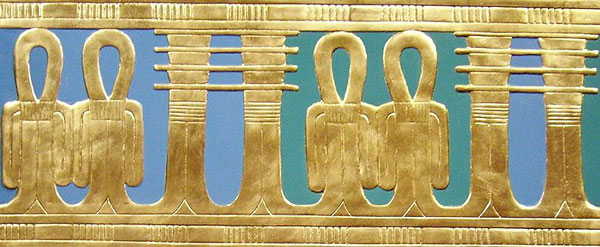
Frieze of ankh, djed, and was signs atop the hieroglyph for “all”
The signs ‘ankh’, ‘ouas’ and ‘djed’, resting on the basket ‘neb.’,
Temple of Queen Hatshepsut – Deir el-Bahari

She also often appears accompanied by the “was” sceptre and the “djed” pillar. Thus Christiane Desroches Noblecourt tells us: “The ankh and ouas signs are often associated. The dead pharaoh, but who is a candidate for rebirth, goes towards a deity, most of the time female, who makes him breathe, in his nose, the ankh and ouas signs which give him life, thus representing divine milk.

While being well known and recognized, the “ankh” sign, as we see, still raises many questions…

We leave the concluding words to Gustave Jéquier: “What could be the primitive meaning of this kind of talisman? We have seen that, held in hand by gods and deified kings, it symbolizes the divine life, and that on the other hand, if simple individuals do not have the right to wear it, they have it represented in the middle of their funerary furniture. In the sarcophagi, it is painted, in principle, at the feet of the dead. With the unambiguous indication ‘on the ground, under the feet’. Elsewhere, we find the expression (…) “the ankh of the two lands” as if it were an object related to the cult of the chthonic (or funerary?) deities, or instead to the protection of Earth. The purpose of the object would therefore have been, initially, to protect things, then people, and finally would have become the emblem of those who enjoy perfect protection, the gods and, to a certain extent, the dead. : The single idea must have evolved at a particular time in two different directions, and depending on whether it was a question of the super-terrestrial life of the gods or the survival of souls, the use of the object itself became absolutely different, the gods alone having the right to hold it in their hands. In religious language, these two meanings always remained very distinct. In contrast, in ordinary language, the meaning of the word ankh was considerably simplified and applied to life in general, life on Earth, and life after death. And this meaning is perhaps still the one that comes closest to the primordial idea of the talisman (ankh), which was to guarantee life to whoever had it in his possession.

Marie Grillot

Sources:

Dictionary of Egyptian Mythology, Isabelle Franco, Pygmalion 1999
Ancient Egypt and its gods – Illustrated dictionary, Jean-Pierre Corteggiani, Fayard 2007
Ruins and Landscapes of Egypt, Gaston Maspero, 1910
The complete Valley of the kings, Nicholas Reeves, Richard H. Wilkinson, The American University in Cairo Press, 2002
History of the Valley of the Kings, John Romer, Vernal – Philippe Lebaud, 1991 “General Catalog of Egyptian Antiquities in the Cairo Museum N° 24001-24990 – Excavations of the Valley of the Kings (1898-1899)“, Fasc. 1”, Georges Daressy, 1902

The ânkh and shen talismans ”, Gustave Jéquier, BIFAO 11 (1911), p. 121-143

Development of the burial assemblage of the Eighteenth dynasty Royal Tombs” , Nozomu Kawai

Treasures of Ancient Egypt at Cairo Museum, National Geographic

Kahlil Gibran: The Madman.

Standard

Once, I will never forget; my brother Al ran away after only five or six months from military service, which was inevitably for every young man those days. He came home to my surprise, sat in the room and let the music play (I think that was Beatles Abbey Road. I asked him what now? It is not my world, he said. I wondered what is then yours, can you explain? He answered; a world in which all the people are mad, that is my world!

Now let’s have a look at the Madman by Kahlil Gibran. It seems that if someone just begins to think more profound on the surface, they will be called mad or may have to be mad!

The Madman, His Parables and Poems is a book written by Kahlil Gibran, published in the United States by Alfred A. Knopf in 1918, with illustrations reproduced from original drawings by the author. It was Gibran’s first book in English, marking the beginning of the second phase of Gibran’s career. May Ziadeh, with whom Gibran had been corresponding since 1912, reviewed it in Al-Hilal, a magazine in Egypt. Wikipedia

The Crazy

You ask me how I became a madman. It happened thus: One day, long before many gods were born, I woke from a deep sleep and found all my masks were stolen—the seven masks I have fashioned and worn in seven lives—I ran maskless through the crowded streets shouting, “Thieves, thieves, the cursed thieves.”

Men and women laughed at me, and some ran to their houses in fear of me.

And when I reached the marketplace, a youth standing on a house-top cried, “He is a madman.” I looked up to behold him; the sun kissed my own naked face for the first time. For the first time, the sun kissed my own bare face, and my soul was inflamed with love for the sun, and I wanted my masks no more. And as if in a trance, I cried, “Blessed, blessed are the thieves who stole my masks.”

Thus I became a madman.

And I found both: freedom and safety, in my madness; the freedom of loneliness, the safety of incomprehension, because those who understand us enslave something inside us.
But let me not be too proud of my safety. Even a thief, imprisoned, is safe from another thief.

From the book Khalil Gibran: The Madman

Here is a small part of this “mad” book!;

The Fox

A fox looked at his shadow at sunrise and said; I will have a camel for lunch today. And all morning, he went about looking for camels. But at noon, he saw his shadow again- and he said, a mouse will do!

Peace, Peace, and Peace! 🙏💖🤗🌹💖🙏

A Solitary Man remains Lonely Even in a Mass! (A short Story of my new Family and Me) P1!

Standard

As you might remember, I mentioned in my last post that I had to participate in my brother in law’s birthday party. It may sound like a usual act somehow. But for me, it will never be!

Actually, I want to tell you about an exciting encounter with a man I met only twice at their parties. Still, first I have to tell you something about my situation in my wife’s family: You know, my wife’s family is working class, and I like them very much. But they are very conservative and accordingly very sceptical about foreigners, and with this, you could imagine how difficult it could be for me to get my approval.

The family is significant in number (though a few of them passed away lately); my wife, Regina, had ten siblings (five sisters and five brothers). I even heard that my mother-in-law had two miscarriages to that, making it thirteen. (Maybe the number was inappropriate!) the father liked to drink a lot, was brutal to the family members, and the mother had nothing to say that much. When I got to know Regina, I realized that she was a wild, free-thinking person, and that’s why I began a relationship with her. And when I got to know her family, I was amazed at the different ways of thinking between her and the rest. The reason might have been that she was the only child who didn’t grow up with her parents but with a foster family. The father-in-law didn’t drink to much and was a socialist! I had got no problem with the foster parents and was welcomed heartily. The forest mother was a good-hearted Christ, and the foster father was an open-hearted man to every kind of person.

Although when Regina had introduced me to the family, the father wasn’t as bad as he used to be. He drank anymore and was the only one who accepted me as I was and liked me at once. But winning the hearts of the siblings was a masterpiece. In my life, I had to challenge often to persuade people, even the very right-wing beliefs, and won. But it is another story!

I don’t have that much contact with them, only if there are ceremonies or on Christmas or whatever we might meet. Of course, I’m happy about that because I hardly have anything in common with them. When we meet, I always want to talk about philosophy or psychology, God and the world, or generally about books I’ve newly read thereabout, but they are all interested in something else: the women about the neighbourhood’s way of life and the men about house construction and its facilities. Therefore, when I get to such meetings, I try to hide and seek somehow. A little yes here, a little OK there, and constantly changing places! I know how to do this. I mentioned it before in my memories that I got used to doing something unusual in societies, those days in Iran and here in Germany.

However, after many years, they slowly but surely accept me as a family member. Above all, Regina’s love and trust in me overwhelmed everyone. But now, as they noticed that I am an Alien, and somehow different, not only to them but also to all other foreigners, they accepted my knowledge (despite being very proud) and want more from me! I know that I’m a nice guy, and no one can resist when I start being nice! And because I rarely meet my good new family, I have no inhibition about being nice, though some people seem to misunderstand it. That is the story about this particular encounter;

To be continued!

Sorry, as I am writing, I notice that it is a longer story than I have accepted; therefore, let’s split it in two! 😁😉🙏💖