Edgar Allan Poe and Herman Melville

Standard

Hello friends!

I am back for a while from my holiday trip, although I am not fully recovered from a cold I caught a week ago, which I am still fighting to get rid of (it seems my immune system has been damaged after that problem earlier this year!). I didn’t plan to make a post today, but when I came across an article about the relationship between Poe and Melville, which I didn’t know about, I thought I would share it with you. Indeed, I should mention that I once published an article on Allan Poe; here it is!

As a new New Yorker, I once travelled across three boroughs to Woodlawn Cemetery to visit Herman Melville’s grave. I didn’t worship him as a hero but as a friend. Through the words of Professor Angela O’Donnell, who says that reading great writers is like having a conversation with them and fosters intimacy, I promised to visit often. Still, I was distracted by city life and never went back. However, a friend of another 19th-century American author never missed a visit.
The Baltimore Sun reports that, for decades, an anonymous “Poe Toaster” left three roses and a bottle of cognac at Edgar Allan Poe’s grave every January 19th. His mystery remains unsolved, as does Poe’s own death.

On October 7, 1849, the literary community remembered Edgar Allan Poe, a master of the macabre whose death remains shrouded in mystery. Although his anniversary has passed, his short, tragic life and death remain deeply saddening. He was found delirious on Baltimore’s streets, and the exact cause of his death remains unclear, speculated to be linked to alcoholism, rabies, or other health issues.

In the days leading up to his death, Poe grappled with personal turmoil and bouts of depression, reflecting the dark themes prevalent in his writing. His life mirrored the tragedies he explored—loss, madness, and mortality.

As we remember Poe, we not only honour his legacy as a pioneering voice in Gothic literature but also reflect on the profound connections between art and the struggles of existence, inviting us to confront the deeper aspects of the human condition he so eloquently captured.

The relationship between Edgar Allan Poe and Herman Melville is a compelling exploration of two iconic figures in American literature, whose works have shaped literary history. Both authors are monumental, yet their life paths and artistic styles diverged significantly, revealing profound themes of existentialism and the complexities of the human experience.

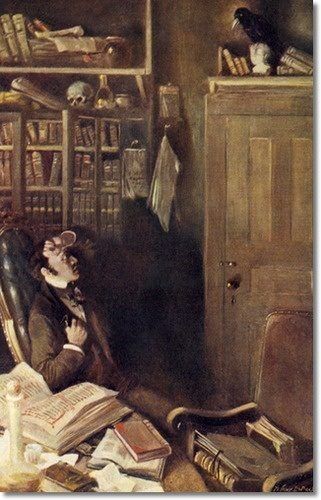
Edgar Allan Poe, born in 1809 in Boston, faced a tumultuous early life marked by personal tragedies. Orphaned as a child, he experienced the pain of loss that profoundly influenced his writing. His struggles with poverty and alcoholism fueled the dark themes in his work. Masterfully crafted tales such as “The Raven,” “The Tell-Tale Heart,” and “The Fall of the House of Usher” explore death, madness, and despair, establishing Poe as a master of horror and Gothic literature.
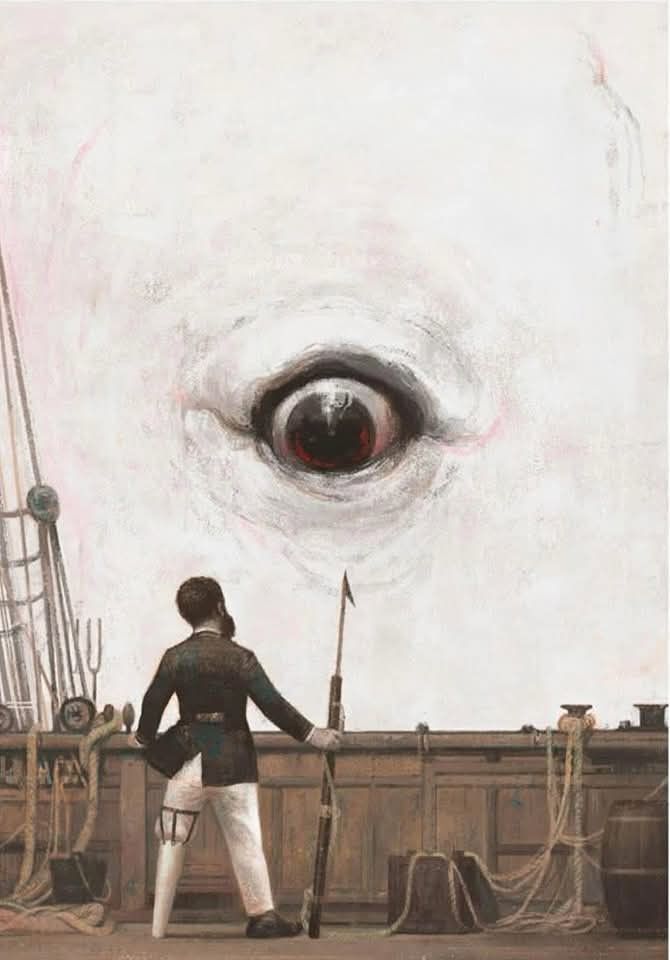
In contrast, Herman Melville, born in 1819 in New York City, enjoyed a more privileged upbringing that was disrupted by his father’s early death. This formative loss set him on a path of adventure at sea, which culminated in his magnum opus, “Moby-Dick.” Melville’s works engage with grand themes of nature and humanity, showcasing a narrative style that embodies the complexities of existence and human ambition.

Despite their differences, Melville and Poe respected each other’s literary talents. Poe’s sharp critiques of Melville’s early works, such as “Typee,” acknowledged Melville’s gift while highlighting differences in their narrative styles. Poe favoured compact storytelling, while Melville embraced sprawling narratives laden with existential questions.

Both writers engaged with themes of death and isolation, particularly evident in Melville’s Captain Ahab, who mirrors the psychological depths of Poe’s characters. Their respective narratives challenge audiences to confront profound aspects of the human condition. Timing also affected their careers; though Poe achieved fame earlier, Melville’s “Moby-Dick” was initially overlooked, though it would eventually be recognised as a key literary work.

Ultimately, the legacies of both authors flourished posthumously, with Poe celebrated for his innovative contributions to literature and Melville emerging as a foundational figure. This interplay between the two writers encourages contemporary readers to explore the connections that define their works.

In conclusion, the relationship between Poe and Melville offers a striking study of contrasting yet complementary voices in American literature. Their distinct views on existential despair and the human experience create a rich tapestry that continues to inspire and intrigue, leaving a lasting impact on generations of writers and readers alike.

Thanks, and have a good time, everybody.
My (Carl Jung’s) Most Difficult Experiment [P. 3]

Standard

“We need a force not to start conflicts but to protect our nation and freedom. Therefore, making military service more attractive could draw more young people”. Said German Bundeskanzler Friedrich März a few days ago.
I wonder how and with what we can make being a soldier attractive. A soldier’s role involves killing; how can we make that aspect attractive?

I remember the 1960s and 1970s, during the Cold War and Vietnam War, when crowds gathered to protest against conflicts and advocate for peace. Over time, Western governments began to prioritise peace more and engaged in disarmament talks, seeking peaceful coexistence. Yet today, they focus on strengthening their military to defend peace and freedom!

What’s happening? Isn’t there enough war worldwide? Is Germany yearning for the glorious days of the 1930s? The facts appear this way!

However, this has always occurred whenever politicians become oblivious to the horrific machinery of war. Therefore, it might be meaningful to consider two of Jung’s dreams from before WWI, as excerpted from his autobiography. “Memories, Dreams, Reflections” describes Carl Jung’s dreams from 1913 to 1914. With thanks to Lewis Lafontaine. 🙏

In October [1913], while I was alone on a journey, I was suddenly seized by an overpowering vision: I saw a monstrous flood covering all the northern and low-lying lands between the North Sea and the Alps.
When it came to Switzerland, I saw that the mountains grew higher and higher to protect our country.
I realised that a frightful catastrophe was in progress.
I saw the mighty yellow waves, the floating rubble of civilisation, and the drowned bodies of uncounted thousands.
Then the whole sea turned to blood.
This vision lasted about one hour.
I was perplexed and nauseated, and ashamed of my weakness.

Thunder is no longer the voice of a god, nor is lightning his avenging missile.
No river contains a spirit, no tree makes a man’s life, no snake is the embodiment of wisdom, and no mountain still harbours a great demon.
Neither do things speak to him nor can he speak to things, like stones, springs, plants and animals.”
~ Carl Jung, CW 18, Para 585

Two weeks passed; then the vision recurred, under the same conditions, even more vividly than before, and the blood was more emphasised.
An inner voice spoke. “Look at it well; it is wholly real, and it will be so. You cannot doubt it.”
That winter, someone asked me what I thought were the political prospects of the world in the near future.
I replied that I had no thoughts on the matter, but that I saw rivers of blood.
I asked myself whether these visions pointed to a revolution, but I could not really imagine anything of the sort.
And so I concluded that they had to do with me myself, and decided that a psychosis menaced me.
The idea of war did not occur to me at all.
Soon afterwards, in the spring and early summer of 1914, I had a thrice-repeated dream that in the middle of summer an Arctic cold wave descended and froze the land to ice.
I saw, for example, the entire region of Lorraine and its canals frozen, and the whole area totally deserted by human beings.
All living green things were killed by frost.
This dream came in April and May, and for the last time in June 1914.
In the third dream, frightful cold had again descended from out of the cosmos.
This dream, however, had an unexpected end. There stood a leaf-bearing tree, but without fruit (my tree of life, I thought), whose leaves had been transformed by the effects of the frost into sweet grapes full of healing juices.
I plucked the grapes and gave them to a large, waiting crowd…

On August 1, World War I broke out!

Now, let’s continue with the next section, following (1, 2), about Dr Jung’s dreams and examining how a forecaster can predict potential human self-destructive plans. As mentioned in Part Two, Jung described hearing a strange woman’s voice in his mind and tried to analyse it.

He believed the voice was “the soul in the primitive sense,” known as the anima, and stated that he employed his analysis to write letters to his anima, experiencing it as both a ghost and a woman. He remembered this voice as that of a Dutch patient from 1912 to 1918, who convinced a colleague that he was a misunderstood artist. The woman had thought the unconscious was art, but Jung had maintained it was a natural phenomenon. The woman was likely Maria Moltzer, and the psychiatrist was Jung’s friend Franz Riklin, who shifted from analysis to painting, studying Augusto Giacometti in 1913. Riklin’s art was semi-figurative and abstract, with a notable 1915/6 work, Verkündigung, in Zürich, donated by Moltzer in 1945. Giacometti found Riklin’s psychological insights exciting, calling him a modern magician.

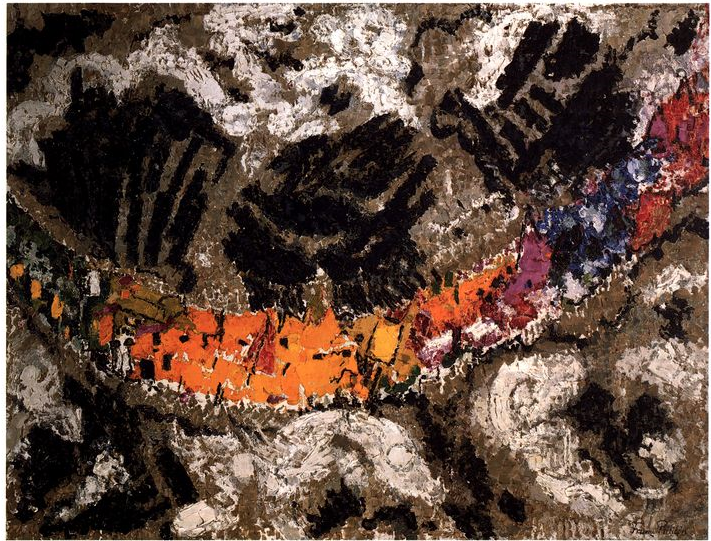
Franz Beda Riklin Verkündigung 1915, Wikimedia

The November entries in Black Book 2 depict Jung’s return to his soul. He recalled dreams that led him to his scientific career and recent dreams bringing him back to his soul. In 1925, he noted his first writing phase ended in November: ” Not knowing what would come next, I thought perhaps more introspection was needed… I devised such a boring method by fantasising that I was digging a hole, and by accepting this fantasy as perfectly real. ” This experiment occurred on December 12, 1913 (See Liber Primus, chapter 5, p. 147).

To be continued …………

Thank you for reading! I don’t want to spoil your mood, but sometimes thinking more deeply can help us and prepare us for the worst. While I am on my way to spend the holidays, please note that responses to comments, if any, may be delayed.🙏💖

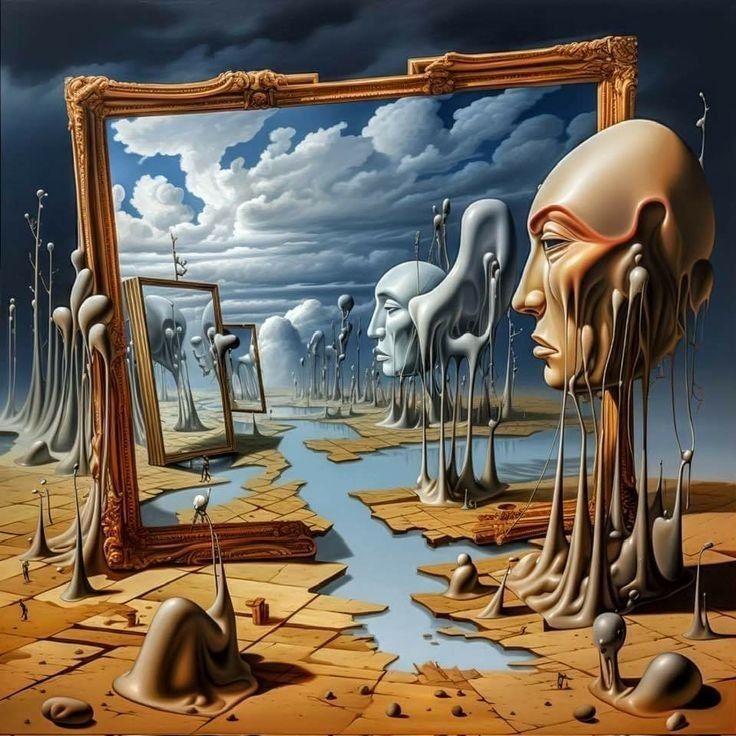
Illustration art at the top: Dali-Inspired Dreamscape