Next week, I have my surgery appointment, and before I go under the surgeon’s knife, as the Germans say, I wanted to say “a short” goodbye. Since I know most of you are doing very well, as I receive your posts every day, every hour, you can send your positive thoughts towards my surgical table in between!
There are no words to describe the suffering and pain I endured, as I understand that one must experience it oneself to truly grasp its affliction. I hope that none of you experience that! What I can say with certainty is that I have gained invaluable insights. I learned about my weaknesses and the extent of my power. I have discovered how low one can go and where the steps are to climb up.
It is by going down into the abyss that we recover the treasure of life. Where you stumble, there lies your treasure. ~Joseph Campbell
I learned about my deep depression, where tiny fairies would converse with me. I’ve learned to remain resilient despite all challenges, echoing Ernest Hemingway’s words: “A man can be destroyed but not defeated.” Additionally, one of his characters, Harry Morgan, states in “To Have and Have Not”: “A man alone ain’t got no chance,” yet he persistently strives to do his best! Of course, I had support from my adorable wife, son, and a few friends. Nevertheless, during my most challenging times, it was ultimately up to me to endure that pain alone. I’m very stubborn about seeking help!
As I conclude my post, I would like to acknowledge my mentor, Dr. Jung, and his perspective on suffering:
Your ideas bring you up against a general cultural problem, which is infinitely complicated.
What is true in one place is untrue in another.
“Suffering is the swiftest steed that bears you to perfection,” and the contrary is also true.
“Breaking in” can be discipline, and this is needed for the emotional chaos of man, though at the same time it can kill the living spirit, as we have seen only too often.
In my opinion, there is no magical word that could finally unravel this whole complex of questions; nor is there any method of thinking or living or acting which would eliminate suffering and unhappiness.
If a man’s life consists half of happiness and half of unhappiness, this is probably the optimum that can be reached, and it remains forever an unresolved question whether suffering is educative or demoralising.
In any case, it would be wrong to give oneself up to relativism and indifferentism.
Whatever can be bettered in a given place at a given time should certainly be done, for it would be sheer folly to do otherwise.
Man’s fate has always swung between day and night.
There is nothing we can do to change this.
Yours sincerely,
C.G. Jung ~Carl Jung, Letters Vol. II, Page 248.
I hope everyone enjoys a tranquil and relaxing time; take care and stay healthy. 🙏💖🌹
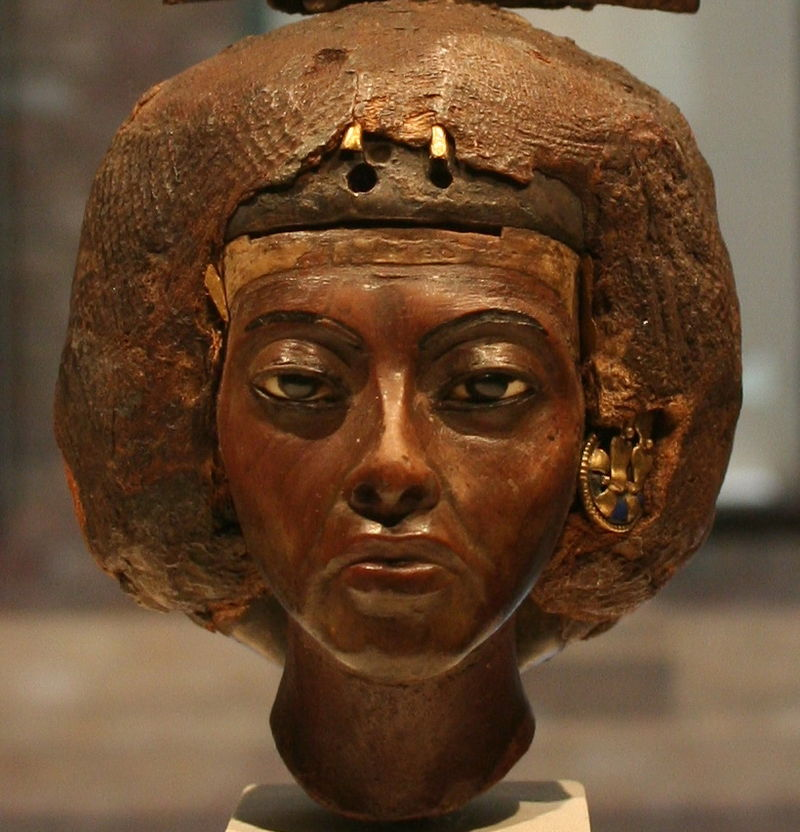
Ägyptisches Museum (Egyptian Museum), Berlin (Wikimedia)
Queen Tiye, recognised for her intellect and formidable character, earned the respect of foreign dignitaries, who were keen to interact with her directly. She maintained an active presence in foreign relations and became the first Egyptian queen whose name was inscribed on official documents.
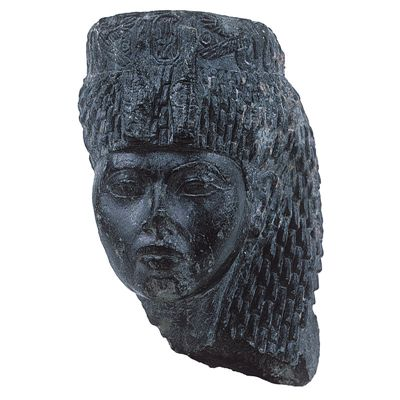
Head of Queen Tiye. Egyptian Museum, Cairo. JE 38257
Here is an impressive presentation by Marie Grillot about a captivating piece of art represented by a magnificent statue that resonates with us through her story.
Wishing you all the best for the Easter holidays. 💖🙏
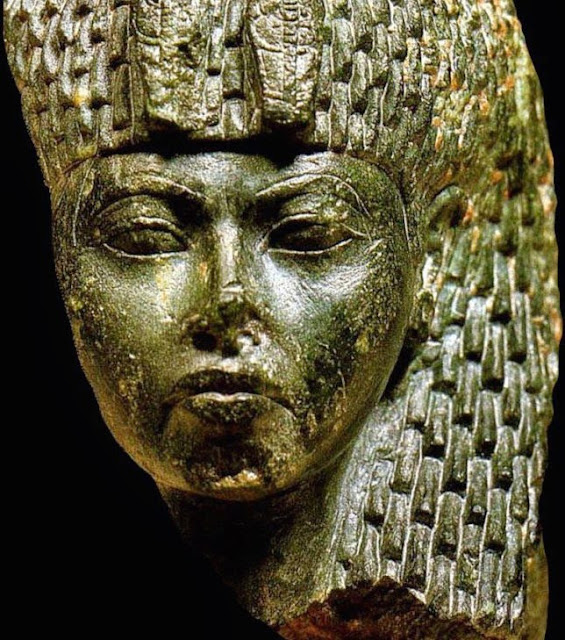
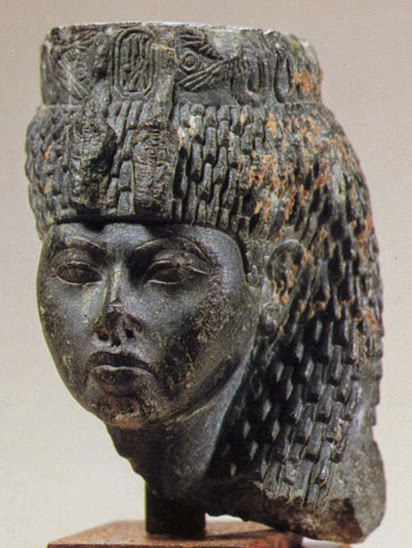
Head of a statuette of Queen Tiye – dark green schistose steatite – New Kingdom – 18th Dynasty Discovered in 1905 by William Matthew Flinders Petrie in the Temple of Hathor at Serabit el-Khadim (Sinai) Egyptian Museum, Cairo – JE 38257
In 1905, the English Egyptologist William Matthew Flinders Petrie led an expedition to the Sinai Peninsula. He was particularly interested in the site of the temple of Serabit el-Khadim. Built during the reign of Snefu for workers who came to work in the turquoise mines, it remained in use until the New Kingdom. The sanctuary is dedicated to the goddess Hathor, “mistress of turquoise,” and the eastern falcon god Sopdu.
The excavation season is expected to yield the discovery of a small female head, measuring 7.2 cm, in a very dark stone.
Head of a statuette of Queen Tiye – dark green schistose steatite – New Kingdom – 18th Dynasty Discovered in 1905 by William Matthew Flinders Petrie in the Temple of Hathor at Serabit el-Khadim (Sinai) Egyptian Museum, Cairo – JE 38257
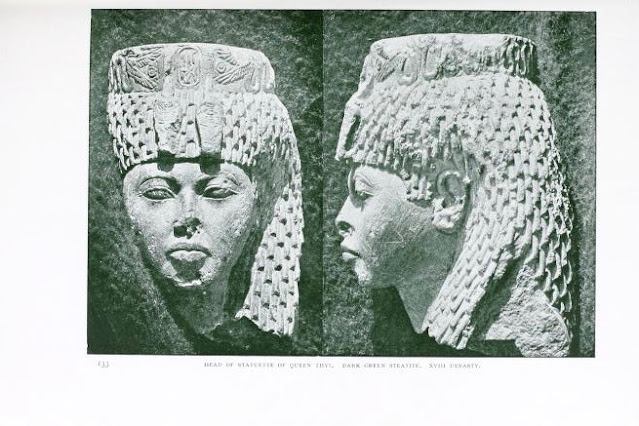
Here is an excerpt from W.M.F. Petrie’s description in his 1906 report “Researches in Sinai”: “A queen has left here one of the most striking portraits ever carved in Egypt. The very famous Queen Thyi, wife of the great Amenhotep III, was hitherto known from a few carved reliefs, but not yet from such a portrait in the round. Strangely, such a remote spot should have preserved this representation, which we have identified from the cartouche in the middle of the crown. The schistose stone is dark green steatite.
The entire statuette must have measured about a foot in height. Unfortunately, we have found no fragments other than the head. The great dignity of the face is combined with a fascinating uprightness. The delicacy of the contours of the eyes and cheekbones testifies to the quality of execution. The lips, whose curious curve curves downwards, are complete and delicate, yet express a disdain devoid of malice. They are, most certainly, a likeness to the truth… The ear is pierced, as is also the case with her son Akhenaten. The crown she wore was probably with gold inlays. The two-winged cobras stretch their length in loops around the head, until they meet at the back; while in the middle of the forehead, they support the cartouche with the name of the great queen of Upper and Lower Egypt. This piece alone was worth all the rest of our earnings for the year; it is now in the Cairo Museum.”
“Head of statuette of Queen Tiye – Dark green steatite” (Egyptian Museum, Cairo JE 38257) published here by William Matthew Flinders Petrie in “Researches in Sinai” (1906), plate 133 – p. 127
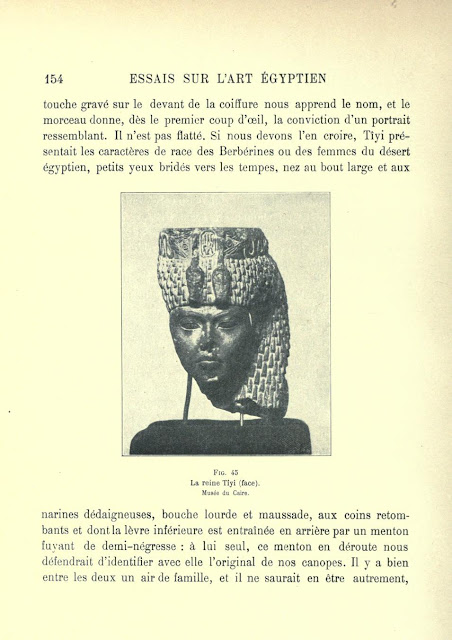
In his book “Essays on Egyptian Art” published in 1912, Gaston Maspero describes it thus: “The right wing of the wig is missing, and the nose has suffered from an unfortunate shock on the left nostril, without however losing the essential part of its shape: a cartouche engraved on the front of the hairstyle tells us the name, and the piece gives, at first glance, the conviction of a portrait likeness. It is not flattering. If we are to believe him, Tiyi presented the racial characteristics of the Berberines or the women of the Egyptian desert, small eyes slanted towards the temples, noses with a wide tip and disdainful nostrils, a heavy and sullen mouth, with drooping corners and whose lower lip is pulled back by a receding chin.”
Head of a statuette of Queen Tiye – dark green schistose steatite – New Kingdom – 18th Dynasty Discovered in 1905 by William Matthew Flinders Petrie in the Temple of Hathor at Serabit el-Khadim (Sinai) Egyptian Museum, Cairo JE 38257 – Published here by Gaston Maspero in “Essays on Egyptian Art”, 1912
What femininity, what willpower, what pride, and what presence! The personality that emanates from this little face is visibly inspiring… And it is touching, even moving, to see how much each Egyptologist is keen to decipher it…
Head of a statuette of Queen Tiye – dark green schistose steatite – New Kingdom – 18th Dynasty Discovered in 1905 by William Matthew Flinders Petrie in the Temple of Hathor at Serabit el-Khadim (Sinai) Egyptian Museum, Cairo – JE 38257 – Museum photo
Thus, for Mohamed Saleh and Hourig Sourouzian (“Official Catalogue of the Egyptian Museum in Cairo”): “The oval face with high cheekbones, almond-shaped eyes and a thick, almost disillusioned mouth is that of a determined and serious woman, who exudes a high spirituality despite her apparent youth.”
In “The Wonders of the Egyptian Museum in Cairo,” Francesco Tiradritti provides the following interpretation: “The corners of the mouth, curved downwards, give the whole face an air of gravity that was often interpreted as an allusion to the decisive and inflexible temperament of Tiyi.”
Head of a statuette of Queen Tiye – dark green schistose steatite – New Kingdom – 18th Dynasty Discovered in 1905 by William Matthew Flinders Petrie in the Temple of Hathor at Serabit el-Khadim (Sinai) Egyptian Museum, Cairo JE 38257 (museum photo)
Jean-Pierre Corteggiani’s analysis (“Egypt of the Pharaohs at the Cairo Museum”) is also not devoid of realism: “There is something haughty, if not contemptuous, in this young and energetic face of a woman who is both highly aware of her rank and proud to have managed to occupy it.”
There are many known representations of the queen, the most famous of which are those in the Egyptian Museum in Berlin (ÄM 21834 – yew wood head found in 1904 in Medinet Gourab), those in the Louvre (N 2312, E 25493 – glazed steatite – Salt Collection), as well as those in the Metropolitan Museum of Art in New York (26.7.1396 yellow jasper, discovered in Amarna from the Carnarvon Collection), without forgetting, of course, the imposing statuary group where she appears seated alongside her husband and with three of their daughters (atrium of the Cairo Museum – ref. GM 610 – JE 33906).
Head of Queen Tiye – yew wood statue in the round discovered in 1904 in Medinet Gourab Berlin Museum – ÄM 21834 (museum photo)
Tiyi lived in the New Kingdom; she was the daughter of Youya and Touya, whom Pierre Tallet (“12 Queens of Egypt Who Changed History”) describes as follows: “Youya was from Akhmim in Middle Egypt and held the titles of director of the royal stables and divine father; her mother Touya was a ‘royal ornament’ and singer of Amun.” She was therefore close to the Court…
“In the palace, rumour had preceded the event: Tiyi would be queen… she was and assumed this role with exceptional talent,” relates Christian Leblanc in his “Queens of the Nile.” And he continues: “Announced beyond the borders by an issue of large commemorative scarabs, the marriage of Tiyi with Amenhotep III was celebrated with great pomp in Memphis… Very quickly, Tiyi had a great influence on the government of the country. Through her strong personality, she exercised a role as confidante and political advisor to her husband.” It appears that her role also continued during the reign of her son, Amenhotep IV, also known as Akhenaten.
Head of a statuette of Queen Tiye – dark green schistose steatite – New Kingdom – 18th Dynasty Discovered in 1905 by William Matthew Flinders Petrie in the Temple of Hathor at Serabit el-Khadim (Sinai) Egyptian Museum, Cairo – JE 38257
The one who was adorned with so many laudatory titles: “Noble lady”, “Great favourite”, “Great royal wife”, “Sovereign of the Two lands”, “Who fills the palace with love”, died between the 12th and 15th year of her son’s reign.
Head of a statuette of Queen Tiye – dark green schistose steatite – New Kingdom – 18th Dynasty Discovered in 1905 by William Matthew Flinders Petrie in the temple of Serabit el-Khadim (Sinai) Egyptian Museum, Cairo JE 38257 – museum photo
The quality of this stone portrait is therefore “up to” the great lady that she was… We must salute the sculptor who was able to render her character traits so accurately and so finely and who, in a way, helps us to better “perceive” the subtle personality of the sovereign…
Presented under number 4257 of the “Visitor’s Guide to the Cairo Museum” (Gaston Maspero, 1915), it was recorded in the museum’s Journal of Entries under reference JE 38257.
Sorry, it’s me again! I intended to share a brief message on Facebook, and I thought, why not just do it on my site, too? So here it is: We must look deeply around us and think twice. I send you all immense gratitude and wish you a lovely weekend.😁🤗💖🙏🦋🌹
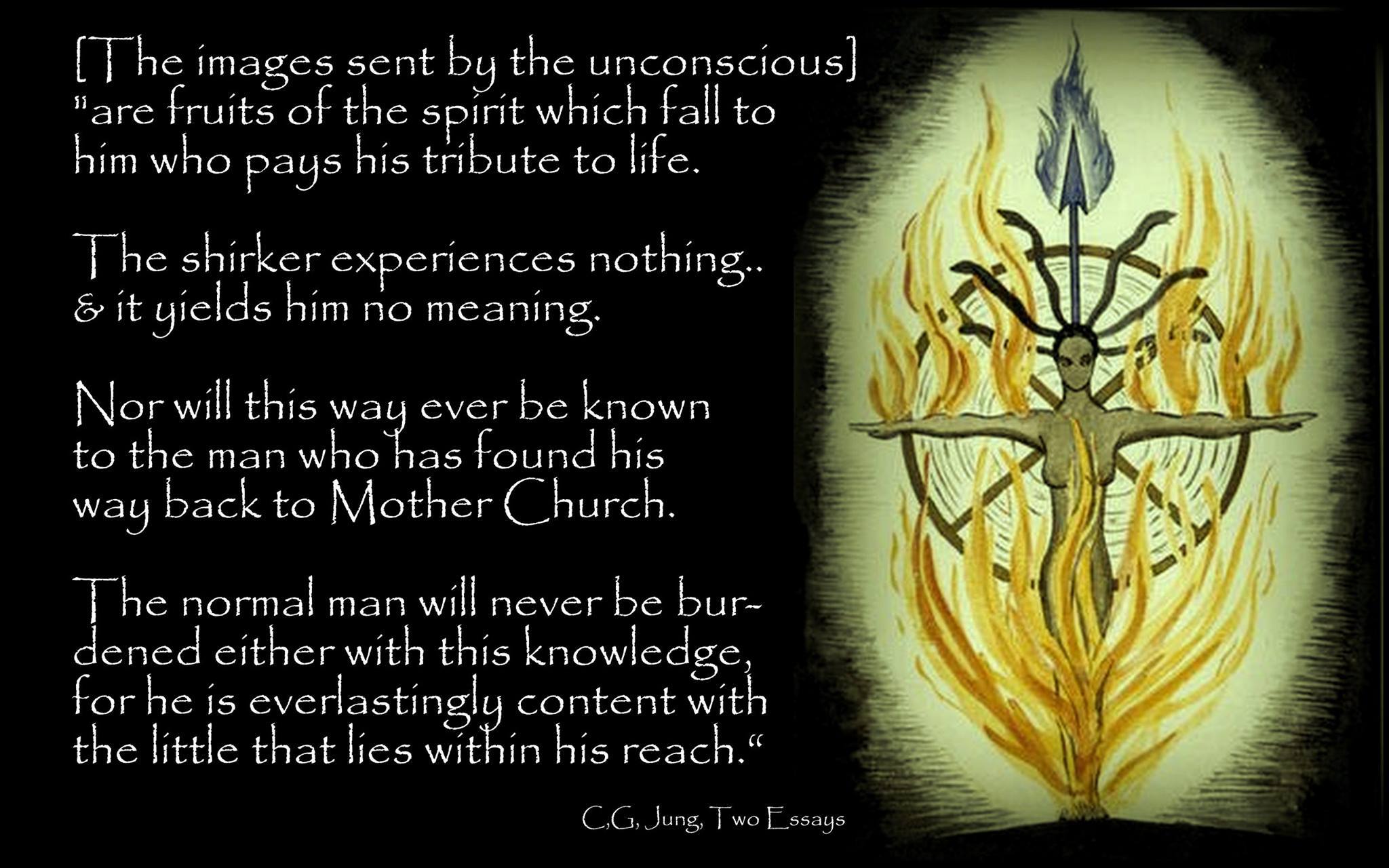
Title image; Art by Andrew Ferez
From Collected Works of C.G. Jung, Volume 7: Two Essays in Analytical Psychology,
I must recall at this point a serious misunderstanding to which my readers often succumb, and doctors most commonly. They invariably assume, for reasons unknown, that I never write about anything except my method of treatment. This is far from being the case. I write about psychology. I must, therefore, expressly emphasize that my method of treatment does not consist in causing my patients to indulge in strange fantasies for the purpose of changing their personality and other nonsense of that kind. I merely put it on record that there are certain cases where such a development occurs, not because I force anyone to it, but because it springs from inner necessity. For many of my patients, these things are and must remain double Dutch. Indeed, even if it were possible for them to tread this path, it would be a disastrously wrong turning, and I would be the first to hold them back. The way of the transcendent function is an individual destiny. But on no account should one imagine that this way is equivalent to the life of a psychic anchorite, to alienation from the world. Quite the contrary, for such a way is possible and profitable only when the specific worldly tasks which these individuals set themselves are carried out in reality. Fantasies are no substitute for living; they are fruits of the spirit which fall to him who pays his tribute to life.
The shirker experiences nothing but his own morbid fear, and it yields him no meaning. Nor will this way ever be known to the man who has found his way back to Mother Church. There is no doubt that the mysterium magnum is hidden in her forms, and in these, he can live his life sensibly. Finally, the normal man will never be burdened, either, with this knowledge, for he is everlastingly content with the little that lies within his reach. Wherefore I entreat my reader to understand that I write about things which actually happen and am not propounding methods of treatment. ~Carl Jung, CW 7, Pages 223-224










 lampmagician
You must be logged in to post a comment.