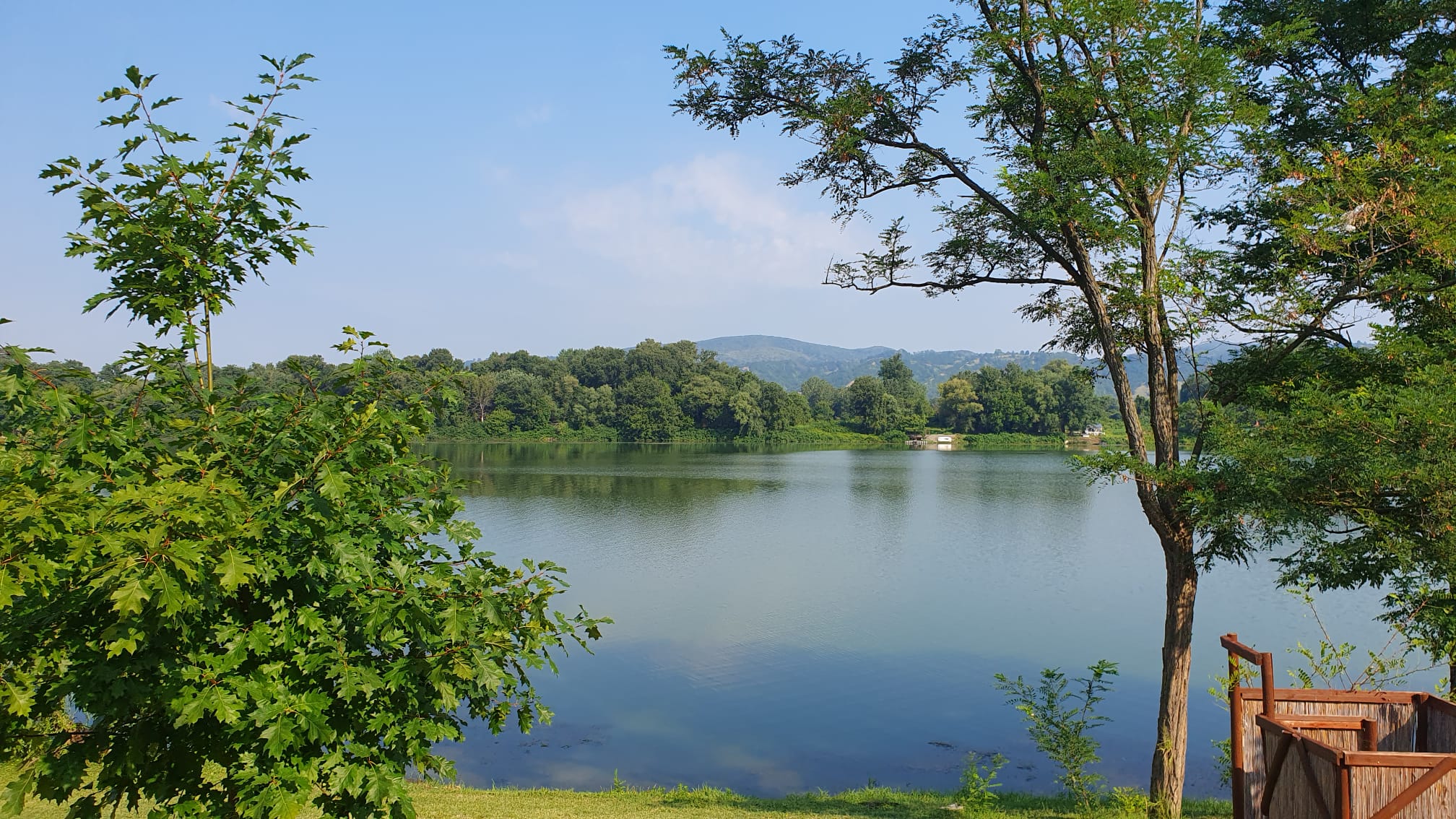
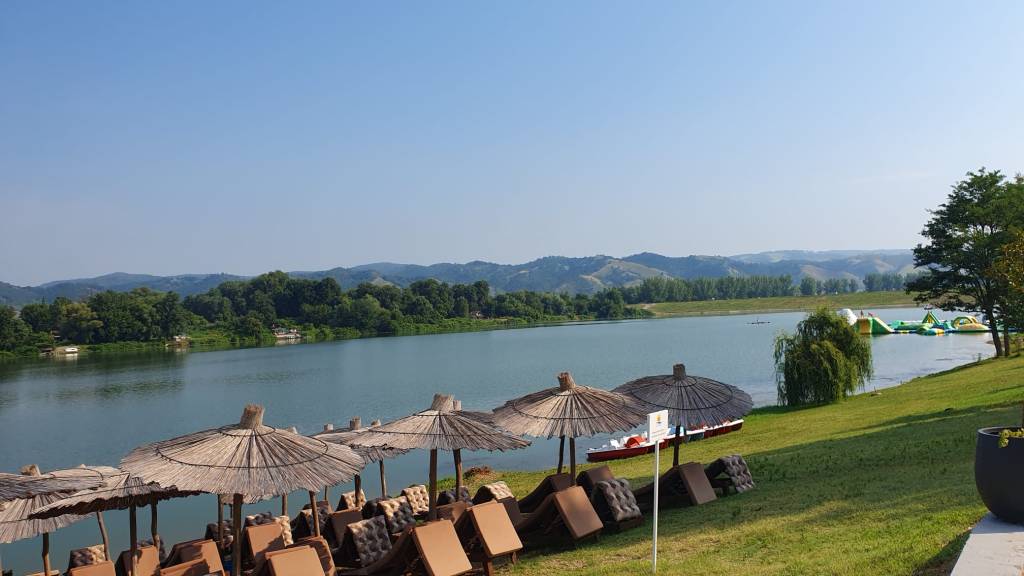
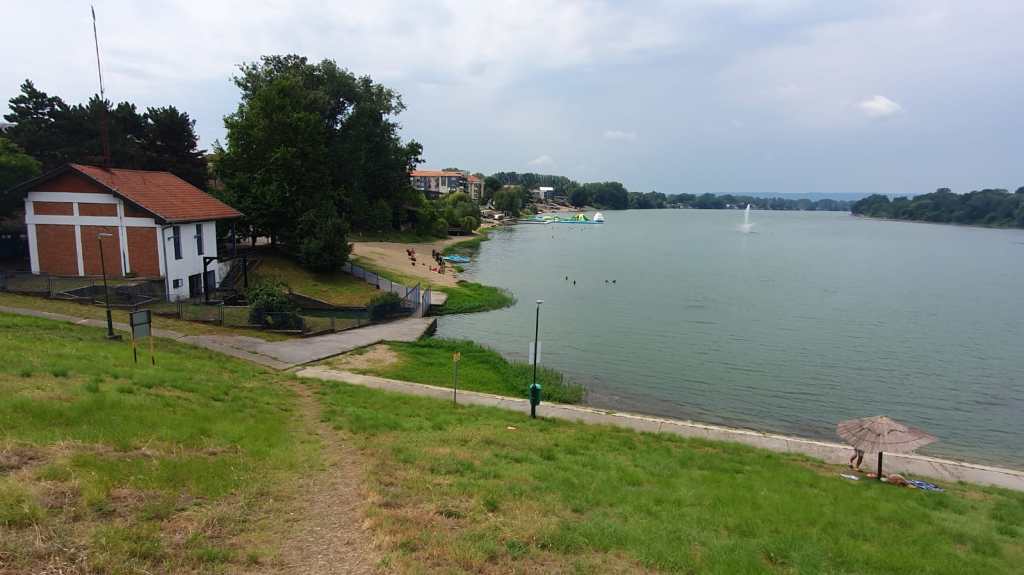
This year, we planned to spend our holidays in the summer instead of spring or autumn like in previous years. Due to my limited budget, we aimed to make the trip as inexpensive as possible. However, a significant reason for undertaking this journey was to visit our daughter-in-law’s birthplace and meet her family. First, we rented an apartment for just under three hundred euros a week to not burden our new family, and then we moved into their house.
Although Serbia is not the great country it once was, which we know as Yugoslavia, nevertheless, it has its quiet, beautiful corners with proudly reserved people. I believe the EU would rather have it apart because it fears the mighty military of the big country!
I know these people well because I worked with some colleagues during those years and found them intelligent, honourable, and insightful.
So! I am splitting this post in two because I have some nice pictures of the prominent Church in Belgrad, The Temple of Saint Sava, which I would like to make a separate post about. Have a lovely weekend, everybody, and thanks to all.
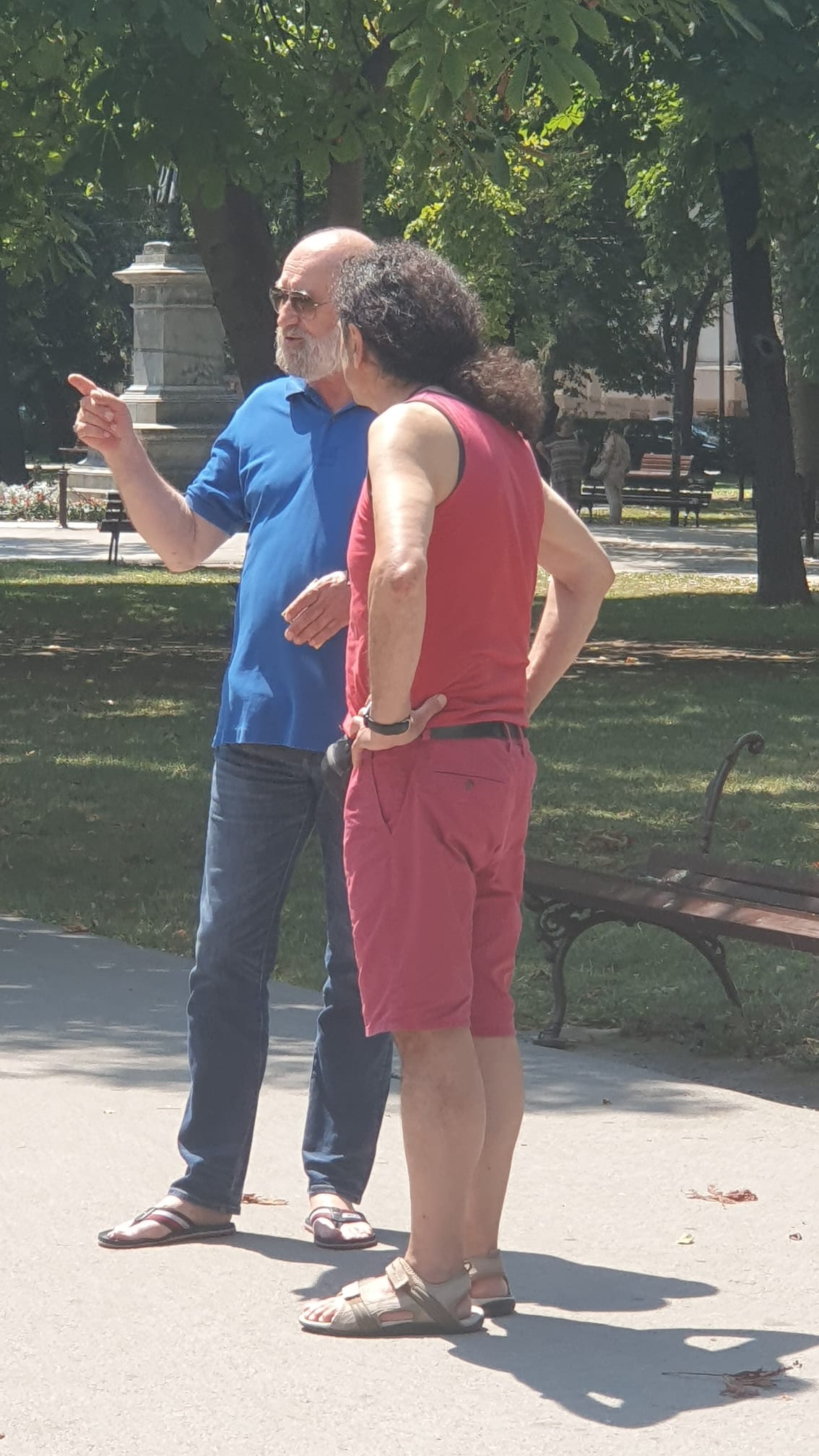
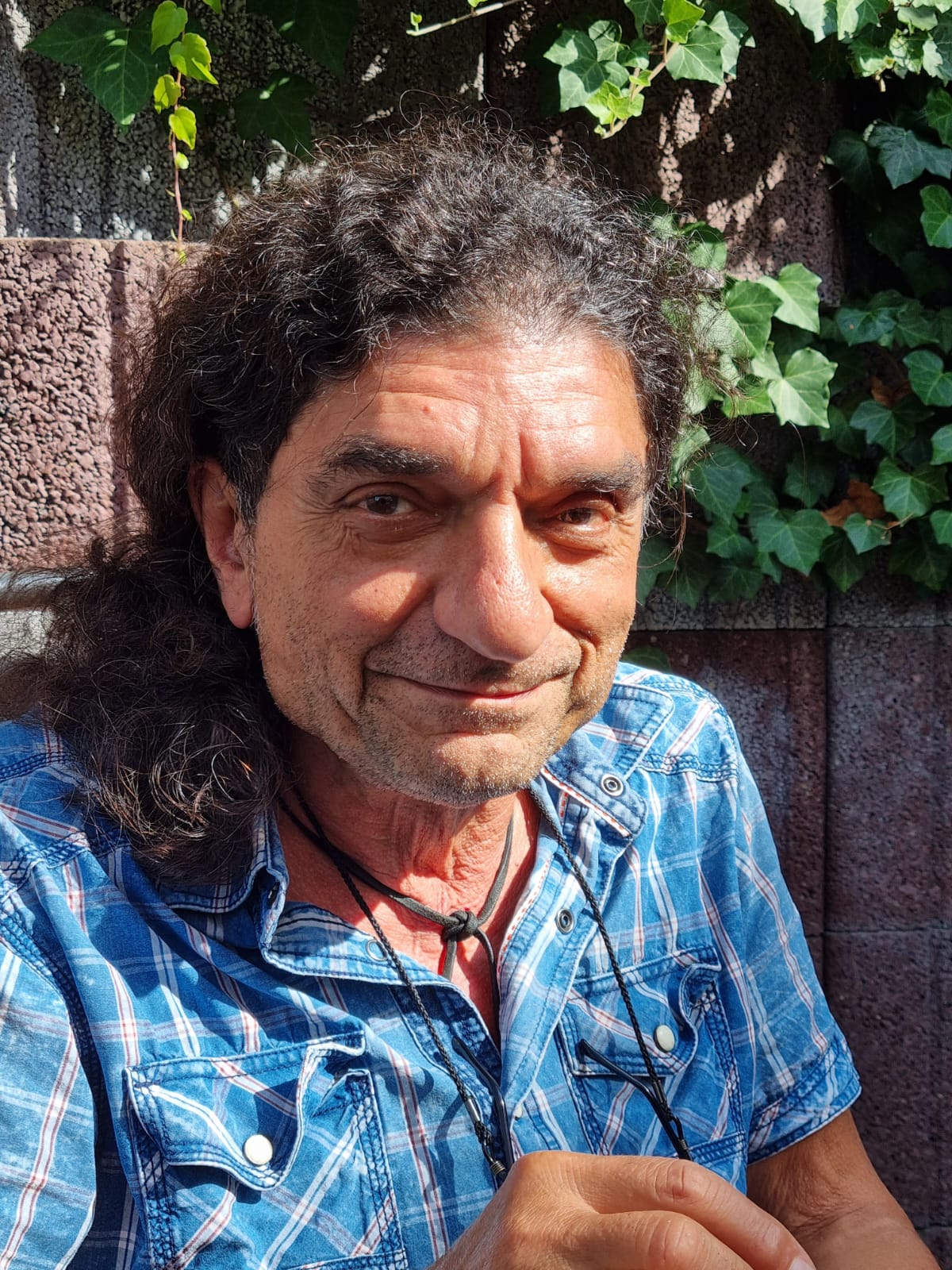
The father of my son’s bride and me; two unconventional individuals! He is some years younger than me!!
Well I’ll be damned Here comes your ghost again But that’s not unusual It’s just that the moon is full And you happened to call And here I sit Hand on the telephone Hearing a voice I’d known A couple of light years ago Heading straight for a fall
As I remember your eyes Were bluer than robin’s eggs My poetry was lousy you said Where are you calling from? A booth in the midwest Ten years ago I bought you some cufflinks You brought me something We both know what memories can bring They bring diamonds and rust
Well you burst on the scene Already a legend The unwashed phenomenon The original vagabond You strayed into my arms And there you stayed Temporarily lost at sea The Madonna was yours for free Yes the girl on the half-shell Would keep you unharmed
Now I see you standing With brown leaves falling around And snow in your hair Now you’re smiling out the window Of that crummy hotel Over Washington Square Our breath comes out white clouds Mingles and hangs in the air Speaking strictly for me We both could have died then and there
Now you’re telling me You’re not nostalgic Then give me another word for it You who are so good with words And at keeping things vague Because I need some of that vagueness now It’s all come back too clearly Yes I loved you dearly And if you’re offering me diamonds and rust I’ve already paid
Translated from volumes published by Lorenz Jung based on the edition “Gesammelte Werke” dtv.de The Symbols of Transformation (1952) and Aion (1950)
With warm regards, I would like to share another section of Jung’s concept of the Mana-Personality (The past sections: here, here, here and here). In this part, he discusses a sequence of dreams and, in the case of neurotics, a series of fantasies and how these are concealed in our subconscious and brought to light through dreams. Another topic is the complex, which also was a crucial subject for Sigmund Freud. The complex is a natural component of everyone’s inner self that accumulates from childhood to adulthood, which nobody can avoid. We should strive to explore our inner selves to untangle their knots- this contributes to the effort of comprehending the unconscious and bringing it into consciousness.
I firmly believe Dr. Jung holds the key to the recovery and healing process for every individual and, consequently, our entire society. His effort to identify and explain the main problems, which are timeless and universal, is truly commendable and offers valuable lessons for us all.
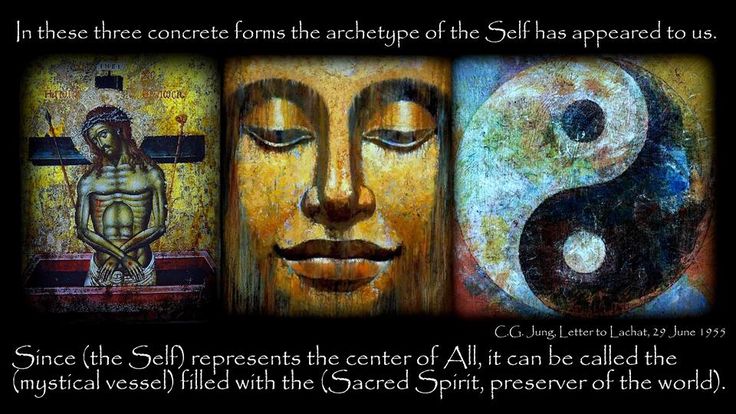
I cannot prove the identity of a historical personage with a psychological archetype. That is why I stop after establishing the fact that in the Occident, this archetype, or this “God-image,” is seen in Christ, in the Orient, in the Buddha, or in the form of Tao (which is not a personification but a metaphysical hypostasis). In these three concrete forms, the archetype of the self appears to us. Since it represents the centre of All, it can be called the vas mysticum, filled with the Spiritus Sancta servitor mundi. Carl Jung Depth Psychology Letters of C. G. Jung: Volume 2, 1951-1961
Since it is impossible for me to present the reader with such a series of images, some of which are very long, in detail, I would ask them to be content with the few examples and otherwise to trust my assertion that these are logically constructed, goal-oriented connections. I use the word “goal-oriented” with a certain hesitation, however. This word should be used with caution and with restrictions. In the case of mentally ill people, one can observe a series of dreams and, in the case of neurotics, a series of fantasies that run almost aimlessly within themselves. The young patient whose suicidal fantasy I mentioned above (The mentioned dream about his bride from the last post) is well on the way to producing a series of aimless fantasies if he does not learn to take an active part and consciously intervene. Only in this way can a direction be achieved towards a goal. The unconscious is a purely natural process, on the one hand, without intention but on the other hand, with every potential direction characteristic of every energetic process. But if the conscious mind actively experiences each stage of the process and at least understands it vaguely, the following image begins at the higher level achieved as a result, and this is how direction is created.
The next goal of dealing with the unconscious is to reach a state in which the unconscious contents no longer remain unconscious and no longer express themselves indirectly as anima and animus phenomena, i.e. a state in which the anima (and the animus) become a function of the relationship to the unconscious. As long as they are not this, they are autonomous complexes, that is, disruptive factors that break through the control of consciousness and thus behave like real troublemakers. Because this is such a well-known fact, my term ‘complex’ has also become common in everyday language. The more ‘complex’ someone has, the more obsessed he is, and if one tries to create a picture of the personality that expresses itself through his ‘complexes’, you may come to the conclusion that it must be a hysterical femininity – hence anima! But if he now becomes conscious of his unconscious contents, not as factual contents of his personal unconscious, but as fantasies of the collective unconscious, he gets to the roots of his complexes and thereby triggers his obsession. The anima phenomenon then ceases.
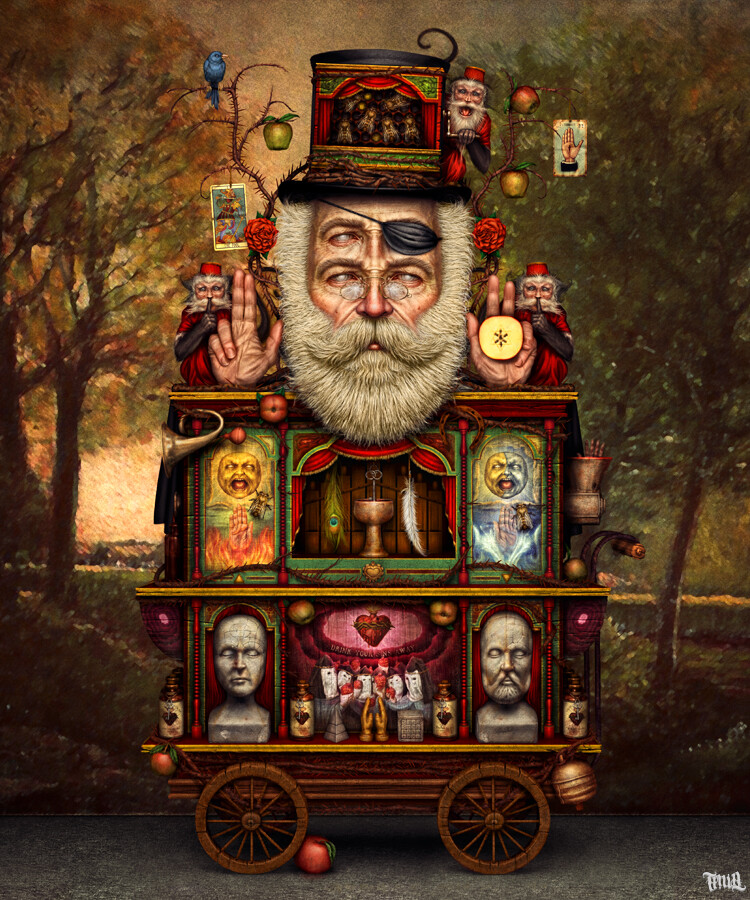
Illustration: Guillermo del Toro
But that certain overpowering force that caused the obsession – what I cannot shake off must be superior to me in some way – should logically disappear with the anima; one should become >complex-free<, psychologically house-trained, so to speak. Nothing should happen that the “I” does not allow, and if the “I” wants something, nothing should be able to interfere. This would secure the “I”, an unassailable position, the steadfastness of a superman or the superiority of a perfect sage. Both figures are ideal images, Napoleon on the one hand and Lao Tzu on the other. Both figures correspond to the ‘extraordinarily effective’ concept, which is the term Lehmann uses in his well-known monograph to explain Mana (Lehmann: Mana, 1922). Therefore, I simply call such a personality a Mana Personality. It corresponds to a dominant of the collective unconscious, an archetype that has developed in the human psyche since time immemorial through appropriate experience. The primitive man does not analyse or explain why another is superior to him. If he is smarter and stronger than him, he has Mana; that is, he has greater power; he can also lose this power, perhaps because someone has stepped over him in his sleep or someone has stepped on his shadow.
Today, I would like to present something different. (There is always a worm inside me looking for variety!). After a long time, I looked into my Amazon Kindle collection and suddenly came across the book “Heart of a Sufi: Fazal Inayat-Khan – A Prism of Reflections”. I wouldn’t say I like to read books on PS or Kindle, so I overlooked this book in those days. Now, I have found it worth sitting and reading.
Fazal Inayat-Khan Fazal (July 20, 1942 – September 26, 1990), also known as Frank Kevlin, was a psychotherapist and poet. I didn’t know him before, and I must thank Ashen Venema, A great, wise friend (https://courseofmirrors.com/); I could get to know this brilliant Sufi. Now, under the motto “long story short,” I picked a part of this book written by Rahima Milburn, whose parents were taught Sufism by Fazal. I hope you will enjoy it.
If I thought I could change the world, I would try, but I am completely convinced, as most of us are, that I cannot. You eventually come to the realisation—and there is much maturity and existential self-possession in this realisation—that we can only change ourselves. Fazal Inayat-Khan, Lecture, New Experiential Wisdom, 1989
Dutch painter Herman Smorenburg
In Roughwood
From “Heart of a Sufi: Fazal Inayat-Khan – A Prism of Reflections (English Edition by Rahima Milburn (Author, Editor), Ashen Venema (Editor), Zohra Sharp (Editor) )”
I’m in Roughwood for the first time since the memorial last December. The first time, I was really touching the fact that you are dead. Dead? The word somehow doesn’t mesh with the reality. For you still are here. Not just your photos and your memories, but you. Your fragrance, your influence. No, YOU. Not just a semblance, an essence – really YOU. In this chilly sitting room, redolent with decades of incense and music, I find you in your silence, in your patience, and in the glad, unyielding faith you have in us. In me. That afternoon in the very early days, we talked here, and your eyes reached into me. To say follow your heart was infinitely more meaningful now I had located it. Or you had located it for me. I had dropped something, it seems. You stooped, picked it up, dusted it off and called after me, ‘Hey, you might be needing this.’ You blew on it to clean it, reached out your hand to give it, and now, in Roughwood, you do it once again.
Shadows of birds swoop across the open windows. In the distance, wood pigeons lament, mourning throatily in the round.
Down this creaky hallway, you feel as we come in from out-of-doors and head for the kitchen. Here you are … passing in a hurry, going somewhere. The movement of you can be felt – that irresistible combination of childlike excitement and manly confidence pushing us, pulling us ever onwards. Never knowing what lies around the next bend but sure that if we could be true, it would be also. Urging me on … like that day you shooed me out of Roughwood to go sell books. ‘You never know how you might be spreading the message,’ you said. What a manipulator, I thought, not wanting to sell books or anything. And now, in Roughwood, you are doing it again. But now I see that it is true: endlessly down this path lies my challenge – the movement of you in me makes it so.
Overhead, almost in the clouds in wide whistling circles, the gliders swing. Evidence. One can soar – all is possible!
This morning, in the garden, you passed beneath the twin trees into that mystery foretold when under them long ago we sat and listened. That voice, wise, wily, winding ideas that mazed us turned the world inside out, flung us ready or not to the borders of reason. I can almost see that summer evening when, after a long hospital stay, you had us gather around. I was unbelieving you could actually have been ill but there you were, yellow to prove it. Speaking softly, slowly, you drew us back to the vistas of liberation. The promised land is one of joyful detachment, ongoing renewal and unquestioning love. You led us there – this brave troop beneath the cedars; brave because the one we followed was so alive, so sure, even when yellowed and frail. And now, in Roughwood, you are doing it again, doing it still. If we stop beneath these trees, with little effort, we can know the sublime, the simple, the outrageous, the evident, the effulgent light that is you.
Butterflies busy themselves in Sitara’s garden, growing as naturally as rain falls in England, as unruly as his hair, as magical as all we are in whom he now lives.
Dead? Slowly by slowly, I realise he has never been more alive.
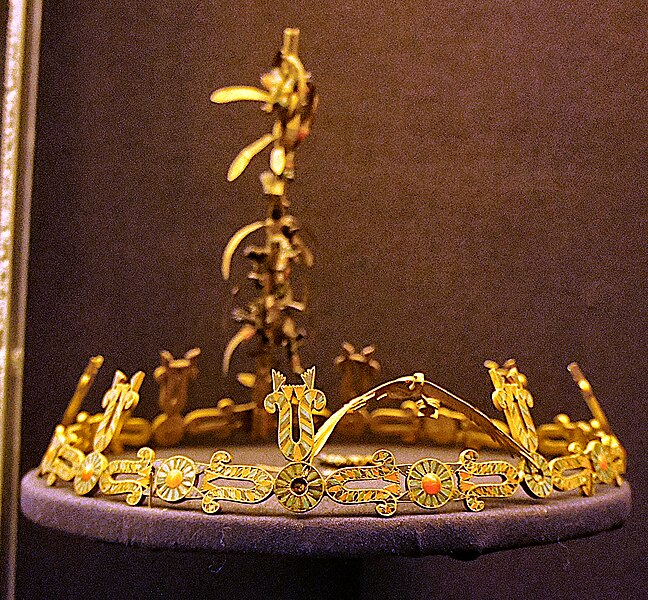
Diadem_of_Princess_Khenmet_or_Khnumit_(cropped)_1 SONY DSC
To be honest, I was never impressed by jewellery. I can’t distinguish the worth of one stone from the other, and I never understood why some people are so fascinated by them. After all, a stone is just a stone, right? But these pieces of jewellery are something extraordinary.😉
Khenmet, or Khnumit, was an ancient Egyptian king’s daughter of the Twelfth Dynasty, around 1800 BC. She is mainly known for her unrobbed tomb, which contains a set of outstanding personal adornments.
Princess Khenmet is only known from her burial next to the pyramid of Amenemhat II at Dahshur. On the West side of the pyramid were three underground galleries with each of two tombs. Four of these tombs, including those of Khenmet, Ita, and Itaweret, were found unlooted. The father of Khenmet is uncertain, but since she was buried in the pyramid complex of King Amenemhat II, it seems likely that she was his daughter.
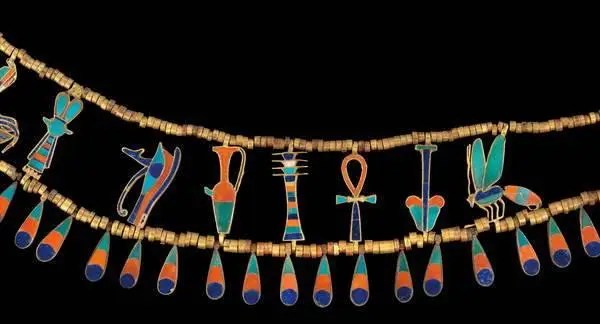
As we delve deeper into these jewels, we realize they are crafted not just from gold for their lustre but also as symbols of destiny, well-being, and everlastingness.
Now, let’s enjoy reading another fascinating discovery of these treasures by Marie Grillot.🙏💖🙏
Two bracelet clasps of Princess Khnumit – gold and stones – Middle Kingdom – 12th Dynasty – reign of Amenemhat II from her tomb, discovered on February 16, 1895, by Jacques de Morgan, in the funerary complex of Amenemhat II in Dahshur Egyptian Museum of Cairo – JE 31091 – CG 52044 and CG 52045
Princess Khnumit was one of the many daughters of Amenemhat II, ruler of the 12th Dynasty (1932 – 1898 BC). According to some sources, she was also his son’s wife and successor, King Senusret II. She was buried in Dahshur, northwest of the White Pyramid (that of Amenemhat II).
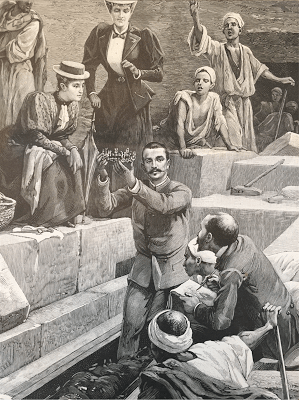
Jacques de Morgan during the discovery of Khnumit’s jewels in February 1905 in Dahchour drawing published in “L’Illustration” on May 11, 1895
It was the French Egyptologist Jacques que Morgan who discovered her tomb in February 1895.
“The sarcophagus had been put in place at the same time as the tomb had been built. Perhaps even the wooden coffin it contained had also been placed before the death of the personage so that on the day of burial, all that remained was to place the body and the offerings in the tomb.”
Plan of the tomb of Princess Khnoumit published by Jacques de Morgan
The discoverer also specifies that the princely mummy was once painted and covered with a bitumen coating. Its gilded mask was decorated with red, blue, and gold designs, and two eyes mounted in silver.”
Sumptuous jewels accompanied her for eternity: necklaces, bracelets, in gold, inlaid with carnelian, emerald and lapis lazuli… The chamber of offerings concealed a veritable treasure. “Terracotta vases filled with the debris of the offerings covered the paving in the middle of a bed of white dust accumulated by the centuries. To the right, along the wall located between the two doors, was a pile of bones of oxen and geese, the remains of the provisions that had been deposited near the dead. Along the eastern wall and almost in the middle was the closed perfume box; further away, a small square board, the bronze perfume burner and finally, the canopic box, which occupied almost the entire back of the room. All these objects were dust-covered, so I found it difficult to distinguish their details in the darkness. However, after removing the vases, I was astonished to find some gold jewels near the perfume box.”
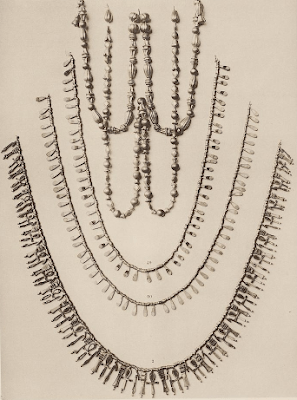
Among Princess Khnoumit’s jewels were numerous necklaces
The jewels that accompany the princess for her eternity are extraordinary, of such accomplished beauty and art that Jacques de Morgan would say: “I do not believe that, even today, a jeweller can achieve such great perfection, such truth of rendering and such beautiful designs as the obscure worker who, many centuries ago, chiselled in some street of Memphis these singular jewels with which Princess Khnoumit was to adorn herself.”
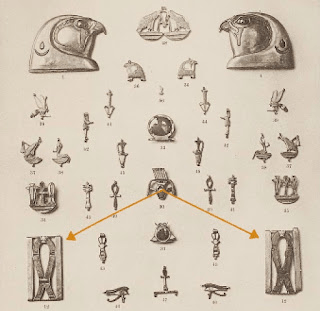
Khnoumit’s Jewels: From work by Jacques de Morgan, this plate reproduces the two clasps decorated with the sign “SA.”
Among these jewels are these two bracelet clasps found in the sarcophagus. Although they are not among the most sumptuous or best known, they nevertheless deserve our interest.
They come in the form of a rectangular plate, nearly 4 cm high and just over 2 cm wide, bordered with gold. This “frame” is pierced with holes in which the threads of the rows of pearls are attached. Inside the sign, ‘SA’ stands out in lapis lazuli, decorated in its highest part with a small lion’s head, or panther, in gold.
Two bracelet clasps of Princess Khnumit – gold and stones – Middle Kingdom – 12th Dynasty – reign of Amenemhat II from her tomb, discovered on February 16, 1895, by Jacques de Morgan in the funerary complex of Amenemhat II in Dahshur – Egyptian Museum of Cairo – JE 31091 – CG 52044 and CG 52045
In “Bijoux et orfèvreries”—Fascicule 2 -, the Egyptologist Émile Vernier provides the following details on the manufacture of the “SA” sign: “It is divided into six pieces by the lioness’s head and by cloisonné links; these links are made of three small strips, the middle one in carnelian and the other two in turquoise.”
The hieroglyph ‘SA’ symbolises protection, “perhaps representing the folded mat used by shepherds to protect themselves from the elements.”
Émile Vernier also tells us about what we cannot see, the reverse side of the clasp: “The reverse side is chiselled, the body of the sign is made like a bundle of seven stems joined together and linked in six places corresponding to the lioness’s head and the five links on the front. These links are divided into three parts, a central one wider than the other two.”
These clasps are now “orphaned” from the rows of gold, carnelian, lapis lazuli, and turquoise beads that made up the bracelet they closed. Therefore, we must rely on our imagination to reconstruct them and imagine them adorning Princess Khnoumit’s arms.
These jewels were deposited at the Cairo Museum, recorded in the Journal of Entries JE 31091, and then in the General Catalogue under the references CG 52044 and CG 52045.
As I sit on my (still not a park bench!) armchair in my working room, I’m still amazed at how these previous times have passed, with renovations and holidays in foreign countries (that is, after all, not in an EU community!)… I’ve reached a certain age where I may not feel physically but still not mentally. I thought, after a difficult post like the one before, I’d gab a bit about my feelings.
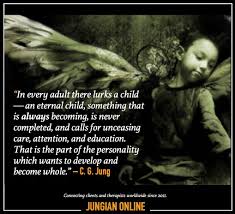
A few days before, one of our friends shared about feeling lonely on his/her birthday. I empathized with, even though I believe a birthday is just like any other day. After all, it’s only a number that goes up, which is definitely better than the alternative! However, my birthday became a big deal in our family because it was a milestone age—something you wouldn’t expect by looking at me! Perhaps it’s the child inside me that never lets my true age show and always keeps that inner child alive.
In the early ninetiesJust a few days ago
Time it was And what a time it was It was . . . A time of innocence A time of confidences Long ago . . . it must be . . . I have a photograph Preserve your memories They’re all that’s left you Bookends
Moreover, my main reason for writing these words is because a sudden rush of memories reminded me of the time when Al and I kept listening to that Simon & Garfunkel album(Bookends) over and over again. We were young back then and didn’t know how strange it was to be seventy years old. Now I know it (unfortunately, Al didn’t reach that); nevertheless, as I still must continue my work and drive the older adults to their destinations, I don’t feel that old as they do.
“Old Friends” by Simon & Garfunkel
Old friends Old friends Sat on their park bench Like bookends A newspaper blown through the grass Falls on the round toes On the high shoes Of the old friends
Old friends Winter companions The old men Lost in their overcoats Waiting for the sunset The sounds of the city Sifting through trees Settle like dust On the shoulders Of the old friends
Can you imagine us Years from today Sharing a park bench quietly? How terribly strange To be seventy
Old friends Memory brushes the same years Silently sharing the same fear
Translated from volumes published by Lorenz Jung based on the edition “Gesammelte Werke” dtv.de The Symbols of Transformation (1952) and Aion (1950)
With heartfelt regards to my friends, I present another episode of the Mana-Personality. I mention the past ones here: 123, as I know it is necessary to read them continually. I had to read the last one myself to know where I was at all! In any case, I think and feel that Dr Jung knows how complicated this issue is and makes an effort to make it easier, and I make an effort to keep translating this jewel from the origin of his own writing, which can be the most trustworthy source.
Dr Jung’s work on this topic (Mana-Personality) stresses the unknown, hidden behind the unconscious, and tries to bring it to the conscious. One of his main points (in most of his works) is pointing back to the collective unconscious and finding the connection in between. That is intensively probing every corner of the human soul, and it is not only fascinating but also important!
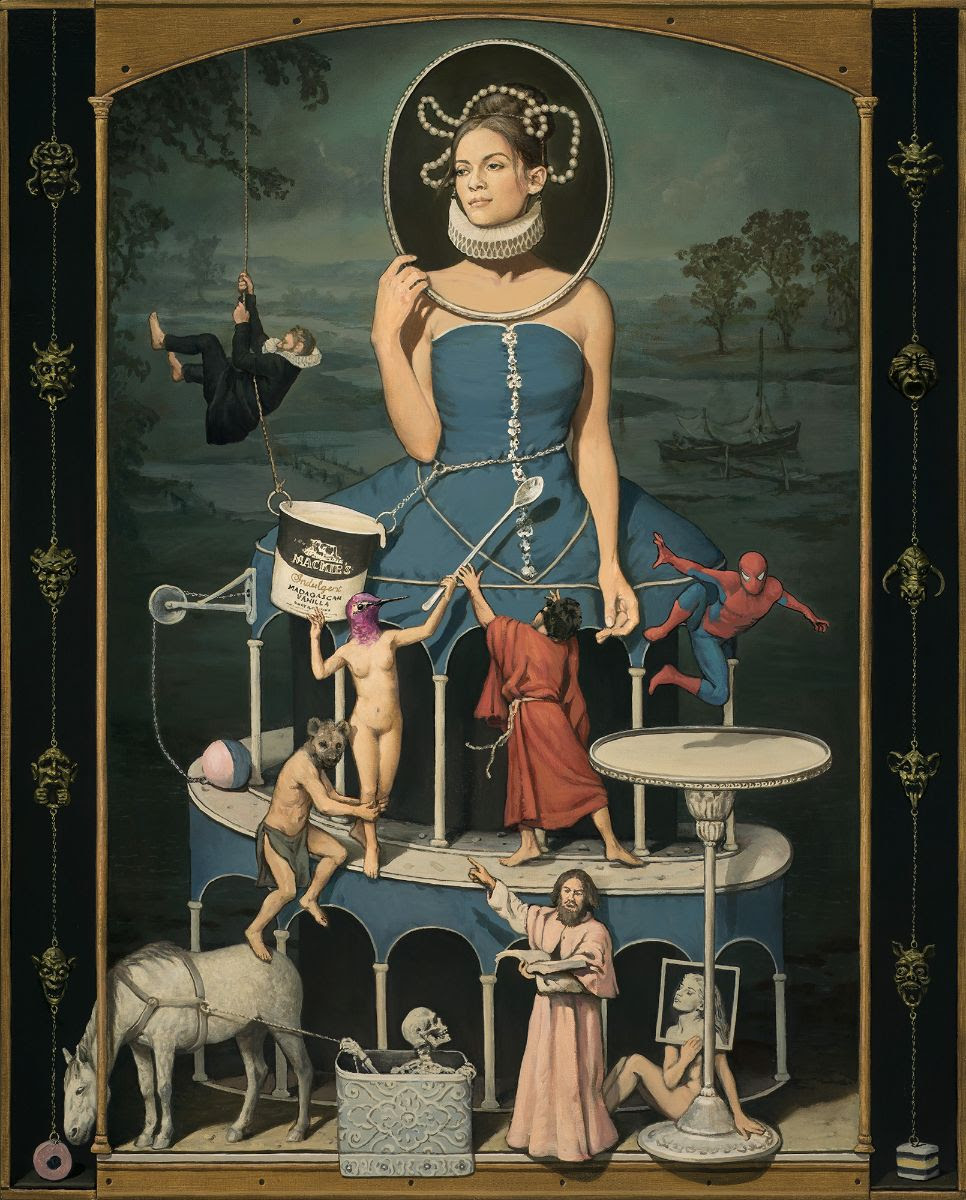
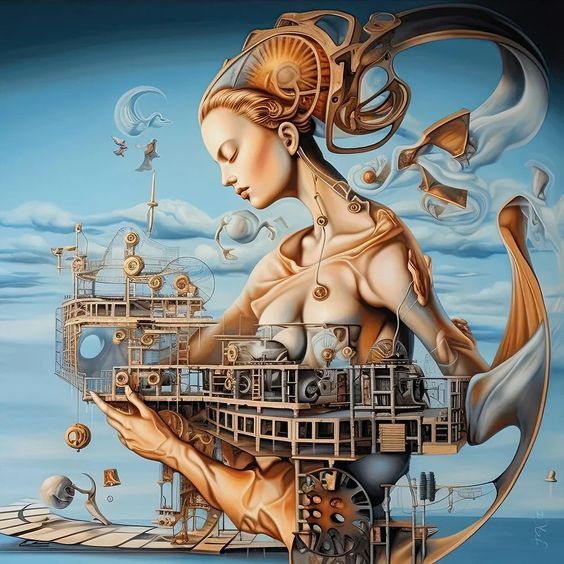
Illustration at the top: Alan Mcdonald: A Spoonful of Sugar.
Let’s continue reading:
The starting point for our problem is the state that follows when the unconscious contents that cause the anima and animus phenomenon have been sufficiently brought into consciousness. This can best be thought of in the following way: The unconscious contents are initially things of the personal atmosphere, perhaps in the manner of the fantasy of the male patient mentioned above: (It refers to the dream of one of his patients: he sees his bride running down the road to the river. It is winter, and the river is frozen. She runs out onto the ice, and he follows her. She goes further out, and there the ice has broken; a dark crack opens up, and he is afraid she might fall into it. Indeed, she sinks into the crack, and he watches her sadly).
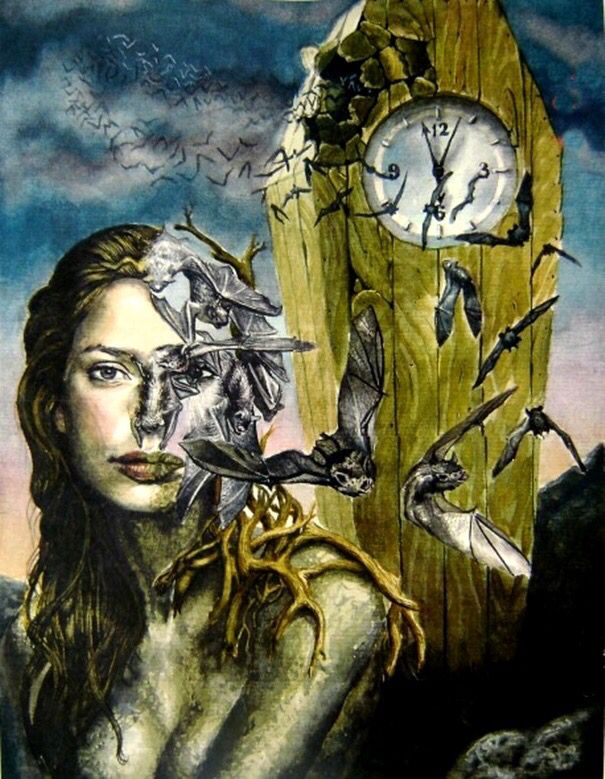
Painting by Peter Gric
Later, fantasies of the impersonal unconscious develop, essentially containing collective symbolism, such as my patient’s vision. These fantasies are not wild and motionless, as one might naively think, but they follow certain unconscious guidelines that converge towards a specific goal. One might, therefore, best compare these later series of fantasies to initiation processes because they are the closest analogy to them. All fairly organized primitive groups and tribes have initiations, often extraordinarily developed, that play an extremely important part in their social and religious life (Primitive Secret Societies, 1908; see Webster.)
Through them, lads will become men and girls into women. The Kavirondos insult those who do not submit to circumcision or excision as ‘animals’. This shows that the initiation rites are the magical means by which man is led from the animal state to the human state. Primitive initiations are evidently mysteries of transformation of the most tremendous spiritual significance. Very often, the initiates are subjected to painful methods of treatment, and at the same time, tribal mysteries are communicated to them: the laws and hierarchy of the tribe on the one hand and cosmogonic and other mythical teachings on the other. The initiations have been preserved among all civilized peoples. In Greece, the ancient Eleusinian mysteries apparently survived until the 7th century. Rome was flooded with mystery religions. One of these is Christianity, which, even in its present form, albeit faded and degenerated, has retained the old initiation ceremonies of baptism, confirmation, and communion. Therefore, no one will be able to deny the enormous historical significance of the initiations.
Time Goes by Like Water by Joseph-art on DeviantArt.
The modern world has nothing to compare with the historical importance of initiation (compare the testimonies of the ancients with regard to the Eleusinian mysteries!). Freemasonry, the I’Église Gnostique de la France, legendary Rosicrucians, theosophy and so on are weak substitutes for something that would be better marked in red letters on the list of historical losses. The fact is that the entire symbolism of initiation appears in the unconscious with unmistakable clarity. The objection that this is old superstition and completely unscientific is as intelligent as someone who, upon seeing a cholera epidemic, notices that it is merely an infectious disease and, what’s more, unhygienic. The question is not, as I must emphasize again and again, whether the initiation symbols are objective truths or not, but simply whether these unconscious contents are equivalents of the initiation practices or not and whether they have an influence on the human psyche or not. Nor is it a question of whether they are desirable or not. It is enough that they exist and that they work.
When my brother, Al, was in the hospital to undergo surgery to remove a tumour from his brain, one of the professors told him that we humans know almost nothing ( just ten per cent) about how our brains work – The rest is still a puzzle! Therefore, unexplained phenomena, such as strange things like seeing ghosts, daydreams, or schizophrenia, are always fascinating topics for inquisitive minds.
According to Dr Carl Jung: …in schizophrenia, the complexes have become disconnected and autonomous fragments, which either do not reintegrate back to the psychic totality, or, in the case of remission, are unexpectedly joined together again as if nothing happened” (1939).
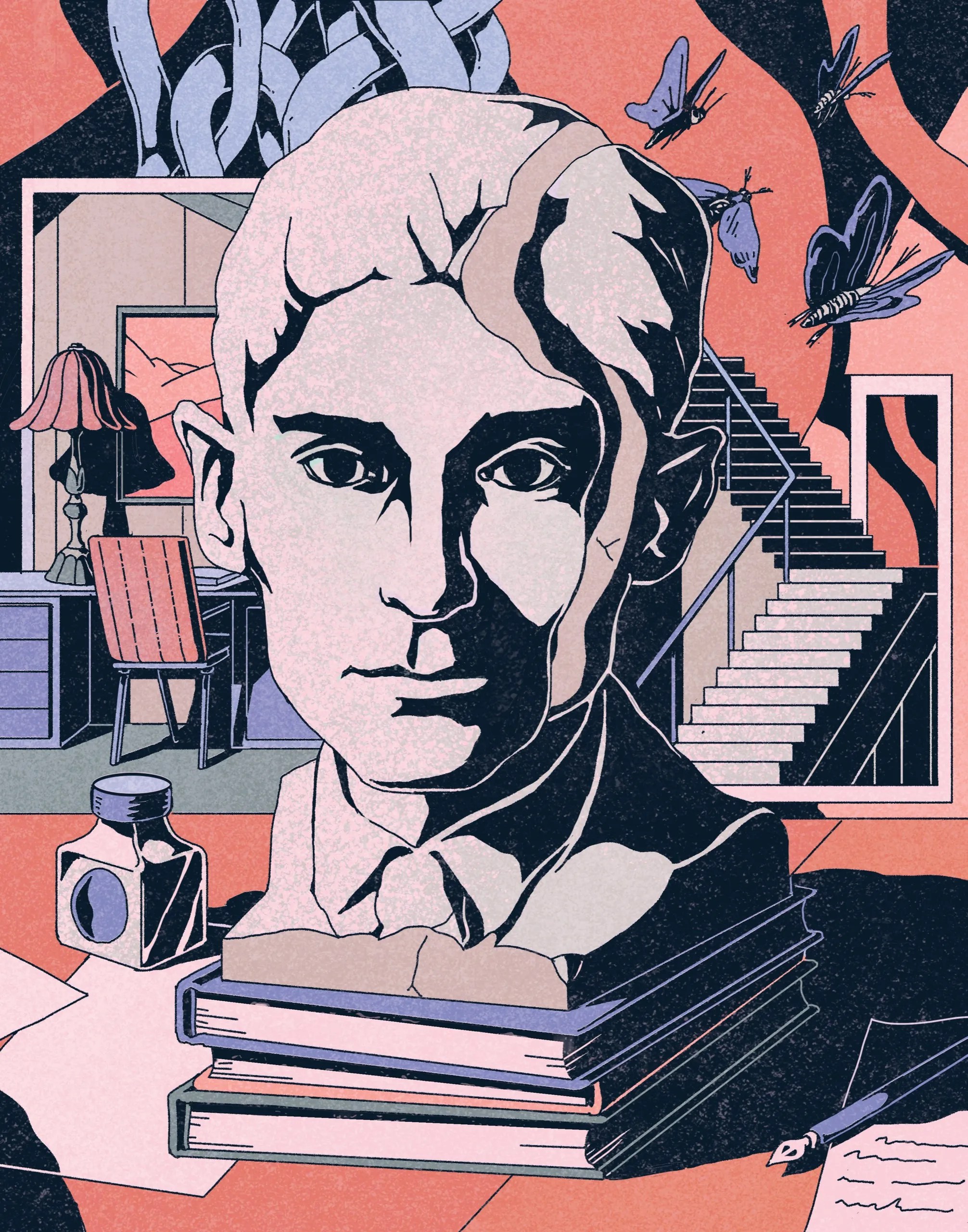
Franz Kafka Dreams >Wrestling matches every night<
During our trip to Serbia (I will write a post about it soon), I brought along some books as I do on any trip. This time, I discovered some surprises. While renovating the apartment, I found a book I couldn’t remember owning. Upon picking it up, I found a shopping receipt in the book dating back to 1995. It was clear that the book belonged to Al. Apart from a few novels, Franz Kafka wrote thousands of letters about his thoughts, dreams, and daydreams, and I was excited to have this particular book. The book is in German, and I translated a description and one of his letters about his dreams. I often considered the similarities between Kafka and Dostoevsky, as the latter frequently had daydreams like a schizophrenic. In this dream, Dostoevsky is interestingly present! I hope you will enjoy it.
The New Yorker
According to Jean-Paul, dreams substantially affect a poet because he is used to fantasy. In contrast, Kafka’s dreams intensified his daytime fears. Taken out of context, his dreams form an interesting “storybook” of events and changes involving real people and places from his life. Kafka’s descriptive notes allow the reader to relive each dream-like episode as if watching a film vividly. This collection also serves as a documentary, presenting the dreams chronologically and reproducing Kafka’s comments on the phenomenon of dreams and dreaming.
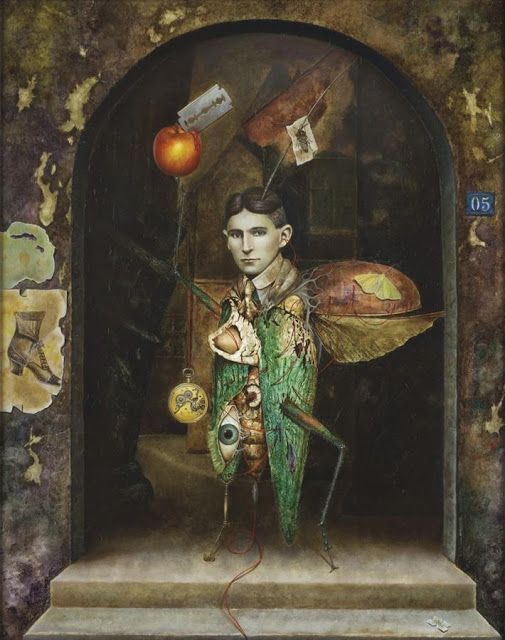
Frank Kortan – THE METAMORPHOSiS
Gregor Samsa woke up one morning to find himself transformed into a monstrous vermin. Franz Kafka’s “The Metamorphosis” challenges readers to accept this transformation as real, denying the possibility of dismissing it as merely a dream. This may frustrate those who rely on reason to understand the world and expect literature to assist them in this endeavour. In 1916, Franz Herwig criticized the rejection of realism and its associated positive aspects in an essay about the authors of the series “The Judgement Day,” in which Kafka’s story appeared. Gregor Samsa’s story “The Metamorphosis” challenges our understanding of reality and urges us to see the world in a new light. Kafka emphasizes that incomprehensible forces are shaping our lives, which may be more influential than we can rationally explain. According to his commentary on the story “The Judgement,” which he wrote in one go from ten o’clock in the evening to six o’clock in the morning, this is the only way to write in such a context—with a complete openness of body and soul! In this type of writing, the usual censorship of the mind is primarily eliminated. Everything can be risked, and a great fire is prepared for everyone for the strangest ideas, in which they perish and rise again.
Dream! [To Milena Jesenska, August 1920; M 170-172]
Today, I think I dreamt of you for the first time since I’ve been in Prague. A dream towards morning, short and heavy, still caught up in sleep after a bad night. I know little about it. You were in Prague; we were walking along Ferdinand Street, a little opposite Vilimek, in the direction of the quay; some acquaintances of yours were walking past on the other side; we turned to look at them; you spoke of them, perhaps there was also talk of Krasa [I know he is not in Prague, I will find out his address]. You said as usual, but there was something incomprehensible, indescribable about rejection in it; I didn’t mention it but cursed myself, thereby only expressing the curse that was on me. Because we were in the coffee house, probably in the Kaffee Union (it was on the way, and it was also the coffee house from Reiner’s last evening), a man and a girl were sitting at our table, but I couldn’t remember them. Then, there was a man who looked very similar to Dostoyevsky but young, with a deep black beard and hair. Everything, for example, the eyebrows and the bulges over the eyes, were incredibly strong. Then you were there, and I. Again, nothing betrayed your aloof manner, but the rejection was there.
Painting: Jorge Ignacio Nazabal
Your face was – I could not look away from the tormenting oddity – powdered, and it was overly obvious, clumsy, bad; it was probably hot, and so whole powder lines had formed on your cheeks; I can still see them in front of me. Again and again, I leaned forward to ask why you were powdered; when you noticed that I wanted to ask, you asked obligingly – the rejection was simply not noticeable – >What do you want?< But I could not ask, I did not dare, and yet I somehow suspected that being powdered was a test for me, a crucial test, that I should ask, and I wanted to but did not dare. And so the sad dream rolled over me. At the same time, the Dostoyevsky man tormented me. His behaviour towards me was similar to yours but still a little different. When I asked him something, he was very friendly, sympathetic, leaned over, and open-hearted. Still, when I didn’t know what to ask or say – this happened every moment – he would withdraw with a jerk, sink into a book, know nothing more about the world and especially not about me, disappear into his beard and hair. I don’t know why I found this unbearable, again and again – I couldn’t do anything else – I had to pull him over to me with a question and again and again, I lost him through my own fault! 💖🙏🤗
The Imagen at top: Youri Ivanov – Artiste Russe (Russian)
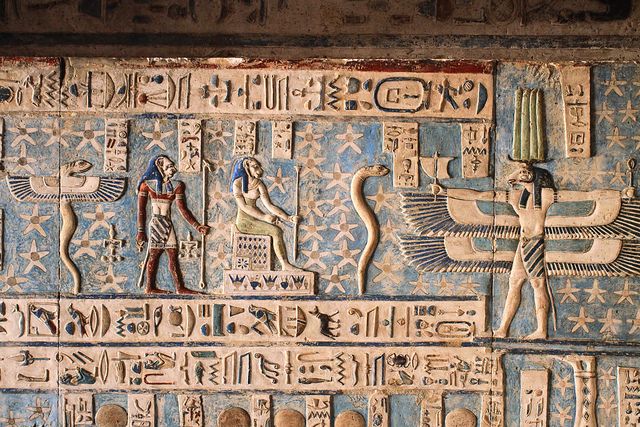
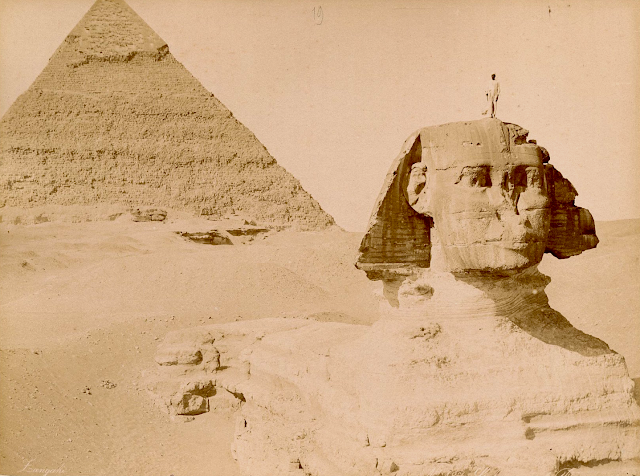
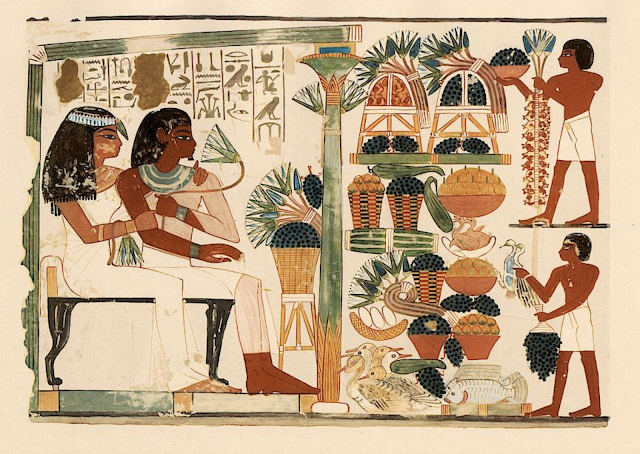
1-The Great Sphinx in Egypt is believed to have the face of Pharaoh Khafre — 2-Dendera: Egypt’s Best-Preserved Temple Complex — 3-View of the west wall, depicting Nakht and his wife, Tawy, seated before offerings (top left), Nakht hunting in the marshes (top right), Nakht and Tawy receiving the produce of the grape harvest (bottom left), and grape harvesting, winemaking, bird capturing, and plucking (bottom right) (Source: OsirisNet).
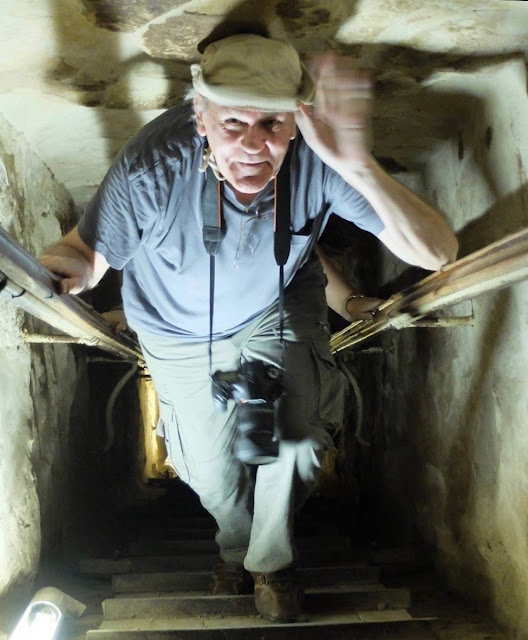
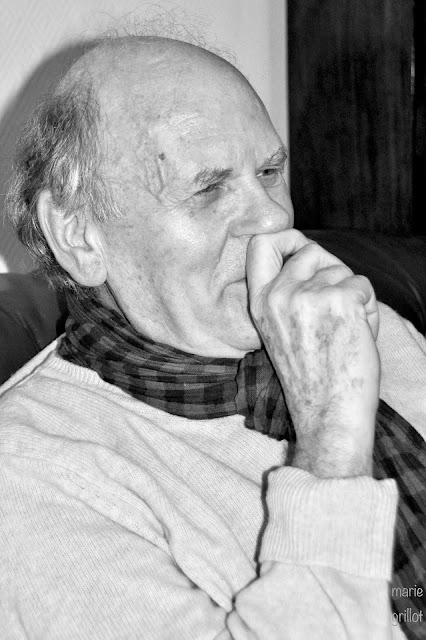
I decided to share this journal post about three short reports by great Egyptologists today in memory of Marc Chartier, an excellent journalist, human and friend whom I enjoyed and learned a lot from his works for a long time, particularly from his fascinating journey reports.
Marc Chartier (Guinevert-Durtal, 23-2-1940 – Argenteuil, 27-7-2024) Journalist, passionate about Egypt in general and the pyramids in particular, creator of the blogs: “Pyramidale”, “L”Egypte entre Guillemets”, “Egyptophile” and founder of the press review “Egypte-actualités.”
With forever thanks and immense gratitude to Marie Grillot, as she wrote in her post: During these periods of questioning that assail us all, Marc refocused on this sentence, full of wisdom, which is, in fact, an African proverb taken up by Aimé Césaire: “When you don’t know where you’re going, look where you come from”… These words brought him back to Guinevert, in Sarthe, to his father, to this little brother who both disappeared too soon and especially to “Mamani” who held her sons so tightly against her during the bombings…
marc sa vie Marc Chartier (Guinevert-Durtal, 23-2-1940 – Argenteuil, 27-7-2024) Journalist, passionate about Egypt in general and the pyramids in particular, creator of the blogs: “Pyramidale”, “L”Egypte entre Guillemets”, “Egyptophile”, and founder of the press review “Egypte-actualités”
Let’s join these amazing trips! RIP Marc.💖🙏💖
A day in Egypt with… Mohammed Ali Kamy, Jean Capart, Léon Labat
“At the foot of the pyramids stands the Sphinx, guardian of the sacred enclosure. It is rightly considered the most famous monument, after the pyramids, of this vast field of the dead, the Giza plateau. The Sphinx is a colossal statue carved in the rock that borders the desert plateau. It must originally have been a rough rock, to which nature had given the vague contours of a crouching animal. The artists of the Old Kingdom gave it the form of a lying lion, a symbol of physical strength, and sculpted a human head, an emblem of mental strength, that of the king, as indicated by the headdress decorated with the uraeus. This fourth wonder of Giza is located north of the Valley of King Chephren temple. (…)
An imposing expression of strength and grandeur remains in the whole, even after the deterioration that the monument has undergone over time: the beard and nose have been broken (part of it is preserved in the British Museum), the neck has shrunk; the mouth smiles, the eyes look into the distance, piercing infinity and the whole face bears the imprint of Egyptian beauty. The red tint that enlivened his features has been erased almost everywhere. No work coming from the hand of men offers more strength or sovereign grandeur. (…) What is he doing there, this impassive being under the sky, lost in solitude? What is he doing there, this being who defies time and seems to say to passers-by: “You are all mortal, I am eternal”?
The ancient historians who visited Egypt gave no information or description about it. All their attention was devoted to the pyramids. Was the Sphinx already buried in the sand since it did not attract the attention of historians? To our knowledge, the first time it was dug out of the sand was under the New Kingdom. At that time, the ancient Egyptians who lived in the vicinity of the necropolis of Giza worshipped it as an image of the God Ra under the name of Hor-em-aches, that is to say, “Horus in the horizon”, or the rising sun. The stelae discovered near the great pyramids prove that the kings sought this region of the suburbs of Memphis for hunting wild beasts and gazelles. For this reason, the ancient Egyptians called it The Valley of the Gazelles. (…) Despite the mutilations of time and men, the Sphinx retains a mighty and terrible serenity that strikes and seizes to the depths of the heart. This calm and impassive figure, whose smile sometimes seems filled with disdain and pity, bears the imprint of great wisdom. His eyes fix the infinite on the side where the sun, creator of all things, rises as if he wanted to be the first to discover, in the morning, over the valley the apparition of Re. The whole evokes a sort of mystery, and the Sphinx retains a sovereign expression of strength and grandeur even in his distress. Faithful guardian of the sacred enclosure, he always watches over the foot of the Pyramids of Giza.
The artist who conceived this prodigious statue was already a complete artist and master of its effects in the beauty of the type, the grace of the expression and the perfection of the work. One never forgets, when one has seen them, the intensity and the depth of thought of these eyes that look so far beyond the reality of things. It imposes an indefinable fear, so much that its face remains impenetrable, and its empty eyes seem to keep the vision of a crowd of distant, unknown and terrible things. How many people have not passed before it, then vanished into time? How many, among humans, are in the presence of this symbol of mystery, and are they not tempted to say to it: “Ah, if you could speak and tell what these eyes have seen that look so far beyond the reality of things!” The Sphinx, Hor-em-aches, God of the Rising Sun, seems to be the ever-living soul of old Egypt.”
(extract from “La Revue du Caire”, n° 102, September 1947)
**********
A day in Egypt with… Léon Labat (1803-1847), a great traveller and former surgeon to the Viceroy of Egypt
Bonfils, low relief of the Temple of Denderah, circa 1880
“One of the most beautiful privileges of architecture is to reveal to posterity the particular character of each person. That of the Egyptians was austere like their customs: the style was simple but imposing and sublime. Their constructions were neither frivolous nor ephemeral like most of ours. Eternity was, for them, a cult whose dogmas they inscribed on the living pages of their gigantic monuments. Everything about them bore the imprint of a noble and thoughtful character. These people, who constantly meditated on the eternal works of God, tried to imitate them as if to come closer to their ancient origin. These monuments, which they would have liked to make imperishable, were to be the object of religious contemplation for present generations and posterity. Greece, Rome, and later our modern Athens erected temples to the gods, palaces to the kings, and circuses for the people’s amusement. To this triple purpose of utility, the Egyptians knew how to add another which constitutes the specific character of their architecture: their monuments, with broad bases and large surfaces, whatever their destination, were arranged in such a way as to receive their hieroglyphic inscriptions.
A religious and conservative principle thus attaching itself to the buildings which were erected from generation to generation, the long valley of the Nile was soon dotted with an infinite number of temples, mausoleums, obelisks, palaces and aqueducts which led water into all the cities. A noble sentiment of religious piety and respect for the dead made them undertake the most prodigious constructions which human power has ever attempted: their masses, which rose up to the heavens, gave birth in the spirit of these populations a feeling of meditation and recollection which we ourselves have deeply felt at the sight of the colossal pyramids of Memphis. Not content with honouring the gods and the memory of great men by erecting monuments to them, they also wanted to give the mortal remains of their parents an asylum of rest and eternal preservation: immense hypogea were dug into the sides of the mountains and into the bosom of the earth to house innumerable mummies which were for them a sort of protest against nothingness. All the actions of these virtuous people constantly recalled the worship of the divinity and the respect for the dead. This respect was such that the Egyptians buried in the tombs of their ancestors the different objects they had loved and the instruments that had contributed to their illustriousness. Finally, they pushed their gratitude for the works of God to the point of embalming and housing in the hypogea of various species of animals. One would be tempted to believe that they wanted to extend the dogma of immortality to all the beings that heaven had brought forth on the fortunate soil of Egypt.”
(extract from Ancient and Modern Egypt, 1840)
**********
A day in Egypt with… Jean Capart (1877-1947), Belgian Egyptologist
Tomb of Nakht at Thebes by Norman de Garis Davies
“Without wishing to settle the most severe problems of aesthetics, let us now ask ourselves if it is impossible to point out in a few simple facts what one could call the awakening of the feeling of beauty among the Egyptians. The first noticeable characteristic to underline is their extraordinarily developed taste for floral decoration. The Egyptians passionately loved flowers, yet the Egyptian flora was not wealthy. They used the lotus for the most diverse uses on feast days, hung garlands at the top of walls, hung the cornice of kiosks and canopies, surrounded vases, and made necklaces and crowns with it. Decorative art, here, only had to copy the usual forms to produce fixed decorations of great richness. Jewellery will remain faithful for a long time to nature’s forms, as rich as they are uncomplicated. Isn’t this love of flowers that can also be linked to the taste for brilliant and coloured materials that will be manifested in the pieces of jewellery with inlays, in the furniture combining materials of various colours, in the carpets and mats, whose repertoire is hugely varied? A thousand clues reveal to us the taste of the Egyptians for grace, elegance, and slenderness in feminine forms. Industrial art, in particular, has drawn from its remarkable types that transform an object of vulgar utility into an object that is truly beautiful or simply pleasant to look at. When the ancient workman gave a container for make-up the form of a young girl carrying a vase on her shoulder or of a swimmer who has seized a duck, he obviously wanted to do more than provide his customer with a container for make-up. The original aim has almost disappeared, and the manufacturer’s intention has focused primarily on creating a pretty object of nature to tempt the elegant woman whose artistic delicacy is thus awakened. In this case, we find ourselves in the presence of an artist who creates beauty and, of equal importance, of a clientele demanding artistic productions. When the Egyptians reproduced grotesque figures, such as that of the god Bes or foreign captives, they intended to provoke laughter or to bring out by contrast the superiority of beautiful and graceful forms.”
(extract from Egyptian Beauty, Advertising Office, 1942)






















 lampmagician

You must be logged in to post a comment.