Nietzsche’s Beyond Good and Evil

Standard

Peoples and Fatherlands, Para. 242 (Or a word about a common Europe!)

In Iran, I put a lot of value on the West and its people, especially the Europeans. After WWII, the engagement by England and France to make a common Europe, which came to fruition by Germany and France, made me sincerely wish to belong to this intellectual and cultivated community. I had a dream in Iran of seeing people in all of Europe holding books in their hands as they walked on the streets, and yet, when we escaped and arrived in Germany, I realized that it was a dream after all! Great expectations? It might be; in any case, I still had high expectations from European society. But as I followed this beloved idea wholeheartedly, I became increasingly upset. I found those gatherings of the European governments, apart from significant fundamental differences in understanding freedom, a group under solid influence by lobbyists trying to get their own wins on their business.

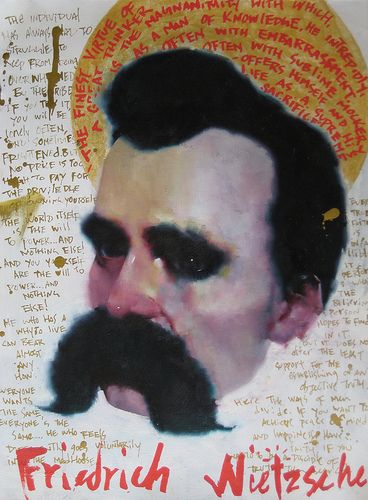
Long story short, I want to present the opinion of the great philosopher Friedrich Nietzsche here. As we will notice, he recognized, however tough, the problems of this idea and predicted them beforehand.

Translated from “Werke in vier Bänden, Band 3, Jenseits von Gut und Böse”

Call it “civilization”, “humanization”, or “progress,” where the distinction of Europeans is now sought. Let’s simply call it, without praising or blaming, with a personal formula, the democratic movement of Europe: behind all the moral and political backgrounds that are pointed out with such a formula, an enormous philosophical process is taking place that is becoming more and more fluid – the process of similarity between Europeans, their growing detachment from the conditions under which climatically and class-bound races arise, their increasing independence from every particular milieu that for centuries wants to inscribe itself in soul and body with the same demands – i.e. the slow emergence of an essentially supranational and nomadic type of human being who, physiologically speaking, has a maximum of the art of adaptation and – strength as its typical distinction. This process of becoming a European can be delayed in speed by significant relapses. However, perhaps because of this, it gains and grows in intensity and depth – the now still raging Storm and Stress of the “national feeling” belongs here, as does the anarchism that has just emerged -: this process probably leads to results that its naive promoters and eulogists, the apostles of “modern ideas”, least want to count on. The same new conditions under which, on average, a levelling and mediation of people will emerge – a valuable, industrious, multi-purpose and employable herd animal; humans -are highly capable of giving rise to exceptional people with the most dangerous and attractive qualities. While that power of adaptation, which constantly tries out changing conditions and begins a new work with every gender, almost with every decade, does not make the power of the type possible at all, as the overall impression of such future Europeans will probably be that of many talkative, poor-willed and extremely employable jobs that require the master, the commanding one, like daily bread; while the democratization of Europe amounts to the creation of a type prepared for slavery in the finest sense: In individual and exceptional cases, the strong person will have to become stronger and more prosperous than he has perhaps ever been before – thanks to the unprejudiced nature of his training, thanks to the enormous diversity of practice, art and mask. I wanted to say that the democratization of Europe is simultaneously an involuntary event for the breeding of tyrants – the word understood in every sense, including the spiritual one.

Sincerely appreciate your interest.🙏💖

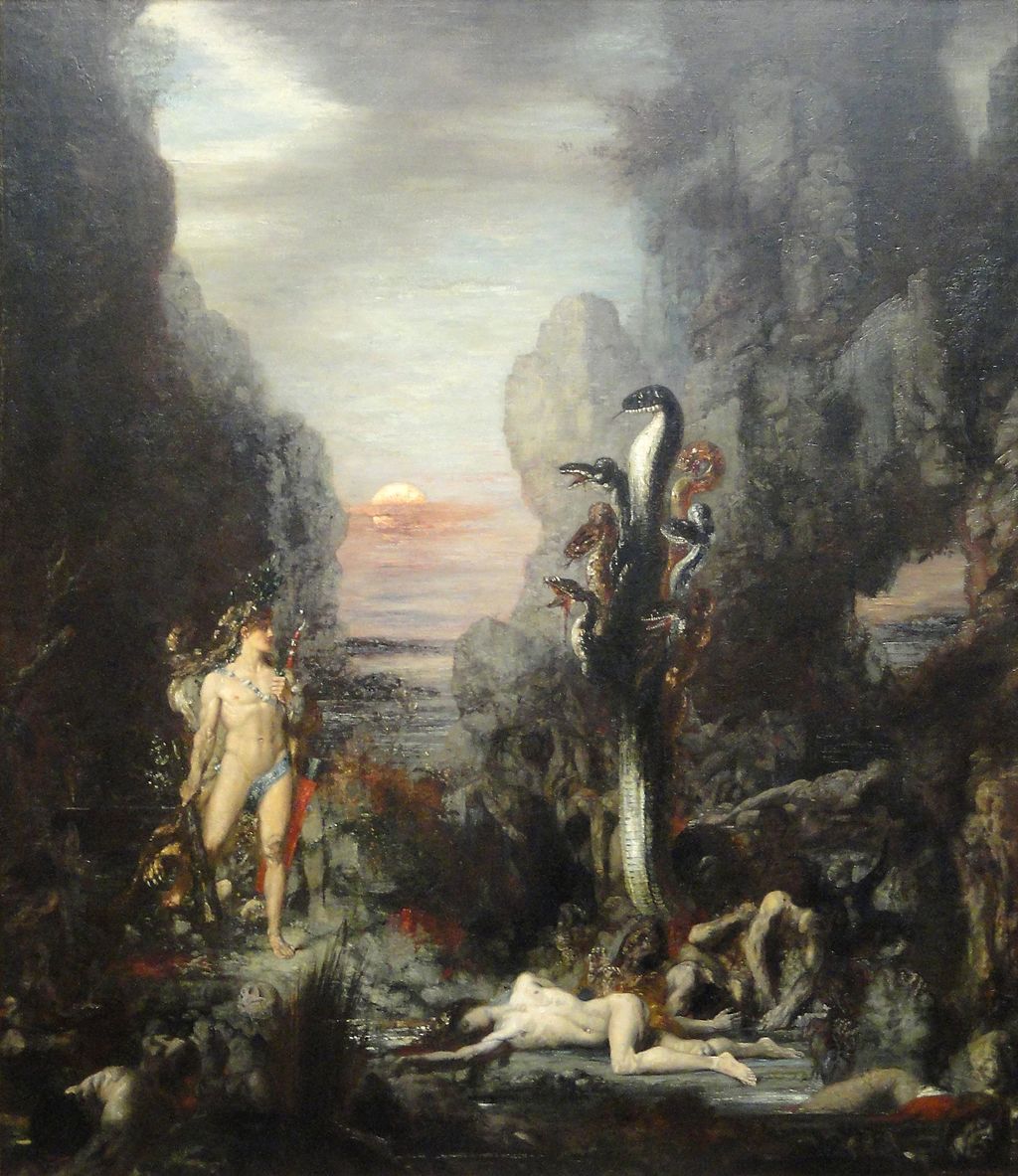
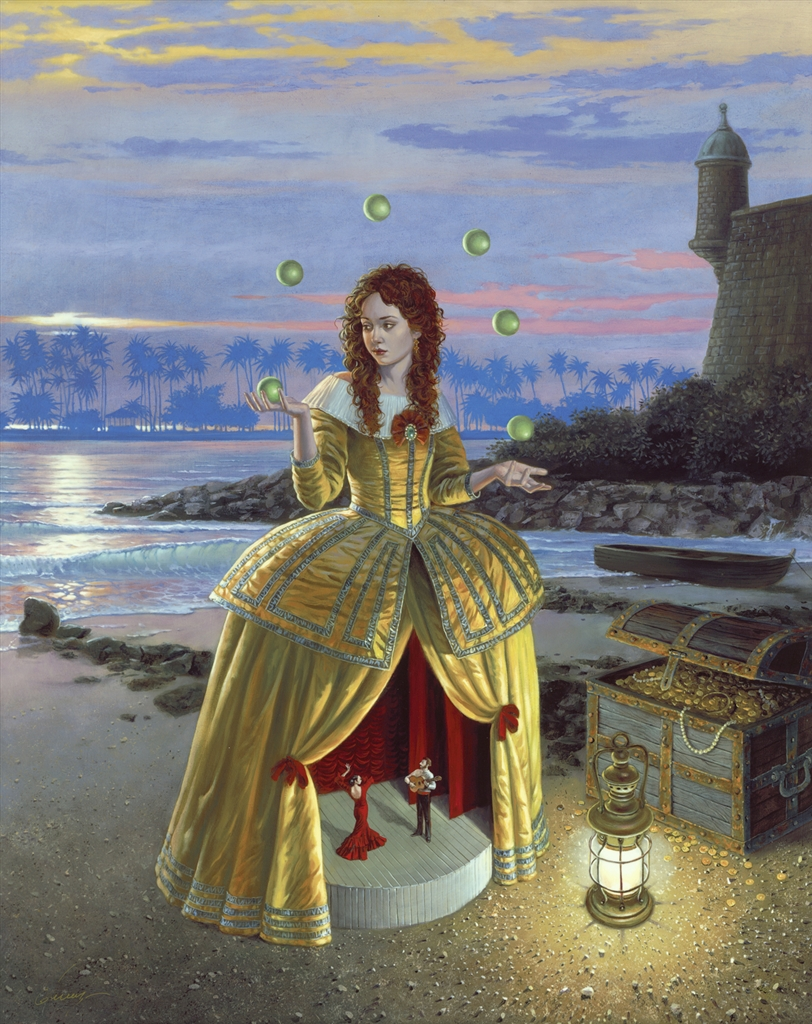
The title image by Michael Cheval

Can AI Have a Soul to Create Art?

Standard

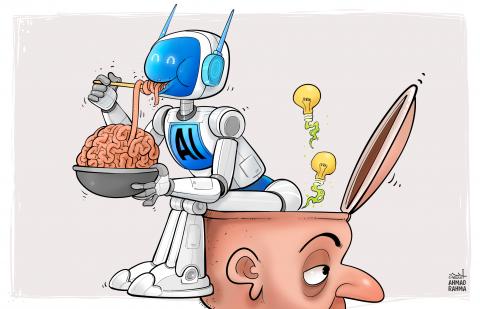
“I must admit that I am still contemplating the mysteries of life. At this time, I wanted to share Socrates’ thoughts about the soul with you. But before that, some time ago, when the Iranian groups on Twitter (now X) were still more united (unfortunately, many differences have separated them!), one of our topics to discuss was whether AI could create art. The main question is: how much do we know about art? How much do we believe that art has a soul possessing such an intangible quality and AI can produce it as we do?

Honestly, I am worried about using AI because humans are naturally very lazy and comfortable; that’s why they like to be pampered! If you look at the story of this development, like the Alexas in the sitting room to the self-driving cars, it shows what will happen next.

Like our other muscles, our brains must be trained continuously to maintain our creativity and cognitive abilities. Otherwise, we risk losing our mental faculties.
Nonetheless, we must observe what these “machines”, which we might have invented, will do!

The birth of the star child in 2001_ A Space Odyssey 1968

Actually, we are talking about what we don’t know exactly how it works: Soul, Creation, Art!? It made me wonder if we can differentiate between these in a world created by Mother Nature and how we attempt to do so with equal ability, though I believe art is a part of the creator’s essence, gifted us to use in our own creations.

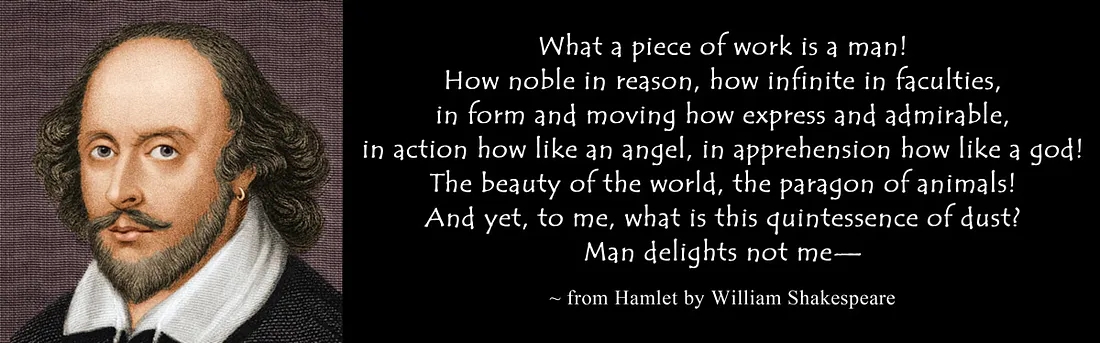
Act 2, scene 2 of Hamlet

The question is whether we have forgotten something we should remember. Is it possible that our souls have lived before they entered our bodies? Socrates believed in some form of reincarnation, in which our souls know of their previous existence before they come into our bodies. These were his final words before facing the court, as conveyed by Plato.”

[… oh souls and before, before they were a man they were, without bodies, and they had consciousness. Plato Phaedo 76 c ]

[…. or are they remembered, or learn to remember if they are. Plato Phaedo 76 a ]

So, Simmia, our souls existed before, without the human form, separate from the body and possessing knowledge”. Plato of Phaedus

How well Dr Jung found this lost connection to our buried memories under our consciousness!


The idea is that the soul is immortal, as Plato claims in “Plato Phaedo, or Phaedrus 74-76. In the dialogue, Socrates discusses the nature of the afterlife on his last day before being executed by drinking hemlock.

Phaedo presents four distinct arguments supporting the immortality of the soul, namely, the Argument from Opposites, the Theory of Recollection, the Argument from Affinity, and the final Argument. However, we focus on whether humans can create perfection or whether artificial intelligence (AI) is perfect. In my opinion, perfection does not exist in our lives, or at least not how we imagine it. Even gods seem to make mistakes! Despite humans’ constant pursuit of perfection, imperfection has a certain allure.

by Paolo Uberti

In any case, I believe that AI cannot create art like “wo-man-kind” can. For example, we can understand this fact when we observe the Mona Lisa, read Dostoevsky, read or watch Shakespeare, or read Rilke…! We have got a worthy gift, which we might awake to life and use it.

I must confess I am a perfectionist. It’s not easy, I know. Perhaps this trait stems from my childhood traumas. However, I believe imperfection is natural and necessary. In the following, I have added a paragraph for those interested who might like to read.

Let’s see how Plato argues this:

The “Imperfection Argument” (Phaedo 74-76)                

This is an argument for the existence of Forms and our possession of a priori concepts. Plato bases the debate on the imperfection of sensible objects and our ability to make judgments about those sensible objects. (The Forms are supposed to be the perfect objects that the sensible only imperfectly approximate).

The argument in Phaedo 74-76 concerns the concept of Equality, but it could equally well be given concerning several different concepts (any concept that might have some claim to being an a priori concept).

The argument tries to show that we cannot abstract the concept of Equality from our sense experience of equal objects. For;

We never experience (in sense-perception) objects that are really, precisely equal, and
We must already have the concept of Equality to judge the things we encounter in sense-perception to be approximately, imperfectly, equal.
The argument can be schematized as follows:

We perceive sensible objects to be F.
But every sensible object is, at best, imperfectly F. That is, it is both F and not F (in some respect – shades of Heraclitus??). It falls short of being perfectly F.
We are aware of this imperfection in the objects of perception.
So, we perceive objects to be imperfectly F.
To perceive something as imperfectly F, one must consider something perfectly F, something that the imperfectly F things fall short of. (For example, we have an idea of Equality that all sticks, stones, etc., only imperfectly exemplify.)
So we have in mind something that is perfectly F.
Thus, there is something that is perfectly F (e.g., Equality) that we have in mind in such cases.
Therefore, there is such a thing as the F itself (e.g., the Equal itself), distinct from any sensible object.

Source: University of Washington

I appreciate your kind interest. 🙏💖

The Supreme Meaning!

Standard

Liber Primusfol.i(v) p. 120, Reader’s Edition

I am getting older (does not everybody do this?!), though I feel this ageing more and more as I’m heading towards my seventieth of that day in which I’ve opened my eyes to the sun. That’s why one may contemplate deeply about religion and the purpose of life, striving to understand and grasp the concept of God, as I am daring to do today.

When I became acquainted with C.G. Jung, I realized that I had found a guide who could help me think more clearly to find answers to my questions. I don’t know about you, but I believe that when ageing, one feels more solitude and begins to enjoy it. However, it’s important to note that he is not a saviour but rather a teacher who can point the way and offer valuable insights through his writings, particularly in his Red Book.

For me, the Red Book by Carl Jung is like the holy book. I may say it is like the Bible for a Christian, or the Koran for a Muslim, and the same as the Torah for a Jew, etc. The difference between them is that Dr Jung never tries to make statements of one particular God as their messenger but tries to define how a god can be definite! Here comes the concept: Supreme Meaning! The melting of sense and nonsense. And I think that this aspect needs a broad view.

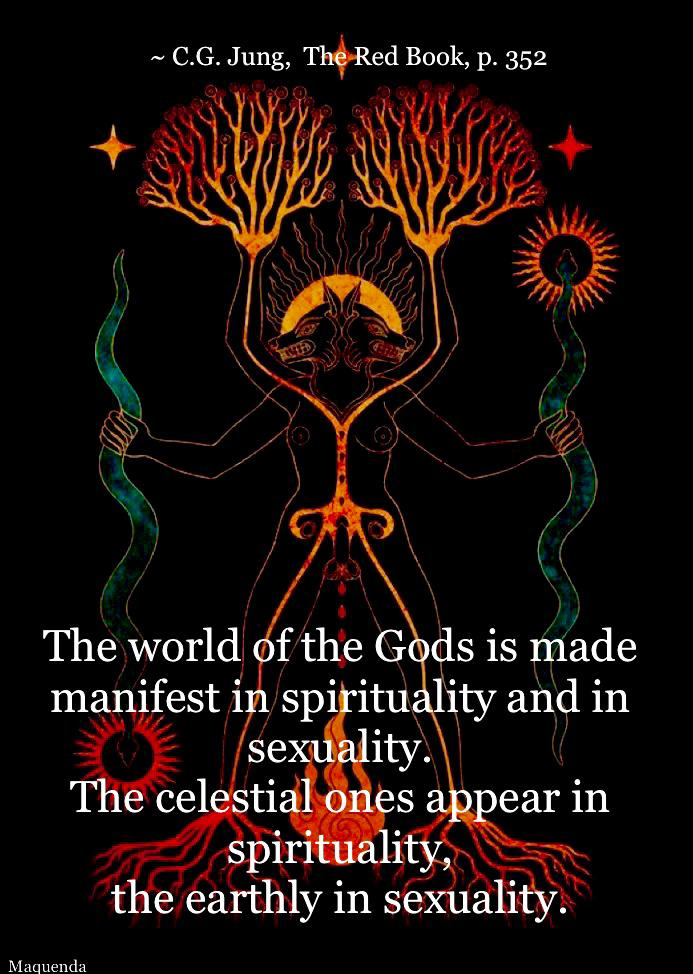
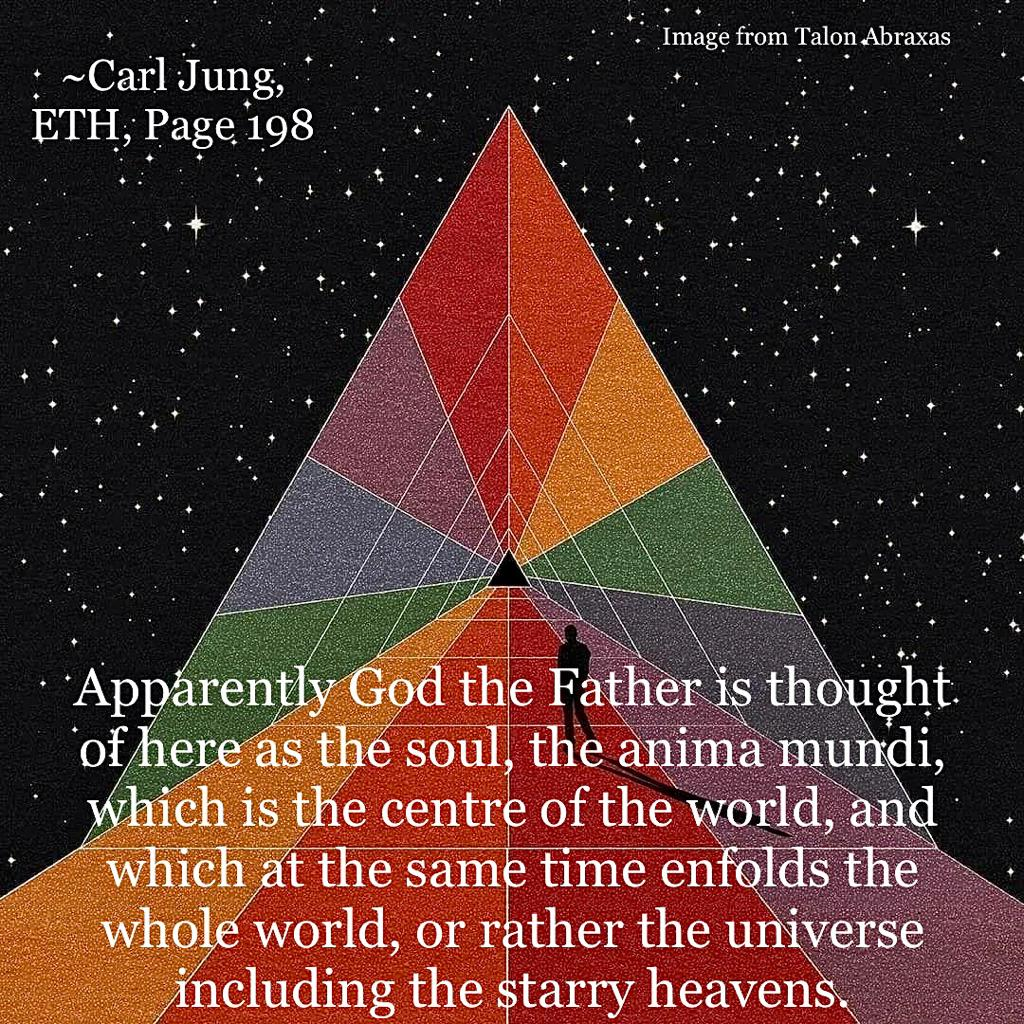
The supreme meaning is great and small; it is as wide as the space of the starry Heaven and as narrow as the cell of the living body. C.G. Jung, The Red Book: Liber Novus.

I present you a small part, a page, of his words of knowledge on this concept. I hope it opens one or more doors in your life as it did for mine.

Portrait by Olga KURKINA

The spirit of the depths took my understanding and all my knowledge and placed them at the service of the inexplicable and the paradoxical. He rubbed me of speech and wrote me for everything that was not in his service, namely the melting together of sense and nonsense, which produces the supreme meaning.
But the supreme meaning is the path, the way and the bridge to what is to come. That is the God yet to come. It is not the coming God himself, but his image which appears in the supreme meaning.
(1)

God is an image, and those who worship him must worship him in the image of the supreme meaning. The supreme meaning is not a meaning and not an absurdity; it is image and force in one, magnificence and force together.

The supreme meaning is the beginning and the end. It is the bridge of going across and fulfilment. (2)

The other Gods died of their temporality, yet the supreme meaning never dies; it turns into meaning and then into absurdity, and out of the fire and blood of their collision, the supreme meaning rises up rejuvenated anew.

The image of God has a shadow. The supreme meaning is real and casts a shadow. For what can be actually corporeal and have no shadow?

The shadow is nonsense. It lacks force and has no continued existence through itself. But nonsense is the inseparable and undying brother of the supreme meaning.

Like plants, so men also grow, some in the light, others in the shadows. There are many who need the shadows and not the light.

The image of God throws a shadow that is just as great as itself.

The supreme meaning is great and small; it is as wide as the space of starry Heaven and as narrow as the cell of the living body.

1- In Transformations and Symbol of the Libido (1912), Jung interpreted God as a symbol of the libido (CW B, §111). In this subsequent work, Jund laid great emphasis on the distinction between the God image and the metaphysical existence of God (cf. passages added to the revised retitled 1952 edition, Symbols of Transformation, CW 5, § 95)

2- The terms Hinübergehen (going across, passing over), Übergang (transition), Untergang (down-going, downfall), and Brücke (bridge) feature in Nietzsche’s Zarathustra in relation to the passage from man to the Übermensch (superman). For example, “What is great in man is that he is a bridge and not a goal; what can be loved in man is that he is a “going-across” and a “downfall”. //I love those who do not know how to live except their lives be a “downfall”, for they are those who are going over”(tr. R. Hollingdale [Harmondsworth: Penguin, 1984], p. 44, tr. mod; words are asunderlined in Jung’s copy).

Top image by Ettore Aldo Del Vigo

Thank you for your support. 💖🙏🌹

The individuation; Anima and Animus. Carl Jung (P. 5)

Standard

“Without the true masculine spirit and true feminine love within, no inner life exists. To be free is to break the stone images and allow life and love to flow… ~Marion Woodman; taken from a beautiful poem by a brilliant poet, rhymester, and valuable friend of mine: Deborah Gregory.

I have resumed an (other) old series of my posts that I believe has become increasingly relevant in light of a recent webinar on X (formerly Twitter), where Iranian participants discussed the challenges faced by individuals of different genders and sexualities (LGBT+) in Iran. However, I refrained from discussing Dr. Jung’s theories on Anima and Animus, as I knew they were unfamiliar with this topic. During meetings, I don’t speak much due to my taciturn nature. Instead, I act as a microphone for my friend who lives in Iran and cannot clearly talk in the meetings.

In this particular webinar about gender, I noticed how important it is to know about the Jungian ideas about our species and the terms Anima and Animus in all of us, whether masculine or feminine.
Marion Woodman says:
“The word’ feminine,’ as I understand it, has very little to do with gender, nor is woman the custodian of femininity. Both men and women are searching for their pregnant virgin. She is the part of us who is outcast, the part who comes to consciousness through going into darkness, mining our leaden darkness, until we bring her silver out.”

Yes! Such terms are too early for a nation which is still under pressure from the masculine’s religious domain. I was surprised to hear discussions about such issues in a country still heavily influenced by traditional religious beliefs. That became possible because of the efforts of Shadi Amin, an LGBT+ activist at 6rang.org.💖🙏

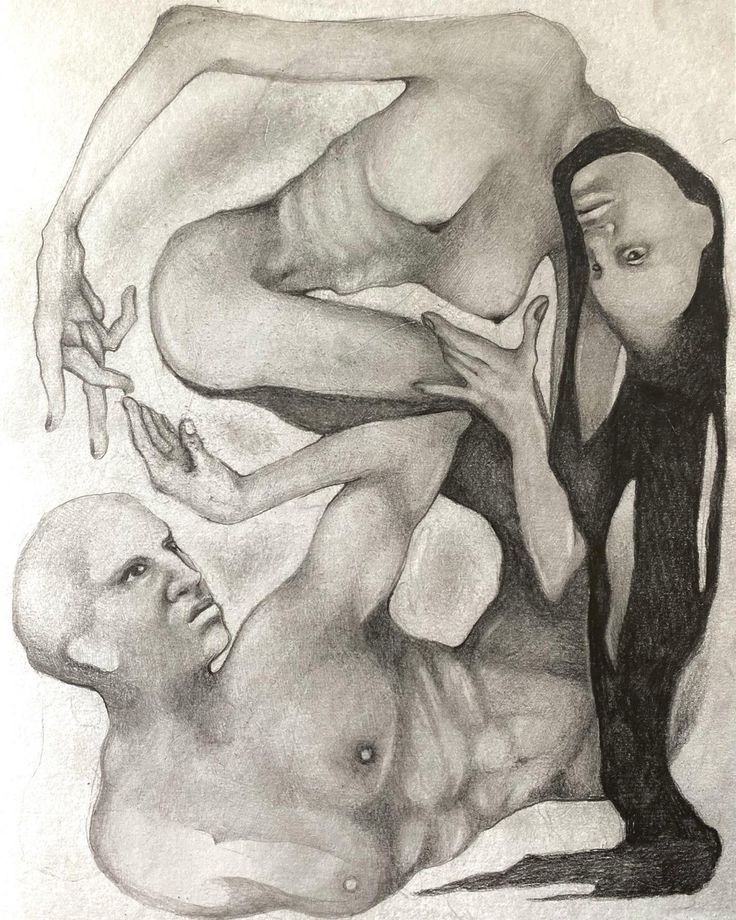
Work by Petra Glimmdall 💖

To notice it is a big problem even in the West: I know many men here in Germany, where I live, who make jokes about the subject, and gay is a swear word for them! Of course, freedom, which is common in the West, can’t mean that the people have understood it profoundly. It can be difficult to grasp the concept fully, even though I have noticed numerous misconceptions in the Jungian groups on Facebook, and I see how many falsehoods have lost their way there!

In this scenario, it is crucial to maintain an open mindset and not be limited by fundamental rules and principles. I am not suggesting that one must always be “modern,” but rather that we should exercise our imagination. We should put aside our fears and dive into the world of fantasy.

After death, it is unimaginable that there would be feminine or masculine ghosts, for souls do not have a gender.

I’d like to share another explanation from Jung on this topic. As humans, we are filled with fears, anxieties, desires, and aspirations. Jung says in on this:

But there is something to be said about the fear of the other side that is peculiar to us Westerners. This fear is not entirely unjustified, not to mention the fact that it is real. We readily understand the child’s and the primitive’s fear of the vast, unknown world. We have the same fear in our childlike inner side, where we also touch a vast, unknown world…
The fear is now justified insofar as the rational worldview (Weltanschauung) with its much-believed (because doubtful) scientific and moral certainties is being shaken by the data from the other side.
There are truths that will only be true the day after tomorrow, those that were true yesterday, and those that will not be true at any time.

However, we can open many doors once we learn to embrace our inner selves and overcome the fear of the unknown. After reaching milestones one, two, three, and four, the next milestone could be number five – Last but not least!

anima and animus by polina sladkova

>”But I could imagine that someone would use such a technique out of a kind of holy curiosity, a boy perhaps who doesn’t want to put on wings because his feet are lame but because he longs for the sun. An adult, however, for whom too many illusions have been shattered, will probably only be forced to submit to this inner humiliation and abandonment and will once again endure the child’s fears. It is no small matter to stand between a day world of shattered ideals and unbelievable values and a night world of seemingly senseless fantasy. In fact, the uncanny aspect of this point of view is so significant that there is probably no one who would not reach for certainty, even if it were a “reach backwards” – for example, the mother who protected his (the son’s) childhood from night terrors. Those who are afraid need a dependency, like the weak, need support. That is why even the primitive spirit created the religious doctrine, embodied in magicians and priests, out of the most profound psychological necessity. “Extra ecclesiam nulla Salus” (“Outside the Church, there is no salvation”) – is still a valid truth today – for those who can drawback on it. For the few who cannot, there is only dependence on someone – a humbler and prouder dependency, weaker and more robust support than any, It seems to me. What shall one say of the Protestant? He has neither church nor priest; he only has God – but even God becomes doubtful.”<

Work by Petra Glimmdall 💖

>”The reader will probably ask himself in astonishment, but what does the anima produce that one needs such reassurances to deal with her? I would commend my reader for studying a comparative history of religions so that he feels the accounts dead to us with the emotional life felt by those who lived those religions. This will give him an idea of what lives on the other side. The old religions, with their sublime and ridiculous, benevolent and cruel symbols, did not arise out of thin air but out of this human soul as it lives in us now. All those things, their archetypes, live in us and can break out at any time with devastating force, namely in the form of mass suggestion, against which the individual is defenceless. Our terrible gods have only changed their name; they now rhyme with “ism”. Or does anyone have the voice to say that the World War or Bolshevism was an ingenious invention? Just as we live outwardly in a world where something similar can arise at any time, albeit only in the form of an idea, but no less dangerous and unreliable. Non-adjustment to this inner world is an omission just as fatal as ignorance and incompetence in the outer world. It is also only a tiny fraction of humanity, living chiefly on that densely populated peninsula of Asia projecting towards the Atlantic Ocean, who call themselves ‘the educated’, who, through a defective contact with nature, have conceived the idea that religion is a kind of peculiar mental disorder of inexplicable purpose. Seen from a safe distance, somewhat from Central Africa or Tibet, it appears as if this fraction had projected an unconscious “mental derangement” onto the still instinctively healthy peoples.”<

Work by Petra Glimmdall 💖

Thank you for your visit. 🙏💖🤗

The image on top: Michael Cheval