Translated from volumes published by Lorenz Jung based on the edition “Gesammelte Werke” dtv.de The Symbols of Transformation (1952) and Aion (1950)
Mana-personality. A personified archetypal image of a supernatural force.
The Mana-personality is a dominant of the collective unconscious, the well-known archetype of the mighty man in the form of hero, chief, magician, medicine-man, saint, ruler of men and spirits, and the friend of God.[The Mana-Personality,” CW 7, par. 377.]
Mana is a Melanesian word referring to a bewitching or numinous quality in gods and sacred objects.
Historically, the Mana-Personality evolves into the hero and the godlike being, whose earthly form is the priest. How very much the doctor is still Mana is the whole plaint of the analyst! [Ibid., par. 389.]
A Mana-Personality embodies this magical power. In individual psychology, Jung used it to describe the inflationary effect of assimilating autonomous unconscious contents, particularly those associated with anima and animus. (The text and the image are from Carl Jung’s Depth Psychology by my brilliant friend Lewis Lafontaine.)
I started with these specific sections of my friend’s website to better understand this enigmatic topic. Personally, I find Mana to be funny, attractive, amusing, intriguing, and, at the same time, very monstrous.
And now, after sharing parts one and two, I present part three, which is a short one so as not to bore you, or better to say, because of the preparations for my trip! I will be taking a two-week vacation, and the internet connection can be difficult on this trip. But after that, I promise to share a larger and more interesting part when I return!!💖
Individuation The Mana Personality (P3)
In contrast, our pitifully limited “I”, if it possesses even a spark of self-knowledge, can only withdraw and quickly abandon any illusion of power and importance. It was an illusion: the “I” has not overcome the anima and, therefore, has not acquired its Mana. The consciousness has not become master of the unconscious, but the anima has lost its domineering presumption to the extent that the “I” has been able to come to terms with the unconscious. This conflict, however, was not a victory of consciousness over the unconscious but the establishment of a balance between the two worlds.
The ‘magician’ could only take possession of the “I” because the “I” dreamed of a victory over the anima. This was an attack, and every attack by the “I” would be followed by an attack by the unconscious.
>In a transformed figure I exercise grim power. < (Goethe: Faust II, Act 5, Scene 4, in Works in ten volumes, Vol. 4, 1961)
Faust surrounded by his Illustration, to Goethe’s Faust by Harry Clarke 1925
Therefore, if the “I” abandons its claim to victory, the obsession by the magician automatically ceases. But where does the Mana go? Who or what becomes Mana if even the magician can no longer perform magic? We now know that neither the conscious nor the unconscious has Mana, for it is certain that if the “I” does not claim power, then no obsession arises, which means that the unconscious has also lost its supremacy. In this state, the Mana must have fallen into the hands of Something that is conscious and unconscious, or neither conscious nor unconscious. This Something is the sought-after “centre” of the personality, that indescribable Something between the opposites, or the unifier of the opposites, or the result of the conflict, or the “achievement” of the energetic tension, the development of the personality, a most individual step forward, the next stage.
I do not expect the reader to follow the rapid overview of the whole problem in every detail. He should consider it a kind of exposition, the more detailed intellectual elaboration of which I will give in the following…
To be continued! I wish you all a great time.💖🙏💖🌹
PS: As the World Wide Web chaos happened yesterday, I hope our flight stays intact!!😁😅🙏
Translated from volumes published by Lorenz Jung based on the edition “Gesammelte Werke” dtv.de The Symbols of Transformation (1952) and Aion (1950)
Another challenge? Yes! I have decided to present a perhaps tricky but important topic; of course, I will try to make it as understandable as possible. I believe Dr. Jung’s theories and thoughts are not difficult to understand. They may seem strange, or rather, they are still new to us, which might make them seem difficult to comprehend. However, they are essential because they show us how to understand our undiscovered inner soul, which we might never notice deeply. Often, we look for problems outside of ourselves.
I understand his concerns about whether he adequately and comprehensively explains his lessons, although he never intended to present himself as a teacher. This may be due to the monstrous and sinister issues he has researched and discovered. “The only real danger that exists is man himself,” he says. “He is the great danger, and we are pitifully unaware of it.” He has seen this danger and tried to show us how to recognize and handle it.
In November of 1960, seven months before his death, C.G. Jung suffered what he called “the lowest ebb of feeling I ever experienced.” He explained the sentiment in a letter to Eugene Rolfe: I had to understand that I was unable to make the people see what I’ve been after. I am practically alone. There are a few who understand this and that, but almost nobody sees the whole… I have failed in my foremost task: to open people’s eyes to the fact that man has a soul, and there is a buried treasure in the field, and that our religion and philosophy are in a lamentable state.
I will do my best and hope that what he tries to convey to us will become more understandable. The topic of Mana might be an unknown subject, though very familiar to all of us. It is with us, man or woman, from childhood to old age. (I decided to translate the original Jung’s words myself because, as I found out, some online translations are incorrect due to false interpretations. Yes, it is hard work, but trustfully!) Here is just a foretaste because it will take some parts more than one post! So, let’s begin:
According to Jung, the ‘Mana Personality’ represents an archetypal phase of the individuation process of remarkable interest in psychological, hermeneutic, and theoretical terms. This figure is characterized by a high initiate potential that fosters the approximation of the Self’s consciousness.
Individuation The Mana Personality
Klingsor verflucht Kundry (Gemälde von Franz Stassen)
My starting material for the following discussion is those cases in which what was presented as the next goal in the previous chapter was achieved, namely the overcoming of the anima as an autonomous complex and its transformation into a function of the relationship of the conscious to the unconscious. By achieving this goal, it is possible to free the ego from all its entanglements with collectivity and the collective unconscious. Through this process, the anima loses the demonic power of the autonomous complex, i.e. it can no longer exercise possession as it is depotentiated. It is no longer the guardian of unknown treasures, it is no longer Kundry, the demonic messenger of the Grail of a divine-animal nature, no longer the >Mistress-Soul<, but a psychological function of an intuitive nature, of which one could say with the primitive: >He goes into the forest to talk to the spirits<, or: >My snake spoke to me<, or expressed in mythological infantile language: >The little finger told me.<
Those of my readers who are familiar with Rider Haggard‘s description of the ‘She-who-must-be-obeyed‘ will certainly remember the magical powers of this personality. She is a mana personality, a being full of occult, magical qualities (Mana) endowed with mystical knowledge and powers. All these attributes, of course, arise from the naive projection of unconscious self-knowledge, expressed in less poetic terms, which would be something like this: ‘I recognize that there is a psychic factor at work within me which can escape my conscious will most incredibly. It can put extraordinary ideas into my head, cause me unwanted and unwelcome moods and effects, induce me to perform astonishing actions for which I cannot take responsibility, disturb my relations with other people in an irritating way, and so on. I feel powerless in the face of this fact, and what is worse, I am in love with her, so I have yet to admire her. < (Poets often call this the artistic temperament; unpoetic ones excuse themselves in other ways.)
If the factor >Anima< loses its Mana, where has it gone? Evidently, the person who mastered the anima has acquired that Mana, in accordance with the primitive idea that the person who kills the Mana person absorbs its Mana.
Being continued! 😉😅
PS: I’m writing this post between doing the laundry, mowing the lawn and cleaning the windows, and unfortunately, I had to skip the second post; I’m completely exhausted! (I always wonder how some people can produce posts every hour!!). Thank you all, and have a lovely weekend.🙏💖🤗
The Red Book by C. G. Jung, Liber Primus fol. i(v)
As I continue to read Carl Jung’s book, The Red Book, I find myself wondering how his words are so relatable to me. They touch me deeply and feel familiar. I do not speak often and tend to keep to myself. However, I want to learn how to express myself more creatively using images. I long to see a sign of mercy that will give me hope and belief, even though I still wish to have visions like Jung had.
He conversed with the spirits, the spirit of the time, the spirit of depth, talking about the Supreme Meaning by the fact that he is laughter and worship; a bloody laughter and a bloody worship. A sacrificial blood binds the poles. Jung has his humanity for help: What solitude, he said, what a coldness of destruction you lay upon me when you speak such! Reflect on the destruction of being and the streams of blood from the terrible sacrifice that the depth demands (Referring to Jung’s vision). Dr Jung had visions which became a reality throughout his time. He was excited, not sure if schizophrenia was threatening him. However, every genius seems to have this ability, as my brother Al had it.
As we observe the world today, starting wars easily, bombing, and killing have become routine occurrences, it might not be necessary for us to have the kind of visions that Dr. Jung had in his time. However, his words hold significance since they reflect a deeper insight into the human psyche.
“But the spirit of the depths uttered: No one can or should halt sacrifice. Sacrifice is not destruction; sacrifice is the foundation stone of what is to come… “The mercy that happened to me gave me belief, hope, and sufficient daring not to resist the spirit of the depths further but so utter his words. But before I could pull myself together to really do it, I needed a visible sign that would show me that the spirit of the depths in me was, at the same time, the ruler of the depths of world affairs.
It happened in October 1813, when I was living alone on a journey. During the day, I was suddenly overcome by a vision in broad daylight: I saw a terrible flood that covered all the northern and low-lying lands between the North Sea and the Alps. It reached from England up to Russia and from the coast of the North Sea right up to the Alps. I saw yellow waves swimming through rubble and the death of countless thousands.
The vision lasted two hours; it confused me and made me ill. I was not able to interpret it. Two weeks passed, then the vision returned, still more violent than before, and an inner voice spoke: “”Look at it; it is completely real, and it will come to pass. You cannot doubt this.“” I wrestled again for two hours with this vision, but it held me fast. It left me exhausted and confused. And I thought my mind had gone crazy.
Jung discussed this vision on several occasions, stressing different details like in his 1925 seminar Introduction to Jungian Psychology (p. 44f), to Mircea Eliade, and Memories (pp. 199-200):
{Jung’s versions were frightening as he saw even a sea of blood over the northern lands. He explains: }
As a psychiatrist, I became worried, wondering if I was not on the way to “doing a schizophrenia,” as we said in the language of those days… I was just preparing a lecture on schizophrenia to be delivered at a congress in Aberdeen, and I kept saying to myself: “I’ll be speaking of myself! Very likely, I’ll go mad after reading out this paper.” The congress was to take place in July 1914 – exactly the same period when I saw myself in my three dreams voyaging on the Southern seas. On July 31st, immediately after my lecture, I learned from the newspapers that war had broken out. Finally, I understood. And when I disembarked in Holand on the next day, nobody was happier than I. Now, I was sure that no schizophrenia was threatening me. I understood that my dreams and my visions came to me from the subsoil of the collective unconscious. What remained for me to do now was to deepen and validate this discovery. And this is what I have been trying to do for forty years.
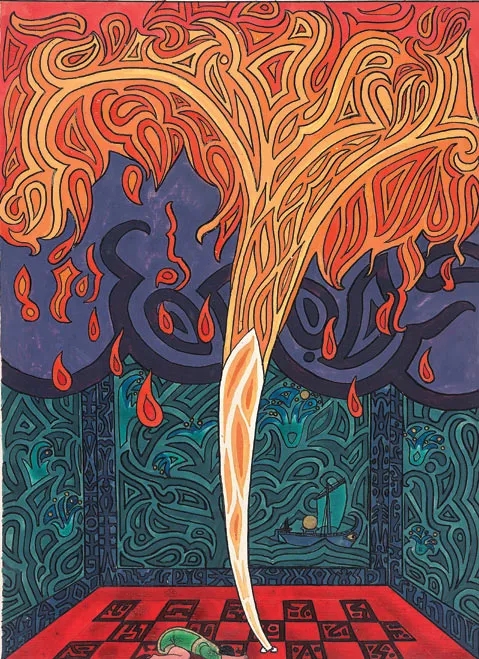
The fire from the egg in Carl Jung’s Red book
In the year 1914, in the month of June, at the beginning and end of the month, and at the beginning of July, I had the same dream three times: I was in a foreign land, and suddenly, overnight and right in the middle of the summer, a terrible cold descended from space. All seas and rivers were ice-locked, and every green living thing had frozen. The second dream was thoroughly similar to this. But the third dream at the beginning of July went as follows: I was in a remote English land. It was necessary that I return to my homeland with a fast ship as speedily as possible. I reached home quickly. In my homeland, I found that in the middle of summer, a terrible cold had fallen from space, which had turned every living thing into ice. There stood a leaf-bearing but fruitless tree, whose leaves had turned into sweet grapes full of healing juice through the working of the frost (like the ice wine). I picked some grapes and gave them to a great waiting throng.
[Draft: This was my dream. All my efforts to understand it were in vain. I laboured for days. Its impression, however, was powerful (p.9). Jung also recounted this dream in Memories].
Can we interpret the end of his dream, where sweet grapes are present, as a positive outcome of human madness? Who knows! Anyhow, hope dies last.🙏💖
Source: The Red Book by C. G. Jung, Liber Novus, A Reader’s Edition; Sonu Shamdasani


 lampmagician
You must be logged in to post a comment.