
Egoism is a philosophical concept and a term that carries significant weight in both ethics and psychology. Derived from the Latin word “ego,” meaning “I” or “self,” egoism centres on the self as the primary, and sometimes sole, motivator of human action. The suffix “-ism” denotes a doctrine or belief, so egoism essentially refers to a system of thought based on the self.
Historically, the term began to take shape in the 18th and 19th centuries, although its roots are much older. Philosophers in ancient Greece, such as Socrates and Epicurus, discussed ideas related to self-interest and personal happiness, but the formal conceptualisation of egoism came later. In the 17th century, thinkers like Thomas Hobbes argued that humans are fundamentally motivated by self-interest, a view that laid the groundwork for later theories. Nowadays—or indeed for quite some time—however, it is perceived as an insult or as offensive. (Egoist!)
In ethics, egoism is most often discussed in two forms: psychological egoism and ethical egoism. Psychological egoism holds that humans naturally act in their own self-interest, even when their actions appear altruistic. In contrast, ethical egoism holds that individuals ought to act in their own best interests. The concept became especially prominent in the works of philosophers such as Max Stirner and Ayn Rand, who advocated the primacy of the self in moral reasoning.
I’ve personally had many experiences with ego and egoism, noticing them in my environment, and I also learned to temper my ego and let it fade away while living with my brother Al. I wanted to support him in his success and, therefore, keep hidden the desires and motivations that would feed my ego.
Today, egoism remains a controversial yet influential idea. It challenges assumptions about morality, altruism, and social responsibility, and continues to spark debate among philosophers, psychologists, and everyday thinkers alike.
“We could all be mediums, and all have absolute knowledge, if the bright light of our ego-consciousness would not dim it.”
~Marie-Louise von Franz
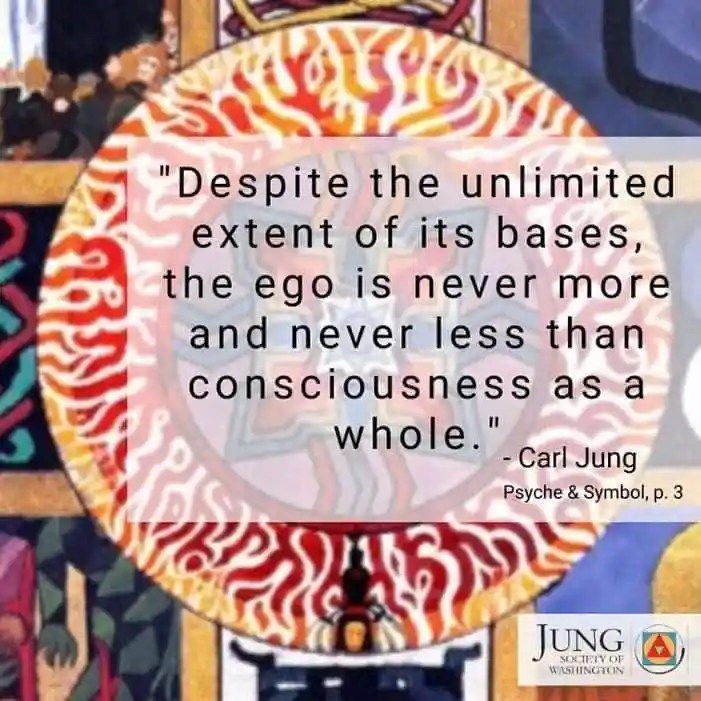
In Carl Jung’s psychology, the ego is the necessary centre of conscious awareness and identity, and it serves as the basis for enduring, translating, and integrating the overwhelming forces of the unconscious.
“The first half of life is devoted to forming a healthy ego; the second half is going inward and letting go of it,” said Betty DeShong Meador, an American Jungian analyst. Carl Jung himself said something similar:
“But we cannot live the afternoon of life according to the program of life’s morning; for what was great in the morning will be little at evening, and what in the morning was true will at evening have become a lie.” (From ‘The Structure and Dynamics of the Psyche’)
Here, I’d like to present an excerpt from Marie-Louise von Franz’s book, The Interpretation of Fairy Tales. A simple and remarkable explanation of why the ego is necessary.
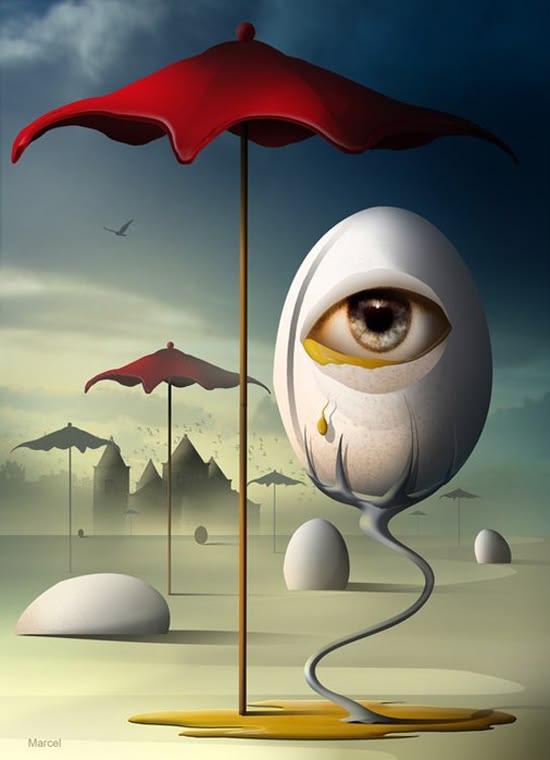
Illustration at the top: Lágrima (Tear), Digital surrealist painting by Marcel Caram
The Interpretation of Fairy Tales (The Three Feathers, p. 61-62)
…Imagine, for instance, that your instinct tells you to run away in a dangerous situation. (You do not require a very conscious ego to tell you that.) If a bull chases you, you do not need to consult your ego; you had better consult your legs, which know what to do. But if the ego functions with your legs, so that while running away from the bull, you also look for a good hiding place or a fence to jump over, then the situation is perfect: your instincts and your ego function in accord with each other. If, on the other hand, you are a philosopher whose legs want to run away but who thinks: “Stop! I must first find out whether it is right to run away from a bull,” then the ego blocks the instinctual urge; it has become autonomous and anti-instinctive and then becomes a destructive nuisance, such as we see in every neurotic individual. A neurosis could even be defined as an ego formation no longer in harmony with the whole personality, whereas when the ego functions in accordance with the larger totality, it reinforces itself and improves the innate cleverness of the basic instinctive arrangement.
Naturally, sometimes the ego would also be useful in resisting instinct. Imagine, for instance, the North Arctic lemmings, which get an instinctual urge to make a migration into another country where they can start again with a new food supply. Driven by an instinctual urge, they collect together and then march on. If, by a piece of bad luck, they come to the sea or a river, they go into it and drown by the thousands. I am sure you know this story, which has always puzzled zoologists, for it shows the silly unadaptedness of some natural instinct. Konrad Lorenz once gave a lecture with many such examples; I remember one about a bird which, to please his mate in the mating season, produces an enormous red sack on his chest with which to enforce his mating songs. This red sack is so heavy that he can not fly, so his enemies gather and butcher that bird. So that is not a good invention. A beautiful red tail or a red behind like a baboon’s to please his wife would be much better and would not prevent him from flying away. So you see, instinctual patterns are not only positive. If a lemming could ask itself what it was doing and reflect that it did not want to drown, and could go back, that would be very useful for it. So that is probably why nature has invented the ego as a new instrument for us; we are a new experiment of nature, for we have an additional instrument for regulating the instinctual urges. We do not live only on our patterns of behaviour but have this strange addition known as the ego.
PS: While I’m still itching my way towards better health every day, I am not giving up hope. Next week, I will continue with the post on Freud’s work. Thank you all for being there. 🙏💖


You must be logged in to post a comment.