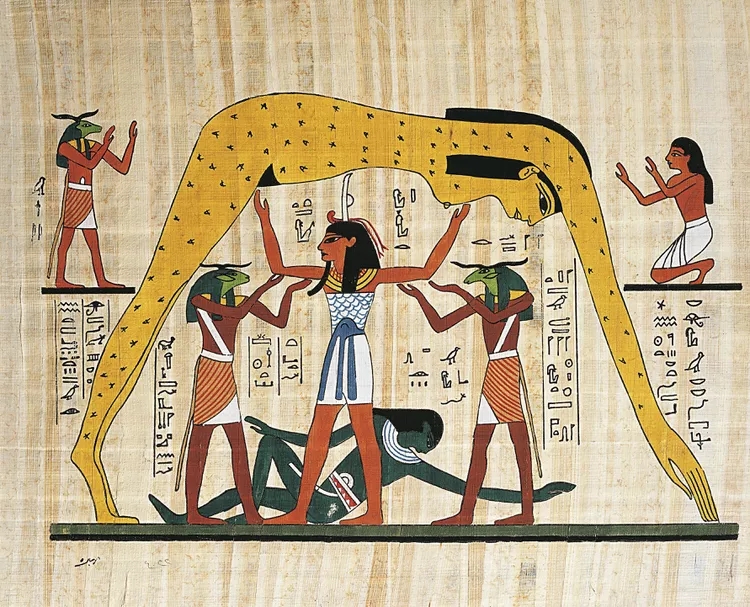
Egyptian civilization. Papyrus. Scene of creation. The sky-goddess Nut, covered with stars, is generated by Geb, the god of the earth. Reconstruction of a fresco from a tomb at Thebes, Valley of the Kings. Cairo, Istituto Del Papiro
As we all know, yesterday marked International Women’s Day, and many posts were published on this topic. I apologize for being late to the celebration; I was until now occupied with my grandson, Ilias! This is the first time I have decided to participate in this acknowledgement match, not just because of a lack of time but because I have some reservations about celebrating a cause on a single day and then forgetting about it for the rest of the year. Perhaps it’s true that those in charge choose to memorialize and celebrate under a specific title to alleviate their guilt instead of resolving the issues. However, I believe in using this special day to awaken their consciousness and galvanize them into action.
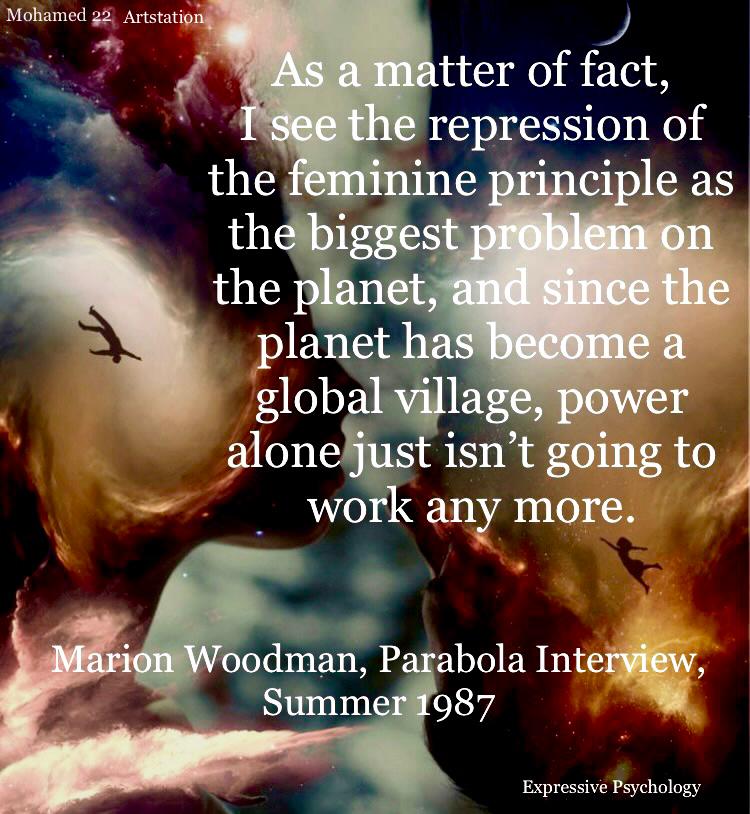
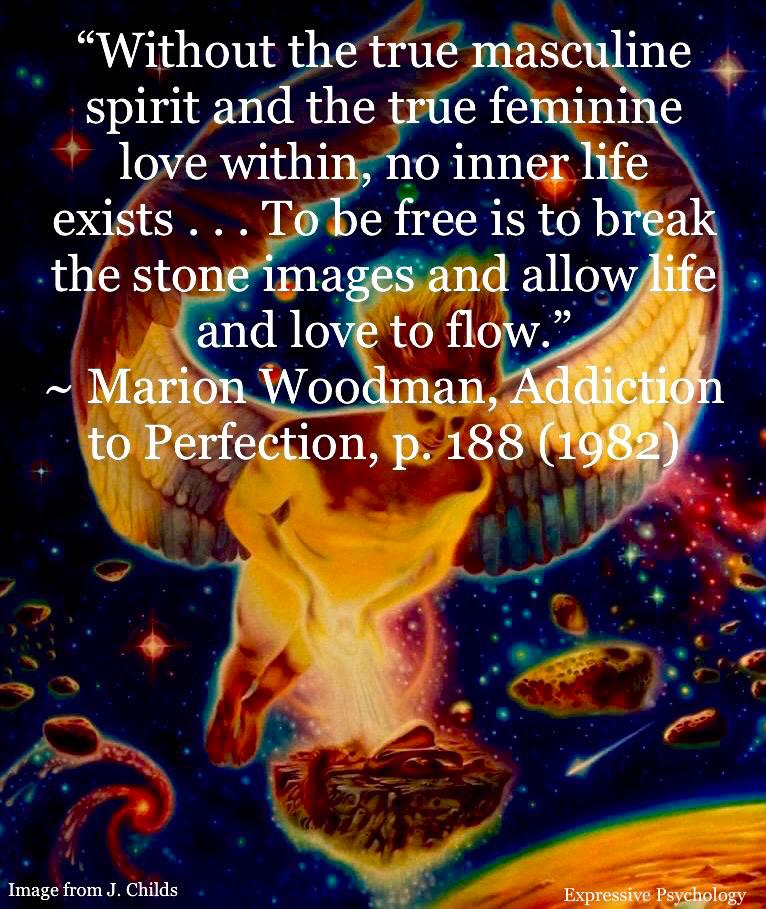
How well described Marion Woodman about the core of the issue.
via Petra Glimmdall 🙏💖
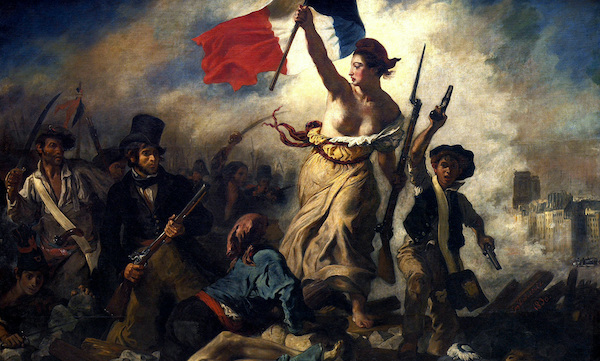
I have frequently written about women’s missing rights and opportunities in society, and I have noticed that progress is being made. A recent example is the approval of a new law by the French parliament to add the right to abortion to their constitution. Bravo! Viva France!
Liberté, Égalité, Fraternité:
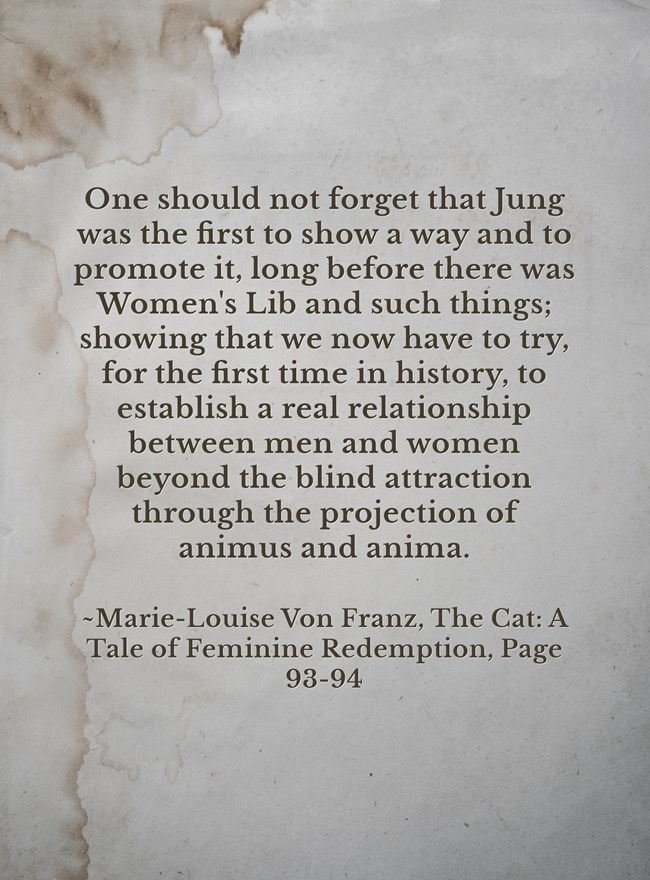
The concept is that if we believe in the duality of everything: cold – warm, above – below, bright – dark, woman – man, etc. Then, they not only mutually prove each other’s existence but also complement each other’s evolution. To comprehend these concepts, we should ponder twice (as the Germans say: Nachdenken!). Coldness would hold no significance if we always had everything cold and were unaware of warmth. Similarly, if we were constantly surrounded by brightness without ever experiencing darkness, we would never be able to comprehend the value of brightness. And it would be the same about feminine and masculine: Anima & Animus.
C. G. Jung introduced terms to describe specific functions of the human “soul” and “mind” ( Anima and Animus, Latin). I have published a partitional post about this issue before. Anima names the feminine unconscious factor in a man, while animus applies to the corresponding masculine factor in a woman’s unconscious.
I believe these are suitable lessons that will make us aware of how to help each other along the difficult path towards achieving the goal or the Self. This is how we can help each other because without encountering the other side, we are incomplete!
However, I have to repeat myself sadly, of man’s blindness as his stupid vanity has damaged a perhaps brave new world!
The Red Book by C. G. Jung, Liber Primus fol. i(v)
As I continue to read Carl Jung’s book, The Red Book, I find myself wondering how his words are so relatable to me. They touch me deeply and feel familiar. I do not speak often and tend to keep to myself. However, I want to learn how to express myself more creatively using images. I long to see a sign of mercy that will give me hope and belief, even though I still wish to have visions like Jung had.
He conversed with the spirits, the spirit of the time, the spirit of depth, talking about the Supreme Meaning by the fact that he is laughter and worship; a bloody laughter and a bloody worship. A sacrificial blood binds the poles. Jung has his humanity for help: What solitude, he said, what a coldness of destruction you lay upon me when you speak such! Reflect on the destruction of being and the streams of blood from the terrible sacrifice that the depth demands (Referring to Jung’s vision). Dr Jung had visions which became a reality throughout his time. He was excited, not sure if schizophrenia was threatening him. However, every genius seems to have this ability, as my brother Al had it.
As we observe the world today, starting wars easily, bombing, and killing have become routine occurrences, it might not be necessary for us to have the kind of visions that Dr. Jung had in his time. However, his words hold significance since they reflect a deeper insight into the human psyche.
“But the spirit of the depths uttered: No one can or should halt sacrifice. Sacrifice is not destruction; sacrifice is the foundation stone of what is to come… “The mercy that happened to me gave me belief, hope, and sufficient daring not to resist the spirit of the depths further but so utter his words. But before I could pull myself together to really do it, I needed a visible sign that would show me that the spirit of the depths in me was, at the same time, the ruler of the depths of world affairs.
It happened in October 1813, when I was living alone on a journey. During the day, I was suddenly overcome by a vision in broad daylight: I saw a terrible flood that covered all the northern and low-lying lands between the North Sea and the Alps. It reached from England up to Russia and from the coast of the North Sea right up to the Alps. I saw yellow waves swimming through rubble and the death of countless thousands.
The vision lasted two hours; it confused me and made me ill. I was not able to interpret it. Two weeks passed, then the vision returned, still more violent than before, and an inner voice spoke: “”Look at it; it is completely real, and it will come to pass. You cannot doubt this.“” I wrestled again for two hours with this vision, but it held me fast. It left me exhausted and confused. And I thought my mind had gone crazy.
Jung discussed this vision on several occasions, stressing different details like in his 1925 seminar Introduction to Jungian Psychology (p. 44f), to Mircea Eliade, and Memories (pp. 199-200):
{Jung’s versions were frightening as he saw even a sea of blood over the northern lands. He explains: }
As a psychiatrist, I became worried, wondering if I was not on the way to “doing a schizophrenia,” as we said in the language of those days… I was just preparing a lecture on schizophrenia to be delivered at a congress in Aberdeen, and I kept saying to myself: “I’ll be speaking of myself! Very likely, I’ll go mad after reading out this paper.” The congress was to take place in July 1914 – exactly the same period when I saw myself in my three dreams voyaging on the Southern seas. On July 31st, immediately after my lecture, I learned from the newspapers that war had broken out. Finally, I understood. And when I disembarked in Holand on the next day, nobody was happier than I. Now, I was sure that no schizophrenia was threatening me. I understood that my dreams and my visions came to me from the subsoil of the collective unconscious. What remained for me to do now was to deepen and validate this discovery. And this is what I have been trying to do for forty years.
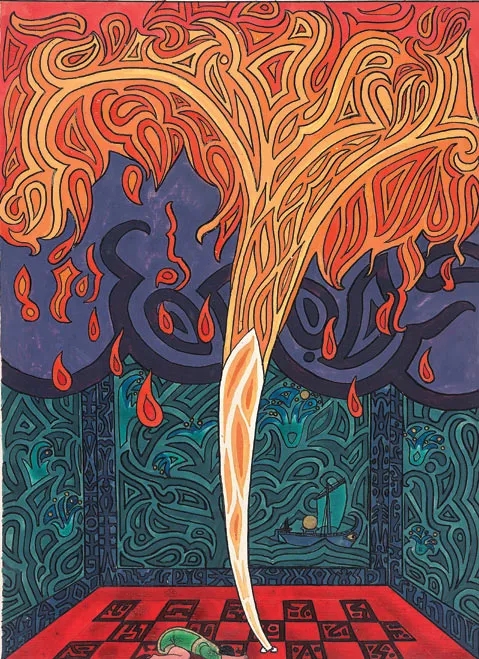
The fire from the egg in Carl Jung’s Red book
In the year 1914, in the month of June, at the beginning and end of the month, and at the beginning of July, I had the same dream three times: I was in a foreign land, and suddenly, overnight and right in the middle of the summer, a terrible cold descended from space. All seas and rivers were ice-locked, and every green living thing had frozen. The second dream was thoroughly similar to this. But the third dream at the beginning of July went as follows: I was in a remote English land. It was necessary that I return to my homeland with a fast ship as speedily as possible. I reached home quickly. In my homeland, I found that in the middle of summer, a terrible cold had fallen from space, which had turned every living thing into ice. There stood a leaf-bearing but fruitless tree, whose leaves had turned into sweet grapes full of healing juice through the working of the frost (like the ice wine). I picked some grapes and gave them to a great waiting throng.
[Draft: This was my dream. All my efforts to understand it were in vain. I laboured for days. Its impression, however, was powerful (p.9). Jung also recounted this dream in Memories].
Can we interpret the end of his dream, where sweet grapes are present, as a positive outcome of human madness? Who knows! Anyhow, hope dies last.🙏💖
Source: The Red Book by C. G. Jung, Liber Novus, A Reader’s Edition; Sonu Shamdasani
“I must admit that I am still contemplating the mysteries of life. At this time, I wanted to share Socrates’ thoughts about the soul with you. But before that, some time ago, when the Iranian groups on Twitter (now X) were still more united (unfortunately, many differences have separated them!), one of our topics to discuss was whether AI could create art. The main question is: how much do we know about art? How much do we believe that art has a soul possessing such an intangible quality and AI can produce it as we do?
Honestly, I am worried about using AI because humans are naturally very lazy and comfortable; that’s why they like to be pampered! If you look at the story of this development, like the Alexas in the sitting room to the self-driving cars, it shows what will happen next.
Like our other muscles, our brains must be trained continuously to maintain our creativity and cognitive abilities. Otherwise, we risk losing our mental faculties. Nonetheless, we must observe what these “machines”, which we might have invented, will do!
The birth of the star child in 2001_ A Space Odyssey 1968
Actually, we are talking about what we don’t know exactly how it works: Soul, Creation, Art!? It made me wonder if we can differentiate between these in a world created by Mother Nature and how we attempt to do so with equal ability, though I believe art is a part of the creator’s essence, gifted us to use in our own creations.
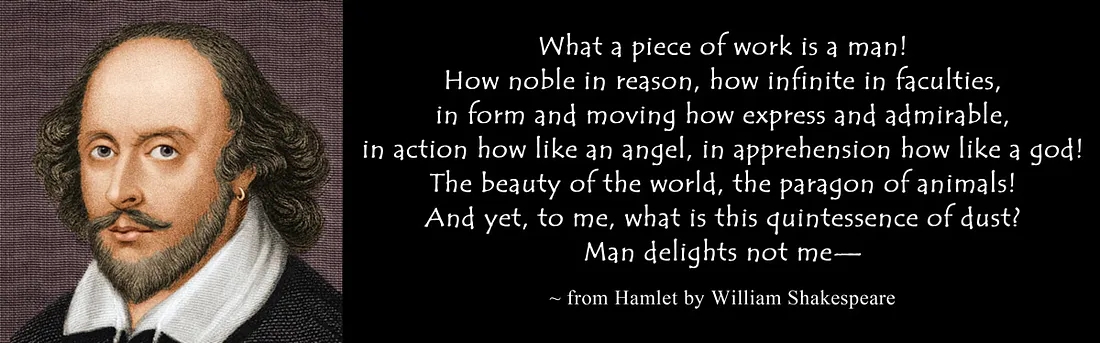
Act 2, scene 2 of Hamlet
The question is whether we have forgotten something we should remember. Is it possible that our souls have lived before they entered our bodies? Socrates believed in some form of reincarnation, in which our souls know of their previous existence before they come into our bodies. These were his final words before facing the court, as conveyed by Plato.”
[… oh souls and before, before they were a man they were, without bodies, and they had consciousness. Plato Phaedo 76 c ]
[…. or are they remembered, or learn to remember if they are. Plato Phaedo 76 a ]
“So, Simmia, our souls existed before, without the human form, separate from the body and possessing knowledge”. Plato of Phaedus
How well Dr Jung found this lost connection to our buried memories under our consciousness!
The idea is that the soul is immortal, as Plato claims in “Plato Phaedo, or Phaedrus 74-76. In the dialogue, Socrates discusses the nature of the afterlife on his last day before being executed by drinking hemlock.
Phaedo presents four distinct arguments supporting the immortality of the soul, namely, the Argument from Opposites, the Theory of Recollection, the Argument from Affinity, and the final Argument. However, we focus on whether humans can create perfection or whether artificial intelligence (AI) is perfect. In my opinion, perfection does not exist in our lives, or at least not how we imagine it. Even gods seem to make mistakes! Despite humans’ constant pursuit of perfection, imperfection has a certain allure.
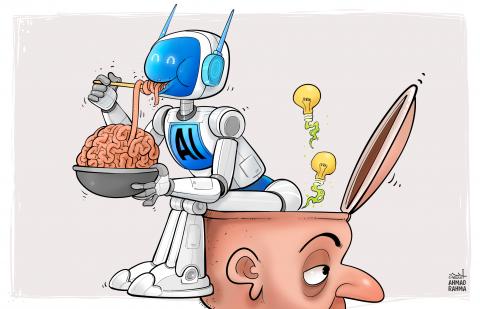
by Paolo Uberti
In any case, I believe that AI cannot create art like “wo-man-kind” can. For example, we can understand this fact when we observe the Mona Lisa, read Dostoevsky, read or watch Shakespeare, or read Rilke…! We have got a worthy gift, which we might awake to life and use it.
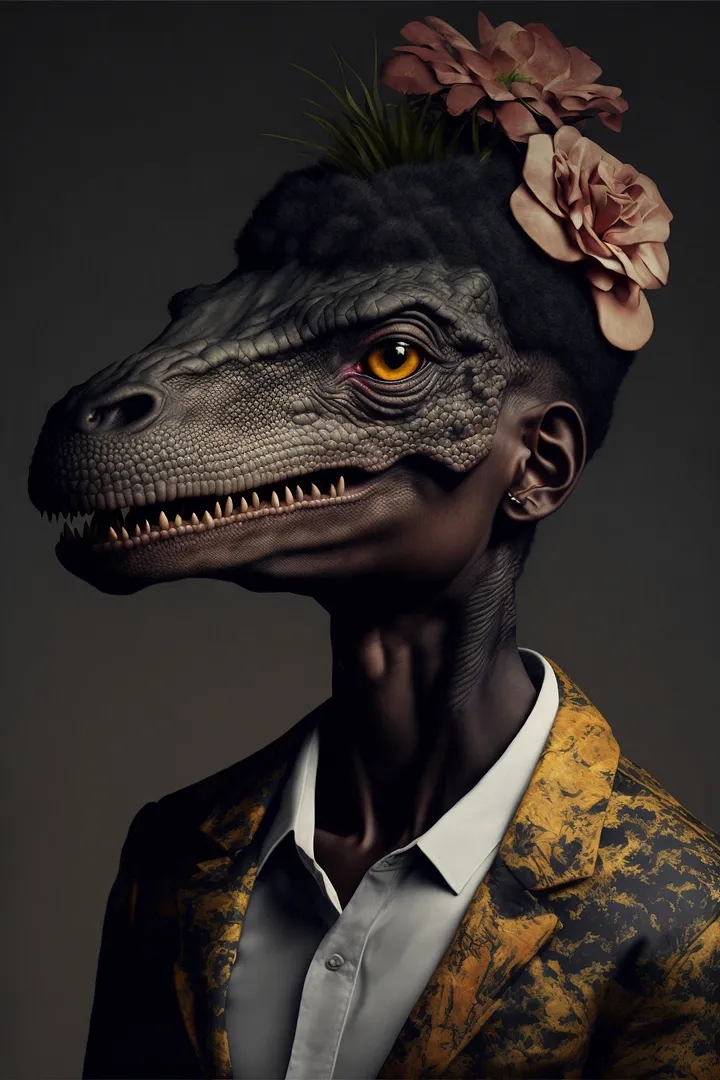
anthropomorphic human dinosaur as a black person by ZelrikAnnual Collective Mind by Shari3Dfashion monkey, city, 4k by BacababAI may see humans in more different forms: so, so, or so!!
I must confess I am a perfectionist. It’s not easy, I know. Perhaps this trait stems from my childhood traumas. However, I believe imperfection is natural and necessary. In the following, I have added a paragraph for those interested who might like to read.
Let’s see how Plato argues this:
The “Imperfection Argument” (Phaedo 74-76)
This is an argument for the existence of Forms and our possession of a priori concepts. Plato bases the debate on the imperfection of sensible objects and our ability to make judgments about those sensible objects. (The Forms are supposed to be the perfect objects that the sensible only imperfectly approximate).
The argument in Phaedo 74-76 concerns the concept of Equality, but it could equally well be given concerning several different concepts (any concept that might have some claim to being an a priori concept).
The argument tries to show that we cannot abstract the concept of Equality from our sense experience of equal objects. For;
We never experience (in sense-perception) objects that are really, precisely equal, and We must already have the concept of Equality to judge the things we encounter in sense-perception to be approximately, imperfectly, equal. The argument can be schematized as follows:
We perceive sensible objects to be F. But every sensible object is, at best, imperfectly F. That is, it is both F and not F (in some respect – shades of Heraclitus??). It falls short of being perfectly F. We are aware of this imperfection in the objects of perception. So, we perceive objects to be imperfectly F. To perceive something as imperfectly F, one must consider something perfectly F, something that the imperfectly F things fall short of. (For example, we have an idea of Equality that all sticks, stones, etc., only imperfectly exemplify.) So we have in mind something that is perfectly F. Thus, there is something that is perfectly F (e.g., Equality) that we have in mind in such cases. Therefore, there is such a thing as the F itself (e.g., the Equal itself), distinct from any sensible object.
I am getting older (does not everybody do this?!), though I feel this ageing more and more as I’m heading towards my seventieth of that day in which I’ve opened my eyes to the sun. That’s why one may contemplate deeply about religion and the purpose of life, striving to understand and grasp the concept of God, as I am daring to do today.
When I became acquainted with C.G. Jung, I realized that I had found a guide who could help me think more clearly to find answers to my questions. I don’t know about you, but I believe that when ageing, one feels more solitude and begins to enjoy it. However, it’s important to note that he is not a saviour but rather a teacher who can point the way and offer valuable insights through his writings, particularly in his Red Book.
For me, the Red Book by Carl Jung is like the holy book. I may say it is like the Bible for a Christian, or the Koran for a Muslim, and the same as the Torah for a Jew, etc. The difference between them is that Dr Jung never tries to make statements of one particular God as their messenger but tries to define how a god can be definite! Here comes the concept: Supreme Meaning! The melting of sense and nonsense. And I think that this aspect needs a broad view.
The supreme meaning is great and small; it is as wide as the space of the starry Heaven and as narrow as the cell of the living body. C.G. Jung, The Red Book: Liber Novus.
I present you a small part, a page, of his words of knowledge on this concept. I hope it opens one or more doors in your life as it did for mine.
The spirit of the depths took my understanding and all my knowledge and placed them at the service of the inexplicable and the paradoxical. He rubbed me of speech and wrote me for everything that was not in his service, namely the melting together of sense and nonsense, which produces the supreme meaning. But the supreme meaning is the path, the way and the bridge to what is to come. That is the God yet to come. It is not the coming God himself, but his image which appears in the supreme meaning. (1)
God is an image, and those who worship him must worship him in the image of the supreme meaning. The supreme meaning is not a meaning and not an absurdity; it is image and force in one, magnificence and force together.
The supreme meaning is the beginning and the end. It is the bridge of going across and fulfilment. (2)
The other Gods died of their temporality, yet the supreme meaning never dies; it turns into meaning and then into absurdity, and out of the fire and blood of their collision, the supreme meaning rises up rejuvenated anew.
The image of God has a shadow. The supreme meaning is real and casts a shadow. For what can be actually corporeal and have no shadow?
The shadow is nonsense. It lacks force and has no continued existence through itself. But nonsense is the inseparable and undying brother of the supreme meaning.
Like plants, so men also grow, some in the light, others in the shadows. There are many who need the shadows and not the light.
The image of God throws a shadow that is just as great as itself.
The supreme meaning is great and small; it is as wide as the space of starry Heaven and as narrow as the cell of the living body.
1- In Transformations and Symbol of the Libido (1912), Jung interpreted God as a symbol of the libido (CW B, §111). In this subsequent work, Jund laid great emphasis on the distinction between the God image and the metaphysical existence of God (cf. passages added to the revised retitled 1952 edition, Symbols of Transformation, CW 5, § 95)
2- The terms Hinübergehen (going across, passing over), Übergang (transition), Untergang (down-going, downfall), and Brücke (bridge) feature in Nietzsche’s Zarathustra in relation to the passage from man to the Übermensch (superman). For example, “What is great in man is that he is a bridge and not a goal; what can be loved in man is that he is a “going-across” and a “downfall”. //I love those who do not know how to live except their lives be a “downfall”, for they are those who are going over”(tr. R. Hollingdale [Harmondsworth: Penguin, 1984], p. 44, tr. mod; words are asunderlined in Jung’s copy).









 lampmagician
You must be logged in to post a comment.