Karfreitag (Good Friday)

Standard
The Crucifixion of Jesus | Jesus was crucified on a hill cal… | Flickr
Flickr

Yes, today according to Christian history, is the day in which Jesus has been crucified. In Germany this day called Karfreitag as in English they call it Good Friday and I can’t say why is it so different; as I read somewhere; it once has been called God’s Friday and then it became for Good!

This is an explanation about its meaning in German; KarfreitagΒ is the day where Christians remember the crucifixion of Christ. According to Duden, theΒ Kar in KarfreitagΒ comes from the Mid High GermanΒ wordΒ chara, whichΒ meansΒ β€œwail,” β€œsorrow” or β€œlamentation.” Another, less commonΒ wordΒ forΒ KarfreitagΒ is stiller Freitag – β€œsilent Friday.” via https://www.thelocal.de/20190419/karfreitag

Here I’ve found an interesting article about the culprit who was responsible for this event: Pontius Pilate. The question is; what actually had happened to the malefactor? It isn’t clear what, but the fact is that he’s never been turned in to stone! In any case if one wants to damn him to the highest level in the hell, I would say in my opinion; he might do his order to make this day an unforgettable day. πŸ™πŸ’–

The Strange Afterlife of Pontius Pilate

The enduring legacy of the Roman governor who faced the ultimate politician’s dilemma. Kevin ButcherΒ | Published 25 March 2016

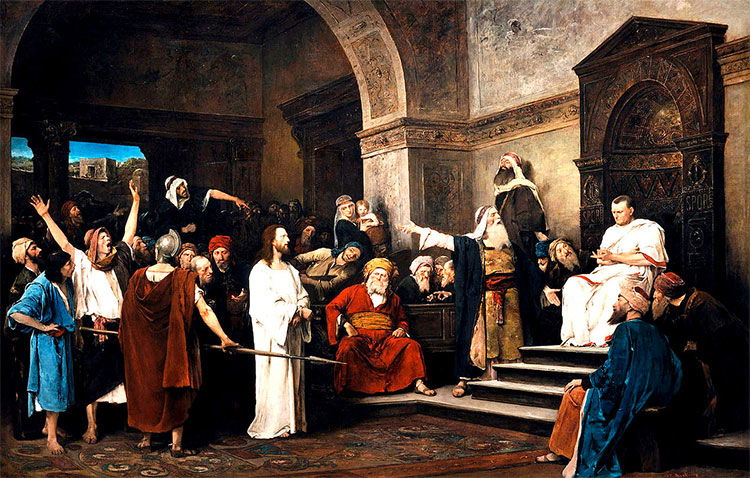
Christ before Pilate, MihΓ‘ly MunkΓ‘csy, 1881Christ before Pilate, MihΓ‘ly MunkΓ‘csy, 1881

Towards the end of the second century AD the pagan intellectual Celsus wrote an anti-Christian treatise mocking belief in Jesus Christ. If Jesus really had been the Son of God, he asked, why hadn’t God punished Pontius Pilate, the man responsible for crucifying him? Why had Pilate not been driven insane or torn apart, like the characters in Greek myths? Why had no calamity befallen him?

While there are plenty of later Christian traditions about the punishment of Pontius Pilate, all of these seem to belong to a period long after Celsus was writing. Celsus’ challenge, and the response of early Christians to it, suggests that there was more than a kernel of truth in the claim that the Prefect of Judaea had evaded misfortune. This is implicit from the efforts early Christians made to absolve him of responsibility for the Crucifixion.

The only reliable statement we have about Pilate’s life after his time in Judaea comes from the pen of the Jewish writer Josephus. In his Antiquities of the Jews, written about 60 years after the events, Josephus states that Pilate was recalled to Rome after his mishandling of a riot involving the Samaritans in AD 36. For this he would have expected to face a hearing before the Emperor Tiberius, the aged but uncompromising ruler who had appointed him ten years earlier. Pilate hurried back, but by the time he arrived, in March AD 37, the ailing Tiberius had died. A new emperor, Caligula, had taken up the reins of power. 

What happened next is guesswork. Josephus says nothing more about him, implying that there was no hearing. Perhaps, in the general euphoria surrounding Caligula’s accession, his case was put on hold, or simply forgotten. Maybe the hearing did go ahead and he was acquitted. For all we know, he was given another posting. 

The lack of a suitably grisly fate for Pilate put Christian apologists in a quandary. As governor, it was Pilate’s job to pass judgement in capital cases: he was the one who condemned Jesus to suffer on the cross. There was no circumventing his guilt. Divine punishment should have followed.

Yet in the early years of Christianity it was difficult to make such claims. The Roman state was suspicious of the new cult and, if Christians wanted to avoid confrontation, it was best not to accuse one of Rome’s officials of deicide. The canonical Gospels stressed that Pilate was not fully to blame. He could find no fault in Jesus: β€˜I have found in him no grounds for the death penalty. Therefore I will have him punished and then release him’, Pilate declares in Luke’s Gospel. John has Pilate twice announce β€˜I find no basis for a charge against him’. The apocryphal Gospel of Peter, thought by many scholars to be among the earliest Christian texts, went even further. In this, Pilate and his soldiers play no part in the crowd’s mocking or torturing of Jesus. He himself declares β€˜I am pure from the blood of the Son of God’ and, together with his soldiers, who guard the tomb of Jesus, he conspires to keep the miracle of the Resurrection secret from the Jewish priests. 

The tradition of a blameless Pilate, a witness to the Passion, led to a strange early Christian fascination with him. By the second century AD, fake letters of Pilate, recounting the wondrous story of Jesus, circulated among the faithful. The so-called Acts of Pilate, allegedly deriving from the governor’s own records, portray Pilate as a convert. Tertullian, the late second-century Christian theologian, described Pilate as someone β€˜who himself also in his own conscience was now a Christian’ and alleged that Tiberius was so convinced by Pilate’s reports that he would have placed Jesus among the Roman gods had not the Senate refused. So influential were the various versions of the Acts of Pilate that in the early fourth century the Roman state created and promoted an anti-Christian, β€˜true’, pagan version in an attempt to discredit the Christian ones. Needless to say this was no more reliable than its rivals.

All of this might seem merely capricious, but the absolution of Pilate came at a terrible cost. The early Christians shifted the blame for the Crucifixion onto others. A rebuttal of the arguments of Celsus, written by the third-century bishop Origen, shows this clearly: β€˜It was not so much Pilate that condemned Him,’ he wrote, β€˜as the Jewish nation’. Celsus had chosen the wrong culprit; and the fact that the Jewish nation had been torn apart by the Romans and dispersed across the face of the earth was proof of God’s retribution. The fake letters and the Christian versions of the Acts of Pilate said much the same thing, as did other Christian apologists. The Acts went so far as to have the Jewish crowd telling Pilate that they willingly accept the blood-guilt, an echo of the Gospel of Matthew, which has the same crowd shouting β€˜his blood be on us and our children!’ These claims formed a basis for Christian persecution of the Jews right up to modern times. 

Video:Β Professor Kevin Butcher of the University of Warwick on the real Pontius Pilate

Pilate’s costly absolution was the product of specific religious and political circumstances. When the Roman Empire became a Christian state in the fourth century, there was no longer any need to emphasise his innocence. The Nicene Creed, formulated under Emperor Constantine in AD 325 and emended in AD 381, stated bluntly that Christ β€˜was crucified under Pontius Pilate’. It became acceptable to cast Pilate as a villain and a range of myths developed describing his grisly end.

Some influential Christians demurred, however. Saint Augustine, writing in the sixth century, argued that when Pilate wrote on the cross β€˜Jesus of Nazareth, King of the Jews’, he really meant it: β€˜It could not be torn from his heart that Jesus was the King of the Jews.’ 

While the West went on to develop the tradition of a β€˜bad’ Pilate who was punished for his misdeeds, the Eastern Church preferred a more sympathetic interpretation. Not only was Pilate a Christian; he was a confessor and even a martyr. One eastern text, The Handing Over of Pilate, has Tiberius ordering the governor to be beheaded for having allowed the Crucifixion to go ahead. First Pilate repents and then a voice from heaven proclaims that all nations will bless him, because under his governorship the prophecies about Christ were fulfilled. Finally an angel takes charge of his severed head. In some accounts he is buried with his wife and two children next to the tomb of Jesus – the ultimate martyr’s sepulchre.

In the Gospel of Matthew, Pilate’s wife warns her husband not to harm Jesus and for this she achieved sainthood among Orthodox Christians. The Copts and Christians of Ethiopia took the next step and canonised Pilate himself. An Ethiopian collection of hagiographies lists St Pilate’s Day as the 25th of the summer month of Sanne, a day shared with his wife Procla and the saints Jude, Peter and Paul: 

Salutation to Pilate, who washed his hands 
To show he himself was innocent of the blood of Jesus Christ

Those familiar with the western tradition may find the idea of St Pontius Pilate curious or even absurd. But the fascination with Pilate never abates. From the Acts of Pilate to Mikhail Bulgakov’s novel The Master and Margerita, the man who cross-examined and crucified Jesus remains an enigma, a shadowy metaphor for opposites: equivocation and stubbornness, cowardice and heroism, cruelty and clemency. His dilemma – to do the right thing or the popular thing – is every ruler’s quandary. Perhaps that is why people can sympathise with him: we too must sometimes face a difficult choice; though, fortunately for us, its legacy is likely to be less enduring.

Kevin ButcherΒ is Professor in the Department of Classics and Ancient History at the University of Warwick and the author ofΒ The Further Adventures of Pontius Pilate.

via https://www.historytoday.com/homepage

Share the Light

Standard

Resa's avatarGraffiti Lux Art & More

Our friendFrancina – Poetry and Art wrote a post, Share the Light .

To view Francina’s post, click on pic!

Francina asks, β€œWhy don’t we all share the light as a sign of hope? We can do this by posting for instance an image of a candle, a lamp, the light of a lighthouse etc. etc. in a blog post with the heading: Share the Light.”

Β Many of our blog pals have posted a β€œShare the Light” and Francina has reblogged them. I hope more join in with a post, and don’t forget to link to Francina’s blog!

She quotes the refrain from Leonard Cohen’s ANTHEM (1982) For those who don’t know it, here is the poet, himself. His opening statement also applies today.

ANTHEM
The birds they sang
At the break of day
Start again
I heard them say
Don’t dwell on what
Has passed away
Or…

View original post 278 more words

The Old Friends

Standard

A time it was, and what a time it was, it was
A time of innocence
A time of confidencesLong ago it must be
I have a photograph
Preserve your memories
They’re all that’s left you

These words are really a masterwork; those days Al and me, we were crazy about these two, and we have swallowed all their works like this one but I understand it now as I myself, getting aged and working with many old peoples, especially in these moments in which they might all feel lonely and scary.

This album actually was not so popular, because, there comes an old-friends talk in between; in a senior institution; we must just to listen to.

therefore, I would like to present this old but forever album to our old friends.

The poems are fascinating; Sharing a park bench quietly?
How terribly strange to be seventy”. it is an imagination of the Arts: it means for me a creation.

So young and so thoughtful

Old friends
Old friends
Sat on their park bench like bookends
A newspaper blowin’ through the grass
Falls on the round toes
Of the high shoes
Of the old friendsOld friends
Winter companions, the old men
Lost in their overcoats, waiting for the sunset
The sounds of the city sifting through trees
Settle like dust
On the shoulders of the old friendsCan you imagine us years from today
Sharing a park bench quietly?
How terribly strange to be seventyOld friends
Memory brushes the same years
Silently sharing the same fearA time it was, and what a time it was, it was
A time of innocence
A time of confidencesLong ago it must be
I have a photograph
Preserve your memories
They’re all that’s left youSource:Β LyricFindSongwriters: Paul SimonBookends Themes lyrics Β© Universal Music Publishing Group

Take care all you old friends, just stay healthy and no fear, be safe πŸ’–πŸ’–πŸ₯°

Fifty + Years Loneliness (!!!)

Standard
Pinterest
Hard but true.

You might be surprised to see I’ve titled this with three Exclamation Marks instead of Nombre 3. I just wanted to show how I feel! 😁

I have mentioned, as I had a look back on the latest two chapters, that I have really a problem to write this story, my life story. I have known it as I read them, again and again, I’ve just thought: “what the hell; this man has a problem!! ” πŸ˜›

You know, I have learned in my life to get out of me, stay beside and look at myself as another person, I think it helps to get knowing oneself better and here I found this memorandum somehow poor. Here I must really thank you, dearest and adorable friends, despite all these poorness did support them. I am deeply grateful and appreciated.

As I might take the advantage of your kindness, let me analyse why I have such a problem with this story; since I got known psychology through Sigmund Freud, I have found out that I have many complexes in my life; When our mother lied us about father’s death, my unconsciousness knew there’s something wrong as I remember Al, who somehow got it clearly, tried to help mother’s secret on one side and to stop me not putting so many questions there all about, dear brother. I have found it out after some months later when I looked into the old magazine and saw the memorial ceremonies of the funeral which took place after father died (he was a famous writer in his time) and I asked her about the matter, her answer was just “get out and let me alone!” I went out, and of course, she came after me and we’ve taken us in arms wept together.

Pinterest

But these all have remained in my inner soul like deep tracks which I had to work with them, as I am still working on.

It’s surely a big problem but to this comes my inexperiences on writing too and also, two foreign languages which I have to struggle with; English and German. You know, I have learned both by myself; Al and I have learned English at home in Iran when we both began to work as a journalist and when we came in Germany, I’ve noticed that no matter if I can live and communicate in English with people I must learn German to better understand and be understood, therefore, bought some grammar books and did it myself! Now when I begin to think or write in English, both languages mixed up together; I am living here in Germany since 1985 and I speak, think, dream in German and when I want to switch into English, the conversant words for me are mostly German words; I have to translate them in English in my head! If you might notice in the last chapter, I’d written in the title; “Fufty” + Loneliness (2) It is just a mixed-up Fifty in English and FΓΌnfzig in German!!

Here is an example by Master Dr Freud πŸ˜‰πŸ˜„

4 in German, is vier (sounds fear) and 6 sounds sex!

You might ask why I don’t write in German, and I might answer; I have the English language almost in my blood, maybe because since my childhood I’m listening to the English music and to be honest; writing in German is not so easy as the German believe in by themselves. πŸ˜‰

Anyway, I wondered how many mistakes I’ve made, not only because of the languages but also my extremely humbleness plus a lot of excitement cause of lack of self-confidence.

Therefore, I dicided to make a stop to write about my life, I am sure I will back on this soon, thank you all again and again for your wounderful, inspiring suports and kind words. Blessing πŸ’–πŸ™πŸ’–πŸ™

The Queen of Illustrations

Standard
The New York Times

I just can’t go by any posts about this Queen without rush on to it and swallow every cell of this wonderful Goddess. Honestly, in my youth, I fell in love with some famous characters; the first one as I clearly can remember was Angela Cartwright; who got famousΒ as Brigitta von Trapp in The Sound of MusicΒ and surely was known as Penny in the TV-series Lost in Space. And there it happened. I have fallen in love with her….

Anyway, the next one as still remains in my memory was Brigitte Bardot (I think that my old male friends can well have understanding!) though our love has a short time and with no success.

Now, I tell you that I have all forgotten and left all my old lovers behind but; this Goddess of painting is unforgettable (I still believe that my male friends all are agreed!)

So, now let’s enjoy this wonderful post by the very agreeable culture site http://www.openculture.com/ Thanks and,,, I love you all πŸ’–πŸ’–πŸ₯°πŸ˜˜

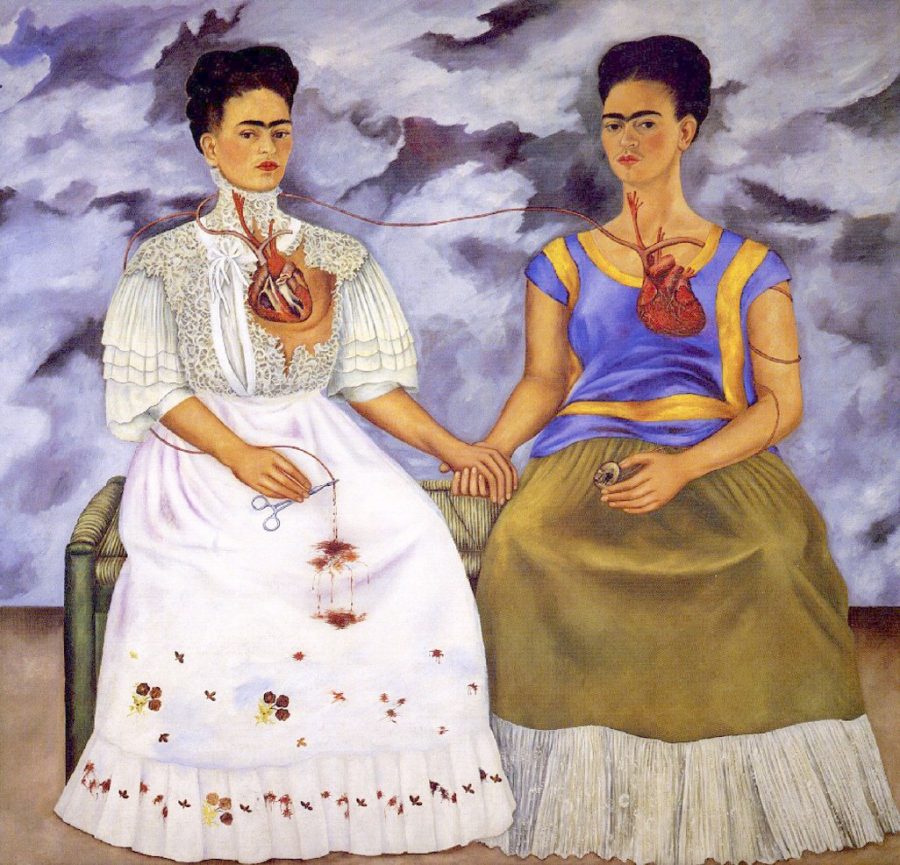
What the Iconic Painting, β€œThe Two Fridas,” Actually Tells Us About Frida Kahlo

I never painted dreams. I painted my own reality. β€”Frida Kahlo

You may be forgiven for assuming you already know everything there is to know about Frida Kahlo.

The subject of a high profile bio-pic, a bilingual opera, and numerous books for children and adults, her image is nearly as ubiquitous as Marilyn Monroe’s, though Frida exercised a great deal of control over hers by painting dozens of unsmiling self-portraits in which her unplucked unibrow and her traditional Tehuana garb feature prominently.

(Whether she would appreciate having her image splashed across shower curtainslight switch coversyoga mats, and t-shirts is another matter, and one even a force as formidable as she would be hard pressed to control from beyond the grave. Her immediately recognizable countenance powers every souvenir stall in Mexico City’s CoyoacΓ‘n neighborhood, where Casa Azul, the home in which she both was born and died, attracts some 25,000 visitors monthly.)

A recent episode of PBS’ digital series The Art Assignment, above, examines the duality at Frida’s core by using her double self-portrait, The Two Fridas (Las Dos Fridas), as a jumping off place.

Kahlo herself explained that the traditionally dressed figure on the right is the one her just-divorced ex-husband, muralist Diego Rivera had loved, while the unloved one on the left fails to keep the untethered vein uniting them from soiling her Victorian wedding gown. (The vein, originates on the right, rising from a small childhood portrait of Rivera, that was among Kahlo’s personal effects when she died.)

It’s an expression of loneliness and yet, the twin-like figures are depicted tenderly clasping each other’s hands:

Bereft but comforted

Fractured but intact

Lonely but not isolated

Broken but beautiful

Humiliated but proud

Kahlo’s boundaries, it suggests, are highly permeable, in life, as in art, drawing from such influences as Bronzino, El Greco, Modigliani, Surrealism, and Catholic iconography in both European religious painting and Mexican folk art.

As for the new thing learned, this writer was unaware that when Kahlo married Riveraβ€”her elder by 22 yearsβ€”in a 1929 civil ceremony, she did so in skirt and blouse borrowed from her indigenous maid… a fact which speaks to the end of her popularity in certain quarters.

ASADI – CROWN ( BEST PERSIAN TRAP MUSIC )

Standard

With Cyrus the great 😊 Merci πŸ™πŸ’–

A JACOB's avatarMusics and Souls

View original post

PICTURES FROM ISOLATION CENTRAL

Gallery

A huge lonesome πŸ™„πŸ˜
When for two, don’t forget the mouth protection πŸ˜‰πŸ˜

Take measure of your soul

Standard

your health is not a disease deteriorating
like a soundless wail. Brilliant πŸ™πŸ‘

Celtic Fairylore: Aos Si & The TΓ­r nAill (The Other Land)

Standard

Great Celts great fairy tales πŸ˜Šβ€πŸ‘