When he arrived at the site of Dahshur on February 17, 1894, Jacques de Morgan, who had headed the Egyptian Antiquities Service for two years, expressed his satisfaction: “I found things as they were. I wanted to see them. The excavations in the south had uncovered mastabas and wells of the Old Kingdom; those in the north, on the contrary, had proved the existence of a vast necropolis of the XIIth Dynasty. “ Two months later, one can imagine, with good reason, that his satisfaction redoubles as he unearths, in the southern pyramid, the tomb of King Fou-ab-Ra Hor or Aou-ab-Ra Hor. The existence of this hitherto unknown ruler has only just been revealed to him by various broken objects bearing his name, left behind by grave robbers. A controversy will also arise between de Morgan and Maspero on the date of his reign: 12th? or XIIIth Dynasty?
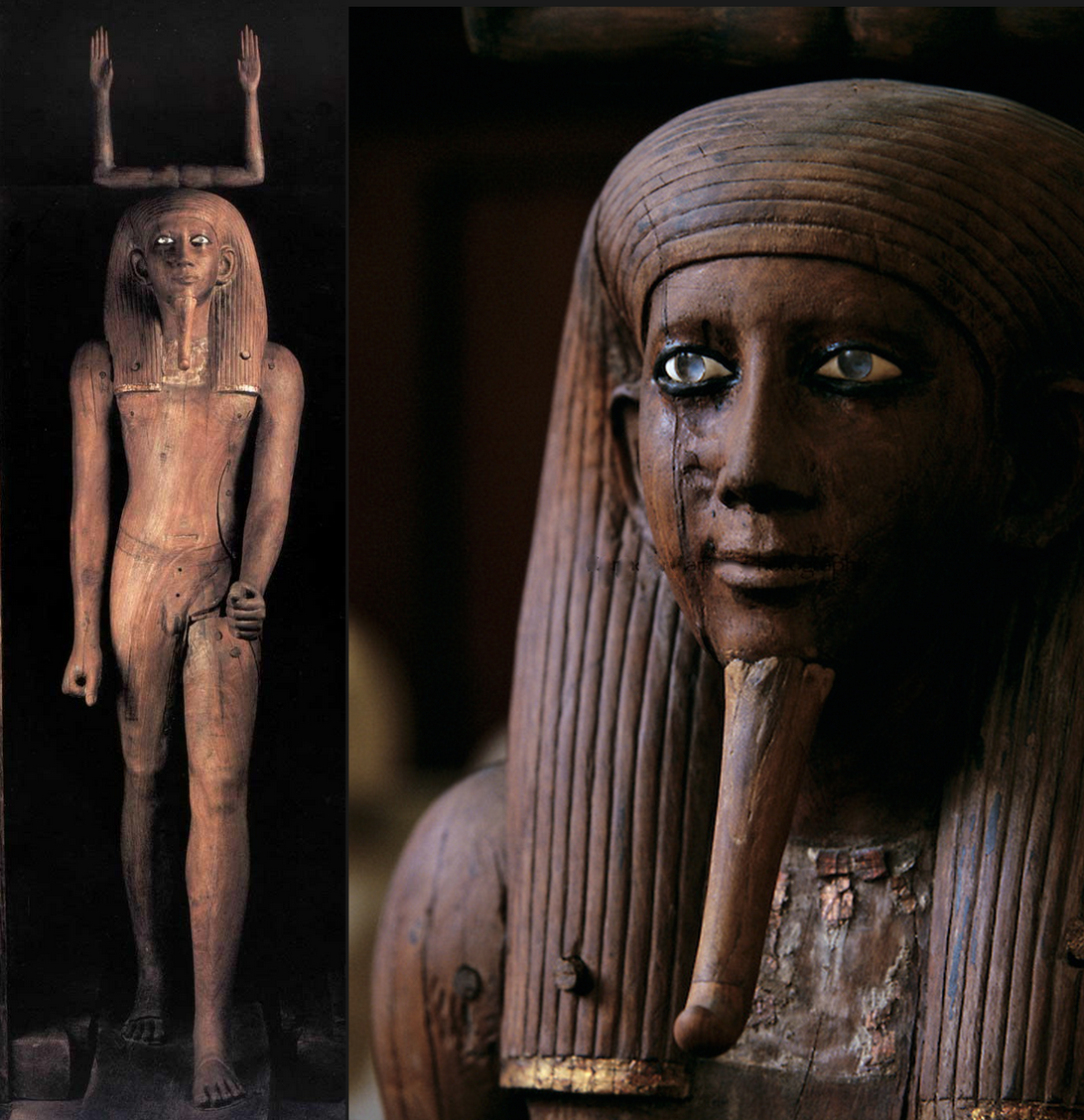
On April 17, as he entered the tomb, accompanied by Gustave Jéquier and Georges Legrain, his attention was drawn to a large wooden naos measuring 2.09 m high, 0.68 cm wide and 0., 92 cm, “inverted flat in the eastern corner of the first chamber”.
Dessins de Georges Legrain représentant la statue dans son naos, parus dans “Fouilles à Dahchour” – Jacques de Morgan, 1894
Here is the account of the incredible discovery:
“The great naos contains the statue of the double (ka) of King Hor-Aou-Ab-Ra (or Fou-ab-Ra). The pediment was decorated with the sun disk with extended wings. The royal protocol was read in full on the uprights of the doors, broken, formerly and now disappeared. The solar disk and the hieroglyphic texts were painted in green on a gold leaf resting on a plaster plate.
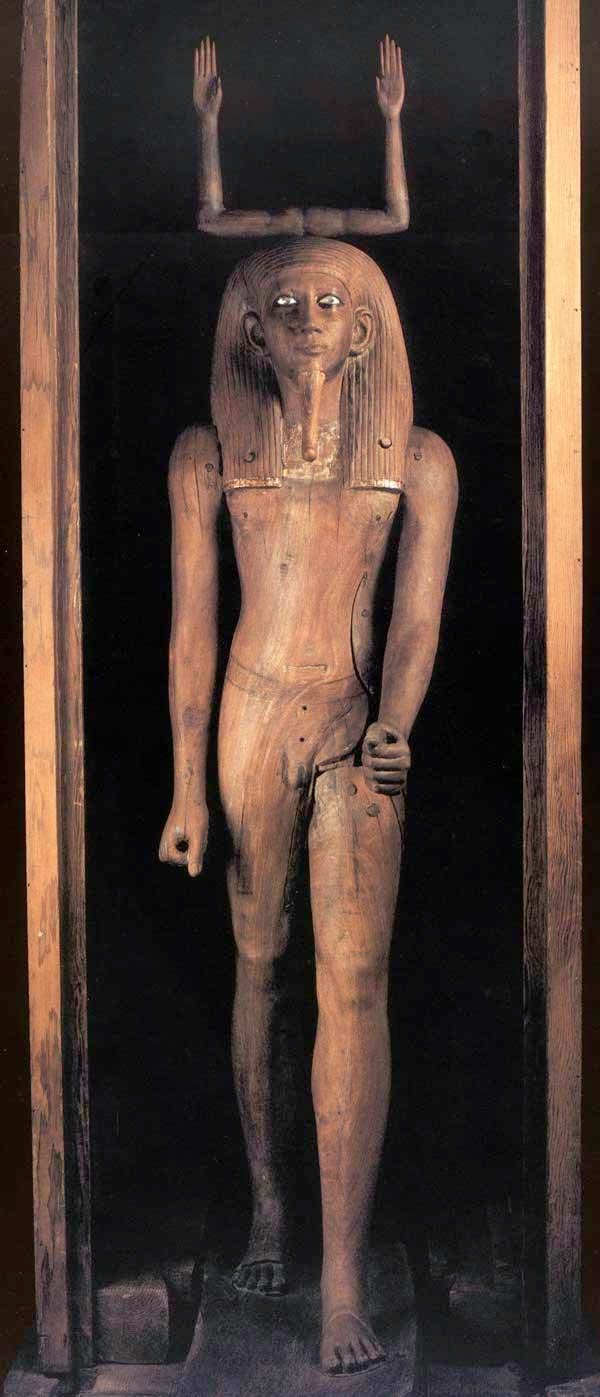
“The double statue of King Hor-Fou-ab-Ra depicting “the shadow of a deceased is unique. When it was found, lying in the naos under a heap of sticks and pottery, it was still covered with a coat of grey paint that fell on the first touch …
The eyebrows, eyelids, beard stand, gorget, the tips of the breasts, toenails and hands were covered with gold leaf.
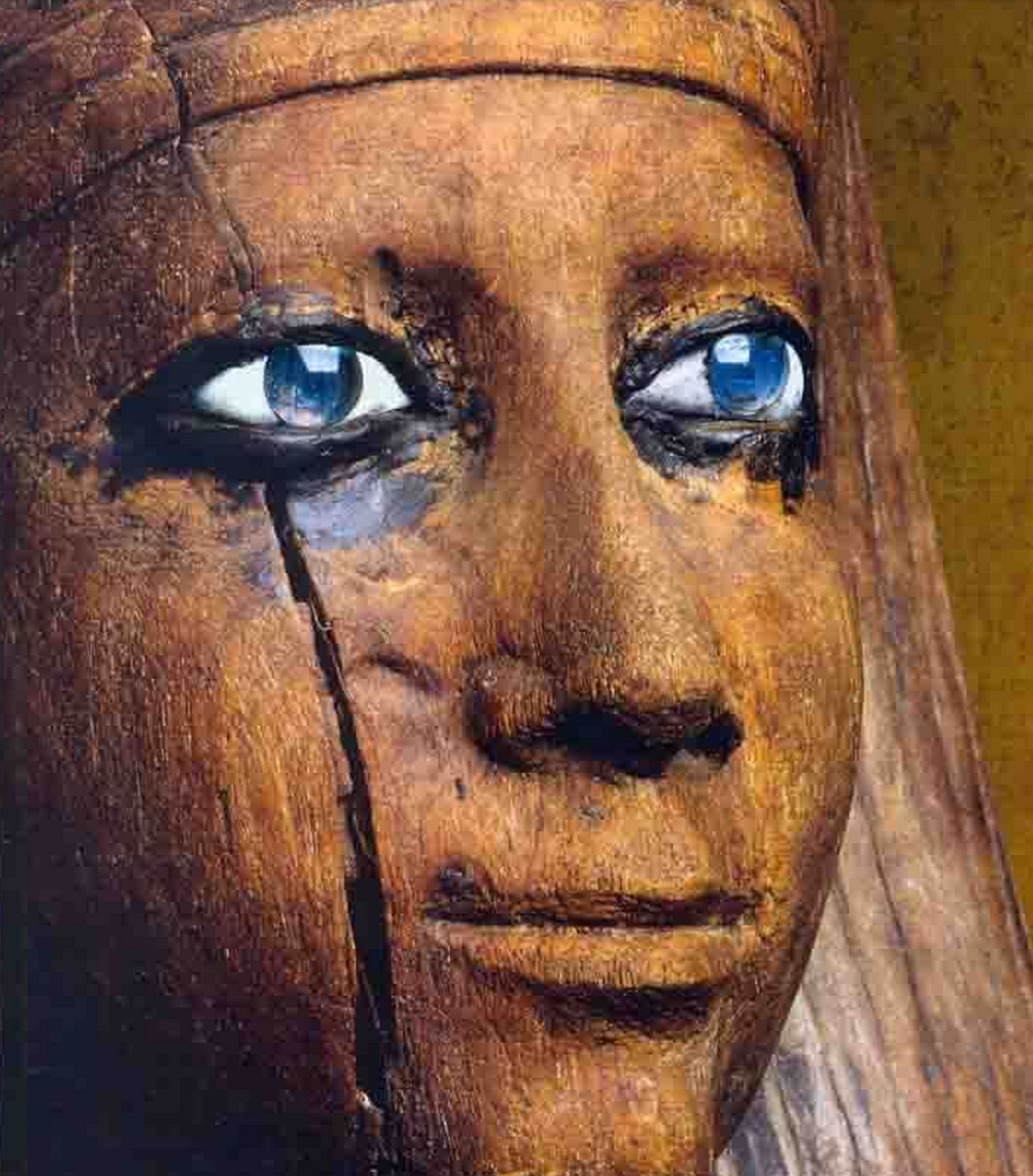
A thin belt of the same metal surrounded the kidneys, knotting at the suprapubic region to drop its extremities, which are one finger wide, down to half of the thighs. Scattered in the back of the naos were found the fragments of the hieroglyphic sign “Ka” which surmounted the head, as well as the eyes and the beard which had once been violently torn off. This representation of the shadow of a king bears no emblem attesting to the sovereignty of the one who united during his lifetime the two crowns of Egypt. The shadow is naked and walks calmly, a stick in the left hand guiding its walk. “
“The Horus Hotep-ab, the master of the diadems of the Vulture and the Ureus, Nojer-Khaou (with splendid appearances) the Golden Horus Nojer Nouterou (the beauty of the gods) the king of Upper and Lower Egypt, ruler of the two lands, the omnipotent Fou-ab-Ra, the son of the Sun, who comes from his side and who loves him, Hor, the royal double living in the tomb; he gives life, stability, strength and health, he rejoices on the throne of the Horus of the living, like Ra, eternally “.(inscription on the facade of the Naos)
“The artist who made this statue cared little for the material he used. He may have made the head, torso and left leg in a single block of wood; but arrived there, he adjusted with large ankles the arms and the right leg and completed his work by adding new pieces to the shoulder blades and toes. All of this disappeared in the past under the coat of grey paint. Anyway and despite the difficulties involved. he was able to meet in the accomplishment of his task, the artist did a masterpiece. The body is perfect for balance and proportions. “
This statue calls out to us in different ways, by its rock crystal eyes surrounded by bronze, by its nudity and the veins of ebony wood which resemble marbling or the grain of the skin, but especially by these arms raised on the head. …
Jean-Pierre Corteggiani enlightens us on this “ka”: “The abstract notion of ‘ka’ is certainly one of the most difficult to define because, despite the ‘double’ translation adopted in the last century, it does not correspond to any of our conceptions Let us just say that with the ba, the akh, the body (The Egyptian Soul), the shadow and the name, the ka is, for an Egyptian one of the constitutive elements of the personality of an individual and that he is, in fact, a manifestation of vital energies, both creative and conservative, related to sexual potency and the forces that maintain order in the world. “
Here is something to be, once again, absolutely amazed by ancient Egypt, by its art of course and always, but also by its way of thinking, by its perception of the components of the individual and by this notion, always immensely present. , and pregnant, of maintaining the cosmic and terrestrial balance.
Is it right? It is right! At least I think so. There are many and many women in the world that have shaped the lives of men, and it is a pity for us men who had not the chance to get such an opportunity to make a worthy life! I am serious; We men can learn a lot by our Amina’s power what we might never know. Please don’t forget that we all are made by one substance. We are so arrogant, have such an inflated arrogance which makes us blind. Open Eyes;
As I believe, the history of the creation of us the high creature has been gone wrong. We might begin from the all first or let all by side and just say to the creator (God?) you have shited about!
Anyway, let’s have a look at this wonderful and genius girl; SHe is self-assured, self-acknowledged, aggressive and progressive; what the hell we have missed!! (The language is in German but with the subtitle. a great well made movie:)
That’s it; Let know about another feminine power; it helps us to understand the world around us better, believe me, MAN
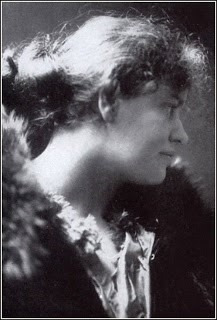
See the fateful woman, the charming, the mistress, the unethical, but also the smart woman, the scientist, the first psychoanalyst, the free-spirited woman, See the wife, see the author… See Lou Andreas- Salomé!
Lou Salomé, Friedrich Nietzsche, Paul Rée
Look at that woman who, like another Kirk, seduced “big men”, seemingly inaccessible, “mountains of spirit”, that became their muse, their passion and their wound as they left them …
Lou Andreas-Salomé
This is why Friedrich Nietzsche wept . It was about him, Lou Salomé, his great, unfulfilled love. She made three (temporary) marriage proposals, and she said no to all three. But for her, it was what the philosopher later said:
” Without Lou, there would be no Zarathustra”
Lou Andreas- Salomé!
..And, Nietzsche may have said that to Lu, but Nietzsche’s sister was saying to Lu that she was the devil. For her, Lou Salomé became passionate about the poet Rainer Maria Rilke, even though she was 14 years her junior as if she had become her mistress, even though she was then married. Rilke was only 21 when he met Lou in 1897 and remained lovers for many years.
Until he met her, Rilke was listening to Rene. She was the one who gave him the name Rainer, which he has kept in his life ever since, and by that name, he became well known as a poet Rilke. Lou helped Rilke with his psychological problem with death, introduced him to the world of art and reason, and it was he who taught him Russian so that he could read works by Pushkin and Tolstoy, which he met on their trip to Russia. It was for him his mother, his mistress, his muse.
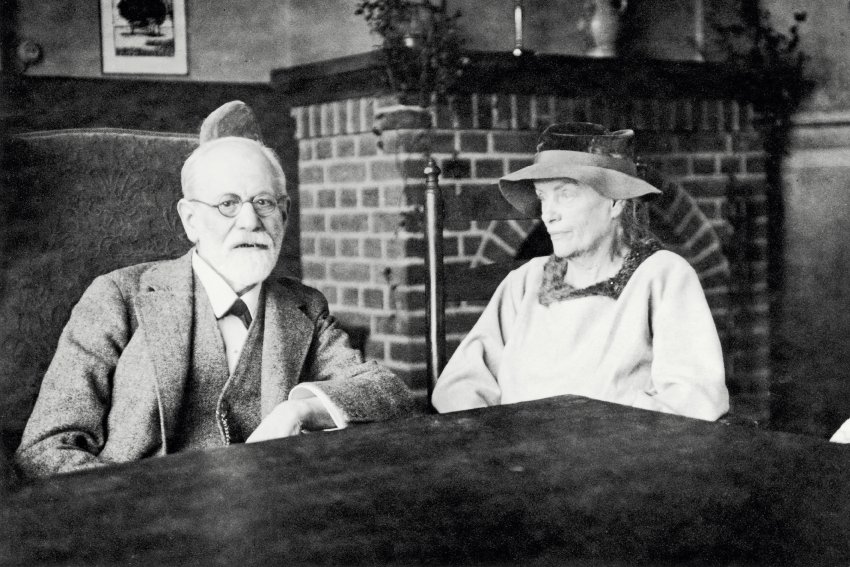
Sigmund Freud and Lou Salome
Of her, Lou Salome, and only of her, Sigmund Freud the famous and famous psychiatrist-psychotherapist received negative criticism and/or suggestions for changes in the way his ideas and perceptions he had set out. Join. So he deleted Adler and Jung and others. For Lu, however, who was his special friend and schoolgirl, when in 1912 and already in his 51st year, Lu joined the psychiatric circle of Vienna, himself had said: ‘ Only one person can do whatever criticism he wants’. And that man was she, Lou. Freud was in love with her but in a specialized way
According to Paul Roazen, a political science professor, psychoanalyst, and author of numerous books on Sigmund Freud, who, like his work, had been thoroughly studied by Freud himself and already a father of six as if he had met Lou in his fifty-six years, and yes, Freud himself later admitted in his writings that he had admired Lou immensely and that he had been attached to her, but that there was no trace of sexuality in her. the relationship.
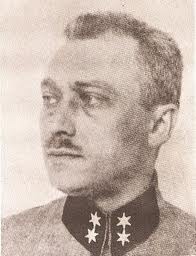
Viktor Tausk
At the same time, her then fifty-three-year-old relationship with Lu’s thirty-year-old Viktor Tausk, perhaps the most important of Freud’s students was involved with both of them with Freud. In Lu, however, many were blamed for Tausk’s suicide in 1919, though six years had elapsed since the end of any relationship between them and the break-up of the latter’s cooperation with Freud.
This, Lou Salomé, was a multi-dimensional woman, who lived freely in a society drowning in her homosexuals, lived as an equal woman in a male-dominated society, and as a scientist opened fields for the women who followed. She was a woman who lived out of time. and the dimensions of its time.
It was she who had set out to fall in love with her so that she could be loved so that she could remain independent. It wasn’t falling. She was the one to conquer the others who fell in love with her and were passionate with her. This was perhaps her strength, the source of her charm, and possibly her hidden trauma. She was an unusual woman, with a free, analytical and sharp spirit possessing a rare spiritual and at the same time, human intensity combined with feminine charm. She had the ability to stimulate the secret passions of her lovers… She also had the ability and develop them autonomously in her own projects.
Lou Andreas-Salomé was a charismatic woman. It had it all. Daughter of an aristocratic family, beautiful, elegant, seductive, with excellent studies, multilingual and multifaceted, smart, with research and free mind, unobtrusive. It was said to combine two elements of character: the male and the female.
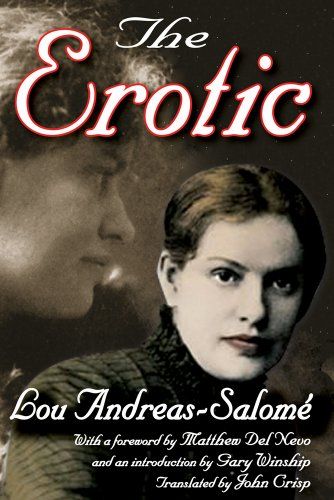
He wrote over twelve books. She was, in fact, the first psychiatrist to dare to write a sex book. Another is love and another is sex. To say sex is a necessity like food, like water .. infidelity, given..
And yet, Lou Salome remained in History as the ultimate lover of great men, as that other Cirque who charmed Nietzsche, Rainer Rilke, Freud and so many others
And, indeed, Lou Salomé had many spiritual or platonic but also passionate sexual relationships in her life, some at the same time with others, relationships with older ones, relationships with people much younger than her … She didn’t talk about it whatever her relationships, the men were the ones who talked about her and about her relationship with her others…
Lou was born on 12/2/1861 in St. Petersburg, Russia to Louise von Salomé or Luíza Gustavovna Salomé, a solitary assassin general of the Russian Army of French descent and mother of Danish descent. He had four other brothers and grew up in an aristocratic environment. As a teenager, she was teaching Hendrik Gillot, pastor of the Protestant Church with whom he had a relationship, because of which he was about to dissolve his marriage. Her mother took her to Zurich, Switzerland, to study Theology and Art History as she wanted, but in the semester she fell ill, so she stopped studying. Then her mother took her to Italy to recover. She was in her twenties at the time.
There, in Italy, Lou met the German philosopher Paul Ree, who was dazzled by her and asked her to marry her, which she refused in response to her need for independence. Later, through Ree, Lou also met Nietzsche, who had been friends with Ree for many years. Nietzsche was also immediately captivated by Lou’s presence and personality. Subsequently, all three of them, Lou with Ree and Nietzsche, briefly lived in the same house. Whether the relationship between the three was an erotic triadic character – as it was rumoured afterwards or a full spiritual one – a kind of monastic communion for solitary free spirits as they called themselves – can not be ascertained.
The fact is that over time, Nietzsche moved away from Lou with a broken heart, while Paul Ree’s old friend had always been associated with her for years – indeed, for many years. Each relationship Paul Ree with Lou stopped with her marriage in 1886. In 1901, Paul Ree found dead after falling from Vracho. Oi conditions of fall, whether it was accident or suicide are topic until today.
1886.-Lou-Salomé-und-Friedrich-Carl-Andreas
Lou Salomé was married once in her life, in 1887, to Friedrich Carl Andreas, a linguist and university professor in Göttingen, Germany. And this man married him because he had tried to commit suicide before their marriage for her sake. Until the day of their wedding, it is said, he had a knife on him to commit suicide, so she did not leave. This is how their marriage took place and lasted with the explicit term she had set: Never ending their marriage, that is, with the condition that they would not have carnal relationships with each other and that she was free to relate to any other man she wished. And so it was throughout their marriage, despite the futile efforts of her husband, until it ended with her death in 1930.
Lou Solomé died despite her wanderings in Göttingen, Germany on 5/2/1937. It was 76 years old. Her books were confiscated by the Gestapo and then destroyed because she was a colleague of Jewish Sigmund Freud. She asked to be buried and buried next to her husband
Many and many have been written about Lou Andreas-Salomé in the years that followed to this day. Others call her a heroine, a free spirit, others call her a narcissist, others a Messalina, and others that she was for her lovers, what the female horse of Virgin Mary for his male lover.
The Paul Roazen (http://Paul Roazen) wrote about this: » H Lu belongs to the kind of women who can collect great men as was Madame de Staëlin the eighteenth century and Alma Mahler in the twentieth. In Lu’s case, beauty was not the main element of their attraction. As beautiful as she was in the past, she had to rely on her knowledge of psychology to draw attention to her possible conquests. Lou was useful in the line of her great men as she could identify with the vulnerable part of their personality who desperately needed support but all who fell in love with her were eventually forced to discover that Lou had remained independent and had given in none of them herself. All her great men needed her, but each of her lovers realized in the end that she had escaped them. “
A younger than her mistress, Swedish psychiatrist Poul Bjerre (15 years younger), who met him in the psychiatric circle of Vienna when she was well over fifty-five, said afterwards: ” ” Lu builds a passionate relationship with a man, and nine months later, the man brings a book to the world. “
And Lou herself said: “Only one who is completely left to himself is fit to be in constant love, for only he can, in living fullness, symbolize another’s life, only he can be felt like a force of her.”
And let me remind you here of something that Dimitris Liantinis had said in his remark on “Gamma”:
“Kirk is smart. That’s why it’s so beautiful that it looks like a witch and a witch kid. That is why it enchants the star and does not walk. If it wasn’t smart, it wouldn’t look pretty either. Beauty is the power of intellect. Beauty is not just curves and colours, rocking and neck and hair. Beauty is demonic dominance in the environment for undefined reasons. It’s the ’embarrassing beauty’ that Plato says. “
Hello dear friends, I hope you are all well and blithely in these horrible and chaotic days. Since this terrifying virus has been present in our world I had never written or even tried to tell about it, though I have seen many people did write many articles under its name. I didn’t want to do it because I just find it a bizarre and indescribable issue which nobody knows what it is; therefore, just kept silence. But now I must talk thereabout, not because of its presence with us but its name strongly appeared at least for one and a half-day at our home!
The story begins last Sunday in which my wife caught a cold. First, she thought it is a light cold but when got worst at night, she has informed the school where she teaches, that she could not come to work. Although it took longer; into the Wednesday, and there the school recommended a Corona-test, as usual, they said! I can understand as the rule demands these days; my wife was a little nervous but I was sure that it was just about a common cold as she often catches when the season changes.
But the term had become alive for us. My fear was not that of the virus itself but of the sloppy works that happen here and there, in such a thrilling situation. My wife told me last week that one of her colleagues got the same problem; caught a cold; had to take the test; they said it’s positive and after she unbelievingly let it for a further checkup, it came out that the result had been swapped! It was my whole excitement.
Anyway, on Friday the result was there and thanks goodness it was negative, but we felt the invisible enemy that lurked around us. It is not only the virus which causes the problem, it is our fear that is much more dangerous than the virus itself. We must not forget that once catching cold was something everyday trouble for us, once a sneeze or cough was not a catastrophic event. Our excitements and fear take us away from reason, therefore, we can’t think clearly and then we make mistakes.
Actually, I’ve come to know Allan Poe through Alan Parsons, the great musician and composer who made many great albums, including the vinyl album “Tales of Mystery and Imagination.”
As I might have noticed before, I have not much to do with poetry, but when I had the vinyl and listened to the poems… I was fascinated. It might be the dark side of Poe’s poetry, or The Dark Side at all, because it is my loveliest side, but I have run to his poems and loved them because they’re with no doubt a psychological look at our hidden edges.
First, there is a dream within a dream.
“A Dream Within a Dream” is a poem written by American poet Edgar Allan Poe, first published in 1849. The poem has 24 lines, divided into two stanzas.
Analysis
The poem dramatises the narrator’s confusion as he watches the important things in life slip away. Realising he cannot hold on to even one grain of sand, he is led to his final question, whether all things are just a dream.
It has been suggested that the “golden sand” referenced in the 15th line signifies that which is to be found in an hourglass, consequently, time itself. Another interpretation holds that the expression evokes an image derived from the 1848 finding of gold in California. The latter interpretation seems unlikely, however, given the presence of the four, almost identical, lines describing the sand in another poem, which is regarded as a blueprint for “A Dream Within a Dream” and preceding its publication by two decades.
Take this kiss upon the brow! And, in parting from you now, Thus much let me avow — You are not wrong, who deem That my days have been a dream; Yet if hope has flown away In a night, or in a day, In a vision, or in none, Is it therefore the less gone? All that we see or seem It is but a dream within a dream.
I stand amid the roar Of a surf-tormented shore, And I hold within my hand Grains of the golden sand — How few! Yet how they creep Through my fingers to the deep, While I weep — while I weep! O God! Can I not grasp Them with a tighter clasp? O God! can I not save One from the pitiless wave? Is all that we see or seem But a dream within a dream?
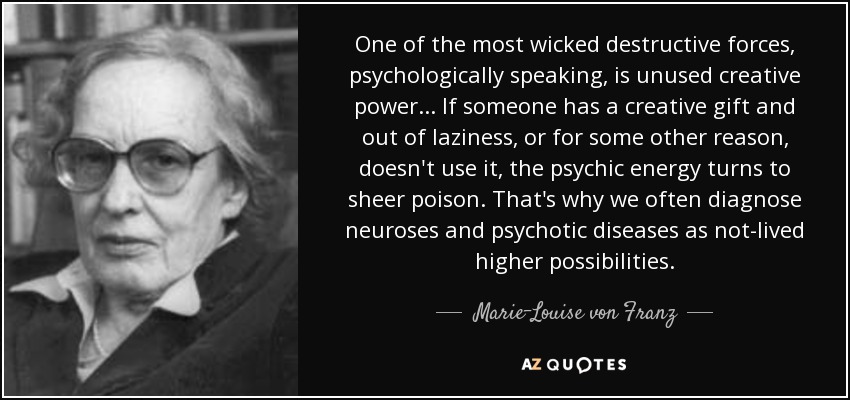
I can be sure that it is always fascinating to explore the hidden side of the soul, but it is not easy; we all have edges to our unknowns, hidden behind our childhood experiences. It’s called complexes, Sigmund Freud meant at least. But they are all present, and we can’t get rid of them; we work with them to know ourselves better.
Shadows of shadows passing
It is now 1831
And as always, I am absorbed with a delicate thought
It is how poetry has indefinite sensations
To which end, music is an essential
Since the comprehension of sweet
sound Is our most indefinite conception
Music when combined with a pleasurable idea is poetry
Music without the idea is simply music
Without music or an intriguing idea
Colour become pallor
Man becomes carcass
Home becomes catacomb
And the dead are but for a moment motionless
Anyway, I bow to Alan Parsons and his Alan Parsons Projects. I have learned a lot. 🙏💖
I think that Queen Cleopatra is known for “almost” every human being around the world, therefore, I don’t have to tell much about her.
There are many puzzles about her although something is sure; she was one of the most beautiful and powerful women in history.
http://SaltLakeCo Mark Antony visits Cleopatra, Sir Lawrence Alma-Tadema painting
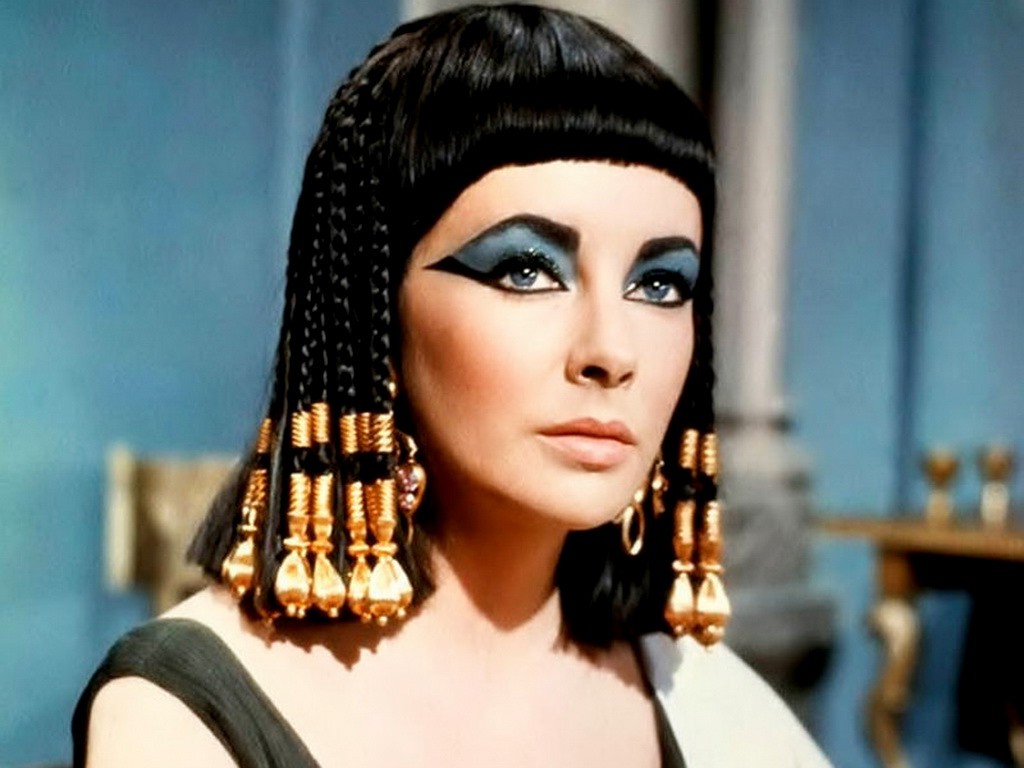
Many directors and producers made so many movies (Hollywood Movies) about her and they tried to have the beautiful actresses for play in her place, especially, Elizabeth Taylor http://Elizabeth Taylor as I believe that she was not only beautiful but also impressive; She is one of my favourites.
Cleopatra VII Philopator was the last active ruler of Ptolemaic Kingdom of Egypt. The Ptolemaic Kingdom was a Hellenistic kingdom based in Egypt. It was formed after the death of Alexander the Great in 323 BC and ended with the suicide of Cleopatra in 30 BC. She ruled from 69 to August 10/12, 30 BC.
But definitely, the bathing of Cleopatra has ever been the dreaming term in all history. Therefore, I have taken this story to share with you; a wonderful tell by Marc Chartier, Marc Chartier. translated from French.
Let’s take a closer look at this beauty. with thanks to Marc Chartier for this wonderful research. 🙏🙏💖
Baths of Cleopatra: one-third of water, two-thirds of legends
Inlay: Elizabeth Taylor, in the movie “Cleopatra” directed by Joseph L. Mankiewicz (1963)
According to tradition, spread orally, Cleopatra VII, queen of Egypt, maintained her beauty with baths in donkey milk … or mud from the Dead Sea. But one can easily imagine that the sublime sovereign, in addition to this cosmetic luxury, also had recourse to more common baths, with quite simply clear water. In any case, the places known as “Cleopatra’s baths” (in addition to making flourish in our modern advertisements!) Appear in certain localities which thus want to keep the memory – no doubt generously embellished by some legend and possible tourist targets – royal ablutions.
We will only take two here.
Siwa Oasis
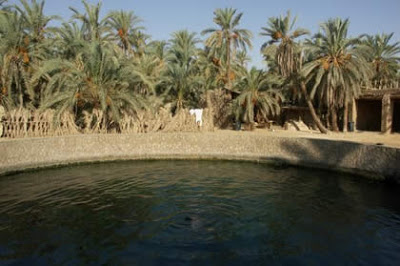
First Siwa, 590 km west of Alexandria and 300 km from Marsa Matrouh. This oasis is famous for its many hot springs to which we attribute therapeutic virtues, the most famous being that of Aïn el-Hammam (“the source of the baths”), formerly called “source of the sun”, and today hui “Cleopatra’s baths”. The queen is said to have bathed there when she came to the site to consult the oracle of Amon in the temple dedicated to this deity. In ancient times, the spring water was known to be cold during the day and hot at night, because the sun went down there in the evening and found its course in the early morning. The “Petit Futé Sahara” (2011 edition) continues to praise the “limpid and light water, incredibly transparent” of this natural swimming pool, to such an extent that “there is no danger of taking a sip ”.
Second place: Alexandria.
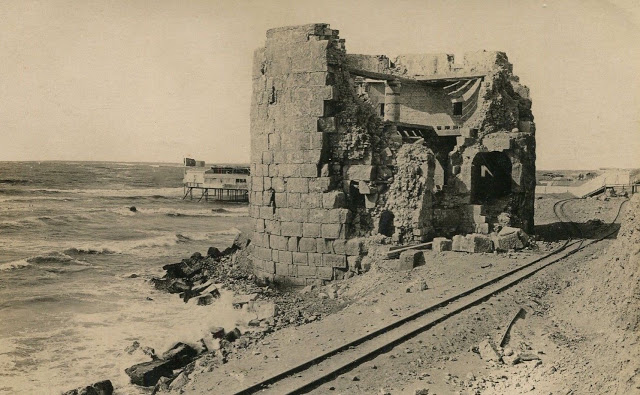
The Plage of Bains de Cléopâtre and the so-called Sarrazine tower, at Ramleh station
In his “Letters on Egypt” (1785), Claude Savary describes the site in these terms: “Half a league south of the city, we descend into the catacombs, a former asylum for the dead. Winding paths lead to underground caves where they were deposited. (…) Going towards the sea, we find a large basin dug in the rock, which borders the shore: on the sides of this basin, we have chiselled two pretty rooms, with benches crossing them. A channel made in zigzag, so that the sand stops in the bends, leads there the water of the sea: it comes there pure and transparent like crystal. I took a bath there. Sitting on the stone bench, we have water a little above the waist. The feet rest softly on fine sand. We hear the waves rustling against the rock, and quivering in the canal. The flood enters, lifts you, withdraws, and going in and out in turn, brings ever new water, and a delicious freshness, under a blazing sky. This place is vulgarly called Cleopatra’s bath. Ruins indicate that it was once adorned. “
In 1840, in his “Overview on Egypt”, Antoine-Barthélemy Clot-Bey adds an important nuance to this story: “Between the catacombs and Alexandria are on the shore a few baths eaten away by the action of the water, which ‘we have pompously, and probably wrongly, decorated with the name of Cleopatra’s baths. ”
Another detail is provided to us by Ange de Saint-Priest in his “Encyclopedia of the nineteenth century” (1846) when he wrote: “On the seashore, artificial excavations had been made in the rock, in shaped like bathtubs, and which we call the Baths of Cleopatra. These baths were said to wash the dead before they were given to burial. “
The proximity between the baths and the catacombs had previously inspired Guillaume-Antoine Olivier, in his “Voyage in l’Empire Othoman, l’Égypte et la Persia” (1804), the following reflections: “It does not seem probable to us, according to the idea that History gives us of Cleopatra, that this queen, so magnificent and voluptuous, would have chosen for the ordinary field of her recreations the neighbourhood of the dead, this place of solitude, silence and meditation. (…) How can we be persuaded, moreover, that this young and beautiful woman would have been careless enough about the freshness of her complexion to expose it to contact with salt water, usually taking sea baths in a place that responded so badly to the magnificence it displayed?
Where is the historical truth? Did the sublime Cleopatra take pleasure in diversifying both nature and the place of her beauty treatments? Let us agree that we like to leave the question open and since we are immersed – or not far from it – in full imagination, let ourselves be subjugated by the poetic impulses of Théophile Gautier when he writes, in “Une Nuit de Cléopâtre” (1838):
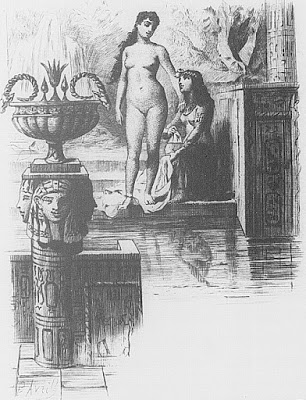
“It was bath time. Cleopatra went there with her women. The baths of Cleopatra were built in vast gardens filled with mimosas, carob trees, aloes, lemon trees, Persian apple trees, the luxuriant freshness of which made a delicious contrast with the aridity of the surroundings. (…) [Cleopatra] was standing on the first step of the basin, in an attitude full of grace and pride; slightly arched back, foot suspended like a goddess who is about to leave her pedestal and whose gaze is still in the sky; two superb folds started from the points of her throat and slipped in a single jet to the ground. (…) Before entering the water, by a new whim, she tells Charmion to change her hairstyle with silver nets; she preferred a crown of lotus flowers with rushes, like a marine deity. Charmion obeyed; her loose hair flowed in black cascades over her shoulders and hung in clusters like ripe grapes down her beautiful cheeks. Then the linen tunic, held only by a gold clip, came loose, slipped down her marble body, and fell in cloudy white at her feet like the swan at Leda’s feet. (…) Cleopatra dipped her ruddy heel in water and went down a few steps; the quivering wave made her a belt and silver bracelets, and rolled in pearls over her breast and shoulders like an unmade necklace; her long hair, lifted by the water, stretched out behind her like a royal cloak; she was queen even in the bath. She came and went, plunged and brought back from the bottom in her hand’s handfuls of gold powder which she threw, laughing at one of her women; at other times she hung on the balustrade of the basin, hiding and uncovering her treasures, sometimes showing only her polished and lustrous back, sometimes showing herself whole like Venus Anadyomene, and constantly varying the aspects of her beauty.
I think as I believe that all process of the human had based on its imagination. All the inventions, discoveries and of course its creations: Art. This power is a present given by God or what so ever, to us to do our works as the Creator self do; to create!
Unfortunately, it doesn’t go well sometimes as we can see in the whole history of man, even now! And it is not the fault of imagination itself but the failure of the education. Nevertheless, the imagination is very important especially at the beginning as a child. All the children have imagination but there are some parents who don’t take them seriously and these are the lost people who have lost their power of creation; they have lost everything!
The power of imagination caused fantasy to create Art. Art is the blood in the veins in our soul, let it run!
“Without this playing with fantasy, no creative work has ever yet come to birth. The debt we owe to the play of the imagination is incalculable.” C. G. Jung
For Al and me, we both might be lucky to grow up with and in our imaginations. Our mother was so busy with the problems which she had hard to solve, couldn’t care about the way how we go with our fantasies but we have used them and built our own world within them; to protect one and the other from the outer world, therefore, we became very solitude and lonesome. Our world was very different with the society in which we’d lived.
So then, let Fantasy go unlimited, to the world of Imagination. 🤗💖
“Fantasy need not always be verbal, nor must there be visual imagery. The account which translates an event into experience may be incorporated bodily through style, gesture, or ritual, like entering into a more subtle or skilled way of going about things. We feel we are getting into the secret of cooking, fingering an instrument, playing· ball, as we fantasy ourselves into a new style. Psychologizing breaks up repetitiveness; it is particularly effective when we perform one activity as if it were another, writing novels as if they were music (like Thomas Mann).” James Hillman, Re-Visioning Psychology
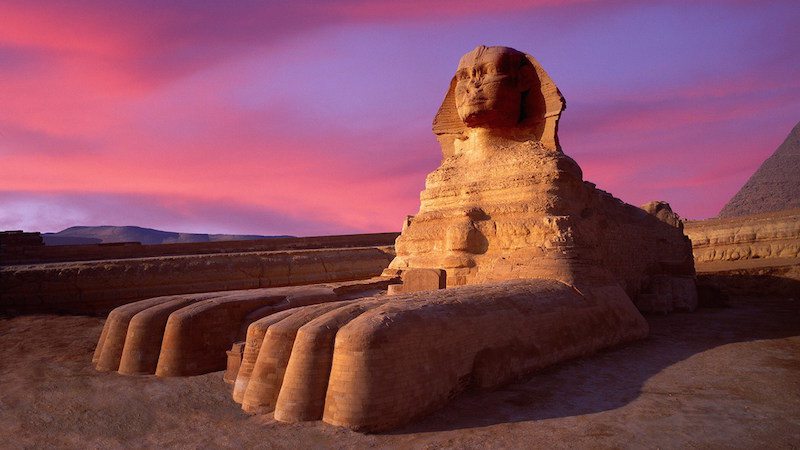
The Great Sphinx; or the Great Mystery of our history. Yes, there are many speculations about her but nobody ever knows when and how it’s made and what the purpose of making this giant sculpture was.
Anyway, these two smaller ones are obviously manmade and perhaps more recognizable but in any case great fonds for the archaeology.
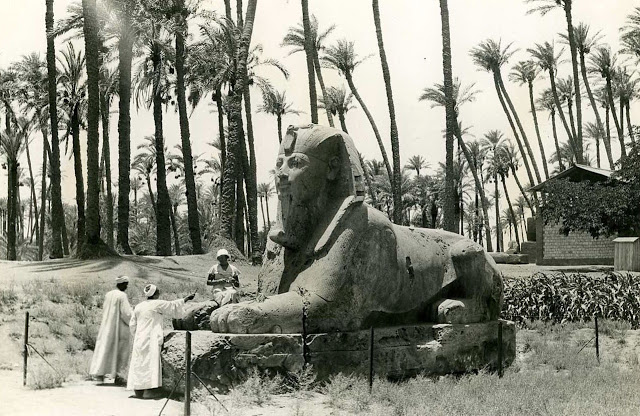
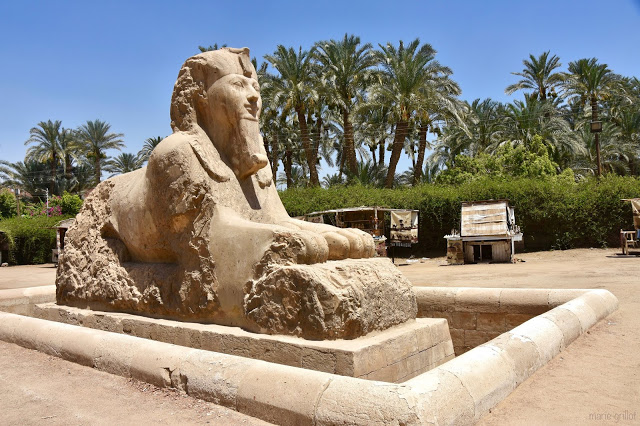
The Sphinx of Memphis – Egyptian alabaster (calcite) – New Kingdom unearthed by William Matthew Flinders Petrie and Ernest Mackay in the early summer of 1912 exhibited today in the open air museum of Memphis – Mit Rahineh
After having excavated a large number of sites, such as Tanis, Naucratis, Hawara, Arsinoe, Illahun, Meïdoum, Amarna, Koptos, Nagada, Thebes, Denderah, or even Giza, William Matthew Flinders Petrie arrives on ancient Memphis – Mit Rahineh – in 1908.
With his assistant, Ernest John Henry MacKay, a British archaeologist – who has worked alongside him since 1907 – he will make, until 1913, beautiful discoveries in the enclosure of the temple of Ptah.
The discoverers of the alabaster sphinx: William Matthew Flinders Petrie and Ernest John Henri MacKay
Located south of Cairo, “Memphis was the city of the god Ptah with whom Sekhmet and Nefertoum were associated from the New Kingdom. The city, the ancient” White Wall “, was the capital of the country during the Old Kingdom and remained an essential seat of administration throughout the history of the Double Country. ” (Isabelle Franco).
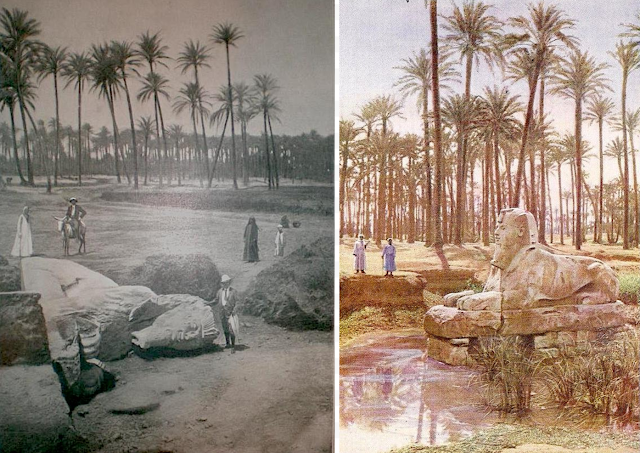
If the site, even today, gives us so little of its past grandeur, we must imagine what Egyptologists then found: a palm grove, most often flooded, in which blocks or remains of stone emerge.
Excavations are hampered by the recurring problem of the presence of water: you have to constantly pump to lower the level and dry out the excavation field. Flinders Petrie recounts the organization put in place: “Such work below the water level was novel and required close organization. The ground was lowered about two feet, just above the water level. water: a drainage system was then put in place, from which the water was pumped with large rubber pumps day and night. “
The excavations will notably allow the discovery of two sphinxes.
“The other sphinx of Memphis” – pink granite from Asouan – New Kingdom unearthed by William Matthew Flinders Petrie and Ernest Mackay in 1912 was donated in 1913 by the “British School of Archeology” (directed by M.W.F. Petrie) to the Penn Museum in Philadelphia
One, carved from a single block of pink granite from Aswan, measuring 3.62 in length and 1.45 m in height, was discovered in 1912. It bears inscriptions on the chest and around the base mentioning the names of Ramses II and his son Merenptah (although some believe that it was carved during a period prior to these two pharaohs). This sphinx, with a rather damaged face, will be offered in 1913 by the “British School of Archeology” (directed by M.W.F. Petrie) to the Penn Museum in Philadelphia.
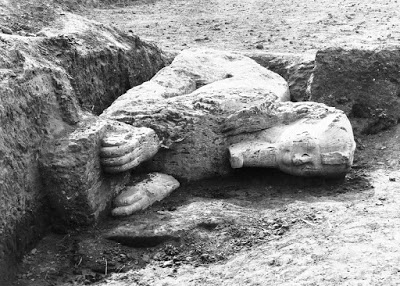
The Sphinx of Memphis – Egyptian alabaster (calcite) – New Kingdomunearthed by William Matthew Flinders Petrie and Ernest Mackay in the early summer of 1912here shortly after its discovery, it is now on display in the open-air museum in Memphis – Mit Rahineh
As for the other sphinx, Ernest Mackay had, in 1911, noticed its tail protruding above the surface, but it will not be actually uncovered until the beginning of the summer of 1912. From a height of nearly 8 meters, 4.25 m wide, its weight is estimated at over 80 tonnes.
Curiously, Petrie will remain very discreet about this discovery and will be little talkative in his publications. “There are a variety of reasons for Petrie’s reluctance about the alabaster sphinx. One of the main reasons is that it is completely lacking in inscriptions and therefore Egyptologists could not, period, date it with certainty at the time. “
The Sphinx of Memphis – Egyptian alabaster (calcite) – New Kingdomunearthed by William Matthew Flinders Petrie and Ernest Mackay in the early summer of 1912exhibited in the open-air museum of Memphis – Mit Rahineh
It will be attributed to Hatschepsout (because of the style of the face), or even Sethi I (by ‘association’ with the fact that his sarcophagus was in alabaster). Finally, “despite the absence of any inscription on the sphinx, Egyptologists estimate the period in which it was carved in the New Kingdom because of the style of the sculpture”.
Different stages of the “recovery” of the Memphis sphinx – Egyptian alabaster (calcite) – New Kingdomunearthed by William Matthew Flinders Petrie and Ernest Mackay in the early summer of 1912it is now exhibited in the open-air museum in Memphis – Mit Rahineh
The colossal statue lay on a side, and in 1913 it was straightened and placed on blocks of stone.
The sphinx is a “hybrid” statue which is most often made up of a lion’s body on which a human-head rests. “The Egyptian sphinx was a protective and positive entity,” and it generally represented the “portrait” of the pharaoh to whom he was dedicated, or allied.
The Sphinx of Memphis – Egyptian alabaster (calcite) – New Kingdomunearthed by William Matthew Flinders Petrie and Ernest Mackay in the early summer of 1912exhibited in the open-air museum of Memphis – Mit Rahineh
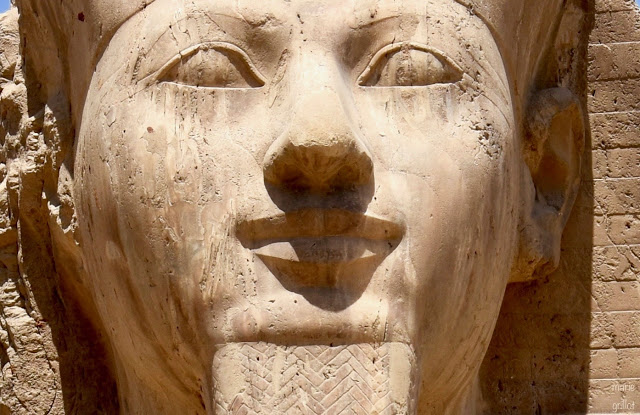
The alabaster sphinx takes on the attributes of a pharaoh, the uraeus, the false beard, and the nemes whose mat rests on his back. He has a very noble look, the face is beautiful, and the enigmatic smile retains all its mystery … The front legs are extended while the rear legs are folded under the body. The statue and its base are carved from the same block of alabaster.
In the chapter he devotes to minerals in his General Overview on Egypt, Clot Bey indicates: “Egyptian alabaster has always enjoyed a great reputation. The ancients exploited a quarry located between the Red Sea and the Nor, at the height of Minieh, 40 leagues from the river and 15 from the sea. They had founded near her a city to which they gave the name of Alabastropolis. “
The Sphinx of Memphis – Egyptian alabaster (calcite) – New Kingdomunearthed by William Matthew Flinders Petrie and Ernest Mackay in the early summer of 1912exhibited in the open-air museum of Memphis – Mit Rahineh
This sphinx, the second in size after that of Giza, was then moved a few meters to be placed on a concrete base. It remained in Mit-Rahineh where it constitutes one of the most beautiful pieces of the open-air museum.
Hello friends! The main reason for this post of mine is at first a letter of Al; my brother, to a common friend which I have found lately in my documents and secondly, the question on what cause more suffering; the loss of a child or the loss of parents.
Without a doubt that Grief is always a part of our life but there is different reasons to grief I think. As I was doing my job as a taxi driver, I had many elder customers (especially aged women) who were living alone and willingly told me their stories about their days and their years and their life. They did it with pleasure because I am a good listener; my pitifulness did it well to them but a few had told me about their loss of a child and I think it is a very painful loss for us all; To lose a partner or parent is surely painful but somehow understandable, to lose your born child is like to lose the result of your life!
For example; I get and read the posts by MeRaw ( MeRaw) http://alienblob.com/author/mrsrawlings/ She is a wonderful writer, poetess, with beautiful pictures and a sorrowful mother as you might know her and see that she is always and still grieving for the loss of his Son. I wish her mercy and blessing. 🙏💖
I accepted the chaos, and in the following night, my soul approached me. ~Carl Jung; Red Book.
Now to the first reason; Al’s letter. He wrote it to a very lovely and unique friend when her father died to comfort her. I have found this first in his papers when he left me and it hit my heart so that I had translated to German and gave it to many friends to read it! Now I’d like to share it here too, with you. Thank you for have a look at it.
All-day long I thought of you and tried to put myself in your position. It was a stupid idea! When I was eight years old my father died and when I was 21 years old my mother died. Explaining the death of father for an eight-year-old boy is not that easy. Especially my mother’s weird behaviour, as she was hiding the fact from me and Aladin. When I think back and look at myself as a boy in the misty thoughts of the past, I see him standing confused in a corner and he doesn’t exactly know if he even belongs to this world or not ?! For a 21-year-old it is even more complicated because in this full energetic and fun-loving youth he suddenly sees how the fresh green leaves of his tree of life take on yellowish tones. There was once an aunt of mine whom I was very fond of. She told Aladin and me to comfort us that the death of the parents was just. Because they don’t have to witness the death of their children. Don’t know … maybe there is no justice at all, or justice is nature itself: the creator and the annihilator. I know a very interesting man named Eugen Drewermann, professor of theology, he was in the service of the Catholic Church. But he got kicked out by the Vatican 8 or 9 years ago for agreeing to condom use. He says:“We have to look at all things from the view of nature. Death is part of nature, hence part of life. Nature gives birth and buries us; it is like a river that always has to run. Man is a small part of nature. What is written in the Old and New Testaments about the centralization of the earth in the universe and about the first creatures, all of this, is covered by a religious license for the exploitation of nature. We have to accept life as it is, not as we want to see it. When nature looks so brutal with its giving and taking, it gives us the phenomenon of love. To love and live in love with others, this is how one comes to the meaning of God.” Perhaps this brings you no consolation or perhaps that consolation is ineffective for you, but what is important here and now is that you live and must continue to live. Not just for yourself, but for those you love and those who love you. Your existence helps them to better fill their own lives. Live as far as you can!
I was twenty-one years when I wrote this song I’m twenty-two now but I won’t be for long Time hurries on And the leaves that are green Turn to brown And they wither with the wind And they crumble in your hand Once my heart was filled with the love of a girlI held her close but she faded in the night Like a poem I meant to write And the leaves that are green Turn to brown And they wither with the wind And they crumble in your hand I threw a pebble in a brook And watched the ripples run away And they never made a sound And the leaves that are green Turn to brown And they wither with the wind And they crumble in your hand Hello, hello, hello, hello Goodbye, goodbye, goodbye, goodbye That’s all there is And the leaves that are green Turn to brown
Women in ancient Sparta. Jean-Jacques-François Le Barbier – Courage des femmes de Sparte. http://Wikimedia Commons
This topic has been lingering in my mind for many years as I’d heard more and more about this interesting but also very strange folk. Even, as I can remember, it was about two years ago that Aquileana (Amalia) https://aquileana.wordpress.com/ had written to me that we could write one time an article together about them, but this, unfortunately, hasn’t come yet.
Therefore, I thought to try it alone; because these Spartans are full of contrasts as we can see in their behaviour. There are many researchers and many tells about them. They might be famous especially because of the movie: 300 which has been run some years ago in cinemas. An action film though, based on lies as the history shows that the Spartans were not alone, they got help by Athens among the others.
Anyway, we see here a folk with a very hard discipline about their masculine and a freewill towards their feminine; The born sons had to learn to be soldiers as children. In this link here we can read how difficult is to be born as a masculine: https://www.history.com/news/8-reasons-it-wasnt-easy-being-spartan
‘The Spartans were a strange people…Their contemporaries in the ancient world were intrigued by the ‘mystery’ that surrounded them, by their secretiveness, their peculiar manner of life and the impenetrable seclusion into which they had withdrawn. In their own day they were a great people; but their greatness sprang from qualities violently and astonishingly different from those that the world regards as typically Greek.’ (H Michell, 1964, Sparta, Cambridge University Press, London, p.1)
It seems that as the Greek or better to say, Plato wanted to build his Utopia school, as he described a perfect society as one where everyone lived harmoniously and without the fear of violence or material possession. He believed that political life in Athens was to rowdy and that no one would be able to live a good life with that kind of democracy.
We can find it in Plato’s book; The Law: The Laws is one of Plato’s last dialogues. In it, he sketches the basic political structure and the laws of an ideal city named Magnesia. The Laws is Plato’s last, longest, and, perhaps, most loathed work. The book is a conversation on political philosophy between three elderly men: an unnamed Athenian, a Spartan named Megillus, and a Cretan named Clinias. These men work to create a constitution for Magnesia, a new Cretan colony. The government of Magnesia is a mixture of democratic and authoritarian principles that aim at making all of its citizens happy and virtuous. https://iep.utm.edu/pla-laws/
But the Spartans were just thinking of making soldiers for the next war!
Here is another look at them from the way in the Greek art of old “tragicomedy” (SPARTA AND SPARTANS IN OLD COMEDY) by Ralph M. Rosen http://Ralph M. Rosen From the book; “The Greek SuperpowerSparta in the Self-Definitions of Athenians” Edited. by Anton Powell & Paul Cartledge, according to the author:
The Athenian attitude towards Sparta that emerges from Aristophanes’ plays, however, is far more complex than this sweeping overview conveys. Even a quick, superficial reading of Acharnians or Lysistrata is enough to show that Aristophanes was not out to persuade his audience to detest the Spartans, despite the many times Sparta or Spartan customs come in for ridicule throughout all his plays. Over the past half-century, scholars have taken up the question of Aristophanes and Sparta systematically, and there is little dispute that Aristophanes’ plays serve up a mixture of hostility, admiration, ambivalence and empathy in their depiction of the Spartans.
Tigerstedt (1965) summed up the matter well when he said that the ‘expressions of popular sentiment against Sparta were not approved without reservation by Aristophanes. He – or his mouthpieces in the comedies – agrees with its adversaries in so far as the Spartans were guilty of much evil. But the Athenians are no better’ (1965, 125). Two subsequent studies, by Cozzoli (1984) and Harvey (1994), have reached similar conclusions, although the latter offers a fuller treatment of the evidence and slightly different analyses than the former. These scholars have done the important groundwork: they have collected the passages in Aristophanes where Spartans are featured – negatively, positively or somewhere in between – and tried to make some sense out of the representations that emerge….
And he continues: This leaves us, however, still with an unresolved problem: if we are not willing to call Aristophanes a ‘sympathizer’, what exactly accounts for the restraint of his attacks on the Spartans and on some occasions, as it seems, his open support of their point of view? This is the question I would like to revisit here, partly because I think more needs to be said about the role of comic poetics in this debate, and also to pay at least some attention to what other poets of Old Comedy, fragmentary though they now are, have to contribute. I hope to show, first, that the particular ways in which Aristophanes wove the Spartans into his plots, or how he constructed them as targets more occasionally in other plays, can be explained as a function of the satirical dynamics governing the genre, without recourse to biographical speculation. Second, I would like to spend more time than earlier scholars have on the question of how Sparta was represented by the non-Aristophanic comic poets, in an effort to show that there is little evidence (as is sometimes imagined) 3 that they were any more vehement in their criticism of Sparta than Aristophanes. In the end, as I hope to show, the particular ways in which Sparta was represented by comic poets during the Peloponnesian War can best be explained by the confluence of several quite specific poetic and cultural factors, where generic forces meet historical specifics.
But interestingly, the women were free to choose what they wanted to do in their lives, of course except to taking part in the wars.
The women of Sparta were unlike any other women of their time. They were educated, known for their beauty, competent in various sporting activities, and looked upon by their Athenian counterparts as exceptional mothers. Contrasting to other Greek women, the women of Sparta were significant within the biological, social, economic, and religious parts of Spartan society and culture. It has been said that Spartan women were seen as the vehicle by which Sparta advanced; in no other Greek city state did women have the privilege of freedom like the women of Sparta.
This greater freedom for Spartan women and girls began at birth. The same care and food given to their brothers was something required for the Spartan girls by law – opposing to other Greek cities, where it was much more common for girls to be rejected or killed, starved and prevented from exposure to sunlight or fresh air.
Spartan girls, once they had reached a certain age, would receive an education. They would be trained in the arts of literacy; being encouraged to speak in public upon many topics, Moussika; to pass on the traditional values of Sparta, such as music, dance and poetry. They were also taught horsemen ship and athletics. Athletics was something that other Greek girls and women were not permitted to do, however, for Spartan women exercising unclothed, with other men, and performing in various athletic events was standard.
Although Spartan women seemed to have more freedom then most women of the Greek world, their one main role was to make strong Spartan offspring. When women in Sparta reached sexual maturity, they were not rushed into marriage or childbirth; unlike the other women of the Greek and ancient world, who would suffer from psychological and even physical injury from being rushed into childbirth at a young age. Spartan laws even advocated the importance of marriage and pregnancy only after women had reached an appropriate age.
Once married the wife would become in control of the estate of her husband, because of the frequency and length of time that the husband would be away devoting his life to the Spartan military. This is where control of the Spartan agricultural economy fell into the hands of the Spartan women. A Spartan husband became dependant on his wife, that she would pay his fees and supply the money for the son’s agoge fees. This control that Spartan women had is a sharp difference to Athenian women, who were never heiress of their husbands or fathers estates – money would be passed down to the next male in the family. Because of all this power that was given to the Spartan women it was often said by Aristotle that Spartan women “ruled” their husbands. In response to this, the wife of King Leonidas said that “Spartan women were the only women who ruled their husbands, because they were the only women who gave birth to men”.
I hope you’ve not gotten tired to read more of it, here is another article was written by the Greek friends which I more or less translated from Greek. 😉Have a great time and a peaceful weekend everyone 💖
As I read all over about the ancients, where so ever from; old Greece, old Persians, or even old Arabs, there are the women who decide over the fate or destiny of all the history of “men” and as I read a lot about Sparta and know them as a brave and advanced folk. WE can really learn a lot from our own history.
Women in ancient Sparta. Jean-Jacques-François Le Barbier – Courage des femmes de Sparte.
Women make up half of the population, but historical sources do not pay even half the attention they deserve and demand their role. But the women of Sparta were an exception. They were the only women in antiquity who, instead of remaining silent, had their own opinion and took care to formulate it. So since in the eyes of the rest of the Greeks the Spartans seemed strange with their manners and habits, their wives also seemed even more strange.
The mission given to them by the semi-mythical legislator Lykourgos was to give birth to boys who would be the soldiers of the next generation, with measures to ensure that they were physically fit. The girls were not required to be inspected by the authorities at birth, and the decision to step up was left entirely to the parents. All they needed was to exercise their bodies in running, wrestling, discus and javelin throwing, while participating naked in religious processions, orchestrations and songs.
Aristotle criticized the Spartan law that allowed women, unlike men, living dissolutely and luxury. From the testimonies, we conclude that the women did not need to exercise after the birth of children or after the age at which they could have children.
So, our contexts lead us to think that women should get married when they reach the right age to have children. The Plutarch writes that they used to marry ” not little girls or immature for marriage, but in the prime of their youth and mature .” That is, while in the rest of Greece they married around fourteen, the Spartan law stipulated that the woman had to be fully physically developed, therefore at the age of eighteen to twenty.
In Sparta, unlike in Athens, the official engagement from the bride’s father was not necessary for a legal marriage, so there was no official promise from the father to give a dowry for his daughter. Lykourgos legislated this with the reasoning that no one should remain unmarried because of poverty or be sought after because of wealth, but that everyone should focus on the character and qualifications of the girl. Therefore, marriages were arranged individually, without implying that there was no agreement between the groom and the father of the bride. In addition, there was the so-called abduction, which the husband simply stole due to custom, although there is evidence that this was done knowingly by the father.
But while men had to divorce their wives in order to marry another woman, a woman was allowed to have Spartans from the time they were married, had her hair short, unlike long-haired men, and possibly wore a veil when appearing in public… sex with two men ! If a man, due to old age or incapacity, wanted to have children, he would bring home any man who admired his physique and character to have children with his wife. Also, if someone saw a woman having beautiful children, she asked, with the consent of her husband, to give birth to his children. Of course, the purpose of the law was to increase the population and give birth to as many older children as possible. The children could legally be considered to belong either to their natural father or to the woman’s husband by agreement of the men. Thus, it is not easy to capture the notion of adultery in Sparta.
However, the moralist and conservative Aristotle refers to sexual innocence when he spoke of the women of Sparta, who imposed their will and how it constituted the political and moral bankruptcy of Sparta. Like the educated Aristotle, the rest of the Greeks embraced the typical macho view that women were inferior to men and that this freedom of the Spartans alienated them unimaginably! They had the view that the Spartans were living a tender and unselfish life, at the urging of their retreating spouses. The truth is, however, that these women were nurtured within a public educational system, which resulted in a dramatic difference from the typical behaviour of other Greek women.
Apart from sexual relations with other men, a very important element for Aristotle to consider Sparta as a female-dominated society was their right to own and manage the same assets, including land ownership, without being subject to any legal committee status. When the rest of the Greek women transferred their property to their husband or the closest relative, the Spartan patrons were the owners of the property they had inherited!
They were also free from the tedious housework, unlike the other Greek women whose whole world was their home. They didn’t cook, they didn’t sew, they didn’t clean: all this was done by women. It is possible that they did not even breastfeed their children. Whether it happened or not, the fame of the Spartan food, which was obviously helots, was so great that, for example, Alcibiades was raised by a helot. In general, the rest of the Greeks, having a distorted view, considered that a climate of moral depravity prevailed and that the Spartans not only imposed their will on men but also exerted influence on state affairs!
In Sparta, there were no celebrations exclusively for women. The girls on the doorstep competed in dance and song, while the married women sang mocking songs and mocked the bachelors.
Another special feature of them was that they did not mourn or smell after the death of a family member. They did not mourn and did not retreat to their homes when their husbands fell in the war, but they walked proudly with a bright and happy face for the glorious death of their husbands.
Archileonis, Vrasidas’ mother, whose son died when some arrived from Amfipoli in Sparta and went to see her, asked if her son had died in a beautiful and dignified manner in Sparta. As they praised him and said that in his achievements he was the best of the Lacedaemonians, she said: “My son was a foreigner, right and virtuous, but Lacedaemon is much superior to him.” Plutarch.
Young people in ancient Sparta. Young Spartans Exercising by Edgar Degas (1834-1917)
Spartan society was the first to try to implement eugenics. The good physical condition of women contributed to being healthy mothers. They were not considered inferior in their society. Young girls were given similar portions of food as boys. They were imbued with a process of education and socialization with the ideals of Spartan society, for the implementation of which their behaviour as adult women was crucial.
Finally, as adults, they had the right to inherit and manage their own property. They could express their opinion about the prospective groom that their father would choose and their opinion was important. It was these women who, if their sons returned defeated and alive, would publicly show them their wombs and ask them insultingly if they wanted to crawl into it! They were just unique in a macho world!
In the Theban tomb of Menna (TT69) a young girl, seated on a mat, holds lotuses in her hands
The flowers, they are one of the wonder on our planet for sure. I am not exaggerating; we may see them all around us and not notice when we look at them we feel some calmness and happiness in our soul.
And here is the proof! The magic of this nature goes back to the magic of ancient Egypt. Here is the tale of the wizard of Nymphaea, the Water Lily.
With a heartily thank to two honourable Egyptologists and friends of mine
“Imagine it if in the hands or on the forehead of women, in bouquets mounted or on offering tables, in decorative friezes or floating on water features in gardens, the image of elegant blue lotus is one that is automatically associated with Egyptian civilization. ” (Jean-Pierre Corteggiani, Ancient Egypt and its Gods, Fayard 2007).
In his “General Overview on Egypt” Antoine Barthélémy Clot-Bey, evokes it thus: “The water lily is the famous Nymphaea lotus of antiquity. When the flood disappears, this aquatic plant covers the surface of its canals. immense leaves, in the middle of which stand out white or azure flowers, of the most elegant form. Its tubers were, according to what Herodotus reports, one of the foods most in favour among the ancient Egyptians “.
Lotus – Nénuphar – Nymphéa
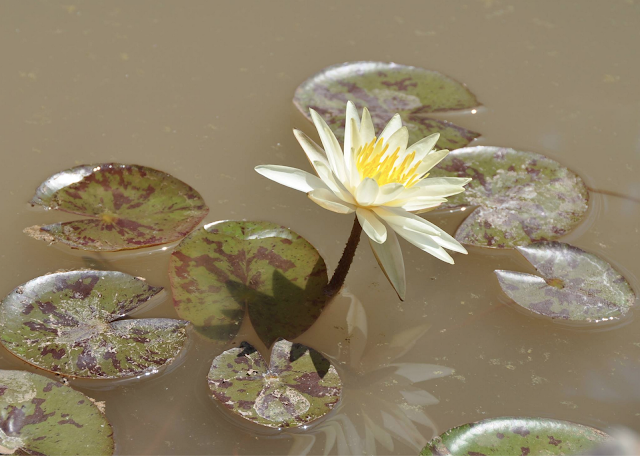
In fact, three different water lilies are usually listed on Egyptian soil: the pink Indian lotus introduced to Egypt by the Persians around 500 BC. AD; the white lotus which opens at nightfall and is characterized by its jagged-edged leaves, rounded buds, spreading petals and strong scent; the blue lotus, with its leaves with a linear edge, its tapered, pointed buds and its narrow, pointed petals.
It is the latter – the Nymphaea caerulea, lotus or blue water lily – that is most characteristic of Egypt.
With a suave and sweet aroma, it blooms during the day, opening at the first rays of the sun, then in the evening, closed for the night, it disappears under the water from which it will not emerge until the next morning. “Its yellow centre, with a blue outline, also evokes the sun in the sky” specifies Salima Ikhram. It is considered by the ancient Egyptians to be “the initial flower” and “the symbol of the birth of the divine star”. Thus, when it has finished its course, the sun takes refuge in the lotus to plunge back into the wave.And the cycle begins again every day and every night, since the dawn of time.
Symbol of birth, the lotus is also that of re-birth. “Chapter 81 of the Book of the Dead allows the deceased to assimilate to the renewed solar god. The vignette which illustrates it represents the skull of the dead springing from the water lily” specifies Isabelle Franco.
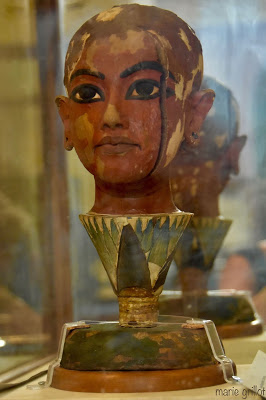
Magnificent polychrome wooden statue representing Tutankhamun whose head emerges from a lotus flower with open blue petals (JE 60723)
This image can only refer us to the magnificent polychrome wooden statue representing Tutankhamun whose head emerges from a lotus flower whose blue petals are open (JE 60723). Christiane Desroches Noblecourt analyzes it thus: “Symbolic image of the rebirth of the deceased, the head of the sovereign emerging from the lotus evoked the Horus-child: Harpocrates”.
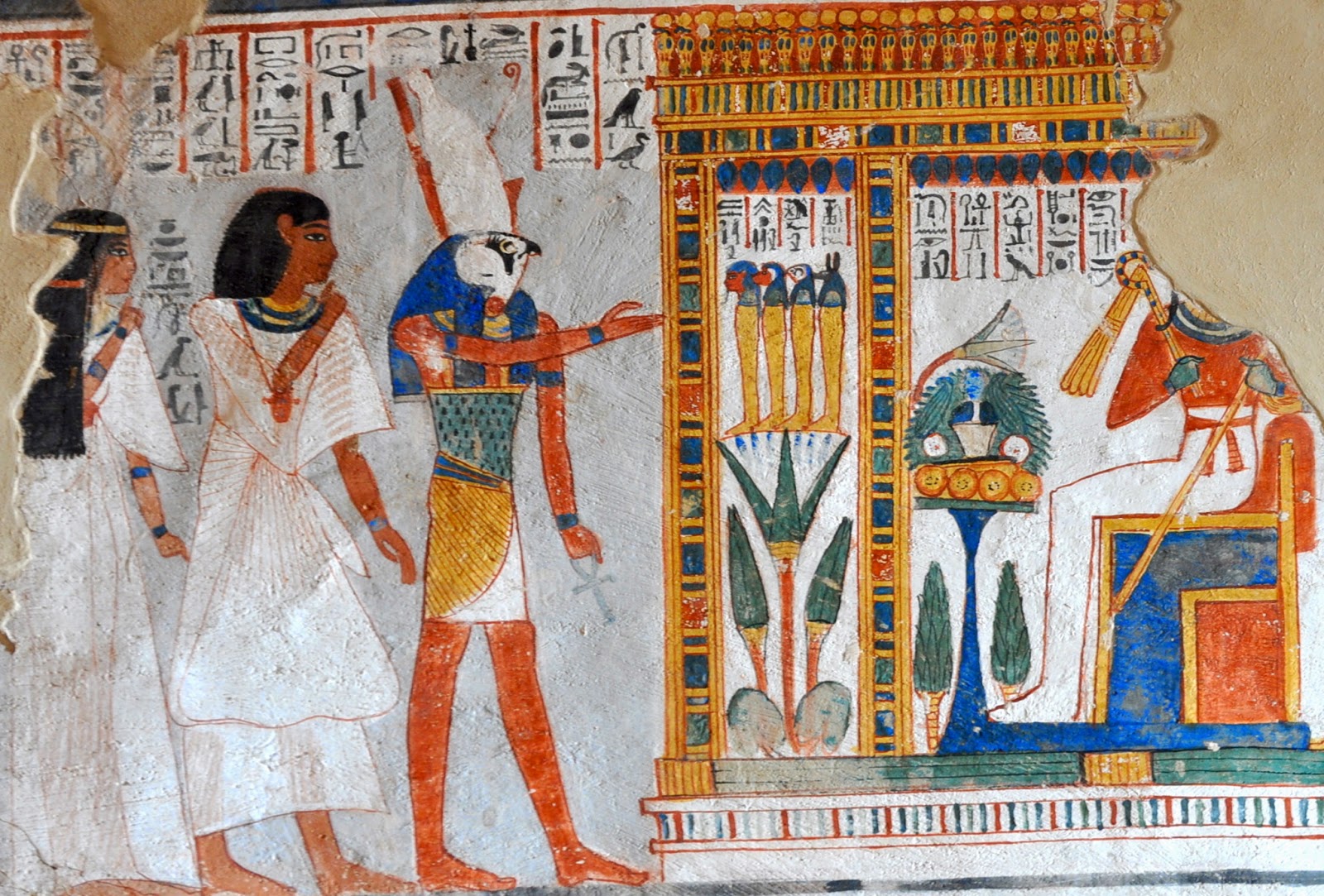
Center: the four sons of Horus stand on a lotus – Roy’s Theban tomb (TT255)
This flower can also serve as a “support” for the four sons of Horus: “This representation appears at the end of the XVIIIth Dynasty, without real systematization at the beginning. Then the motif of the four standing figures, frozen in a precise order, on the corolla of the open lotus will be the standard cannon from the XXth Dynasty until Roman times …
The choice of the blue lotus is clearly related to the rise at this time of the Hermopolitan cosmogony. This presents, at the dawn of time, four male characters who fertilize the primordial lotus floating on the abyssal waters of the Nun (or the Nun himself, from which the plant will emerge); lotus from which will spring the solar child, and therefore Creation “… (Osirisnet)
The lotus was endowed with other functions, symbolic and mythological; it was used in particular to represent Upper Egypt, Lower Egypt has been associated with the papyrus. Thus the two plants are instituted as the “heraldic plants” of Egypt and are often presented linked to signify the union of the two lands.
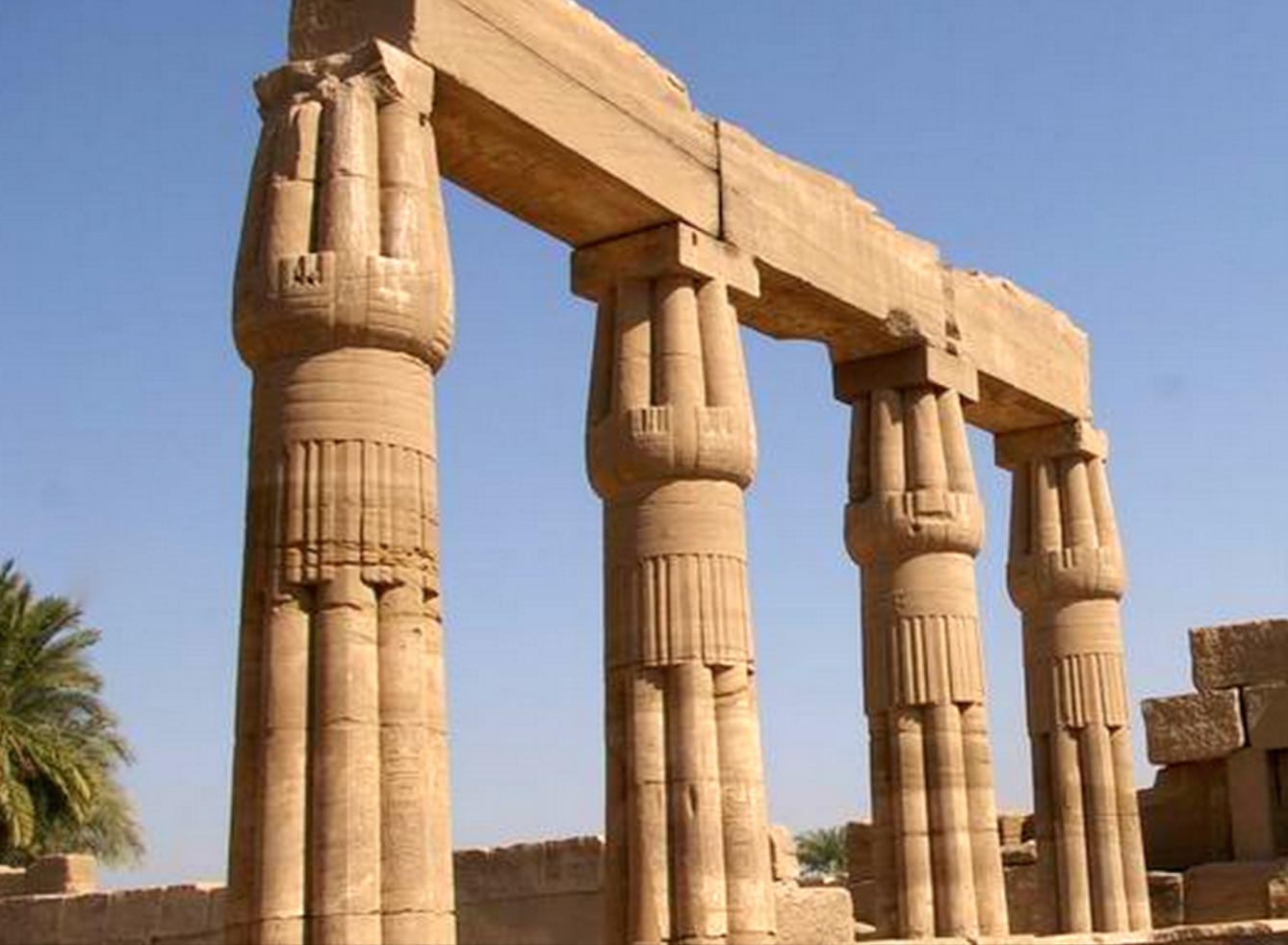
Lotiform columns: portico of the temple of Akh-Ménou (Karnak)
It is widely used in the decoration of temples. This is how we find columns with loti form capitals – “they may have originally represented, writes Gaston Maspero, a bundle of lotus stems whose buttons, tight around the neck by a link, meet in a bouquet to form the capital “- and that often” the base of the columns is surrounded by leaves, the foot of the walls were lined with long stems of lotus or papyrus “.
In the Theban tomb of Nakht (TT52) lotus bouquet decorating an offering table
The lotuses are very often represented in the scenes of the tombs. They are found on offering tables, in floral wreaths, on headbands worn by beautiful ladies, or, quite simply, in their hands and sometimes turned towards their nostrils …
As we can see on certain wall decorations, or pavements, which reach us from the Amarna period, the lotus, like the papyrus, expressed their freshness and their overflowing nature …
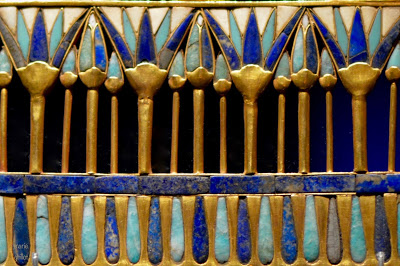
Lotus flowers and buds: detail of a breastplate from Tutankhamun (JE 61897 – GEM 139)
It is also very popular in goldsmiths where it is found in rings, bracelets, elements of necklaces or pectorals or in certain chalices which borrow its shape.
He was the emblem of the god Nefertum, son of Ptah and Sekkmet, “divinity of the pleasant smell”, appeared “like a lotus in the nostril of Ra”.
“Despite its brevity, comments Jean-Pierre Corteggiani, this [last] formula is important since, in addition to the allusion to the fact that the flower is breathed, it establishes a relationship with the sun, a link that underlines (…) the only other mention of the god in the oldest corpus of Egyptian religious texts: invoked as ‘image of Nefertum’, the lotus then becomes that of the primordial flower, ‘exit of the Nun’ [personification of the primordial waters existing before creation], d ‘where the solar child arises every day as he did the first time. ”
Represented in the “erotic” papyrus of Turin, above the heads of the characters, the lotus was famous, such as Ginko Biloba, for its tonic, narcotic and aphrodisiac virtues, against the effects of ageing or sexual “breakdown”.
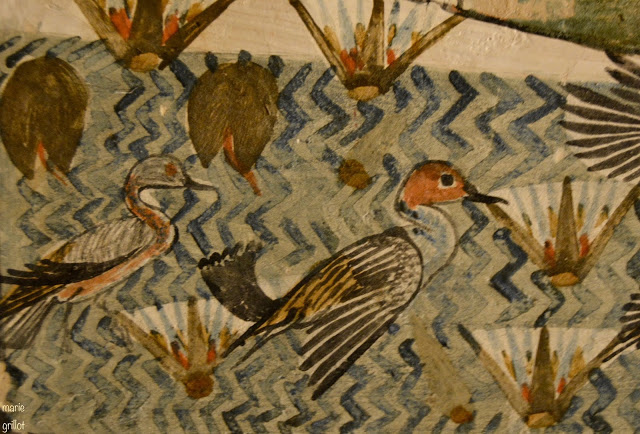
In the Theban tomb of Menna (TT69) ducks swim among the lotuses
The lotus was, therefore, for the Egyptians of antiquity, a flower, beautiful and fragrant, loaded with meaning, life, and promises …
sources: Dictionary of Egyptian Mythology, Isabelle Franco, 2013 Ancient Egypt and its gods, Jean-Pierre Corteggiani, 2007 Egyptian Archeology, Gaston Maspero, 1910 General Overview on Egypt, Clot-Bey, Antoine B., Paris, 1840 https://digi.ub.uni-heidelberg.de/diglit/clotbey1840bd1/0200/text_ocr osirisnet.net The fabulous heritage of Egypt, Christiane Desroches Noblecourt, 2004


























 lampmagician


You must be logged in to post a comment.