
Dream Stimuli and Dream Sources (Traumreize und Traumquellen)
Dreams are the guiding words of the soul. Why should I henceforth not love my dreams and not make their riddling images into objects of my daily consideration?
~Carl Jung, The Red Book
Carl Jung believed that dreams are direct messages from the unconscious mind. According to Jung, these nightly visions are not random or meaningless; instead, they offer valuable insight into our deepest thoughts, feelings, and truths. By paying attention to dreams, he argued, we can better understand aspects of ourselves that are usually hidden from conscious awareness. He saw dream interpretation as an important tool for personal growth and self-discovery. Through understanding our dreams, Jung believed we could achieve greater harmony within ourselves and that dreams serve as direct messages from the unconscious mind.
“Dreams are impartial, spontaneous products of the unconscious psyche, outside the control of the will. They are pure nature; they show us the unvarnished, natural truth, and are therefore fitted, as nothing else is, to give us back an attitude that accords with our basic human nature when our consciousness has strayed too far from its foundations and run into an impasse.”
~Carl Jung, CW, Vol.10, para 317
However, since Jung is more advanced in his ideas on this issue, we return to the basic findings that Freud had begun to explore and move on to the next level of his book, Dreams’ Meaning. (Preview here!)
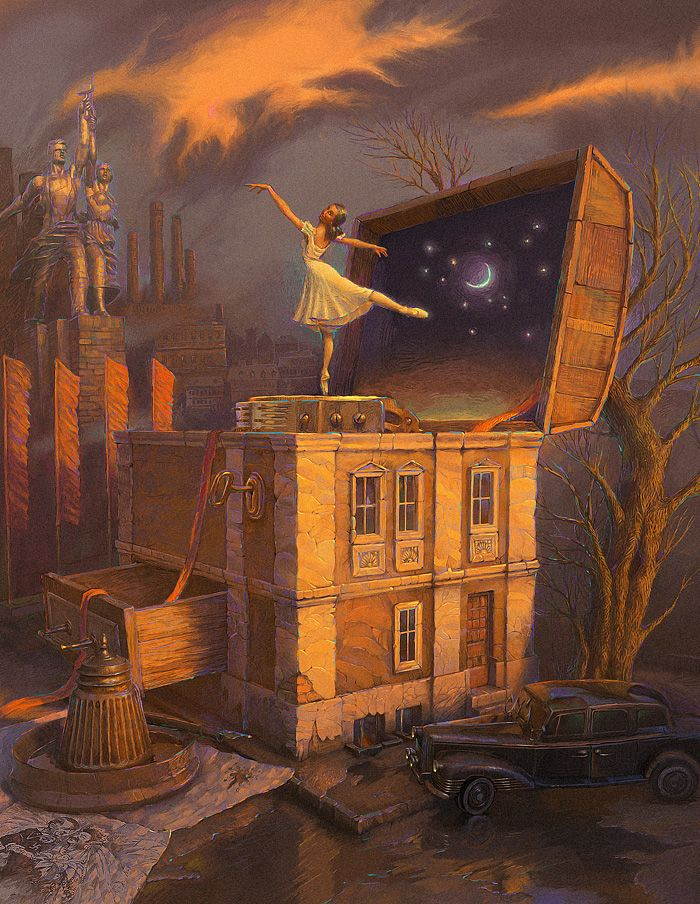
“The painting at the top: Andrew Ferez, a surreal Russian illustrator”
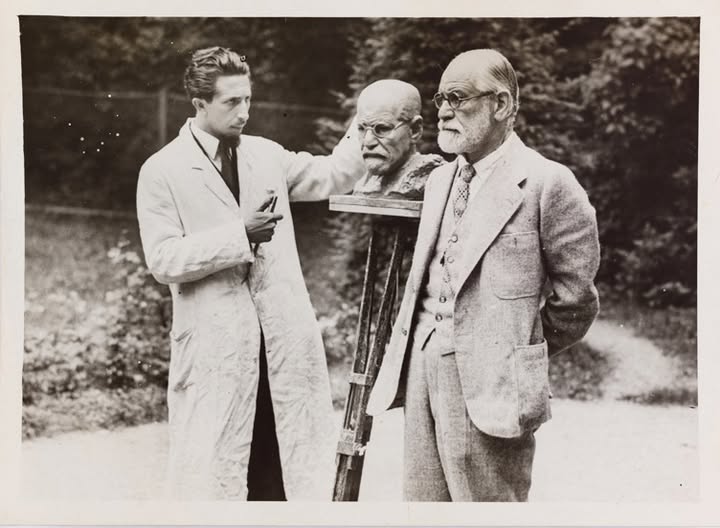
Source: Freud Museum London
Ad 4) Sources of psychological irritation
When we discussed the relationship of dreams to waking life and the origin of dream material, we learned that it is the view of dream researchers—both the earliest and the most recent—that people dream about what occupies them during the day and what interests them while awake. This interest, carried over from waking life into sleep, constitutes not only a psychological link connecting the dream to real life but also provides a source of dreams that should not be underestimated; alongside the stimuli that become significant during sleep—namely, those acting upon the sleeper—it should suffice to explain the origin of all dream images. However, we have also heard the objection to the above claim—namely, that the dream detaches the sleeper from the interests of the day, and that we—for the most part—only dream of the things that gripped us most deeply during the day once they have lost their immediate relevance to waking life. Thus, in analysing dream life, one constantly gains the impression that it is impermissible to lay down general rules without introducing qualifications such as “often,” “as a rule,” or “mostly,” and without preparing for the validity of exceptions.
If waking interests, together with internal and external sleep stimuli, sufficed to account for the aetiology of dreams, we ought to be able to give a satisfactory explanation for the origin of every element within a dream; the riddle of dream sources would be solved, leaving only the task of distinguishing the respective contributions of psychic and somatic dream stimuli in individual dreams. In reality, however, such a complete resolution of a dream has never been achieved; anyone who has attempted it has almost invariably been left with a substantial number of dream elements whose origins could not be determined. Evidently, waking interests as a psychic source of dreams do not go as far as one might expect, given the confident assertions that people continue to pursue their daily business in their dreams.
No other sources of psychological dreams are known. Thus, all explanations of dreams found in the literature—with the possible exception of Scherner’s, to be mentioned later—leave a significant gap regarding the derivation of the imagery most characteristic of the dream. Faced with this difficulty, the majority of authors have tended to minimise as much as possible the psychological component of dream formation, which is so elusive. While they do distinguish—as a primary classification—between dreams triggered by nervous stimuli and those arising from association (the latter deriving exclusively from reproduction; Wundt, p. 365), they cannot shake the doubt as to “whether they occur without an initiating somatic stimulus” (Volkelt, p. 127). The characteristic of the pure association dream also fails: “In true association dreams, such a firm core is no longer present. Here, the loose grouping penetrates even the centre of the dream. The imaginative life, already freed from reason and intellect, is no longer held together by those more weighty bodily and mental arousals and is thus left to its own colorful pushing and shoving, its own loose, chaotic tumbling” (Volkelt, p. 118). Wundt then attempts to downplay the psychological component of dream excitation by stating that “the phantasms of dreams are probably wrongly regarded as mere hallucinations. Most dream representations are likely in reality illusions, in that they originate from the faint sensory impressions that never cease during sleep” (pp. 359 ff.). Weygandt adopted this view and generalised it. He claims that for all dream representations, “their immediate cause is sensory stimuli; only then do reproductive associations follow” (p. 17). Tissié goes even further in suppressing the psychic sources of stimuli (p. 183): “Dreams of absolute psychic origin do not exist,” and elsewhere (p. 6): “The thoughts of our dreams come from outside…”
Authors who, like the influential philosopher Wundt, occupy an intermediate position do not fail to note that in most dreams, somatic stimuli and the—unknown or recognised as matters of daytime interest—psychic instigators of the dream interact.
We shall learn later that the riddle of dream formation can be solved by uncovering an unsuspected source of psychic stimulation. For the moment, we need not be surprised by the tendency to overestimate the role of stimuli originating outside mental life in the formation of dreams. Not only are these stimuli easily identified and even verifiable through experimentation, but the somatic view of the origin of dreams also aligns entirely with the prevailing school of thought in psychiatry today. While the brain’s dominion over the organism is emphasised most strongly, anything that might demonstrate the independence of mental life from demonstrable organic changes—or spontaneity in its manifestations—alarms psychiatrists today, as if acknowledging such things would inevitably bring back the era of natural philosophy and the metaphysical soul. The psychiatrist’s mistrust has, as it were, placed the psyche under guardianship, demanding that none of its stirrings betrays a capacity of its own. Yet this attitude reveals nothing so much as a lack of confidence in the durability of the causal link extending between the physical and the mental. Even when investigation reveals the mental as the primary cause of a phenomenon, deeper inquiry will eventually trace the path all the way to the organic basis of the mental. Yet where the mental represents the limit of our current knowledge—what ought to be the final station—it need not be denied on that account.
It will continue. I might update my condition here shortly: it’s been about 10 days since my surgery, but I still don’t feel fully well. Still, I need to improve, as I have to work on Tuesday! Take care, everyone.🙏✌


You, take care of you xxxx
LikeLiked by 2 people
I will do that, thank you very much, my lovely Lady. xxxx
LikeLiked by 1 person
We all want you well xxx
LikeLiked by 2 people
And I appreciate that xxxxxxxxxxxx
LikeLiked by 1 person
Thank you for this absolutely fascinating post, Aladin!
I am so sorry to hear you are still not feeling fully well after your surgery.
Please don’t overdo it and take care of yourself; your health comes first!
I’m sending you lots of strength for a speedy and peaceful recovery.
LikeLiked by 3 people
That is very kind of you, my dear Luisa. I will take all your kindness to heart, and you are right: health comes first.
🙏💖🤗
LikeLike
You are so very welcome, Aladin!
Please take good care of yourself, my dear friend. ❤️
LikeLiked by 1 person
I’ll do my best. Heartfelt thanks, lovely friend. 🎊🙏❤️
LikeLiked by 1 person
Sending a big hug 🤗💗🤗
LikeLiked by 1 person
Best wishes. Get well soon🙏🖖
LikeLiked by 2 people
I’ll do my best, buddy; thanks. 🙏🤞🖖
LikeLiked by 1 person
Excellent post that is very thought provoking. Take care of yourself, friend.
LikeLiked by 2 people
Thank you so much, my friend. I’ll do it.
LikeLiked by 1 person
You’re more than welcome!
LikeLiked by 1 person
😊🙏
LikeLiked by 1 person
😀
LikeLiked by 1 person
Okay, I followed all of this, Aladain.
It is intriguing how much of a ruckus dreams have caused intellectuals.
My grandmother was a boat child in 1905, had no formal education, and could read. She had a dreams interpretation book and would look up her dreams every morning. It all made sense to her.
Okay, I look ahead to your next dreams post.
Please feel better (I hope) and have a good return to work on Tuesday!
❦❦★❦❦
💙💜💙
LikeLiked by 2 people
Your grandmother is intellectual without needing an education! There is no need to be intellectual to look up dreams. I think even grandmas have much more to say about dream interpretations. I remember my aunt, who had a huge understanding of it.
Thank you, my dear friend. I hope it will get better.
🤗💖💞🙏
LikeLiked by 1 person
You are welcome, Aladin!
Your most well done post makes it seem like you are 100% better. I think sharing your fabulous mind with us gives you a kind of energy.
Thank you!
★★~ ༺❦❦༻ ~★★
LikeLiked by 1 person
Totally, it gives me a lot of adrenaline, which we all need. 😉😊🙏❤️🙏🫂
LikeLiked by 1 person
YES!
⭐️⭐️⭐️⭐️⭐️⭐️xo
LikeLiked by 1 person
Blessings, wishing you a good recovery ♥
LikeLiked by 2 people
Thank you sincerely, my dear Ashen. Your kindness truly means a great deal to me. 🥰🙏💖
LikeLike
☼ ♥ ☼
LikeLiked by 1 person
🤗💕🌹
LikeLike