
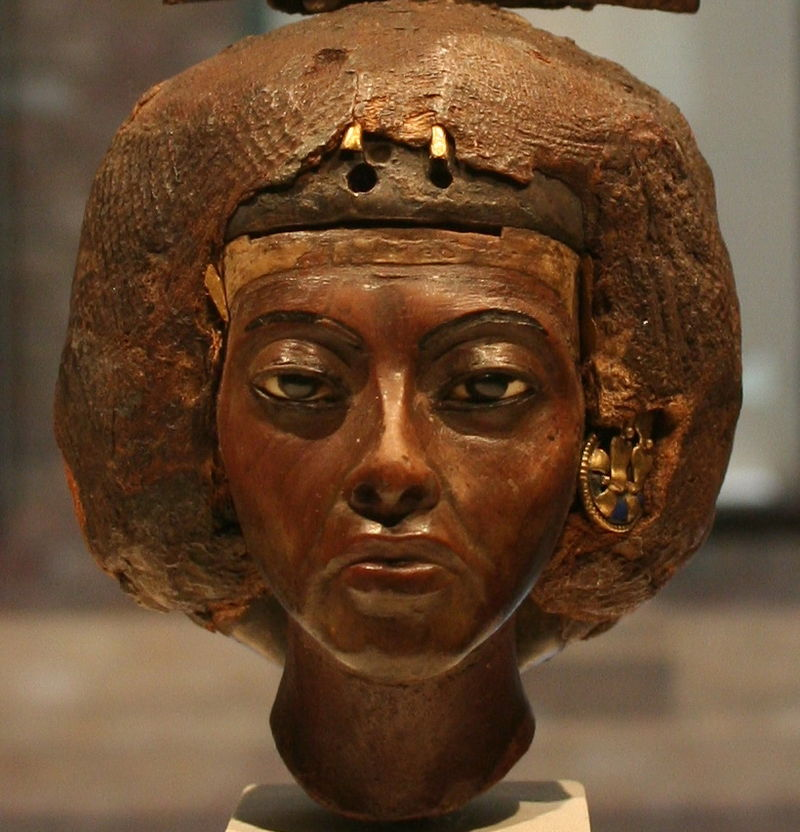
Queen Tiye, recognised for her intellect and formidable character, earned the respect of foreign dignitaries, who were keen to interact with her directly. She maintained an active presence in foreign relations and became the first Egyptian queen whose name was inscribed on official documents.

Here is an impressive presentation by Marie Grillot about a captivating piece of art represented by a magnificent statue that resonates with us through her story.
Wishing you all the best for the Easter holidays. 💖🙏
Tiyi, a face of royal beauty
via égyptophile
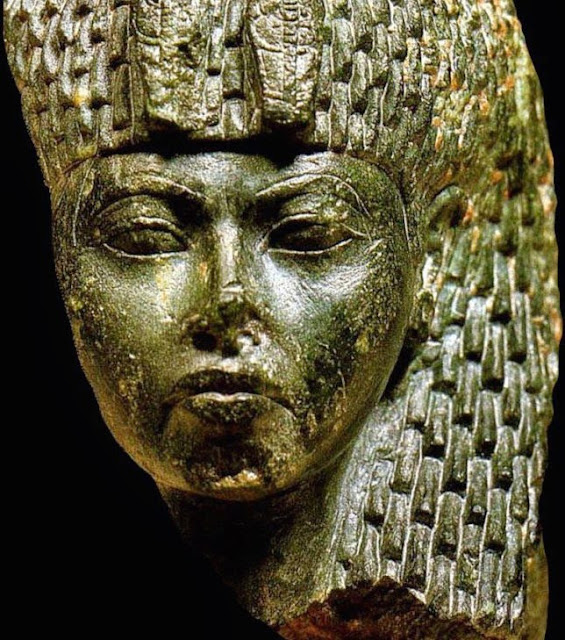
Discovered in 1905 by William Matthew Flinders Petrie in the Temple of Hathor at Serabit el-Khadim (Sinai)
Egyptian Museum, Cairo – JE 38257
In 1905, the English Egyptologist William Matthew Flinders Petrie led an expedition to the Sinai Peninsula. He was particularly interested in the site of the temple of Serabit el-Khadim. Built during the reign of Snefu for workers who came to work in the turquoise mines, it remained in use until the New Kingdom. The sanctuary is dedicated to the goddess Hathor, “mistress of turquoise,” and the eastern falcon god Sopdu.
The excavation season is expected to yield the discovery of a small female head, measuring 7.2 cm, in a very dark stone.
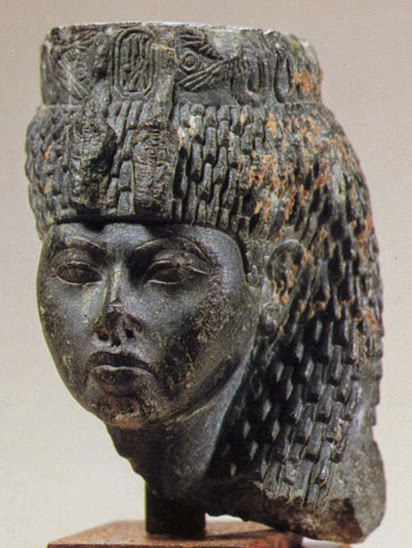
Discovered in 1905 by William Matthew Flinders Petrie in the Temple of Hathor at Serabit el-Khadim (Sinai)
Egyptian Museum, Cairo – JE 38257
Here is an excerpt from W.M.F. Petrie’s description in his 1906 report “Researches in Sinai”: “A queen has left here one of the most striking portraits ever carved in Egypt. The very famous Queen Thyi, wife of the great Amenhotep III, was hitherto known from a few carved reliefs, but not yet from such a portrait in the round. Strangely, such a remote spot should have preserved this representation, which we have identified from the cartouche in the middle of the crown. The schistose stone is dark green steatite.
The entire statuette must have measured about a foot in height. Unfortunately, we have found no fragments other than the head. The great dignity of the face is combined with a fascinating uprightness. The delicacy of the contours of the eyes and cheekbones testifies to the quality of execution. The lips, whose curious curve curves downwards, are complete and delicate, yet express a disdain devoid of malice. They are, most certainly, a likeness to the truth… The ear is pierced, as is also the case with her son Akhenaten. The crown she wore was probably with gold inlays. The two-winged cobras stretch their length in loops around the head, until they meet at the back; while in the middle of the forehead, they support the cartouche with the name of the great queen of Upper and Lower Egypt. This piece alone was worth all the rest of our earnings for the year; it is now in the Cairo Museum.”
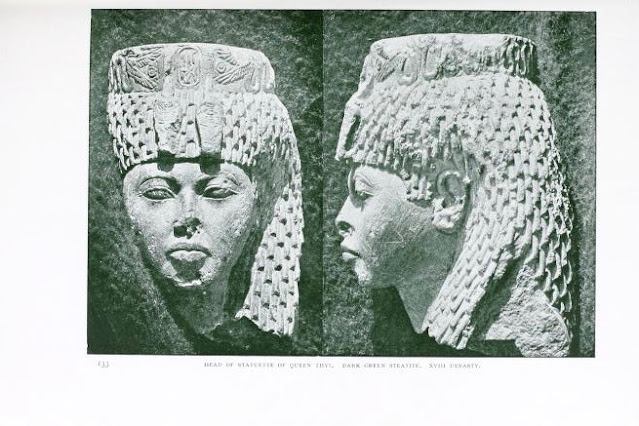
published here by William Matthew Flinders Petrie in “Researches in Sinai” (1906), plate 133 – p. 127
In his book “Essays on Egyptian Art” published in 1912, Gaston Maspero describes it thus: “The right wing of the wig is missing, and the nose has suffered from an unfortunate shock on the left nostril, without however losing the essential part of its shape: a cartouche engraved on the front of the hairstyle tells us the name, and the piece gives, at first glance, the conviction of a portrait likeness. It is not flattering. If we are to believe him, Tiyi presented the racial characteristics of the Berberines or the women of the Egyptian desert, small eyes slanted towards the temples, noses with a wide tip and disdainful nostrils, a heavy and sullen mouth, with drooping corners and whose lower lip is pulled back by a receding chin.”
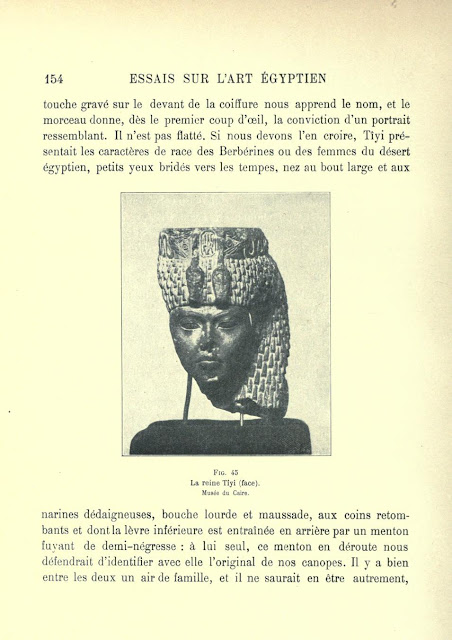
Discovered in 1905 by William Matthew Flinders Petrie in the Temple of Hathor at Serabit el-Khadim (Sinai)
Egyptian Museum, Cairo JE 38257 – Published here by Gaston Maspero in “Essays on Egyptian Art”, 1912
What femininity, what willpower, what pride, and what presence! The personality that emanates from this little face is visibly inspiring… And it is touching, even moving, to see how much each Egyptologist is keen to decipher it…

Discovered in 1905 by William Matthew Flinders Petrie in the Temple of Hathor at Serabit el-Khadim (Sinai)
Egyptian Museum, Cairo – JE 38257 – Museum photo
Thus, for Mohamed Saleh and Hourig Sourouzian (“Official Catalogue of the Egyptian Museum in Cairo”): “The oval face with high cheekbones, almond-shaped eyes and a thick, almost disillusioned mouth is that of a determined and serious woman, who exudes a high spirituality despite her apparent youth.”
In “The Wonders of the Egyptian Museum in Cairo,” Francesco Tiradritti provides the following interpretation: “The corners of the mouth, curved downwards, give the whole face an air of gravity that was often interpreted as an allusion to the decisive and inflexible temperament of Tiyi.”
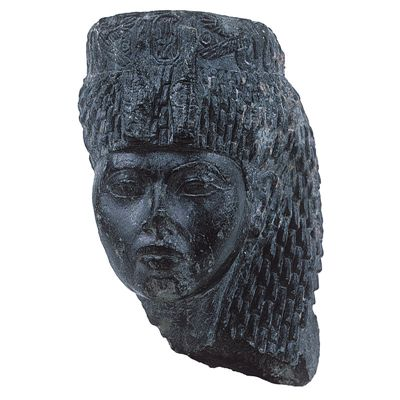
Discovered in 1905 by William Matthew Flinders Petrie in the Temple of Hathor at Serabit el-Khadim (Sinai)
Egyptian Museum, Cairo JE 38257 (museum photo)
Jean-Pierre Corteggiani’s analysis (“Egypt of the Pharaohs at the Cairo Museum”) is also not devoid of realism: “There is something haughty, if not contemptuous, in this young and energetic face of a woman who is both highly aware of her rank and proud to have managed to occupy it.”
There are many known representations of the queen, the most famous of which are those in the Egyptian Museum in Berlin (ÄM 21834 – yew wood head found in 1904 in Medinet Gourab), those in the Louvre (N 2312, E 25493 – glazed steatite – Salt Collection), as well as those in the Metropolitan Museum of Art in New York (26.7.1396 yellow jasper, discovered in Amarna from the Carnarvon Collection), without forgetting, of course, the imposing statuary group where she appears seated alongside her husband and with three of their daughters (atrium of the Cairo Museum – ref. GM 610 – JE 33906).

discovered in 1904 in Medinet Gourab
Berlin Museum – ÄM 21834 (museum photo)
Tiyi lived in the New Kingdom; she was the daughter of Youya and Touya, whom Pierre Tallet (“12 Queens of Egypt Who Changed History”) describes as follows: “Youya was from Akhmim in Middle Egypt and held the titles of director of the royal stables and divine father; her mother Touya was a ‘royal ornament’ and singer of Amun.” She was therefore close to the Court…
“In the palace, rumour had preceded the event: Tiyi would be queen… she was and assumed this role with exceptional talent,” relates Christian Leblanc in his “Queens of the Nile.” And he continues: “Announced beyond the borders by an issue of large commemorative scarabs, the marriage of Tiyi with Amenhotep III was celebrated with great pomp in Memphis… Very quickly, Tiyi had a great influence on the government of the country. Through her strong personality, she exercised a role as confidante and political advisor to her husband.” It appears that her role also continued during the reign of her son, Amenhotep IV, also known as Akhenaten.

Discovered in 1905 by William Matthew Flinders Petrie in the Temple of Hathor at Serabit el-Khadim (Sinai)
Egyptian Museum, Cairo – JE 38257
The one who was adorned with so many laudatory titles: “Noble lady”, “Great favourite”, “Great royal wife”, “Sovereign of the Two lands”, “Who fills the palace with love”, died between the 12th and 15th year of her son’s reign.

Discovered in 1905 by William Matthew Flinders Petrie in the temple of Serabit el-Khadim (Sinai)
Egyptian Museum, Cairo JE 38257 – museum photo
The quality of this stone portrait is therefore “up to” the great lady that she was… We must salute the sculptor who was able to render her character traits so accurately and so finely and who, in a way, helps us to better “perceive” the subtle personality of the sovereign…
Presented under number 4257 of the “Visitor’s Guide to the Cairo Museum” (Gaston Maspero, 1915), it was recorded in the museum’s Journal of Entries under reference JE 38257.
Sources:
Head from a statuette of Queen Tiye
https://egyptianmuseumcairo.eg/artefacts/head-from-statuette-of-queen-tiye/
William Matthew Flinders Petrie, Researches in Sinai, John Murray, London, 1906
http://www.serendipity.li/petrie/rs01.htm
https://archive.org/details/researchesinsina00petruoft/page/n11/mode/2up
Jean-Pierre Corteggiani, Egypt of the Pharaohs at the Cairo Museum, Hachette Paris, 1986
Charles Bonnet, Dominique Valbelle, The Temple of Hathor, Mistress of Turquoise, at Serabit el-Khadim, Proceedings of the meetings of the Academy of Inscriptions and Belles-Lettres, 1995, 139-4 pp. 915-941
http://www.persee.fr/web/revues/home/prescript/article/crai_0065-0536_1995_num_139_4_15537
Mohamed Saleh, Hourig Sourouzian, Official Catalogue of the Egyptian Museum in Cairo, Verlag Philippe von Zabern, 1997
Francesco Tiradritti, Treasures of Egypt – The Wonders of the Egyptian Museum in Cairo, Gründ, 1999
Abeer El-Shahawy, The Egyptian Museum in Cairo, Matḥaf al-Miṣrī, American University in Cairo Press, 2005
Pierre Tallet, 12 Queens of Egypt Who Changed History, Pygmalion, 2013
Published on January 17, 2015 by Marie Grillot


Oh wow, those wonderful statues. What a beautiful queen, she was.
LikeLiked by 2 people
Indeed; Thank you, Chris! 💖🙏🤗
LikeLiked by 1 person
I didn’t know this beautiful queen!Thanks a lot for sharing this fascinating article, dear Aladin!
LikeLiked by 1 person
Thank you as well, my dear friend, for your inspiring words.🤗❤️🌹
LikeLiked by 1 person
As always, you’re more than welcome!
LikeLiked by 1 person
That is a beautiful sculpture, encompassing all spoken of in this post.
She appears to have one of the “strongest” expressions on a face I’ve see of the Egyptian Queens. Yet, she looks pretty, despite her scowl.
Thank you another trip into ancient Egypt, Aladin!
🌟💙🌸💖🤗
(I answered your mail!)
LikeLiked by 2 people
Thank you so much, my dear Resa, for your exquisite portrayal of her moments. Your words truly resonate with me, and I absolutely love it!
👍🤗🙏❤️❤️
LikeLiked by 1 person
Thank you, Aladin!
🌹❦🎶🌹❦🎶
LikeLiked by 1 person
What an incredible statue. Thank you for sharing, Aladin. I hope you have a great weekend!
LikeLiked by 2 people
Thank you so much, dear Chanel. Your inspiring words mean a great deal to me, and I sincerely appreciate them. 🥰🙏🌹
LikeLike
Excellent! I look forward to these blog posts from you and you never disappoint!
LikeLiked by 2 people
Wow! That’s a great compliment to keep me going, my dear, wise friend; thank you! 🤗🙏
LikeLike
A striking figure. Thank you for sharing the historical information, Aladin. Easter wishes to you. 💐
LikeLiked by 2 people
These words resonate deeply and deserve to be spoken by a lady like you! Thank you, dear Michele, for the inspiration you bring and for your delightful visit. 🙏
Wishing you and your loved ones a truly joyful and memorable holiday season, filled with warmth and togetherness.🙏🤗🌹❤️
LikeLiked by 1 person
Thanks so much, Aladin. 🙏🏻🥰
LikeLike
Another fascinating piece Aladin – such amazing works of art! Sending love light and Easter wishes from us both. 😊
LikeLiked by 3 people
Thank you so much, dear In. Your heartfelt words and warm wishes have truly touched my heart. I’m sending you both my love and appreciation. 🥰🙏❤️🤗🦋
LikeLiked by 2 people
what a distinctive face! great post
LikeLiked by 1 person
She was indeed a remarkable queen! Thank you, dear lady DA-AL. 🙏🤗
LikeLiked by 1 person
fascinating as always !💙
LikeLiked by 2 people
I sincerely appreciate it, dear friend. 🙏🤗❤️
LikeLike
Such a beautiful queen I can imagine how she looked from these, they are so lifelike. 😍
LikeLiked by 2 people
It is truly a masterpiece; thank you! 🥰🙏
LikeLiked by 1 person
Magnifique J’adore !!!!
LikeLiked by 2 people
Je vous en suis sincèrement reconnaissant. Merci d’être passé. 🥰🙏
LikeLike