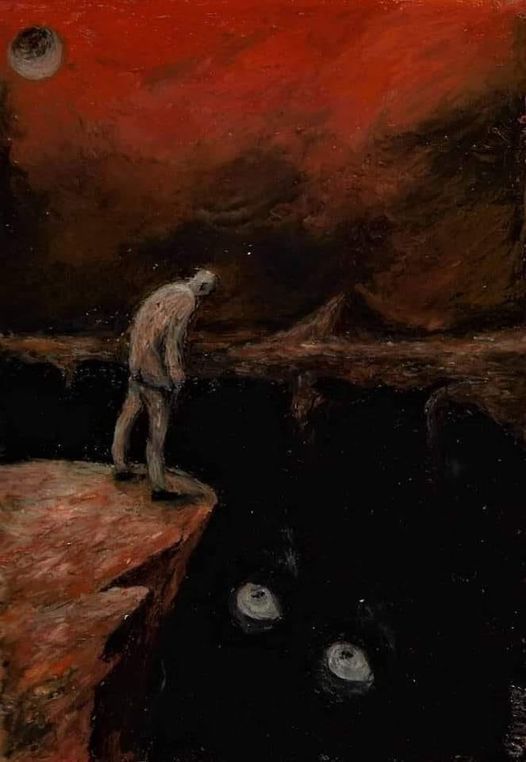
“Whoever fights with monsters should be careful not to become a monster himself. When you gaze long into an abyss, it also gazes into you.” ~Friedrich Nietzsche, Jenseits von Gut und Böse (1886) ch. 4, no. 146
Actually, I need to rest and post less frequently than before, but this short essay by adorable Laura London, an excellent Jungian expert at X (formerly Twitter), invigorated me. I couldn’t resist sharing it with you.
For many, contemplating and analyzing death is uncomfortable or even frightening. However, when we psychologically examine the world around us, we observe everything as dualistic, such as warm and cold, dark and light, love and hate, joy and grief… and, of course, life and death; neither can exist without the other!
There is no reason for many young people to think about death, except for some like me who are confronted with it by losing a part of their parent or both. However, as we reach a certain age, this challenge becomes unavoidable. Fear is not a solution, as we will inevitably confront the other side. Therefore, it is better to attempt to understand or envision it as much as possible. Reading this essay soothes the soul!
This quote from Jung is one of my favourites because it offers a breakthrough in our understanding of death.
Now, let’s read a tiny Colletti of Jung’s explanation on this issue, with heartfelt thanks to Laura London, which also included an introduction to an excellent book by Richard Wilhelm.
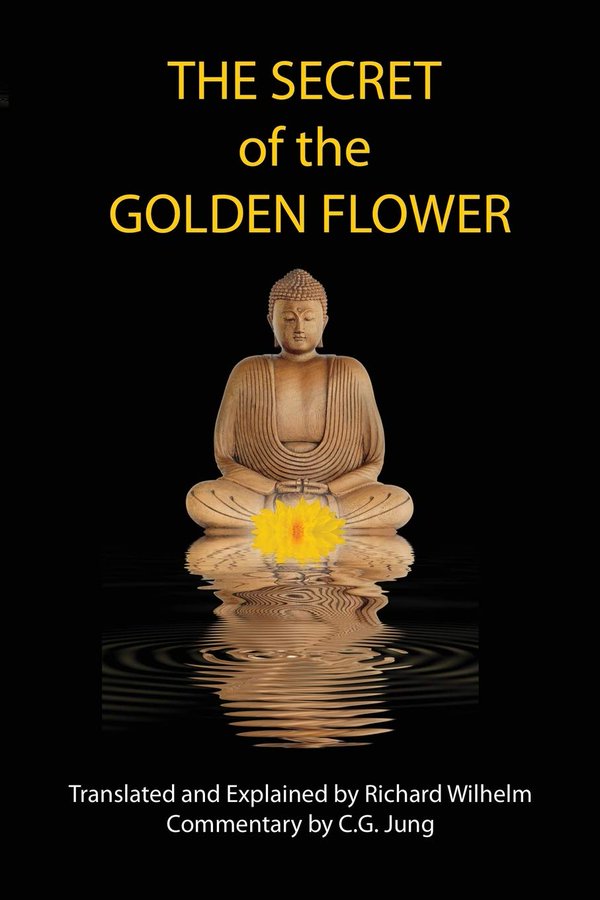
“From 1929 to 1934, #Jung presented his more mature thoughts about the mystery of death in three separate essays.⁵ In one of these essays, he stated that ‘anyone should draw the conclusion that the psyche, in its deepest reaches, participates in a form of existence beyond space and time, and thus partakes of what is inadequately and symbolically described as ‘eternity’’ [CW 8, par. 815]. Because of this, he also stated that as a doctor, I make every effort to strengthen the belief in immortality, especially with older patients … For … death is not an end but a goal, and life’s inclination towards death begins as soon as the meridian is passed’ [CW 13, par. 68]. Jung argued that the crisis of the second half of life is a sign that ‘nature prepares itself for death’ [CW 8, par. 808], hence, ‘it is hygienic … to discover in death a goal towards which one can strive’ [CW 8, par. 792], since ‘dying … has its onset long before actual death’ [CW 8, par. 809]. Jung concluded that ‘the #unconscious is all the more interested in how one dies; that is, whether the attitude of #consciousness is adjusted to dying or not’ [par. 809]. Death, then, became not only a goal for Jung but also a reality that could enrich life. Death begins before it happens, in midlife, so how one lives with death and how one approaches that goal became for Jung of paramount importance. In 1928, Jung received a copy of The Secret of the Golden Flower, a Chinese Taoist-alchemical text that, together with a dream he had which was set in Liverpool [Memories, Dreams, Reflections, pp. 220–223], confirmed to him that the goal of the #individuation process is the self, ‘the archetype of wholeness’ [CW 9ii, par. 351].”
⁵ “Commentary on ‘The Secret of the Golden Flower’” (1929); “The Stages of Life” (1930); “The Soul and Death” (1934).
~Luis Moris, Jungian psychoanalyst, “Jung’s Confrontation with Death: An Introduction, Confronting Death, pp. 7-8
🌼 You can watch my interview with Jungian psychoanalyst Luis Moris, editor of the book Confronting Death, in Episode 139 of Speaking of Jung.
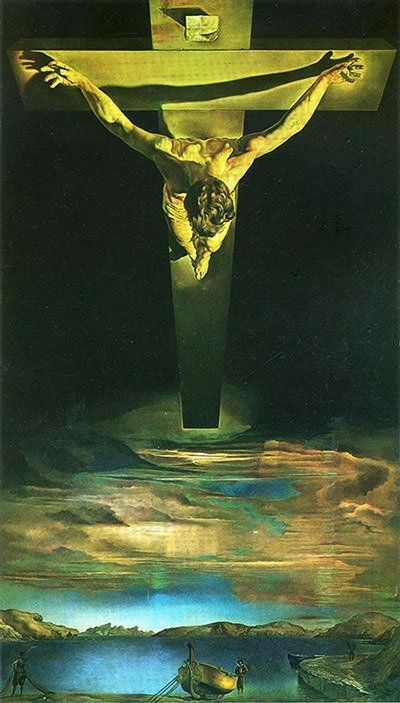
“Now, from the sixth hour, there was darkness over the whole land until the ninth hour. And about the ninth hour, Jesus cried out loudly, saying, ‘Eli, Eli, lema sabachthani? ‘ that is, ‘My God, my God, why have you forsaken me? Matthew 27:45-47 (also Mark 15:33-34)
No, I have not become religious, nor am I comparing myself to Jesus on the cross! I’ve just always been fortunate that my guardian angel has protected and supported me through troubling times. But this year, I feel she has ultimately let me down, and I wonder why! After much consideration, I have decided to provide a brief update—not because I seek sympathy or believe everyone is wondering where I am! It is simply to maintain our connection. I also apologise for my infrequent presence on your sites, such as likes, comments, etc.
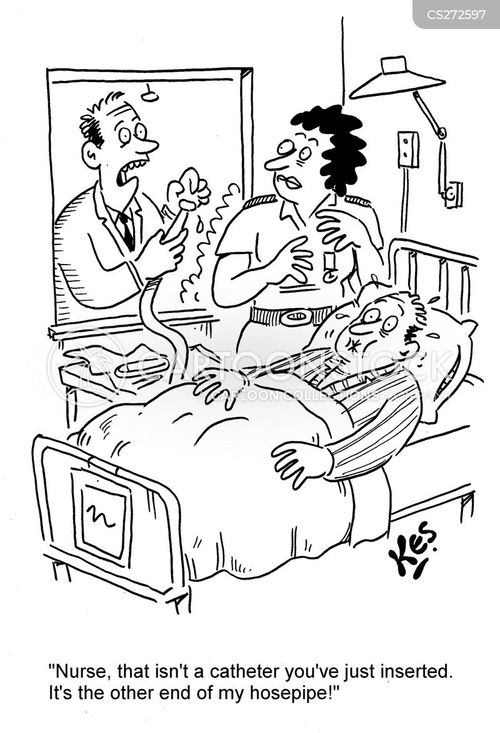
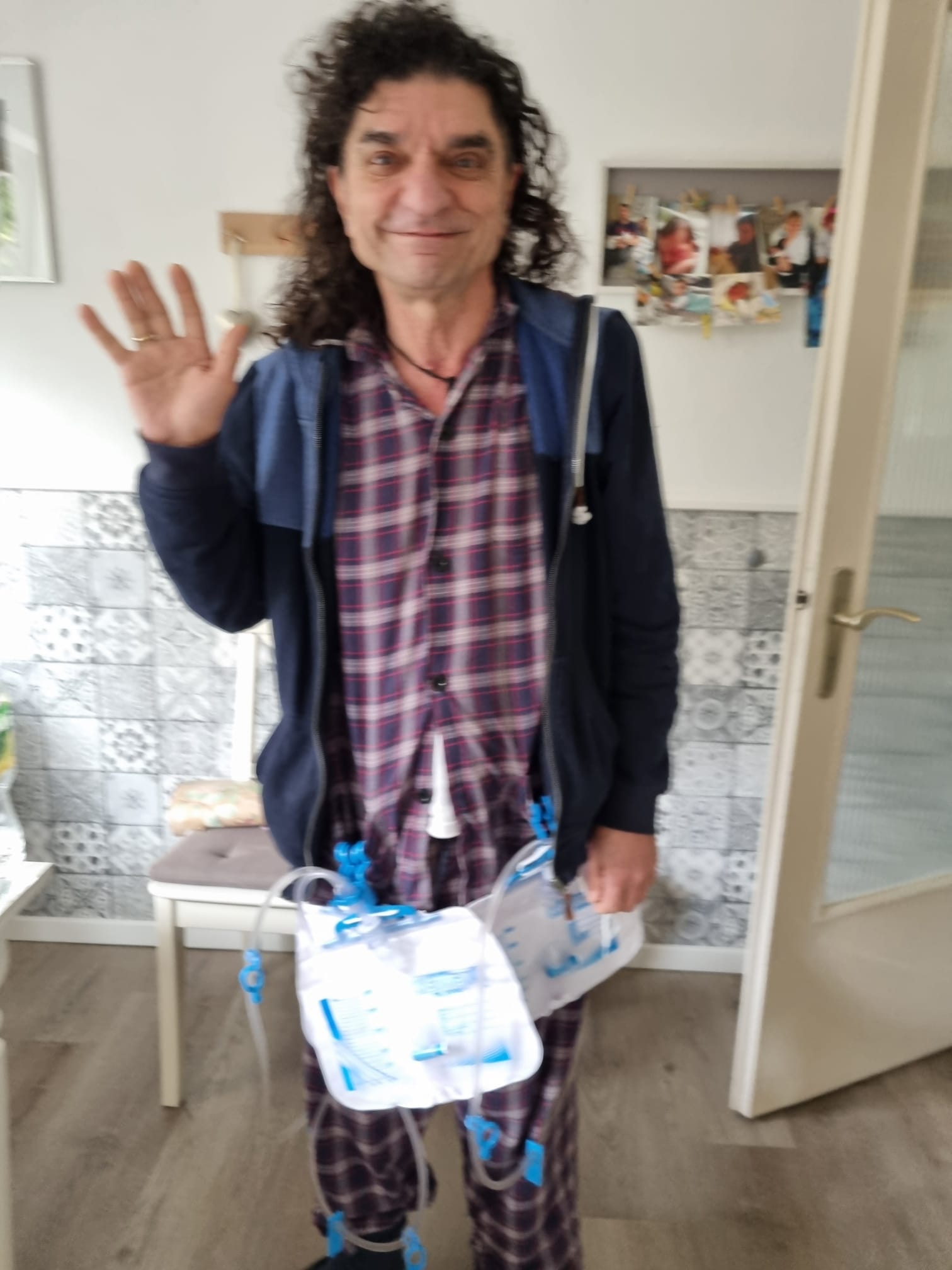
This illustration depicts a man wearing a robe and carrying a urine bag hooked to a catheter.
Well, everything seemed stable to me, which gave me hope—but it turned out not to be! I have struggled with a catheter in my stomach for the last two months, and after visiting the doctor to replace it, everything went awry, and I had to be taken to hospital with a fever of 40 degrees. There, I underwent several treatments with antibiotics and had two additional catheters placed in my kidneys; now, I have to do a threesome several times!
My PSA blood levels have risen in the hospital, causing a significant delay. The doctors need to determine whether these levels are due to my inflammation or if I have prostate cancer. I left the hospital a few weeks ago and am currently at home. Although my blood levels were down last week, they have increased again, necessitating a sample to be taken from my prostate. A neighbour suggested that these three catheters could also cause inflammation, which might be the cause. Still, I assume that testing for suspected cancer is more beneficial for the doctors, right?
The latest update is that, after consulting with the other doctors at the hospital, my doctor called to inform me that my PSA level is not overly concerning just yet. They plan to proceed with the surgery as scheduled, which will take place at the end of April. This means I will need to struggle with my three catheters for the next six weeks!
Look after yourselves everyone, and have a great time!
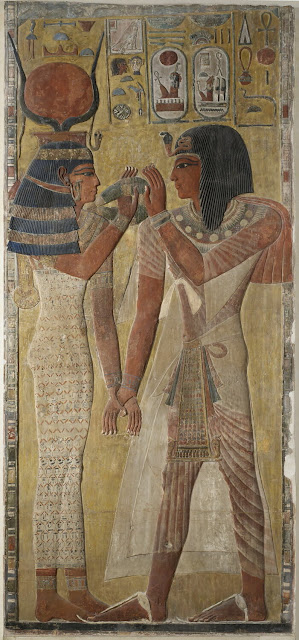
I must confess I dream of such an encounter with a divine goddess, and I should not be a king!
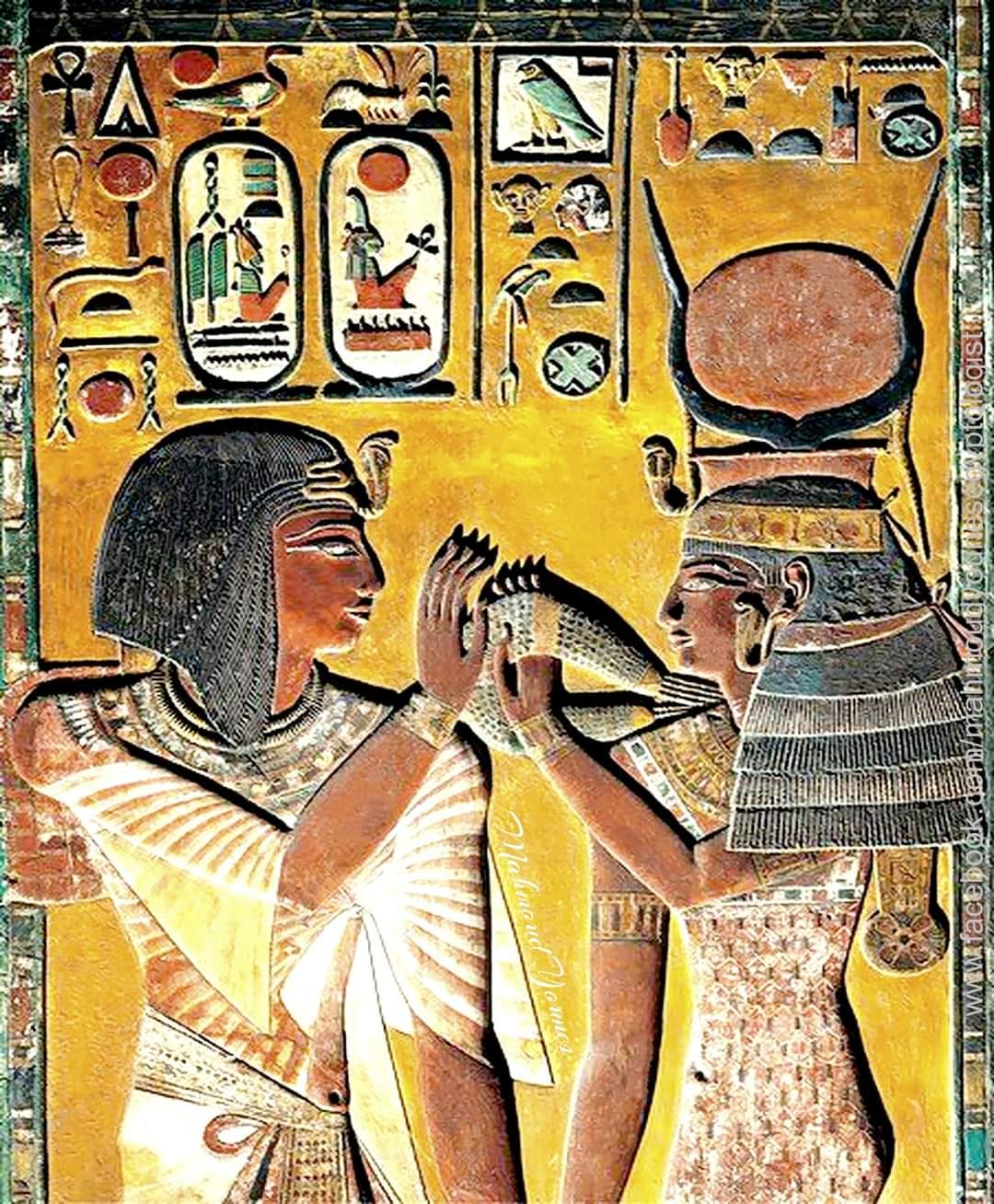
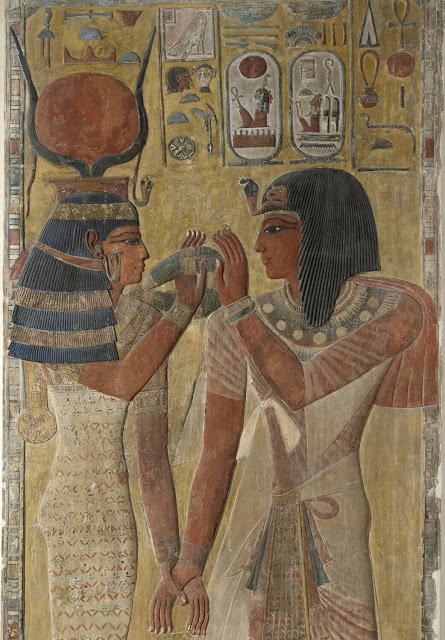
This relief adorns the well-preserved tomb of King Seti I (KV17) in the Valley of the Kings. Hathor, Lady of the West, welcomes Seti and presents her menat necklace as a symbol of protection. Her wig is adorned with cow horns, her sacred animal, and a solar disk indicating her status as Ra’s daughter. The hieroglyphic text above identifies her using a falcon symbol in a temple, reading Hwt-Hr, meaning ‘House of Horus’.
The Goddess Hathor and Seti I painted reliefs on a pillar in Seti I’s tomb, Thebes, New Kingdom, Dynasty XIX, Egypt.
We read a splendid description of this enchanting and divine encounter by the exceptional Marie Grillot. Enjoy!
Hathor and Seti I: a divine and royal face-to-face!
What intensity, what symbiosis in this divine and royal face-to-face! This “painting” of fine painted limestone, 226.5 cm high and 105 cm wide, brings together the goddess Hathor and Seti I under the sign of the sky – and elegance. As Christiane Ziegler so aptly points out in “Ancient Egypt at the Louvre”: “The scene is treated with the refinement characteristic of the time of Seti I: careful bas-relief, the richness of warm colours, transparency of pleats, the perfection of details for the stone-encrusted front or the pearl net adorning the divine tunic whose motifs take up the names of Seti I.”
This dress, punctuated with geometric patterns and bordered with alternating-coloured rectangular braid, magnificently highlights the slender body of Hathor, “patron saint of the Theban necropolis.” Ravishing finery adorns her neck and limbs: a gorget, bracelets, armillae, periscelides, all in perfect taste. Her earring caresses her cheek in the shape of an upright serpent (not without announcing the one Nefertari wore in several representations of her tomb). Her face, of absolute purity, is illuminated by a stretched eye, surrounded by kohol and surmounted by an eyebrow which corresponds precisely to the stretching of the line of eyeshadow… Her “ruffled” vertically striated wig is available in two tones. It is enhanced with a gold-coloured headband above the forehead and, a little lower down, with this red ribbon tied on the nape of the neck so particular to goddesses. Her head is surmounted by a simple mortar in the centre, which is stuck in two cow horns enclosing the solar disk. On the other side stretches a cobra, whose head can be seen on the front and the tail on the back.
Seti I, son of Ramses I, the second king of the 19th Dynasty, who reigned over the Dual Land for eleven years, is depicted in full ceremonial dress. His magnificent black wig is encircled by the rearing cobra with its coiled body. His feet are shod with gold sandals. His clothing is made of the finest linen, and his loincloth features a superb front. Bordered with ribbons are composed of vertical bands with a herringbone pattern and ends with a frieze surrounded by two cobras.
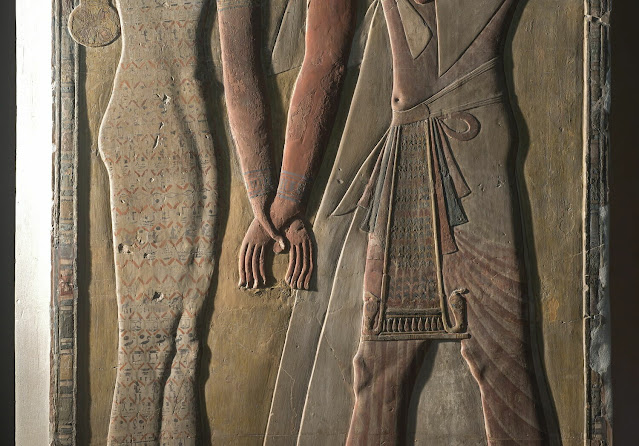
His right arm is stretched along his body, and his hand clasps the goddess’s left hand. “One will notice the very Egyptian symmetry of the composition and the unusual gesture of the joining hands” (Christiane Ziegler, “Ancient Egypt at the Louvre”). His left arm is bent, and his hand thus reaches the height of Hathor’s, who, making the same gesture, extends her menat necklace towards him as a sign of protection.
“The menat is a necklace with a counterweight, both an ornament and a musical instrument. Specific to the goddess Hathor, it served to transmit her fluid. The counterweight is clearly associated with the idea of rebirth and transition rites, while the gesture is clearly jubilee,” analyze Christiane Ziegler and Jean-Luc Bovot in “Art and Archaeology, Ancient Egypt.” This magnificent relief comes from the entrance to the fourth corridor (the transition point to the underworld) of the pharaoh’s tomb. Giovanni Battista Belzoni unearthed it in the Valley of the Kings on October 18, 1817. It extends 137 m into the Theban mountain via seven long corridors serving 10 rooms! It is certainly one of the most beautiful and “completely” decorated in the royal necropolis. C’est aussi l’une de celles où la qualité des peintures atteint la plus haute perfection… Le découvreur est subjugué par la beauté de ce qui s’offre à ses yeux : “Je jugeai, par les peintures du plafond et par les hiéroglyphes en bas-relief que l’on distinguait à travers les décombres que nous étions maîtres de l’entrée d’une tombe magnifique”. La clé de lecture des hiéroglyphes n’étant pas encore résolue, il est alors impossible de savoir à qui appartient cette demeure d’éternité. Ainsi, dans un premier temps sera-t-elle appelée “tombe Belzoni” ou encore “tombe de l’Apis”, en référence à la “carcasse de taureau embaumé avec de l’asphalte” qui y fut trouvée. C’est bien plus tard qu’elle sera attribuée au père de Ramsès II puis référencée KV 17.
With the invaluable help of Alessandro Ricci, Giovanni Battista Belzoni documented the most beautiful scenes from the hypogeum. He exhibited them, starting in May 1821, at the Egyptian Hall Piccadilly in London and then 1822 at the Chinese Baths in Paris.
Jean-François Champollion, who was among the visitors, was apparently left “speechless with admiration” when he visited the “larger-than-life main room”… It was at about the same time, on September 14, 1822, that the brilliant code-breaker exclaimed, “I HAVE MY CASE”! After years of work, he had just understood the extremely complex principle of Egyptian writing, which was at once ideographic, alphabetic and phonetic… On September 27, in his famous “Letter to Mr. Ironside”, he presented the results of his research to the Academy of Inscriptions and Belles-Lettres.
Seven years later, in 1829, while he was in the Valley of the Kings with the Franco-Tuscan Expedition, he could finally enter the tomb… “In the tomb of Sety I, J.-Fr. Champollion and I. Rosellini could not resist, faced with the beauty but also the risk of seeing them amputated or destroyed, to have two painted bas-reliefs detached from the embrasures of a corridor door, which would be shared, upon their return, by the Louvre (B7/N124) and Florence (inv. no. 2468) museums. These panels, of extraordinary finesse, represent the king standing in the company of the goddess Hathor,” specifies Christian Leblanc in his “Regards croisés sur la civilisation égyptienne”. In her “Champollion”, Karine Madrigal recalls that: “To justify this act, Champollion explains to his friend Dubois that he ‘dared, in the interest of art, to carry a profane saw into the coolest of all the royal tombs of Thebes'”…
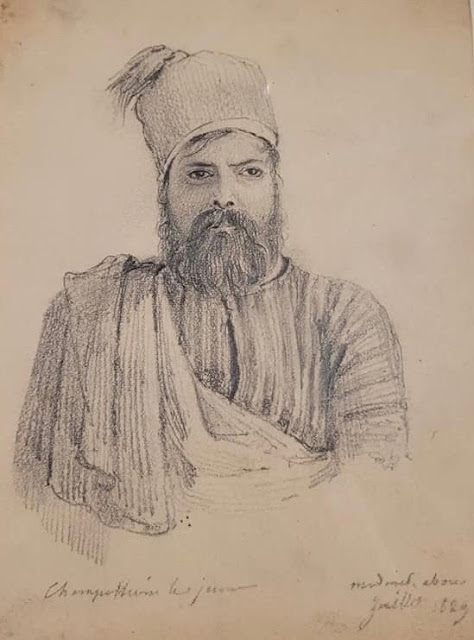
Jean-François Champollion, “The Younger,” decipherer of hieroglyphs, founder of Egyptology (Figeac, December 23, 1790 – Paris, March 4, 1832) Portrait depicting him in Egyptian dress, painted by Salvatore Cherubini in Medinet Habu, July 1829 Acquired by the Champollion Museum in Vif in June 2022
This is how this bas-relief will take the “path” to France. Jean-François Champollion will personally oversee its transport and loading in Alexandria. “On November 8, the twenty or so crates of antiquities and the sarcophagus intended for the Charles X Museum were placed in a safe place in the holds of the Astrolabe” (Alain Faure, “Le savant déchiffré”). Under the command of Verninac de Saint Maur, the corvette left the port on December 6, 1829, to sail towards the French coast. It docked in Toulon on December 23. The corvette transported the precious objects to Le Havre, where a barge finally took them to the great Parisian museum via the Seine.
Relief of Seti I and Hathor https://collections.louvre.fr/ark:/53355/cl010009693 Jean-François Champollion, Monuments of Egypt and Nubia: plates / based on drawings executed on site under the direction of Champollion the Younger, and the handwritten descriptions he wrote, published under the auspices of Mr Guizot and Mr Thiers, Ministers of Public Instruction and the Interior, by a special commission composed of Messrs. Silvestre de Sacy, Letronne, Biot, Champollion-Figeac, Paris, Didot, 1845, plate 251 Champollion the Younger, Letters Written from Egypt and Nubia in 1828 and 1829, Publisher Didier, Paris, 1868 http://gallica.bnf.fr/ark:/12148/bpt6k103771z/f345.item.r=septembre%201829.texteImage Jacques Vandier, Summary Guide to the Louvre Museum, The Department of Egyptian Antiquities, Éditions des Musées Nationaux, Paris, 1961, p. 20 Bertha Porter, Rosalind L.B. Moss, Topographical Bibliography of Ancient Egyptian Hieroglyphic Texts, Reliefs, and Paintings, 1.2, The Theban Necropolis. Royal Tombs and Smaller Cemeteries, Oxford, At the Clarendon Press, 1964, p. 539 http://www.griffith.ox.ac.uk/topbib/pdf/pm1-2.pdf Giovanni Battista Belzoni, Journey to Egypt and Nubia, Pygmalion, 1979 Jean Lacouture, Champollion, A Life of Enlightenment, Grasset, 1988 Jean-Jacques Fiechter, Harvest of the Gods, Julliard, 1994 Guillemette Andreu, Marie-Hélène Rutschowscaya, Christiane Ziegler, Ancient Egypt at the Louvre, Louvre Museum, Hachette, Paris, 1997, p. 137-140 Guillemette Andreu, Patricia Rigault, Claude Traunecker, The ABCs of Ancient Egypt, Paris, Flammarion, 1999, p. 51 Christiane Ziegler, Sophie Labbé-Toutée, Pharaoh, Exhibition Catalogue, Paris, Arab World Institute, 15-10-2004 – 10-4-2005, Paris, Flammarion, 2004, p. 261 Alain Faure, Champollion, the Scholar Deciphered, Fayard, 2004 Christiane Ziegler, Jean-Luc Bovot, Small Manuals from the École du Louvre, Art and Archaeology, Ancient Egypt, École du Louvre, Réunion des Musées Nationaux – Grand Palais, 2011, p. 227 Sylvie Guichard, Jean-François Champollion, Descriptive Notice of the Egyptian Monuments of the Charles X Museum, Paris, Louvre Editions – Editions Khéops, Paris, 2013, p. 51 Christian Leblanc, Crossed Perspectives on Egyptian Civilization, Selected Pages of Archaeology and History, L’Harmattan, Paris, 2024 https://www.editions-harmattan.fr/catalogue/livre/regards-croises-sur-la-civilisation-egyptienne/76432 Karine Madrigal, Champollion, Ellipses, 2024 Theban Mapping Project – KV 17 – Sety I https://thebanmappingproject.com/tombs/kv-17-sety-i
I’m still grappling with the issues surrounding Organa Urinaria! Therefore, alongside sending my best regards, I am sharing this brief contribution, which includes two insightful quotes from Master Carl Jung. Make it better!🤗💖
“Individuation means becoming a ‘single, homogenous being, and in so far as ‘individuality’ embraces our innermost, last, and incomparable uniqueness, it “also implies becoming one’s own self. We could, therefore, translate individuation as ‘coming to selfhood’ or ‘self-realization.’ (Two Essays on Analytical Psychology, CW 7, p. 171)
“One could say, with a little exaggeration, that the persona is that which in reality one is not but which oneself as well as others think one is” (The Archetypes and the Collective Unconscious, CW 9, pp. 122)
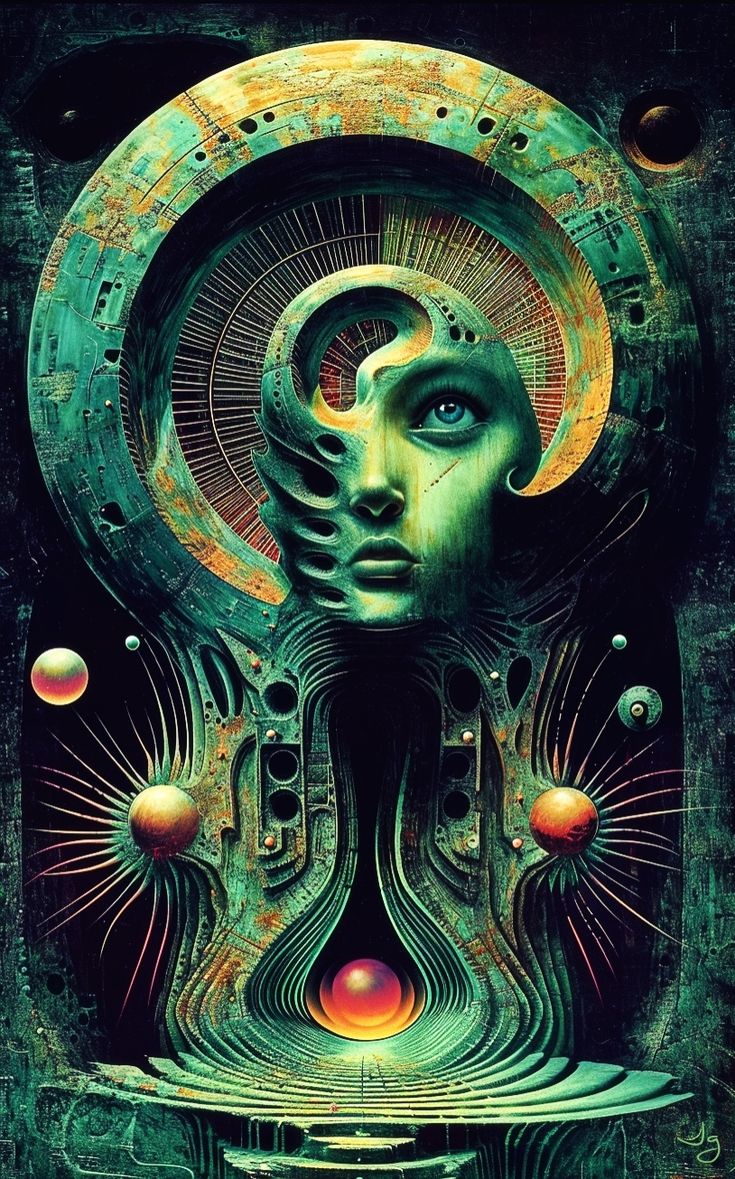
Image credit: world abstract Surrealism, wall art, original art by Jeramondo Djeriandi, Jg (@djeriandi)
Throughout human history, numerous hints—such as books, signs, or symbols—have sought to reveal the truth or, at the very least, refresh our forgotten memories. However, we often appear too naive or too lazy to make the effort to understand.
Here is one: although we may be able to read and decipher it, we must also discern the underlying meaning—”reading between the lines!”—and therein lies the key!
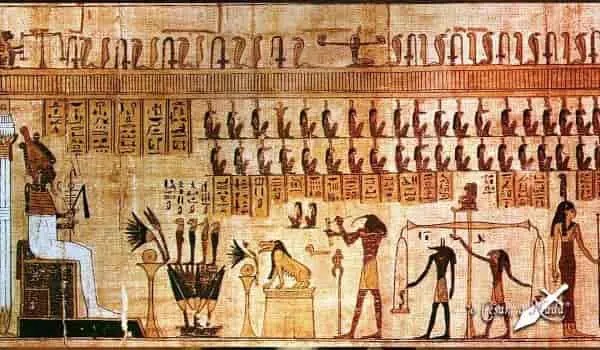
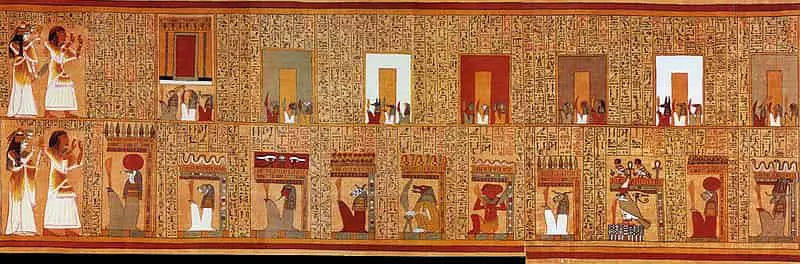
In the upper register, Ani and his wife face the “Seven Gates of the House of Osiris.” Below are ten of the twenty-one “Mysterious Portals of the House of Osiris in the Field of Reeds.” They are all protected by fearsome guardians. (from Historicaleve)
So, let’s continue engaging and aim to gather more information. Here is Marie Grillot‘s brilliant report on this topic for its purpose!
The Book of the Dead by Kha, Architect of the Place of Truth
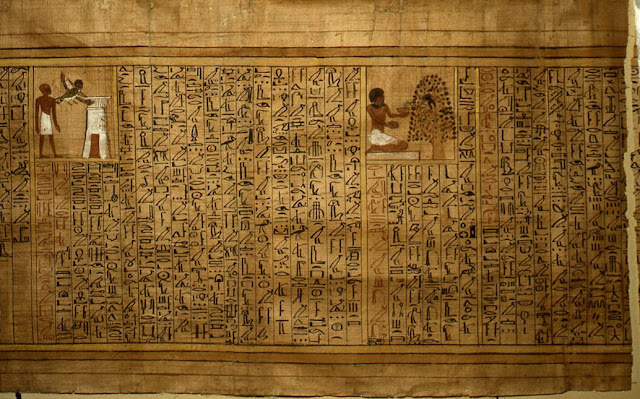
Book of the Dead of Kha and Merit – plant fiber/papyrus, ink, pigments New Kingdom – 18th Dynasty – reigns of Amenhotep II, Thutmose IV, Amenhotep III – circa 1425 – 1353 BC from their tomb – TT 8 – discovered on February 15, 1906, in the necropolis of Deir el-Medina by Ernesto Schiaparelli and Francesco Ballerini of the Italian Archaeological Mission of the Turin Museum exhibited at the Museo Egizio in Turin – Inv. No.: Suppl. 8316/03 = Suppl.8438 – museum photo
“In use from the beginning of the New Kingdom to the Roman period, the Book of the Dead, of which a ‘canonical’ version appeared in the Saite period, could be written on leather, on the mummy’s own bandages, on pieces of funerary furniture or, particularly at Deir el-Medina, on the walls of the vault, but it was almost always on a papyrus roll, bearing the name and titles of the deceased, that the various chapters that constituted it succeeded one another. Their titles being written in red ink – the literal meaning of the term ‘rubric’ – these were written in cursive hieroglyphs, in hieratic, then in demotic, and were almost always, especially in the New Kingdom, accompanied by beautiful painted ‘vignettes’ that make the Book of the Dead the oldest illuminated book in the world” indicates Jean-Pierre Corteggiani in “Ancient Egypt and its Gods”.
The “Book of the Dead” was originally called the “Book for going out during the day”. This “recent” name is due to the Egyptologist Richard Lepsius, who, in 1842, while translating a papyrus kept in the Turin Museum, called it “Todtenbuch” (“Book of the Dead”).
Book of the Dead of Kha and Merit – plant fiber/papyrus, ink, pigments New Kingdom – 18th Dynasty – reigns of Amenhotep II, Thutmose IV, Amenhotep III – circa 1425 – 1353 BC from their tomb – TT 8 -discovered on February 15, 1906 in the necropolis of Deir el-Medina by Ernesto Schiaparelli and Francesco Ballerini of the Italian Archaeological Mission of the Turin Museum exhibited at the Museo Egizio in Turin – Inv. No.: Suppl. 8316/03 = Suppl.8438 – museum photo
Paul Barguet, who also made a translation published by Éditions du Cerf, recalls its “divine” genesis: “The god Thoth is said to be the mythical author of the magic formulas of the Book of the Dead (or “Book to go out at/the day”, a title preferred by Jean-Louis de Cénival). Each time a deceased person recites a formula, he is theoretically the author since he reactivates it at the moment of pronunciation. But the formulas of the Book of the Dead were indeed written a very first time. The Egyptian priests identified this first author. In their minds, it was a divinity, not expressly named, but originating from Hermopolis. It would then seem that it was the god Thoth. This first paternity is rarely mentioned in the Book of the Dead, but it exists in the formula sections 30B, 64, 137A and 148″…
This precious collection, intended to ensure the well-being of the deceased and to be a true guide to eternal life, was placed in the tombs of the royal sphere and in those of individuals. It contained prayers for the divinities, religious and magical texts, listed the formulas allowing one to cross the doors to access the afterlife, to be “justified”, to face dangers and threats, to benefit from offerings, to feed oneself, to go out on earth during the day after having, during the night, crossed the underground world of Osiris…
Book of the Dead of Kha and Merit – plant fiber/papyrus, ink, pigments New Kingdom – 18th Dynasty – reigns of Amenhotep II, Thutmose IV, Amenhotep III – circa 1425 – 1353 BC from their tomb – TT 8 – discovered on February 15, 1906, in the necropolis of Deir el-Medina by Ernesto Schiaparelli and Francesco Ballerini of the Italian Archaeological Mission of the Turin Museum exhibited at the Museo Egizio in Turin – Inv. No.: Suppl. 8316/03 = Suppl.8438 – museum photo
In “The Egyptians,” Françoise Dunand and Roger Lichtenberg specify that the one who knows the formulas “will go to earth among the living… He will go out every day, he wants, and return to his tomb without being arrested… Thus, while the body remains in the tomb, the soul, ba (represented as a bird with a human head), is supposed to leave it to wander at will on earth and then find it again”…
The total number of formulas stated is sometimes indicated as 150, 165, or even 194; this difference is probably due to the periods… The copies that have come down to us are not all identical; they vary in fact in the number of formulas as well as in that of the “vignettes”. Thus, Florence Maruejol, the ancient Egyptians, asked “the scribes of the Houses of Life for a choice of chapters. Or it is the scribes themselves who make the selection… The shortest measures 1 or 2 meters in length, the majority reach about fifteen meters, and the longest exceed 25 meters. The chapters are generally illustrated by vignettes drawn in line or painted by an artist who takes over from the scribe”.
Book of the Dead of Kha and Merit – plant fiber/papyrus, ink, pigments New Kingdom – 18th Dynasty – reigns of Amenhotep II, Thutmose IV, Amenhotep III – circa 1425 – 1353 BC from their tomb – TT 8 – discovered on February 15, 1906, in the necropolis of Deir el-Medina, by Ernesto Schiaparelli and Francesco Ballerini of the Italian Archaeological Mission of the Turin Museum exhibited at the Museo Egizio in Turin – Inv. No.: Suppl. 8316/03 = Suppl.8438 – museum photo
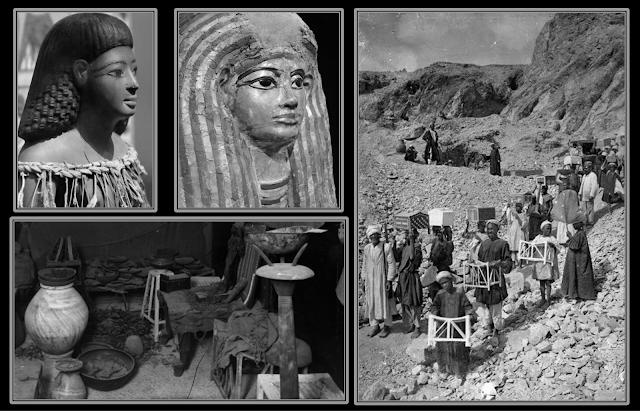
The “Book of the Dead” of Kha, architect of the Place of Truth, was found in the tomb he shared with his beloved wife, Merit. Discovered on February 15, 1906, in the northern circus of the necropolis of Deir el-Medina, by Ernesto Schiaparelli and Francesco Ballerini of the Italian archaeological mission of the Turin Museum, it contained more than 500 objects that constitute highly instructive testimonies of the life of a couple of the New Kingdom who had been particularly successful in this ‘microcosm’ that was then the community of artisans.
Left, top: Statuette of the architect Kha-wood – Museo Egizio Turin, S. 8335 Funeral mask of his wife Merit – painted and gilded stucco cardboard – Museo Egizio Turin, S 8473 Left bottom: The inviolate tomb of Kha and Merit – 18th dynasty – TT 8 Deir el-Medineh – when it was discovered on February 15, 1906, by the Italian Archaeological Mission of the Turin Museum led by Ernesto Schiaparelli and Francesco Ballerini Right: Artifacts coming out of the tomb – photos Museo Egizio
Curiously, their “Book of the Dead” was not “rolled up” but was found folded and placed on the intermediate coffin of Kha, who died after his wife. “Composed of 38 sheets of papyrus, stuck together for almost 14 meters in total length… it lists 33 formulas arranged from left to right, often accompanied by abundantly illustrated vignettes. The introductory scene shows Kha and Merit before the god Osiris enthroned under a canopy facing a richly decorated pedestal table; this scene synthesizes the axis around which the concept of death is articulated in ancient Egypt, that is to say the encounter with the god Osiris, sovereign of the world of the dead, whose judgment determines access or not to eternal life” specifies Enrico Ferraris in the “Museo Egizio”…
The following sheets (all 35 centimeters wide) contain other formulas related to the funeral procession, the ritual of opening the mouth, protecting the deceased, amulets, etc.
Book of the Dead of Kha and Merit – plant fiber/papyrus, ink, pigments New Kingdom – 18th Dynasty – reigns of Amenhotep II, Thutmose IV, Amenhotep III – circa 1425 – 1353 BC from their tomb – TT 8 – discovered on February 15, 1906, in the necropolis of Deir el-Medina by Ernesto Schiaparelli and Francesco Ballerini of the Italian Archaeological Mission of the Turin Museum exhibited at the Museo Egizio in Turin – Inv. No.: Suppl. 8316/03 = Suppl.8438 – museum photo
Dated 1425 – 1353 BC, from the reigns of Amenhotep II, Thutmose IV, and Amenhotep III, this “Book of the Dead” was registered in the Museo Egizio – S. 8316/03 = S.8438. In the work cited above, Enrico Ferraris notes “strong formal and sequential analogies with the copy found in the tomb of Yuya and Tuya, parents of Queen Tiye, wife of Amenhotep III, which could suggest the use of a reference model shared by the workshops that wrote these two funerary papyri…









 lampmagician
You must be logged in to post a comment.