
Translated from volumes published by Lorenz Jung based on the edition “Gesammelte Werke” dtv.de The Symbols of Transformation (1952) and Aion (1950)
Recently, on X (Twitter), during one of Perian’s talks titled “The Way of Democratic Talk,” someone mentioned that social morals are crucial for keeping people mindful of their behaviour towards others. I responded that social morals are relative and not constant; throughout human history, they have consistently changed after wars or revolutions. I prefer to use the word “conscience.” Another friend said she would stick with “morals” because she was tired of having a guilty conscience. I replied that conscience is based on inner awareness and individuality and, therefore, has a more substantial and profound foundation, strengthening our consciousness as individuals.
Anyway, it was a prologue to noticing that words like consciousness, ego, anima, and their influential product, Mana, are important to take seriously. Mana may sound strange and unknown, but we all have it inside us!
Jung has always attempted to clarify that good and evil exist within every human and has made significant efforts to help us realize that it all depends on us to recognize these and find the balance between them.
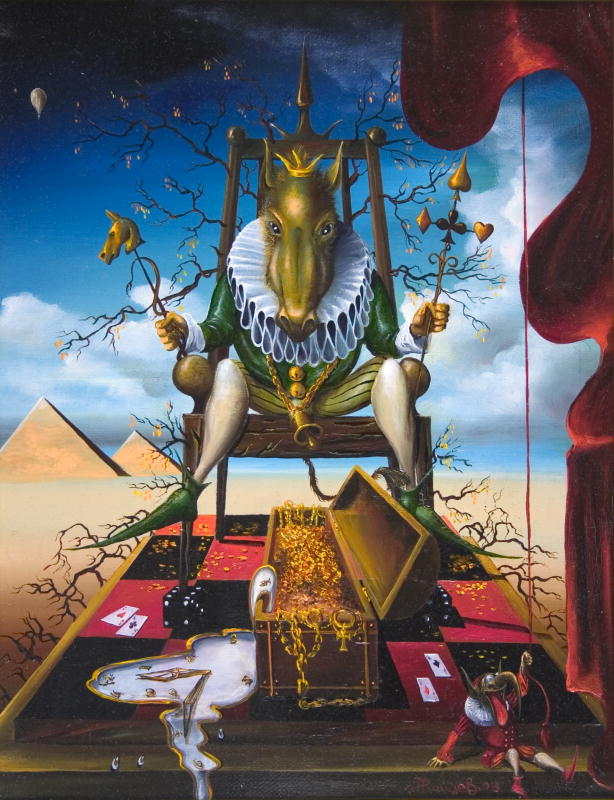
Illustration at the top: NIKOLAY ZAITSEV
Here, in the continuation of the first part, I share some more words from this magical Mana.
Individuation
The Mana Personality (P2)
Who has now come to terms with the anima? Apparently, the conscious “I”, and therefore the “I”, has taken over the Mana. In this way, the conscious “I” becomes the Mana personality. The Mana personality, however, is a Dominant of the collective unconscious, the well-known archetype of the mighty man in the form of the hero, the chief, the magician, the medicine man and saint, the lord of men and spirits, the friend of God.
This is now a male collective figure that emerges from the dark background and takes possession of the conscious personality. This psychological danger is of a subtle nature; by inflating consciousness, it can destroy everything that has been gained through the confrontation with the anima. It is, therefore, of no minor practical importance to know that in the hierarchy of the unconscious, the anima is only the lowest level and one of the possible figures and that its overcoming creates another collective figure that now takes over its Mana. In reality, it is the figure of the magician – as I will call her in short – that draws the Mana, that is, the autonomous value of the anima to itself. Only insofar as I am unconsciously identical with this figure can I imagine that I myself possess the Mana of the anima. But under these circumstances, I will do so infallibly.

The figure of the magician has a no less dangerous equivalent for women: it is a maternal, superior figure, the great mother, the all-merciful one who understands everything and forgives everything and always wanted the best, who always lived for others and never sought her own, the discoverer of great love, just as it is the herald of the ultimate truth. And just as great love is never appreciated, great wisdom is never understood either. And they can’t stand each other at all.
There must be a serious misunderstanding here because it is undoubtedly a case of inflation. The “I” has appropriated something that does not belong to it. But how did it appropriate this Mana? If it really was the ego that overcame the anima, then the Mana also belongs to it, and then the conclusion is correct: one has become significant. But why does this significance, the Mana, not affect others? That would be an essential criterion! It does not work because one has not become significant but has simply merged with an archetype, another unconscious figure. So, we must conclude that “I” has not overcome the anima and, therefore, has not acquired the Mana. It is just that a new merger has occurred, with a figure of the same sex that corresponds to the father’s imago and has perhaps even greater power.
From the power that binds all beings,
The person who overcomes himself frees himself<
(Goethe: The Mysteries. A Fragment, in. Works in ten volumes, Vol. 7, 1962)
Thus, he becomes a superman, superior to all powers, a demigod, perhaps even more. ‘I and the Father are one’, this powerful confession in all its terrible ambiguity stemming from precisely this psychological moment.
To be continued! 🙏💖


Wonderful, fascinating… and a bit difficult for someone like me who has only dealt with the “history of philosophy”, not philosophy, as a (secondary) school subject when I attended high school
LikeLiked by 1 person
Oh, my dear, I was very naughty and not well-behaved at school! However, as I know, Albert Einstein was also no good in school; therefore, the school of life is the best and has no limit till the end!😉🥰🙏💖😅😘😘
LikeLiked by 1 person
Thanks a lot for your great reply, dear Aladin
Have a great weekend 🌹🤗🤗
LikeLiked by 1 person
You, too, my dear Luisa.💖🙏
LikeLiked by 1 person
A great post Aladin – interesting and at the same time quite a complex topic. BTW I love the art you are using to accompany these posts!
LikeLiked by 2 people
Heartfelt thanks, dearest Lin. Oh, yes, it’s a complex issue, though I do my best to simplify it. However, with some suitable images, it doesn’t look so terrifying! Sending my love and best regards. 💖🙏🌹🥰🫂
LikeLiked by 2 people
I’m caught by the sentence “its terrible ambiguity.” My Jungian teacher was careful to help his students avoid presuming they had the power of a mana personality. Inflation is a true danger. It seems DT has completely lost any caution and wants to take on as much power as possible. I’m not sure this is the same way you’re using “mana personality,” but it’s what comes in mind for me at this tense moment in world power politics. The idea of infallibility is a dangerous inflation in the wrong mind and hands. Thank you for articulating this.
LikeLiked by 1 person
Your comparison with today’s world is appropriate. We might interpret Mana as ambition; it could be helpful and dangerous at the same time! Our realizations are crucial. Thank you again for sharing your wisdom, my lovely friend.🤗💖🙏
LikeLike
Brilliantly written.
LikeLiked by 1 person
You are honouring me, thanks a lot. Sorry for the belated answer; I am primarily Busy with the grandkids on Sundays!😉🙏🖖🙏
LikeLike
So, the ego has stolen the Mana, and becomes all of it.
Yet a discrepancy arises, in the idea of a merger.
So it seems these mergers all have relevant outcomes. Yet, not all outcomes are good, in terms of all of humanity. Or, as I think about it, the Mana.
Let me know if I’ve gotten lost!
Also, your prelude was interesting.
Conscience vs morals… yes I agree, very different.
Yet, I understand your friends logic of choice.
With much support logic, I recently referred to many of the homeless in Toronto, as Urban Campers. Therein lies a logic of choice.
❦🌹🌟🎼💖🍒
LikeLiked by 2 people
My dear Resa, I appreciate your efforts to catch the point; it is amazing! Jung is talking of merges as they are sometimes helpful (completing) and sometimes fail and go wrong. We might take them like cocking a mail: it might become a very delicious food, or the mixture could be terrible! There are also gas capsules to attend!! In any case, we have a monstrous Mana in sight, which can be helpful or go the other way around. I remember once I discussed with a friend about the power of Zorn. It is the German word for anger, rage or fury, which I meant it can be damaging and sometimes beneficial to success. Love to you, take care.🤗🥰🌹🦋🌻
PS: That with the homeless’s choice was brilliant!💖
LikeLiked by 1 person
I do try. Sometimes I read 2 or 3 times, and my understanding changes.
Thanks…about the homeless point!
I fear trump has harnessed Zorn.
.🤗🥰🌹🦋🌻
LikeLiked by 1 person
Excellent! 😂🤙🙏❤️
LikeLiked by 1 person
Fascinating reading Aladdin. Thank you for the amazing post. 🌹
LikeLiked by 1 person
Thank you, lovely Rene. I wanted to continue this article this weekend, but we had renovations (repainting walls) in our apartment all week, so I have no strength or concentration! I might only try to tell a story about this restoration!!😅 Love and peace.💖🙏🌹
LikeLiked by 1 person
Good luck with the renovations , always fun 😉. Love and peace to you. 🌹
LikeLiked by 1 person
Oh, maybe; thank you! However, on the threshold of the seventies, it may leave you a bit out of breath!😜😅💖🙏
LikeLike
Haha I was being facetious, I’ve painted walls and it’s no fun. ❤️
LikeLiked by 1 person
😂🤙💖
LikeLiked by 1 person
🤗🌼🖌️
LikeLiked by 1 person
🌹
LikeLiked by 1 person
“conscience” > social morals👍😉… Ideally, right!
LikeLiked by 1 person
You say that!🖖🙏🤙
LikeLike