#Woman_Life_Freedom

The #womanlifefreedom movement is a revolution motive not just in Iran but worldwide. Free souls remain alive in art.
This is a valuable gift that I could not resist reblogging! With heartfelt thanks to Resa. 🙏🙏💖💖🥰🦋🌹
#Mahsa_Amini

The #womanlifefreedom movement is a revolution motive not just in Iran but worldwide. Free souls remain alive in art.
This is a valuable gift that I could not resist reblogging! With heartfelt thanks to Resa. 🙏🙏💖💖🥰🦋🌹
#Mahsa_Amini
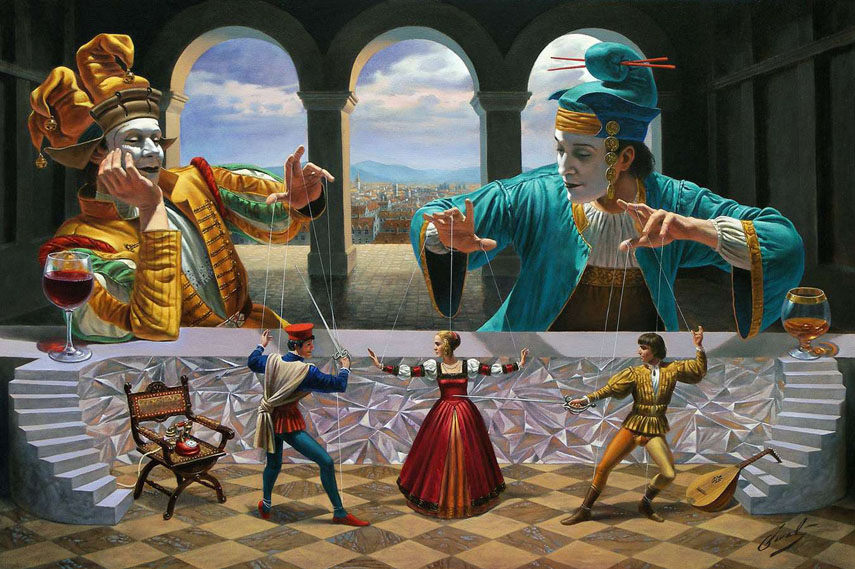
In the history of humanity, we can find many cases that were cover-ups and manipulated in favour of the ruling authority. I recall someone once saying: ‘In every battle, if you lose, you are a criminal. But if you win, you are a hero! Now that AI has become more prevalent, manipulation in our society has become much easier. I wonder whether the recent technological advancements result from human ingenuity or if there is an extraterrestrial influence at work!? To put it bluntly, I sometimes feel that all this technical progress in the hands of human beings is akin to giving a carrot juicer to a five-year-old child!

“Until lions have their historians, tales of the hunt shall always glorify the hunters.” Or the winner takes it all!
We will not define or reach the truth until we examine every issue in depth and consider both sides. It would be wise to observe beyond the events, to read between the lines, and not allow ourselves to be seduced by the brilliance of the stronger ones. Never believe the hype. Never trust a rumour! We must rely on our own awareness through our experiences. I have encountered numerous online instances where verses, quotes, or thoughts have been manipulated or attributed to great thinkers who never actually expressed them. It is just abusing the name of a great personality just to make a multiple share on the web!
As Ernest Hemingway once said, meeting Americans individually or personally is amazing, but they are terrible and even dangerous in one mass.
As Dr. Jung says, Thinking is difficult; therefore, let the herd pronounce judgment!

These can constantly appeal to ordinary, everyday facts known to everyone. Still, the instinct for wholeness requires, for its evidence, a more highly differentiated consciousness, thoughtfulness, reflection, responsibility, and sundry other virtues. Therefore, it does not commend itself to the relatively unconscious man driven by his natural impulses because, imprisoned in his familiar world, he clings to the commonplace, the obvious, the probable, and the collectively valid, using his motto: “Thinking is difficult, therefore let the herd pronounce judgment!” It is an enormous relief to him when something that looks complicated, unusual, puzzling and problematical can be reduced to something ordinary and banal,
especially when the solution strikes him as surprisingly simple and somewhat droll. –Carl Jung, Flying Saucers: A Modern Myth of Things Seen in the Sky, p. 48
This quote is also an example of how things get turned around, which may explain the misappropriation. He has never said, “Thinking is difficult; that’s why most people judge.” But this latter became famous and therefore accepted because it has been repeated countless times! However, referring to the quote itself says to think twice and keep questioning before concluding.
Numerous misattributed quotes are circulating online, and one of them is, “Sometimes a cigar is just a cigar.” Contrary to popular belief, Sigmund Freud never actually said that. It’s important to note that it’s challenging to verify the authenticity of quotes online; Abraham Lincoln humorously stated, “The problem with quotes on the Internet is that it is hard to verify their authenticity.”!!
This African proverb is used to describe how dominant groups inscribe power through historical narrative metaphorically. We can see the unfairness in the world despite the access to social media and the questionable accuracy of the information shared. Those in power often have the upper hand. The dominant voice is heard and believed.
One must have tough skin to survive! I prefer to avoid all deception and manipulation and conceal myself behind a strong and unaffected mask to be protected. Or to be so wise as Rumi, keep going and sing your song like a bird.

As a Russian proverb says: Trust is good, but control is better!! Have a leisurely weekend.🙏🖖💕🥰🌹
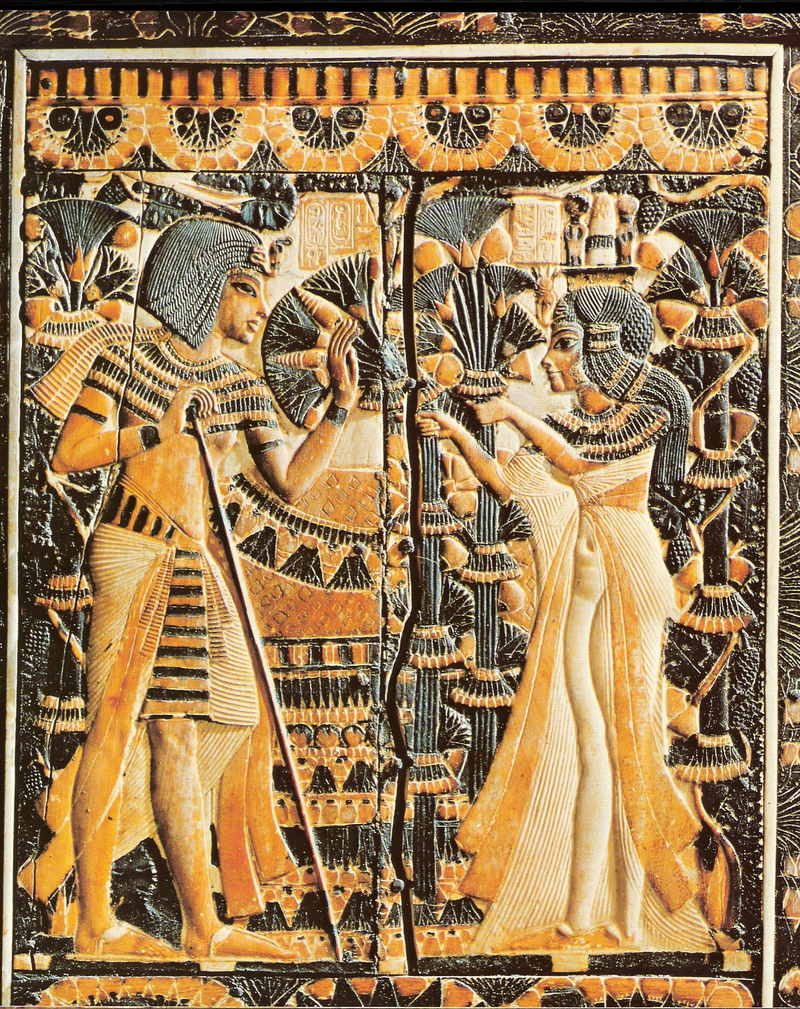
King Tutankhamun is one of the most famous rulers ever, thanks to Howard Carter‘s 1922 discovery of the pharaoh’s tomb in Egypt’s Valley of the Kings, sponsored by British aristocrat George Herbert. The find stirred the imaginations of millions fascinated by the boy king’s golden-masked mummy.
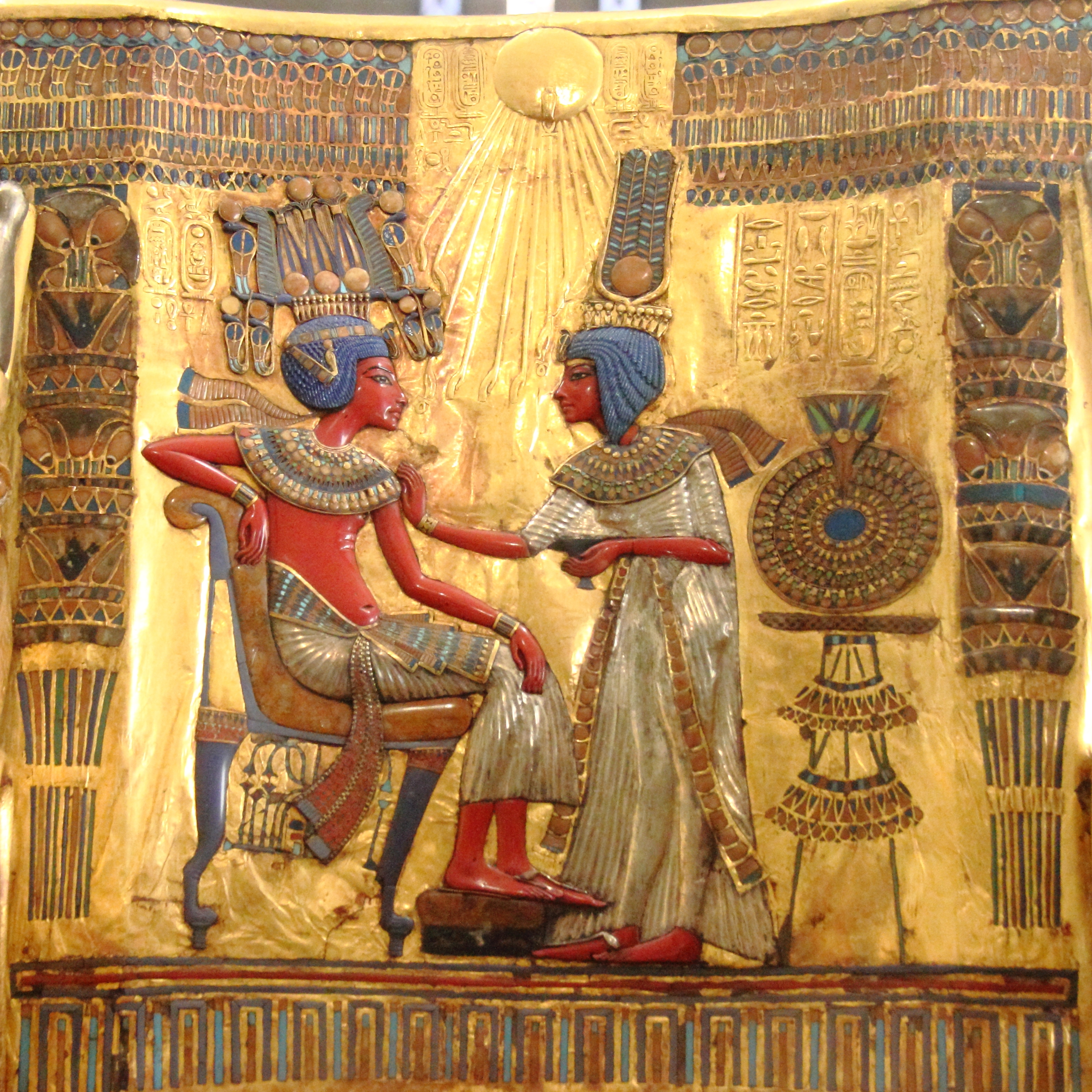
He and his tomb are (one of) the most beautiful and, tragically, the most robbed and plundered in ancient Egyptian explorations. No wonder the shining gold and humans’ greed! Nonetheless, the efforts of the good side of humans still try to restore and discover more details of the life of this fascinating man, and they will continue for sure!
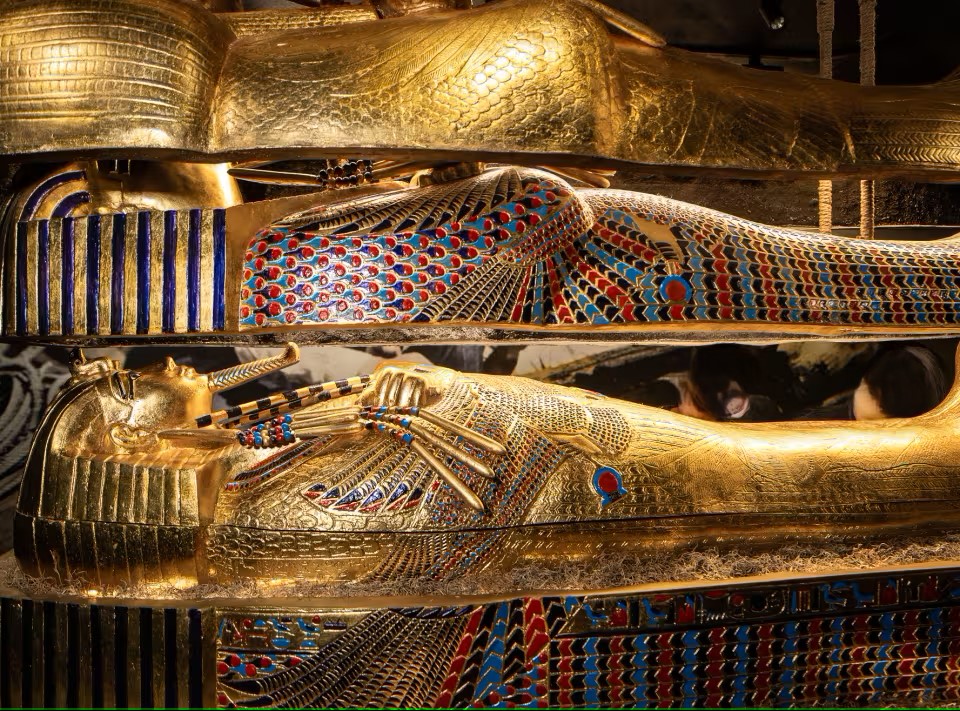
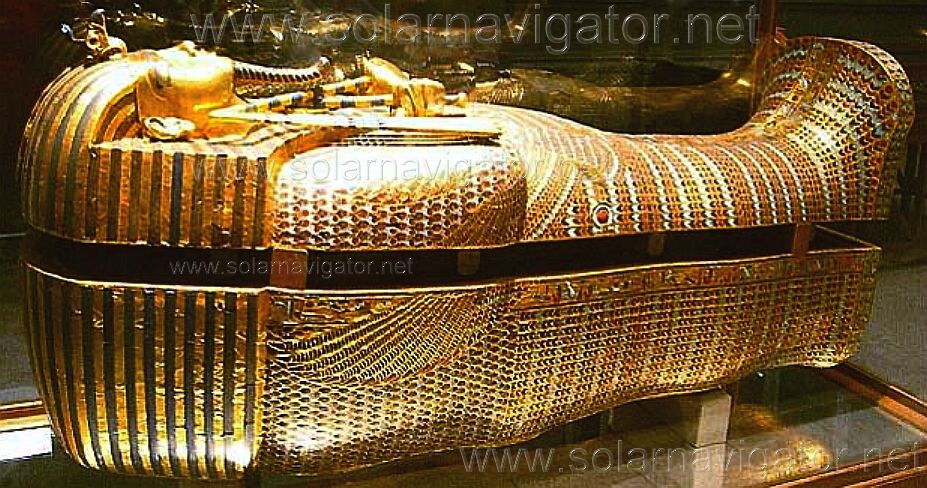
Here, we read an exciting story by Marie Grillot and Marc Chartier about a deep investigation and discovery using modern technology.
via égyptophile
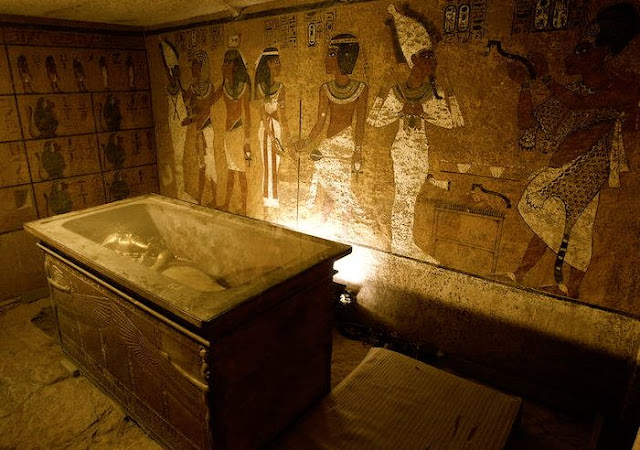
In November 1922, after ten years of excavations and research in the Valley of the Kings, Howard Carter and Lord Carnarvon finally discovered the first step of Tutankhamun’s tomb, which they had been desperately searching for.
Within this KV62, with an area of just over 100 m², a team of the best experts will work on clearing and saving the objects. Some will devote nearly ten years to it, and the whole world, fascinated by this young pharaoh emerging from oblivion, will marvel at the priceless treasures surrounding him for his afterlife.
For more than 90 years, the number of visitors who have entered the pharaoh’s tomb to absorb a small part of his eternity has continued to increase, endangering his survival. The humidity generated by these visits significantly deteriorated the paintings and generated mould, causing significant damage. This led the Antiquities Department to limit the number of daily visits and close access to the site to the public in 2011.
This context, which seemed inevitable, was understood in 2002, and the basis for constructing a replica of the KV62 was studied.
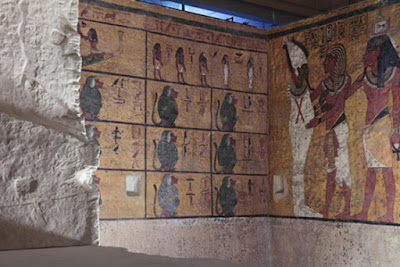
Illustration Factum Arte
The company Factum Arte, founded by the British painter Adam Lowe and based in Madrid, was chosen to build this replica. The Egyptian Ministry of Tourism and Antiquities and funds from the European Union partially financed it.
Experts in these new technologies have implemented, used, and piloted innovative techniques, the most advanced of which is 3D. In 2009, for many months, the Factum Arte team invested in the tomb to memorize every centimetre with the highest precision. “The first work consisted of carefully recording the relief of the walls and the sarcophagus with a scanner specially designed for the occasion. Its resolution reached one hundred million points per m². Then, the second stage consisted of photographing the paintings with a very high resolution and faithfully respecting the colours.”
Armed with this data, Factum Arte technicians returned to their premises in Madrid, where they began manufacturing the facsimile in the form of hundreds of high-density polyurethane panels. These were assembled on-site to form the four walls of the mortuary chamber. The inauguration of the “double” tomb took place in April 2014.
And this is where another part of this beautiful story begins…
Egyptian Minister of Antiquities, Mamdouh Al Damati, listening to British Egyptologist Nicholas Reeves,
near the sarcophagus of Tutankhamun – Photo: AFP/ Khaled Desouki
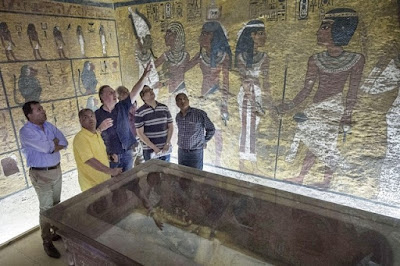
Nicholas Reeves, an English Egyptologist and foremost specialist in Tutankhamun, carefully studies the photos taken by Factum Arte in the burial chamber. This room is the only one in the tomb, and it is decorated with paintings: “rudimentary, classic, of austere simplicity” executed on a plaster coating painted yellow. These paintings reflect the ritual name given to it in antiquity: “the Hall of Gold.” He then noticed reliefs which could be blocked openings overtures onto two rooms unexplored until now. By pushing further his reasoning, he believes that one wall (the north wall) would be Queen Nefertiti’s burial place, while the other (the west wall) would be a storage space.
Nicholas Reeves supports his hypothesis – contested, it is necessary to recall, by other Egyptologists – first of all on his interpretation of the frescoes of the northern wall of the tomb (which represent the young king Tutankhamun performing a funerary ritual for his mother, Queen Nefertiti), then on the fact that Tutankhamun died prematurely, at the age of 19, and that, due to lack of an available tomb, the priests would have taken the decision to reopen Nefertiti’s tomb, ten years after his death, to bury the young king in a hypogeum not provided for him.
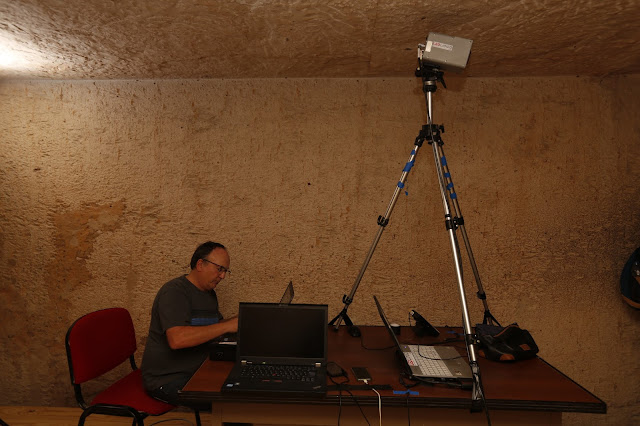
To verify this hypothesis, the Ministry of Antiquities has given the green light to enter noninvasive and nondestructive techniques onto the scene. First of all, infrared thermography is an operation led by Jean-Claude Barré, who came to Egypt as part of the “Scan Pyramids” mission. Based on images captured regularly over 24 hours, this technique can reveal temperature differences, possibly leading to cavities under a given surface. This was indeed the case in the tomb of Tutankhamun, where such temperature differences were detected through the painted coating of the north wall, without it being possible to determine the exact configuration of a hollow space or, even more so, its content.
After some tests in a tomb whose configuration is already known (the KV5) to verify the effectiveness and reliability of the equipment used, the second series of surveys in Tutankhamun’s tomb was carried out using the radar technique. This device was placed 5 cm from the wall to prevent damage.
During the press conference, held in Luxor on November 28, 2015 late in the morning, at the house of Howard Carter, the Minister of Antiquities, Dr. Mamdouh El-Damaty, announced that the radar scans revealed the existence of a large void, with a long corridor, behind what we now know to be a false wall (a “ruse”, a ploy, intended to thwart possible tomb robbers) in Tutankhamun’s burial chamber. It is helpful to remember that the tomb was robbed several times in antiquity.
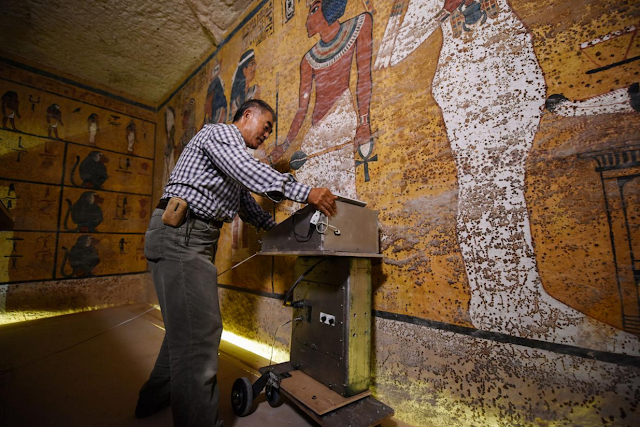
Analyzes by Hirokatsu Watanabe, a Japanese radar specialist, also provide evidence of a second door hidden in the adjoining west wall.
The Minister declared, “We previously spoke of a 60 per cent chance that something was behind the walls. But now, reading the first analyses, we can assert a 90 per cent probability.”
He specifies that the data collected will quickly be examined more deeply in Japan.
He then mentioned a possible next step: digging a small hole in the wall (on an unpainted space) of the neighbouring room, called the “Treasure Room,” adjoining the “empty” behind the wall in the burial chamber to introduce a browser camera.
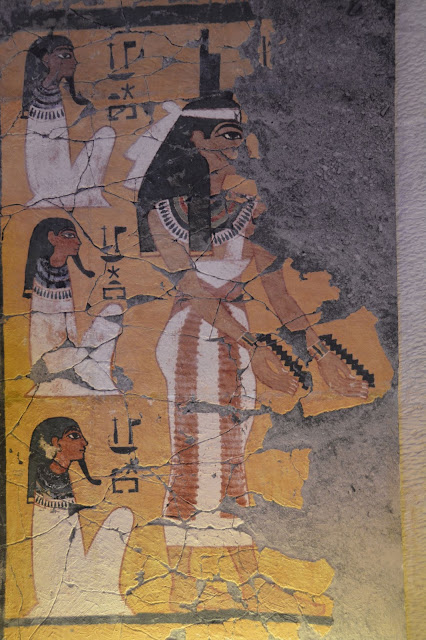
It is unthinkable to risk damaging or deteriorating these painted walls. It is helpful to remember that during the second season of excavation, Howard Carter destroyed part of the scene on the south wall and then recovered the fragments. Still, these practices are no longer used today.
The questions remain and even multiply… But one answer is inevitable: Tutankhamun has not finished being in the spotlight!
To complete the information:
http://news.nationalgeographic.com/2015/11/151126-nefertiti-tomb-tut-egypt-archaeology/ http://news.nationalgeographic.com/2015/11/151128-tut-tomb-scans-hidden-chambers/ http://english.ahram.org.eg/NewsContent/9/40/171833/Heritage/Ancient-Egypt/Radar-test-underway-before-search-for-Nefertiti-in.aspx

After my last post, I felt a little done, so I came across one of my drafts, which I thought would fit with that: living, dying, and growing again! I hope you will enjoy it.💖

Now, leave me alone.
Now, get used to it without me.
I am going to close my eyes
And I only want five things,
five favourite roots.
One is endless love.
The second thing is to experience autumn.
I can’t be without the leaves
fly and return to earth.
The third thing is the grave winter,
the rain that I loved, the caress
of fire in the wild cold.
Fourthly, summer
round like a watermelon.
The fifth thing is your eyes,
My beloved Matilda,
I don’t want to sleep without your eyes,
I don’t want to live without you looking at me:
I change the spring
why you keep looking at me.
Friends, that’s all I want.
It’s almost nothing and almost everything.
Now if you want you can go.
I have lived so long that one day
they will have to forget me by force,
erasing myself from the slate:
my heart was endless.
But why do I ask for silence?
Don’t think I’m going to die:
The opposite happens to me:
It happens that I’m going to live.
It happens that I am and that I continue.
It will not be, then, but within
grain will grow from me,
first, the grains that break
the earth to see the light,
but Mother Earth is dark:
and inside me, I am dark:
I am like a fountain in whose waters
the night leaves its stars
and continues alone through the field.
It’s about how much I’ve lived
that I want to live as long.
I never felt so in harmony,
I have never had so many kisses.
Now, as always, it’s early.
The light flies with its bees.
Leave me alone with the day.
I ask permission to be born.

Out of the darkness, through the open window of Birth, human life comes to the earth; it dwells for a while before our eyes into the darkness, and then, through the open window of Death, it vanishes out of sight.
Annie Besant
This post may serve as a brief introduction to a significant revolution in a fledgling nation striving for its freedom and the right to lead a happy and healthy life. I decided to write this article because, in my latest post, I mentioned a short note about women and their fight for their rights in Iran, and one of my adorable friends, Petra Glimmdall, asked me to write a more extensive article about this happening.
I’ve written about this topic once or twice before! However, I’ll do my best to provide more details about one of the most widespread, laborious, and challenging struggles for freedom faced by the people of a vast country with a rich history. They have come a long way in their quest for rights but have not yet achieved their goal.

Iran has a long history of uprising, starting with the Persian Constitutional Revolution at the beginning of the twentieth century (1905-11), which could hold on but annihilated and oppressed by Reza Khan Pahlavi‘s ambition and selfishness (1925), up to the nationalize Iran’s oil industry under Dr Mossadegh‘s government (1951-53), which has been collapsed by Mohammad Reza Pahlavi’s coup d’état, until 1979 the revolution against Shah’s regime which Islamic treacherous Mullahs had stolen. Now we see there is no end to this!
However, this time, the heart of the issue is women who hold the head of the rope in their hands, and these protests represent the first uprising led by women.

The Women’s Life Freedom Movement in Iran started in September 2022 after the tragic death of Mahsa (Jina) Amini. She was a young Iranian woman who was arrested by the morality police for not wearing her hijab correctly and found dead in the hospital a few days later.
In fact, the Iranian uprising began in 2009 during the so-called Green Movement. This occurred after the presidential election that year, and the people felt deceived by the extremists in front of the regime, although it was a pretext to rebel against them.

Even then, there was a woman who fanned the flame of the Green Movement revolution: Neda Agha-Soltan, an Iranian student of philosophy, who was participating in the protests with her music teacher and was walking back to her car when she was fatally shot in the upper chest.
It took some months then after the Islamic Regime brutally suppressed the revolution by banning international media, cutting off the internet for a week and killing more than one thousand and five hundred protestors.
This time, however, it has been ongoing for about two years, and it seems to be gaining momentum because, in my opinion, it is under the banner of Women, Life, and Freedom. It is not just for the Iranian people but for all people (especially women) around the world.
Honestly, I am a pessimist, not specialized in the Iranian future, but rather in the human condition as a whole. I have some theories that some might consider conspiratorial! However, I believe that for many decades, the actions in Iran, particularly the Islamic Regime, have been under the control of great powers like the USA and other interested authorities. I’m just trying to reason: How can it be that a regime that is unpopular and hated from within and is subjected to constant sanctions from outside remains in power so calmly and shows no weakness?! The West certainly supports this.
Significant changes will occur in the Near and Middle East when the time comes. When is this time? It is when weapons factories achieve good sales, when Putin’s regime becomes weak (though Putin shouldn’t go away!), and when peace is restored. At that point, it will be time for a regime change in Iran. These are my predictions!

Do you smile like the Rose at loss and gain? For the Rose, though its petals may be torn and asunder, it still smiles on, and it is never cast down.
Maulana Jalaluddin Rumi
Finally, to help you understand the core of this uprising, I’m showing you an example named Nika, Nika Shakarami. She is one of many victims of this injustice and brutality—a girl, as you can see in this short video, with lots of dreams, full of hopes and a joyful heart and soul. She was one of the first victims of the Mahsa (Jina) revolution, possibly because of their optimism in believing the uprise would soon win.
Here is a new report of her brutal death, which BBC broadcasted:
I have added two more videos about the history of the Iranian uprising to provide you with additional fundamental information.
I believe I have mentioned this before, but I want to reiterate that I understand everyone faces different challenges in life, and nothing is easy. While I value every thought and acknowledgement, I would appreciate your sympathy and empathy, my dear friends. May the justice win at last! 🙏💖🙏✊

During one of my workdays, I had a guest in my car – an intelligent woman who left a lasting impression on me with her profound awareness. We delved into a conversation about various topics such as God, the world, and eventually, my birthland, Iran. I shared my views on equality between men and women. Then I dared to discuss Femininity, Anima, Animus, and Dr Jung’s idea of their existence, which are present in every human. She listened attentively, found my words intriguing, and even agreed somewhat. However, she expressed her preference for being a “pure woman” and did not desire to have any masculine traits in herself!
I believe the current wave of feminism is a form of emancipation fueled by frustration toward men. This frustration stems from the fact that men have dominated the world’s history. However, I wanted to discuss this further to convince her to understand my perspective.
Unfortunately, we arrived at her destination before we finished, and she got out of the car and left.
I have gathered here some words and quotes on femininity, body and soul, which I believe has very little to do with gender (as Marion Woodman says so well), and we might need a vested development to comprehend it.

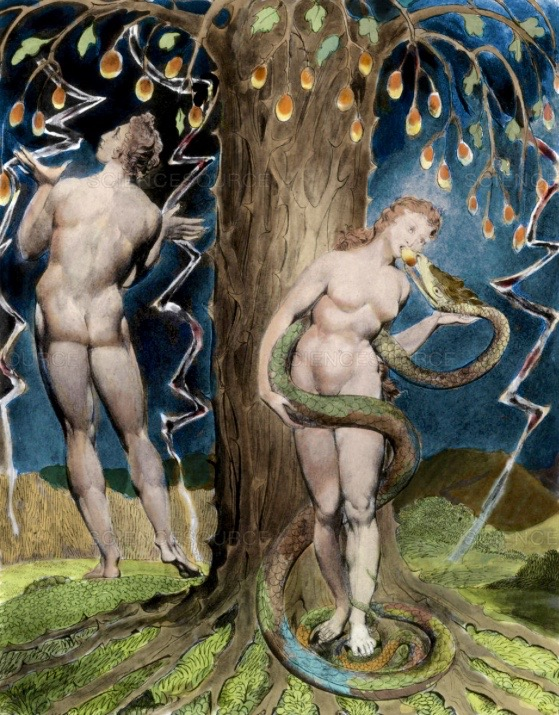
The Garden of Love – William Blake
I went to the Garden of Love and saw what I had never seen: A Chapel was built in the midst, Where I used to play on the green. And the gates of this Chapel were shut, and “Thou shalt not” writ over the door; So I turned to the Garden of Love that so many sweet flowers bore; and I saw it was filled with graves, and tomb-stones where flowers should be; and Priests in black gowns were walking their rounds, And binding with briars my joys & desires.
“Do what you will; this world’s a fiction and is made up of contradiction.” William Blake (UK 1757-1827) Infant Joy – Infant Sorrow – by William Blake


“William Blake says the body is ‘that portion of soul discerned by the five senses’ I live with that idea. I sit and look out my window here in Canada, and the autumn trees are golden against the blue sky. I can feel their “food” coming into my eyes and going down, down, down, interacting inside, and I fill up with gold. My soul is fed. I see, I smell, I taste, I hear, I touch. Through the orifices of my body, I give, and I receive. I am not trying to capture what is absent. It’s that interchange between the embodied soul and the outside world that is the dynamic process. That’s how growth takes place. That is life.”
~Marion Woodman, Conscious Femininity, P. 44-45
Award-winning author Teri Degler quoted:
“….embodying the divine feminine is critically important for our times. (Teri Degler: The Divine Feminine Fire)
It shows you how to accomplish this by getting to know your body, bringing your body and your dreams together, and uniting body and soul. Marion Woodman, author of Dancing in the Flames
This issue might have a long way to go, and as I am involved in something more primitive like the situation in Iran, I can see those women who are beyond all boundaries and fighting for their rights; I discern light at the end of the tunnel! Thank you all for your interest. Have a lovely weekend, everybody.🙏💖🥰

Usermaatre Amenemope was an ancient Egyptian pharaoh of the 21st Dynasty who ruled between 1001–992 BC or 993–984 BC. Amenemope wrote The Instruction of Amenemope during ancient Egypt’s late New Kingdom period. The text contains practical maxims and admonitions for leading a good life, similar to other wisdom literature. It’s been noted that Amenemope’s work shares similarities with the Hebrew Book of Proverbs in structure and content, but the nature of their relationship is debated.

Amenemope tomb is notable for being one of only two entirely intact royal burials known from ancient Egypt; the other is that of Psusennes I. However, only the metal objects from the tomb survived.
The chamber is 10.63 meters long, 2.85 meters wide, and 3 meters high at the centre. The rock quality is inferior; three large fissures have caused significant damage. In the past, cracks were filled with mud and fired to even the surface.
Now, let’s read another fascinating Marie Grillot report about this magnificent, gold-shining, divine amulet and its discovery.
via égyptophile

This pectoral is one of only two that accompanied Pharaoh Amenemope for his eternity. A gold plate, square in shape (8.8 x 8.9 cm), is attached to a heavy gold chain with a length of 46 cm, which is relatively original because this type of pendant fits most often a rectangular shape.
Jean Yoyotte explains how the goldsmith designed it: “Two gold sheets of the same size fit together dry, adjusted on a thin filling (cement?), the whole being provided with two welded fluted bails on the edge, small rods are used to fix the chain.
The pectoral decoration resembles the architecture of a temple door, topped by a grooved cornice on which stretches—just like in temples—a representation of the winged sun.
The lower part of the pendant is made up of a frieze of thirteen motifs repeated alternately: the Djed pillar is reproduced seven times, while the Tit loop appears six times.
These protective emblems are associated with Osiris and Isis, respectively.

Indeed, the Djed pillar is an Osirian amulet, a symbol of stability, present in Egypt since the most ancient times, while the: “knot of Isis (Tit) is, for its part, assimilated to the blood and the magical power of ‘Isis’ (Isabelle Franco).
The central scene “picture”, evoking a funeral rite, is presented in a frame bordered by a Ramesside frieze. Suppose this scene is prevalent in funerary iconography. In that case, Christiane Ziegler nevertheless explains its originality here: “Of all the pectorals of Tanis, this is the only one to depict the pharaoh. The decor, executed in embossed on the gold leaf, depicts King Amonemope offering incense and a libation to the god of the dead, Osiris. An identical motif is chiselled on the bottom plate.
The pharaoh, wearing a nemes headdress and a front loincloth, is standing in a walking attitude. He is facing Osiris, who is seated on his throne. The god of the underworld, wearing the imposing crown Atef, is represented in his mummified appearance. He clutches the whip and the flail to his chest.

Amenemope raises his right hand and holds a cassolette of incense in his left. “Between the two partners, a vertical legend specifies that the first is supposed to incense and libation to his father Osiris” (Jean Yoyotte).
In the worship of gods and deities, the fumigation of incense is, along with the libation of water, one of the most important rituals of the pharaonic liturgy. The high function of fumigation was to “restore life through incense supposed to be an emission from the body of Osiris”. This scene is often reproduced on the walls of temples or the walls of tombs, most often performed by a sem priest or by the pharaoh himself…”. It is also important to point out that it is reproduced on one of the walls of the tomb of Amenemope.
Incense, rare in Egypt, was mainly dedicated to worshipping divinities and the pharaoh; it could be frankincense, terebinth, myrrh, styrax, etc. But the most sought after, the most prized, was kyphi, produced by a mixture of 10 to 50 substances. It is worth remembering that “The priests offered Ré three kinds of incense daily, one at sunrise, one at midday and one at sunset.”…
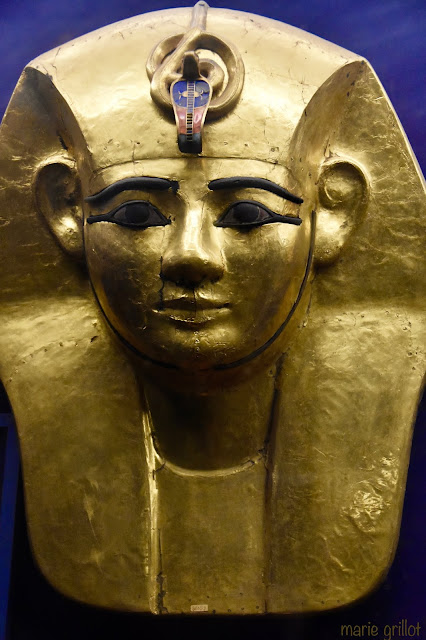
Amenemope is a pharaoh of the 21st Dynasty whose reign, which was exercised from Tanis, is located approximately around 1001-992 BC. In “The Treasures of the Egyptian Museum”, a collective work written under the direction of Francesco Tiradritti, we can read that: “successor of Psusennes I was buried in the tomb of the latter, in a room covered with granite, originally created to accommodate the remains of Moutnedjemet, wife and sister of Psusennes I”.
We can only be surprised that he was buried in a single-room vault even though he has his own burial referenced NRT IV (NRT = Royal Necropolis of Tanis).
Still, his “true” eternal home – the one in which his mummy rested – was discovered in the spring of 1940 by Pierre Montet and his team.
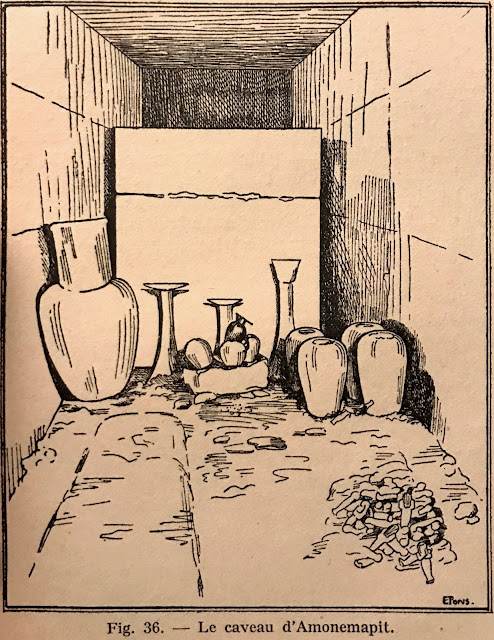
In “Tanis – Twelve years of excavations in a forgotten capital of the Egyptian Delta”, the discoverer relates this very special day: “The entrance was opened on April 16. His Majesty King Farouk arrived the day before in Sân, where he had to set up a tent city, was present, as well as Mr Canon Drioton, director of the Egyptian Antiquities Service and a young Egyptian Egyptologist, Professor Abou Bekr. The vault was furnished almost like that of Psusennes: at the bottom, a granite sarcophagus; in the front half, the canopic vases, the metal vases, a large sealed jar, funerary statuettes, and a vast gilded wooden chest that had collapsed due to the effects of time and humidity. When these objects had been placed in a safe place, the sarcophagus lid was placed in their location. Much less abundant than Psusennes, the new sovereign was content with a single stone sarcophagus and an anthropoid wooden coffin covered in gold. The wood had been reduced to almost nothing, and the gold plates were removed. It is hardly necessary to say that the mummy suffered enormously. His ornaments, less numerous than those of Psousennès, nevertheless constitute a wonderful collection: a gold mask, two necklaces, two pectorals, two scarabs, hearts of lapis and chalcedony, bracelets and rings, a giant falcon in cloisonné gold with outstretched wings, and canes.
In this troubled period of the Second World War, the artefacts will be brought to safety as quickly as possible. Thus, from May 3, 1940, it was in a truck protected by the army that the Amenemope treasure would travel to the Egyptian museum in Tahrir Square…
The pectoral will be recorded in the Journal des Entries under the reference JE 86038.
Sources:
Gold Pectoral of King Amenemope http://www.globalegyptianmuseum.org/record.aspx?id=15529 Tanis – Twelve years of excavations in a forgotten capital of the Egyptian Delta, Pierre Montet, 1942
Tanis the gold of the pharaohs, exhibition catalogue Paris, National Galleries of the Grand Palais, March 26 – July 20, 1987
The discovery of the Treasures of Tanis, Georges Goyon
Treasures of Egypt – The wonders of the Egyptian Museum in Cairo, Francesco Tiradritti
Tanis: treasures of the pharaohs, Henri Stierlin and Christiane Ziegler, Seuil, 1987
Pharaons – Catalog of the exhibition presented at the Institute of the Arab World in Paris from October 15, 2004, to April 10, 2005
Ancient Egypt and its gods, Jean-Pierre Corteggiani, 2007
Dictionary of Egyptian mythology, Isabelle Franco,
Published December 13th 2019 by Marie Grillot
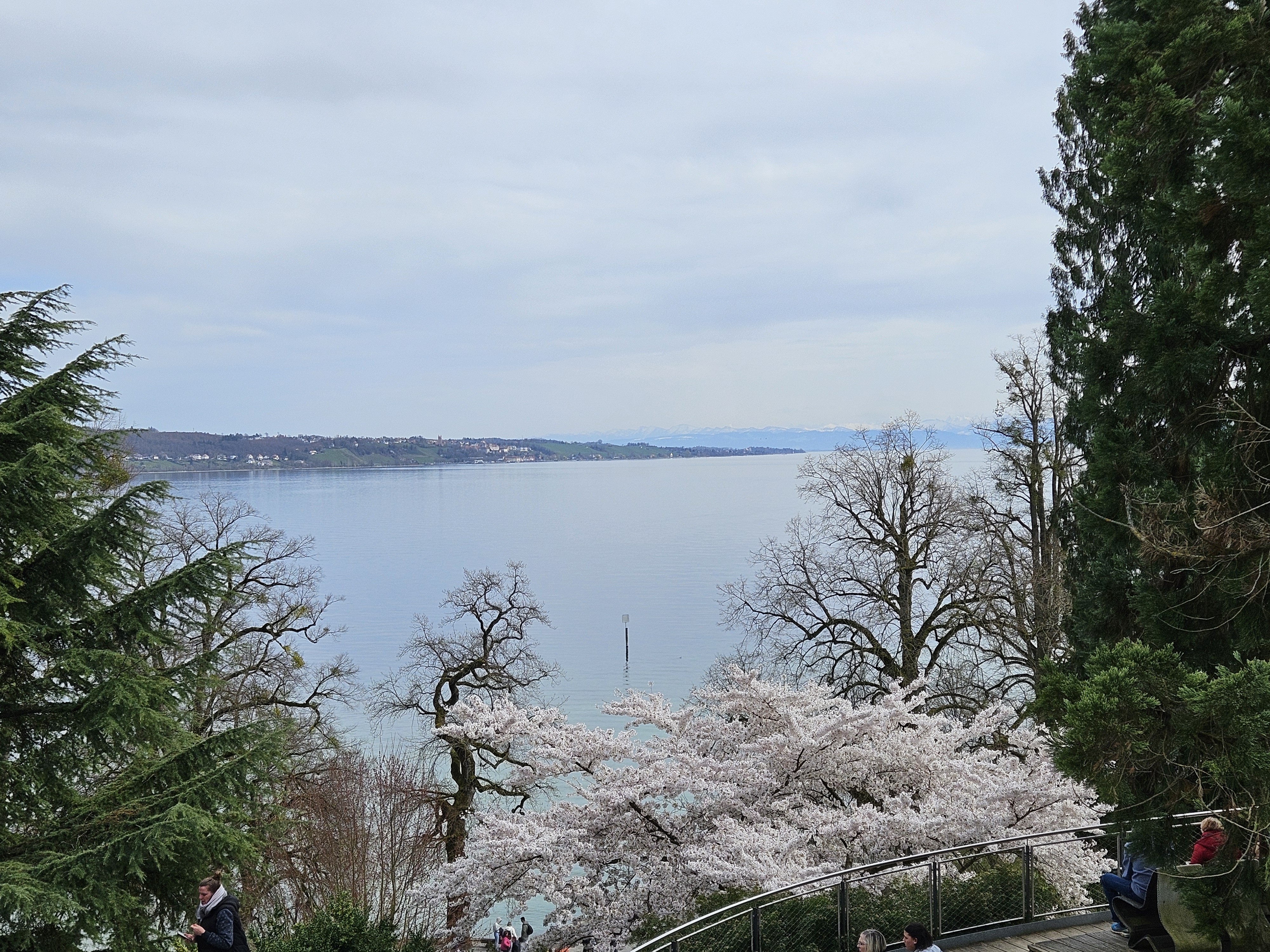
Well, it was getting better or brighter, and the wind calmed down. We were encouraged to dare more; there is an island or peninsula on Bodensee named Mainau, the flower island, which one can reach by boat or car. We decided on the latter because it was cheaper.
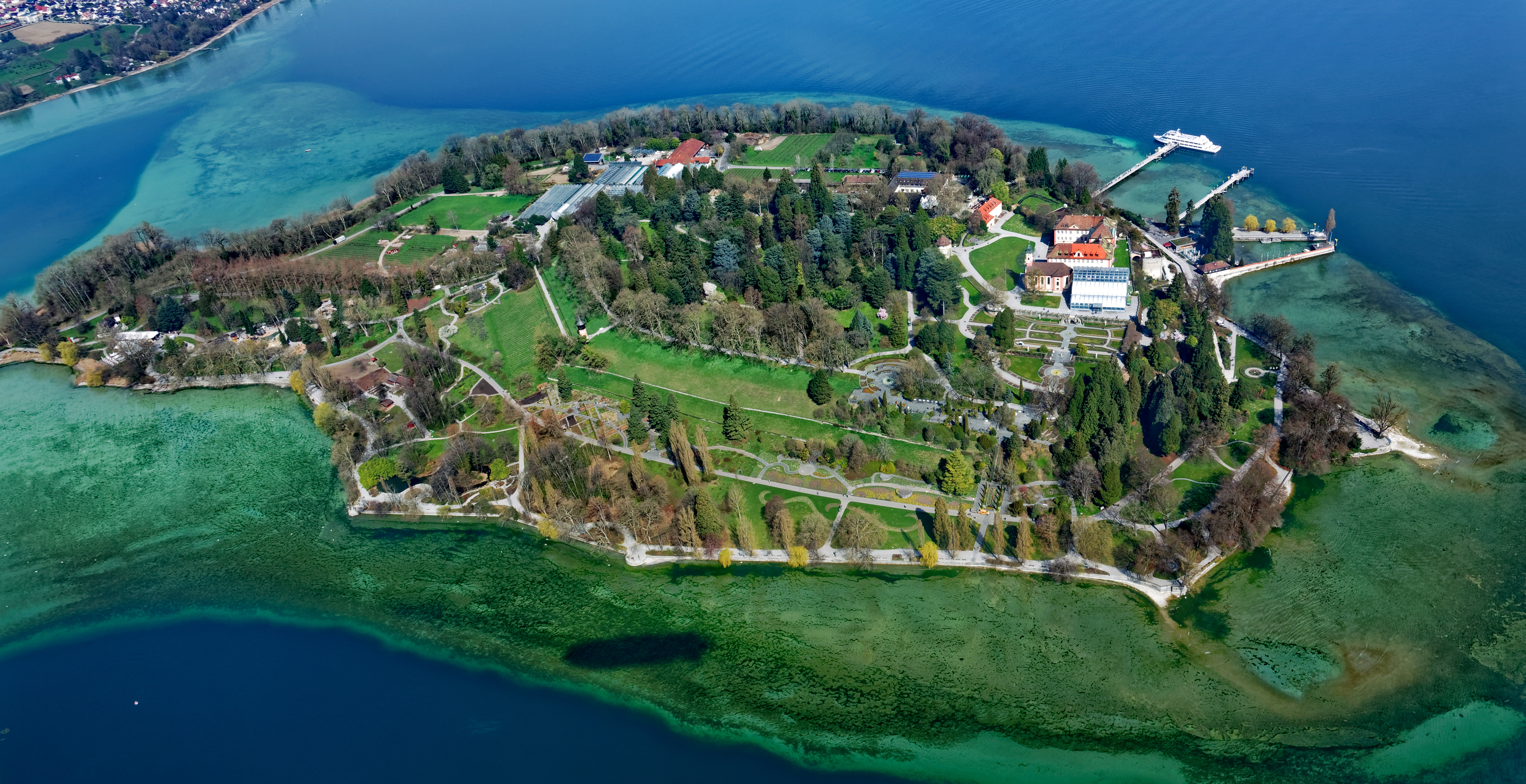
The island is owned by The Lennart Bernadotte Foundation, which was established by Prince Lennart Bernadotte, Count of Wisborg, a former Prince of Sweden and Duke of Småland. (If you at least have read Annemarie Selinko‘s book, Désirée, you got the point!)
The island is a popular tourist destination on Lake Constance and is known for its beautiful flowers and park landscape that offers breathtaking views of the lake.
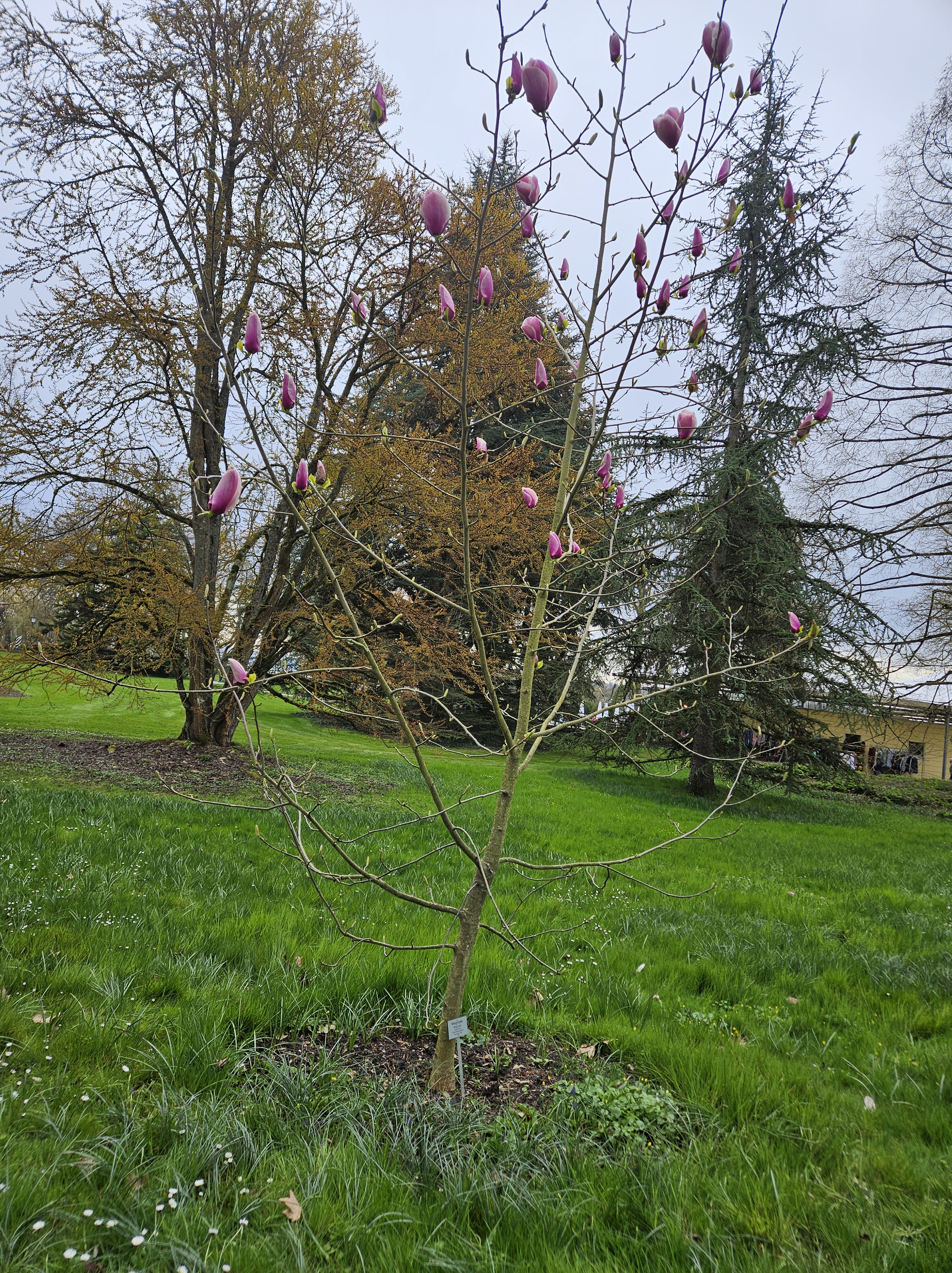


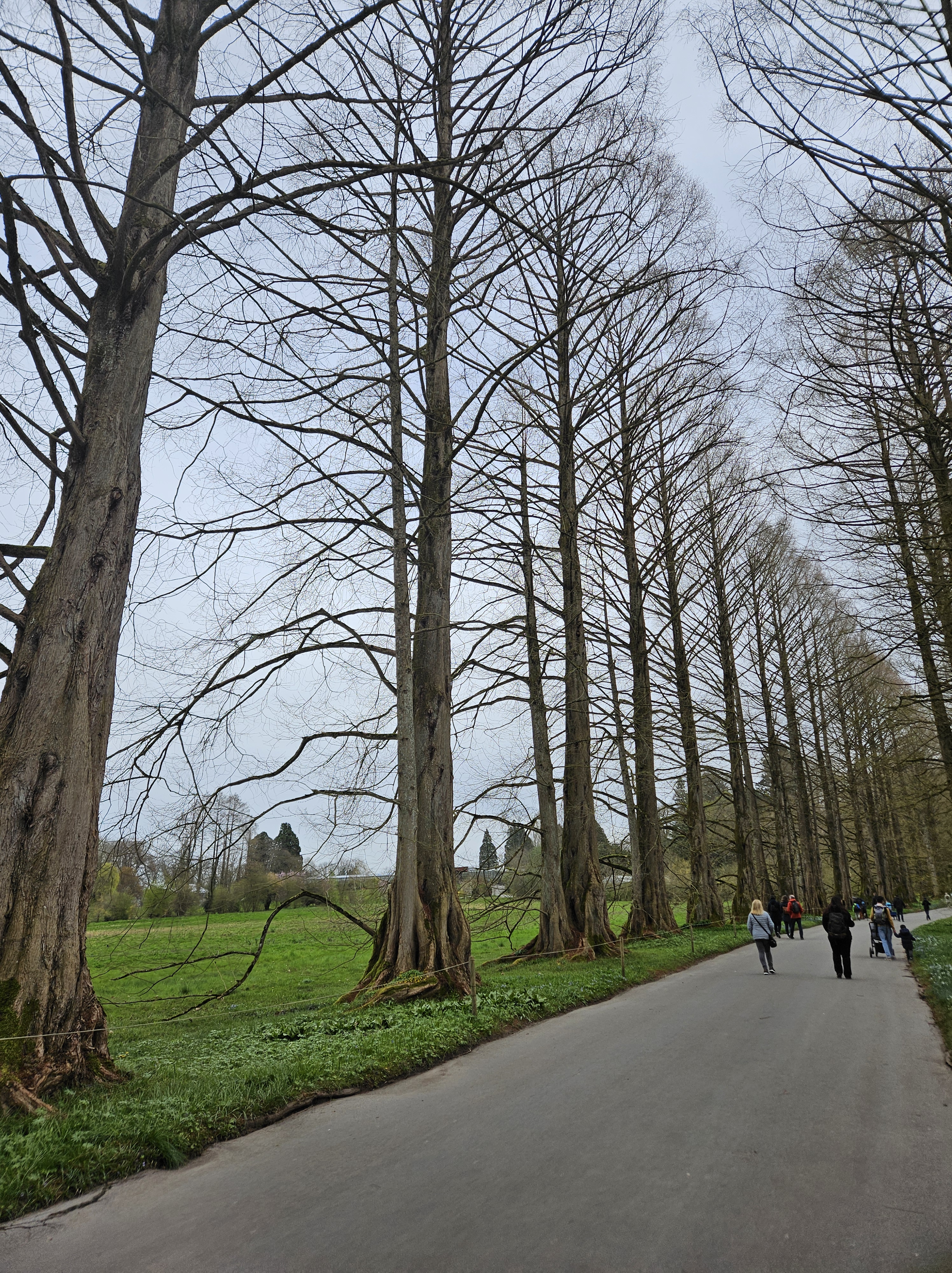
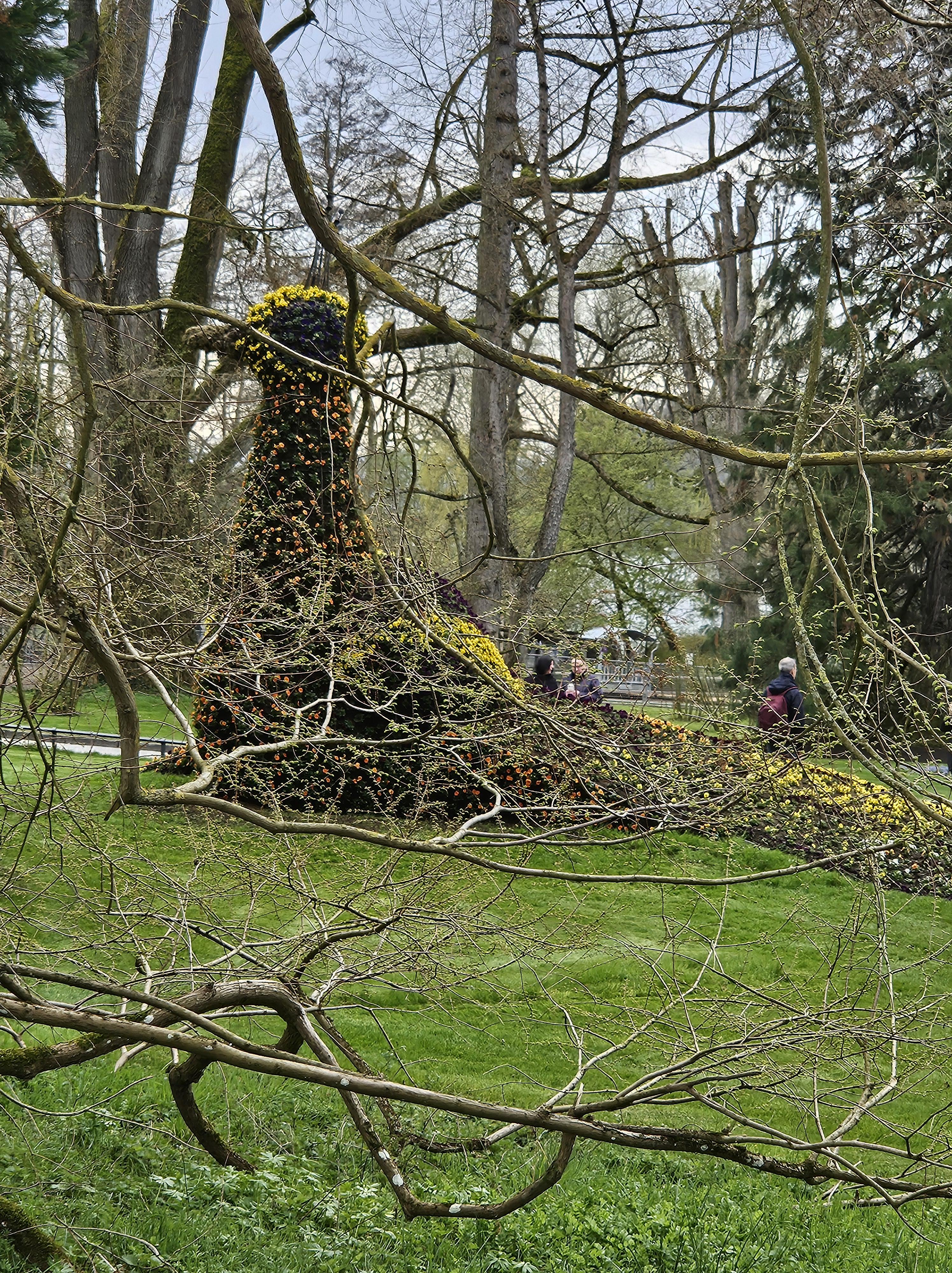

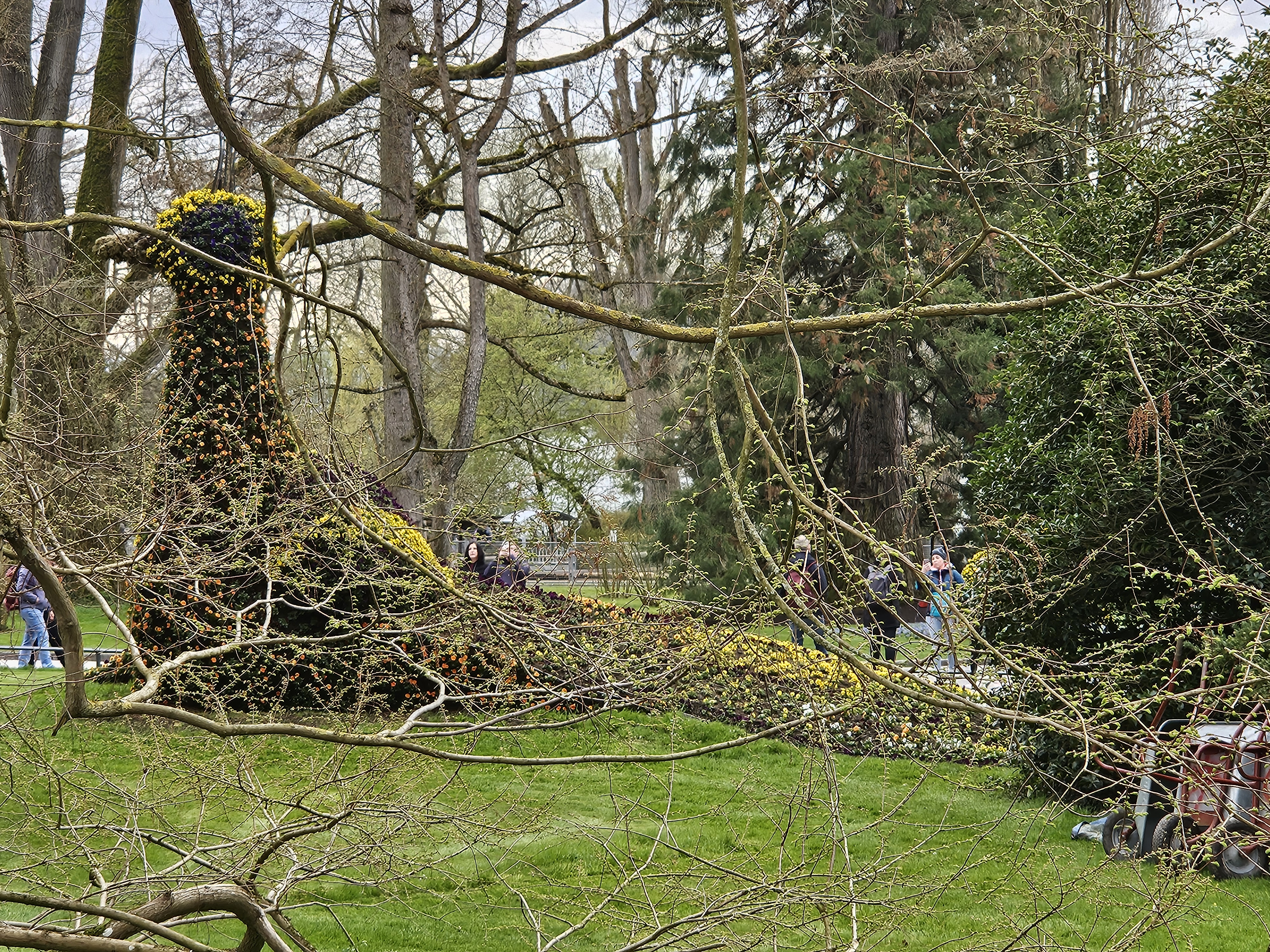
At this very moment, I had to think of Lin Gregory and her beautiful sights and pictures.


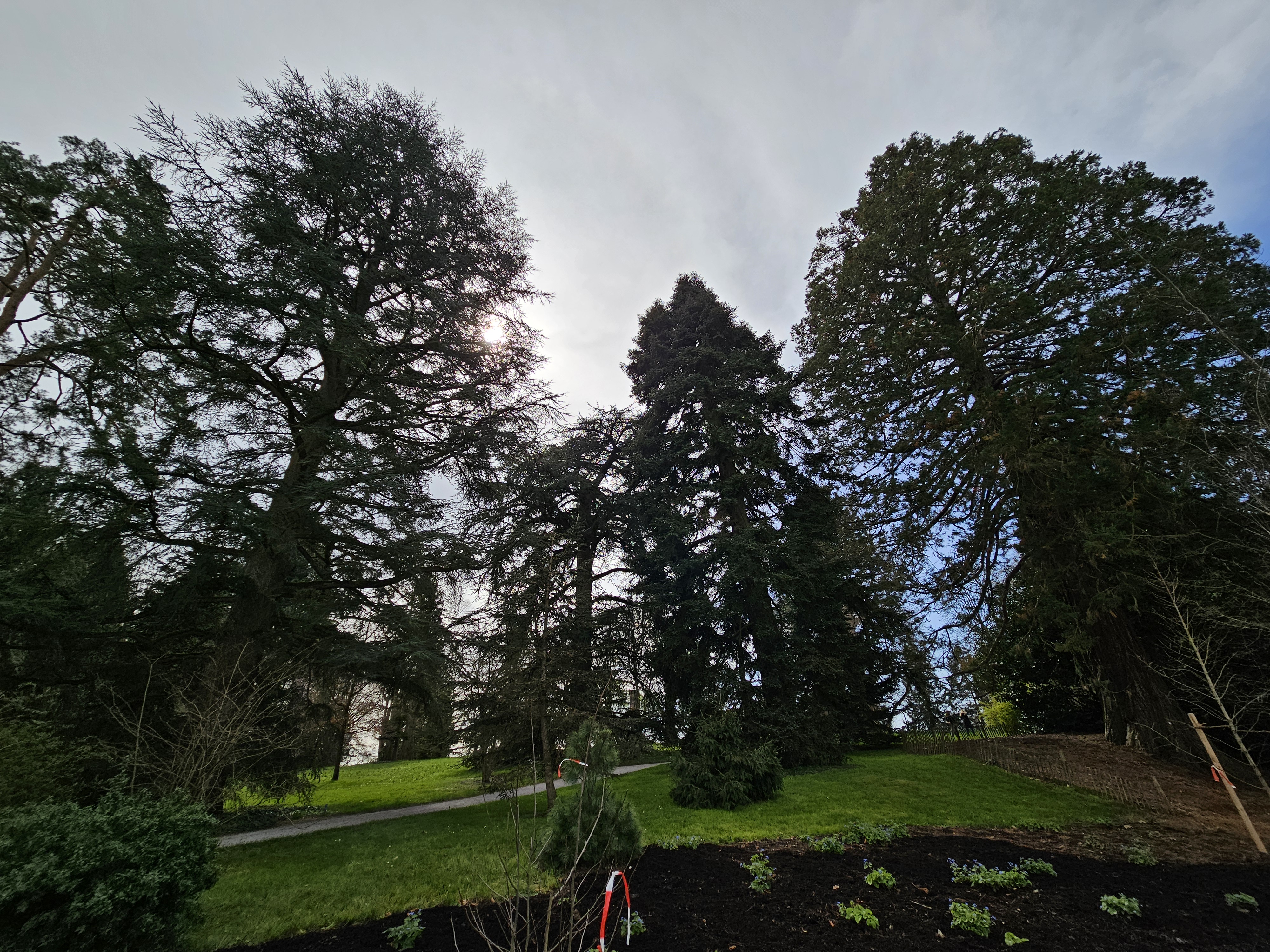
The island also has a tropical climate greenhouse, home to thousands of butterflies. However, I must admit that I feel ashamed of myself with great pity for the butterflies as I walk, among many others trying to catch a good pic! Countless butterflies were in that air-conditioned garden, watching us, wondering what we wanted; some restlessly flew here and there, and some were sitting and posing in front of the camera, cooly unperturbed!


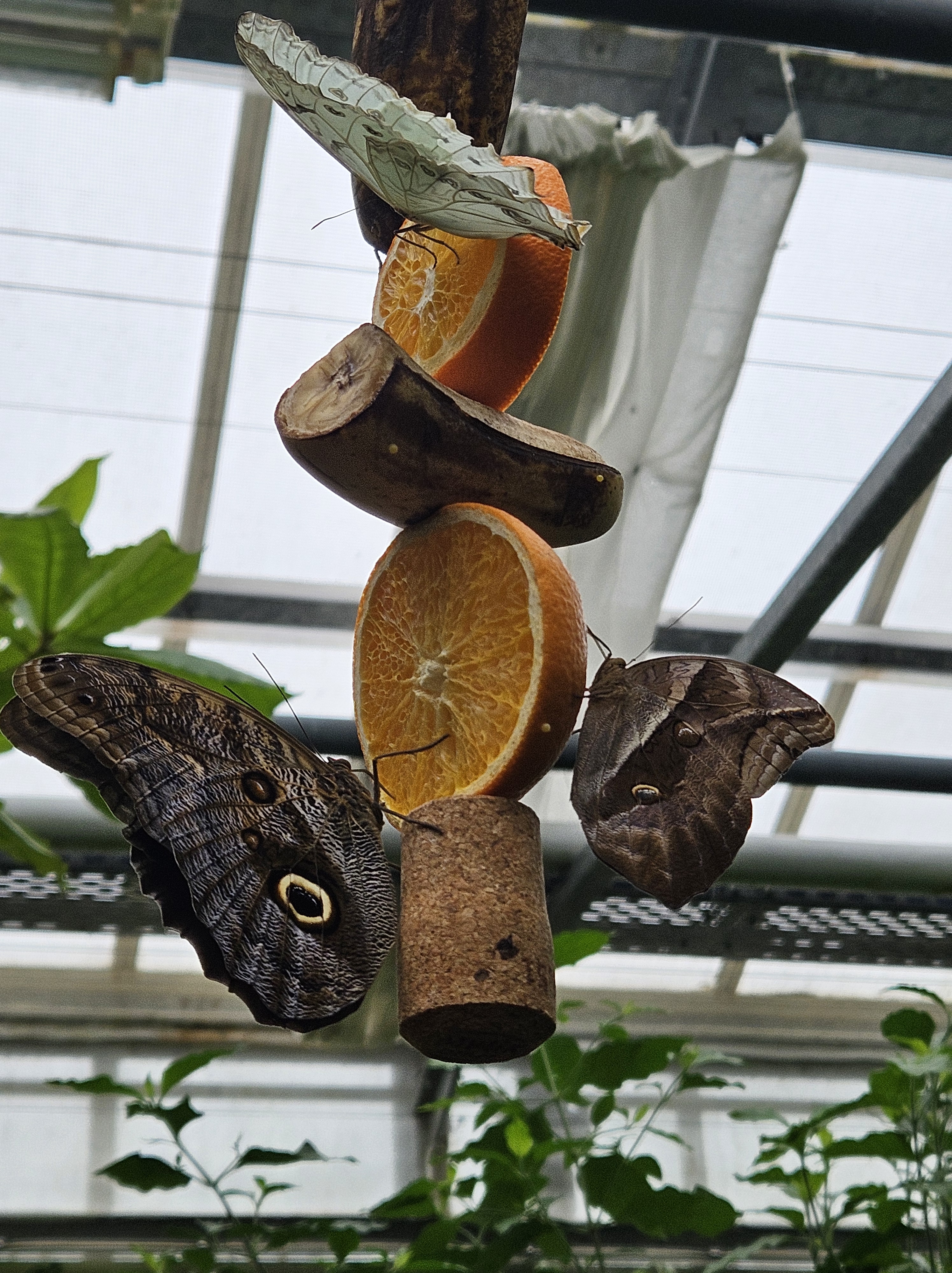
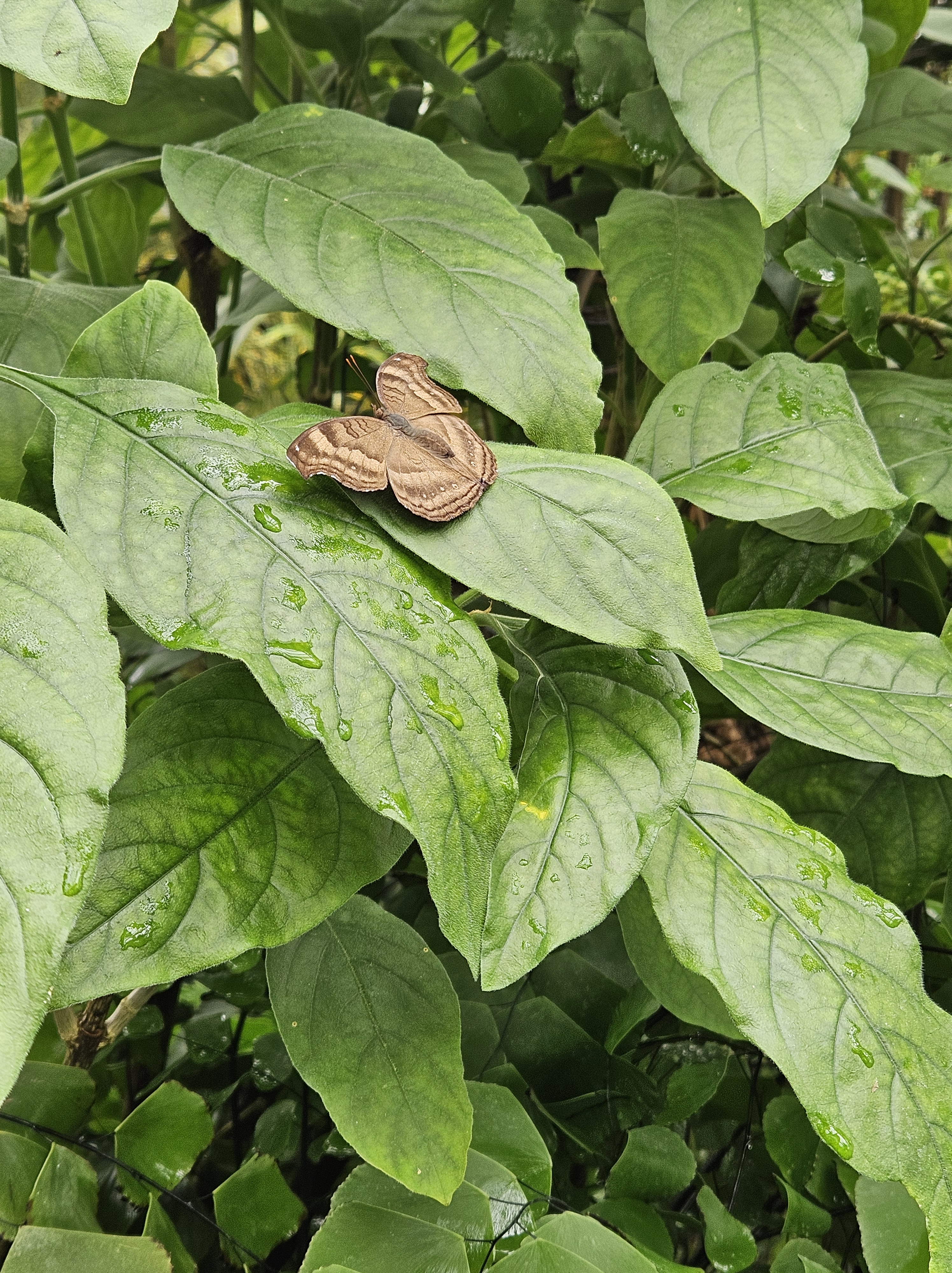




And here are my thoughts towards the Master of Monarch: Elaine Mansfeld.
To put a video here is a challenge in life!!😜
There were also more beautiful sights to observe, but let’s make a third part?!😂🙏💖🤙🌟
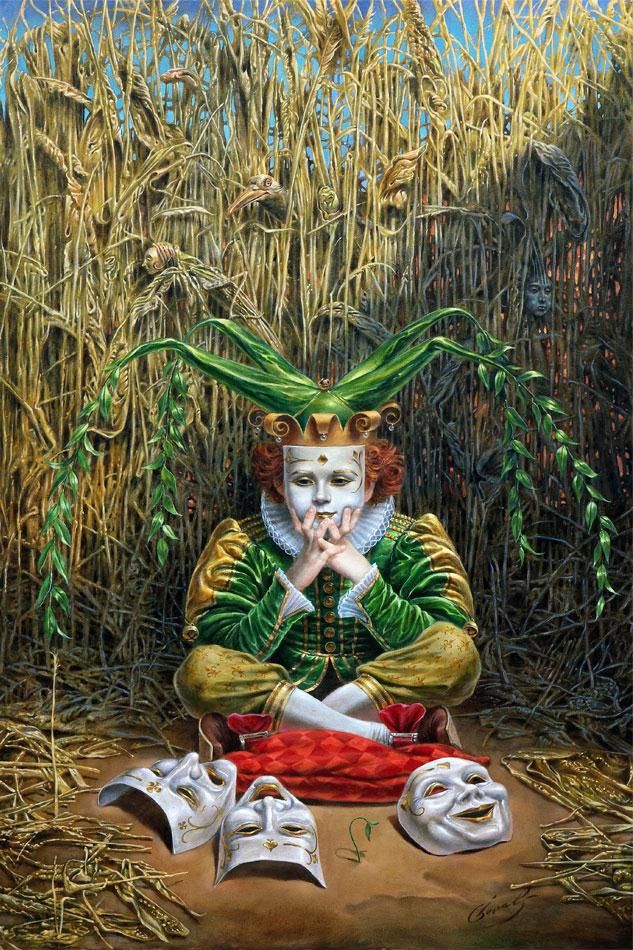
I laid awake for at least three hours last night! In fact, I fell asleep initially but woke up after about two hours, and my thoughts started working. It’s not the first time I’ve been lying awake more often lately. The reason is not any concern about private life; however, there are enough issues to consider, and not limited to my birthplace, Iran and its young freedom fighters; what worries me is the future of humanity as a whole. A theory develops in my head!
These days, I’m very busy with the world’s condition. I see how humanity is on a downward spiral and think about what could be the reason, and it forced me to theorize!
I see greed and hate. I see children suffering due to the thoughtlessness and mistakes of their parents, and politics makes it worse. While I might bite my tongue, I ask myself, is it not better to die as a child than to grow up and continue fighting? How can someone believe that peace can be achieved by bombarding a folk? How is it possible to forget one’s pain of losing the mother, father, or entire family? Those who sow hatred will reap vengeance!
I observe how people chase after happiness as it slips away, and I believe that our obsession with money, possessions, and accumulating more and more has caused us to lose sight of what truly matters – enjoying life.
I believe that enjoyment lies in the limitation of having!
As Lao Tzu said: Have little, and you will gain. Have much, and you will be confused.
The entire statement is instructive:
Bend, and you will be whole. Curl, and you will be straight. Keep empty, and you will be filled. Grow old, and you will be renewed.
Have little, and you will gain. Have much, and you will be confused.
“Tao Te Ching: Chapter 22” by Lao Tzu
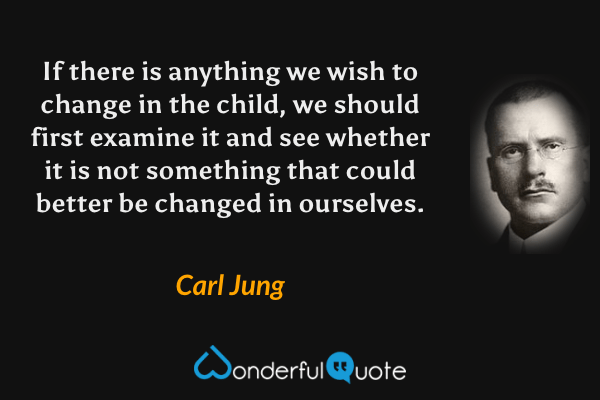
What we often forget is that the child in us never dies! I have previously shared some information on this topic (as it is part 4). In Part 1, I provided a translated summary of “The Archetype as a Past State.” Now, I would like to share Dr. Jung’s thesis on Child Archetypes: “The Function of the Archetype”, which may help us understand and awaken in adulthood.
To begin with, I will provide a brief introduction to Archetypes.
(Archetypes are not myths themselves but rather components of myths due to their typical nature. They are present in myths, fairy tales, dreams, and even psychotic fantasy products. In an individual, archetypes appear as unreal manifestations of unconscious processes. In myths, they are traditional forms of mostly inestimable age. These myths are usually tribal, transmitted from generation to generation through retelling. The primitive mind state differs from the civilized one primarily in that consciousness is much less developed in extent and intensity. The spontaneity of the act of thinking lies in the unconscious.)
The child motif not only represents something that has been and is long past but also something present. That means it is not just a remnant but a currently functioning system intended to meaningfully compensate for or correct the inevitable one-sidedness and extravagances of consciousness. The essence of consciousness is concentration on relatively few contents, which are, if possible, increased to a level of complete clarity. Consciousness has a necessary consequence and prerequisite, the exclusion of other contents that are currently equally capable of consciousness. This exclusion inevitably causes a certain one-sidedness in the content of consciousness. Since the differentiated consciousness of civilized people is now given an effective instrument for the practical implementation of its contents in the form of the dynamics of the will, the greater the development of the will, the greater the danger of straying into one-sidedness and of digressing into lawlessness and rootlessness.
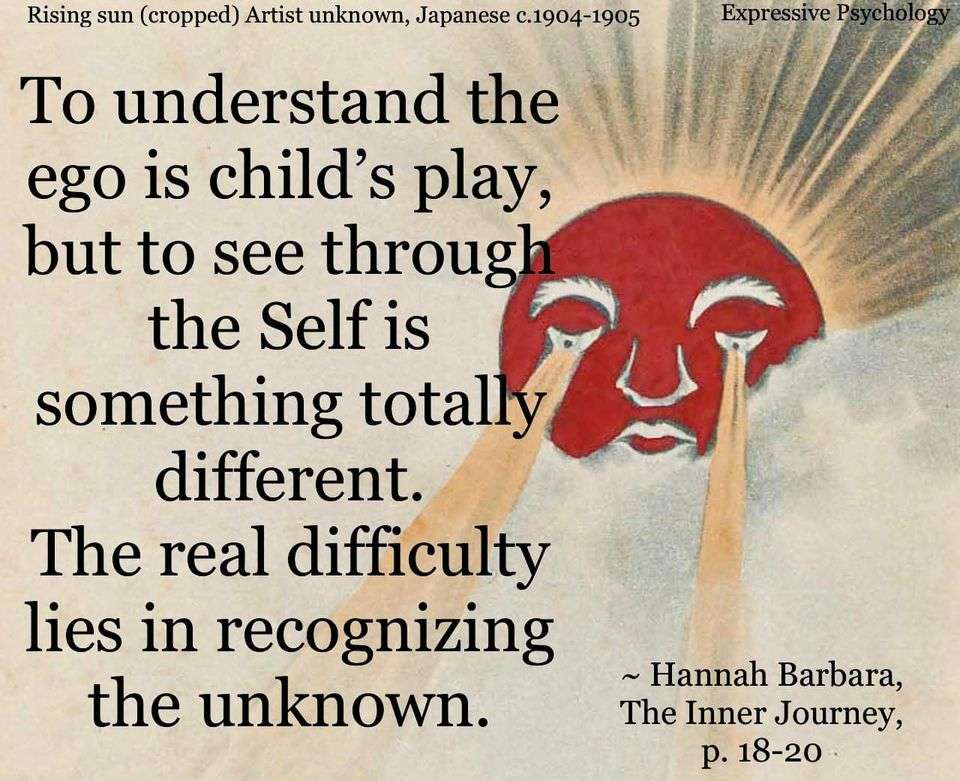
However, from the standpoint of progress, compensation symptoms are formulated in unflattering terms, such as inertia, backwardness, scepticism, nagging, conservatism, timidity, pettiness, etc. But insofar as humanity has a high degree of ability to get rid of its own foundations, it can also allow itself to be carried away uncritically by dangerous one-sidedness and even catastrophe. The retarding ideal is always more primitive, more natural (in a good or bad sense) and more “moral” insofar as it adheres faithfully to the traditional law. The progressive ideal is always more abstract, unnatural, and “immoral,” which requires disloyalty to tradition. Progress forced by will is always hard and cramped. Although backwardness is close to naturalness, it is constantly threatened by an embarrassing awakening. The older view was aware that progress is only possible ‘Deo Concedente’, with which it identifies itself through the possession of opposite consciousness and repeats the ancient >rites d’entrée et de sortie< to a higher level. But the more consciousness differentiates, the greater the danger of its separation from the root state. The complete separation occurs when the ‘Deo Concedente’ is forgotten. It is now a psychological principle that a part of the soul that has been split off from consciousness is only apparently inactivated, but in reality, leads to an obsession of the personality, whereby its objective is distorted in the sense of the part of the soul that has been split off. Suppose the childlike state of the collective soul is repressed to the point of complete exclusion. In that case, the unconscious content takes control of the conscious goal, whereby its realization is inhibited, falsified or even destroyed. However, viable progress only comes about through the cooperation of both. (Archetypen, dtv.)
Children are our fellowship for the future, and our responsibility is to leave a legacy that fosters their growth and development. Thank you for reading.🙏💖🙏

 lampmagician
You must be logged in to post a comment.