“I would like to bid farewell to the old year by sharing a great poem by Pablo Neruda since this is my last post for the year. I know that some of my friends share posts daily or a few even hourly, but I do not have that much free time. Therefore, I would like to take this opportunity to wish everyone a happy New Year’s Eve and a healthy new year.” Viva Freedom!🙏🤗💖
Benito Cerna, 1960 ~ Figurative painter
I want you to know one thing.
You know how this is: if I look at the crystal moon, at the red branch of the slow autumn at my window, if I touch near the fire the impalpable ash or the wrinkled body of the log, everything carries me to you, as if everything that exists, aromas, light, metals, were little boats that sail toward those isles of yours that wait for me.
Well, now, if, little by little, you stop loving me I shall stop loving you little by little.
If suddenly you forget me do not look for me, for I shall already have forgotten you.
If you think it long and mad, the wind of banners that passes through my life, and you decide to leave me at the shore of the heart where I have roots, remember that on that day, at that hour, I shall lift my arms and my roots will set off to seek another land.
But if each day, each hour, you feel that you are destined for me with implacable sweetness, if each day, a flower climbs up to your lips to seek me, ah, my love, ah, my own, in me, all that fire is repeated, in me, nothing is extinguished or forgotten, my love feeds on your love, beloved, and as long as you live, it will be in your arms without leaving mine.
“Whereas the truth is that the State in which the rulers are most reluctant to govern is always the best and most quietly governed, and the State in which they are most eager, the worst.” ― Plato, The Allegory of the Cave
These days, there is a huge need for us to look more profoundly into the world around us and be aware of all that is happening, even if it hurts! As I wanted to retake a look at my archive, the following of the previous articles (1, 2, 3) suddenly fell on my lap.
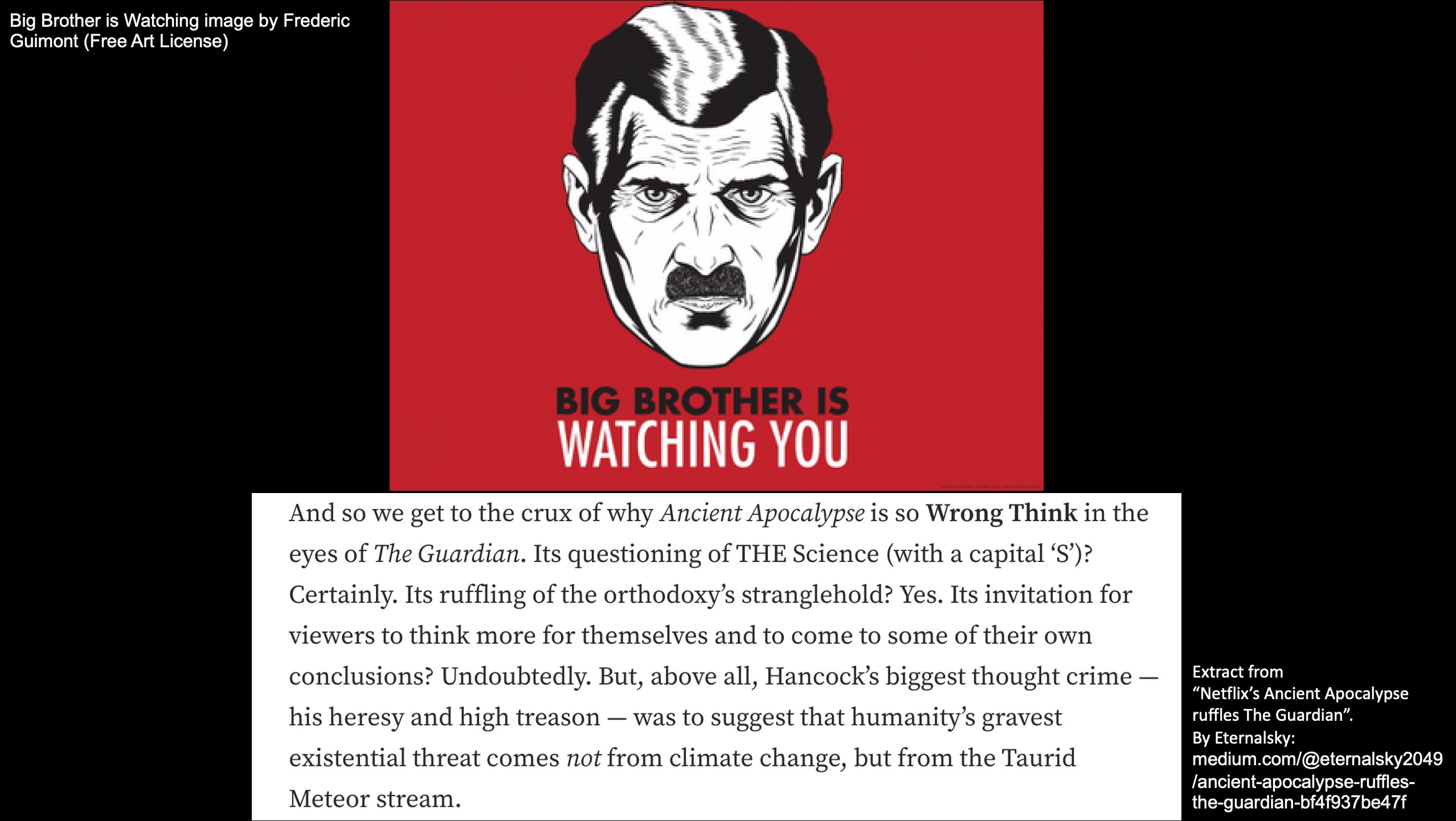
I believe there is no reason to be afraid of expressing critical opinions. However, some governments or regimes in the world may hold opposing views. It shows for sure that we are on the right path!
“Most people are not just comfortable in their ignorance, but hostile to anyone who points it out.” ― Plato, The Allegory of the Cave.
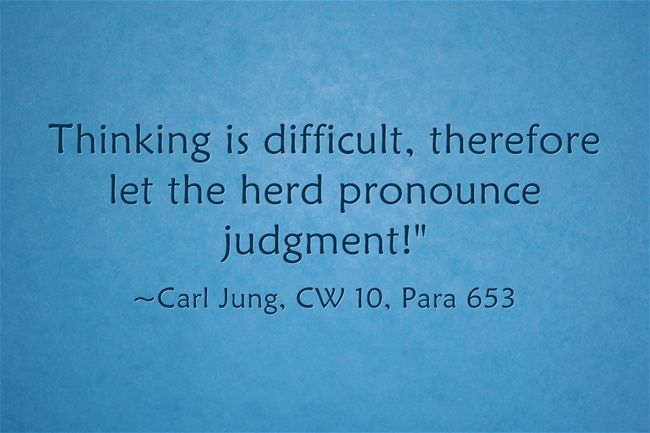
Apart from what Dr. Jung said, I have shared some quotes from Plato first. I think he is a novice in this way of philosophy because, unlike Aristotle, he didn’t accept compromising arguments and tried to find a way towards the truth, even if it was bitter or unpleasant. However, my prominent persons are these two geniuses: Orwell and Huxley.
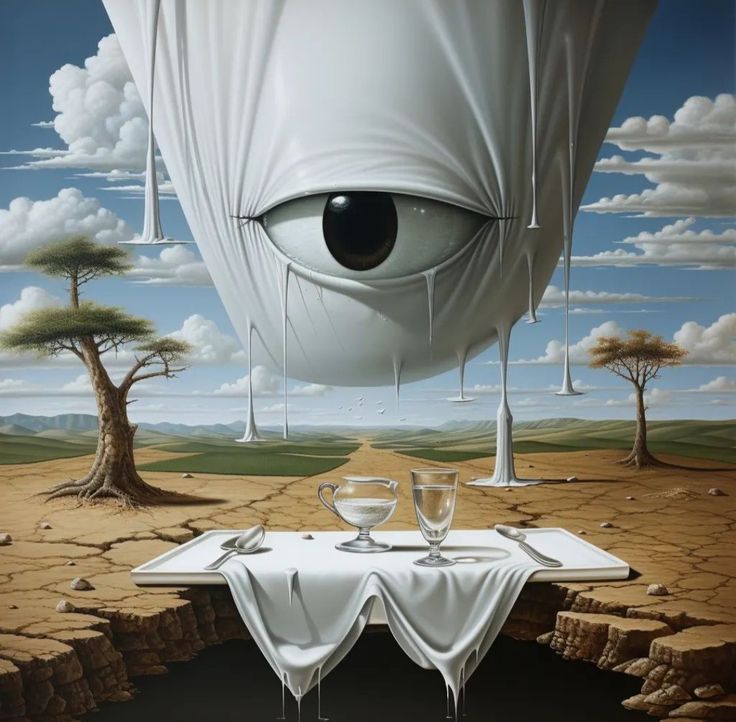
Remaining open-minded and considering all possibilities is essential, even if it may sound like a conspiracy theory. The threat of getting caught up in the minutiae of our everyday lives is increasing, and we risk becoming trapped in a cage of our own making. Therefore, we better unlock our mind potential! I have no issue reiterating that Orwell and Huxley are among the most valuable thinkers we can learn from.
FmXGFftXoAUtZiu
“What Orwell feared were those who would ban books. What Huxley feared was that there would be no reason to ban a book, for no one wanted to read one. Orwell feared those who would deprive us of information. Huxley feared those who would give us so much that we would be reduced to passivity and egoism. Orwell feared that the truth would be concealed from us. Huxley feared the truth would be drowned in a sea of irrelevance. “Orwell feared we would become a captive culture. Huxley feared we would become a trivial culture, preoccupied with some equivalent of the feelies, the orgy porgy, and the centrifugal bumblepuppy. However, it seems that the Orwell vision didn’t work out, and the Huxley vision is more beneficial.
As Orwell’s vision may partly be limited to various parts of the world, Huxley’s narrative seems to envision and capture today’s world more powerfully, as his vision is more in tune with today’s challenging problems. Global consumerist culture is prevalent, and the impact of social class stratification in many cultures is strongly felt, especially during the COVID-19 pandemic (the completely disparate experiences of the pandemic by the rich and the poor). A massive emphasis on pleasure, hedonism, and mere happiness rather than the culture of questioning and critical thinking could be observed in many societies of today’s world.
Here is a 16-minute clip to better catch his concept.
In a letter that Huxley wrote to Orwell, he refers to:
Partly because of the prevailing materialism and respectability, nineteenth-century philosophers and men of science were unwilling to investigate the odder facts of psychology for practical men, such as politicians, soldiers and policemen, to apply in the field of government. Thanks to the voluntary ignorance of our fathers, the advent of the ultimate revolution was delayed for five or six generations. Another lucky accident was Freud’s inability to hypnotize successfully and his consequent disparagement of hypnotism. This delayed the general application of hypnotism to psychiatry for at least forty years. But now psychoanalysis is combined with hypnosis; hypnosis has been made easy and indefinitely extensible through barbiturates, which induce a hypnoid and suggestible state in even the most recalcitrant subjects.
Actually, I attended to share an extensive article today. Still, as I found out yesterday that I had to undertake a marathon with my grandchildren until midday today, I grabbed an hour yesterday afternoon when my wife took them to get some flour from the store to bake cookies to write these words. I usually turn out all connections to the world when I have the kid with me. I hope I can utter my mind comprehended enough.
As I look back into my posts, I see two posts I have written about this Persian’s traditional old ceremony. The first one, proudly to inform my friends about one of the oldest Persian festivals, and the second one, a painful hint to this elderly celebration which has been smeared with blood and suffering. Although with the hope that it would be a peaceful one this year, what a false assumption! Someone once said: If we look at this deeply, we see the differences between the old Persian rituals & festivals and all the celebrations in Islamic Iran after the Arabs occupied Persia. In ancient Persian the rituals and feasts, contrary to the Arabs, adorn love, light, and cosiness.
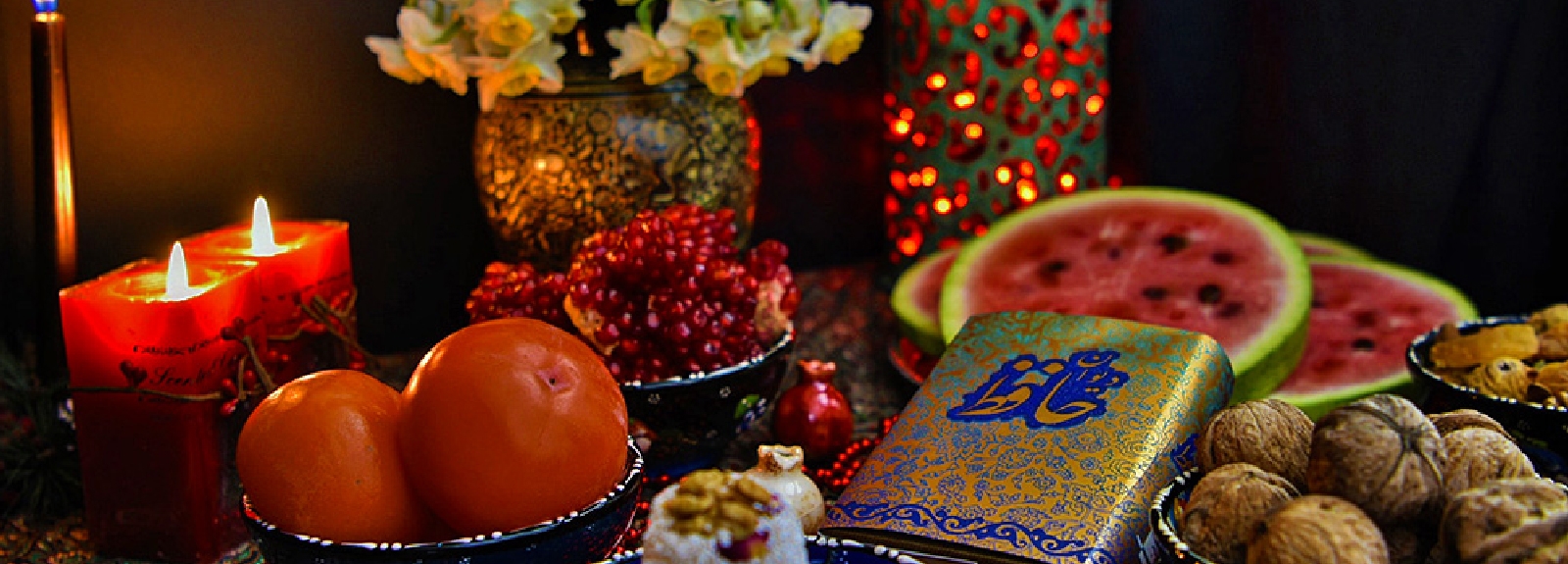
However, on every Yalda night, the Iranian winter solstice tradition, observers gather with family in a warm, cosy room and read or take an omen of fortune from FAL-E HAFEZ (Omens of Hafez) by Hafez Shirazi’s sonnets and quatrains (Ghazals). As I remember from my childhood, it was a nut and nutcracker, and the oldest woman in the family told beautiful fairytales to greet the returning sun. I am sure that this tradition will continue indefinitely under any circumstances; as I noticed on the web, they have even this year celebrated with grief and pride for their loss but with great hope to conquer evil.
It becomes clear that this fight for their right will be a war of attrition, even though it will come at the cost of bloodshed, but the secret to success is in synergy and solidarity. Together, we stand; divided, we fall!
Anyway, with my heartfelt regards, I send my best wishes to all of you, dear friend. Have a blessed Yule, Merry Christmas, and have a lovely time with your loved ones.🙏💖🌹🎅
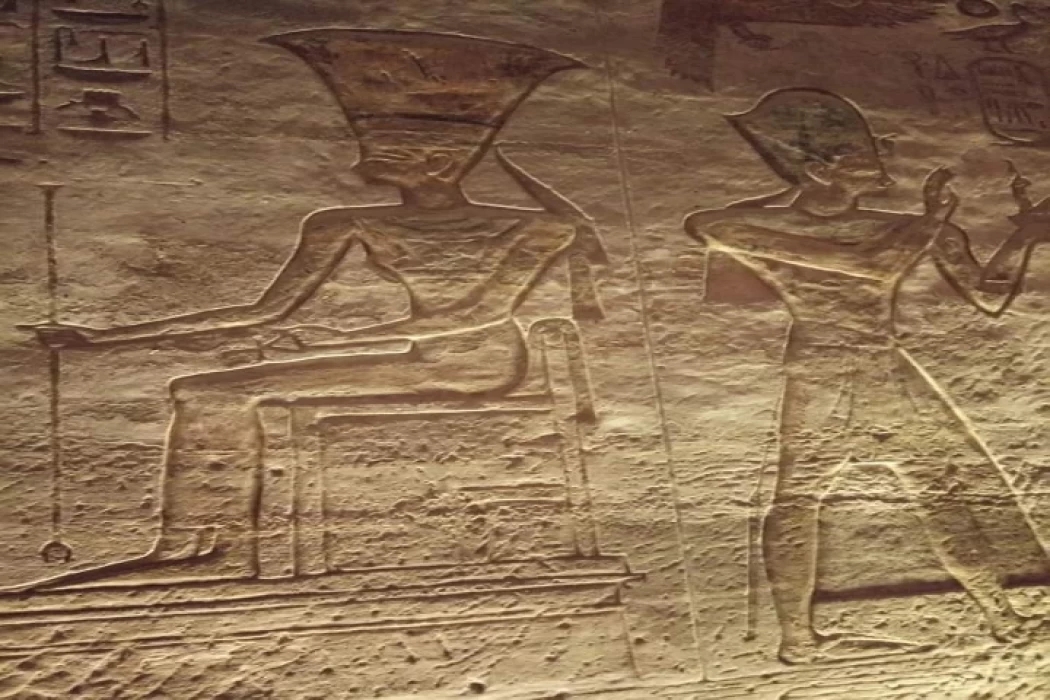
As we continue researching the precious heritages of ancient Egypt, we find more and more feminine Myths of the Goddesses! Here is another one: Anuket, Anouket, Anukis, the Goddess of Nil.
Anuket (or Anukis, her Greek name) is a Nubian goddess, represented as a lady with a crown of feathers or reeds, with a sceptre, and the well-known ankh of Ancient Egyptian culture. Her name means “she who embraces”, and she was venerated in Sehel and Elephantine. Cairo
Anuket, in Egyptian religion, is the patron deity of the Nile River. Anuket is usually depicted as a beautiful woman wearing a crown of reeds and ostrich feathers and accompanied by a gazelle. She was initially a Nubian deity.
Here, we read an article about a beautiful emblem of this fascinating Goddess by the brilliant Marie Grillot. I wish everybody a leisurely and peaceful Merry Christmas.💖🌹🥰
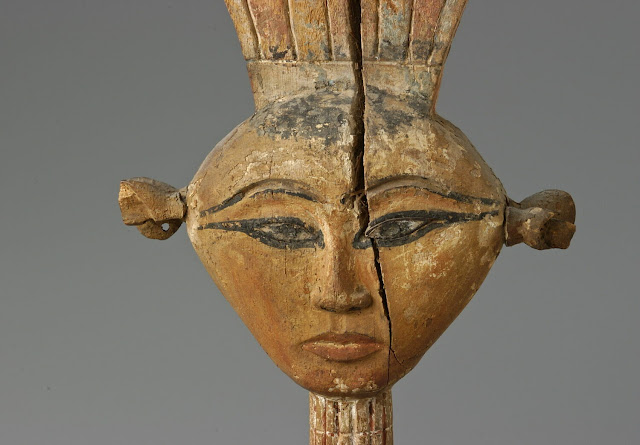
This emblem of Anouket in the Louvre attests to her cult in Deir-Medineh
Associated with the god Khnum and the goddess Satis, Anouket (Anoukis) is the third divinity of the triad of the First Cataract, or Elephantine triad. She is generally presented as “the daughter of the divine couple” or even “the wife of the god”.
In “Ancient Egypt and its Gods”, Jean-Pierre Corteggiani specifies that one of her titles is: “Mistress of To-Seti, that is to say of Nubia; she is sometimes called the Nubian, although there is no evidence that it actually originated in this region, one of its functions is to guard the southern border of Egypt… And he adds, “As a text from the temple of Edfu clearly explains, if it is up to Satis, assimilated to Sothis, to raise the beneficial flow, it falls to Anoukis (Anouqis) the equally essential task of reduce and thus allow, after the flood has receded, seeds to germinate and vegetation to grow on the land released by the waters.” Therefore, it depends on the food and subsistence of an entire people, a whole country… This can explain the reason for the spread of its cult towards the north, notably to Deir el-Medineh, where it was probably introduced “by the workers who worked in the granite quarries of Aswan.
Between the high walls of “Set Maât her imenty Ouaset” (“the Place of Truth to the west of Thebes”, today’s Deir el-Medineh), they lived between 60 and 120 families dedicated to digging and decorating tombs of royal necropolises. They had stone houses covered with palm leaf roofs, their own necropolis, and places of worship. Amon, Ptah, Meretseger, and Hathor were celebrated there, but other divinities also had their place. Indeed, as Guillemette Andreu points out in “The Artists of Pharaon”, “Khnoum and his two consorts, Satis and Anoukis, enjoyed great favour in the community, without us knowing if a particular sanctuary was built for them. Likely, one of the numerous devotional chapels located north of the site was occasionally used as a place of worship, but these cults appear essentially private and domestic.
“Two-faced” emblem of Anouket (Anoukis) – painted wood (tamarisk and shea) – 19th dynasty (around 1295 – 1186 BC) from Deir el-Medineh – Department of Egyptian Antiquities of the Louvre Museum – N 3534 by the acquisition of the Salt Collection in 1826 (Salt n°559) published here by Dominique Valbelle in BIFAO 75, 1975
This “two-faced” emblem of Anouket made “For the ka of the servant in the Place of truth, Pached, acquitted”, testifies to this cult. On the other hand, in their “Guide to Deir el-Medina”, Guillemette Andreu and Dominique Valbelle recall that “the procession of the emblem of Anouqet is represented in the chapel of the tomb of the team leader Neferhotep”.
Two things are striking in the representations of Anouket: her very particular headdress, we will come back to it, and, more strikingly, her resemblance to Hathor. “As D. Valbelle has shown, this object, whose appearance evokes that of a hathoric sistrum, illustrates a syncretism between Ânouket of Elephantine and Hathor of Diospolis Parva in the context of a local cult in Deir el- Medineh” recalls Christophe Barbotin in “Egyptian statues of the New Kingdom”.
It is made from tamarisk wood, is 27.5 cm high and 13.5 cm wide, and rests on a shea tree base. The support, comparable to a fluted column, is surrounded by horizontal lines. The head surmounts it – in fact, two heads, reproduced identically, “back to back” – of the Goddess. Her face takes the shape of a diamond with rounded contours. The widest part is at the level of the cow’s ears and the thinnest at the chin level. Her large eyes, stretched with a line of makeup, are painted black with a large dark iris, which leaves little space for the white of the eye. They are topped over their entire length by very arched eyebrows, hollow and encrusted with a black material. The nose is flat, and the mouth with drooping corners displays a slight difference on the two sides, one of the upper lip being thinner. The left side of one of the two faces is marked with a long and painful scar.
Anouket’s main attribute, which makes her immediately identifiable, is her high and generous headdress made of ostrich feathers. Christophe Barbotin precisely describes this: “The mortar, painted red with vertical white lines, is topped with feathers with traces of blue and red paint (seven feathers on each side, three on each edge). It is placed on a black-painted cap visible at the top of each face but not on the sides. The top of the feathers constitutes a perfectly flat surface.
This Anouket emblem dates from the 19th dynasty (c. 1295 – 1186 BC). It arrived at the Louvre Museum in 1826 through the acquisition by Charles X – for the sum of 250,000 francs – of the collection of the British consul Henry Salt. Jean-François Champollion will also go to Livorno to draw up a descriptive inventory of the 4014 objects, this one bearing the number 559. In his “Descriptive note of the Egyptian monuments of the Charles X Museum” (1827), he will present it under A.136, “Painted wood. Symbolic head of the goddess Anouké”. Today, it is exhibited in the Sully wing, in room 336, dedicated to the Nile, under inventory number N 3534.
Anouket Emblem https://collections.louvre.fr/ark:/53355/cl010024883 Jean-Pierre Corteggiani, Ancient Egypt and its gods – Illustrated dictionary, Fayard 2007 Sylvie Guichard, Jean-François Champollion, Descriptive notice of the Egyptian monuments of the Charles 87-88, illus. p. 88, A. 136 Guillemette Andreu, The artists of Pharaon. Deir el-Medina and the Valley of the Kings, RMN; Brepols, 2002, p. 273, ill. p. 272, no. 221a -Andreu, Guillemette; Valbelle, Dominica, Guide to Deir el-Medina. A village of artists, Cairo, French Institute of Oriental Archeology (IFAO), 2022, p. 150, fig. 131 – Barbotin, Christophe, Egyptian statues of the New Kingdom, 1, Royal and divine statues, [Louvre Museum, Paris], Paris, Louvre éditions / éditions Khéops, 2007, p. 146-147, figs. 1-15 p. 238-241, no. 85 Dominique Valbelle, Testimonies of the New Kingdom on the cults of Satis and Anoukis at Elephantine and at Deir el-Médineh, Bulletin of the French Institute of Oriental Archeology (BIFAO), 75, 1975, p. 123-145, https://www.ifao.egnet.net/bifao/75/7/, p. 141-145, figs. 7, pl. XXI-XXIIII, Doc. 10 Jean-François Champollion, Descriptive notice of the Egyptian monuments of the Charles X Museum, Paris, Imprimerie de Crapelet, 1827, p. 7, A.136 https://gallica.bnf.fr/ark:/12148/bpt6k1040365n
As I must run immediately to the first ballet performance of my almost five-year-old granddaughter, Mila, I only share my second post, a part of one of my favourite ballets of all time. I hope you enjoy it.🤗
Here is the complete version if you like to watch it!🥰🤗
“Without the true masculine spirit and true feminine love within, no inner life exists. To be free is to break the stone images and allow life and love to flow… ~Marion Woodman; taken from a beautiful poem by a brilliant poet, rhymester, and valuable friend of mine: Deborah Gregory.
I have resumed an (other) old series of my posts that I believe has become increasingly relevant in light of a recent webinar on X (formerly Twitter), where Iranian participants discussed the challenges faced by individuals of different genders and sexualities (LGBT+) in Iran. However, I refrained from discussing Dr. Jung’s theories on Anima and Animus, as I knew they were unfamiliar with this topic. During meetings, I don’t speak much due to my taciturn nature. Instead, I act as a microphone for my friend who lives in Iran and cannot clearly talk in the meetings.
In this particular webinar about gender, I noticed how important it is to know about the Jungian ideas about our species and the terms Anima and Animus in all of us, whether masculine or feminine. Marion Woodman says: “The word’ feminine,’ as I understand it, has very little to do with gender, nor is woman the custodian of femininity. Both men and women are searching for their pregnant virgin. She is the part of us who is outcast, the part who comes to consciousness through going into darkness, mining our leaden darkness, until we bring her silver out.”
Yes! Such terms are too early for a nation which is still under pressure from the masculine’s religious domain. I was surprised to hear discussions about such issues in a country still heavily influenced by traditional religious beliefs. That became possible because of the efforts of Shadi Amin, an LGBT+ activist at 6rang.org.💖🙏
Work by Petra Glimmdall 💖
To notice it is a big problem even in the West: I know many men here in Germany, where I live, who make jokes about the subject, and gay is a swear word for them! Of course, freedom, which is common in the West, can’t mean that the people have understood it profoundly. It can be difficult to grasp the concept fully, even though I have noticed numerous misconceptions in the Jungian groups on Facebook, and I see how many falsehoods have lost their way there!
In this scenario, it is crucial to maintain an open mindset and not be limited by fundamental rules and principles. I am not suggesting that one must always be “modern,” but rather that we should exercise our imagination. We should put aside our fears and dive into the world of fantasy.
After death, it is unimaginable that there would be feminine or masculine ghosts, for souls do not have a gender.
I’d like to share another explanation from Jung on this topic. As humans, we are filled with fears, anxieties, desires, and aspirations. Jung says in on this:
But there is something to be said about the fear of the other side that is peculiar to us Westerners. This fear is not entirely unjustified, not to mention the fact that it is real. We readily understand the child’s and the primitive’s fear of the vast, unknown world. We have the same fear in our childlike inner side, where we also touch a vast, unknown world… The fear is now justified insofar as the rational worldview (Weltanschauung) with its much-believed (because doubtful) scientific and moral certainties is being shaken by the data from the other side. There are truths that will only be true the day after tomorrow, those that were true yesterday, and those that will not be true at any time.
However, we can open many doors once we learn to embrace our inner selves and overcome the fear of the unknown. After reaching milestones one, two, three, and four, the next milestone could be number five – Last but not least!
anima and animus by polina sladkova
>”But I could imagine that someone would use such a technique out of a kind of holy curiosity, a boy perhaps who doesn’t want to put on wings because his feet are lame but because he longs for the sun. An adult, however, for whom too many illusions have been shattered, will probably only be forced to submit to this inner humiliation and abandonment and will once again endure the child’s fears. It is no small matter to stand between a day world of shattered ideals and unbelievable values and a night world of seemingly senseless fantasy. In fact, the uncanny aspect of this point of view is so significant that there is probably no one who would not reach for certainty, even if it were a “reach backwards” – for example, the mother who protected his (the son’s) childhood from night terrors. Those who are afraid need a dependency, like the weak, need support. That is why even the primitive spirit created the religious doctrine, embodied in magicians and priests, out of the most profound psychological necessity. “Extra ecclesiam nulla Salus” (“Outside the Church, there is no salvation”) – is still a valid truth today – for those who can drawback on it. For the few who cannot, there is only dependence on someone – a humbler and prouder dependency, weaker and more robust support than any, It seems to me. What shall one say of the Protestant? He has neither church nor priest; he only has God – but even God becomes doubtful.”<
Work by Petra Glimmdall 💖
>”The reader will probably ask himself in astonishment, but what does the anima produce that one needs such reassurances to deal with her? I would commend my reader for studying a comparative history of religions so that he feels the accounts dead to us with the emotional life felt by those who lived those religions. This will give him an idea of what lives on the other side. The old religions, with their sublime and ridiculous, benevolent and cruel symbols, did not arise out of thin air but out of this human soul as it lives in us now. All those things, their archetypes, live in us and can break out at any time with devastating force, namely in the form of mass suggestion, against which the individual is defenceless. Our terrible gods have only changed their name; they now rhyme with “ism”. Or does anyone have the voice to say that the World War or Bolshevism was an ingenious invention? Just as we live outwardly in a world where something similar can arise at any time, albeit only in the form of an idea, but no less dangerous and unreliable. Non-adjustment to this inner world is an omission just as fatal as ignorance and incompetence in the outer world. It is also only a tiny fraction of humanity, living chiefly on that densely populated peninsula of Asia projecting towards the Atlantic Ocean, who call themselves ‘the educated’, who, through a defective contact with nature, have conceived the idea that religion is a kind of peculiar mental disorder of inexplicable purpose. Seen from a safe distance, somewhat from Central Africa or Tibet, it appears as if this fraction had projected an unconscious “mental derangement” onto the still instinctively healthy peoples.”<
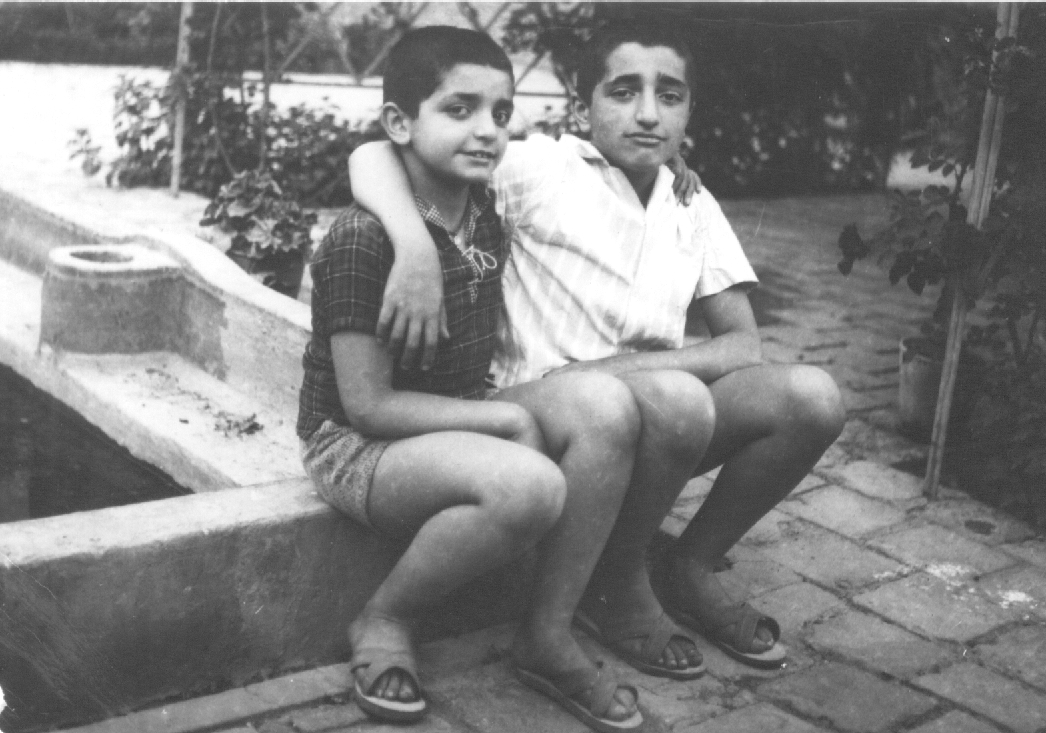
You would be seventy-one today, although you are above all these countings of this tiny earth moving the orbit around the sun when you are high up there looking down.
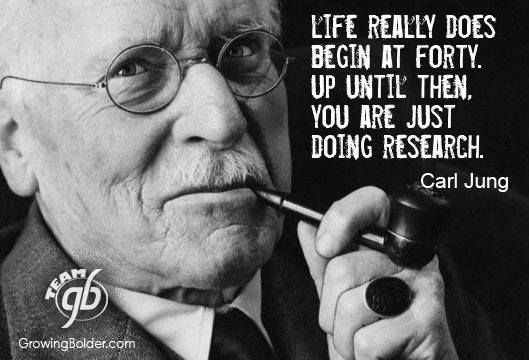
Even though this photo above was taken on your 40th birthday, it shouldn’t matter to you who flies up there and is not into celebrating birthdays. However, as your beloved psychologist, Dr Carl Jung, mentioned, that was the beginning of your life; though short, I am sure enough that you have just done your research.💖
We had a lot of fun that night with this party for two. We walked into the city, hopped into a pub, drank some beers, and met a talkative Iranian whose nonsense talk made our evening delightful!
Anyway, let me take this opportunity to celebrate your (wel)coming on this orbit as I am forced to count these rotations so long I live the life here on the surface. We had joy, we had fun, we had seasons in the sun…
I’d like to add a part of a poem by an excellent poet and friend, Holly (House of Heart), because I somehow found a connection between them. I hope she doesn’t mind! (Of course, the whole poem is to read here: Departure. 🙏💖
I’ve etched your voice in my memory, not to forget the sound of flight, birds battered by the wind. Still In dreams you orbit above me, a hint of blue at dawn that I may sleep free of shadow.
I’ve pared us down to dark and light, forgotten all I know of love and when I speak my words catch like rose petals tied with silk, crushed beneath a breath.
Our relationship was something unique. I mean for us both, and I am so happy to have this privilege.
I’ll hold your thoughts and teaching tightly as they remain in my mind. Keep an eye on me! 🙏💖🤘
In memory of the time of our imagination and research!🦋🌈🌱🌿
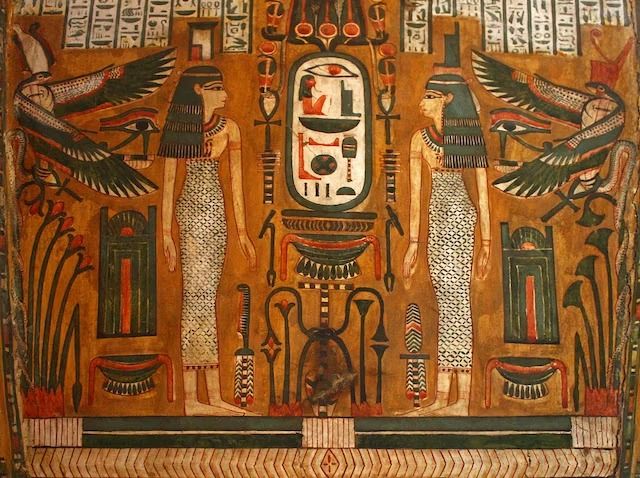
Ancient Egyptian culture recognizes Nephthys, also known as Nebet-Het, as a powerful goddess. She belonged to the Great Ennead of Heliopolis from Egyptian mythology. The myths recognize Nephthys as the daughter of the god Geb and goddess Nut. Mythology pairs the goddess herself with Isis, her sister, in funerary rites.
The interior of the coffin of Imenemipet (1069-945 BCE). Nephthys appears on the left, while Isis seems on the right; a cartouche bearing Osiris’s name lies between them. The kite forms of each goddess can be seen behind their respective human states. FRANS VANDEWALLECC BY-NC-SA 2.0 mythopedia
Honestly, I didn’t know much about Isis’s sister. It is always fascinating to learn more about this magical ancient Egypt. With forever thanks to Marie Grillot for her brilliant article about this piece of jewelry.
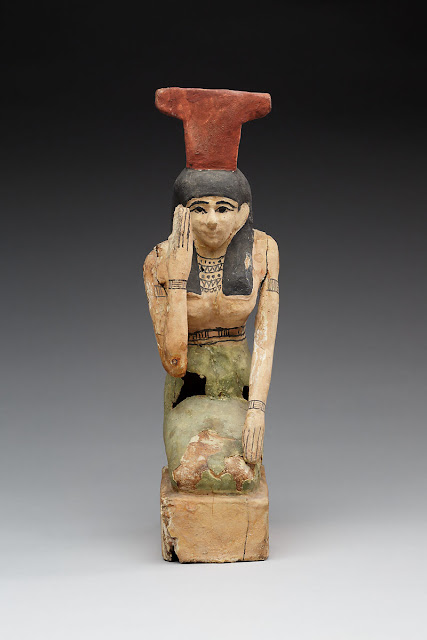
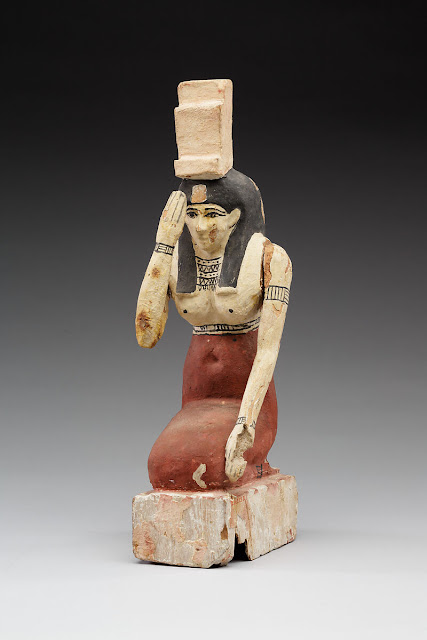
Statue of Nephthys as a mourner – wood, painted gesso – Ptolemaic period, 332 to 30 BC AD Metropolitan Museum of Art, New York – entry number 12.182.23a (by acquisition in 1912 from Mohammed Mohassib, an antique dealer in Louqsor)
“Isis and Nephthys, the divine mourners, appear many times in tombs in the form of wooden statuettes”, indicates Marcelle Werbrouck in her magnificent work on “The Mourners”. This representation of Nephthys, with a height of 24.5 cm, is actually made of wood, covered with painted gesso. It is from the Ptolemaic period: this dating covers three centuries, from 332 to 30 BC. AD
The goddess kneels on a thick, rectangular base, ideally suited to her size and position. What she wears on her head, represented quite schematically, allows her to be identified. These are the two hieroglyphic signs enabling one to write her name: the ideogram castle (hout) surmounted by the basket (neb).
“The Lady of the Castle is the sister of Osiris, Isis and Seth, and the latter’s wife. During the fight between the two brothers, she was nevertheless the ally of the martyr god and helped Isis to reconstitute his corpse. Anubis is sometimes considered the adulterous son that Osiris would have given him. She appears with her sister near the divine remains, mourning and watching over her…” specifies Isabelle Franco in her “Dictionary of Egyptian Mythology”. Thus, Isis and Nephthys are frequently represented in the funerary context in their specific gestures, such as mourning, weeping, protective goddesses, and participating in the deceased’s rebirth. They are often associated with Neith and Selqet.
Statue of Nephthys as a mourner – wood, painted gesso – Ptolemaic period, 332 to 30 BC AD Metropolitan Museum of Art, New York – entry number 12.182.23a (by acquisition in 1912 from Mohammed Mohassib, an antique dealer in Louqsor)
Nephthys wears a black tripartite wig covering most of her forehead but exposing her ears. Her large black eyes, stretched with a thin line of makeup, are topped with slightly arched eyebrows, which match them perfectly. The nose and mouth are briefly represented.
Around her neck hangs an ousekh necklace, the rows and pattern drawn in black. She wears wrist bracelets, armillas (on the humerus) and periscelides (on the ankle), all materialized by black horizontal and vertical lines. Under her bare chest, her green dress is held together by a belt or border, also painted black. The visible areas of the flesh are light yellow in colour.
Her left arm is placed flat on her left thigh while her right is raised in front of her face. The hands are made “in one piece”, and the fingers are defined delimited by black lines. The palm of her right hand is turned towards her; it is a ritual gesture of mourning, one of the postures of mourners.
Statue of Nephthys as a mourner – wood, painted gesso – Ptolemaic period, 332 to 30 BC AD Metropolitan Museum of Art, New York – entry number 12.182.23a (by acquisition in 1912 from Mohammed Mohassib, an antique dealer in Louqsor)
Although frozen in silence, this representation lets the lamentations resonate, and the sadness spread… The divine sisters embody the mourner’s par excellence; thus specifies Marcelle Werbrouck, “Isis is the ‘great mourner’, Nephthys the ‘little mourner’. They are also sometimes called the two complainers”.
Near Isis, Nephthys occupies a place as discreet as it is significant. “Always alongside, if not in its shadow, she participates in the rites ensuring the rebirth and protection of the dead god, a use to which an untranslatable epithet – Kheresket” relates, sensitively analyzes Jean-Pierre Corteggiani. He also specifies that: “The discovery of the remains of a temple from the Roman era, at Kômir, not far from Esna, showed that Nephthys could be venerated for herself: a hymn dating from Antoninus the Pious, engraved on the base of the rear wall of this monument which she shares with Anouqis, assimilates her to most of the great goddesses of the pantheon”…
This statue of Nephthys entered the collections of the Metropolitan Museum of Art in New York in 1912, under number 12.182.23a, and that of her “inseparable” sister Isis, under number 12.182.23b. “They were probably placed at each end of the sarcophagus of the deceased as they appear at each end of the body of Osiris”, specifies the Museum.
Statue of Isis as a weeper – wood, painted gesso – Ptolemaic period, 332 to 30 BC AD Metropolitan Museum of Art, New York – entry number 12.182.23b (by acquisition in 1912 from Mohammed Mohassib, an antique dealer in Louqsor)
They were acquired from Mohammed Mohassib, a well-known antique dealer in Louqsor Square at the time. In his youth, he had been a “donkey boy” in the service of Lady Duff Gordon, who, according to “Who was Who in Egyptology”, had taught him English. After being a seller of antiques “on the run”, he was able, at the beginning of the 1880s, to “settle down” and open a store. The antiques trade was then unregulated and enjoyed a good reputation. Thus, a significant number of artefacts from the Theban region passed through his hands…
Marcelle Werbrouck, Marcelle Baud, The mourners in ancient Egypt, Editions of the Queen Elisabeth Egyptological Foundation, Brussels, 1938 Youri Volokhine, Ritual sadness and funeral lamentations in ancient Egypt, Ritual expressions of sadness and weeping in ancient Egyptian mourning, Revue de l’Histoire des Religions, Armand Colin, OpenEdition Journals, 2008 https://doi.org/10.4000/rhr.6043
Isabelle Franco, Dictionary of Egyptian mythology, Pygmalion 1999 Jean-Pierre Corteggiani, Ancient Egypt and its gods, Fayard, 2007 Morris L. Bierbrier, Who Was Who in Egyptology, London, Egypt Exploration Society, 2012 Mourning Isis https://www.metmuseum.org/art/collection/search/566487
So, my dear friends. Let me end my second post with a short but wise anecdote before I drown again in the ocean of my big and small tasks.
There is an old Japanese tale that recounts the story of a samurai who was known for his warlike nature. One day, the samurai challenged a Zen master to explain the meaning of heaven and hell.
The monk replied with disdain, “You are nobody but a mere mortal. I cannot waste my time with someone like you.”
With his ego hurt, the samurai angrily drew his sword, screaming, “I could kill you for your insolence!”
“This,” said the monk calmly, “is hell.”
Startled, realizing how true the teacher was telling him about the rage that had taken over him, the samurai calmed down, sheathed the sword, and bowed, thanking the monk for his profound knowledge.
I have already written two sections about this topic, p1/p2, and I was unsure if I would write another part. It seems like I have to emphasize the importance of children in our lives. They are not only one of the most vital aspects but also one of the most vulnerable groups, especially during the ongoing wars that are devastating so many parts of the world. We must be mindful of the traumatic experiences that children face during these conflicts, which can affect them psychologically for a long time.
I don’t know whether Dr Jung would try to work on this dilemma again or forego it entirely! What humans do to their children is indescribable.
“If there is anything that we wish to change in the child, we should first examine it and see whether it is not something that could be better changed in ourselves. “Children are educated by what the grown-up is and not by his talk.” Carl Jung, ‘On the Becoming of Personality’ (1932)
It tears my heart apart when I see these children suffer by doing the foolishness of the grown-ups, no matter from which side of any conflict. As a child, they will never know why, and that stays in their soul forever: trauma!
Image by Petra Glimmdall 🙏💖
Anyway, let’s try to keep learning from Dr Jung, who understood children well and believed that intuition is a gift that exists from childhood and is essential.
Image by Petra Glimmdall 🙏💖
Jung was fascinated by intuition as an exceptional gift or function in the traditional sense. This was evident in his 1896-1899 Zofingia Lectures and 1902 On the Psychology and Pathology of So-called Occult Phenomena: A Psychiatric Study. As seen in his Red Book, a significant shift occurred in 1913 when he began using esotericist intuitions for psychological purposes. His personal and private use of intuition, which was remarkable, led Jung to place intuition at the core of his psychology. It became a necessary intuitive form of empathy in his practice and, as we will see, at the heart of his theory. In 1921, Jung wrote Psychological Types, where intuition became one of the four fundamental functions and types of the psyche, alongside thinking, feeling, and sensation. In doing so, Jung proved to the world that intuition was no longer a psychologist’s hobby for table-turning but the most significant function of the psyche.
Image by Petra Glimmdall 🙏💖
As Christmas approaches, we begin the period of anticipation for the birth of the Christ child, a symbolic representation of the birth into divinity. Despite our beliefs or disbelief, we may try our best to save the child’s soul from the pain and trauma it may encounter.



















 lampmagician
You must be logged in to post a comment.