My (Carl Jung’s) Most Difficult Experiment [P. 1]

Standard

Regarding foresight, few individuals possess this ability, or perhaps it exists in everyone, yet most fail to recognise it. I knew some of my relatives, and one of my aunts had mastered it. She had seen ghosts in her large, old house, conversed with them, and could perceive events (in dreams) before they occurred. My brother Al also possessed such a gift, particularly in the final years of his life when he underwent surgery on his head to remove a tumour. I do not know if it is a gift, a curse, or a blessing; nonetheless, I would treasure that.

I, myself, have a small example: I had a dream in which one of my customers, an elderly woman I had driven to the doctor for many years but could no longer assist because she needed special transport, urgently called me to ask if I could pick her up and take her to her doctor. I wondered why I had dreamt of her after all this time. Two days after my dream, while driving a guest from her neighbourhood, she told me she recognised me as the person who had driven her friend from next door for a long time and asked if I knew she had passed away. I said no and asked when it had happened. She replied it was the night before last, the same night I had dreamt of her!

Dream analysis stands or falls with [the hypothesis of the unconscious]. Without it, the dream appears to be merely a freak of nature, a meaningless conglomerate of memory fragments left over from the day’s happenings.
~Carl Jung
“Modern Man in Search of a Soul”, p.2, Psychology Press

Now, let us read about one of the great minds in this field: Carl Gustav Jung. He was among the most sensitive and intuitive visionaries of all time. Here, he talks about his dreams, odd and extraordinary dreams. Once, he was even afraid that he had schizophrenia.

<Although it is from The Red Book, which everyone might have or may have even read, I believe many still do not notice the fineness in the “Introduction” at the beginning of the book, as I find it fascinating.>

From Carl Jung’s “The Red Book, Liber Novus: A Reader’s Edition,” by Sonu Shamdasani. (Introduction)

In 1912, Jung had some significant dreams that he did not understand. He gave particular importance to two of these, which, as he felt, showed the limitations of Freud’s conceptions of dreams. The first follows:

I was in a southern town, on a rising street with narrow half-landings. It was twelve o’clock midday–bright sunshine. An old Austrian customs guard or someone similar passes by me, lost in thought. Someone says, “That is one who cannot die. He died already 30 – 40 years ago but has not yet managed to decompose.”

I was very surprised. Here, a striking figure came, a knight of powerful build clad in yellowish armour. He looks solid and inscrutable, and nothing impresses him. On his back, he carries a red Maltese cross. He has continued to exist since the 12th century, and he takes the same route daily between 12 and 1 o’clock midday. No one marvelled at these two apparitions, but I was extremely surprised.

I hold back my interpretive skills. As regards the old Austrian, Freud occurred to me; as regards the knight, I myself.

Inside, a voice calls, “It is all empty and disgusting.” I must bear it. (Black Book 2, pp. 25-26)

Jung found this dream oppressive and bewildering, and Freud was unable to interpret it.

(In 1925, he gave the following interpretation to this dream: “The meaning of the dream lies in the principle of the ancestral figure: not the Austrian officer – obviously he stood for the Freudian theory – but the other, the Crusader, is an archetypal figure, a Christian symbol living for the twelfth century, a symbol that does not really live today, but on the other hand in not wholly dead either. It comes out of the time of Meister Eckhart, the time of the culture of the Knights, when many ideas blossomed, only to be killed again, but they are coming to life again now. However, when I had this dream, I did not know this interpretation” (Introduction to Jungian Psychology, p. 42).

Around half a year later, Jung had another dream:

I dreamt at that time (it was shortly after Christmas 1912) that I was sitting with my children in a marvellous and richly furnished castle apartment – an open columned hall – we were sitting at a round table, whose top was a marvellous dark green stone. Suddenly, a gull or a dove flew in and sprang lightly onto the table. I admonished the children to be quiet so they would not scare away the beautiful white bird. Suddenly, this bird turned into a child of eight years, a small blond child, and ran around playing with my children in the marvellous columned colonnades. Then, the child suddenly turned into the gull or dove. She said the following to me: “Only in the first hour of the night can I become human while the male dove is busy with the twelve dead.” With these words, the bird flew away, and I awoke. (Black Book 2, pp. 17-18)

In Black Book 2, Jung noted that it was this dream that made him decide to embark on a relationship with a woman he had met three years earlier (Toni Wolff, Ibid., p. 17). In 1925, he remarked that this dream “was the beginning of a conviction that the unconscious did not consist of inert material only, but that there was something living down there (Introduction to Jungian Psychology, p. 42). He added that he thought of the story of the Tabula Smaragdina (emerald tablet), the twelve apostles, the signs of the Zodiac, and so on, but that he “could make nothing out of the dream except that there was a tremendous animation of the unconscious. I knew no technique for getting to the bottom of this activity; all I could do was just wait, keep on living, and watch the fantasies.”

I include this footnote to highlight his insatiable greed and relentless pursuit to decipher the meaning behind his dream and how he developed the interpretation.

Ibid., pp. 40-41. E. A. Benner noted Jung’s comments on this dream: “At first, he thought ‘twelve dead men’ referred to the twelve days before Christmas, for that is the dark time of the year, when traditionally witches are about. To say ‘before Christmas’ is to say before the sun lives again, for Christmas day is at the turning point of the year when the sun’s birth was celebrated in the Mithraic religion… Only much later did he relate the dream to Hermes and the twelve doves” (Meeting with Jung: Conversations recorded by E.A. Brenner during the years 1946-1961 [London: Anchor Press,1982; Zürich, Daimon Verlag, 1985], p. 93). In 1951, in “The Psychological Aspects of the Kore”, Jung presented some material from Liber Novus (describing them all as part of a dream series) in an anonymous form (“case Z.”), tracing the transformations of the anima. He noted that this dream “shows the anima as a elflike, i.e., only partially human. She can just as well be a bird, which means that she may belong wholly to nature and can vanish (i.e., become unconscious) from the human sphere (i.e., consciousness)” (CW9, I, § 371). See also Memories, pp. 195-96.

These dreams led him to analyse his childhood memories, but this did not resolve anything. He realised that he needed to recover the emotional tone of childhood. He recalled that as a child, he used to like to build houses and other structures, and he took this up again.

While he was engaged in this self-analytic activity, he continued to develop his theoretical work. At the Munich Psycho-Analytical Congress in September 1913, he spoke on psychological types. He argued that there were two basic movements of the libido: extraversion, in which the subject’s interest was oriented towards the outer world, and introversion, in which the subject’s interest was directed inward. Following from this, he posited two types of people, characterised by the predominance of one of these tendencies. The psychologies of Freud and Adler were examples of the fact that psychologies often took what was true of their type as generally valid. Hence, what was required was a psychology that did justice to both of these types (“On the question of psychological types,” CW 6).

Although this captivating story continues, I will share it in parts to facilitate understanding and enjoyment. Thank you for taking the time to read!

PS: In case someone interested, I will try to write about my new condition in a separate post. 🙏💖

On the Following Night, However, I Had a Vision.

Standard

Hi everybody. Since Wednesday, our furnace has broken down, and my plans have been disrupted! I wanted to write some posts, but my brain is almost frozen! That’s why I took an old post from my other site (I really don’t know who created it; I didn’t!), which I also took from my valued friend, Lewis Lafontaine and his blog.🙏

So, here is an extraordinary vision from Carl Jung’s remarkable book, The Red Book. I hope you will enjoy it, and I wish you all a thrilled New Year.

Title image: Angel by Samuel Bak

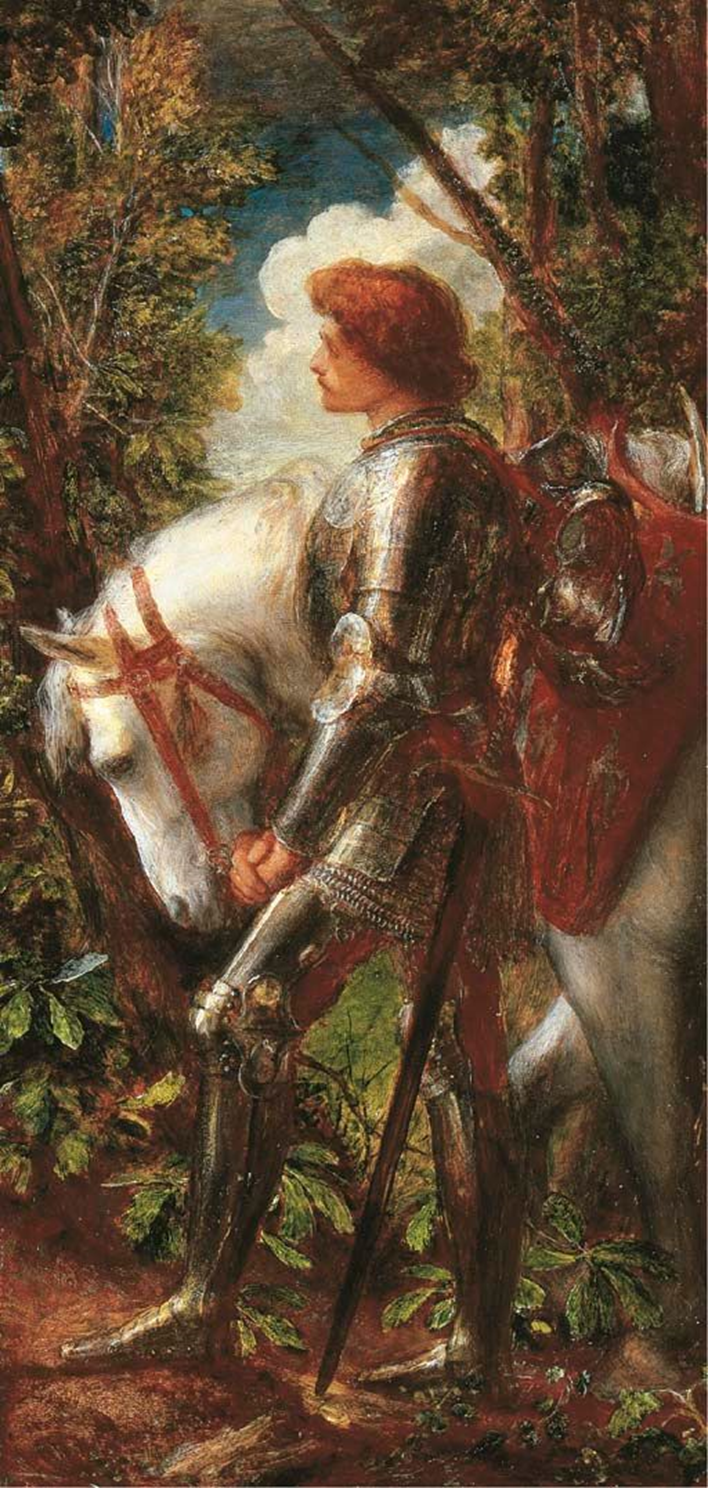
Sir Galahad, source: George Frederic Watts

As he came around the following night, however, I had a vision: I was with a youth in the high mountains. It was before daybreak, and the Eastern sky was already light.

Then Siegfried’s horn resounded over the mountains with a jubilant sound. We knew that our mortal enemy was coming.

We were armed and lurked beside a narrow rocky path to murder him. Then, we saw him coming high across the mountains on a chariot made of the bones of the dead.

He drove boldly and magnificently over the steep rocks and arrived at the narrow path where we waited in hiding.

As he came around the turn ahead of us, we fired at the same time, and he fell slain. Thereupon, I turned to flee, and a terrible rain swept down.

But after this, I went through a torment unto death, and I felt certain that I must kill myself if I could not solve the riddle of the murder of the hero.

Then the spirit of the depths came to me and spoke these words:

“The highest truth is one and the· same with the absurd.” This statement saved me, and like rain after a long, hot spell, it swept away everything in me which was too highly tensed.

From The Red Book, via Carl Jung Depth Psychology

Then I had a second vision: I saw a merry garden clad in white silk, with forms walked, all covered in coloured light, some reddish, the others blueish and greenish.

I know; I have stridden across the depths. Through guilt, I have become a newborn.

We also live in our dreams; we do not live only by day. Sometimes, we accomplish our greatest deeds in dreams. On that night, my life was threatened since I had to kill my lord and God, not in single combat, since who among mortals could kill a God in a duel? You can reach your God only as an assassin if you want to overcome him.

But this is the bitterest for mortal men: our Gods want to be overcome since they require renewal. If men kill their princes, they do so because they cannot kill their Gods and because they do not know that they should kill their Gods in themselves.

If God grows old, he becomes a shadow, nonsense, and he goes down. The greatest truth becomes the greatest lie, and the brightest day becomes the darkest night. As day requires night and night requires day, so meaning requires absurdity, and absurdity requires meaning.

Day does not exist through itself; night does not exist through itself.

The reality that exists through itself is day and night.

So, the reality is meaning and absurdity.

Noon is a moment, midnight is a moment, morning comes from night, evening turns into night, but evening comes from the day, and morning turns into day.

So meaning is a moment and a transition from absurdity to absurdity, and absurdity is only a moment and a transition from meaning to meaning.

Oh, the German hero, Siegfried, blond and blue-eyed, had to fall by my hand, the most loyal and courageous!

He had everything in himself that I treasured as the greater and more beautiful; he was my power, my boldness, my pride.

I would have gone under in the same battle, and so only assassination was left to me. If I wanted to go on living, it could only be through trickery and cunning.

Judge not! Think of the blond savage of the German forests, who had to betray the hammer-brandishing thunder to the pale Near-Eastern God nailed to the wood like a chicken marten.

The courageous were overcome by a certain contempt for themselves.

But their life force bade them go on living, and they betrayed their beautiful wild Gods, their holy trees and their awe of the German forests.

What does Siegfried mean for the Germans! What does it tell us that the Germans suffer Siegfried’s death!

That is why I almost preferred to kill myself in order to spare him. But I wanted to go on living with a new God.

After death on the cross, Christ went into the underworld and became Hell. So he took on the form of the Antichrist, the dragon.

The image of the Antichrist, which has come down to us from the ancients, announces the new God, whose coming the ancients had foreseen.

Gods are unavoidable. The more you flee from God, the more surely you fall into his hand.

The rain is the great stream of tears that will come over the people; the tearful flood of released tension after the constriction of death had encumbered the people with horrific force.

It is the mourning of the dead in me, which precedes burial and rebirth.

The rain is the fructifying of the earth; it begets the new wheat, the young, germinating God. ~Carl Jung, The Red Book, Pages 241-242

Carl Jung, The Red Book; Soul and God

Standard
Francisco de Holanda – De aetatibus mundi imagines – 1545

I won’t bore you with a lengthy account of my personal life. Still, I will mention that my wife and I had to take care of our cute grandchildren all week due to the lack of support from the German government for kindergarten care and education (the two issues are assumed to be unimportant!). We are also facing a death (redemption!) in the family, which I will write about later.

Amidst all the chaos, I found solace in reading my “holy book”, The Red Book, by Dr. Jung, attempting to nourish my soul. I hope you can find some comfort in reading it, too.🙏

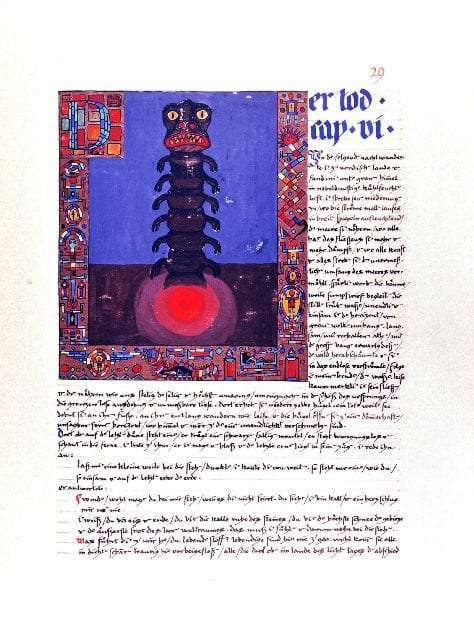
[H I ii(r) 2] Cap. ii (P. 130, 131, 132; Liber Primus, A Reader’s Edition)

On the second night, I called out to my soul (Nov. 14, 1913):

I am weary, my soul, my wondering has lasted too long, my search for myself outside myself. Now, I have gone through events and found you behind them, for I made discoveries on my erring through events, humanity, and the world. I found men. And you, my soul, I found again, first in images within men and then you yourself. I found you where I least expected you. You climbed out of a dark shaft. You announced yourself to me in advance in dreams (which were dark to me and which I sought to grasp in my own inadequate way). They burned in my heart, drove me to all the boldest acts of daring, and forced me to rise above myself. You let me see truths of which I had no previous inkling. You let me undertake journeys whose endless length would have scared me if the knowledge of them had not been secure in you.

I wandered for many years, so long that I forgot that I possessed a soul (I belonged to men and things. I did not belong to myself {Black Book 2}). Where were you all this time? Which Beyond sheltered you and gave you sanctuary? Oh, you must speak through me, that my speech and I are your symbol and expression! How should I decipher you?

Who are you, child? My dreams have represented you as a child and as a maiden (and I found you again only through the soul of the woman {Black Book 2}). I am ignorant of your mystery (Look! I bear a wound that is as yet not healed: my ambition to make an impression {Black Book 2}). Forgive me if I speak as in a dream, like a drunkard – are you God? Is God a child, a maiden? (I must tell myself most clearly: does He use the image of a child that lives in everyman’s soul? Were Horus, Tags, and Christ not children? Dionysus and Heracles were also divine children. Did Christ, the God of man, not called himself the son of man? What was his innermost thought when doing so? Should the daughter of man be God’s name {Black Book 2})? Forgive me if I bobble. No one else hears me. I speak to you quietly, and you know that I am neither a drunkard nor someone deranged, and my heart twists in pain from the wound, whose darkness delivers speeches full of mockery: “You are lying to yourself! You spoke so as to deceive others and make them believe in you. You want to be a prophet and chase after your ambition.” The wound still bleeds, and I am far from being able to pretend that I do not hear the mockery.

How strange it sounds to me to call you a child, you who still hold the all-without-end in your hand (how thick the earlier darkness was! How impetuous and egoistic my passion was, subjugated by all the diamonds of ambition, the desire for glory, greed, uncharitableness, and zeal! How ignorant I was at the time! Life tore me away, and I deliberately moved away from you, and I have done so far all these years. I recognise how good all of this was, but I thought you were lost, even though I sometimes thought I was lost. But you were not lost. I went on the way of the day. You went invisibly with me and guided me step by step, putting the pieces together meaningfully {Black Book 2}) and letting me see the whole in each part.

You took away where I thought to take hold and gave me where I did not expect anything. Time and again, you brought about fate from new and unexpected quarters. Where I sowed, you robbed me of the harvest, and where I did not sow, you gave it to me again where I would never have foreseen it. You upheld my belief when I was alone and near despair. At every decisive moment, you let me believe in myself.

I appreciate your being here. Have a lovely weekend.🙏💖🤗🌹🦋

The Odyssey of Carl Jung

Standard

Or a Sequel to THE WAY OF WHAT IS TO COME.

I am an orphan, alone; nevertheless, I am found everywhere. I am one but opposed to myself. I am a youth and an old man at one and the same time. I have known neither father nor mother because I have had to be fetched out of the deep like a fish or fell like a white stone from heaven. In woods and mountains, I roam, but I am hidden in the innermost soul of man. I am mortal for everyone, yet I am not touched by the cycle of aeons.

Illustrated by Petra Glimmdall 💖🙏

C. G. Jung, Memories, Dreams, Reflections, p.227. (Bollingen Tower)

I made this part separately to show how instructive Dr Jung is, even though he didn’t want to teach! After describing his dreams, with the last one ending full of hope with him standing in front of a tree bearing leaves but no fruit, which then transforms into sweet grapes full of healing juice, Dr Jung, although humble, shares his wisdom and knowledge from his vast experience. Despite his insistence that he never intends to teach or give lessons, we can appreciate the profound wisdom contained within his words.

Title image:  “Bleeding Light” By Jeffrey Smith.

Drawings by Jane Adams

Liber Primus fol.i(v)

In reality, now, it was so: At the time when the great war broke out between the peoples of Europe, I found myself in Scotland, compiled by the war to choose the fastest ship and shortest road home. I encountered the colossal cold that froze everything; I met up with the flood, the sea of blood, and found my barren tree whose leaves the frost had transformed into a remedy. And I plucked the ripe fruit and gave it to you, and I do not know what I poured out for you, what bittersweet intoxicating drink left an aftertaste of blood on your tongues.

Believe me (my friends): It is no teaching and no instruction that I give you. On what basis should I presume to teach you? I provide you with news of this man’s way but not of your own way. My path is not your path; therefore, I / cannot teach you! (CF. the contrast to John 14:6: “Jesus said unto him, I am the way, the truth and the life: no man cometh unto the father but by me.) The way is within us, but not in Gods, nor in teachings, nor in laws. Within us is the way, the truth, and the life.

Woe betide those who live by way of examples! Life is not with them. If you live according to an example, you thus live the life of that example, but who should live your own life if not yourself? So live yourselves. (This is not a law, but notice of the fact that the time of example and law, and of the straight line drawn in advance, has become overripe”p.10)

The signposts have fallen; unblazed trails lie before us. (My tongue shall wither if I serve up laws if I prattle to you about teaching. Those who seek such will leave my table hungry!) Do not be greedy to gobble up the fruits of foreign fields. Do you not know that you yourselves are the fertile acre which bears everything that avails you?

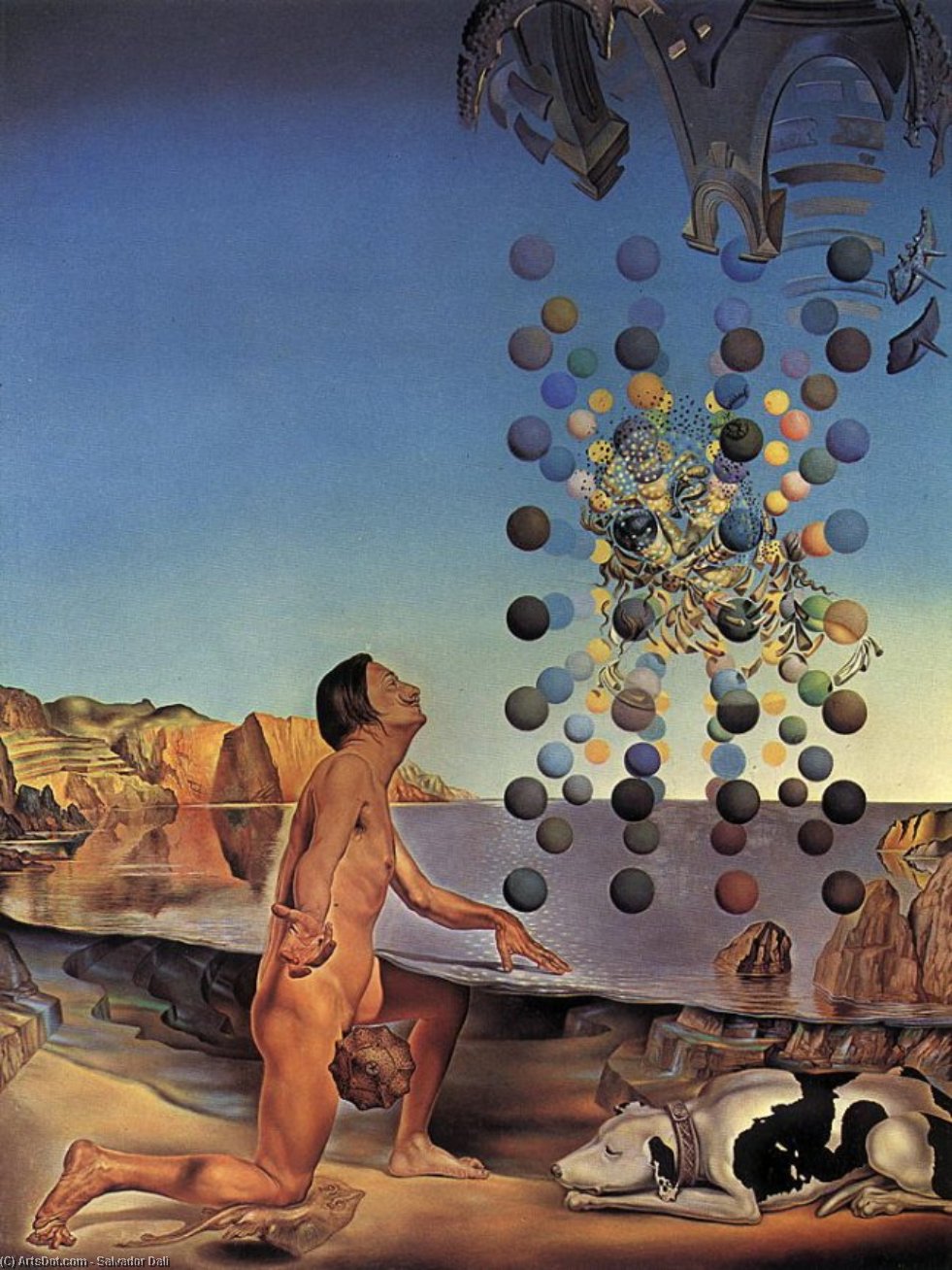
Salvador_dali-self-portrait_1954

Yet, who today knows this? Who knows the way to eternally fruitful climes of the soul? You seek the way through mere appearances, you study books and give an ear to all kinds of opinions. What good is all that?
There is only one way, and that is your way. (only one law exists, and that is your law. Only one truth exists, and that is your truth”p.10)

May each go their own way!

I will be no saviour, no lawgiver, no master teacher unto you. You are no longer little children. (One should not turn people into sheep, but sheep into people. The spirit of the depth demands this, who is beyond present and past. Speak and write for those who want to listen and read. But do not run after someone so you do not soil the dignity of humanity- it is a rare good. A sad demise in dignity is better than an undignified healing. Whoever wants to be a doctor of the soul sees people as being sick. He offends human dignity. It is presumptuous to say that man is sick. Whoever wants to be the soul’s shepherd treats people like sheep. He violates human dignity. It is insolent to say that people are like sheep. Who gives you the right to say that man is sick and a sheep? Give them human dignity so they may find their ascendancy or downfall, their way”p. 11)

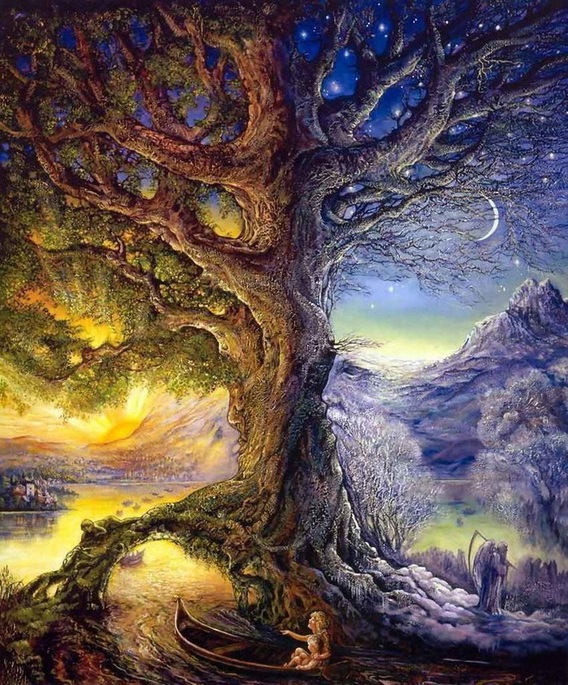
Art by Josephine Wall

Giving laws, bettering, making things easier, has all become wrong and evil. May each one seek out their own way. This way leads to mutual love in the community. Men will come to see and feel the similarity and community of their ways.
Laws and teachings held in common compel people to solitude so that they may escape the pressure of undesirable contact, but solitude makes people hostile and venomous.

Therefore, give people dignity and let each of them stand apart so that each may find their own fellowship and love it.
Power stands against power, contempt against contempt, love against love. Give humanity dignity and trust that life will find a better way.
The one eye of the Godhead is blind, the one ear of the Godhead is deaf, and the order of its being is crossed by chaos. So be patient with the crippleness of the world and do not overvalue its consummate beauty. (This is all, my dear friends, that I can tell you about the grounds and aims of my message, which I am burdened with like the patient donkey with a heavy load. He is glad to put it down!”p.12)

🙏💖🌟

The Way of What is to Come.

Standard

The Red Book by C. G. Jung, Liber Primus fol. i(v)

As I continue to read Carl Jung’s book, The Red Book, I find myself wondering how his words are so relatable to me. They touch me deeply and feel familiar. I do not speak often and tend to keep to myself. However, I want to learn how to express myself more creatively using images. I long to see a sign of mercy that will give me hope and belief, even though I still wish to have visions like Jung had.

He conversed with the spirits, the spirit of the time, the spirit of depth, talking about the Supreme Meaning by the fact that he is laughter and worship; a bloody laughter and a bloody worship. A sacrificial blood binds the poles. Jung has his humanity for help: What solitude, he said, what a coldness of destruction you lay upon me when you speak such! Reflect on the destruction of being and the streams of blood from the terrible sacrifice that the depth demands (Referring to Jung’s vision). Dr Jung had visions which became a reality throughout his time. He was excited, not sure if schizophrenia was threatening him. However, every genius seems to have this ability, as my brother Al had it.

As we observe the world today, starting wars easily, bombing, and killing have become routine occurrences, it might not be necessary for us to have the kind of visions that Dr. Jung had in his time. However, his words hold significance since they reflect a deeper insight into the human psyche.

Carl Jung On Psychosis
Carl Jung Depth Psychology

Let’s read what he speaks about his visions:

“But the spirit of the depths uttered: No one can or should halt sacrifice. Sacrifice is not destruction; sacrifice is the foundation stone of what is to come…
“The mercy that happened to me gave me belief, hope, and sufficient daring not to resist the spirit of the depths further but so utter his words. But before I could pull myself together to really do it, I needed a visible sign that would show me that the spirit of the depths in me was, at the same time, the ruler of the depths of world affairs.

It happened in October 1813, when I was living alone on a journey. During the day, I was suddenly overcome by a vision in broad daylight: I saw a terrible flood that covered all the northern and low-lying lands between the North Sea and the Alps. It reached from England up to Russia and from the coast of the North Sea right up to the Alps. I saw yellow waves swimming through rubble and the death of countless thousands.

Carl Jung: “On Pictures In Psychiatric Diagnosis” – Carl Jung Depth Psychology

The vision lasted two hours; it confused me and made me ill. I was not able to interpret it. Two weeks passed, then the vision returned, still more violent than before, and an inner voice spoke: “”Look at it; it is completely real, and it will come to pass. You cannot doubt this.“” I wrestled again for two hours with this vision, but it held me fast. It left me exhausted and confused. And I thought my mind had gone crazy.

Jung discussed this vision on several occasions, stressing different details like in his 1925 seminar Introduction to Jungian Psychology (p. 44f), to Mircea Eliade, and Memories (pp. 199-200):

{Jung’s versions were frightening as he saw even a sea of blood over the northern lands. He explains: }

As a psychiatrist, I became worried, wondering if I was not on the way to “doing a schizophrenia,” as we said in the language of those days… I was just preparing a lecture on schizophrenia to be delivered at a congress in Aberdeen, and I kept saying to myself: “I’ll be speaking of myself! Very likely, I’ll go mad after reading out this paper.” The congress was to take place in July 1914 – exactly the same period when I saw myself in my three dreams voyaging on the Southern seas. On July 31st, immediately after my lecture, I learned from the newspapers that war had broken out. Finally, I understood. And when I disembarked in Holand on the next day, nobody was happier than I. Now, I was sure that no schizophrenia was threatening me. I understood that my dreams and my visions came to me from the subsoil of the collective unconscious. What remained for me to do now was to deepen and validate this discovery. And this is what I have been trying to do for forty years.

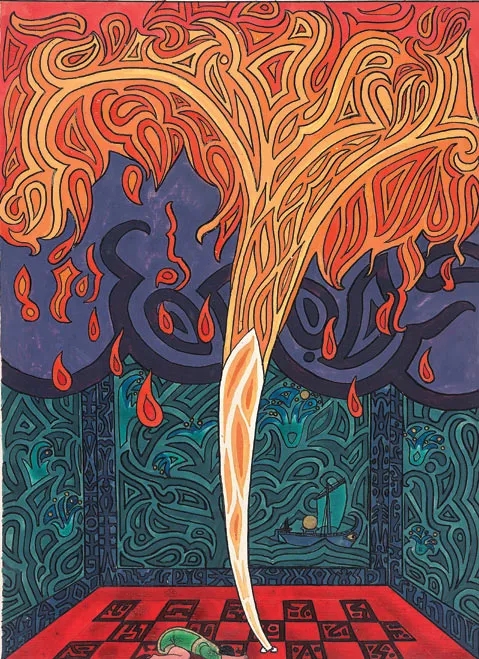
The fire from the egg in Carl Jung’s Red book

In the year 1914, in the month of June, at the beginning and end of the month, and at the beginning of July, I had the same dream three times: I was in a foreign land, and suddenly, overnight and right in the middle of the summer, a terrible cold descended from space. All seas and rivers were ice-locked, and every green living thing had frozen.
The second dream was thoroughly similar to this. But the third dream at the beginning of July went as follows: I was in a remote English land. It was necessary that I return to my homeland with a fast ship as speedily as possible. I reached home quickly. In my homeland, I found that in the middle of summer, a terrible cold had fallen from space, which had turned every living thing into ice. There stood a leaf-bearing but fruitless tree, whose leaves had turned into sweet grapes full of healing juice through the working of the frost (like the ice wine). I picked some grapes and gave them to a great waiting throng.

[Draft: This was my dream. All my efforts to understand it were in vain. I laboured for days. Its impression, however, was powerful (p.9). Jung also recounted this dream in Memories].

Can we interpret the end of his dream, where sweet grapes are present, as a positive outcome of human madness? Who knows! Anyhow, hope dies last.🙏💖

Source: The Red Book by C. G. Jung, Liber Novus, A Reader’s Edition; Sonu Shamdasani

Title illustration by Mariusz Lewandowski

The Supreme Meaning!

Standard

Liber Primusfol.i(v) p. 120, Reader’s Edition

I am getting older (does not everybody do this?!), though I feel this ageing more and more as I’m heading towards my seventieth of that day in which I’ve opened my eyes to the sun. That’s why one may contemplate deeply about religion and the purpose of life, striving to understand and grasp the concept of God, as I am daring to do today.

When I became acquainted with C.G. Jung, I realized that I had found a guide who could help me think more clearly to find answers to my questions. I don’t know about you, but I believe that when ageing, one feels more solitude and begins to enjoy it. However, it’s important to note that he is not a saviour but rather a teacher who can point the way and offer valuable insights through his writings, particularly in his Red Book.

For me, the Red Book by Carl Jung is like the holy book. I may say it is like the Bible for a Christian, or the Koran for a Muslim, and the same as the Torah for a Jew, etc. The difference between them is that Dr Jung never tries to make statements of one particular God as their messenger but tries to define how a god can be definite! Here comes the concept: Supreme Meaning! The melting of sense and nonsense. And I think that this aspect needs a broad view.

The supreme meaning is great and small; it is as wide as the space of the starry Heaven and as narrow as the cell of the living body. C.G. Jung, The Red Book: Liber Novus.

I present you a small part, a page, of his words of knowledge on this concept. I hope it opens one or more doors in your life as it did for mine.

Portrait by Olga KURKINA

The spirit of the depths took my understanding and all my knowledge and placed them at the service of the inexplicable and the paradoxical. He rubbed me of speech and wrote me for everything that was not in his service, namely the melting together of sense and nonsense, which produces the supreme meaning.
But the supreme meaning is the path, the way and the bridge to what is to come. That is the God yet to come. It is not the coming God himself, but his image which appears in the supreme meaning.
(1)

God is an image, and those who worship him must worship him in the image of the supreme meaning. The supreme meaning is not a meaning and not an absurdity; it is image and force in one, magnificence and force together.

The supreme meaning is the beginning and the end. It is the bridge of going across and fulfilment. (2)

The other Gods died of their temporality, yet the supreme meaning never dies; it turns into meaning and then into absurdity, and out of the fire and blood of their collision, the supreme meaning rises up rejuvenated anew.

The image of God has a shadow. The supreme meaning is real and casts a shadow. For what can be actually corporeal and have no shadow?

The shadow is nonsense. It lacks force and has no continued existence through itself. But nonsense is the inseparable and undying brother of the supreme meaning.

Like plants, so men also grow, some in the light, others in the shadows. There are many who need the shadows and not the light.

The image of God throws a shadow that is just as great as itself.

The supreme meaning is great and small; it is as wide as the space of starry Heaven and as narrow as the cell of the living body.

1- In Transformations and Symbol of the Libido (1912), Jung interpreted God as a symbol of the libido (CW B, §111). In this subsequent work, Jund laid great emphasis on the distinction between the God image and the metaphysical existence of God (cf. passages added to the revised retitled 1952 edition, Symbols of Transformation, CW 5, § 95)

2- The terms Hinübergehen (going across, passing over), Übergang (transition), Untergang (down-going, downfall), and Brücke (bridge) feature in Nietzsche’s Zarathustra in relation to the passage from man to the Übermensch (superman). For example, “What is great in man is that he is a bridge and not a goal; what can be loved in man is that he is a “going-across” and a “downfall”. //I love those who do not know how to live except their lives be a “downfall”, for they are those who are going over”(tr. R. Hollingdale [Harmondsworth: Penguin, 1984], p. 44, tr. mod; words are asunderlined in Jung’s copy).

Top image by Ettore Aldo Del Vigo

Thank you for your support. 💖🙏🌹