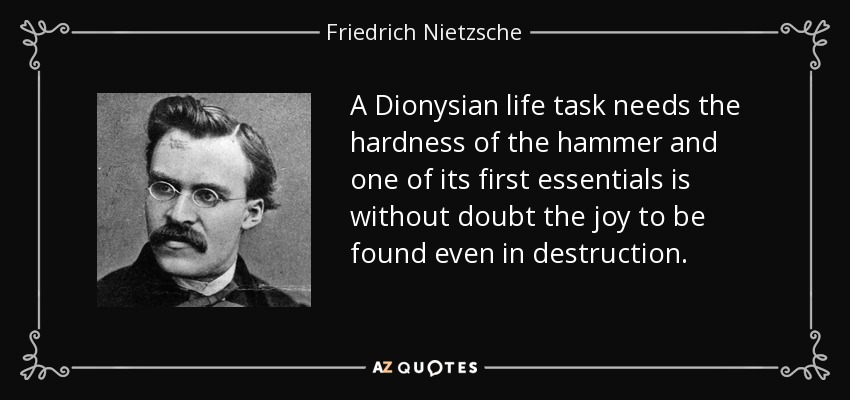
Friedrich Nietzsche’s Political View; A Look at the State.

Standard

Recently, I saw a critical performance of Richard Wagner on German TV about his racism, presented by an Italian or Spanish artist whose name I have forgotten. However, this reminded me of Nietzsche’s distancing himself from Wagner due to his disgust towards specific individuals, even though Nietzsche was in love with his sister, Cosima. (The reason may also be that Nietzsche had a very close relationship with a man named Paul Rée, who was Jewish.)
For Nietzsche, the Tribschen period was far from idyllic. It was challenging as he constantly tested himself to meet Wagner’s expectations. He began writing his first book while regularly visiting the Wagners’ home in Tribschen, anxious about whether his work would satisfy Wagner. This era was marked by aspiration, vulnerability, and self-testing for Nietzsche. He was essentially an apprentice to a genius, experiencing a vital rite of passage in his creative journey.

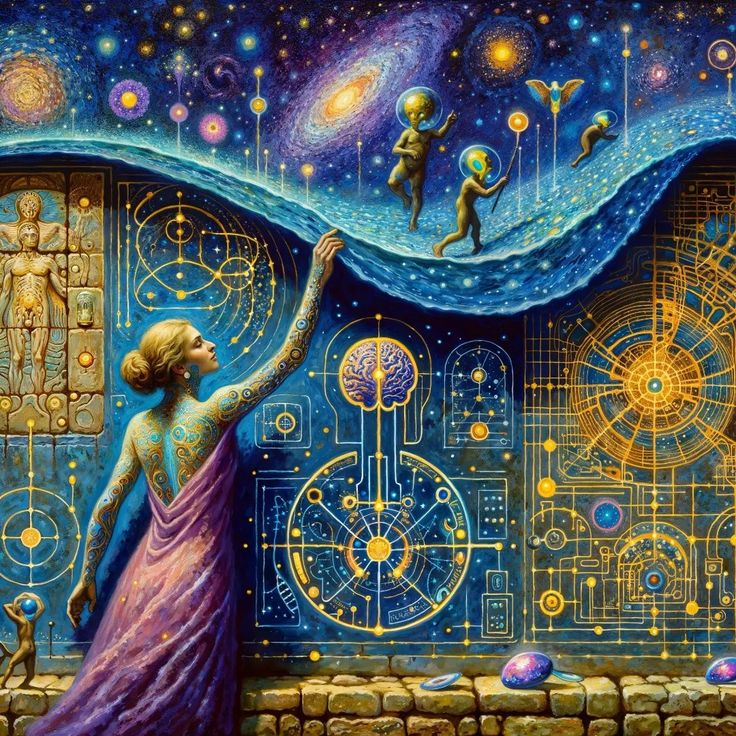
Free AI Art
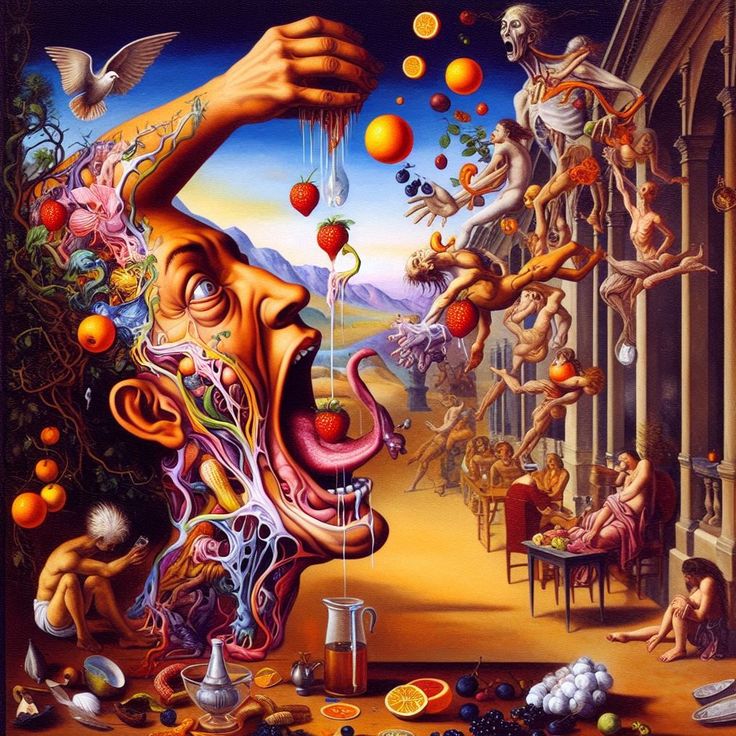
(On the top: Surreal Abstract Painting.)

Neither Nietzsche nor Wagner understood one another realistically. Nietzsche saw Wagner as a benevolent father but felt disappointed by his egotism. Conversely, Wagner viewed Nietzsche as a loyal son who became a rebellious thinker. Both pursued psychological needs that overshadowed their friendship and intimacy.

Anyway, I found two paragraphs I’ve translated from one of his books, Menschliches, Allzumenschliches (Human, All Too Human). I present them to you because I believe they are very relevant to our “political” society today.
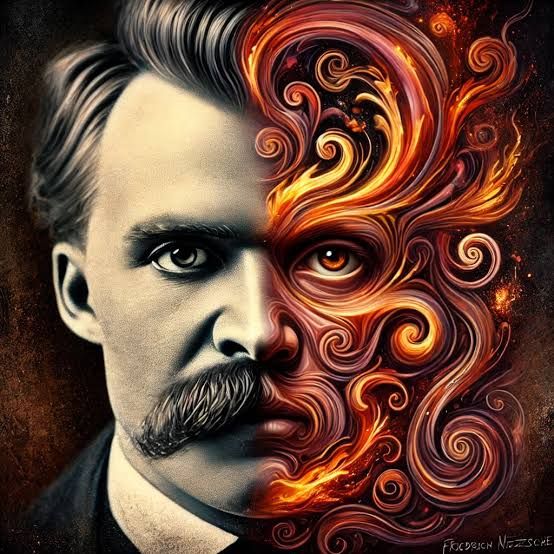
From the Book “Human, All Too Human”, Volume One

(No. 458) Guiding Spirits and their Tools.

We see great statesmen and generally all those who have to use many people to carry out their plans, sometimes proceed in this way, sometimes in that way: either they select very finely and carefully the people who suit their plans and then give them relatively great freedom because they know that the nature of these chosen people will lead them to where they themselves want them to go, or they choose poorly, even take what comes to hand, but form something suitable for their purposes out of every ton. This last type is the more violent; it also requires submissive tools, its knowledge of human nature is usually much less, and its contempt for human nature is greater than that of the first-mentioned minds. Still, the machine they construct generally works better than the machine from the workshop of the former.

Spiral to the Hole

(No. 460) The Great Man of the Masses.

The recipe for what the masses call a great man is easy to give. Whatever the circumstances, get them something they find very pleasant, or first put it into their heads that this and that would be very pleasant, and then give it to them. But not immediately at any price: you have to fight for it with the greatest effort or seem to be fighting for it. The masses must have the impression that there is a powerful, even indomitable willpower; at least, it must seem to be there. Everyone admires a strong will because no one has it, and everyone says to themselves that if they had it, there would be no limits to them and their egoism. If it turns out that such a firm will achieve something that the masses find very pleasant, people admire it once again and wish themselves luck instead of listening to the wishes of its greed. Moreover, he has all the qualities of the masses: the less they are ashamed of him, the more popular he is. So, He is violent, jealous, exploitative, scheming, flattering, grovelling, conceited (narcissist) or anything, depending on the circumstances.


A brief update: My challenging circumstances remain the same, but I’m relieved that my boss has exited the hospital. His blood tests are standard, yet he still cannot return to work. Therefore, I must continue managing things as the acting boss!
I am always grateful for your support and companionship, and I wish you all a lovely weekend.🙏💖
The Way We Go!

Standard
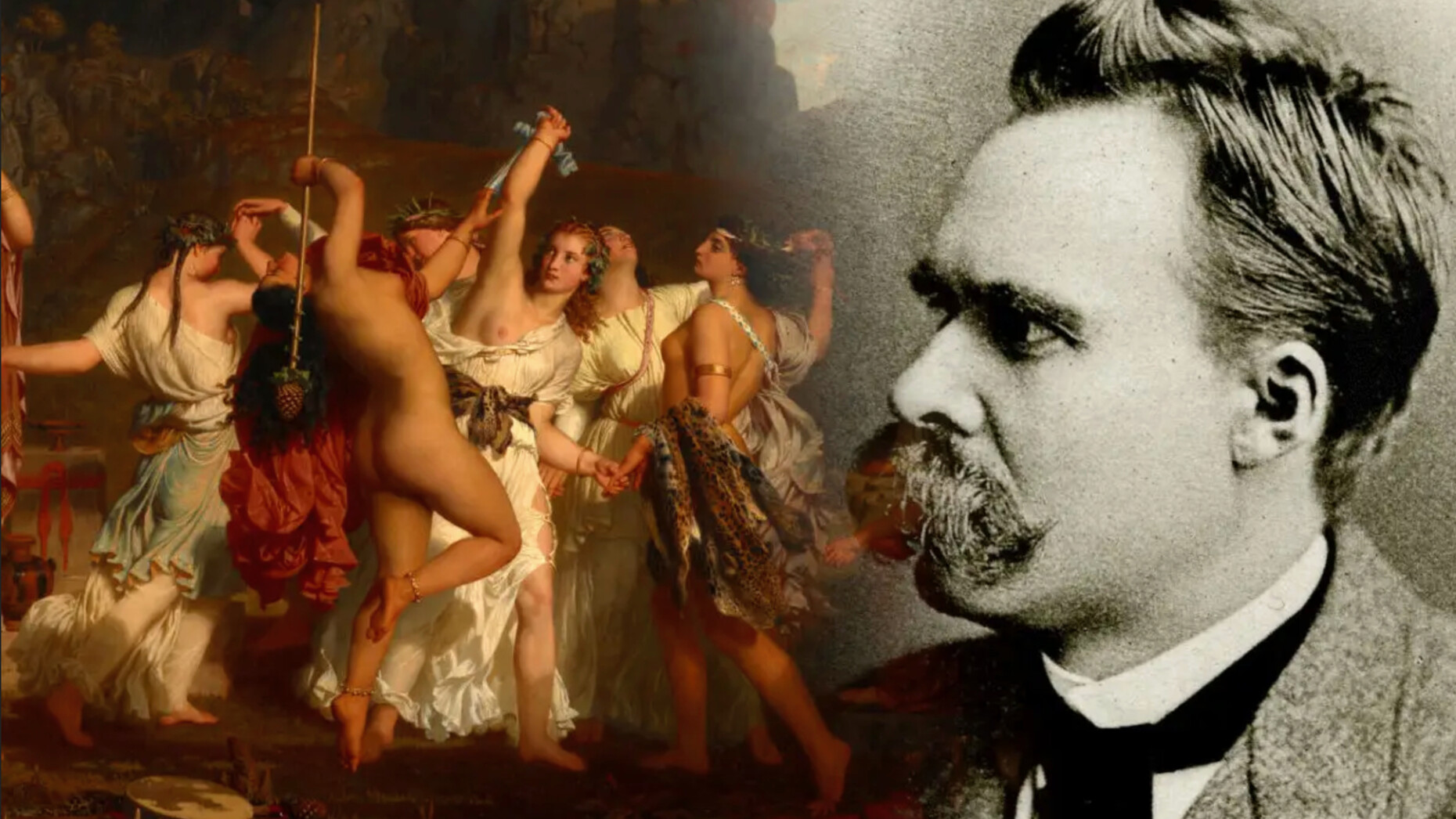
The Dance of the Bacchants, by Charles Gleyre and Friedrich Nietzsche (Artwork: Mark Rothko)

Recently, I read a post on FB from a good friend, Scott D. Smith, about how we might have to get through Nietzsche to understand Dr. Jung better! I agree totally; though Dr. Jung’s works are not philosophical but psychological, Nietzsche has an immense influence on Jung’s doctrine work and his psychological analysis in general.

Nietzsche admired Greece and Greek mythology, often quoting Schopenhauer and using Hegelian ideas to discuss art. He connected ancient Greek tragedy with Richard Wagner’s opera. Let’s see what he meant by Dionysian.

Dionysus, the Greek god of wine and music, is associated with the Dionysian, a state of self-forgetting where individuals unite with others and nature. According to Nietzsche, the Apollonian and the Dionysian are essential to art creation. Dionysian art, particularly music, represents madness and drunkenness, appealing to primal human desires and mystical unity with nature.
In “The Birth of Tragedy” (1872), Nietzsche introduced the terms Apollonian and Dionysian to describe contrasting forces in art. The Apollonian represents a calm, rational art, while the Dionysian embodies intense emotion and ecstasy. Nietzsche believed these forces could come together to create a unique art form, as seen in the Greek tragedies of Aeschylus and Sophocles.

“The saying Yes to life even in its strangest and hardest problems; the will to life, rejoicing over its inexhaustibility even in the very sacrifice of its highest types – that is what I call Dionysian.”

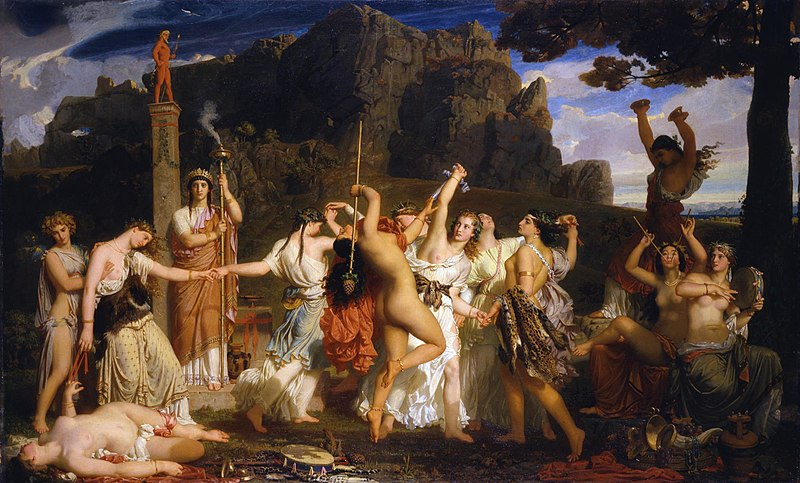
Charles Gleyre La Danse des bacchantes. Wikimedia
The Dance of the Bacchantes, the last painting by Gleyre exhibited publicly in Paris (at the Salon of 1849)

I believe his thoughts are timeless, as humans almost permanently experience the same failures based on ignorance. Here he speaks:

“Now we see the struggle, pain, the destruction of appearances as necessary because
of the abundance of countless forms pressing into life because of the boundless
fecundity of the world will…That primal Dionysian delight experienced even in
the presence of pain is common to music and tragic myth.”
“Dionysian art wants to convince us of the eternal delight of existence… Now
struggle, pain, and destruction… are seen as necessary…Despite terror and pity
we rejoice in living not as individuals but as part of the life force with whose
procreative lust, we have become one.”
“the world is becoming and perishing, creation and destruction, without any
moral content, in eternal innocence.”
“Now, sure of united victory,
We celebrate the feast of feasts:
Friend Zarathustra has come, the guest of guests!
Now the world is full of laughter, the gruesome curtain is rent,
The wedding day has come for light and darkness.”
Nietzsche: Disciple of Dionysus

Sometimes, our strengths push us so far that we can no longer bear our weaknesses and decline from them.

Of course, we happen to predict this way out, but we can’t change anything. And then we become cruel in that which we ought to guard within ourselves, and our greatness makes us barbarous.

This experience, which we are ultimately forced to pay for with our lives, symbolizes bad people’s effect on others and their time.

With the best they possess—they have within themselves—with that which only they can accomplish, they destroy too many weak, uncertain, unformed, and hesitant beings with the best they have and thus become harmful.

And it can even happen that they do nothing but cause harm because this oldest part of themselves is suddenly emptied, so to speak, only by beings who suffocate their logic and individuality in a glass of strong drink.

And they get drunk to such a point that they can’t help but break their whole body – hands, legs – in all the ways that their drunkenness will lead them.

Source: kwize

‘Man is evil‘ – all the wisest have told me that to comfort me. Ah, if only it were still true today! For evil is man’s best strength. ‘Man must become better and more evil’ – thus, I teach. The most evil is necessary for the “Übermensch’s” best. It may have been good for that preacher of the little people to suffer and be burdened by man’s sin. But I rejoice in great sin as my great consolation. – But such things are not said for long ears. Neither does every word suit every mouth. These are subtle, remote things: sheep’s hooves should not reach for them!” Thus Spoke Zarathustra:

Let us think of the idea in its most terrible form: “existence as it is, without meaning or purpose, but inevitably returning, without a finale into nothingness: ‘the eternal return’. That is the extreme form of nihilism: nothingness (the ‘senseless’) eternal!”

And here, I add one of his poems, Last Will, translated from German.

Last Will

To die thus,
as I once saw him die -,
the friend who cast divine lightning and glances
into my dark youth.
Mutinous and deep,
a dancer in battle -,
the most cheerful among warriors,
the most difficult among victors,
Fate resting upon his doom, hard, thoughtful, premeditated –
trembling that he had won,
rejoicing that he had won while dying –
commanding as he died-
and he commanded that man should destroyed…
To die thus,
as I once saw him die:
Victorious, Destroying…

Thank you, as always, for your presence and stopping by. Have a peaceful weekend, everybody.🙏💖✌

It Makes no Sense to Wait for Godot (The Massias)!?

Standard

One essay from Thus Spoke Zarathustra: The Speeches of Zarathustra.

I took on another challenging task, even though I didn’t have as much time as I thought! Nevertheless, I managed to translate another part of Nietzsche’s “Thus Spoke Zarathustra,” which I believe closely relates to the current human situation and way of life. Although Nietzsche seems to be a bitter and pessimistic philosopher, I find that he made valid points about the human condition that, in my opinion, he addressed reasonably.

His writing style is poetic and difficult to translate, using old-fashioned German. I did my best to make it more apprehensive. I hope you enjoy it.🙏💖🌹

(The word Hinterweltler literally means Backworlders, but he intends to show the unknown people living behind and around the subjects, unaware of the centre. I couldn’t find any word in English that matched this one, so I didn’t translate it!).

About The Hinterweltler

Zarathustra once cast his madness beyond man, like all other Hinterweltlers. The world seemed to me to be the work of a suffering and tormented God.

The world seemed to me a dream, the poetry of god-coloured smoke before the eyes of one who was divinely dissatisfied.

Good and evil and pleasure and pain and I and you – it seemed to me like coloured smoke before creative eyes. The Creator wanted to look away from himself – so he created the world. It is a drunken pleasure for the sufferer to look away from his suffering and lose himself. The world seemed to me to be one and the same: drunken pleasure and losing oneself.

This world… eternally imperfect, an image and an imperfect image of an eternal contradiction – a drunken pleasure of its imperfect Creator – so the world once seemed to me.

So I, too, once cast my madness beyond man, like all Hinterweltlern. Beyond man in truth? Their books, too, this God that I created was the work of man and madness, like all gods!

He was human, and only a poor piece of human and I: This ghost came to me from my own ashes and embers, and honestly! It did not come to me from the beyond!

What happened, my brothers? I overcame myself, the sufferer, I carried my own ashes to the mountain, I invented a brighter flame for myself. And behold! Then the ghost left me!

It would be suffering for me now and torment for those who have recovered to believe in such ghosts: it would be suffering for me now and humiliation. So I speak to the Hinterweltlern.

It was an unfortunate, and inability – that created all the Hinterweltlern: and that brief madness of happiness that only the most suffering experience.

Tiredness that wants to reach the last will with one leap; with a deathly leap, one poor, ignorant tiredness that no longer even wants to want: that created all gods and Hinterwelten.
Believe me, my brothers! It was the body that despaired at the end – it heard the belly of the being speaking to it.
And then it wanted to go through the last walls with its head, and not just with its head – over to “that world”.

But ‘that world’ is well bent before man, that dehumanized, inhuman world which is a heavenly nothingness, and the belly of being does not speak to man at all, unless as a human being.

Truly, all beings are difficult to prove and difficult to make them speak. Tell me, brothers, is it not the most wonderful of all things, the best proven?

Yes, this ego and the ego’s contradiction and confusion still speaks most honestly about its being, this creative, willing, evaluating ego, which is the measure and the world of things.
And this honest being, the ego – that speaks of the body, and it still wants the body, even when it writes poetry and raves and flutters with broken wings.

Constantly learns to speak more and more honestly, the ego: and the more it learns, the more it finds words and honours for body and earth.
My ego taught me a new pride, and I teach it to people: no longer to bury one’s head in the sand of heavenly things but to carry it freely, an earthly head that gives meaning to the earth!

I teach people a new will: to want this path that man has blindly walked, to welcome it, and no longer sneak away from it like the sick and dying.

It was the sick and dying who despised body and earth and found the heavenly and the redeeming blood stopper, but they also took these sweet and dark poisons from body and earth.

They wanted to escape their misery, and the stars were too far away for them. Then they sighed: >Oh if only there were heavenly ways to sneak into another existence and happiness!< – So they invented their tricks and bloody potions! They thought they were now removed from their bodies and this earth, these ungrateful people. But whom did they thank for their rapture, their pain and their bliss? Their bodies and this earth.

Zarathustra is gentle with the sick. Indeed, he is not angry with their forms of consolation and ingratitude. May they recover and conquer and create a higher body for themselves!
Zarathustra is not angry with the recovering people either when he looks tenderly upon their madness and sneaks around the grave of their God at midnight: But illness and a sick body remain for me, and their tears still remain.

There have always been many sick people among those who write poetry and are God-addicted; they furiously hate those who know and that youngest of virtues, which is called honesty.

They always look back to dark times. Of course, madness and faith were two different things then; the madness of reason was godlike, and doubt was a sin.

I know these godlike people all too well: They want people to believe in them, and doubt is a sin. I also know all too well what they themselves believe in best.

Truly not in the Hinterwelten and redeeming drops of blood, but they instead believe best in the body, and their own body is their thing for itself.

But it is a sick matter to them, and they would gladly lose their temper. That is why they listen to the preachers of death and preach about the Hinterwelten.

Listen to me instead, my brothers, to the voice of the healthy body: This is a more honest and purer voice.

The healthy body speaks more honestly and more purely, the perfect and right-angled one: And it speaks of the meaning of the earth.

The image on top by Jay Coby Art

The Child Inside Us!

Standard

What matter is with you? Regina, my wife, asked me a few days ago. I looked at her with confusion and asked what she meant. She said she was referring to my lack of enthusiasm towards my work; I used to be excitedly busy with my WordPress and would run to my room every morning to write a new story, but she noticed that I had lost that passion lately. After considering this, I had to admit that she was right. I seem to be losing the drive and motivation to create new stories. As I analysed myself, like so often I do, I have noticed that I am (too much) involved in very high themes with such great individuals like Dr Jung, Nietzsche, Gibran, etc., and I feel a bit exhausted, “intermingle with the greats is not everybody’s job!”

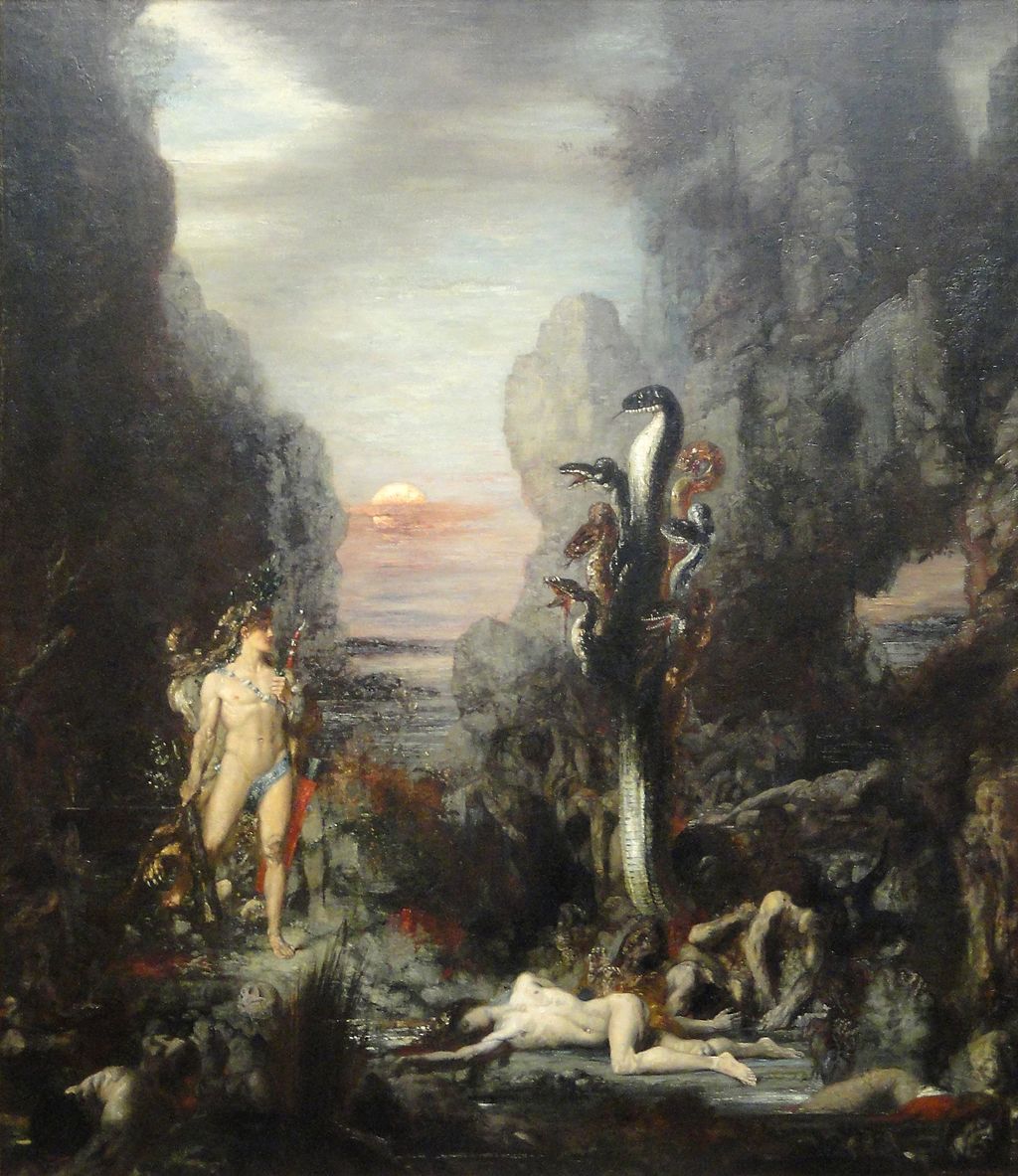
Hercules and the Lernaean Hydra, 1875-1876, by Gustave Moreau – Art Institute of Chicago

I believe that one’s expectations are crucial in determining success. I have noticed that with each article I write, I tend to push myself to do better and aim higher, which might be good. (I must thank YOU, all my lovely friends, who inspired me so much).🙏💖🙏
But, I have also realized that sometimes I may have gone too far, just like Icarus, whose wings melted in the sun’s rays and fell. This is where the book ‘Great Expectations’ by Charles Dickens becomes relevant. We must be honest with ourselves and know where we stand.
Ultimately, happiness is not an unachievable goal but a state of inner peace and calmness.

Hence, I decided to come down and take it more easily. Although this new post is from Nietzsche, as I stumbled upon lately, it is a short text and relevant today: losing the child inside us! This child gives us the imagination to have fantasies. Nietzsche noticed it centuries ago, and it is didactic.

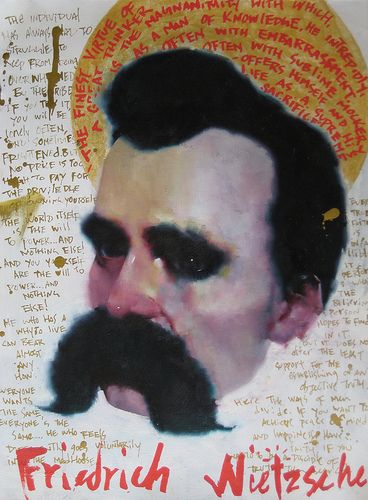
Artwork at the top: Farzad Golpayegani – Beautiful Bizarre artist directory

Illustration by
Akira Beard

The Free Spirit, from Beyond Good and Evil, par. 31, by Friedrich Nitzsche

I had to work on translation to make Nietzsche’s complex grammar more understandable!😉

At a young age, one worships and despises without that art of nuance, which is the best gain in life, and one has to pay a fair amount of punishment for having attacked people and things with Yes and No in this way. Everything is set up so that the worst of all tastes, the taste for the unconditional, is cruelly fooled and abused until people learn to put a little art into their feelings and rather dare to try something artistic, like the right ones do Artists of Life do. The anger and awe that characterizes youth does not seem to rest until it has manipulated people and things so that it can be vented on them – youth is itself something more counterfeit and deceitful. Later, when the young soul, tormented by loud disappointments, finally turns back suspiciously on itself, still hot and wild, even in its suspicion and remorse: How angry they are now, tearing themselves apart impatiently, how taking revenge for their long self-delusion as if they had been voluntary blindness! In this transition, one punishes oneself by distrusting the feelings; one tortures one’s enthusiasm through doubt; one even feels one’s good conscience as a danger, as it were as a self-concealment and a weariness of one’s finer honesty; and above all, they take orientation, fundamentally oriented against ‘youth’. – A decade later, they realize that all of this was still -youth!