
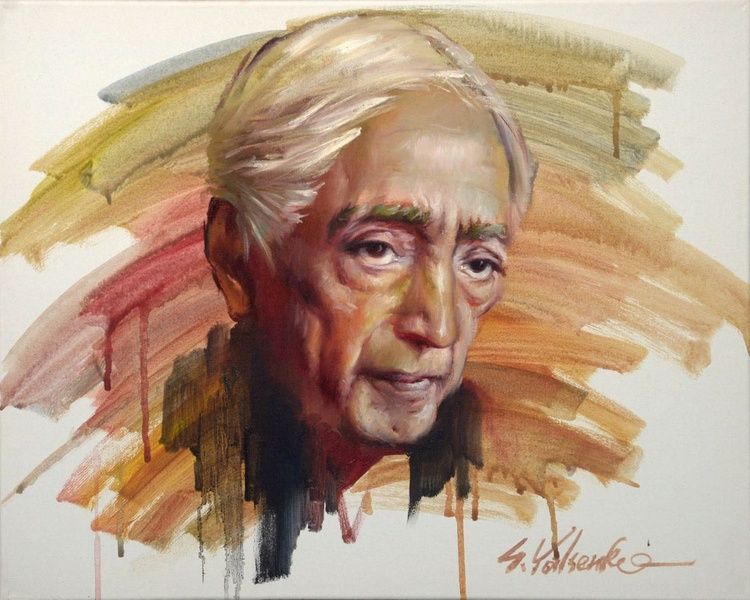
I think it’s time to set aside our current critical perspective on life for a moment and take a deeper look. Jiddu Krishnamurti can gently guide us and help us see things anew.
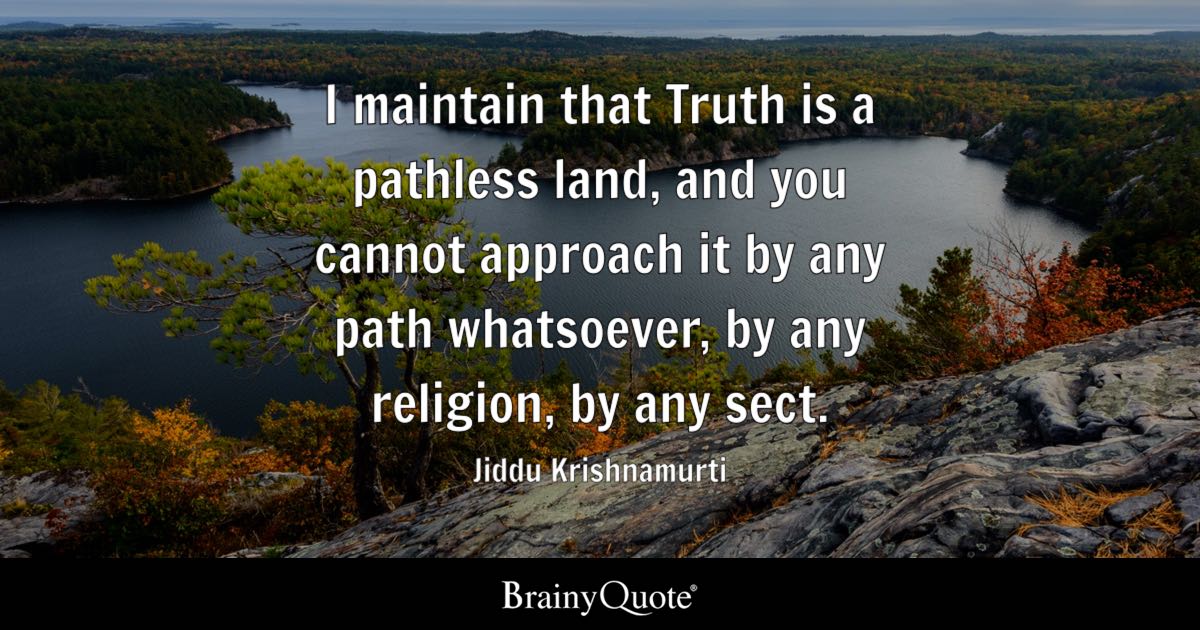
Jiddu Krishnamurti (1895-1986) was a prominent spiritual teacher and philosopher, famous for his rejection of organised religion, gurus, and spiritual authorities, including his own. Born in colonial India, his life changed when members of the Theosophical Society recognised him as the expected “World Teacher.” In 1929, at age 34, he disbanded his organisation, stating that “truth is a pathless land” and no belief system ensures understanding. Over more than sixty years, Krishnamurti travelled globally, giving talks on the mind, consciousness, and suffering. His teachings emphasised direct observation and awareness, urging questioning of authority to achieve psychological freedom. He believed that the separation between the observer and the observed causes conflict. He encouraged living without fear, exploring love and relationships, and transforming consciousness. His legacy includes books, talks, and schools, inspiring individuals to seek truth from within rather than externally.
Jiddu Krishnamurti’s Parables and Poems
Jiddu Krishnamurti’s parables and poems are central to his teachings, offering glimpses of truth through imagery and metaphor rather than through direct argument. These works appeal to intuition and feeling, promoting immediate perception, often inspired by nature—such as a flower blooming or a bird flying—while highlighting his core idea that truth is perceived directly rather than through thought or belief. They do not explain but point, creating space for sudden insights beyond words. His poems share this sense of immediacy; they are simple, unembellished, emerging from attentive presence—watching, listening, and being aware. Their language is calm, observing without a separate observer, often dissolving the boundary between seer and seen, reflecting his teaching that authentic perception occurs only when the self is absent. These works are essential because they echo his main message: transformation arises through direct insight, not through knowledge. Instead of enriching conceptual understanding, they invite us to set aside concepts, to observe, listen, and remain present without interpretation. His literary works might be his most genuine expression—offering not solutions but gateways to experience.
Once upon a time, when there was great understanding and in a world full of rejoicing, there lived a gentlewoman full of years. One day, she found herself in a temple before an altar made by human hands. She was crying bitterly to heaven, and none was there to comfort her, till in the long last, a friend of God took notice of her and asked the reason for her tears. “God must have forgotten me. My husband is gracious and well. My children are full and strong. Many servants are there to care for us. All things are well with me, and mine own. God has forgotten us.” The friend of God replied, “God never forgets His children.” When she came home, she found her son dead. She
never cried. “God remembers me and mine own.”
Every step we take in life lays the foundation for the experiences we gather. Krishnamurti soon recognised these and attempted to share his experience with us.
A HYMN
I have stood in Thy holy presence. I have seen the splendour of Thy face. I prostrate at Thy sacred feet. I kiss the hem of Thy garment, I have felt the glory of Thy beauty. I have seen Thy serene look.
Thy wisdom has opened my closed eyes. Thine eternal peace has transfigured me.
Thy tenderness, the tenderness of a mother to her child,
The teacher to his pupil, I have felt.
Thy compassion for all things, living and non-living, the animate and inanimate, I have felt.
Thy joy, indescribable, has thrilled me.
Thy voice has opened in me many voices.
Thy touch has awakened my heart. Thine eyes have opened mine eyes.
Thy glory has kindled the glory in me.
Master of Masters, I have longed, yea, yearned for this happy hour, when I should stand in Thy holy presence.
At last, it has been granted unto me.
I am happy. I am peaceful, peaceful as the bottom of a deep, blue lake. I am calm, calm as the snow-clad mountain-top above the storm clouds.
I have longed for this hour; it has come.
I shall follow humbly in Thy footsteps along that path
which Thy holy feet have trodden. I shall humbly serve the world, the world for which
Thou hast suffered, sacrificed and toiled. I shall bring that peace into the world. I have longed for this happy hour; it has come.
Thine image is in mine heart.
Thy compassion is burning in me.
Thy wisdom guides me.
Thy peace enlightens me.
Thy tenderness has given me the power to sacrifice.
Thy love has given me energy.
Thy glory pervades my entire being.
I have yearned for this hour; it has come, in all the
splendour of a glorious spring. I am as young as the youngest. I am as old as the oldest.
I am happy as a blind lover, for I have found my love. I have seen.
I can never be blind, though a thousand years pass. I have seen Thy divine face everywhere, in the stone, in the blade of grass, in the giant pines of the forest,
in the reptile, in the Hon, in the criminal, in the saint. I have longed for this magnificent moment; it came and
I have grasped it.
I have stood in Thy presence.
I have seen the splendour of Thy face.
I prostrate at Thy sacred feet.
I kiss the hem of Thy garment.
Thanks a lot for visiting and for your time in reading! 🙏💖🙏
 lampmagician
You must be logged in to post a comment.