As the ape tracked down the tree and lost its sharp teeth and hair, invented the cloth to hide his/her naked body and later, invented the mask to hide his/her naked soul. 🙏💖
The American psychologist William James, coined the expression stream of consciousness to define the chaotic sequence of thoughts of the conscious mind, a flow, which has no boundaries and cannot be stopped except by sleep. That is the truest, uncensored part of ourselves. When our thoughts become audible words, in fact, we use the filter of convenience and social convention, thus, wearing the mask of propriety, we become a “persona”, which was for modernist artists a less interesting subject than that unconstrained current, as it lacked in authenticity. Virginia Woolf in her essay Mr Bennett and Mrs Brown says:
Mr. Bennett says that it is only if the characters are real that the novel has any chance of surviving. Otherwise, die it must. But, I ask myself, what is reality? And who are the judges of reality?
Reality, we could say, is, therefore, what hides under the many masks we…
One of the most feared creatures of the night is the Werewolf.
This fascinating creature the Werewolf is also known as (Old English: werwulf, “man-wolf”) or occasionally lycanthrope /ˈlaɪkənˌθroʊp/ (Greek: λυκάνθρωπος lukánthrōpos, “wolf-person”) is a mythological or folkloric human with the ability to shape-shift into a wolf.
The lycanthrope is a famous concept in European folklore, existing in several variables, which are related by a common development of a Christian interpretation of underlying European folklore formed in the medieval period. From the early modern period, werewolf beliefs expanded to the New World with colonialism.
Belief in werewolves developed in parallel to the belief in witches, in the course of the Late Middle Ages and the Early Modern period. Similar to the witchcraft trials as a whole, the trial of supposed werewolves emerged in what is now Switzerland (especially the Valais and Vaud) in the early 15th century and spread…
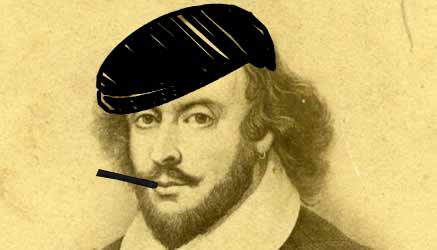
William Shakespeare is the emblem of English literature for sure, but, you know, every time I read his works he seems so familiar to me, so Italian. This is not only because 15 out 37 of his works are set in Italy, he knows the nature of the Italians so well, that some of his immortal lines mirror perfectly some unchangeable traits of our society. An example? In his famous soliloquy “to be or not to be” , he actually seems to be pondering about committing suicide speculating on life and death, but he truly complains about some aspects of society that have the stamp of the Italian character. First of all ” the law’s delay” (it may take more than ten years to see the conclusion of a trial here and in the end you have spent so much money to pay the lawyers to end up…
We have come to use the words “comedy” and “tragedy” very differently than the Greeks, which is who we get those two words from.
For the Greeks, a comedy was any narrative that started darkly – pain, suffering, death, grief – and ended happily – joy, love, marriage, reconciliation, even birth.
A tragedy, on the other hand, ran the opposite direction – from bliss to sorrow, from peace to strife.
Given that definition, the tale of Cupid and Psyche is a comedy.
*
The visual narrative can be found in Greek art dating back to the 4th century B.C.E.; however, we have no extant literary sources until the 2nd century C.E., where it appears as a central chapter in Apuleius’ The Golden Ass. In the same way that his fellow Roman, Ovid, retold (and reinterpreted) Greek myths, this is as close to the source material as we can…
« Chacun de nous tient ses souffrances pour les plus cruelles de toutes »
Traduction approximative :
“Each of us considers his or her sufferings to be the most cruel of all.”
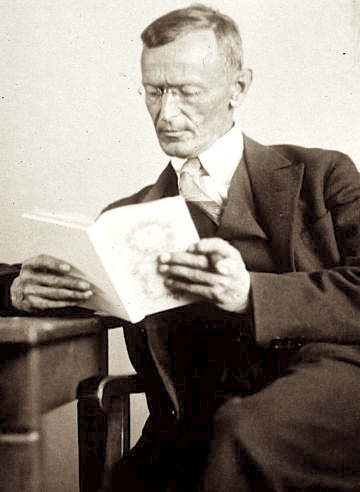
Hermann Hesse (1877 – 1962) est un romancier, essayiste, poète et peintre allemand naturalisé suisse : prix Bauemfeld en 1905, prix Goethe en 1946, prix Nobel de littérature en 1946. Il a notamment écrit Le Loup des steppes en 1927, chef d’oeuvre de la littérature, interdit sous le régime nazi, Herman Hesse fuira ce régime pour s’installer en Suisse.
There’s no doubt that any thinker is somehow fascinated over this man; Nietzsche. As I once in my youth was interested in Philosophy, after struggling to understand Socrates by Plato, got a book about the story of philosophy; by Will Durant ” William James “Will” Durant ” of course translated in Persian, by Abbas Zirab-Khuii, a great historian and translator in Iran, from Plato to the new world philosophers like William James. You can imagine the situation for a young man about 20 years old, to handle all these new thoughts (for me of course!) and to process with.
Anyway, one of these highly recommended geniuses was Friedrich Nietzsche, who got my not only thoughts but also soul occupied or more engaged to keep thinking about him and to understand this madness!
I adore Socrates and I love Espinoza and I’d stared in front of Schuppenhauer but Nietzsche makes me crazy!! his determination over “Selbstüberwindung” overcome self, or “übermensch” Superman. or his desperation about God’s creation;
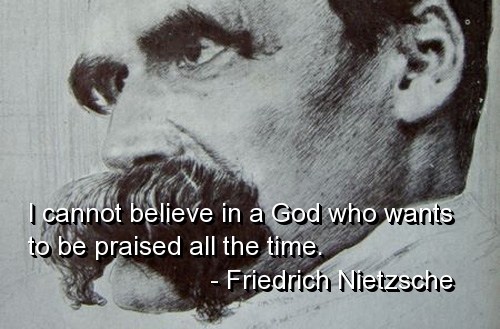
or his doubt of a God who wants to be adored;
or “Sklavenmoral” slave morality. especially the latest; I was and am also against this term; Moral or Morality, this is a social problem! as history tells us, the moral has been changing all through the time especially, in the time of wars in according with the situation. I prefer to use “Conscience” as in German: “Gewissen”; that has nothing to do with the mass, it is individual, it is the self; you with you yourselves conscience, and nobody else.
There’s no shame if you’ve never known how to pronounce Friedrich Nietzsche’s name correctly. Even less if you never remember how to spell it. If these happen to be the case, you may be less than familiar with his philosophy. Let Alain de Botton’s animated School of Life video briefly introduce you, and you’ll never forget how to say it: “Knee Cha.” (As for remembering the spelling, you’re on your own.) You’ll also get a short biography of the disgruntled, dyspeptic German philosopher, who left a promising academic career at the University of Basel in his mid-20s and embarked to the Swiss Alps to write his violently original books in solitude before succumbing to a mental breakdown at 44 when he saw a cart driver beating a horse.
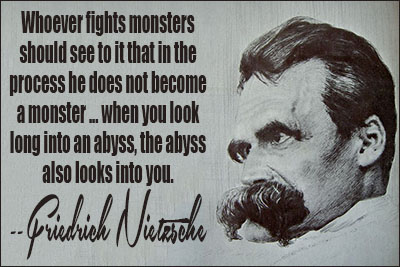
Nietzsche died after remaining almost entirely silent for 11 years. In these years and after his death, thanks to the machinations of his sister Elizabeth, his thought was twisted into a hateful caricature. He has since been rehabilitated from associations with the Nazis, but he still calls up fear and loathing for many people because of his relentless critiques of Christianity and reputation for staring too long into abysses. Maybe we can’t help but hear fascistic overtones in his concept of the ubermensch, and his ideas about slave morality can make for uncomfortable reading. Those steeped in Nietzsche’s thought may not feel that de Botton’s commentary gives these ideas their proper critical due.
Likewise, Nietzsche himself is treated as something of an ubermensch, an approach that pulls him out of his social world. Important figures who had a tremendous impact on his personal and intellectual life—like Arthur Schopenhauer, Richard and Cosima Wagner, Lou Salomé, and Nietzsche’s sister—don’t even receive a mention. But this is a lot to ask from a six-minute summary. De Botton hits some of philosophical highlights and explains some misconceptions. Yes, Nietzsche held no brief for Christianity at all, but this was because it caused tremendous suffering, he thought, by making people morally stunted and bitterly resentful.
Instead, he argued, we should embrace our desires, and use so-called sinful passions like envy to leverage our ambitions. Nietzsche is not a seducer, corrupting the youth with promises of greatness. You may very well fail, he admitted, and fail miserably. But to deny yourself is to never become who you are. Nietzsche scholar Babette Babich has described this aspect of the philosopher’s thought as the ethics of the supportive friend. She quotes David B. Allison, who writes that Nietzsche’s advice comes to us “like a friend who seems to share your every concern—and your aversions and suspicions as well. Like a true friend, he rarely tells you what you should do.”
Except that he often does. Babich also writes about Nietzsche as educator, and indeed he considered education one of the highest human goods, too precious to be squandered on those who do not appreciate it. His philosophy of education is consistent with his views on culture. Since God is Dead, we must replace scripture and liturgy with art, literature, and music. So far, so many a young Nietzsche enthusiast, pursuing their own form of Nietzschean education, will be on board with the philosopher’s program.
But as de Botton also explains, Nietzsche, who turned Dionysus into a philosophical ideal, might have issued one prescription too many for the average college student: no drinking. If that’s too much to stomach, we should at least take seriously that stuff about staring into abysses. Nietzsche meant it as a warning. Instead, writes Peter Prevos at The Horizon of Reason, “we should go beyond staring and bravely leap into the boundless chasm and practice philosophical base jumping.” No matter how much Nietzsche you read, he’s never going to tell you that means. We only become who we are, he suggests, when we figure it on our own.






 lampmagician
You must be logged in to post a comment.