Why is the Red Sea so named?

Standard
The Red Sea – Photo: Ludivine Bourgeois

Worthy to know! With great thanks to Marc Chartier
Also sincerely to Marie Grillot

via; https://egyptophile.blogspot.com/

By playing on the colours of the colour chart, we could also ask ourselves the same question for the Black Sea, the White Sea, the Yellow Sea, the Vermeille Sea … Limit ourselves to the one that bathes the stations of Hurghada, Sharm El- Sheikh, Quseir, Marsa Alam.
The question does not date from today, and the consensus for a possible answer seems to be the responsibility of both historians and specialists in submarine observation.
An overview of a few attempts at explanation over the centuries makes it possible to set the scene and juxtapose various opinions.
The “Journal des sçavants” (sic) published in 1667 begins strongly in the paradox. It reads: “The waters of the White Sea appear black; those of the Black Sea appear white, and those of the Red Sea and the Vermeille Sea do not have these colours in themselves. But the Pont-Euxine has been called the Black Sea because navigation is very dangerous; on the contrary, the Archipelago has been called the White Sea because it is a very safe sea; and for the Red Sea and the Vermeille Sea, they have been so named because of the colour of their sand. “
That to say! Here at the outset, however, a great imbroglio that the “Encyclopédie or Dictionnaire reasoned science, arts and crafts “, ” in 1780, will have some difficulty in disentangling: “It is difficult to know, read- In this publication, where does this name of the Red Sea come from? Pliny, Strabo, and Quinte-Curse advance, without any proof, that this Red Sea, in Greek ‘Erythrea’, was named after a certain king Erythros, who reigned in Arabia. The moderns have in their turn sought several etymologies of this name, the most learned of which are apparently the least true. It is with this sea as with the White Sea, the Blue Sea, the Black Sea, the Vermeille Sea, the Green Sea, etc., chance, fantasy, or some particular event, has produced these bizarre names, which have then provided material for scholarly criticism. It is more important to note that the name of the Red Sea has sometimes been extended to the Persian Gulf and the Indian Sea; In the absence of this attention, the interpreters have resumed very badly about several places of the old authors whom they did not hear.

While partially adopting the previous opinions, the French zoologist and paleontologist Georges Frederic Cuvier (1773-1838), in his “Dictionary of Natural Sciences” (1825), brings some new elements of answer: “The consecrated denominations of Black Sea, sea Blanche, Vermeille Sea, Red Sea, Yellow Sea, etc., do not indicate, as one might think, that the regions of the Ocean which have received these significant names, always present particular colours.
Several of these epithets have been given by motives foreign to the colour of the waters, and others because of certain bodies which are seen in a transient manner, either on the surface of the sea or within it. The Black Sea, for example, appears to have been so-called only because its navigation is dangerous, and it is in opposition that the Orientals have designated the sea of ​​the Archipelago as the White Sea.

According to many others, the name of the Red Sea is only the translation of the Edom Sea or the Edumits, which the Hebrews gave him, ‘Edom’ meaning red in the language of the latter; although the naturalists are more inclined to believe, despite this etymology, that the Red Sea owes its name, as Don Jean de Castro said, to a species of pipe polyp (the ‘tubipora musica’ which covers its rocks and which, as we know, is of a very bright crimson red, or still, as Coock and Marchant think, to myriads of small microscopic crustaceans of a beautiful red, of which they have seen this sea covered during spaces of several leagues.

“In his essay “On the origin of the names Red Sea, White Sea, etc.”, published in 1854 by the Paris Academy of Sciences, the French engineer Charles-Hippolyte de Paravey (1787-1871) sheds new light which will be resumed later by other researchers, including Leopold de Saussure in his article “The origin of the names of Red Sea, the White Sea and the Black Sea”, published by “The Globe. Geneva Geography Magazine “in 1924. This new approach is based on the” geo-chromatic code “inspired by the traditions of distant Asia:” The Academy of alleged causes has been maintained several times, and some seas have been given the name the Red Sea, Yellow Sea, Vermeille Sea, and there are microscopic algae, either red or yellow. I do not deny the existence of these local phenomena, but I come to deny highly that it is because of these momentary phenomena and very little extended, that the various seas have been denominated by the colours yellow, or red, or others. (…) The Yue-ling calendar, composed towards the times of Alexander, and preserved in China, a combined calendar in Assyria, a central country, and not in China, assigns to the north the black colour; in the east, the color green; to the south, the color red; in the west, the color white; and, in the center, the yellow or orange color. (…) If one places oneself towards Palmyra, as centre, and in Syria, central and yellow country, essential meaning of the name of Syria, and which made name the Jaxarte Sir-Daria, or Yellow river, color of wax, at home; then we have, in the north, the Pont-Euxine, hence Black; in the south, the Arabian Gulf, from there Red says; on the east, the Gulf of Persia, named Green Sea, among Orientals; to the west, the Mediterranean, called the White Sea (ac-Thalassa), by all the Orientals. “
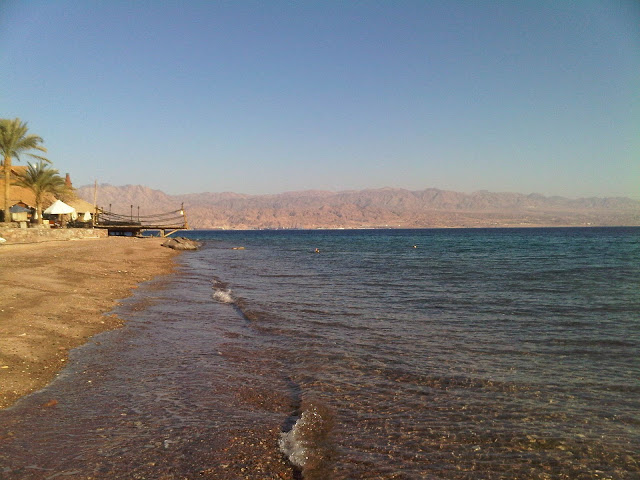
Banks of the Red Sea in Taba

This combination of colours with the cardinal regions, complete Leopold de Saussure, was not considered by the Chinese as arbitrary, but as the expression of the physical laws of nature. Boreal Sea or the Black Sea was (…) for them equivalent terms, as well as Southern Sea and the Red Sea, since black is the colour of the north and darkness as the red is that of the south and the fire (. ..) direct confirmation when I read, in Herodotus, that the Persians call the Red Sea the Southern Sea and that the Tigris and the Euphrates “throw themselves into the Red Sea”. The red colour, as we have seen, is in China the attribute of the south. “

In summary, two main “theses” meet face-to-face, while perhaps complementary, to solve the enigma of the colour attributed to the Red Sea: that of naturalists and that, probably more likely, the Geo-chromatic code. Only variable to bring: the nature of the algae which, according to their evolution, take a reddish or brown colour, because of the presence of a red internal pigment, phycoerythrin. “The red pigments reads in an article of” Futura Planète “(unsigned or dated article), can also have a biological origin.

The Red Sea – photo: Ludivine Bourgeois

In the case of the Red Sea, for example, two cyanobacteria [photosynthetic bacteria] are involved: ‘Trichodesmium Erythraeum’ and ‘Oscillatoria Erythraeum’. The first takes a reddish-brown colour when it dies, and the second contains a red-brown pigment. During an efflorescence (bloom), the concentration of these micro-algae becomes sufficient to dye the sea in red. Other plank-tonic algae can create red tides phenomena in a marine or lacustrine environment, according to the same principle. Some of these algae can be toxic, while others are harmless. It also happens that some bacteria, such as Ferro bacteria, use iron instead of oxygen to ‘breathe’. These microorganisms thus use iron, dissolved or solid, as the electron acceptor. This biological oxidation reaction creates mineral pigments which then colour the water red. “

Whatever the case may be, the Red Sea is renowned, among all diving enthusiasts, for the shimmering colours of its translucent waters with incomparable underwater architecture, including rich coral formations. unparalleled and a very diversified aquatic fauna. Ludivine Bourgeois regularly practices diving in Hurghada, where she graduated “Prevention and Rescue Diver”: “The divers,” she says, “call this underwater universe the world of silence. It is a soothing place, reassuring, of beauty. A world where you feel well. A world that brings me the serenity I need and where I feel free!”
Marc Chartier

Reading The Red Book (9)

Standard

The dream is a little hidden door in the innermost and most secret recesses of the soul, opening into that cosmic night which was psyche long before there was any ego-consciousness, and which will remain psyche no matter how far our ego-consciousness extends.

Carl Jung
🙏💕💖🙏

A Creation Myth From Guinea: Death and His Son-In-Law

Standard

Blackbird singing in the death of night…
a fundamental truth 🙏🙏💖👍

MythCrafts Team's avatarMyth Crafts

Now, we all know that if you have a companion, things can get complicated; when you add a child to the mix, things can easily go from complicated to downright problematic.

This was the issue facing Sa, also known as Death. He, his wife, and his daughter were (apparently) the only beings in creation. Not just that, they were the only “things” in an eternal darkness. Verily, Sa, his wife, and daughter were the only forms in a formless void, beings adrift in the Great Empty.

Sa, however, had Magic on his side; words that could be used to speak existence into being.

“I can fix this”, he thought to himself.

And so, using his incantations, he invoked a river of mud.

Aesthetically pleasing? Probably not.

Practical – well at least for the (non)-time being.

On top of this river of mud, he built a hut big enough for the…

View original post 1,000 more words

#lessons learned from @CorneliaFunke and #GuillermodelToro: #write a #fairytale to enrich the #history of your #story.

Standard

Fairytales for ever ❤❤🙏👍⚘❤❤

jeanleesworld's avatarJean Lee's World

Once upon a time, when magic did not hide from human eyes as thoroughly as it does today…

“The Mill That Lost Its Pond”

You know the words.

Once upon a time.

So many fairy tales begin this way. Like river stones bridging shores, we travel with those words from our world to another, eager to see what lies beyond.

Filmmaker Guillermo del Toro has been luring his audiences to cross reality’s river for years, but this summer he and author Cornelia Funke did more than lure us over the river. They led us through the hills past Grandmother’s house into a forest where past and present seemingly grow as one.

According to IndieWire,del Toro had wanted to expand on the folklore within his fantasy film Pan’s Labyrinth, and I’m so very glad he did. The book’s a beautiful reading experience from cover…

View original post 1,626 more words

Leonard Cohen

Standard

Happy birthday old chap and companion 🙏💖💖🙏

luisa zambrotta's avatarwords and music and stories

Leonard_Cohen

Today is Leonard Cohen birthday. The Canadian artist was born in Québec on 21 September 1934.

He began his career as a poet and novelist, then he ventured into music when he was in his thirties, and is now remembered for both his literary works and his musical creations.

The year before his death (7 November 2016),  he began working on a new album, although he was suffering from health problems and intuitively knew that the end was near. This album, which focused on issues like death, God, and humour, was released in October 2016, when Leonard Cohen was dying.

🎵 There is a crack, a crack in everything
That’s how the light gets in. 🎵

“Anthem” (from the 1992 album The Future)

(C’è una breccia, una breccia in ogni cosa
È da lì che entra la luce)

View original post

The Death and what Now!?

Standard

For Whom the Bell Tolls
by John Donne: http://www.yourdailypoem.com/listpoem.jsp?poem_id=2118

No man is an island,
Entire of itself.
Each is a piece of the continent,
A part of the main.
If a clod be washed away by the sea,
Europe is the less.
As well as if a promontory were.
As well as if a manor of thine own
Or of thine friend’s were.
Each man’s death diminishes me,
For I am involved in mankind.
Therefore, send not to know
For whom the bell tolls,
It tolls for thee.”

Please believe me that I don’t want to be a sad messenger here but just an ambassador of faith.

It has just reminded me of this poem, which I and many others would know this from the novel; For Whom the Bell Tolls  by Ernest Hemingway when I got to know the sad news about my wife’s brother who had died the night before.

He was ill I must add this here; he was actually an unlucky boy; born as the last child (my wife has or had ten siblings) of a working-class family, with a humpback and was also epileptic. It was not enough, he had often got hardly beating by drunk father now and then.

Anyway, he’d grown up with his miserable fortune and became also an alcoholic, like his father. When I’ve got to know him I was a professional musician and he became a true fan of mine!

In any case, he’d lived alone in the supervised home almost all his life and after getting some hard psychological seizure, he had brought to a hospital till his last hours.

Of course, his death was not a loss in our life because of fewer connections in the last years, and when I’ve got the news by my wife, I’ve just thought; it was surely as a salvation or redemption for him at last. Truly, I wish I never live in this condition!

It just remembers me when I was in the hospital with my brother in almost a state of coma for about ten days, and I have mentioned in the last day his hands and feet getting thicker, I asked the nurse; what’s happening? His body doesn’t work well anymore, she said. Then I got to the balcony at the very evening to smoke a cigarette; I just tell heartily; Oh my lord, please take him to you. Don’t let his beautiful body get worst, save his beautiful soul, take him now!

Then, in the same night he’d died. ❤ ❤

Anaxímenes de Mileto.-

Standard

Anaxímenes de Mileto.-

The Air as I arche

Anaximenes puts the air that is an infinite principle as arjé, as the apex of Anaximating; but determined, like Thales water. Air as arche replaces Thales’ water, but at the same time incorporates some of the properties of Anaximander’s Apeiron. In Anaximander, the arche is infinite and indeterminate. For Anaximenes the air, as I arche, is an apex (infinite) but determined.

Anaximenes has probably found in the empirical air a series of properties that would perform better than other elements the functions of arjé.

First of all the invisibility and the infinity of the air. According to news from Hipólito (Ref. I 7, 3), the air “when it is perfect is imperceptible to the eye”. The air is infinite but determined. But the determination of air is more abstract to the senses than that of water: it is invisible like the apex.

Secondly, the air has a divine character (“Anaximenes says that the air is a god”, Aecio, I 7, 13) and is compared to the soul. The air is related since ancient times with the psychic powers (Aecio, I 3, 4): “Just as our soul (yuch ‘) being air keeps us together, so also the breath (pneûma) or air encompasses the entire cosmos”.

The two opposites (hot and cold) that Anaximander extracted from the abrupt ex-Apeiron, Anaximenes builds them through condensation and rarefaction: «the compressed and condensed is cold, and the weird and lax is hot (Plutarch, Frigid cousin, 7, 947 F.

Aquileana's avatar⚡️La Audacia de Aquiles⚡️

El Aire como arjé

Anaxímenes pone como arjé el aire que es un principio infinito, como el ápeiron de Anaximando; pero determinado, como el agua de Tales. El aire como arjé sustituye al agua de Tales, pero a la vez incorpora alguna de las propiedades del ápeiron de Anaximandro. En Anaximandro el arjé es infinito e indeterminado. Para Anaxímenes el aire, como arjé, es un ápeiron (infinito) pero determinado.

Probablemente Anaxímenes haya encontrado  en el aire empírico una serie de propiedades que desempeñarían mejor que otros elementos las funciones de arjé.

En primer lugar la invisibilidad y la infinitud del aire. Según noticia de Hipólito (Ref. I 7, 3) el aire “cuando es perfecto es imperceptible a la vista”. El aire es infinito pero determinado. Pero la determinación del aire es más abstracta a los sentidos que la del agua: es invisible como el ápeiron.

En segundo lugar…

View original post 118 more words

Empédocles de Agrigento.-

Standard

Agrigento Empedocles.-

“Happy of him who obtained the wealth of divine thoughts, miserable, on the other hand, he who is only occupied by an obscure opinion about the gods” (frag.132; Péri Physeos).

Love/Hate

The world for Empedocles is settled between Love, Hate, phase in which the separation of the elements predominates.“These elements never cease their continuous change. Sometimes they unite under the influence of Love and in this way everything becomes the One. Other times they disintegrate by the hostile force of Hate and have an unstable life. ” (Fr. 17)
The cosmic cycle consists of four stages, two extremes represented by triumph, be it of friendship, be it of discord, and two intermediates, of transition from one to discord; or vice versa: “Something double I will say: Once it grew to be One only from many, and again it separated from many to be one” (frag. 17). It is, therefore, the two cosmic forces of “Love and Hate” that move the elements. The movement of composing and dissolving cyclic“All of this occurs through a double cycle of history, both of the world and of living beings; “Double is the generation of mortal beings, double their disappearance” (frag. 17).
This cyclicity, so specifically archaic, is shown, according to Empédocles, in the future of the world (kosmos), which presents a clear Heraclitean influence. But, by demand of his own reasoning, with an obvious Parmenidean influence, he will sustain eternity and immutability of being.

Aquileana's avatar⚡️La Audacia de Aquiles⚡️

 “Felíz de aquél que obtuvo la riqueza de los pensamientos divinos, miserable, en cambio, aquel a quien sólo lo ocupa una obscura opinión sobre los dioses” (frag.132; Péri Physeos). 

Amor/Odio 

El mundo para Empédocles se dirime entre el Amor, el Odio, fase en la que predomina la separación de los elementos.
“Estos elementos nunca cesan su continuo cambio. En ocasiones se unen bajo la influencia del Amor y de este modo todo deviene lo Uno. Otras veces se disgregan por la fuerza hostil del Odio y tienen una vida inestable”.  (Fr. 17)
El ciclo cósmico consta de cuatro etapas, dos extremas representadas por el triunfo, sea de la amistad, sea de la discordia, y dos intermedias, de transición de lo uno a la discordia; o viceversa: “Algo doble diré: Una vez creció hasta ser Uno solo desde muchos, y otra vez se separó desde muchos…

View original post 117 more words