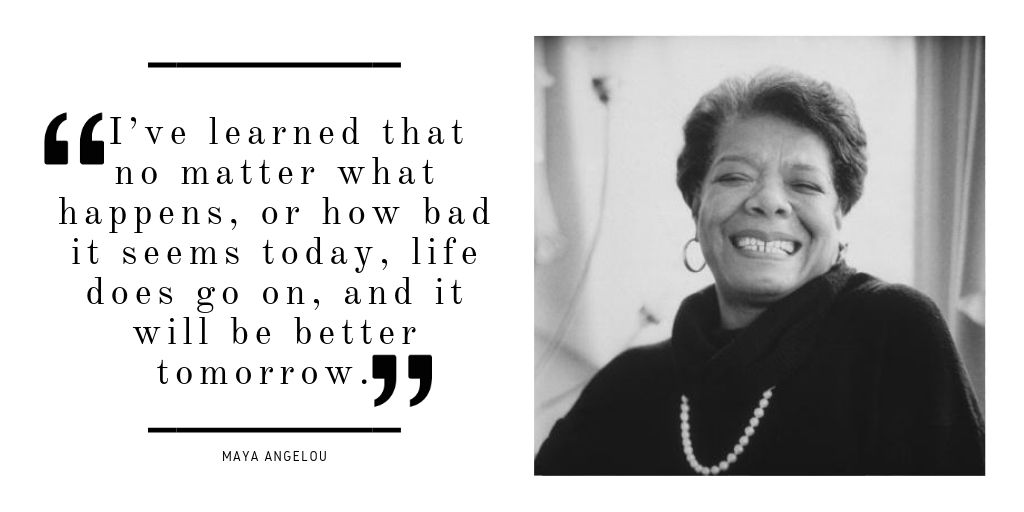
Amen! What great advice in our situation these days. I must confess that I know her newly by the media and not in her lifetime. But as the German says: später besser als nie (later better than never.) Yes, I know her now and stunned how wise she was (is), we can feel her wisdom in her poets, and her books. Let’s read her thoughts, her wisdom, and her poet. With a great thank to https://searchingthemeaningoflife.wordpress.com/ 🙏🙏💖
Maya Angelou was an American poet, memoirist, and civil rights activist. She published seven autobiographies, three books of essays, several books of poetry, and is credited with a list of plays, movies, and television shows spanning over 50 years. She received dozens of awards and more than 50 honorary degrees. Wikipedia
You can write me in history With your bitter, crooked lies You can drag me into the dirt itself But still, like dust, I will climb high.
Does my euphoria upset you? Why do you surround me with darkness? Maybe why do I walk like I own oil wells that overflow from my living room?
Just like the moons and like the suns With the certainty of the tide Just like the hopes that come from above I will still rise .
Did you want to see me break? Covered head and lowered eyes? Shoulders falling down like tears Weak from my angry screams?
Does my tall stature offend you? Do not you find it very difficult That I laugh like I have gold mines Digging in my backyard?
You can shoot me with your words You can slaughter me with your eyes You can kill me with your hatred But still, like air, I will rise high.
Does my sexuality bother you? Are you surprised Where I dance like wearing diamonds The moment my thighs merge?
Beyond the huts of the shame of history I rise Over a past rooted in pain I rise I am a black ocean, wavy and open Exhaling I grow up and withstand the tide
Leaving behind nights of fear and terror I rise In a sunset that is wonderfully bright I rise Carrying the gifts that my ancestors bequeathed to me I am the dream and the hope of the slave. I rise I rise I rise
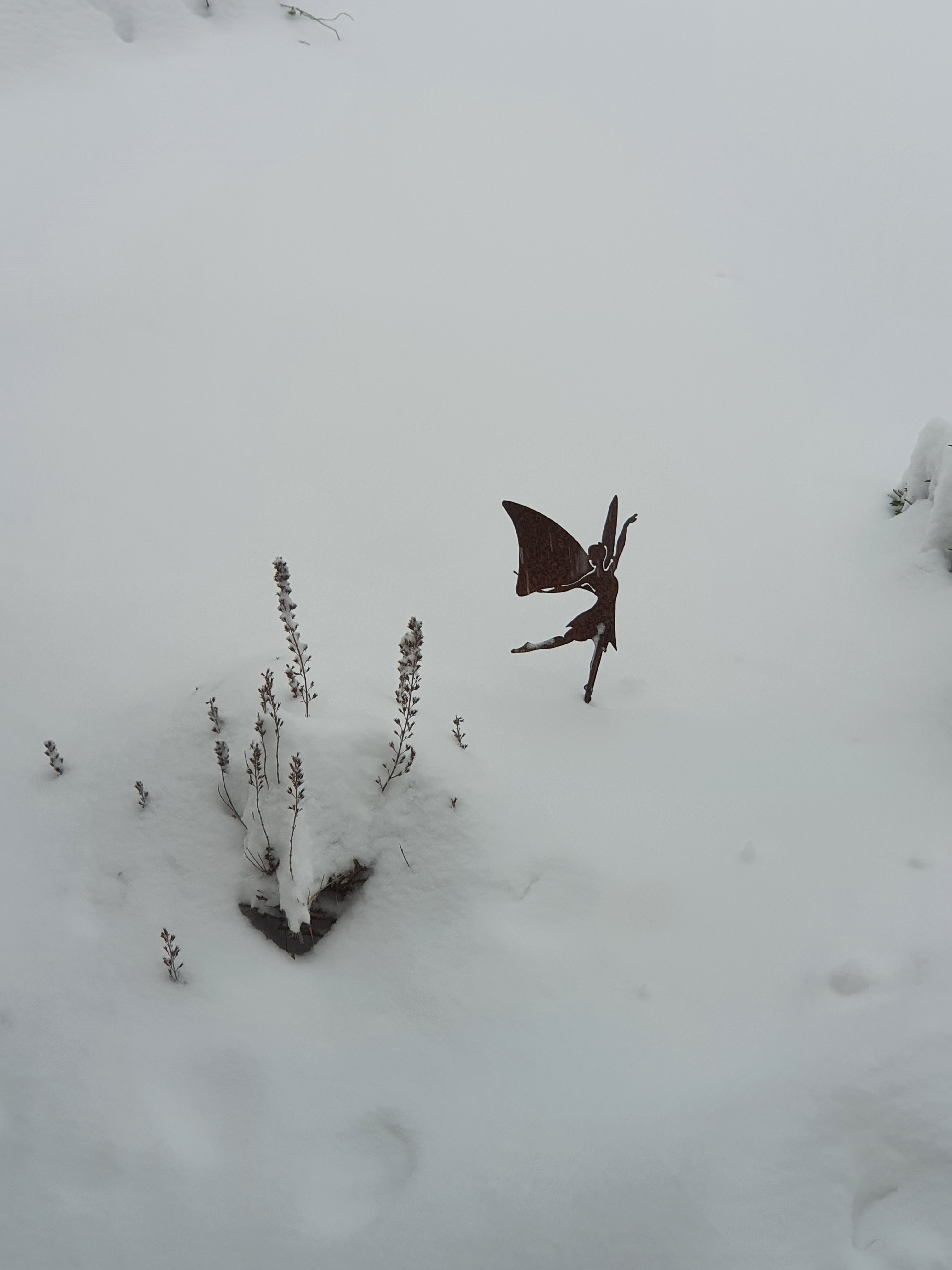
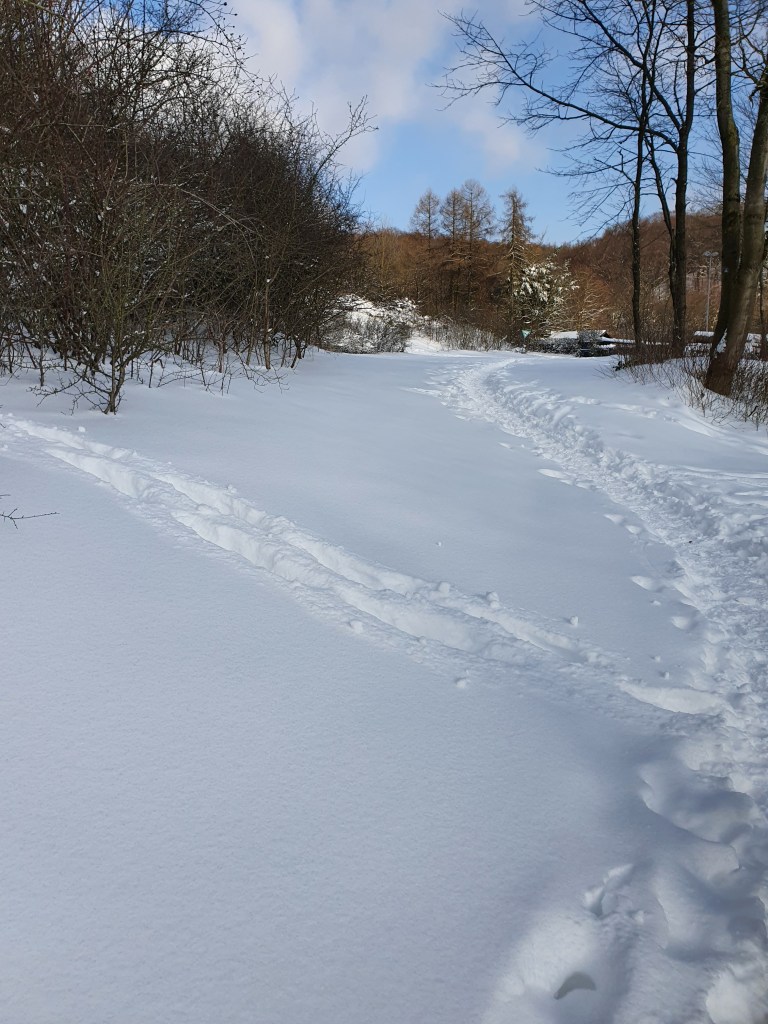
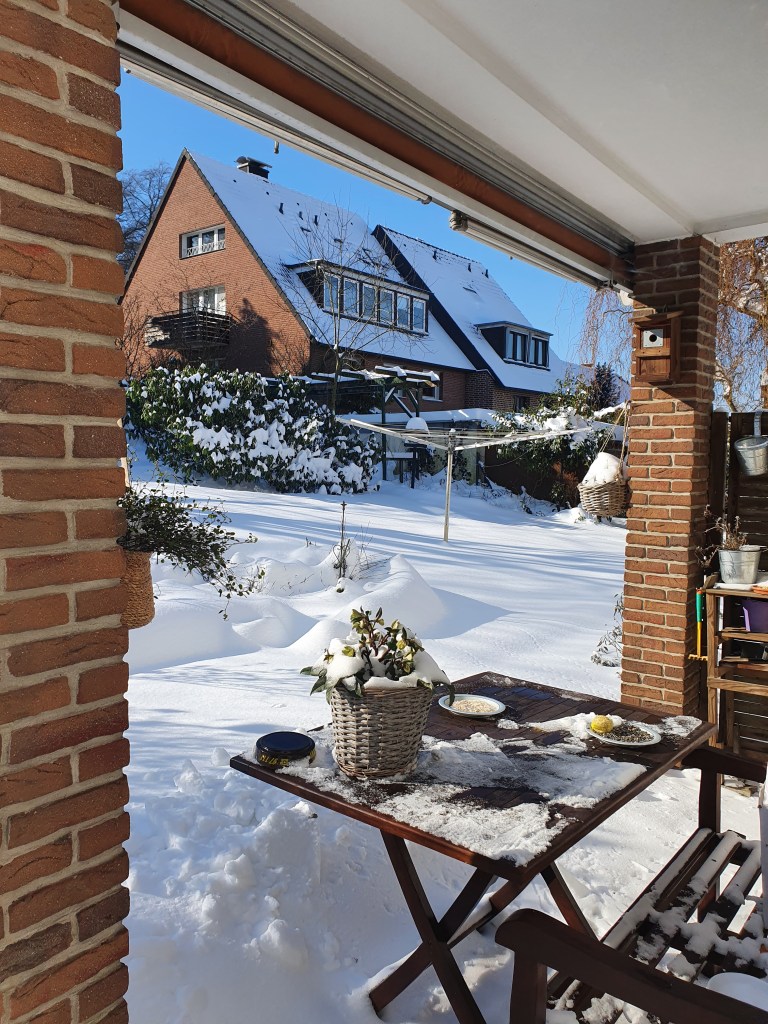
It might be not a phenomenal issue to get so much snow. I know there are many countries in which snowing every winter a great deal, and have eminently cold weather; like Canada, as I’ve heard it goes to ca. -45 degrees Celsius. But for us in Europe, It became rarer in the last decades and even worse in the latest years as it was mostly rainy and stormy. But this year it seems that nature finds her way back to her old manner (because of Corona?). For example, a winter as you would expect, with all the trimmings and with its beauty for sure.
The weather has become fickle. We notice it whenever we look out of the window; it is running somehow crazy. There is no doubt that the climate is changing.
Of course, I don’t want to discuss the scientific reasons; why is it so, or who is guilty. I only do believe in this changing. As we can see in the History of Earth and Meteorology, these changes have been happening since the Earth exists and it is a fact!
And another fact is that I believe we humans are separating us farther away from mother nature. In the beginning, we weren’t so, it may be caused by our progress in technology, (I don’t want to use the word; “Civilization” because,to be civilized means to me, being human intelligent, and not the sort of artificial.) to make a more artificial life for humans; who mostly are the laziest and the most comfortable creatures! I do my best not to belong to that sort, here is the proof; another walk into the snowy cold but the hearty warm beauty. 😉😅
It might be not like in California for sure, but might be a dream, like California Dreamin’. 🤗
Long ago, I have seen a movie named Dersu Uzala. I don’t know if you have seen it too. A story of a man, a human who belonged to nature, or he was an ingredient of nature. it’s a calm narrative of life, with its high and low into the end. Let’s read the story:
The film is based on the 1923 memoir Dersu Uzala (which was named after the native trapper) by Russian explorer Vladimir Arsenyev, about his exploration of the Sikhote-Alin region of the Russian Far East over the course of multiple expeditions in the early 20th century. It shot almost entirely outdoors in the Russian Far East wilderness; the film explores the theme of a native of the forests, who is fully integrated into his environment, leading a style of life that will inevitably be destroyed by the advance of civilization. It is also about the growth of respect and deep friendship between two men of profoundly different backgrounds, and about the difficulty of coping with the loss of strength and ability that comes with old age. Dersu Uzala, from 1975 by Akira Kurosawa http://Akira Kurosawahttp://Dersu Uzala (1975 film) – Wikipedia
To be such a person like Dersu Uzala means to observe more our environment, more listen to nature, the wind, the trees, the birds, open-mindedly.
To put it bluntly, I am not a freaky vegan or someone who wherever he sees a tree, wants to hug it. I always try to use everything more naturally than using machines and keep my mind creative. I think if we don’t exaggerate, life will be more effortless and make much more fun. Anyway, we can just be waiting and look forward to what will happen next!
They’re maybe not a lot, but a few geniuses as exceptional, leave weight in our history: like Mozart, Einstein, Leonardo da Vinci, Jung … And we must add Nikola Tesla in this list too. He is definitely a genius, though remains unknown, somehow! I suppose the reason is that we still don’t understand his brilliant mind.
And I am convinced that some of his ideas still sound like science fiction for us!
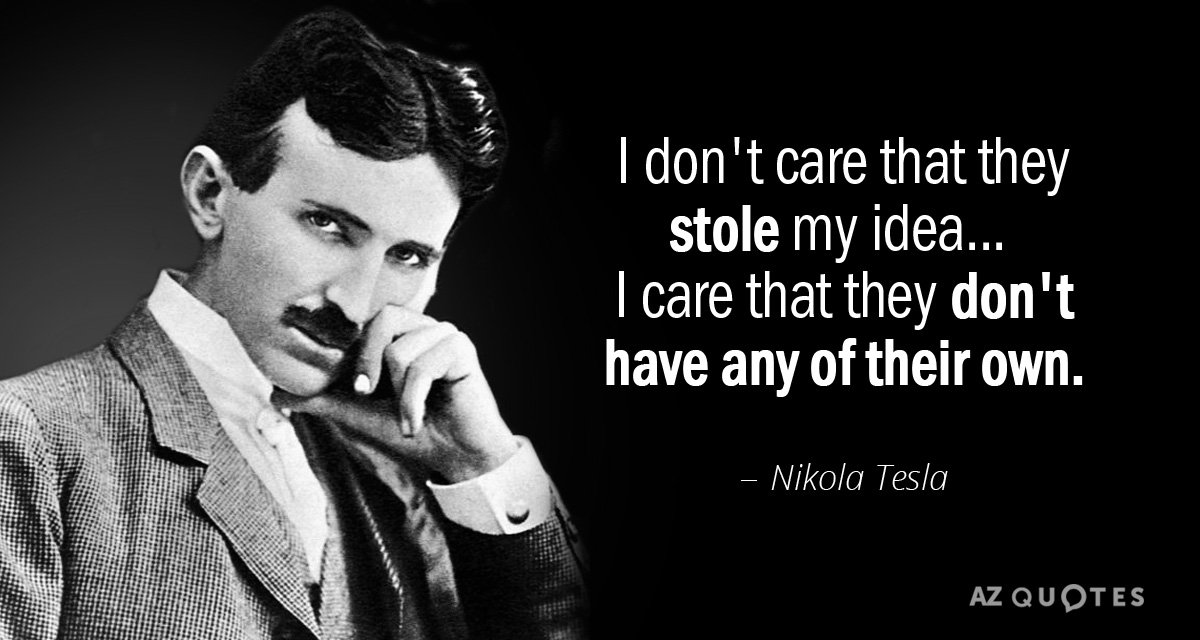
I don’t want to compare Tesla with Edison, as I never do Jung with Freud. But when someone becomes famous in his/her life with ambitious work, there is always a certain conservatism at play which causes to stop when the one reached a certain point. The reason is fear of failure.
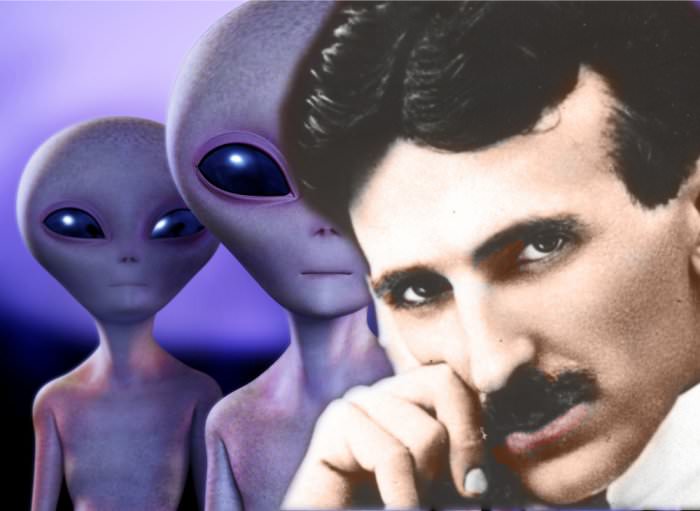
There, we can identify where the ingeniousness between other thinkers and who is the real genius. And Nikola Tesla is one of them without a doubt. But if he had any connection with ETs, or was he one of them? I don’t know. I am only sure that part of us, humans, is not earthy, though a few know about it. 😉
Anyway, I have recently found this old article in my inbox and want to share with you, worth to read. I hope you enjoy it. Have a leisurely weekend. 🤗💖🙏
Nikola Tesla was one of the greatest minds of all time and was considered to be the father of the 21st century. There were rumors that Tesla received his inventions from E.T. sources. Was this the main reason every step Tesla made was monitored by the elite?
Hidden in plain sight
Many devices that we use today contain Tesla’s patents, ideas, concepts. Most people have no idea that Tesla is behind these inventions. However, we rarely hear his name mentioned, especially in school books. His genius was often too much both for ordinary people and the elite. From bankers like JP Morgan to politicians, jealous, scientists, and others, the goal was to not only stop him from bringing these inventions to humanity but to steal them while keeping it out of the public eye.
His research was a threat to everything humanity was allowed to know. Could there have been something hidden about Tesla that was an even bigger threat?
Tesla’s entrance into this world
Tesla’s birth is mentioned in many stories, especially in the region of the Balkans. Tesla was born on July 10th, 1856 in a village in what was then Austro-Hungarian empire which is modern-day Croatia. His mother had a midwife helping her that night when Nikola was about to be born. There was relentless thunder outside. The story goes on to say that the midwife was very scared, but Tesla’s mother told her not to be afraid, that her child would be a very important person. When the midwife started getting used to relentless thunder outside the house, she asked Tesla’s mother how she knew the baby would be a very important person. Tesla’s mother responded that she did not know how but she simply knew.
His very birth was an interesting event because later Tesla literally played with thunder in his experiments and was born during similar circumstances. Just like his mother knew that her child would become an important person, Tesla simply knew what to do and would create complete devices in his mind before experiments. Another interesting thing is that his father was a Serb Orthodox priest and his son was anything but his father in terms of understanding the universe.
Tesla was also born in a region that was not particularly known for anything at that time. If you believe many Tesla followers that Tesla himself was an alien who incarnated in this world, the question is why he chose the family and the region for his birth and why there was such a storm while he was being born.
The period in which Tesla was born coincided with the old Zoharic prophecy about the opening of the gates of wisdom upon the earth. Coincidentally, Einstein was born during this time as well.
Tesla’s childhood
The “genius who lit the world”, as some call him, witnessed a terrible accident at the age of seven. In 1863 Tesla’s brother Danijel was killed in a riding accident. Tesla was in a state of shock and was reported to have started seeing visions. Many people have said that Tesla suffered from lifelong mental illnesses caused by the loss of his brother. A more logical explanation is that this shock served as a trigger in Tesla’s mind (as it happens to many people who witness terrible things) and that it prepared him for the unique way of using his mind.
Tesla’s life was very dramatic. At an early age he showed the superiority of his mind and was fascinated with thunderstorms and lightning. It is possible that this was also caused by the impressions of the storm when he was born. Nikola was fascinated with electricity and was absolutely determined that he would harness the power of the Universe to help humanity.
Tesla’s downloads
In 1882, the idea of a brushless AC motor simply came to him as Tesla was walking. He sketched the images in the sand. That is the first story about how he would simply have an idea in an instant, create the whole design in his head, and then simply start building it from scratch.
When Tesla moved to New York in 1884, he was hired as an engineer at Thomas Edison’s headquarters. Edison was impressed with Tesla and told Tesla he would give him 50 thousand dollars for a better design of his DC dynamos. Tesla experimented for months. However, when he presented his solution, Edison did not give Tesla any money and Tesla quit.
Tesla then decided to work alone and ideas kept coming one after another. In 1887 and 1888 he was granted more than 30 patents for his inventions. George Westinghouse, Edison’s major competitor, was very interested in Tesla’s work. What followed is one of the greatest and strangest stories of all time.
Tesla kept creating more and more, sleeping only two hours at night. Tesla would stay awake 22 hours a day, taking a nap 15 – 20 minutes for every four hours awake. This started when he was very young. When he was studying in Graz, Austria, Tesla became very good at playing billiards. Sometimes he would play more than 48 hours in a stretch. Also, once Tesla worked in his laboratory for 84 hours without any rest or sleep.
To the people around him this was simply incredible. Tesla had unusual amounts of energy and would get complete schematics in an instant. All this and much more points to two possible conclusions: Tesla was an E.T. or Tesla was able to contact them and the invisible realms and that is how he would get his ideas and energy.
Probably the most famous Tesla quote regarding his communication with other realms is:
“My brain is only a receiver. In the Universe there is a core from which we obtain knowledge, strength, and inspiration. I have not penetrated into the secrets of this core, but I know that it exists.“
Tesla openly stated that his brain was a receiver and that the knowledge came from a core. Was he trying to mask the fact that he was communicating with an E.T. race that many say he was a part of? It is possible, but it is certainly much easier to explain his incredible work to the public in this way, saying that he was doing something that Da Vinci and Einstein were also famous for – communication with other realms.
Another quote is very interesting:
“My method is different. I do not rush into actual work. When I get a new idea, I start at once building it up in my imagination and make improvements and operate the device in my mind. When I have gone so far as to embody everything in my invention, every possible improvement I can think of, and when I see no fault anywhere, I put into concrete form the final product of my brain.”
The whole process explained in his words, an invention in his brain without any drawing, experiments, something most people can only dream of, yet so natural to Tesla. Was it possible because he communicated with E.T.’s, other realms, the core as he called it?
Intelligent electrical signals from space
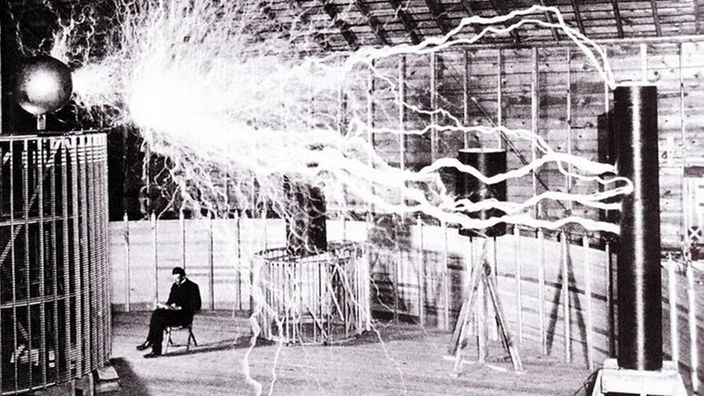
Nikola Tesla built a laboratory in Colorado Springs, Colorado, in 1899, to experiment with high frequency electricity and other phenomena. In that laboratory he received and recorded cosmic radio waves on his sensitive instruments. He announced that he received extraterrestrial radio signals. The scientific community in 1899 did not believe him, because knowledge of cosmic radio signals did not exist at that time.
Here is what Tesla said about the signals:
“I can never forget the first sensations I experienced when it dawned upon me that I had observed something possibly of incalculable consequences to mankind. I felt as though I were present at the birth of a new knowledge or the revelation of a great truth.
My first observations positively terrified me as there was present in them something mysterious, not to say supernatural, and I was alone in my laboratory at night; but at that time the idea of these disturbances being intelligently controlled signals did not yet present itself to me.
The changes I noted were taking place periodically and with such a clear suggestion of number and order that they were not traceable to any cause known to me. I was familiar, of course, with such electrical disturbances as are produced by the sun, Aurora Borealis, and earth currents, and I was as sure as I could be of any fact that these variations were due to none of these causes.
The nature of my experiments precluded the possibility of the changes being produced by atmospheric disturbances, as has been rashly asserted by some. It was sometime afterward when the thought flashed upon my mind that the disturbances I had observed might be due to an intelligent control. Although I could not at the time decipher their meaning, it was impossible for me to think of them as having been entirely accidental. The feeling is constantly growing on me that I had been the first to hear the greeting of one planet to another. A purpose was behind these electrical signals.”
This is very revealing- Tesla openly stated that he had the feeling that he had been the first to hear the greeting of one planet to another. Here Tesla went further and replaced the core that he had mentioned with a direct link with E.T. life. It seems that to an open mind person it cannot be any clearer.
At the time, it was surmised by prominent scientists that Mars would be a likely haven for intelligent life in our solar system, and Tesla at first thought these signals may be originating from the red planet. He would later change this viewpoint as he became more adept at translating the mysterious signals. Near the end of his life, Tesla had developed several inventions that allegedly could send powerful amounts of energy to other planets.
“The signals are too strong to have traveled the great distances from Mars to Earth,” wrote Tesla. “So I am forced to admit to myself that the sources must come from somewhere in nearby space or even the moon. I am certain however, that the creatures that communicate with each other every night are not from Mars, or possibly from any other planet in our solar system.”
Tesla said he had flashes, some kind of light, and then he would get his ideas. He never said that the images in his mind were holographic, but some researchers claim that it was exactly what was going on in his mind. It may have been similar to what computers do today when they create models, rotate them, and analyze all possibilities needed to complete the task.
Tesla wrote letters to friends in which he talked about mysterious signals. He was convinced that the communication was with E.T’s. Tesla was not very popular in those days and many newspapers mocked him for saying that he was in contact with some kind of space intelligence. What the press wrote was almost certainly ordered by those who did not want Tesla to succeed in his intentions. So what better way to belittle him than say that he was a mad scientist who thought he was in contact with aliens? It often works in our so-called modern age, so it definitely worked such a long time ago.
The first clean energy
When speaking of Tesla, we cannot forget about Wardenclyffe Tower that was located in Long Island, New York. The tower was 187 feet to the top and 120 feet into the ground. What Tesla had in mind were various wireless transmitter points all over Earth. Tesla wanted to move energy from one tower to the next wirelessly. No, we are not talking about wireless technology like we have today, which is very toxic and harmful. This was clean energy to be used interplanetary.
Researchers at MIT managed to transmit power wirelessly only 100 years after Tesla and at a much shorter distance. 100 years is a lot of time and it is hard to believe that it took so much time for scientists to imitate Tesla to some extent.
Tesla wanted to give free energy to humanity but the Tower was demolished in 1908. J.P. Morgan was the founder of the project. When he discovered what Tesla’s intentions were, he did everything to stop him. Tesla also invented beam weapons, wireless power transmission, antigravity devices, anti-war shields, and a plethora of other suppressed inventions.
Can we prove that Tesla had contact with alien intelligence? If we take a closer look at what Tesla did, said, and created, we can at least say that he had the ability to tune into the core that he talked about.
His life was full of drama, sci-fi-like stories, synchronicities, and many interesting things and events. But is there proof that Tesla had ET contact? If we accept the fact that we live within the visible light in that tiny fraction of what we call space, we can also accept that some consider our reality to be a projection in our minds. Proof is just in the physical realm that we decode, but Tesla was not limited by visible light. His genius can almost certainly be attributed to his communication with other realms and probably aliens themselves.
Tesla was the most brilliant scientist that Earth has probably ever had, and he was not afraid to say that he believed in spirituality. This is not even common in the science community today. He was a spiritual scientist in communication with other realms and possibly E.T.’s- and left a legacy behind of bewilderment and awe in the true history of humankind.
About the author: Omar Fehimović was born in Sarajevo, Yugoslavia (modern-day Bosnia and Herzegovina) in 1971. At an early age he felt attracted to what we call reality and wanted to know more about it having a strong sensation that our reality was not what most people thought it was. During his elementary school days he felt a strong connection to the English language and Nikola Tesla, the electric genius who was born not far from where Omar was born. He became interested in the occult and esoteric having read so much about Tesla and he started researching many subjects in his 20s. Having become proficient in English at a very early age, he was able to expand his knowledge even more. In 2009 he became a free-lance interpreter, continuing his research in his free time. The current focus of his research is hidden meanings in the English language and modern culture, the Saturn-Moon Matrix and the afterlife. He can be contacted at his e-mail: sarajevo1971@yahoo.com or on Facebook: Omar Fehimović
In5D PATREON: https://www.patreon.com/in5d See our In5D articles the day before they’re released, AD FREE, on Patreon for a minimal donation!
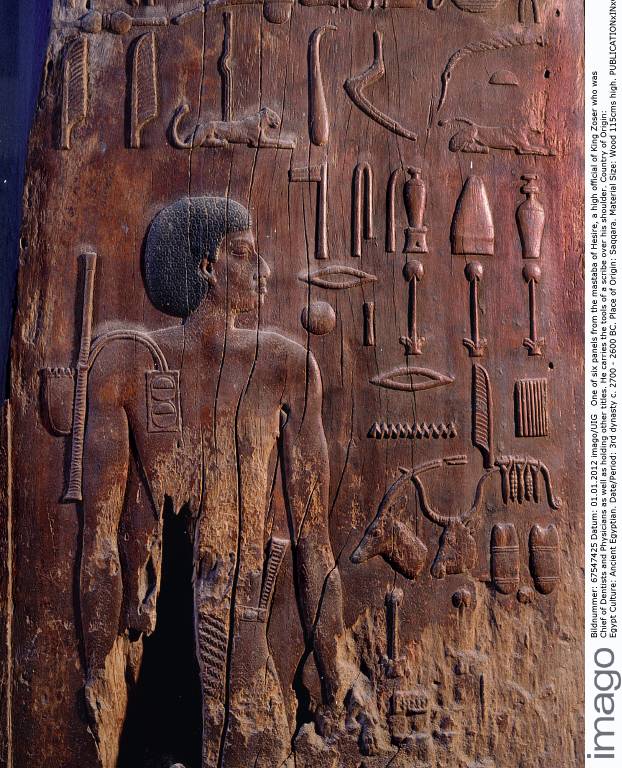
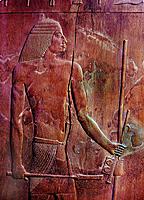
http://Imago Images One of six panels from the mastaba of Hesire, a high official of King Zoser who was Chief of Dentists and Physicians as well as holding other titles. He carries the tools of a scribe over his shoulder. Country of Origin: Egypt Culture: Ancient Egyptian. Date/Period: 3rd dynasty c. 2700 – 2600 BC. Place of Origin: Saqqara. Material Size: Wood 115cms high. PUBLICATIONxINxGERxSUIxAUTxHUNxONLY Copyright: WernerxForman 951_05_55401375 One of Six Panels from The Mastaba of Hesire a High Official of King Zoser Who what Chief of dentists and Physicians As Well As Holding Other titles he carries The Tools of a Scribe Over His Shoulder Country of ORIGIN Egypt Culture Ancient Egyptian Date Period 3rd Dynasty C 2700 2600 BC Place of ORIGIN Saqqara Material Size Wood High PUBLICATIONxINxGERxSUIxAUTxHUNxONLY Copyright WernerxForman 951_05_55401375
This time, we have a special fund in magic Egypt. The Stele on woods! ( decorated Lebanese cedar panels) which, Hesy-re lets to be imported and worked in such quantity.
The Mastaba of Hesy-re is an ancient Egyptian tomb complex in the great necropolis of Saqqara in Egypt. It is the final resting place of the high official Hesy-re, who served in office during the Third Dynasty under King Djoser (Netjerikhet). His large mastaba is renowned for its well-preserved wall paintings and relief panels made from imported Lebanese cedar, which are today considered masterpieces of Old Kingdom wood carving. The mastaba itself is the earliest example of a painted tomb from the Old Kingdom and the only known example from the Third Dynasty. The tomb was excavated by the Egyptologists Auguste Mariette http://Auguste Mariette and James Edward Quibell http://James Edward Quibell.. https://en.wikipedia.org/wiki/Mastaba_of_Hesy-Re
What we have here are six beautiful worked panels of woods. Now let’s read the brilliant description by Marie Grillot, http://Marie Grillot about this fascinating fund. With heartfelt thanks. 🙏💖 via https://egyptophile.blogspot.com/
The wooden panels from the mastaba of Hésiré discovered in 1860 by Auguste Mariette in Saqqarah were exhibited at the Boulaq Museum (ref .: 1037 – 1038 – 1039) Photograph by MM. Delié and Béchard, taken from the Album of the Musée de Boulaq
In 1859, Auguste Mariette returned to Cairo where he was “confirmed at the head of historical monuments and the museum”. His projects are numerous and the sites he is opening in the Delta, in Thebes or Saqqarah, are up to his ambitions. They will bring some very beautiful discoveries. In particular, in 1860, he discovered, in Saqqarah, in the mastaba C8, the statue of Ka-Aper (Kaaper), the very famous Sheikh el-Beled!
The same year, north of the pyramidal complex of Pharaoh Djoser – where 140 mastabas will be unearthed – will be discovered that of Hésiré (Hosi, Hésyra, Hésy-Rê, Hézirê).
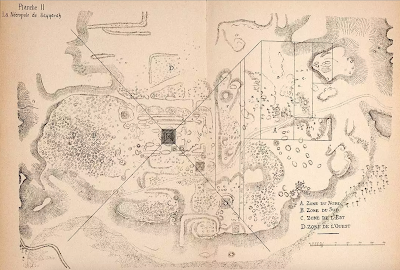
Necropolis of Saqqara – Plan taken from “The Mastabas of the Old Empire”, Auguste Mariette, Paris, 1889
In “The Mastabas of the Old Empire”, Auguste Mariette and Gaston Maspero recall that the mastabas generally consist of: “five parts which are the exterior of the tomb, the interior itself, the serdab, the well, the vault underground”. In this book, the pages devoted specifically to the mastaba of Hesiré – referenced A3 – contain only drawings. No details are given on the exact circumstances of the discovery.
The scribe Hésiré represented on one of the panels of his mastaba discovered in 1860 by Auguste Mariette in Saqqarah Third Dynasty – 2649-2575 BC. J.-C. Cairo Museum – JE 28504 = CG 1426 – CG 1427 – CG 1428
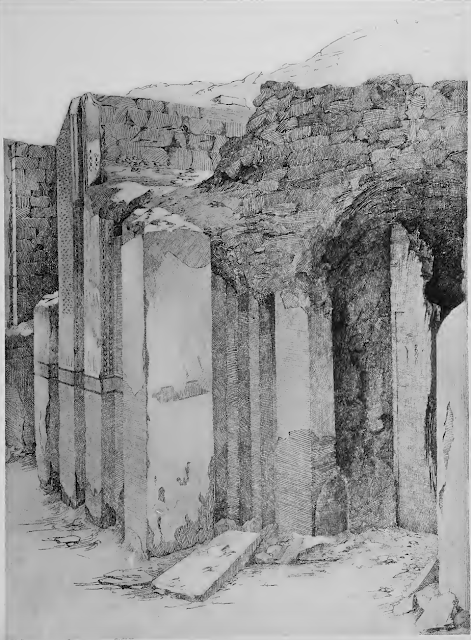
Hesire’s eternal home is dated to the Third Dynasty, around 2700 BC. In its original state, the mastaba was 43 m long, 22 m wide and 5 m high. It was made of hardened mud bricks. The inner and outer walls were completely covered with limestone in white. The structure of the inner chamber consisted of a long corridor and several rooms and chapels. “
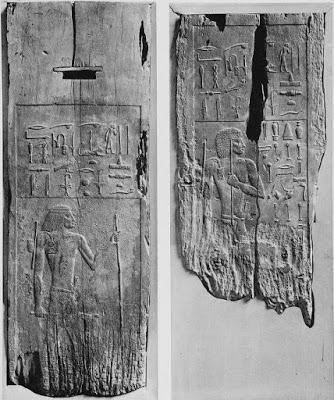
Eleven niches are hollowed out in the west wall: they are decorated with magnificent wooden panels, rectangular, more than a meter high and 40 cm wide. They are sculpted with incomparable precision, finesse and art. These panels were to play: “the role of false doors which represent the deceased in the Hereafter, awaiting his offerings”. They were fixed: “by wedges driven into the upper part of the panels”.
The wooden panels of the mastaba of Hesire discovered in 1860 by Auguste Mariette in Saqqarah Third Dynasty – 2649-2575 BC. J.-C. Cairo Museum – JE 28504 = CG 1426 – CG 1427 – CG 1428
In “Egyptian Art in the Age of the Pyramids”, it is specified that: “the first five were found by Mariette and transported to the museum in 1866”.
Two other wooden panels by Hésiré presented in “Excavations at Saqqara” (1911-1912). The Tomb of Hesy, JE Quibell, Cairo, 1913
A sixth was discovered 45 years later by James Edward Quibell who resumed excavations of the mastaba in 1911-1912. As for the other five, only fragments remained: “which unfortunately he will not take the trouble to save”.
A wooden panel in position, from a pencil drawing by FH Darke “Excavations at Saqqara (1911-1912). The Tomb of Hesy”, JE Quibell, Cairo, 1913
Under the numbers 1037 – 1038 – 1039, three of these panels are presented by Gaston Maspero in the “Visitor’s Guide to the Boulaq Museum”: “These three panels were embedded in as many stelae in the form of a false door. A fourth panel, more mutilated than the others, is exposed (n ° 913) on the kind of shelf which reigns at the back of the room (!). The scribe Hosi, seated or standing, is the only person represented. He has a rough face. , the features accentuated by age: the hieroglyphics carved above his head give us his name and his titles … Inscriptions and figures are cut with extraordinary hand surety: the artist who executed this work did not give it up. nothing to the one who carved the Sheik el-Beled. “
The wooden panels of the mastaba of Hesire discovered in 1860 by Auguste Mariette in Saqqarah Third Dynasty – 2649-2575 BC. J.-C. Boulaq Museum (ref .: 1037 – 1038 – 1039) then Cairo Museum – JE 28504 = CG 1426 – CG 1427 – CG 1428
The panels presented to Boulaq must correspond to those recorded in the Journal of Entries of the Egyptian Museum in Cairo JE 28504, and in the General Catalog CG 1426 – CG 1427 – 1428.
Hesire is represented standing, seated, in various postures, with different wigs or outfits. The panels seem to tell, “in the comic strip”, so many important moments of his life, haloed with the glory of his attributions. The stiffness of the attitude makes one feel with more force the importance of his rank and the solemnity of his functions.
During the Universal Exhibition of 1878, inaugurated on May 1 in Paris, Auguste Mariette will choose to exhibit the three panels. They then constituted the oldest pieces illustrating the pharaonic antiquities presented at the Trocadero Palace.
In the catalogue he will write for this event, “Exposition Universelle de Paris, 1878. The Gallery of Ancient Egypt at the Trocadero retrospective exhibition, brief description, by Auguste Mariette-Bey …”, he will explain about admirably, and with a beautiful sensitivity, the reasons for his choice underlining the exceptional character of the work. “Compared to the style of other monuments of the Old Kingdom, the style of the panels in Egyptian art in fact takes the place of what is called elsewhere the archaic style. The finesse of the engraving, the unusual grouping of hieroglyphics and the rare forms of several of them, the hitherto unique arrangement of the utensils that the character carries in his hands, are in fact distinctive features which show us in the three panels extraordinarily ancient monuments. especially the character of the head, whose bony cheeks and strongly aquiline nose have absolutely nothing that recalls the full face, the round nose, the thick and smiling lips of the other statues of the old Empire. “
On January 25, 2021, the Ministry of Antiquities announced that: “within the general framework of the ‘Launch of the restoration project of the wooden panels of the Egyptian Museum in Tahrir’, under the title ‘Towards new horizons to assess the situation, the restoration and reappearance at the museum ‘, the Egyptian museum launched the restoration project of the wooden panels of Hassi Ra, exhibited on the ground floor of the museum, in cooperation with the French Institute of Oriental Archeology (IFAO). The second phase of the project will consist of the study of their “new exhibition” at the museum, their “reinstallation” having to recall the context of their “original” presentation in the Mastaba …
I see what you don’t see! Do you know this game? It is not so important if you know this play. What I meant with this sentence is what an artist does see and the others not! In this way, I would describe an artist. I don’t want to put myself in this category because I think I still have some to do to achieve that class. But, as I have grown up in a family of artists and lived a long time with an ingrained one (my brother Al), I can understand them well.
In the novel Zorba the Greek, by Nikos Kazantzakis, Zorba asked his writer friend, Basil, “why it happens such brutal and tragic events in our life? You are an intellectual writer, how can you explain it?” Basil answered; We can’t explain why. We only try to reduce the pain by writing thereabout.
An artist, like a writer, or filmmaker or a painter, has an intensive view on events which, many others never notice. That makes the difference. I think that we are all artists, we just have to open our eyes, the eyes in our soul, to understand our environments.
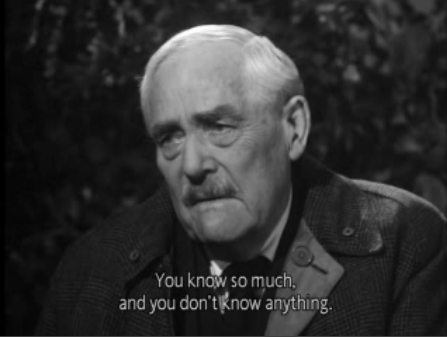
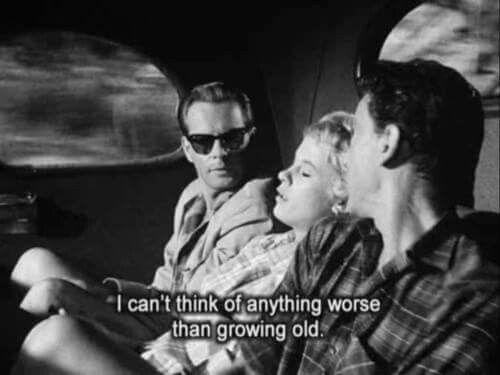
Here, I want to introduce a movie; Wild Strawberries by Ingmar Bergman. He is one of the greatest filmmakers in the history of the movie, and he is also a psychologist as his works all are talking about unknown inside the unconsciousness; the dark side.
Bergman, in this movie, has all the best players by his side; even his teacher Victor Sjöström in the main role. And also Max von Sydow as a gas station attendant in only a few minutes.
The movie begins with a dream, a dream by Isak Borg, a widowed 78-year-old, physician Professor who, specialized in bacteriology. He is stubborn and egotistical and also in his latest years. This scene is in a class of its own;
The movies of Bergman might look inconvenience somehow, or teasing the soul (as I read in some comments here and there), but I think that they are awakening. Digging soul!
When I came to Germany, I tried to share my thoughts and opinion on life with my new friends, and I invited them to watch the movies which I liked, they all were surprised. They said: Oh! that’s how you see life!
Anyhow, what I found in this movie; was what shaped my life. Though, you can not determine the path of your life but, you can learn a lot in every curve, something new, something different. And sometimes, be damned to loneliness.
There does not exist; neither wrong nor right. We act according to our needs.
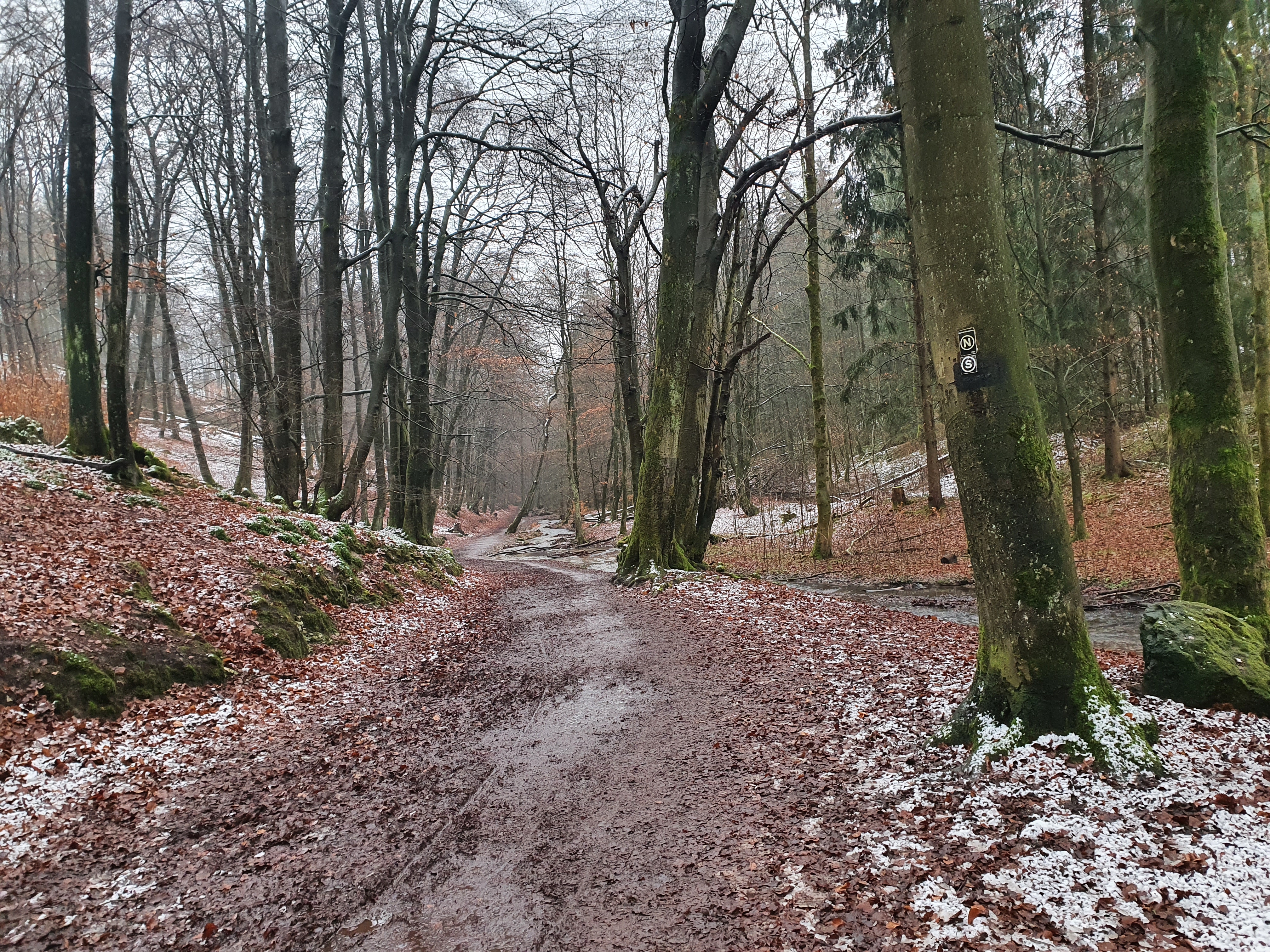
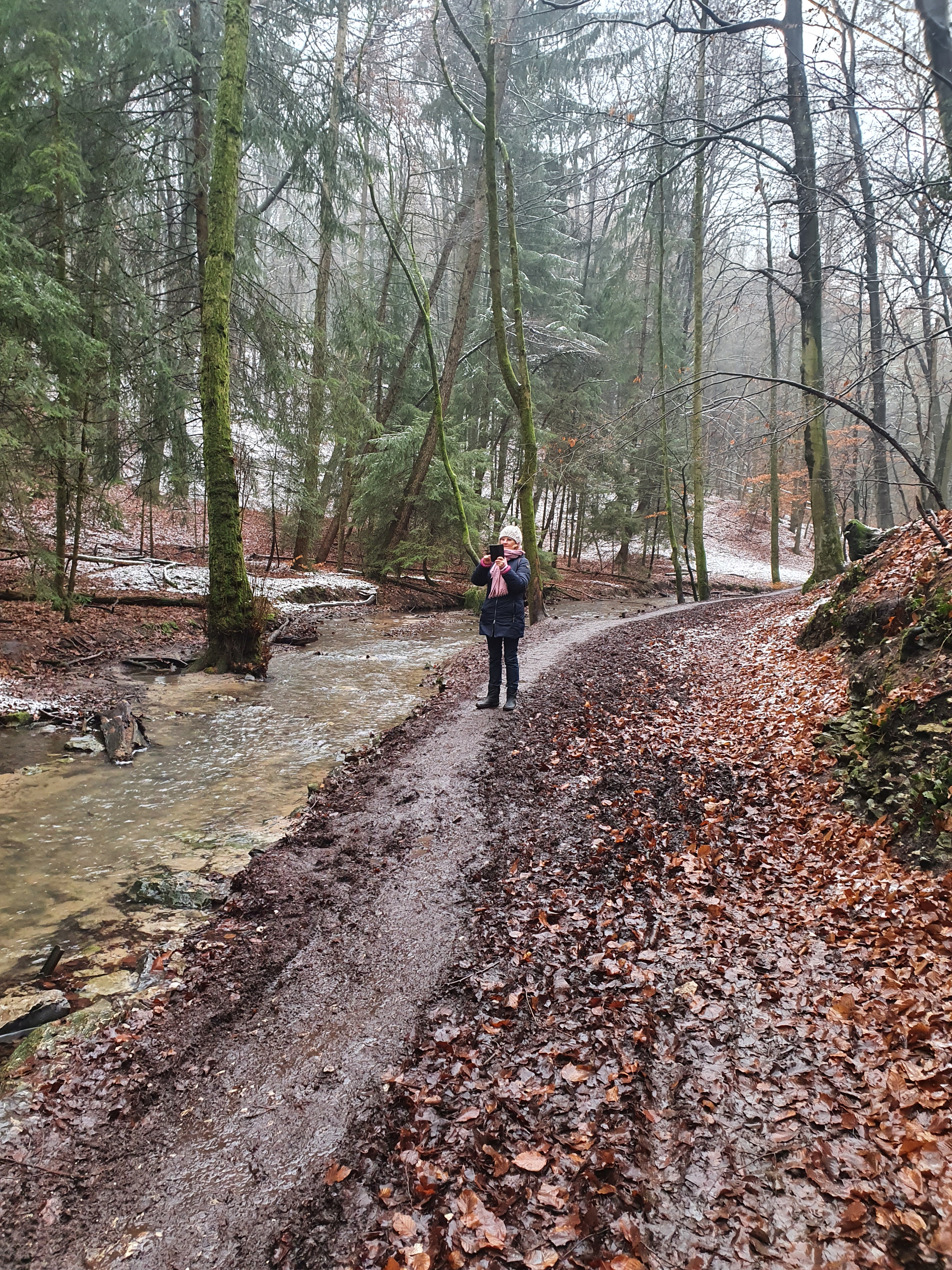
Menkhauser Bach am Teutoburger Wald Menkhauser Bach in the Teutoburg Forest
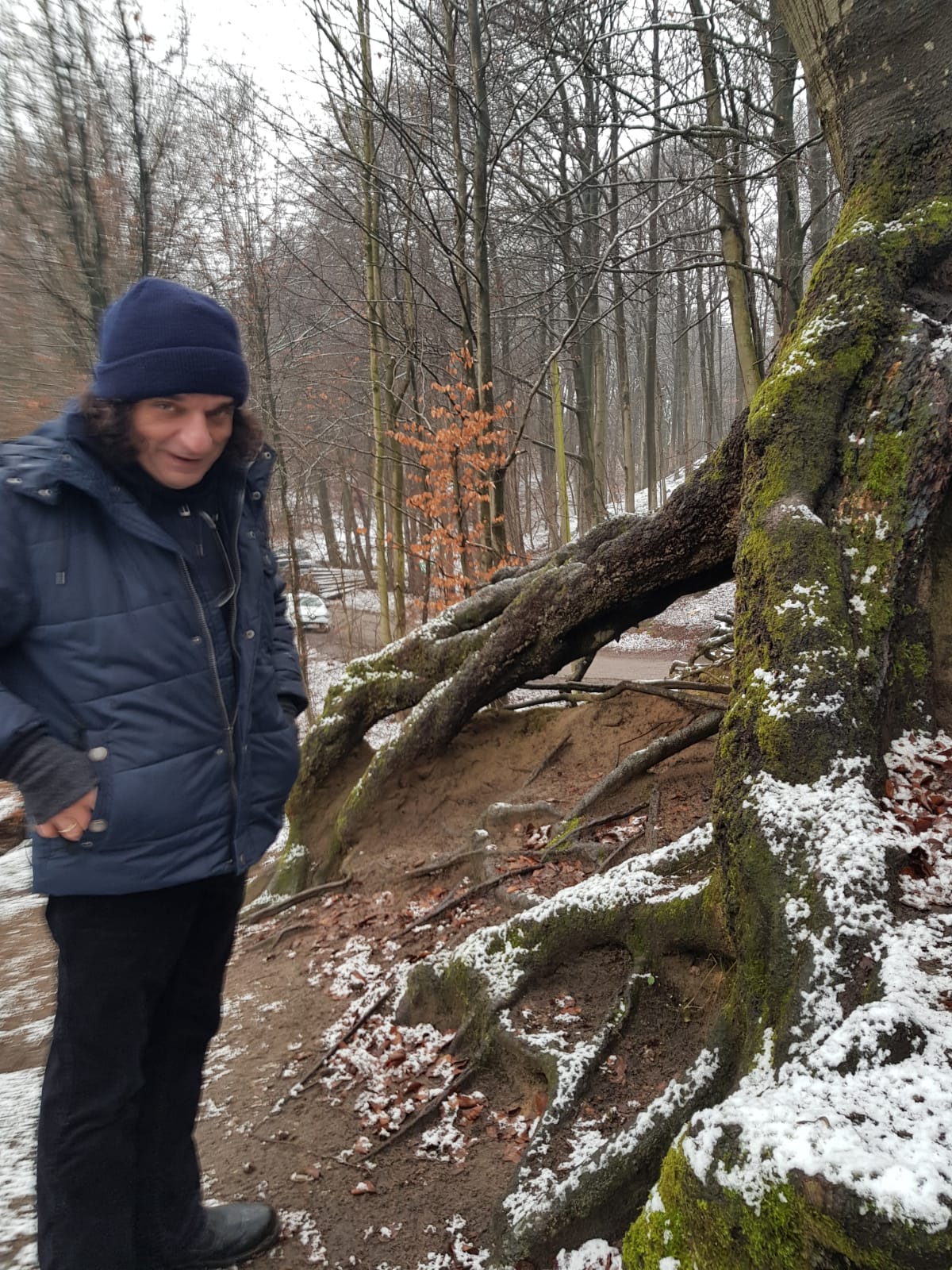
Oh yes! Unbelievable but true: I gave my wife my consent to take a long walk with her! Of course, it was a pleasant walk, although it was cold and wet. I have done it often (a couple of times) despite I admit I’m a little lazy 😉 but, when it comes, I am ready.
That was about three hours walk (ca. 7 Km), of course with many view-pausing included.
Actually, I am not so amused about the town, where I’m living. It is a village which should stay that way, though it always likes to be accepted as a town but, It is a village, and it will remain in the future. That is the worse side, but the better side; is the forest called Teutoburger Wald, which has spread itself on a wide hill, in an area of ca. 4000 square meters (c. 4,000 km² almost all of it included officially in one of two natural parks: 1,220 km²), from the middle towards Northern Germany. That is a good chance for us to catch up this natural park in a few minutes to feel healthier more than ever.
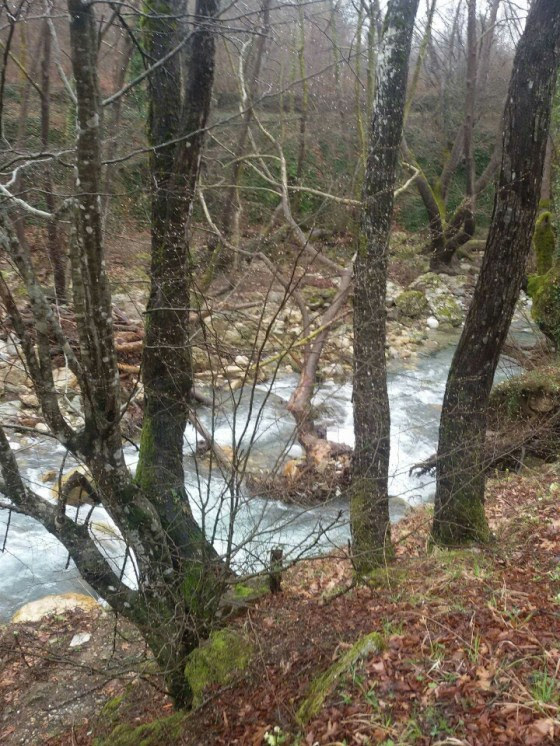
And Regina, my adorable lady, who can’t do anything without having been outside for a walk every day, knew this path very well, which goes along a slim clean flow, a brook, named Menkhauser Bach. It was a very enjoyable, especially, when in a moment of silence, we’d only hear birds and running water.
And the trees…
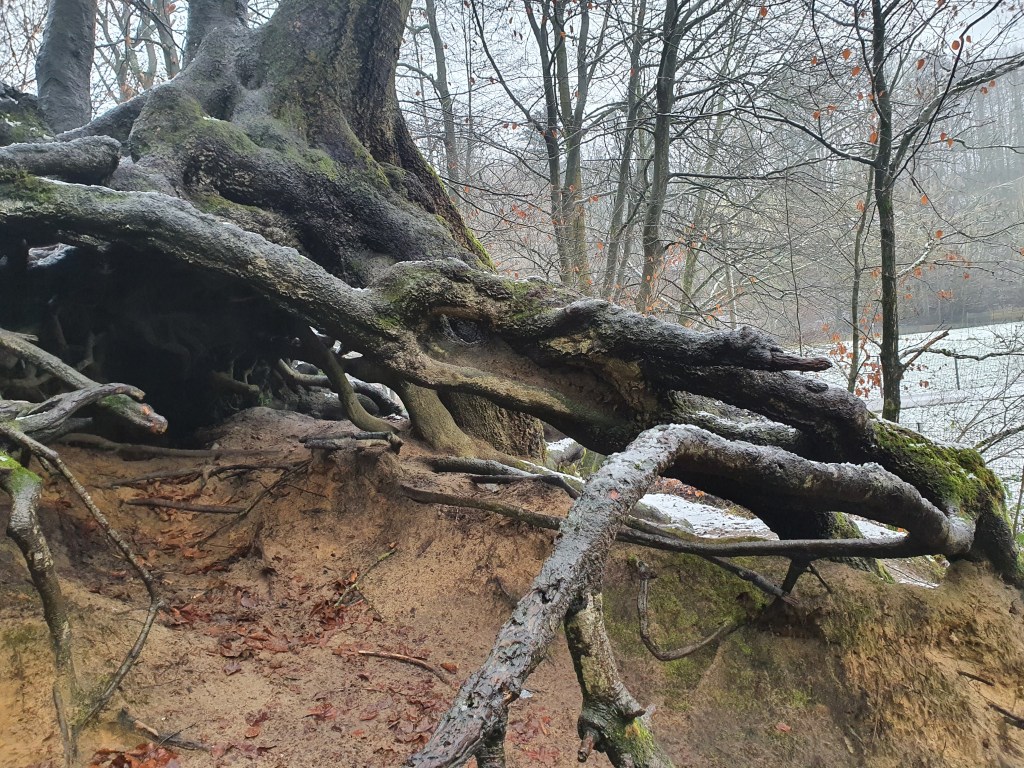
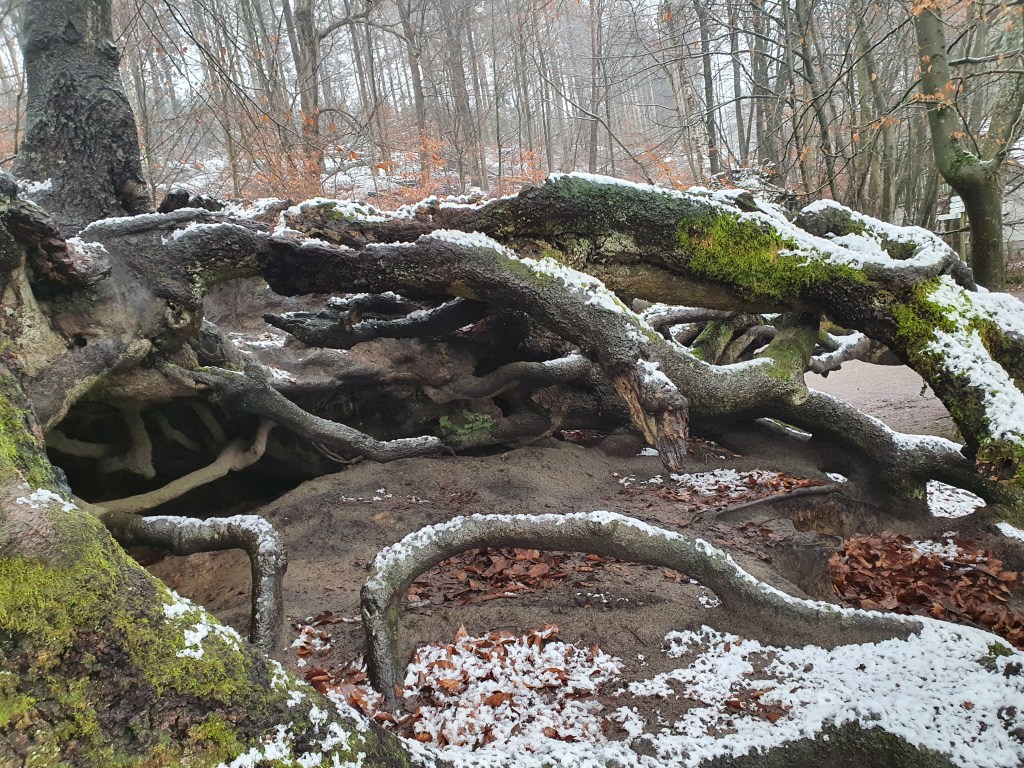
We observed the roots of old trees that peeked out of the ground like snakes.
Nature is fascinating, and if we only understand that we are a part of it, we will appreciate it and can enjoy our life.
As I wanted to write about our excursion, coincidentally I saw this post by my Greek friend. I thought that how fit is this with my story, and with so many good tips. Stay safe, healthy and tuned, and try to go out for a walk now and then. 🤗💖
The country that prescribes walks instead of drugs
In Scotland, instead of drugs, they prescribe activities in nature ATHENS LEVENTI
There is a kind of “medicine” without side effects and costs: the walk in nature. And now doctors in Scotland have the right to prescribe it to their patients with the aim not only of improving physical health and reducing mental illness, stress and anxiety.
In the modern world we usually do not pay much attention, but the time we spend in nature is crucial for our well-being, as research like this points out .
If we spend 90 minutes of our day in nature, the activity in the area of the brain associated with depression is limited. At the same time, aggression is reduced, pain control is improved and the immune system is strengthened.
There is a whole booklet of “natural” prescriptions that accompanies the program, full of suggestions. Among other things, the program proposes to make works of art on the beaches from natural materials, to plant bulbs or to do bird watching. They even suggest different activities per month: For example, in October, we can appreciate a cloud or talk to a horse. In November, feed the birds in the garden. And as for May, then we can throw our face in the grass. And all this, with a doctor’s prescription. We can find all the suggestions here .
While “nature recipes” are currently only available in Scotland, no one is stopping us from prescribing a little nature to ourselves.
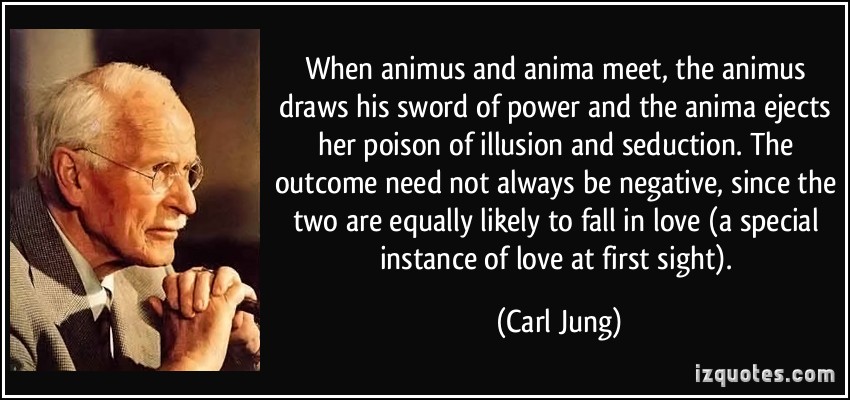
I have to thank my mother for giving me her full power of her Anima that I grew independent from the antipode. She had lost a girl-child and wished to have a daughter, but first were Al and then me, therefore, she had brought me up to everything as a daughter might learn. And on the other hand, I can understand well all genders whom I meet or associate. I don’t want to advise anyone (men), better I want to give them as a suggestion, to look about themselves and find their both sides.
Anyhow, better to read some lectures from the great Mythology of Greece: for example the story of Tiresias. Honestly, I wish I could experience what he/she had got to know. For me, it is a great chance to have such an adventure. Be frankly, don’t you want to?
As we read below, Hera, or possibly Athena, had punished Tiresias’ gender to be changed into feminine for seven years. And after that, his/her evaluation on the pleasure of men and women during sex, which was warranted about 10 to 1 for women! It has been hard for Hera to endure! She made him blind but, with the power of prediction, as goodwill! Let’s read the whole story;
“Like other oracles, how Tiresias obtained his information varied: sometimes, he would receive visions; other times he would listen for the songs of birds, or ask for a description of visions and pictures appearing within the smoke of burnt offerings or entrails, and so interpret them. Pliny the Elder credits Tiresias with the invention of augury.
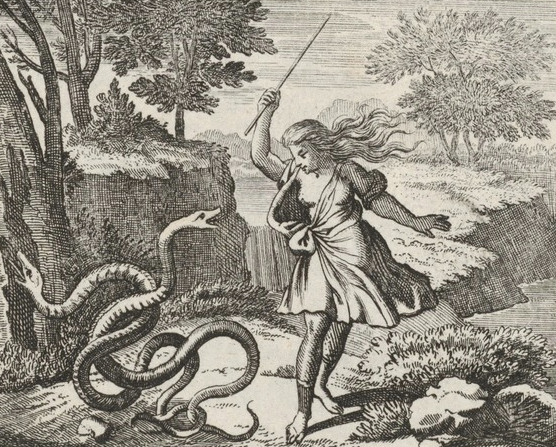
On Mount Cyllene in the Peloponnese, as Tiresias came upon a pair of copulating snakes, he hit the pair with his stick. Hera was displeased, and she punished Tiresias by transforming him into a woman. As a woman, Tiresias became a priestess of Hera, married and had children, including Manto, who also possessed the gift of prophecy. After seven years as a woman, Tiresias again found mating snakes; depending on the myth, either she made sure to leave the snakes alone this time, or, according to Hyginus, trampled on them. As a result, Tiresias was released from his sentence and permitted to regain his masculinity. This ancient story was recorded in lost lines of Hesiod.
In Hellenistic and Roman times Tiresias’ sex-change was embellished and expanded into seven episodes, with appropriate amours in each, probably written by the Alexandrian Ptolemaeus Chennus, but attributed by Eustathius to Sostratus of Phanagoria’s lost elegiac Tiresias. Tiresias is presented as a complexly liminal figure, mediating between humankind and the gods, male and female, blind and seeing, present and future, this world and the Underworld.”
Tiresias appears as the name of a recurring character in several stories and Greek tragedies concerning the legendary history of Thebes. In Sophocles’ Oedipus Rex, Oedipus, the king of Thebes, calls upon Tiresias to aid in the investigation of the killing of the previous king Laius. At first, Tiresias refuses to give a direct answer and instead hints that the killer is someone Oedipus really does not wish to find. However, after being provoked to anger by Oedipus’ accusation first that he has no foresight and then that Tiresias had a hand in the murder, he reveals that in fact, it was Oedipus himself who had (unwittingly) committed the crime. Outraged, Oedipus throws him out of the palace, but then afterwards realizes the truth.
Here we can see also, that in ancient Africa, the importance of both genders is an issue: the story of Mawu-Lisa.
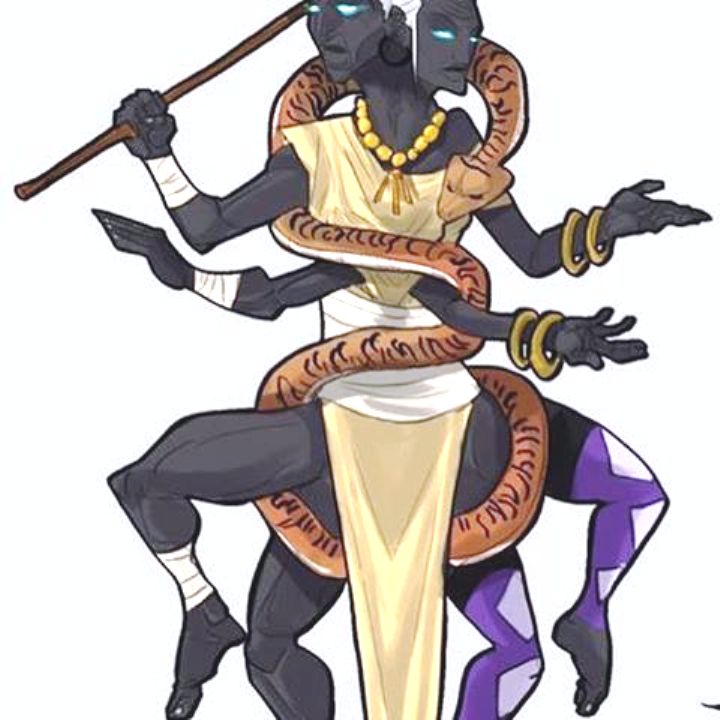
MAWU-LISA is a complex deity worshiped in coastal West Africa by the Fon and most of the Ewe. Occasionally Mawu and Lisa are considered as separate deities; sometimes they are seen together as a complementary sexual pair. The issue is complicated because the Ewe peoples use the term mawu both to refer to God in a general way or to a specific deity.
As a specific deity, Mawu is seen as a creator, but she rarely has shrines, priests, or rituals dedicated to her. Among peoples such as the Fon, Mawu is conceived of as a female deity associated with the moon, and it is in this manifestation that she is most often paired with Lisa. Among the Fon, the cult of Mawu-Lisa was centered in Abomey, the capital of the old kingdom of Dahomey. Mawu is depicted as an elder female figure in conjunction with Lisa, a younger male consort. Other complementary qualities are seen in them. For example, whereas Mawu is associated with the moon (night) and is cool (gentle and forgiving), Lisa is associated with the sun (day) and is hot (fierce and punitive). Sometimes even their actions are complementary. In one mythic tradition, Mawu created the earth and then retired to the heavens. When she saw that things were not going well with men, she sent Lisa to make tools and clear the forests so that men could farm and live a civilized life.
So dear men, let’s forget about being Machos, and take it softly, take it easy. Have a nice weekend everyone 🙏💖🙏🤗
Nebamun was a middle-ranking official “scribe and grain accountant” during the period of the New Kingdom in ancient Egypt. He is thought to have lived c. 1350 BCE and worked at the vast temple complex near Thebes where the state-god Amun was worshipped. Wikipedia
Now let’s have another look at this endless fascination of the magic land Egypt; Our history. With forever thanks to dear Lady; Marie Grillot http://Marie Grillot for her brilliant description. 🙏💖
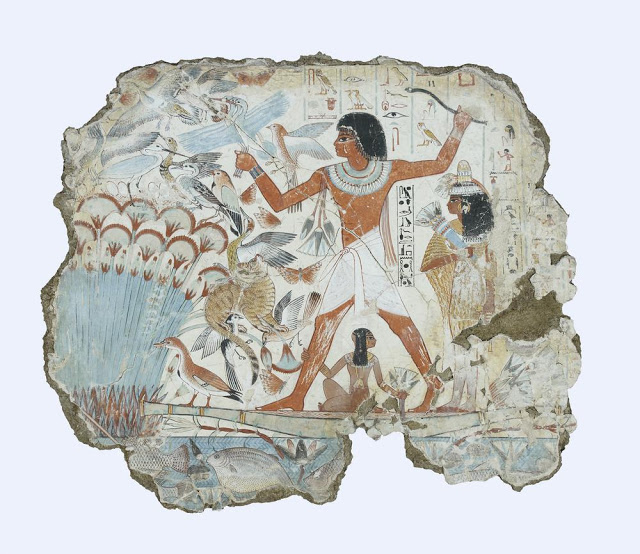
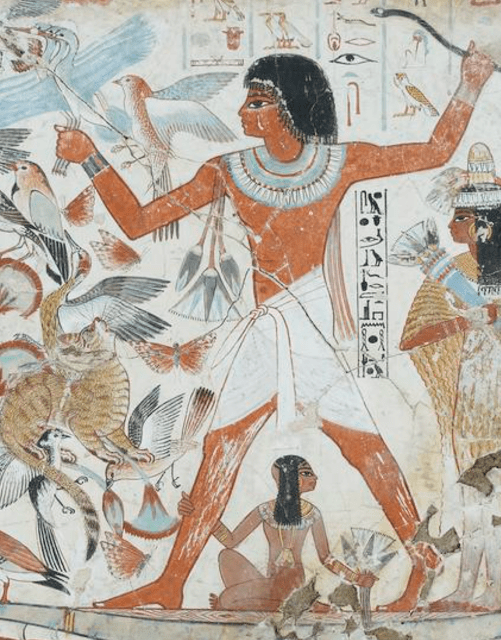
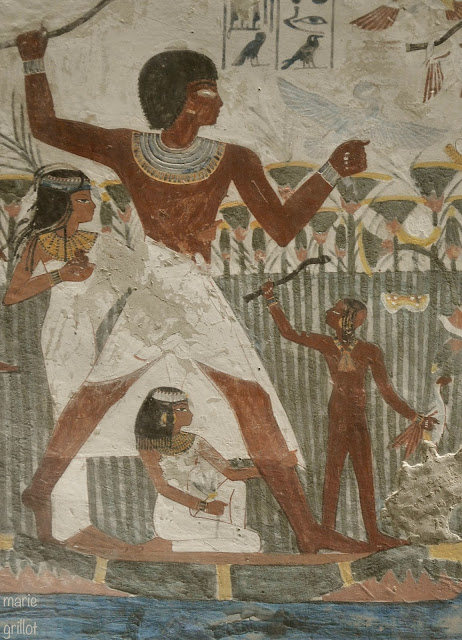
Fragment of a polychrome painting of Nebamon, standing in a boat,f hunting and fishing in the swamps Provenance: Tomb of Nebamon – Theban Necropolis (location lost today) Discovered in 1820 by Giovanni d´Anastasi on behalf of Consul Henry Salt Salt collection acquired by the British Museum in 1821 – Reference EA37977
On the frail skiff made of bundles of tied reeds, with the bow and the stern slightly raised, are three characters evolving in the luxuriant universe of a marsh, rich in vegetation, birds, birds, butterflies, and fish … Their presence – and that of the cat that accompanies them – seems to have stirred up this colourful and variegated fauna which cheers up with a rustle of wings.
Center is Nebamon, scribe and accountant of the grain in the attic of divine offerings at the temple of Amun at Karnak in the 18th Dynasty. He is shown standing in a position ensuring the balance necessary to launch the boomerang which he holds in his left hand. With his right fist, he grips the legs of several birds he has just captured and which are struggling to regain their freedom.
Fragment of a polychrome painting of Nebamon, standing in a boat, hunting and fishing in the marshes Provenance: Tomb of Nebamon – Theban Necropolis (location lost today) Discovered in 1820 by Giovanni d´Anastasi on behalf of Consul Henry Salt Salt collection acquired by the British Museum in 1821 – Reference EA37977
His face is lit by a stretched eye, surrounded by kohol. He wears a beautiful curly wig. Dressed in a white linen loincloth, nicely tied at the front, he wears an ousekh necklace in shades of green, white and red, as well as large bracelets. Three long lotus stems – a central one, the flower of which is open, the other two in the bud – fall from his shoulder.
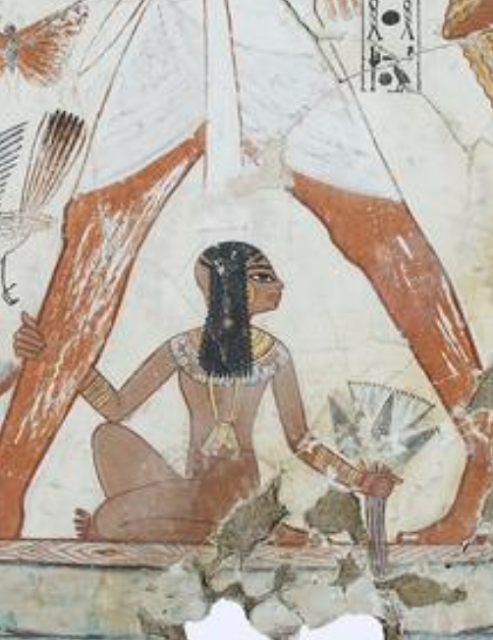
Between her spread legs, occupying the centre of the skiff, a young girl – probably a child of the couple – is kneeling. She is depicted naked and wears the lock of childhood, composed of tight braids that reveal a tiny part of a large earring. This is not the only jewel that adorns her: she has multiple gold rings around her arms, an ousekh necklace that partially covers her shoulders, and another set with the golden pendant reaching her height. bellybutton …
Fragment of a polychrome painting of Nebamon, standing in a boat, hunting and fishing in the marshes Provenance: Tomb of Nebamon – Theban Necropolis (location lost today) Discovered in 1820 by Giovanni d´Anastasi on behalf of Consul Henry Salt Salt collection acquired by the British Museum in 1821 – Reference EA37977
Her attitude is curious: her face, lit by a stretched almond-shaped eye, is turned backwards, while the action unfolds in front of her … Charming details are to be noted, such as her right hand which encloses his father’s calf as if to cling to him; her little fan-shaped toes, and this bouquet of lotuses, one open and three in buttons, which she is holding in her left hand …
Fragment of a polychrome painting of Nebamon, standing in a boat, hunting and fishing in the marshes Provenance: Tomb of Nebamon – Theban Necropolis (location lost today) Discovered in 1820 by Giovanni d´Anastasi on behalf of Consul Henry Salt Salt collection acquired by the British Museum in 1821 – Reference EA37977
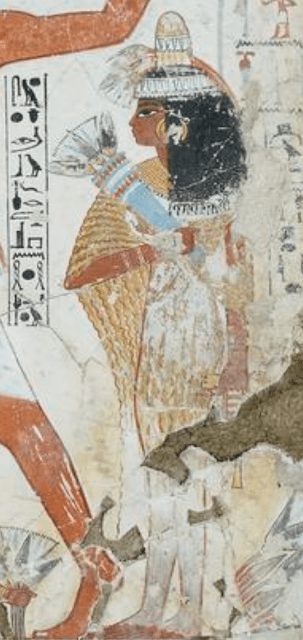
Standing at the stern is Hatshepsut, the wife of Nebamon and presumably the mother of the child. She is wearing an elegant long pleated dress and a shawl, also pleated, in yellow. Her pretty wig with fine braids, adorned with a headband and lotus stems, is topped with a cone of ointment. His left arm is stretched along the body while his hand encircles one or two partly damaged “accessories”: a Menat, a Sistrum? Her right arm is bent and, in her hand, brought to her chest, she holds a magnificent bouquet of lotus. These flowers – symbols of rebirth – are extremely present throughout the “painting”.
Fragment of a polychrome painting of Nebamon, standing in a boat, hunting and fishing in the marshes Provenance: Tomb of Nebamon – Theban Necropolis (location lost today) Discovered in 1820 by Giovanni d´Anastasi on behalf of Consul Henry Salt Salt collection acquired by the British Museum in 1821 – Reference EA37977
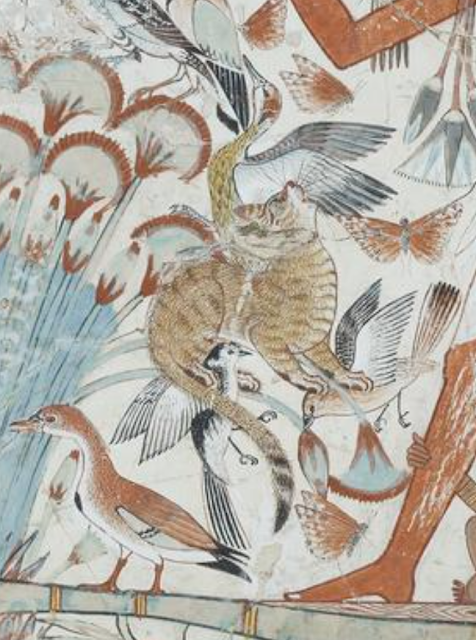
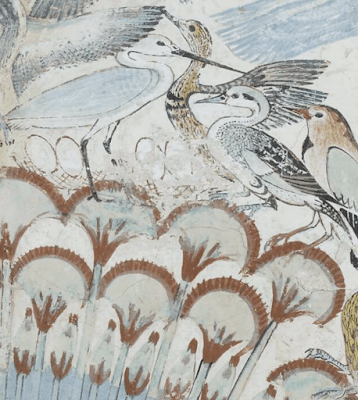
The environment is magnificent. On a white background, multiple species of birds, with colourful plumages, fly away. One, no doubt more reckless, landed at the bow of the boat, while three others, less fortunate, fell prey to the tawny tabby cat… The cats were family pets, but he is shown here because a cat could also represent the Sun God driving out enemies of light and order. His unusual golden eye alludes to the religious meanings of this scene, says the British Museum.
Fragment of a polychrome painting of Nebamon, standing in a boat, hunting and fishing in the marshes Provenance: Tomb of Nebamon – Theban Necropolis (location lost today) Discovered in 1820 by Giovanni d´Anastasi on behalf of Consul Henry Salt
Salt collection acquired by the British Museum in 1821 – Reference EA37977
Eggs, oval and white, are in a nest which seems to be placed on the magnificent bouquet of papyrus which blooms in infinite grace… To this is added the presence of a few butterflies with outstretched wings that we seem to see fluttering… The aquatic life appears just as dense … In the blue river, whose waves are nicely rendered, large fish swim between the lotuses …
We have to understand that the size differences in the treatment of subjects are voluntary: thus, Nebamon appears very imposing compared to his wife; the same goes for birds or fish that seem “larger than life” …
This scene is of a freshness that is part of accomplished art. There is no doubt that it is the work of an artist (or several?) Of great talent: a naturalist as gifted as a portrait painter, and marvellously tracing the hieroglyphics as the eight vertical registers of great quality also prove …
Detail of the hunting and fishing scene in the marshes in the tomb of Nakht and his wife Taouy (TT 52) Theban Necropolis – Sheikh Abd el-Qurna TT52 la tombe de Nakht et de son épouse Taouy nécropole thébaine, vers le bas de la partie nord de la colline de Sheikh Abd el-Gournah,
This hunting and fishing in the marshes can be found in the iconography of many tombs. We cannot help but compare this scene to those that can be admired in particular in the tombs of Nakht (TT 52) and Menna (TT 69). The style, just like the spirit and the composition, are really similar, Even if everything here seems more “finished”.
The British Museum takes a deeper look at this “painting”: “It is more than just an image of recreation. The fertile marshes were seen as a place of rebirth and eroticism. The hunt for animals could represent the triumph of Nebamun on the forces of nature as he was reborn. The huge ‘striding’ figure of Nebamun dominates, ever happy and ever young, surrounded by the rich and varied life of the swamp. “
As for Thierry Benderitter, in his excellent site: Osirisnet.net, he analyzes the identical scene of the TT 52: “The swamp and its high papyri (which can only be found in the Delta) represent the same thing for the deceased as the marshes of Chemmis for the child Horus, a place away, where he can grow up, and which must be protected from the Isfet. We find all this: the forces of evil (the Isfet), represented by the birds (which do not belong to an organized world) must be fought, as they threaten the reborn deceased as Seth threatened Horus “.
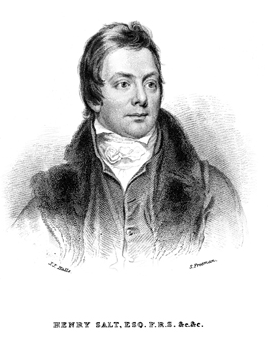
Henry Salt (Lichfield, UK – 14-6-1780 – Alexandria, Egypt – 30-10-1827) diplomat, the British consul in Egypt from 1816 to 1835, collector of antiques
Nebamon’s tomb was discovered at the beginning of the 19th century by Giovanni d’Athanasi. His real name: Demetrio Papandriopulos, a son of a Greek merchant living in Alexandria than in Cairo, entered the service of the distinguished and elegant British Consul General, Henry Salt when he was barely 20 years old. For nearly a decade, this keen collector of antiques, and his main “agent” Giovanni Battista Belzoni, took “Yanni” on their travels. The travellers, communicated to him about their passion for excavations and antiques. Then with general permission, granted by Muhammad Ali Pasha of Egypt, Belzoni led campaigns mainly in the Theban region, and in the years 1817-19, he built up a remarkable collection of large and important sculptures from the eastern and western shores of Thebes “(N. Strudwick, Masterpieces of Ancient Egypt, London 2006).
When the collaboration of Salt and Belzoni ended in 1819 Athanasi quite naturally replaced him in the field. Salt trusted him completely, he appreciated his ability to estimate the quality and value of antiques, as well as his sense of commerce. Thus, he supplied the Salt collections while building his own personal collection.
The house was built by Consul Henry Salt in Gournah in the years 1815-1820 and in which, settled in particular Yanni – Giovanni d’Athanasi
The consul had built a house in Qurna, a small fortress in which, Athanasi settled among the villagers. He integrated very well, benefits from their good knowledge of the Theban mountains, offers them work in excavation sites, and got informed of all traffic. He was also the neighbour of John Gardner Wilkinson with whom he seemed to have a good relationship.
Is it thanks to this positive “relational environment” that he discovered, in 1820, the tomb of Nebamon?
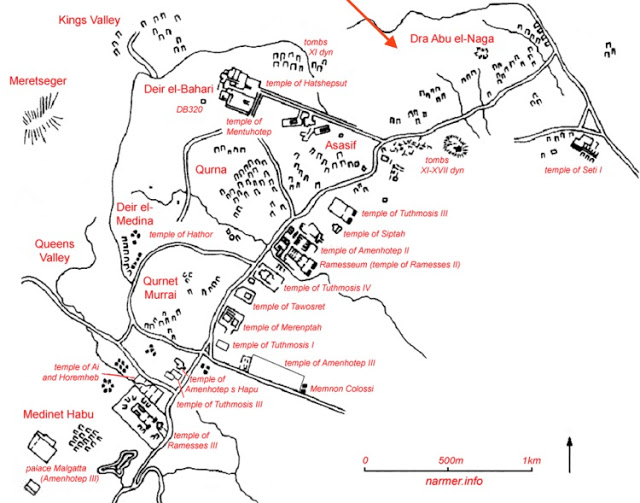
Map of the west bank of Luxor (source narmer.info): the necropolis of Dra Abu el-Naga is located at the top right)
Its location is unfortunately lost today, but it might be located in the necropolis of Dra Abu el-Naga and it dates from a period of flourishing arts: “Stylistically, the magnificent murals can be dated either to the last years of the reign of Amenhotep III (1390-1352 before our era), i.e. the first years of his successor “.
Eleven panels painted on plaster were taken from the chapel and sold by Consul Salt to the British Museum in 1821. This hunting scene in the marshes, 83 x 98 cm, was recorded under the reference EA37977. The Museum also specifies that “other fragments were found in Berlin and perhaps even in Cairo” …
Paintings from the Tomb-chapel of NebamunP. Kozloff, B. Bryan, and M. Berman, Egypt’s Dazzling Sun, Cleveland 1992, p. 299 [Pl.31] = Le Pharaon-Soleil, Paris 1993, p.238 [Fig.IX.23].At the dawn of Hellenic Egyptology and the constitution of Egyptian collections: New discoveries on Giovanni d’Anastasi and Tassos Neroutsos, Tenth International Congress of Egyptologists, Vassilis Chrysikopouloshttps://www.academia.edu/2000910/A_l_aube_de_l_hellenic_égyptologie_and_de_la_constitution_des_collections_égyptiennes_Des_nouvelles_découvertes_sur_Giovanni_d_Anastasi_et_Tassos_Neroutsos_Egyptologists_Tongenthress_
http://Lewis Lafontaine Carl Jung Depth Psychology
I am a little confused at the time (I hear you shout!!) I will come to my point later. Now, let’s take refuge to my (or might yours too?) Master to take a breath.
With great thanks to Lewis Lafontaine, who does work hard for letting us know more about this genius. I am getting old, I know it, even the peoples around me don’t believe it. 🙏💖💖
After a hard struggle I have come a piece of the way nearer to you. How hard this struggle was! I had fallen into an undergrowth of doubt, confusion, and scorn. Only the love of those, to whom I gave love, saved me from the darkness. ~Carl Jung, The Black Books, Vol. II, Page 165
In memory of Hermann Sigg,/ my very dear friend,/ died on 9 January 1927.
At his tower in Bollingen, Jung painted a mural bearing a stone-carved inscription in Latin and describing the culmination of the process of the rebirth of the divine that forms a central theme of Liber Novus and the Black Books.
The Sphinx “This is where the God is buried,/ this is where he arose. / like the fire inside the mountains,/ like the worm from the earth,/ the God begins. / like that serpent from ashes, / like the Phoenix from the flames, / the God arises / in a wondrous way. / like the rising sun, / like flame from the wood, / the God rises above. / like ailment in the body,/ like the child in its mother’s womb,/ the God is born. / He creates divine madness,/ fateful errors,/ sorrow and heartache./ like a tree / man stretches out his arms / and sees himself/ as a heavenly man / that he did not know,/ facing the world’s orb / and the four rivers of paradise. / And he will see the face / of the higher man and spirit, / of the greatest father / and the mother of God. / And in an inconceivable birth / the God frees himself/ from man / from image, / from every form, / while he enters / the unimaginable and absolute / secret./ In memory of Hermann Sigg,/ my very dear friend,/ died on 9 January 1927.” ~The Black Books, Vol. VII, Page 239, fn 252
Hermann Sigg (1875- 1927) was a businessman and a close friend and neighbor of Jung’s and the founder, in 1904, of Haus Sigg & Co., which specialized in olive oil and had plantations and factories in Tunisia, Spain, and France.
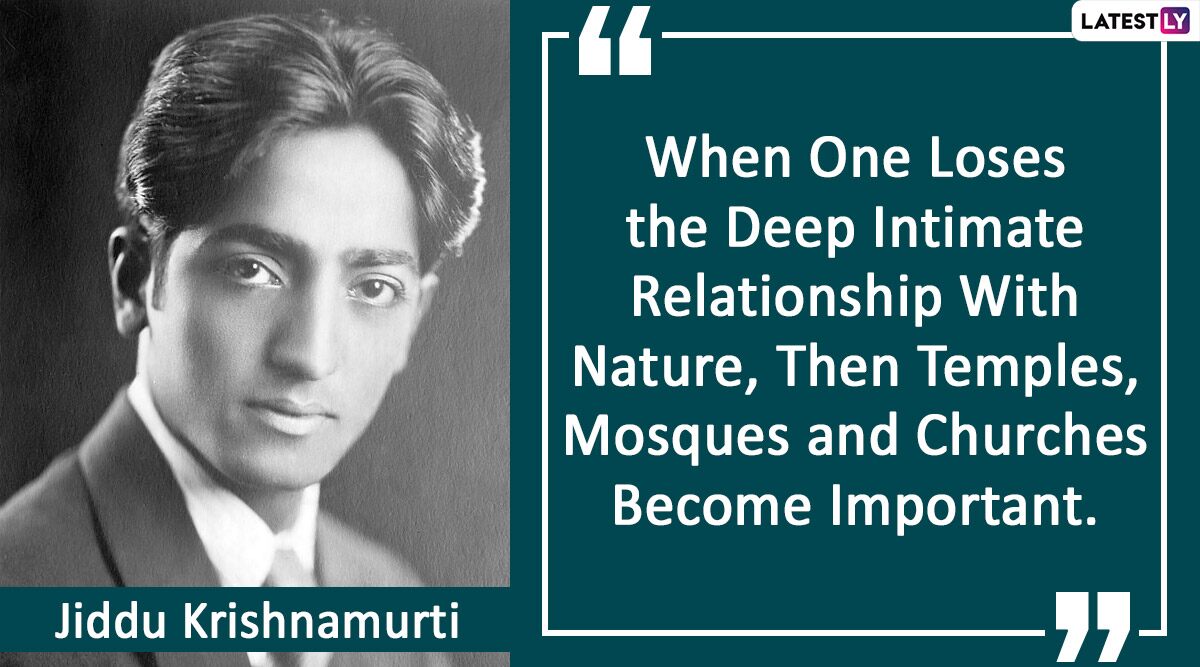
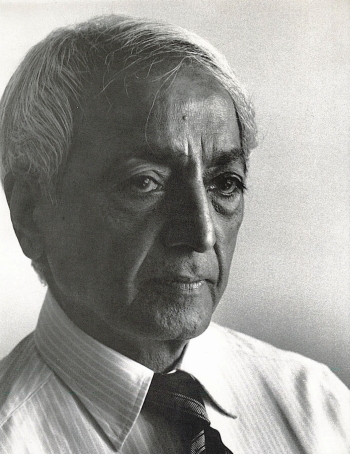
Jiddu Krishnamurti was a philosopher, speaker and writer. In his early life, he was groomed to be the new World Teacher, but later rejected this mantle and withdrew from the Theosophy organization behind it.
A spiritual man who has believed in no difference between religions, caste or philosophy but the self.
… woke up early with that strong feeling of otherness, of another world that is beyond all thought … there is a heightening of sensitivity. Sensitivity, not only to beauty but also to all other things. The blade of grass was astonishingly green; that one blade of grass contained the whole spectrum of colour; it was intense, dazzling and such a small thing, so easy to destroy …
This experience of the otherness would be present with him in daily events:
It is strange how during one or two interviews that strength, that power filled the room. It seemed to be in one’s eyes and breath. It comes into being, suddenly and most unexpectedly, with a force and intensity that is quite overpowering and at other times it’s there, quietly and serenely. But it’s there, whether one wants it or not. There is no possibility of getting used to it for it has never been nor will it ever be ..Krishnamurti’s Notebook
Here are three poems with or among Krishnamurti’s descriptions about love. I translated it from Greek, and I don’t know if these poems are from him. I couldn’t find them on the web.
Anyhow, all a wonderful lesson and enjoyable mind. 🤗💖
1. IN MY HEART In my heart they fight for you: love with love; desire with affection; jealousy with goodness; tenderness with violence; lust with purity; care with indifference; the serious with the ridiculous; joy with sorrow;
compassion with anger; anxiety with peace; fear with himself; yesterday with today; tomorrow with now. My only weapon – despite all this – is my Innocence. In my heart, I fight for you with centuries of human sorrow, with centuries of infinite human pain, with centuries of dependence, with centuries of loneliness, with centuries of despair, with centuries of need for love, with centuries of pursuit of pleasure , with centuries of fear of death.
Inside my heart you sink slowly like poison and pass into my veins, flooding everything inside me, last test before passing through the door behind it waiting patiently the Freedom that has no name, the Love that is there for everyone.
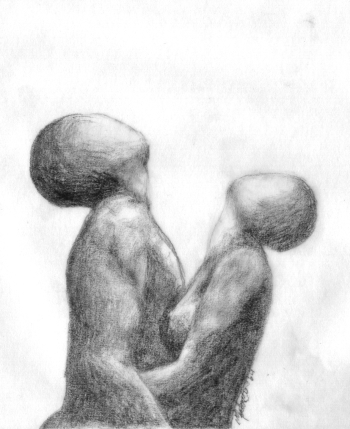
marias-couple-sitting
The kind of love we feel now is something full of sadness; the love we know has sadness, bitterness, frustration; the pain of this love is martyrdom; in it, we know fear and bitterness. And we can not escape this love, even though it is martyrdom. The fool blames love, without understanding the cause of pain; if you do not know its conflict there is no pain beyond reason. If you do not become aware of the source of the conflict, of the feeling of dissatisfaction, then love brings pain. It is the feeling of dissatisfaction that brings pain and not love. It is the feeling of dissatisfaction and not the love that creates the addiction and all the sad issues that are born.
2. THE END That morning, he visited his love story.
It was there, with the incredible quality of beauty that has something old, worked overtime. It was there, like an old huge house, with many rooms, closed windows and empty. People had left Taking the furniture with them, to take it to another house, to another story. But the house still had the atmosphere of those people’s story and you could feel it, relive their whole story deeply – without emotions – with a strange sense of peace. In the morning he had entered the house and was walking around the empty rooms, sucking all the feeling that was in them. He wanted to see and learn. And then it would come out forever.
marias-couple-standing
If you want to understand the issue of sexual intercourse, do not try to solve it separately away from other human problems. It’s all one. The act of love becomes a problem when there are frustrations. When our work, which should be the true expression of our existence, becomes merely mechanical and becomes stupid and useless, then there is frustration; when our emotional life, which should be rich and complete, is torpedoed by the phobias, then there is frustration; when the mind that should be awake, flexible, unrestricted, bends under the weight of tradition, self-defence memory, ideals, beliefs, then there is frustration. Thus, the act of love becomes an overemphasized and unnatural problem. When there is fullness, there are no problems. When you are fragile in love, the act of love is not a problem. For, the man for whom the act of love is a simple sensual pleasure, it becomes a pressing problem that devours his mind and heart….
You opened the shutters and the sun swept everything. It took you a while until your eyes got used to it. The mourning was over. As they stood at the window, you took a deep breath and were flooded with life and gratitude. You may have learned to accept death. Maybe you ‘learn to stay with what happens to you, what if it’ is, to learn deeply about it with him. What tremendous freedom not to run away! Maybe you learned to look inside, quietly, without blaming anyone for what is happening to you. Maybe you have learned to look inside you with compassion and care and so, without trying, leave the window open to divine Denial, without putting it running on your feet. The blessed “crisis” that for the first time you were not afraid to come whenever She wants to end. Now the mourning is over. What a strange discovery: even after the death of love there is mourning! Just like when someone you love dearly dies and every now and then you take a few flowers to his grave and “tell” him a word. Yes, there is mourning after the death of love. And then nothing. Vacuum. Only something shines at one end of your heart. The holy pain that you sat and felt, and looked inside her like in a mirror. The sadness that you felt all over, knowing now that it is not only yours. Love, his path to death, his death, mourning for him and then emptiness.
What an incredible beauty! The sun comes in through the window and refills the living room. If only one could stay still with the vacuum, forever. Who knows…
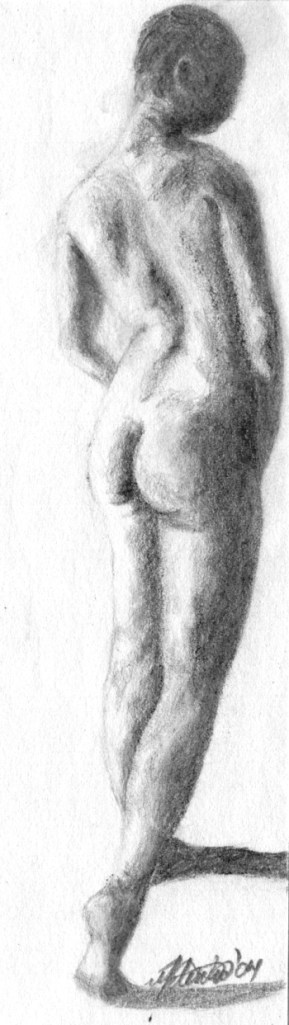
marias-woman-leaving
*
You are attached to someone and you see the whole history of attachment: what it includes, its whole structure, its nature, its consequences. And at some point, you finish it. What happens then? Go slowly, what happens; The person, of course, is still there. If you were attached to this person before and you are no longer, you are not complete, what happened? A change was made, right ?. What does that mean? Did the memory that you cling to you, fade away? Just the moment you completely gave up clinging? This is very important to see if you have done it. Why; What happens; When I was attached, the whole recording mechanism worked. So; Now that I am not at all attached, the recording mechanism has stopped. If it has not stopped, then it means that the attachment continues, perhaps in a different way. Now: When the mind was freed from attachment, what recorded, has been erased, right? This is the issue: There is no psychological memory. I tell you – if you do – there will be no memory. It is one thing to forget something and another to not have its psychological memory. Let’s take another example: suppose I have been hurt. The memory of this wound, the feeling of the wound is always there. If, now, I erase this wound, then with this erasure, with the cleansing, there is never again the feeling that I have been wounded. Yeah Al that sounds pretty crap to me, Looks like it ain’t for me either. You can’t even recall it – psychologically. You practically remember the fact, but if you want to put the emotion back there, you can not remember it, you can not recall the state of your mind or emotions are hurting…






























 You are attached to someone and you see the whole history of attachment: what it includes, its whole structure, its nature, its consequences. And at some point, you finish it. What happens then? Go slowly, what happens; The person, of course, is still there. If you were attached to this person before and you are no longer, you are not complete, what happened? A change was made, right ?. What does that mean? Did the memory that you cling to you, fade away? Just the moment you completely gave up clinging? This is very important to see if you have done it. Why; What happens; When I was attached, the whole recording mechanism worked. So; Now that I am not at all attached, the recording mechanism has stopped. If it has not stopped, then it means that the attachment continues, perhaps in a different way. Now: When the mind was freed from attachment, what recorded, has been erased, right? This is the issue: There is no psychological memory. I tell you – if you do – there will be no memory. It is one thing to forget something and another to not have its psychological memory. Let’s take another example: suppose I have been hurt. The memory of this wound, the feeling of the wound is always there. If, now, I erase this wound, then with this erasure, with the cleansing, there is never again the feeling that I have been wounded. Yeah Al that sounds pretty crap to me, Looks like it ain’t for me either. You can’t even recall it – psychologically. You practically remember the fact, but if you want to put the emotion back there, you can not remember it, you can not recall the state of your mind or emotions are hurting…


You must be logged in to post a comment.