I have always been excited about ticklish or prickly stories or movies. Therefore, I have seen all the Alfred Hitchcock’s, almost all the movie seriesDracula’s and many other creepy films, and read a lot of thrillers like Agatha Christie’s or Sir Arthur Conan Doyle’s.
I am amazed at how many women there are as thriller authors, Agatha Christie (as mentioned), Dorothy L Sayers, Ann Cleeves, Ruth Rendell, and many others for sure. Even Metta Fuller Victor’s The Dead Letter, published by “Seeley Register” in serial form between 1866 and 1867, is widely recognised as the first detective novel written by a woman. And, of course, I must add J. K. Rowling to this list.
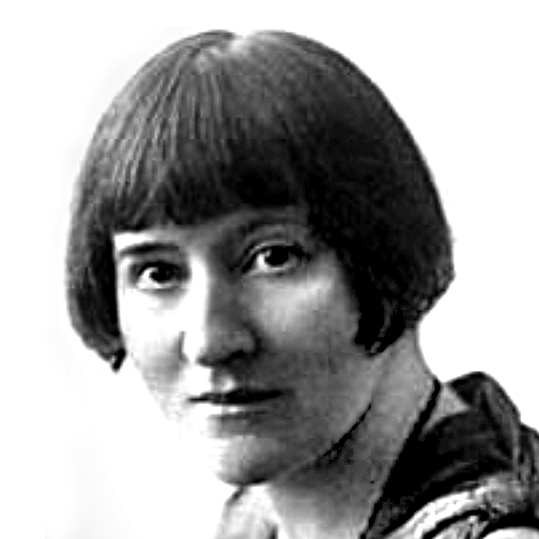
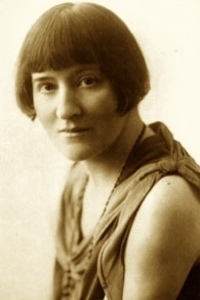
As we read; She was favourably compared to Edgar Allan Poe, Agatha Christie and Dorothy L Sayers.
Sheffield Hallam student Alex Csurko, who is embarking on a PhD into Ethel, believes her father’s invention may have been the genesis of her brilliance.
“The amazing thing about Ethel is that, despite writing all her life, she wasn’t truly recognised until she was in her 60s,” he said.
“Maybe it took her move to London before she was introduced to the right people?” “We know from the 1911 census that, aged 35, she was still living at home with her parents – by which time she’d already had dozens of poems and short stories published in the press – over 100 in her lifetime,” he said.
That is something that seldom happens to men; I might not wonder? Since when did it all go wrong? I can still remember it!!
She was not so successful as Agatha Christie, may because she was, as Mr Csurko said: “Ethel simply wasn’t prepared to play the fame game which made stars of other writers. “In an interview with critic Peter Cheyney, she said: ‘I was not born. I have never been educated and have no tastes or hobbies. This is my story, and I’m sticking to it.” He said that in many reviews, Ethel was alternately described as “spikey”, “witty”, and “sarcastic”. By 1938 she hit stardom when Alfred Hitchcock chose to adapt her detective thriller The Wheel Spins – about a young woman on a train and her missing companion – into his film The Lady Vanishes. “The Lady Vanishes was Hitchcock’s last British-made film, and I think it’s fair to say it was the one which made Hollywood studios sit up and take notice of him. Said Mr Csurko.
However, while the legacy of other writers such as Agatha Christie has lived on, Ethel’s reputation has faded into the background.
“I think there is an easy explanation for this,” said Mr Csurko. “Ethel simply wasn’t prepared to play the fame game which made stars of other writers.
“She was brilliant in her own time, but when you consider the likes of Agatha Christie started a decade before her and carried on until the 70s, there’s just not the volume of work to compare them fairly,” Mr Csurko said.
Ethel would have two more novels adapted for the big screen – Midnight House was filmed as The Unseen, and The Spiral Staircase was based on her novel Some Must Watch.
Ethel died of ovarian cancer in 1944. Intriguingly and quite macabrely, her will demonstrated her lifelong fear of being buried alive, which can be read in her 1935 novel The First Time He Died.
The will read: “I give and bequeath unto Annis Dora White [her sister] all that I possess on condition she pays a qualified surgeon to plunge a knife into my heart after death.”
Thanks, this girl and the others, for giving us men something to consider!
PS: Next week is the birth of an extraordinary one. Therefore, I must see if I find an opportunity to post something new… Have a great time, everyone. 🙏💖👍🙏💖
That was in the early 70s when I read “Dubliners.” A collection of James Joyce’s short stories from 1914. Of course, it translated into the Persian language because my English was not so good so far as now is (if we’d call it good now!), and I was thankful for that.
One exciting thing that I can mention here about Iranians is that despite the majority of the population being illiterate, we had a significant part in one of the most famous streets in Tehran, full of bookshops. All the books from everywhere globally, written by well-known or known or unknown writers, and all translated!
To translate books is an art in itself; The excellent translator must have many abilities to do their job: Knowing both languages perfectly and having enough writing skills. We had a few of that kind and many who were not convincing. And this Dubliners was, unfortunately, one of the latter.
I know reading Joyce is not easy; maybe that’s why the good translators didn’t want to try this one. Notwithstanding, I have read it, excruciating but to the end. Of course, it is a great book, as I reread it in the original language some years ago. One of the stories is “The Dead“. It is by far the most extended story in the collection and, at 15,952 words, is almost long enough to be described as a novella.
The name: “The Dead” is an interesting choice by Joyce; I mean, the story could have another name: a family fiesta, or the people among themselves, or whatsoever. It deals with themes of love and loss and raises questions about the nature of the Irish identity. But he has chosen this name for it. He could want to show us how people are so busy with their everyday lives that they forget there might be an end! At the end of the story, Gabriel Conroy’s wife, Gretta, tells him about a boyfriend from her youth and his early death, and Gabriel has an epiphany about life and death and human connection.
T. S. Eliot called “The Dead” one of the greatest short stories ever written. And Joyce biographer and critic Richard Ellmann wrote: “In its lyrical, melancholy acceptance of all that life and death offer, ‘The Dead’ is a linchpin in Joyce’s work.
Anyway, my purpose is that I have recently watched the made movie from the story.
In 1987, it was adapted into the film The Dead, directed by John Huston, starring Anjelica Huston as Gretta Conroy and Donal McCann as Gabriel Conroy. One can expect an excellent adaptation from Huston, who had many brilliant works, like The Misfits, The Man Who Would Be King, Moby Dick, etc.?
Lately, when I suggested to my wife that we’d watch this movie together, she was confused and thought it would be all about dying, but it wasn’t that gruesome, and she liked it. Anyhow, it is highly recommended, and you might like it too.
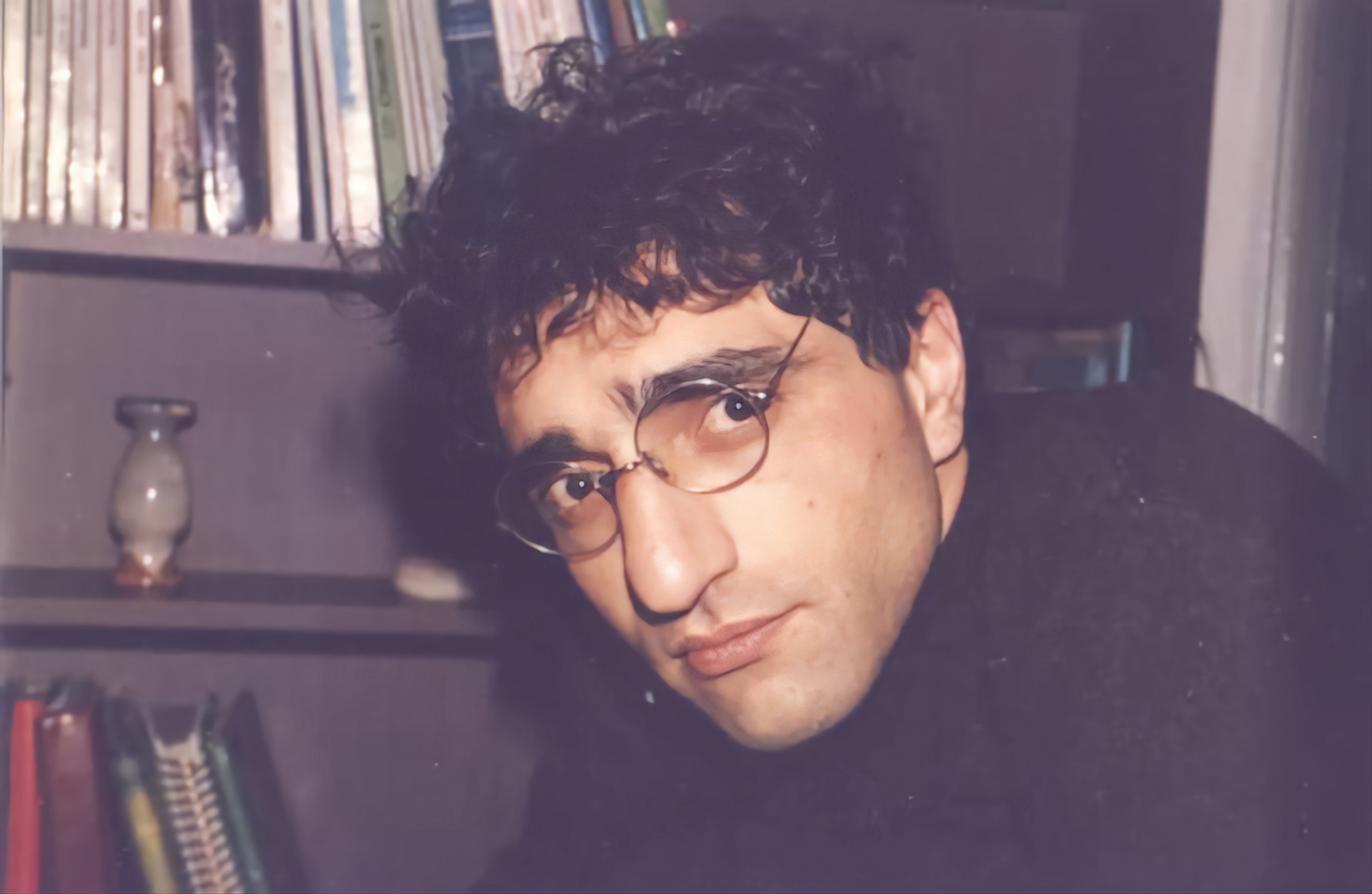
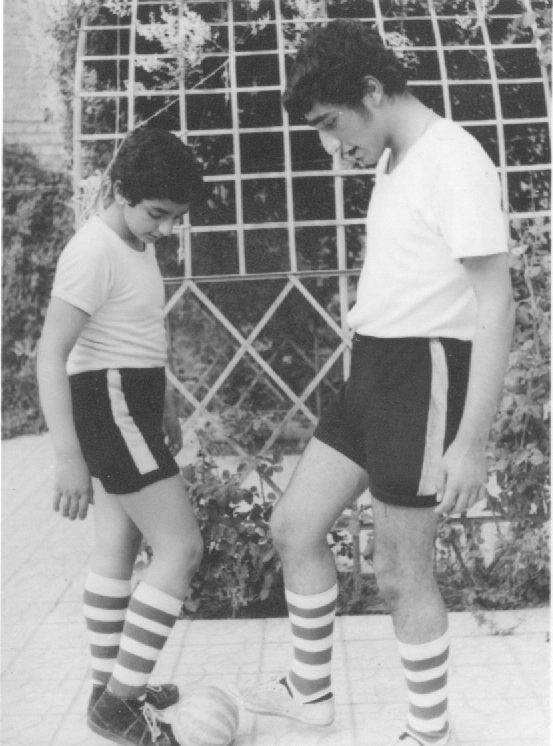
I’ve just thought that I’ve shared some of my inner feelings and complaints about the conditions these days lately (I heartfelt thanks for your supports); I might tell you that I have always been in that way! Of course, it was my brother Al who opened the door of my locked soul with his own rebellion.
He is Sagittarius, could have already on December 9th his 69th birthday, and he’s a typical Sagittarius, with all his pride, intelligence and firmness. He started his revolt from childhood when he started building his world. I was still dumb!
As I remember, we played downstairs, and our father was working (writing) upstairs, and when we became louder than usual, he came downstairs from his room and beat Al with his belt. I don’t know why he did nothing to me, only Al. Then, Al had beaten me as revenge! I was the latest child, and there was nobody else after me. Therefore, I learned to forgive.
My rebellion began after our father’s death when I found out that my mother had kept it secret from us almost a year later. I was skin and bones those days, and one could see and count my ribs. Then I began to eat! I have had many competitions with the adults and always won! Of course, I got rounder but stopped in my puberty because the girls didn’t like it. 😉😁
But the proper outbreak happened many years later when Al and I were often alone at home, and we had some long conversations on our different views of life. Honestly, I had no idea or opinion; my problem was Al’s unusual behaviour towards the world, which confused me. Al had not many chances to cause me to understand his view of life; (I was so dumb!). Therefore, he only told me that his world is full of mad people! One day, the turning point came when I was under the shower: ‘Eureka! Eureka! I cried out like Archimedes and jumped out of the bathroom! Of course, it was not the number Pi that I found out, but only that I didn’t know! I just have found out that I was still not understanding Al’s world, but it’s a challenge for me to think about it. That was my first step!
For sure, it is a never-ending way to get knowledge and to understand everything. But I am so thankful to take the first, and in my opinion, the hardest, step.
I have written the rest of my protesting time in my blogs: here and here. If one is interested.
Anyhow and in fact, I have deep gratitude to Al, who never stopped believing in me and let me suffer in my ignorance until I forced my brain to work. Happy and glorious birthday, buddy.
Finally, I would like to share two enjoyable songs from a Master of “Jazz/ Blues Fusion”; John Mayall, with whom we have had a lot of joy. This LP is more remarkable because there is no drummer in this album. Have a peaceful weekend, everybody. 🤗💖🙏🙏
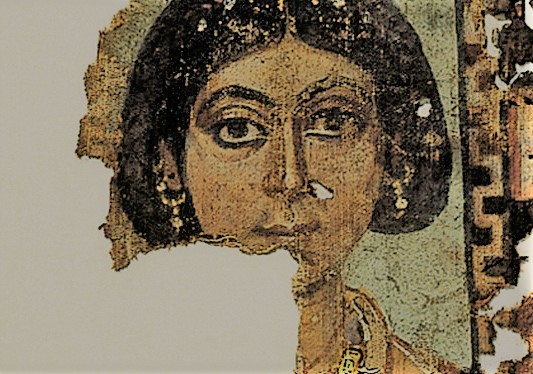
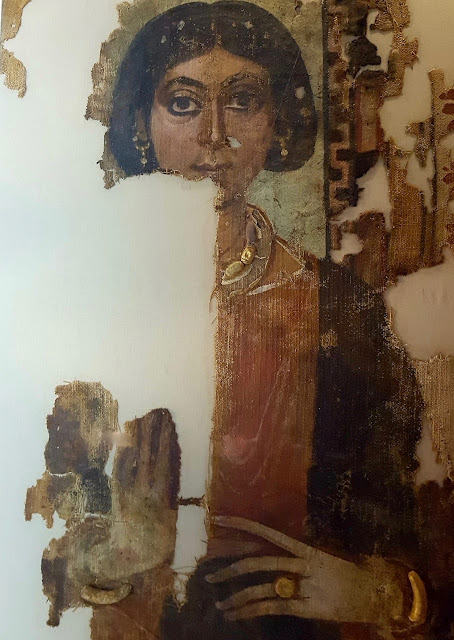
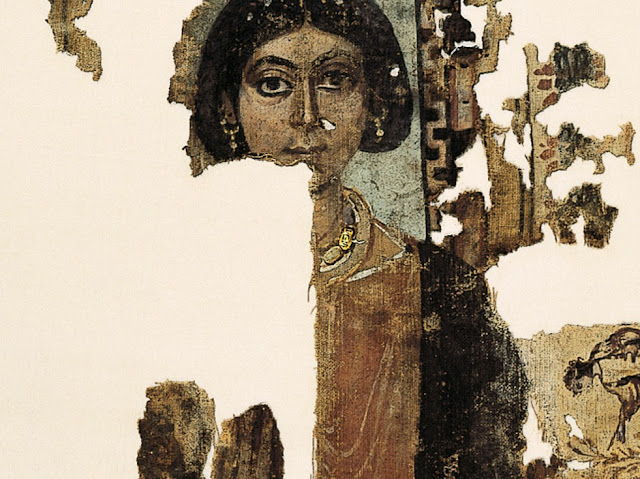
This linen canvas, known as the “Lady of the Vatican”, belongs to a particular type of female burial shroud. There are only six known specimens dispersed in various museums. The portrait of the deceased is not limited solely to the face but instead depicts the full life-size figure of the woman. She is reclining, as may be seen by the position of her feet, which are elongated and rest on a cushion. She wears jewellery, executed in relief using plaster and gilded. The figurative panel is divided, in the upper part, by a series of concentric frames and friezes and, in the lower part, by a frieze divided into rectangular areas with figurative illustrations, of which two are conserved: in the first, there is a scene of philosophical instruction with a teacher and young pupil, probably the deceased herself; in the second, of a doubtful interpretation, there is what appears to be a fight between a young man and a lion. The shroud was discovered in 1900 by Albert Gayet in the site of Antinopolis and donated to Pope Leo XIII in 1902 by Émile Guimet, along with the corresponding mummy. The archaeological context of origin and an iconographical study of the portrait would date it from the third century A.D. The robe and jewels are typical of the Roman context, and the hairstyle, in particular, is inspired by the fashion of women of the Severian imperial house.
Here is a brilliant description of the find and its story by Marie Grillot. 🙏💖🙏
The canvas of the “Lady of the Vatican” – Painted linen – 3rd century AD. J.-C. Provenance: Antinoé – Excavations by Emile Guimet directed by Albert Gayet Vatican Museum – Inv. 17953 – Gift of Émile Guimet – 1902 Toile funéraire de femme, appelée aussi “Dame du Vatican”.Antinoé – IIIe siècle après J.C.
“It is the first mummy with a painted portrait that M. Gayet brought back from Antinoe. I thought it was Christian, and I gave it to the Vatican Museums with all the fabrics with Christian symbols around it. “indicates Emile Guimet in” The portraits of Antinoé at the Guimet Museum “.
This is how this fragmentary shroud, 1.73 m high, 13 to 52 cm wide, representing a lady of good Roman society from the beginning of our era, took, in 1902, the route of the Holy See, under the pontificate of Leo XIII. She was then, in a beautiful way, “assimilated” to her new “home” since she was very quickly called the “Lady of the Vatican”.
The canvas of the “Lady of the Vatican” – Painted linen – 3rd century A.D. J.-C. Provenance: Antinoé – Excavations by Emile Guimet directed by Albert Gayet Vatican Museum – Inv. 17953 – Gift of Émile Guimet – 1902 – Photo of the Museum
“She is part of a typology of female funeral canvases of which only six examples are known in museums worldwide. The portrait of the deceased is not limited to the face, but the woman is represented life-size, full-length. . She is stretched out, as can be seen from the position of the feet stretched out and resting on a cushion. She wears jewellery, made in relief, in plaster and gilded, “specifies the Museum …
The canvas of the “Lady of the Vatican” – Painted linen – 3rd century A.D. J.-C. Provenance: Antinoé – Excavations by Emile Guimet directed by Albert Gayet Vatican Museum – Inv. 17953 – Gift of Émile Guimet – 1902
Her face, of beautiful symmetry, is lit by large eyes edged with kohol. The iris, round and black, stands out against the white of the eye, which seems wet with tears. The eyebrows are nicely arched, while light circles mark the lower eyelid. The nose is small. The palate is small, with a marked cupid arch and slightly raised corners.
Her brown hair, styled in a short “square”, is separated by a central part and adorned with a pearl tiara. The hairstyle slightly returned to the back, revealing beautiful pendant earrings adorned with pearls.
The canvas of the “Lady of the Vatican” – Painted linen – 3rd century A.D. J.-C. Provenance: Antinoé – Excavations by Emile Guimet directed by Albert Gayet Vatican Museum – Inv. 17953 – Gift of Émile Guimet – 1902
She is wearing a purple-orange tunic embellished with a thin white border at the neckline and purple clavis that: “fall on her forearms and reach just above the knees; the one on the right is stopped on the dress by a pin. The nails go down from the arms and delimit the central part, occupied by a shawl. At the height of the belt, the abdomen and the legs up to the knees are, in fact, covered with a rectangular fabric or fringed and with two large purple medallions applied to the centre, “says Lorenzo Nigro in his excellent study” The portrait of the ‘Lady of the Vatican’ on the linen cloth by Antinoe: a new interpretive analysis after the restoration. “
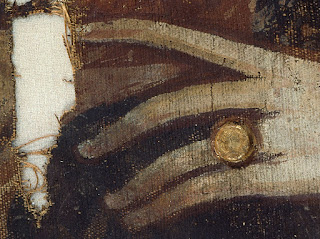
Necklaces of gold and precious stones adorn her neck; her wrists also are adorned with bracelets embossed in gold leaf. We admire the elegance of the gesture she sketches with her hand with long tapered fingers, which perfectly highlights the ring she wears on her left ring finger.
Detail of the painting of the “Lady of the Vatican” – Painted linen – 3rd century A.D. J.-C. Provenance: Antinoé – Excavations by Emile Guimet directed by Albert Gayet Vatican Museum – Inv. 17953 – Gift of Émile Guimet – 1902
“The presence of the ring is particularly significant because this attribute indicates with good reliability the belonging of the woman to an aristocratic family. In fact, it is not a simple personal ornament. Still, an indicator of the social rank of The set of precious ornaments described makes the ‘Lady of the Vatican’ one of the most richly decorated female figures in the available presentations of the same series of works, in particular, thanks the jewellery is worn around the neck “(Lorenzo Nigro).
The canvas of the “Lady of the Vatican” – Painted linen – 3rd century AD. J.-C. Provenance: Antinoé – Excavations by Emile Guimet directed by Albert Gayet Vatican Museum – Inv. 17953 – Gift of Émile Guimet – 1902 published in “Les portraits d’Antinoé au Musée Guimet”, Emile Guimet, Librairie Hachette et Cie, Paris
The rest of the canvas, unfortunately incomplete, presented one: “series of frames and concentric friezes and, in the lower part, a frieze divided into small rectangular panels, of which only two are preserved: in the first one we have to distinguish a scene of philosophical instruction with a master and a young pupil, probably the deceased herself; in the second, less readable, one indicates a fight between a young man and a lion “.
The hairstyle, clothes and adornments have made it possible to date this shroud from the 3rd century, particularly from the Severan dynasty, founded by Septimius Severus in 193 AD. J.-C …
The ruins of Antinoe today extend into a village called Sheikh ‘Abade (Middle Egypt)
The city of Antinoe where it was discovered is located in Middle Egypt, on the eastern bank of the Nile, 300 km south of Cairo. The city already existed in the New Kingdom, but Hadrian renamed it in the 1st century from the name of his handsome lover Antinous. Its ruins today extend into a village called Sheikh ‘Abade.
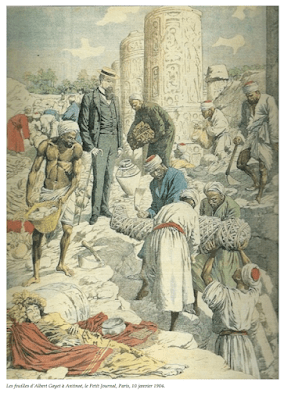
Illustration representing Albert Gayet’s excavations in Antinoopolis (published in the Petit Journal – 1904-686)
From 1896, in agreement with the Direction of the Antiquities Service, Emile Guimet will become, for many years, the patron of the excavations directed by Albert Gayet. This Dijon Egyptologist arrived in Egypt in 1881 with the Permanent French Archaeological Mission in Cairo created by Gaston Maspero. This last will push him towards “a direction still little known: the archaeology of Egypt of late antiquity”. This is how he will become a specialist …
Antinoé will reveal the secrets of his necropolises throughout the missions: painted portraits and fabrics and clothes are certainly their most beautiful treasures. They make it possible to “revive” a whole cosmopolitan society rich in various influences; this “lady” is a perfect example …
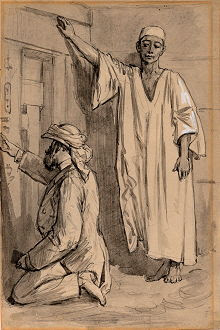
Anonymous, Monsieur Guimet reading an Egyptian inscription Ink on paper – Lyon, Musée des Beaux-Arts
How not evoke this excellent analysis made by Emile Guimet? “Was the ‘Vatican Lady’ ‘idolatrous’ or was she ‘Christian’? We won’t know. She was a bit isiac (of or about the goddess Isis or her worship), because of the Egyptian temple door that surrounds her face; she was a bit Buddhist, by the windings which adorn the medallions of her dress; she was a little Syriac, by the miniature painting which adorns her shroud and represents two figures seated to the right and the left of the tree of life; she was a little Christian, by the gesture of her right hand which the lady with the golden cross will imitate, by her spiritual aspirations, by the symbols spread on the fabrics found around her. Ensured all paradises “.
The “Lady of the Vatican” was registered at the Museum, which gave her name under the inventory number 17953.
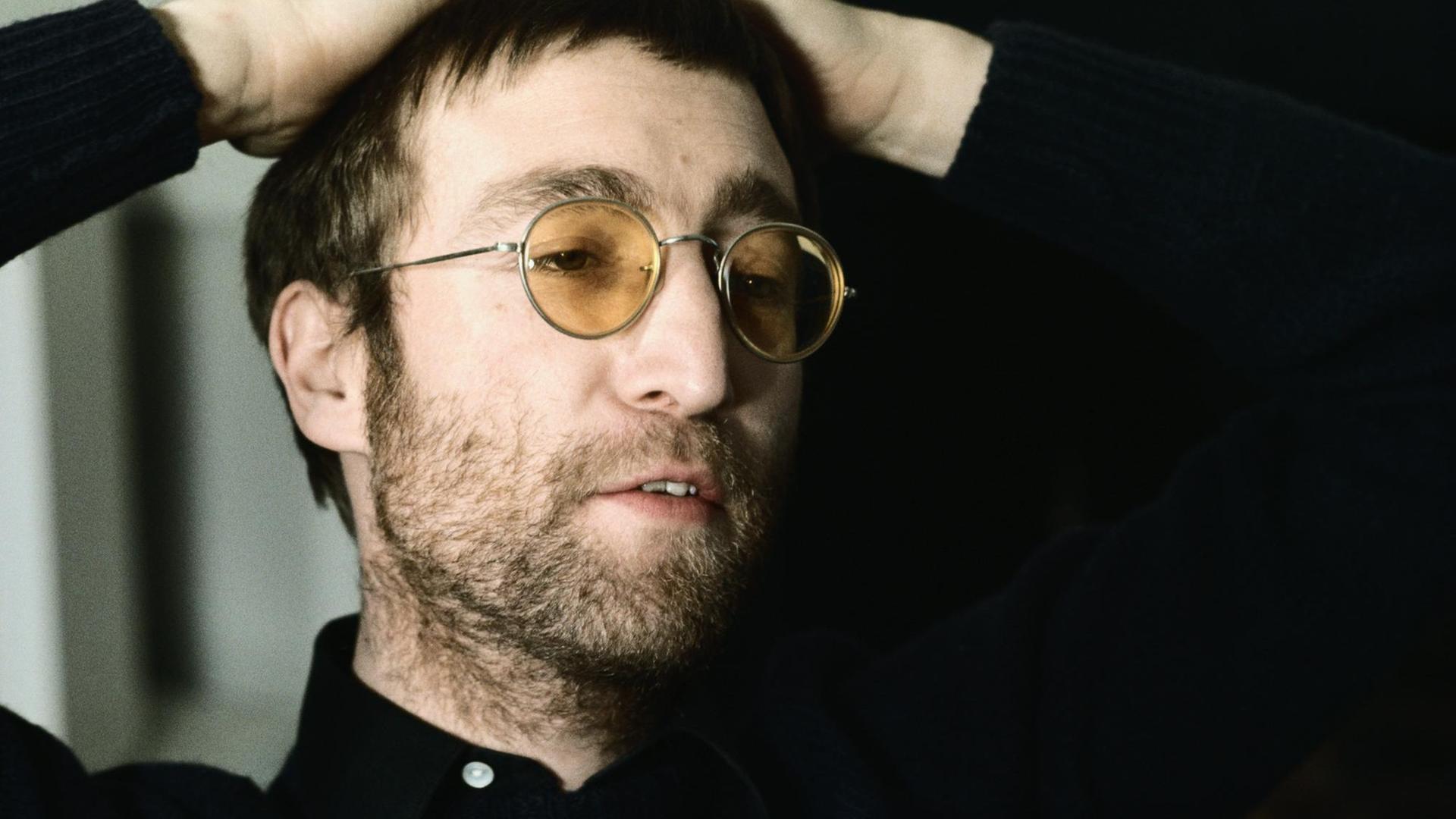
A short but deeply tribute to the best composer, musician and human of all time: John Lennon. As you all know, an ill-minded person, a product of a poor-minded society, shot him forty-one years ago. Though, He and his works will remain alive in our minds forever. Happy Christmas, everybody.
It was Thursday early in the morning when I woke up at 5,30 AM to prepare myself to get to work; suddenly, the telephone rang unexpectedly. Usually, I ignore the ringing phone because nobody wants to speak to me, and all calls are for my wife, Regina. But at that time, she was still sleeping, and I picked the phone up quickly not to disturb her.
“Hallo Aladin, that is me, Manfred”, said at the other end. I knew him. He’s a fellow teacher of the same school as my wife. I greeted him back and asked what was wrong? As I could guess, something must be wrong. He said it was urgent, and if Regina awoke? I told him it was too early for her, but it seemed necessary to wake her up.
She jumped out of bed when I opened the sleeping room door and grabbed the phone. I didn’t listen to them anymore cause I had to go on with my own mess. After that, when she ended the call, she was so excitedly running back and forth that I had to ask her what was going on? She told me that in their routine Corona testing on children, it seems that yesterday one of the samples turned out positive. Therefore, she must call every parent to say that their child has to stay home until the laboratory finds out which child is infected. I wished her good luck and went out to work with an ulterior motive (worry) that what should happen next.
Anyway, when I came back home, she told me she had reached all the parents in the evening, and she, with all others, had to wait until tomorrow, Friday, for the results from the laboratory values. And after discovering which child was infected, all the teachers had to give a PCR test! I must confess here that I have never seen such fatigue and worry in the eyes of my lovely wife. She noticed my worries and told me that she had to cancel all her plans for the weekend because the test would take two days to show the result, and it sucks!
What we could do, was to take it “somehow” easy and try to get relaxed. On Friday, the following day, she woke up early to get the necessary connections to the colleagues for further underactions. And at half-past eight, on the same Friday, in the early morning, the news from the school’s secretary came that all results were negative and there was just a failure from the laboratory! Don’t worry and be happy. Error is human!!
I was just watching her face with joy, how her eyes got pacified.
Raffaello Sanzio, here in his famous painting: “School of Athens“, shows in the centre Aristotle on the right, stretching his arm to compromise, while Plato on the left raises his Index finger to the sky. Augustine Academy
Today, I want to share with you my idea, which I’ve had in my mind since my youth, about philosophy, as I believe it is the primary thought of our life. As I wrote once, I came to know philosophy through Socrates and Plato. However, history shows that society accepted Aristotle’s philosophy as more plausible. What a pity! I think it’s because Aristotle had better understood humans with greed, envy, and lust for power.
Oh yes! As most people know, Plato’s name is associated with the “platonic relationship”; Plato was more preoccupied with the human soul. He might be a dreamer, as I think the philosophers must be. And I believe following his lessons would make a better world for us all to live in.
Of course, if we try to understand his thoughts, we will find that it is not so wrong or elusive:
Plato is also considered the founder of Western political philosophy. His most famous contribution is the theory of Forms known by pure reason, in which Plato presents a solution to the problem of universals known as Platonism (also ambiguously called either Platonic realism or Platonic idealism).
Here is a declaration of a “blind man” who is quite noticeable these days.
And as we look at it more deeply, that is a psychological observation of the man’s soul. Here is a brilliant description of Plato’s definition of the soul. I hope you have enough time and joy to read this good article.
Desires and Pleasures in Plato’s STATE: Man, Lion and Monster
In the leading world philosophy, “The State”, Plato does not describe the correct organisation of a state formation as the battle in the human soul between logic and desires. A competition from which it will judge if he finally manages to taste the only genuine pleasure, that of the ideal life.
According to Plato, the three parts that make up the soul are the desirable, the thymic and the mental.
The desired part of the soul expresses the bodily or “horse desires” of man, such as the body’s needs (hunger, thirst, erotic mood, etc.). It is the seat of desires, multifaceted and polynomial. The realisation of these desires is a pleasure, which, however, according to the philosopher, is apparent and superficial. If, for example, you are hungry and eating, you have simply satisfied your desire to stop being hungry and nothing more. There can be no substantial pleasure from the desired part of the soul but mere satisfaction of a bodily, equine need.
Higher than desirable is the thymic part of the soul. It is the fighting element or, in other words, the radically volitional element. It is about satisfying your need to be recognised by others as dignified and honest. The thymic part of the soul can lead to ruptures and battles to defend your honour. It can motivate you to seek out positions and greater recognition. It is not related to material goods but to protecting your “being”.
The third part of the soul is the accounting or mental. According to Plato, this should “rule” the soul with the consent of the thyroid and the voluntary submission of the desirable. The mental part “houses” the proper judgment and is attracted by the pleasures provided by mental employment and knowledge.
According to the philosopher, the pleasures from the satisfaction of the mind are the only true and accurate. Their pursuit offers permanent relief from the vicious circle of desire and its fulfilment, since the objects of philosophical knowledge will not disappear, as do, for example, the foods we eat, but will remain as unchanging and immortal elements, offering a stable filling status.
Plato uses an image to depict the inner battle waged within man between the three parts of his soul. In this battle, the accounting part is represented by a man, a lion’s thyroid, and a multi-headed beast’s desire. If a man lets the lion and the beast become more assertive at the expense of the accounting, then they will fight fiercely, leading him to a sinful life, the slave of his opposing desires and passions, as well as the outbursts of his rage. But suppose a man (accounting) manages to tame the beast (voluntary) with the help of the lion (thymus). In that case, he will be able to discipline his desires and uproot his passions to enjoy the pleasure of harmony in his soul.
But it would be wrong if this view concluded that man can, or should, try to exterminate the beast or lion within him. On the contrary, Plato proposes that man satisfy his desire in moderation so that he is not passionate about either deprivation or overfilling. Thus, he leaves the accounting part of the soul devoted to its search in a state of calm. Knowledge is the supreme pleasure.
When the accounting part reaps the pleasures it seeks, all soul aspects will be satisfied. At the same time, if the happiness of another part prevails, then the whole order of human life will be disturbed, so no interest will be satisfied as it deserves.
PHILOSOPHICAL LIFE: The ideal life, according to Plato and how it can be achieved
The three parts of the soul and their predominance in every human being determine all three types of life he can have: an intellectual life for the man who is dominated by accounting, a dignified life for the one who is overwhelmed by the thymic and a profitable life for the one who is overlooked from the desired.
It may seem to all three categories of people that the most hedonistic life is theirs. Still, in reality, only the philosopher knows that his own life is the most hedonistic because he has experienced the pleasures of the other two, while the others have not been able to meet his own. The philosopher can also value his life as a “whole” and claim superiority over others’ lives, using his experience and logic that others cannot.
According to Plato, three essential virtues characterise a virtuous life: prudence, bravery and wisdom. If we add to them a fourth, justice, which corresponds to the balance of the whole, then we have a just man, a man who has managed to harmonise the three parts of his soul under the hegemony of the mental.
With the supremacy of the mental, man can control his desires and, with restraint and wisdom, transform his passion into bravery. In other words, by ruling the different parts, reason offers man happiness, as it eliminates internal conflicts and the harmonious relationship between the features of the soul.
Plato calls “friendship” the ideal relationship between the parts of the soul, as it does not describe a state of uninterrupted repression but a discipline in which the just man finds pleasure. The kind part of the soul, having achieved this “friendship” with the other two pieces, comes in contact with knowledge, the “really being”, and then the conjunction “mind and truth” is born, where “mind” is the accounting part of the soul and “truth” the “really being”. Neither the “truth” exists before its coupling with the soul nor the “mind” before its collision with the truth. Only the union gives substance to the two parts of marriage, and only with marriage does man acquire fundamental knowledge.
Happiness does not depend on the existence of a specific, favourable environment (from others or from circumstances), but on ourselves. We can create it, developing the “logic” and making us righteous.
The pursuit of spiritual pleasures, according to Plato, offers permanent relief from the vicious circle of moving bodily needs. Since, thanks to the greater degree of reality, the objects of philosophical knowledge will not disappear, like the foods we consume. Still, they will keep the philosopher in a steady state of filling.
Man, free from inner compulsions and impulses, therefore enjoys the feeling of permanent fulfilment and, unmoved, devotes himself to the further search for wisdom that offers the ultimate sanctity and goodness in life.
Annas, J., Introduction to Plato’s State, mtf. Ch. Grammenou, edited by C. Zafeiropoulos-P. Bourlakis, Athens: Kalentis, 2006.
Despotopoulos, K.I., Plato’s Philosophy, Athens: Academy of Athens, Research Center of Greek Philosophy, 1997.
Dimas, P., “The Philosophy of Plato”, in S. Virvidakis et al., Greek Philosophy and Science, from Antiquity to the 20th Century, vol. A ‘, Patras: EAP, 2000.
Kalfas, V. – Zografidis, G., Ancient Greek Philosophers, Thessaloniki: Institute of Modern Greek Studies [Manolis Triantaphyllides Foundation], 2006.
Lekkas, G., “Argumentative Strategies in the State of Plato”, Platon 53, 2003.
Pappas, N., Plato’s State, A Reading Guide, mtf. D. Papagiannakos, Sci. edited by I. Patsiotis, Athens: Eight Publications, 2006.
Vegetti, M., History of Ancient Philosophy, mtf. επιστ. Edited by G.A. Dimitrakopoulos, Athens: P. Travlos, 2003 [2000].
I want to open my heavy heart again if you, dear friends here, forgivingly let me do that. I had to consider a long time whether I shall speak about this current and at the same time an unspeakable topic or not (why is it so?) And after some sleepless nights, I decided to share my thoughts, as I can’t bear the pressure of its weight on my soul.
The topic, as you may guess, is the Coronavirus and our freedom. I must again mention that I don’t want to deny any virus and any illness causations. I only wish to caution; we must be aware and conscious about behaving and judging the environment. Therefore, I used there above ☝ this quote from Dr Jung.
The main thing that worries me is not the world’s governments but the people and nations in their countries. Mainly, the dictatorship begins there.
I have got once at all the feeling that it begins to be a party; we might not ask if someone is vaccinated or not, we might ask if the one belongs to the (our) party or not?!
I will talk about the Germans, as I live here and can observe the situation, although I read almost every news from all over the world I would rather stay here because I’d better judge. The Germans, not all but most, have the talent to let the others (the government) decide and do the job. The most important thing is that they can rest and not worry about their responsibilities, but if they should judge, they do it gladly and quickly!
This illustration looks maybe a bit harsh, but believe me, we are not so far away from it. Let me tell you why I think so.
It is set like many other countries; If you want to go to public places, such as restaurants or cinemas, etc., you have to have one of three confirmations, tested, recovered or vaccinated, or even only the latest two. As I watch the news, it shows people (of course vaccinated) who angrily criticize and complain about the incorrect controls in cafes and restaurants because the hosts don’t check them up entirely and only ask them if they have their papers with them. This act, of course, is understandable, but they want to call the police to come and charge the place immediately!
It recalls me from Iran, in the early time of the young revolution. As you might know, the last Persian Shah had a secret service called Savak. This organization spied on people and arrested many. The new regime had destroyed Savak and was still too young to make a new one; therefore, Khommeyny said: we don’t need the Savak; our secret service is the whole nation who will look after the renegades and will notify our police. We have thirty-six million personal services! (those days Iranian population were about this number, now it is about eighty million.) You could imagine how we, the “unbelievers”, would feel in this vast observation.
It sounds the same here, as the (vaccinated) people must alarm the police when they see the traitors! Although I experience this stupidity also in the family environment.
It is dangerous and also unfortunate. Last Wednesday, my wife, sad and concerned, came back from school and told me there was a conference about the current situation with this virus. Two of her colleagues uttered themself that they didn’t want to get vaccinated, treated by others like the lepers!
This is a small clipping from a newspaper but says a lot.
We are already on the edge of collapse; our society, our humane relationship is at risk. We must be highly aware not to lose our minds and respect individual decisions.
And finally, I share a wise quote from another wise man, which my adorable wife sent me later, of course in German. Let us be aware and decide wisely.
The arts and the artists have always tried to try to help us develop our imagination. They can talk to you make you say anything; they can’t make you believe it.
The Tomb of King Ayi WV23 Luxor Egypt in the Valley of the Kings Hurghada Excursions
Kheperkheperura-Ay was the 14th Pharaoh of the 18th Dynasty, who had a short reign of 3 or 4 years (1346-1343 BC), succeeding the young Tutankhamon, who died prematurely. With him closed what was called “the Amarna period”, during which Akhenaton, “the heretic”, and his immediate successors tried to change the thousand-year-old religious system of the country. In fact, these had never disappeared, and after these pharaohs, they returned to their honourable state. (Here)
Pharaoh Ay is performing the Opening of the Mouth ceremony on his predecessor Tutankhamen. He is wearing the Leopard skin worn by Egyptian High Priests and a Khepresh, a blue crown worn by Pharaohs.
Ay held the throne of Egypt for a brief four-year period in the late 1300s BC. Before his rule, he was a close advisor to two, and perhaps three, other pharaohs of the Dynasty. It is theorized that he was the power behind the throne during Tutankhamun‘s reign. His prenomenKheperkheperure means “Everlasting are the Manifestations of Ra,” while his nomen Ay it-netjer reads as “Ay, Father of the God.” Records and monuments that can be clearly attributed to Ay are rare, both because his reign was short and because his successor, Horemheb, instigated a campaign of damnatio memoriae against him and the other pharaohs associated with the unpopular Amarna Period. Wikipedia
Sarcophagus room from the Tomb of Aÿ (KV-WV 23), the successor of Tutankhamun – New Kingdom discovered in 1816 by Giovanni Battista Belzoni in the West Valley
It is in the Valley of the West – “Ouadi al-Gharbi” – the tomb of the pharaoh Aÿ (KV – WV – 23 – King Valley / West Valley). The entrance to the “secondary” branch of the royal Necropolis, also called Bibân al-Gouraud (tomb or door of the monkeys), is located to the right of the Valley of the Kings.
View of the wadi which, in the West Valley, leads to the tomb of Aÿ (KV-WV 23) discovered in 1816 by Giovanni Battista Belzoni
This mineral universe, surrounded by high cliffs, which in shades of pink, beige, brown, draw strange shapes and soar in rocky spurs against an intense blue sky, should not differ much from that which was offered to Giovanni Battista Belzoni when he borrowed it in 1816 and accidentally discovered the tomb there. “I went further into the valley, and in one of the most remote places, I saw a heap of stones which seemed to detach from the mass. The voids between these stones filled with sand and rubbish. It turns out that I had a stick with me, and by pushing it into the holes in the rocks, I found that it penetrated very deeply. I immediately returned to Gournou and procured myself a few men to open this place “.
Portrait of Giovanni Battista Belzoni (Padua, 5-11-1778 – Timbuktu, 3-12-1823)by Jan Adam Kruseman
He will come back with them the following day, but after severe ophthalmia, he will have difficulty finding the place. Then, “As we removed a few stones, we found that they were running inward; and, indeed, we were so close to the entrance that in less than two hours, we removed all the stones. I had brought candles, and I entered, followed by the Arabs. I cannot boast of having made an extraordinary discovery in this tomb. However, it contains several curious and singular painted figures on the walls. After its extended, and part of a sarcophagus remained in the centre of a large chamber, there is reason to suppose that it was the burial place of some person of distinction. The tomb consists of three chambers, two corridors and a staircase; but the remote location in which it was found makes it remarkable “.
It will be excavated in 1824 by Carl Richard Lepsius and John Gardner Wilkinson, the following year by James Burton, then, in 1908, by Howard Carter. After restoration by the Supreme Council of Antiquities, Otto Schaden will conduct the last excavations there in 1972 …
Entrance ticket for the tomb of Aÿ (KV-WV 23) discovered in 1816 by Giovanni Battista Belzoni in the West Valley
To visit it nowadays, you have to “recover” the gaffer in his little hut, which is in front of Theodore Davis’ house: it is he who holds the key to the tomb and will operate the generator.
The wadi, its almost white ground, is covered with bivalves and lamellibranchs and sinks into the mountain’s heart for more than 2 km. At a junction, halfway, we leave the tomb of Amenhotep III (KV 22) discovered by the scholars of Bonaparte on the left, and we continue the path to its end. …
The unfinished hypogeum is at the top right, a few meters from two other small, anonymous tombs without decoration (KV 24 and KV 25) …
Sarcophagus room from the tomb of Aÿ (KV-WV 23), the successor of Tutankhamun – New Kingdom discovered in 1816 by Giovanni Battista Belzoni in the West Valley
It comprises a long corridor that descends steeply and serves a small vestibule than the “gold room”. The imposing rectangular sarcophagus (2.96 m × 1.20 m and 1.79 m high) is at its centre: carved from red granite, it is a naos shape. Discovered broken, it was taken to the Cairo Museum at the beginning of the 20th century for restoration, then “it regained its original place in the 1990s. The tank presents scenes from the Book of the Dead, and at the angles, the moving goddesses Neith, Selket, Isis and Nephthys extend their winged arms as a sign of protection while, in the centre, radiates the solar disk, also winged.
At the four angles of the sarcophagus of Aÿ (KV-WV 23), the goddesses Neith, Selket, Isis, and Nephthys extend their winged arms as a sign of protection of the deceased while in the centre radiates the solar disk, also winged.
As for its domed lid on which “there is a central column of text, in which the king’s cartouches not being hammered”, it was discovered by Otto Schaden in 1972.
In the walls of this room (8.89 m × 6.46 m × 3.92 m) were dug four “niches”, intended to house the “magic bricks” or “sacred bricks” related to Osiris: “According to chapter 137A of the Book of the Dead, on the western brick, it is to be placed a pillar-djed, which is an Osirian object, and on the eastern brick, the figurine of Anubis, which is closely associated with the protection of the dead god. Likewise, according to this text, the magic brick must be made in “sjn wȝḏ”, which designates raw clay, but also green clay, an Osirian colour par excellence “; the other two bricks being: “in the south – the one with the torch and in the north – the brick with the mummiform figurine” (Elka Koleva-Ivanov).
The representations of Aÿ (here in front of Osiris or greeted by the goddess Hathor bearing the sign of the West) are all damaged by hammering – Tomb of Aÿ (KV-WV 23)
The wall scenes, painted on plaster, immediately bring back to the iconography of Tutankhamun’s tomb… “The sarcophagus room is decorated with various stages, including a bird hunting scene; on the right wall, twelve cynocephaly (those of the twelve hours of the night of the Book of Hades) gave this hypogeum the name of Bâb el-Qouroud, the tomb of the monkeys “analyzes the Egyptologist Marcelle Baud (” Guide Bleu Egypt “, 1956).
Tomb of Aÿ (KV-WV 23): “the solar boat carrying the star in the making in the form of the Khépri scarab, sail in the night sky. Khepri is flanked by two worshipping men, whose divine nature is evidenced by their curved beards; each named “Osiris”, they represent Ay osirified “(Thierry Benderitter)
Kent Weeks specifies that “The tomb of Aÿ owes its plan to the royal tombs of Tell el-Amarna rather than those from the beginning of the 18th Dynasty. This tomb is similar to KV 62 (Tutankhamun), and some Egyptologists believe these two tombs were the exact artist’s work. In both cases, only the burial chamber received a decoration. Unfortunately, many scenes of KV 23 were damaged, sometimes since Antiquity, by anxious Egyptians to erase all evidence of the Amarna period – the cartridges and the faces of the sovereign were almost all mutilated – but also by thieves and vandals “.
When he became the 14th Pharaoh of the 18th Dynasty, Aÿ was in his sixties. “Flabellifère on the right of the king, director of all the horses of His Majesty, his true scribe, his beloved, Ay”, or even “Divine Father”: these titles testify to his long career, military and political, in the service of the sovereigns previous ones. Strongly linked to the “Amarnian episode”, he had a vital role in the confused and troubled time that followed the decline of Akhenaten and the “return” to the cult of Amun. Succeeding Tutankhamun, who died prematurely, he married his young widow Ankhesenamon …
In the tomb of Aÿ (KV-WV 23), the four sons of Horus are shown seated, two by two facing each other. They are represented osiriform, with a tight shroud from which emerge the hands holding a nekhakha whip. Douamutef and Qebsenouef on the left wear the white crown of Upper Egypt while, on the right, Amset and Hapy wear the red crown of Lower Egypt
His mummy was not found, and the question arises whether this grave was really meant for him and whether he was really buried there …
Tomb of Aÿ (KV-WV 23): One of the twelve baboons depicted on the north wall
For Kent Weeks: “There is no doubt that the last occupant was Aÿ, the successor of Tutankhamun and Smenkhkarê. Nevertheless, Egyptologists convinced that the tomb could have been dug first for AmenophisIV / Akhenaton, Tutankhamun, Smenkhkârê “…
Tomb of Aÿ (KV-WV 23): Hunting scene in the swamps
For Marc Gabolde: “It appears that Aÿ most likely buried in grave WV 23 but that the grave was desecrated shortly after the burial. In fact, knowing the sponsor’s identity of this desecration could help to know who the funeral’s real organizer was. Some logic would say that it was Horemheb. But since equally convincing arguments allow us to believe that Horemheb is the author of the mutilations of royal names and images in the tomb … it is hard to imagine that the same character initially piously organized the funeral of his predecessor. Subsequently, had the tomb reopened to expurgate the names and representation … “
Hieroglyphics in the tomb of Aÿ (KV-WV 23)
Part of the story, therefore, remains to be written … This is what the Egyptian teams are working on, who regularly carry out excavations in this area, to try to find the tomb of Ankhesenamon there … Its discovery would, most certainly, bring many answers and clarifications on this “pivotal” period which still retains large grey areas …
Belzoni, Giovanni Battista. Narrative of the Operations and Recent Discoveries within the Pyramids, Temples, Tombs, and Excavations, in Egypt and Nubia. London: Murray, 1820. Pp. 123-124.
Quantum is the Latin word for Amount“how much” and, in modern understanding, means the smallest possible discrete unit of any physical property, such as energy or matter. The energy contained in a quantum field comes in integer multiples of some fundamental energy.
In physics, it is a discrete quantity of energy proportional in magnitude to the frequency of the radiation it represents. Quantum theory is the theoretical basis of modern physics that explains the nature and behaviour of matter and energy on the atomic and subatomic levels. The nature and behaviour of matter and energy at that level is sometimes referred to as quantum physics and quantum mechanics.
Actually, I am not the “one” in physic, but since I have seen the TV series; Star Trek (oh yes, I am a Treky!) and especially one of them: Quantum Realities, my interests have become wide awakened!
I will try to explain what I mean: I believe It is fascinating indeed. Look! There are many ways to start or continue the day in our lives, and it belongs to the decisions we make, which one comes to life. Just imagine that on one of your ordinary days, you will not do something, which you do every day and plan on another option, because you have more opportunity to do it, and with every decision you make, you cause another story in your life with different outcomes. And each one is reality itself.
Is it a vast ocean of energy that appears and disappears in milliseconds, over and over again? Then, the question will remain: what or which is reality? Is there any reality at all? We might try to see the universe in a different way. We will see when we read this article by our loving and intelligent friends, with thanks.
Nobel Prize-winning physicists have proven beyond any doubt that the physical world is a vast ocean of energy that appears and disappears in milliseconds, over and over again…
Nothing is compact. This is the world of Quantum Physics…
They have also shown that thoughts are what create and sustain this constantly changing energy field, making the “objects” we see…
So why do we see a person instead of a radiant energy?
Think of the film as a movie. The movie is a collection of 24 frames per second. Each frame is separated from its neighbors by a gap. However, due to the speed with which each frame replaces the previous one, our eyes are deceived and we think we are watching a continuous, moving movie…
The TV screen is a surface on which piles of electrons strike in a specific way, creating the illusion of shapes and motion.
Think TV…
This is how things are. You have five physical senses (sight, hearing, touch, smell and taste). Each of these senses has a specific spectrum (eg a dog hears a different range of sounds from you, a snake sees in a different spectrum of light from you, etc.)…
In other words, your set of senses perceives this ocean of energy from a specific point of view and creates an image based on it. This image is neither complete nor accurate. It’s just an interpretation…
All our interpretations are based only on the “inner map” of our reality and not on the real truth. Our “map” is the result of our accumulated life experiences…
Our thoughts are connected with this invisible energy and determine what shape this energy will take. Your thoughts essentially change the Universe particle-particle to create your physical life…
Look around you…
Everything you see in your physical world started as an idea, an idea that grew as it was shared and expressed, until it grew big enough to become a physical object through a series of steps…
You basically became what you thought most…
Your life becomes what you imagined and believed the most…
The world is essentially the mirror that allows you to experience the physical level of what you perceive as your truth… until you change it…
Quantum Physics shows us that the world is not the hard and unchanging thing it seems to be. On the contrary, it is a very fluid place that is constantly changing through our individual and collective thoughts.
What we think of as truth is in fact an illusion, almost like a magic trick…
Fortunately we have begun to reveal the illusion and most importantly, how to change it…
What does your body consist of?
Nine systems make up the human body: The circulatory, the digestive, the endocrine, the muscular, the nervous, the reproductive, the respiratory, the skeletal and the urinary…
What do these systems consist of?
. From tissues and organs
What do tissues and organs consist of?
. From cells
What do cells make up?
. From molecules
What do molecules consist of?
. From individuals
What do atoms consist of?
. From sub-atomic particles
What are sub-atomic particles made of?
. From energy !!!
You and I are pure energy in the most beautiful and intelligent formation. The energy beneath the surface is constantly changing and you control it with your mighty mind…
You are a stellar and mighty Human Being…
If you could see yourself under an electron microscope and do various experiments with it, you would see that you are made up of clusters of constantly changing energy in the form of electrons, neutrons, photons and so on. …
The same thing happens with everything around you. Quantum Physics tells us that the observation of an object results in it being in the position it is in so that we can observe it…
No object exists without its observer! So, as you can see, your observation, your attention to something and your intention actually create the specific object…
This is a proven science…
Your world is made up of spirit, mind and body…
Each of these three, the spirit, the mind and the body, has a unique function that it does not share with the other two. What you see with your eyes and experience with your body is the physical world, what we will call the Body. House is a result, created by a cause…
The cause is Thought…
The House cannot create. He can only experience and be experienced… this is his own unique function…
Thought can not experience; it can only create and interpret. It needs a world of relativity (the physical world, the Body) to experience itself…
The Spirit is the All That Is, that which gives Life to the Thought and the Body…
The House does not have the power to create, although it does give the impression that it has that power.
This illusion is the cause of such great frustration. The House is simply the result and has absolutely no power to cause or create…
The key to all this information is how you learn to see the Universe in a different way than you do today and be able to do whatever you really want.














 lampmagician
 - Opening_of_the_Mouth_-_Tutankhamun_and_Aja.jpg, Public Domain, https://commons.wikimedia.org/w/index.php?curid=9865495)
You must be logged in to post a comment.