
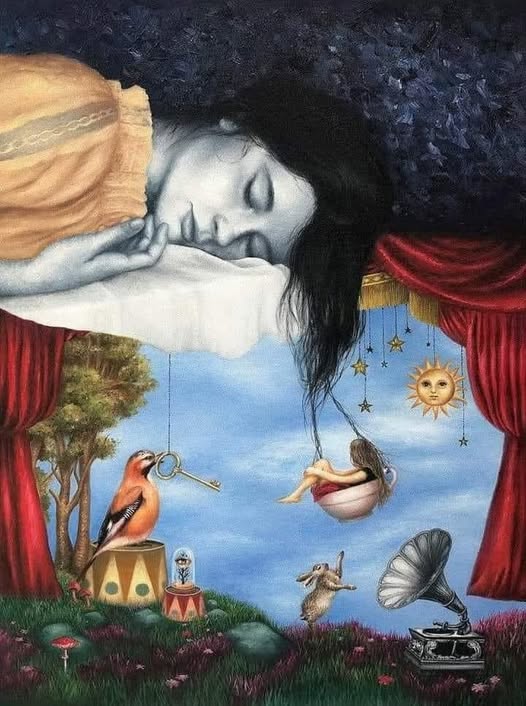
Let’s move on to the next section, which examines the link between dreams and wakefulness. Dr Freud’s effort to study the history of dreams is noteworthy, and naturally, Dr Jung held Freud’s contributions in high regard.
In Carl Jung, CW 5, Para 1, we read:
Anyone who can read Freud’s Interpretation of Dreams without being outraged by the novelty and seemingly unjustified boldness of his procedure, and without waxing morally indignant over the stark nakedness of his dream-interpretations, but can let this extraordinary book work upon his imagination calmly and without prejudice, will not fail to be deeply impressed at that point where Freud reminds us that an individual conflict, which he calls the incest fantasy, lies at the root of that monumental drama of the ancient world, the Oedipus legend.
The impression made by this simple remark may be likened to the uncanny feeling which would steal over us if, amid the noise and bustle of a modern city street, we were suddenly to come upon an ancient relic—perhaps upon the Corinthian capital of a long-since walled-up column, or upon the fragment of an inscription. And yet, but a moment before, we were utterly immersed in the hectic, fleeting life of the present; in the very next moment, however, something profoundly distant and alien flashes before us, directing our gaze toward a different order of things. We turn away from the vast confusion of the present to glimpse the higher continuity of history.
(My thanks go to Lewis Lafontaine.)
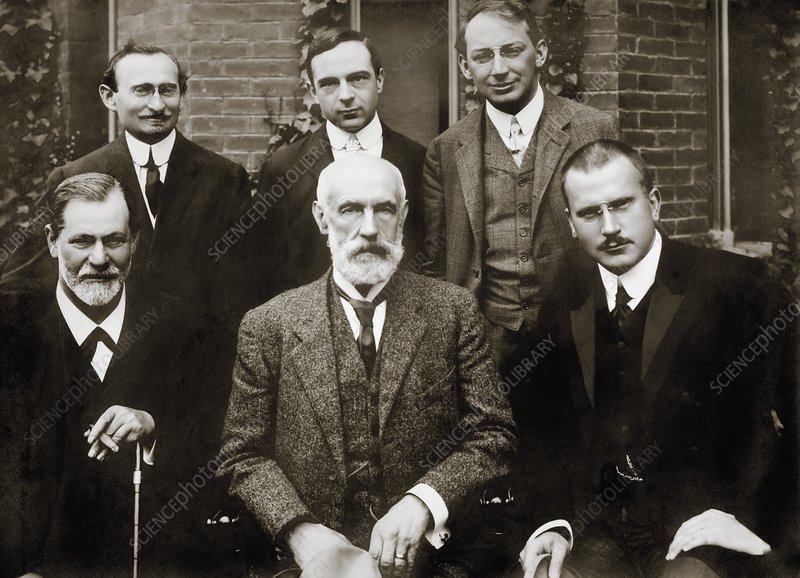
Credit: LIBRARY OF CONGRESS / SCIENCE PHOTO LIBRARY
I’ll begin with a few sentences from the earlier post; may the thread make it easier to get to the topic. Of course, you can find the previous post here.
The relationship between dreams and waking life (Beziehung des Traumes zum Wachleben)
…However, the vast majority of authors have held the opposite view on the relationship between dreams and waking life. For example, Haffner (p. 19) states: “First of all, dreams continue waking life. Our dreams always connect to the ideas that were present in our consciousness shortly beforehand. Close observation will almost always find a thread in which the dream linked to the experiences of the previous day.” Weygandt (p. 6) directly contradicts Burdach’s assertion quoted above, “for it can often be observed, apparently in the vast majority of dreams, that they lead us right back into ordinary life, instead of freeing us from it.” Maury (Le sommeil et les rêves, p. 56) states in a concise formula: “nous rêvons de ce que nous avons vu, dit, desiré ou fait”; Jessen, in his psychology published in 1855 (p. 530), elaborates somewhat more: “More or less, the content of dreams is always determined by the individual personality, by age, gender, social class, level of education, accustomed way of life, and by the events and experiences of the entire life to date.”
The ancients thought no differently about the dependence of dream content on life. I quote from Radestock (p. 139): When Xerxes, before he campaigned against Greece, was distracted from his decision by good advice but repeatedly spurred on by dreams, the ancient, rational Persian dream interpreter, Artabanus, aptly remarked to him that dream images usually contained what a person already thinks while awake.
In Lucretius’ didactic poem, De rerum natura, we find (IV, v. 959) the following passage:
»Et quo quisque fere studio devinctus adhaeret,
aut quibus in rebus multum sumus ante morati
atque in ea ratione fuit contenta magis mens,
in somnis eadem plerumque videmur obire;
causidici causas agere et componere leges,
induperatores pugnare ac proelia obire, … etc. etc. « “And to which almost everyone adheres, bound by their passion,
or to which things we have previously spent a lot
and in which the mind was more content,
We often seem to do the same in dreams;
lawyers argue cases and draft laws,
induperators fight and fight battles, … etc., etc.”
Cicero (De Divinatione II) says very similarly, as does Maury much later: »Maximeque reliquiae earum rerum moventur in animis et agitantur, de quibus vigilantes aut cogitavimus aut egimus.« “The greatest relics of those things move in the minds and are agitated, of which we have either thought or acted vigilantly.”
The contradiction between these two views regarding the relationship between dream-life and waking-life appears, indeed, irresolvable. It is therefore fitting to recall the account given by F. W. Hildebrandt (1875), who suggests that the distinctive characteristics of the dream cannot, in fact, be described in any other way than through a “series of contrasts which seemingly culminate in contradictions” (p. 8). “The first of these contrasts is constituted, on the one hand, by the strict detachment—or self-contained isolation—of the dream from real and true life, and on the other, by the constant encroachment of the one upon the other, the constant dependence of the one upon the other. — The dream is something entirely distinct from the reality experienced while awake—one might say a mode of existence hermetically sealed within itself, separated from real life by an unbridgeable chasm. It detaches us from reality, extinguishes within us all normal memory of it, and transports us into a different world and into an entirely different life-story—one which, fundamentally, has nothing whatsoever to do with our actual life…” Hildebrandt then elaborates on how, with the onset of sleep, our entire being—along with all its modes of existence—vanishes “as if behind an invisible trapdoor.” One might, for instance, undertake a sea voyage in a dream to St. Helena, there to offer the imprisoned Napoleon some exquisite Moselle wine. One is received by the ex-emperor with the utmost graciousness and almost regrets seeing this fascinating illusion shattered by the act of waking. Yet now, one compares this dream-situation with reality. One has never been a wine merchant, nor has one ever harboured the desire to become one. One has never undertaken a sea voyage—and St. Helena would be the very last place one would choose as a destination for such a journey. As for Napoleon, one harbours absolutely no sympathetic sentiments toward him, but rather a fierce, patriotic hatred. And to top it all off, the dreamer was not yet even among the living when Napoleon died on the island; establishing a personal connection with him lay entirely outside the realm of possibility. Thus, the dream experience appears as something alien, interpolated between two phases of life that fit together perfectly and seamlessly flow into one another.
“And yet,” Hildebrandt continues, “the apparent opposite is just as true and correct. I mean to say that, alongside this self-containment and seclusion, the most intimate relationship and connection go hand in hand. We may go so far as to say: Whatever the dream may offer, it draws its material from reality and from the mental life that unfolds within that reality. … No matter how strangely it may play with this material, it can, in truth, never truly break free from the real world; and its most sublime creations, no less than its most grotesque, must always borrow their raw substance from that which has either appeared before our eyes in the world of the senses, or has somehow already found a place in the train of our waking thoughts—in other words, from that which we have already experienced, whether outwardly or inwardly.”
Next time, we’ll explore memory in dreams. Take care! 🙏💖
 lampmagician
As ever this is a fantastic. Regards, Mike
LikeLiked by 1 person
As always, I appreciate your encouragement, my esteemed teacher. Yours sincerely, Aladin
LikeLike
I really enjoyed this! Thanks for stimulating the mind today, friend!
LikeLiked by 1 person
Thank YOU so much for your generous support, dear friend.
LikeLiked by 1 person
You’re very welcome!
LikeLiked by 1 person
Memory in dreams..is that like recurring dreams? Thanks Aladin ❤️
LikeLiked by 1 person
That is well depicted, dear Kathy. Thank you as well. 🤗🙏💖
LikeLike
Excellent, Aladin.
Whether dreams are an extension of awake life, or hermetically sealed (an alternate reality?) so far all I know is we must be alive in reality, to sleep and have dreams.
Then again, I have had wildly vivid dreams while fully awake, or only partly asleep. I have struggled between several apparent real worlds, that were dreams designed exactly as a moment in life. Lost, floundering from one same reality/dream to another, I finally arrive back here. This may not make sense. I have been trying to explain this for many years.
Sometimes I’ve wondered, if I died in my sleep during a dream, is that a new reality? Will I live there?
Anyway, I look forward to the next article on this!
PS_ My mind’e eye often plays interesting tricks on me.
The first time I read “found a place in the train of our waking thoughts” – I actually read found a place in the train wreck of our thoughts
💙🕊🌹xx
LikeLiked by 2 people
Fascinating, my dear friend! Your description of your daydreams brings to mind Franz Kafka, who often experienced similar fantasies. It’s important to reflect on such thoughts, as they are worth exploring.
Your misreading of that sentence seems somewhat negative, though it is also noteworthy.
Traditionally, Iranians believe that the interpretation of women’s dreams is the opposite of what they actually dream.
Let’s think positively! 😉🤗
As always, thanks a lot for your thoughtful words.💞🙏🌹🫂 💖
LikeLiked by 1 person
I will and do think positively. Interesting that my twist of sight upon reading seemed negative to you. Thinking about it, I didn’t question.
More intrigue on the Iranian take on women’s dreams.
Thank you for everything, Aladin!
❦🌹❦xx
LikeLiked by 1 person
Sorry! I realise I misunderstood earlier. In the sentence, “found a place in the train wreck of our thoughts,” I initially imagined a forgotten, wrecked location within our minds. But after reading it twice, I now see your skilful use of language. (I still come across for me unknown surprises in the English language that I need to learn!) 😜😅
So, I correct myself: it actually carries a positive message for me, even as a compliment!
You are a wonderful and valuable friend to me. 💖🙏🌹
PS: I had a stressful week and might need some time to avoid making mistakes. 🤗😘
LikeLiked by 1 person
NO Worries, Aladin!
My mind’s eye “skilful use of language.” often flies over people’s heads, according to my husband. And they all speak English.
You know, when you pointed that out, it did make me think. Am I correct in saying there is something “Freudian” about this exchange of words and thoughts?
There are no mistakes here, between you and me. There is only discussion, and thoughtfulness.
Yes…I had a stressful week too. (Government stuff)
XOXOXOXO
LikeLiked by 1 person
Exactly, and I’m super happy to have your insightful friendship, my wise friend.
🤗🤗❤️💞😘
LikeLiked by 1 person
❦🕊❦
LikeLiked by 1 person
This is a marvelous exploration, Aladin. Dreams are a fascinating subject. I need to catch up with this series. I love the picture too. Hugs.
LikeLiked by 1 person
You hit the nail on the head, my dear! Thank you so much for dropping by. Sending hugs and more hugs.
LikeLiked by 1 person
I’ve always been fascinated by dreams and their meanings. I do have some weird dreams and haven’t worked out what they mean.
Enjoying your series on dreams, Aladin 😀 xx
LikeLiked by 1 person
Wonderful! You might write down your dreams. I would do the same if I could remember them! Thanks a lot, my lovely friend. 🙏🤗💕
LikeLiked by 1 person