“Living with these things all the time, I can see how there are certain universal patterns for these manifestations. A shaman among the Navajo or in the Congo will say things that sound remarkably similar to those of Nicholas Cusanus, Thomas Aquinas, or C. G. Jung, leading one to realise that these ranges of experiences are common to the human race. There are some people who close themselves away from them, some people who open themselves to them …” -Joseph Campbell “Living Myths: A Conversation with Joseph Campbell,” Parabola, Volume I, Issue 2, Spring 1976, p. 70
In this tumultuous world, where corrupt leaders continue to pursue their plans for the “New World Order,” the most prudent approach is to allow our strained minds to be guided by the wisdom of eminent thinkers and to find solace in uniting our bewildered souls.
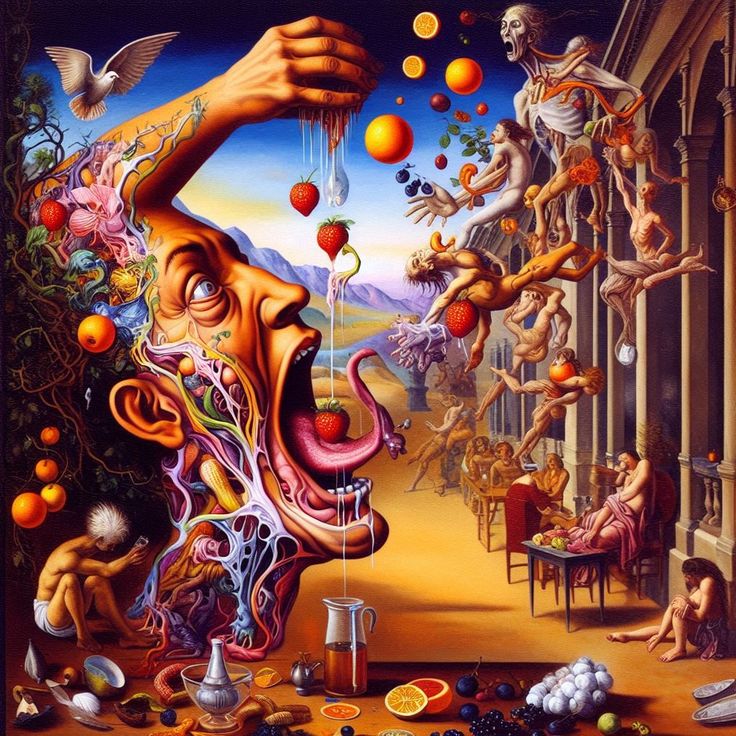
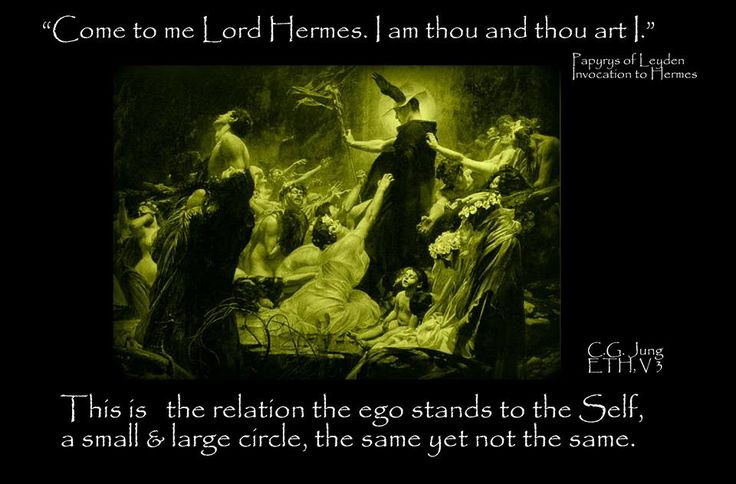
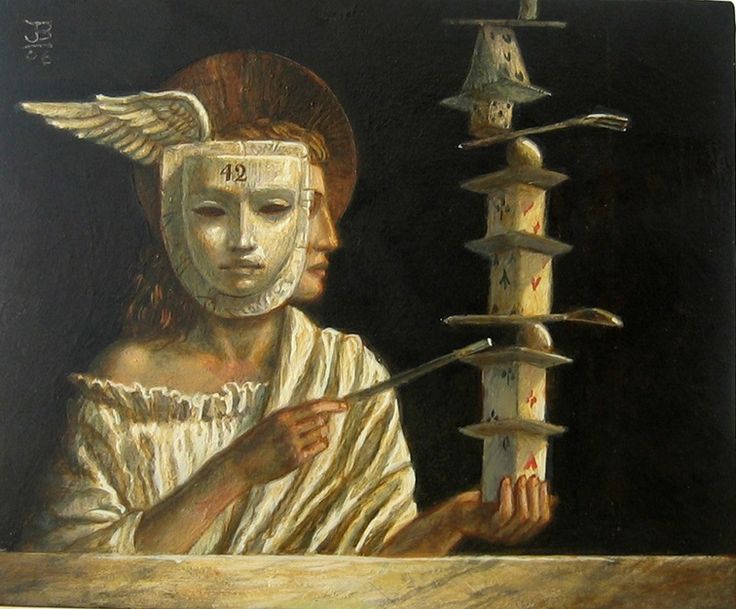
Surreal Abstract Painting (“Dadaism in nature” or “Psychedelic Surrealism”. )
My anger has subsided somewhat since last week, given how my words might have been taken. Nevertheless, I’m completely drained and fed up! Especially after that so-called ceasefire, which is like leaving an injured monster in a room with inocent people and locking the door!
These days, death has become the norm. We can see that the lives (of others, of course!) are not so important, but as we all know, the grim reaper is lurking, waiting for us all, regardless of our wealth or status, around the world. So, it’s essential to remember this.
That’s why I turn to myth, as an addendum to my recent post, and death!
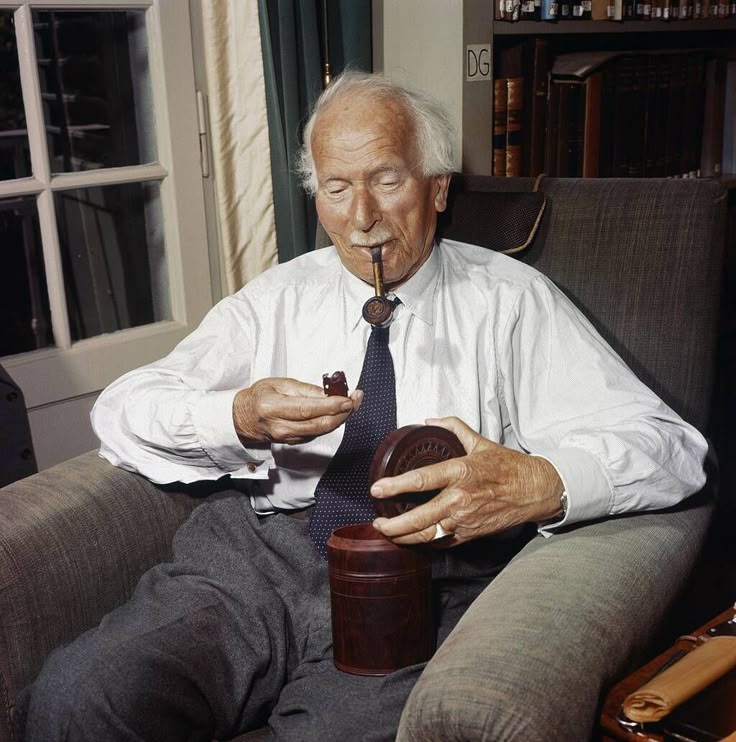
Carl Gustav Jung around 1960 in his house in Zurich. (Photo RUE DES ARCHIVES)
Here are some words by Carl Jung:
For example, I do not know for what reason the universe has come into being, and I shall never know. Therefore, I must drop this question as a scientific or intellectual problem. But if an idea about it is offered to me—in dreams or in mythic traditions—I ought to take note of it. …They (The foreknowledge) may be in accord with reality, and then again they may not. I have, however, learned that the views I have been able to form based on such hints from the unconscious have been most rewarding. Naturally, I am not going to write a book of revelations about them, but I will acknowledge that I have a “myth” that encourages me to look deeper into this whole realm. “Myths are the earliest form of science.” When I speak of things after death, I am speaking out of inner prompting and can go no farther than to tell you dreams and myths related to this subject.Naturally, one can contend from the start that myths and dreams concerning the continuity of life after death are merely compensating fantasies inherent in our natures—all life desires eternity. The only argument I can adduce in answer to this is the myth itself.
People go their own way; everyone is preoccupied with their own interests, such as gaining more followers, likes, and positive feedback, to create beautiful moments, days, and a life. The media dominates the world, but not in a positive way; rather, it strokes the ego. It is not just here or there; it is everywhere. As I observe it on Facebook, WordPress, or even on X (formerly Twitter), I notice how the people in Iran are suffering, while those Iranians abroad raise their mottos and banners.
By Lewis Lafontaine PS: The quote is from Marie-Louise von Franz and not Jung!
Marie-Louise von Franz pointed out these words in those days, when there was no media at all, which I believe we can easily adapt to a modern context today.
People are struggling all around the world, particularly children. The question is, is there any hope?
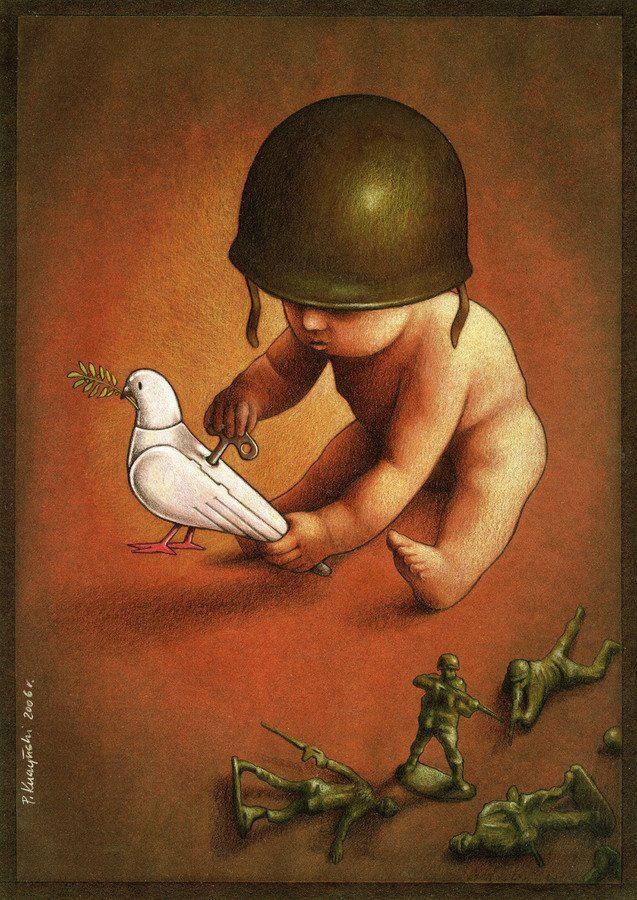
Artwork by Pawel Kuczynski, Poland
There’s nothing left to say… and waiting is the hardest part!
PS: If you are upset, just leave it; frankly, I don’t give a damn”!!🙏
Today, I can only articulate my perplexed reflections regarding this event, which I may have somewhat anticipated yet did not expect. I am referring to the conflict that commenced yesterday between Israel and Iran. I do not wish to convey any patriotic sentiment, as I do not possess such feelings; however, I still experience ambivalent emotions regarding the dismantling of the Islamic regime and my connection to my place of origin. That is what Carl Jung called the “Collective Unconscious.”
As I once responded to a dear friend’s question regarding my feelings; I have never supported war, but when one resides in a country governed by such a regime—killing young and old of one’s own people without mercy—and each day when venturing out onto the streets, uncertain if one will return alive, there is no other conclusion to draw!
Carl Jung’s perspective on war is complex and nuanced. He viewed war as a reflection of deeper psychological processes in individuals and nations, rather than just a political clash. Jung believed the “shadow” – the darker aspects of the human psyche – significantly influences this, with nations projecting undesirable traits onto enemies. He warned against the dangers of mass psychology and unconscious forces overwhelming reason, which can lead to destruction. Jung’s views on war extend beyond military tactics; they explore the psychological roots of conflict, highlighting self-awareness, the risks of unchecked unconscious forces, and how individuation fosters peace.
Recalling the phallus dream and brick games, Jung forms associations leading to his adult views on global devastation and “rivers of blood.” In autumn 1913, he sensed a sombre atmosphere, an oppression that appeared to emanate from external sources, as if something significant lingered in the air. He recalls how this feeling grew stronger over the months, eventually leading to a remarkable vision that took hold of him:
“I saw a monstrous flood covering all the northern and low-lying lands between the North Sea and the Alps. When it came to Switzerland, I saw that the mountains grew higher and higher to protect our country. I realised that a frightful catastrophe was in progress. I saw the mighty yellow waves, the floating rubble of civilisation, and the drowned bodies of uncounted thousands. Then the whole sea turned to blood.” Jung recalls several recurring dreams, regarding them as premonitions of world destruction leading up to the First World War.”
Anyway, I’ll just have to deal with it, just like so many others who have the same concerns. I truly hope this situation comes to a swift and favourable resolution, ultimately leading to a free and prosperous Iran.
As I reflect on my past life, the passing years prompt me to recall memories, and I see how I wish to revisit specific moments to alter them or improve them. I have led an adventurous life (as you may recall from my series of posts about my memories), and I acknowledge that I have made numerous mistakes, which I deeply regret. However, with guidance from great thinkers, I have learned to view these mistakes from a different perspective: The Value of Experience!
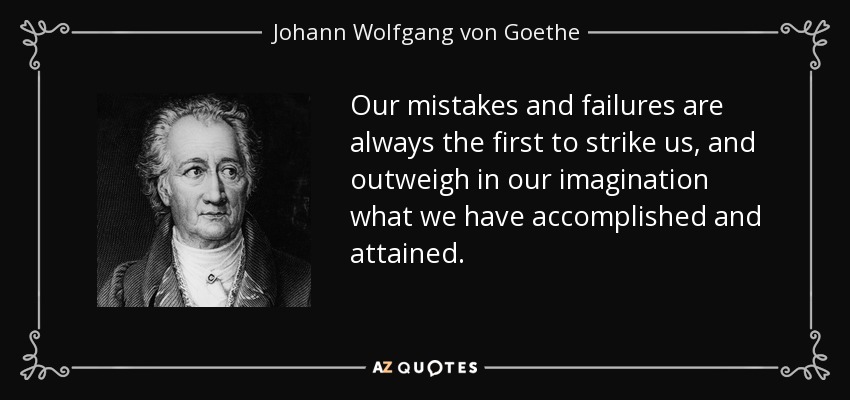
It is a prevalent issue for people around the world to avoid making mistakes. I, myself, am one of those who strive for perfection, and I recognise that it is misguided! Johann Wolfgang von Goethe says, “Geschlagener Quark macht breit, nicht fest!” (Beaten curd becomes broad, not strong!)
“If we look at the problems raised by Aristotle, we are astonished at his gift of observation. What incredible eyes the Greeks had for many things! Only they committed the mistake of being overhasty, of passing straightway from the phenomenon to the explanation of it, and thereby produced specific theories that are pretty inadequate. But this is the mistake of all time, and is still made in our own day.”
From Maxims & Reflections, Johann Wolfgang von Goethe; Science, 559
Additionally, Carl Gustav Jung reminds us that we can make mistakes and learn from them.
Whatever we look at, and however we look at it, we see only through our own eyes. For this reason, science is never made by one man but by many. The individual merely offers their contribution, and in this sense, I dare to speak only of my way of seeing things. ~Carl Jung, Modern man in Search of a Soul, p.84.
Plato proposed that absolute knowledge can be gained through acquaintance, meaning through intellectual insight into the otherworldly Forms. Jung shared a similar notion regarding acquaintance with the archetypes of the “unus mundus” (one world), representing the primordial, unified reality from which all things originate. Nevertheless, in contrast to Plato, Jung asserted that archetypes cannot be perceived directly. Instead, we can comprehend their psychic significance, gaining at least a hint of absolute knowledge.
I believe we can make mistakes, but after each one, we should take a step back and carefully examine how and where it happened, then try to approach the experience more thoughtfully. Experience teaches us more than thousands of books ever could!
Jung inspired individuals to engage with the world and savour life, rather than rely solely on theoretical knowledge from books. He regarded the unconscious mind as a treasure trove of experiences accessible through reflection and symbolic language. Ultimately, Jung’s work emphasises that while books and knowledge are valuable, they shouldn’t overshadow the importance of direct experience and self-reflection. Genuine growth and understanding flourish when we engage with our surroundings and explore our inner lives.
Sometimes a tree tells you more than can be read in books. ~ C.G. Jung; Letters Volume 1; Page 179.
Experience, not books, is what leads to understanding. ~Carl Jung, CW 12, Para 564
Thank you for reading; have a lovely holiday! 🙏🤗🌹💕
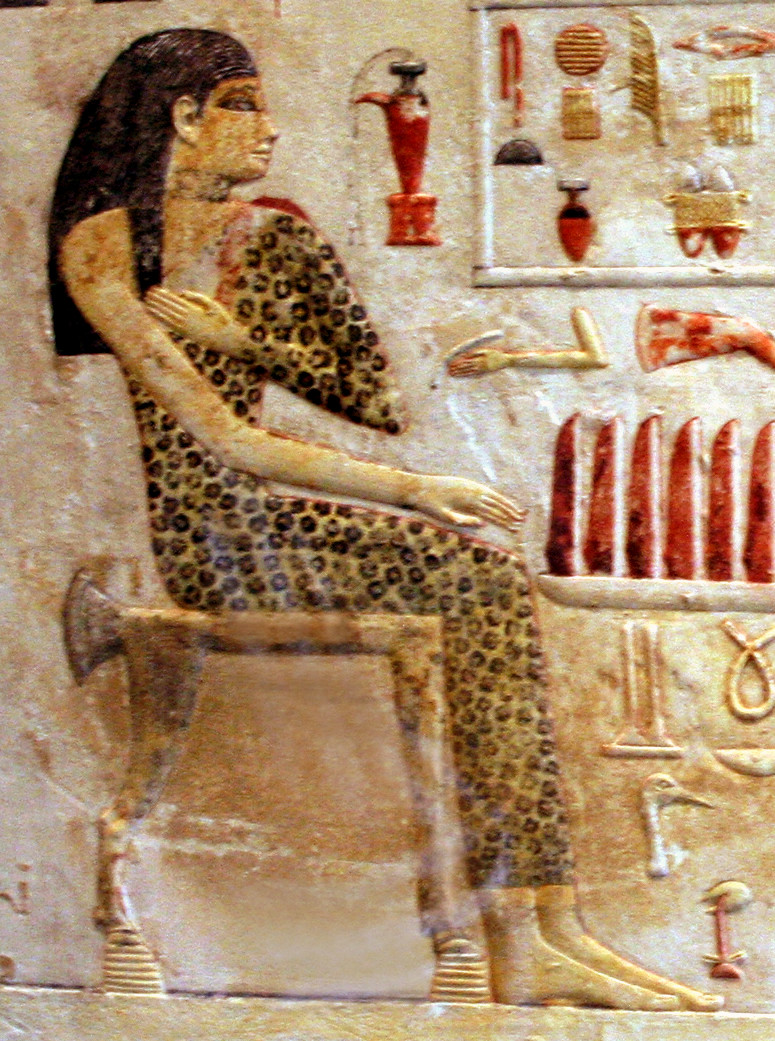
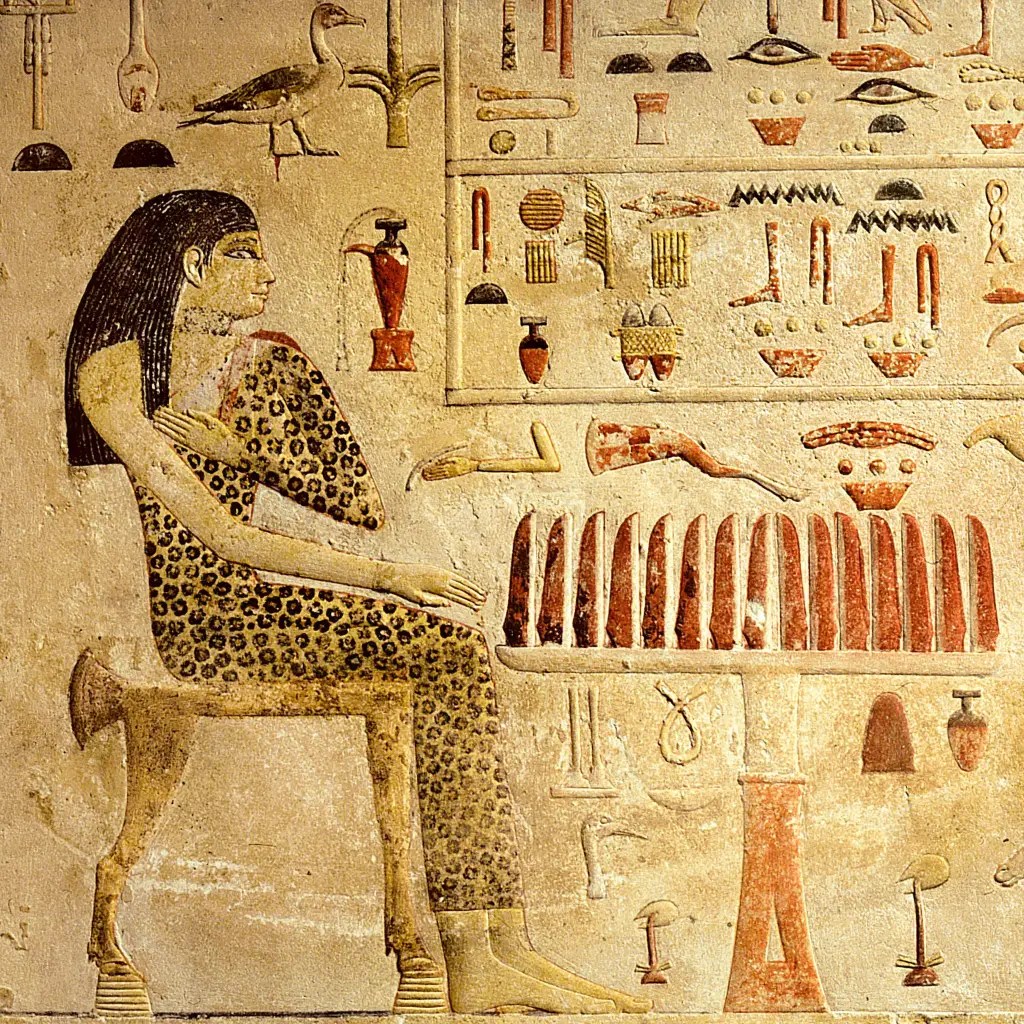
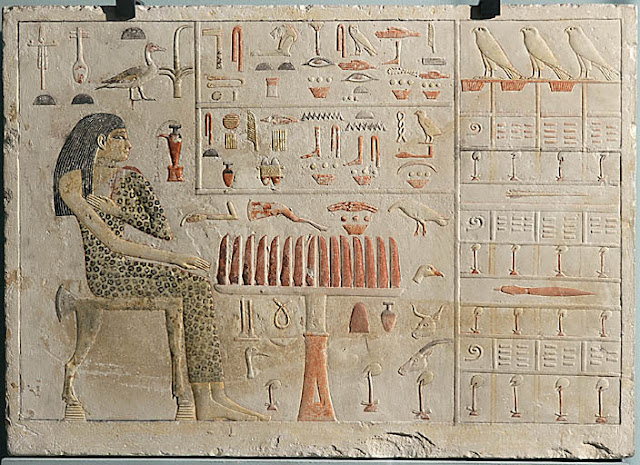
This relief stele from Princess Nefertiabet’s tomb (G 1225) in Giza depicts her and other relatives of the king, including Nefertiabet, daughter of Khufu. She is shown seated, facing to the right, depicted with a long wig and a panther-skin garment.
An offering table before her holds customary reeds and various food items. Below are linen and ointment on the left, and bread, beer, oryx, and bull on the right. A linen list is displayed beside the slab.
Stele of Princess Nefertiabet and her food offerings Egypt Museum
Now, I would like to share an excellent description of the discovery of this beautiful ancient artwork by the brilliant Marie Grillot.
The stele of Nefertiabet: from its mastaba in Giza to the Louvre Museum
Stele depicting Princess Nefertiabet before her funeral meal – painted limestone – reign of Khufu (4th Dynasty) Discovered by Montague Ballard in 1902 in mastaba G 1225 at Giza Entered into the Louvre Museum in 1938 by the gift of L., I. and A. Curtis – E 15591
In 1901-1902, Montague Ballard, a British brewer, obtained an excavation permit at the Giza site. He stayed there for only a very short time, but it was long enough to make some interesting discoveries. In 1902, in the western cemetery, he discovered a mastaba, which would be referenced as G 1225, that notably contained the “Stele of Nefertiabet,” named after its “owner.”
Most of the artefacts discovered during his mission were subsequently dispersed. Three pieces from the mastaba ended up in Arthur Sambon’s collection. They were then put up for sale on May 25, 1914, in Paris by the expert Jacob Hirsch. The stele seems to correspond to the object presented under No. 2 of the “Stone Sculptures of Egyptian Art.” Did it then pass into other hands? In any case, it was later found in the possession of an aesthete and art lover: Atherton Curtis.
Born in New York in 1863, he settled in Paris in 1904, where he “brought and continually increased his collection.” In “La Grande Nubiade,” Christiane Desroches Noblecourt recalls: “Among the most prestigious donors (to the Louvre), not only for the Egyptian department but for all the others, was Atherton Curtis. He wanted to add to his name that of Louise, his first wife, who died prematurely, and that of the second, who was also passionate about all antiquities, Ingeborg.” The stele entered the Louvre in 1938 through the “Curtis Bequest.” It was during the November 8, 1938 meeting of the Council of National Museums that Charles Boreux, Curator of the Department of Egyptian Antiquities, informed “the Council of the immediate gift, by Mr. and Mrs. Atherton Curtis, of three magnificent pieces of sculpture included in the donation subject to usufruct that they made to the Louvre a few months earlier. These are a painted limestone group representing King Amenhotep and Queen Nofertiti, a group from the Old Kingdom, and finally a polychrome bas-relief in the name of Princess Nofritabtj.” He died in 1943, and the stele was then permanently housed at the Louvre, registered under the reference E 15591.
Measuring 37.70 cm high, 52.50 cm wide, and 8.30 cm thick, it is made of painted limestone. It belongs to the category known as “slab stelae,” which are in fact “slabs embedded in the walls of funerary chapels” and which represent the oldest reliefs in Giza.
While the scene depicted is relatively common in Old Kingdom funerary iconography, its quality and the finesse of its execution remain exceptional. This suggests that it was likely executed in the workshops of Pharaoh Khufu. This could also be explained by the fact that Nefertiabet was either “the daughter or sister of the great pharaoh” or, according to another interpretation, “probably a sister of King Khufu and a daughter of Snefru.”
The rectangular surface is surrounded by a plain band standing out in slight relief. Nefertiabet is depicted alone facing her eternal meal. She is on the left side, seated on a delightful bull-legged stool, the back of which is decorated with a papyrus umbel.
Slim, fine, slender, her “yellow skin colour is well preserved,” and she is particularly elegant. Her panther-skin dress is held together, on the left, by “seven red shoulder knots, all applied with paint,” while on the right, the shoulder is bare. The garment stops above the ankles, revealing the bracelets that adorn them, while her bare feet rest flat on the ground.
Stele depicting Princess Nefertiabet before her funeral meal – painted limestone – reign of Khufu (4th Dynasty) Discovered by Montague Ballard in 1902 in mastaba G 1225 at Giza Entered into the Louvre Museum in 1938 by the gift of L., I. and A. Curtis – E 15591 This stele, walled up in the chapel of her tomb in Giza, magically ensured the eternal nourishment of the deceased, a relative of King Khufu.
Her perfectly profiled face is highlighted by a long, black, tripartite wig, which covers a large part of her forehead but leaves her ears visible. Her large eyes are rimmed with kohl, and her nose and mouth are of ideal proportions; only her neck, adorned with a necklace, appears a little short. “The face expresses the ideal of feminine beauty at the time of the pyramids: slightly rounded forehead, fine, straight nose, delicately contoured lips and nostrils, and a rounded throat” (Christiane Ziegler, “Egypt at the Louvre”).
Her left arm rests, hand flat, on her right breast, while her right arm is held alongside her body, hand outstretched towards “a white stone footed tray, placed on a cylindrical terracotta support, and covered with slices of cake with a golden crust and white crumb”.
The quality of the carved and painted hieroglyphs that “document” the stele is of total perfection, as proven by the precision of execution of the libation ewer, the animal heads, and even the birds,…
Above Nefertiabet’s head, “an inscription in large hieroglyphs enhanced with colour specifies her name and title; one will particularly admire the reed and the duck, meaning respectively ‘king’ and ‘daughter’… All around (the pedestal table) hieroglyphic signs and images immortalise the offerings necessary for her survival that the inscription wishes her thousands of: duck with its head cut off; head, foreleg and rib of beef; jug of wine. Above the table, two lines of hieroglyphs, arranged in a frame, list the products of the funerary ritual (incense, ointment, green and black makeup) as well as fruits and drinks: figs, jujubes, carobs, beer, and wine. The entire right-hand side is occupied by lists listing thousands of pieces of fabric, undoubtedly necessary for mummification, with their quality and length, as specified by Christiane Ziegler in the work cited above.
One might rightly wonder how this stele, which dates from 2590-2565 BC and is therefore more than 4,500 years old, has reached us in such a well-preserved state. Here is part of the explanation: “This stele was sealed on the outer wall of its tomb in Giza, at the foot of the Great Pyramid. Later walled up, it was protected from the wear and tear of time and men.
In his study “Slab Stelae of the Giza Necropolis” published in 2003, Peter Der Manuelian specifies however that: “The remains of the original mud-brick chapel have not been preserved and the exact location of the slab stela could not be determined due to the destruction of this part of the mastaba wall by Ballard”…
But at the Louvre, in the heart of the prestigious Parisian museum – precisely on the first floor of the Sully wing, in room 635 dedicated to the Old Kingdom – Nefertiabet remains very much alive, adorned with everything fundamental to ensure her a long, very long eternity…
Stele of Nefertiabet https://collections.louvre.fr/ark:/53355/cl010005261 Jacob Hirsch, Expert, Catalogue of Works of Art and High Curiosities…, Faience…, Saxon Porcelain,… Egyptian and Greek Sculptures…, Persian Manuscripts…, Old Paintings… Forming the Collection of Mr. Arthur Sambon… Sale: May 25-28, 1914, Imprimerie Georges Petit, Paris, 1914 https://gallica.bnf.fr/ark:/12148/bpt6k12478139/f12.item.r=tombeau Charles Boreux, The Atherton Curtis Donation, Bulletin des musées de France, November 1938 http://gallica.bnf.fr/ark:/12148/bpt6k58649569/f8.image.r=curtis?rk=21459;2 Christiane Desroches Noblecourt, The Great Nubian or the Journey of an Egyptologist, Stock, 1992 Guillemette Andreu, Marie-Hélène Rutschowscaya, Christiane Ziegler, Ancient Egypt at the Louvre, Hachette, 1997 Christiane Ziegler, Egyptian Art in the Age of the Pyramids, Réunion des musées nationaux, 1999, p. 20, 207-208, notice no. 54. Peter Der Manuelian, Slab Stelae of the Giza Necropolis, The Peabody Museum of Natural History of Yale University, The University of Pennsylvania Museum of Archaeology and Anthropology, New Haven and Philadelphia, 2003 http://giza.fas.harvard.edu/search-results/?q=1225 Morris L. Bierbrier, Who Was Who in Egyptology, London, Egypt Exploration Society, 2012 Campbell Price, Ancient Egypt, Pocket Museum, Thames & Hudson, 2018
An Essay on the Valuable Contributions of Pam Lazos.
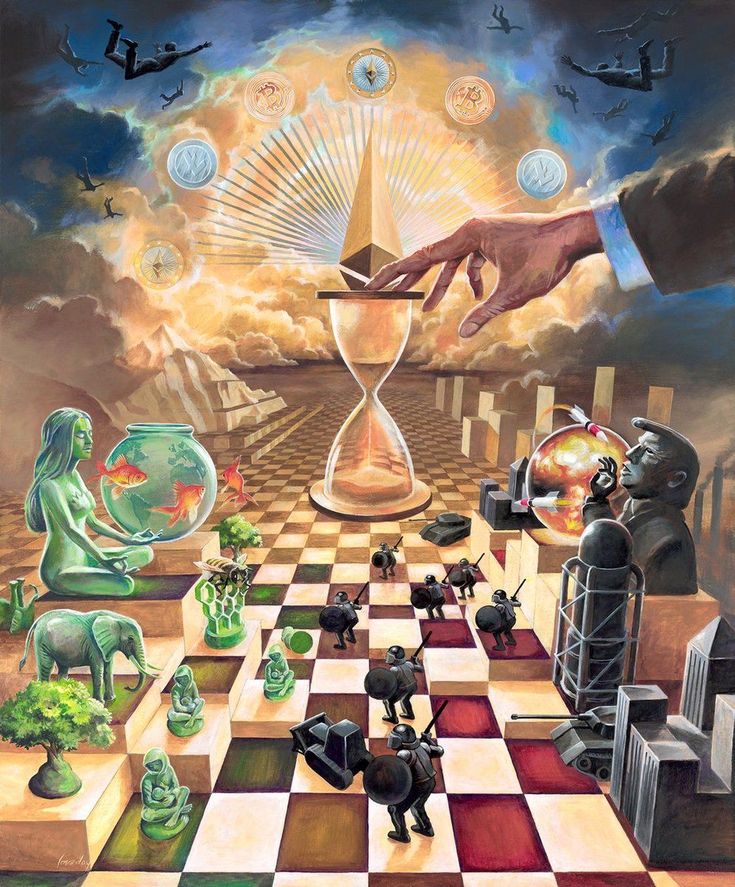
Time of no time (AI modified)
For many years, I held back from reblogging other posts. However, this time, it’s not just due to my limited involvement; Pam generously offered me this opportunity, and I sincerely hope it contributes a little to this invaluable work, but also it’s truly because of this excellent book by the incredibly insightful writer and thinker Pam Lazos. She doesn’t merely glance at things; she truly comprehends the depth of what’s unfolding in our environment. As I pressed the Reblog button, WordPress provided a blank space for me to write! I then copied and pasted the original link here, and I hope it works!
It is highly recommended for those wishing to become more informed and stay vigilant.










 lampmagician
You must be logged in to post a comment.