The Intoxication of Mythology

Standard

Mythology (derived from the Greek word ‘mythos’, meaning ‘story’, and ‘logos’, meaning ‘word’) studies a culture’s sacred narratives or fables, known as myths. These stories explore various aspects of the human condition: good and evil, suffering, the origins of life, place names, cultural values, and beliefs regarding life, death, and deities. Myths reflect a culture’s values and beliefs. Mythology may also concentrate on specific collections of myths, whereas history examines significant past events and real individuals. Central characters in myths include gods, demigods, and supernatural beings. The earliest myths date back over 2,700 years, particularly in the works of the Greek poets Homer and Hesiod. Scholar Joseph Campbell defines four essential functions of myth: metaphysical, cosmological, sociological, and pedagogical.

“The wonder is that the characteristic efficacy to touch and inspire deep creative centres dwells in the smallest nursery fairy tale—as the flavour of the ocean is contained in a droplet or the whole mystery of life within the egg of a flea. Because the symbols of mythology are not manufactured, they cannot be ordered, invented, or permanently suppressed. They are spontaneous productions of the psyche, and each bear within it, undamaged, the germ power of its source.”
-Joseph Campbell / From The Hero With A Thousand Faces

However, we can trace back to the ancient Assyrians, where we discover the epic of Gilgamesh (a form of the name derived from the earlier Sumerian form) and Enkidu. Honestly, whatever I know or feel passionate about that subject, I owe it to Al, my brother, who opened the mysterious gate for me to this fascinating world. We cannot overlook the allure of these stories, which not only expand our imagination but also impart a great deal of wisdom through their narratives. Thus, as Dr Jung emphasises here, possessing a myth is of considerable significance. There may even be some truth hidden within it; who knows?

(Parenthesis open) I have tried to write my usual “two posts,” though it has shown me that I do not quite fit as I usually do! I must confess that she, Resa, spurred me to work, for which I am very grateful. I also thank all my friends who attempted to support me, even if it sometimes sounded like Marie Antoinette’s supposedly quoted remark to the starving people of France: “If there is no bread, let them eat brioche!” Although there is no evidence that she actually said this. Also, I must rest. Nevertheless, I thank you all. (Parenthesis closed)!
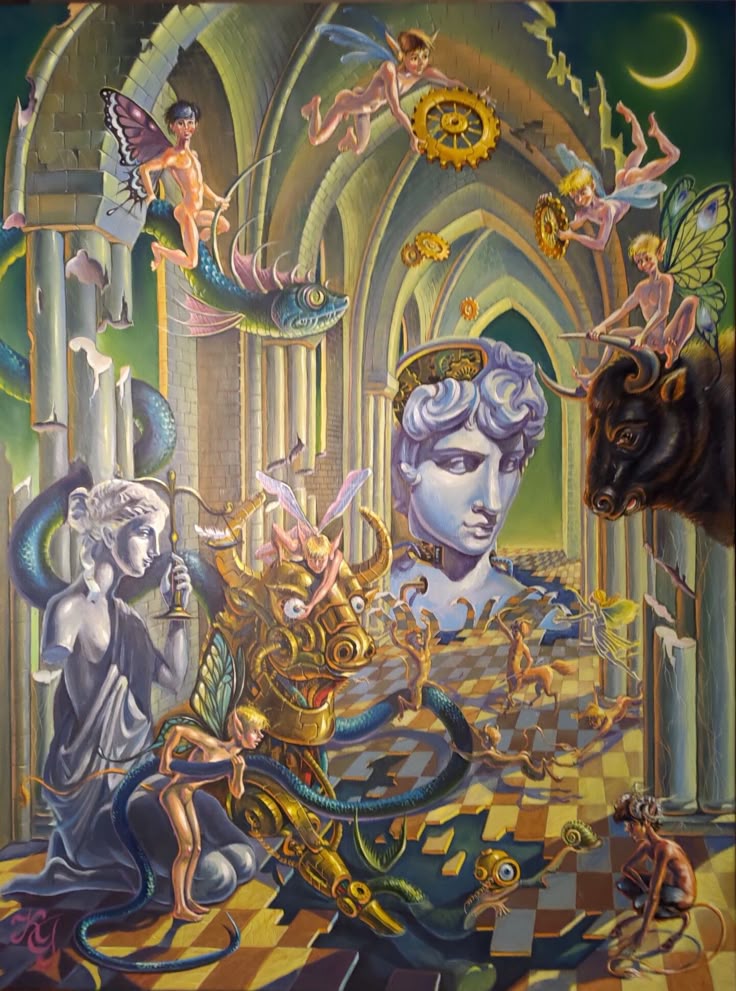
Painting (Oil) Original Artwork by Greg Known The Abducted Europe

I have selected an intriguing excerpt from the Red Book, Liber Novus, Introduction by Sonu Shamdasani, Reader’s Edition, to share. It illustrates the significance and necessity of having a myth for every individual. I have created a summary to keep it concise!

In 1908, Jung bought land by Lake Zürich in Küsnacht and built a house where he lived for life. In 1909, he resigned from Burghölzli to focus on his practice and research. His retirement coincided with a shift in interests toward methodology, folklore, and religion, leading to a vast private library. This research culminated in “Transformations and Symbols of the Libido,” published in two parts in 1911 and 1912, marking a return to his intellectual and cultural roots. He found this mythological work thrilling; in 1925, he reflected, “It seems to me I was living in an insane asylum of my own making. I went about with all these fantastic figures: centaurs, nymphs, satyrs, gods and goddesses, as though they were patients and I was analysing them. I read a Greek or a Negro myth as if a lunatic were telling me anamnesis. (Introduction to Jungian Psychology, p. 24). The late nineteenth century witnessed a surge in comparative religion and ethnopsychology scholarship, with primary texts being translated and examined, such as Max Müller’s “Sacred Books of the East,” which Jung owned, offering a global relativization of Christianity worldwide.

In Translations and Symbols of the Libido, Jung differentiated two types of thinking: directed and fantasy thinking. The former is verbal and logical, exemplified by science, while the latter is passive, associative, and imagistic, represented by mythology. Jung argued that the ancients lacked directed thinking, a modern development. Fantasy thinking occurs when directed thinking ceases. This work extensively studies fantasy thinking and the mythological themes present in contemporary dreams and fantasies. Jung linked the prehistoric, primitive, and child, suggesting that understanding adult fantasy thinking illuminates the thoughts of children, savages, and prehistoric people. (Jung, The Psychology of the Unconscious, CW B, s36. His 1952 revision clarifies this [Symbols of Transformation, CW 5, s29]. In this work, Jung synthesized 19th-century theories on memory, heredity, and the unconscious, proposing a phylogenetic layer of mythological images present in everyone. He viewed myths as symbols of libido, reflecting its movements, and used anthropology’s comparative method to analyze a wide range of myths, calling this “amplification.” He argued that typical myths correspond to ethnopsychological developments of complexes. Following Jacob Burckhardt, he referred to these as “primordial images” (Urbilder). One key myth, that of the hero, represents an individual’s journey to independence from the mother, with the incest motif symbolizing a desire to return to the mother for rebirth. Jung eventually hailed this discovery as the collective unconscious, though the term emerged later.

Myth!

The Symbologist “The Red Book_ Liber Novus” By Kathryn Harrison (via Carl Jung Depth Psychology)

In a series of articles from 1912, Jung’s friend and colleague Alphonse Maeder argued that dreams had a function other than that of wish fulfilment, which was a balancing or compensatory function. Dreams were attempts to solve the individual’s moral conflicts. As such, they did not merely point to the past but also prepared the way for the future. Maeder was developing Flournoy‘s views of the subconscious creative imagination. Jung was working along similar lines and adopted Maeder’s positions. For Jung and Maeder, this alteration of the conception of the dream brought with it an alteration of all other phenomena associated with the unconscious.

In his preface to the 1952 revision of Transformations and Symbols of the Libido, Jung wrote that the work was written in 1911 when he was thirty-six: “The time is a critical one, for it makes the beginning of the second half of life, when a metanoia, a mental transformation, not infrequently occurs (CW 5, p. xxvi). He added that he was conscious of the loss of his collaboration with Freud and was indebted to the support of his wife. After completing the work, he realised the significance of what it meant to live without a myth. One without a myth “is like one uprooted, having no true link either with the past, or with the ancestral life which continues within him, or yet with contemporary human society (Ibid. p. xxix).

As he further describes it:

   “I was driven to ask myself in all seriousness: “What is the myth you are living?” I found no answer to this question and had to admit that I was not living with a myth, or even in a myth, but rather in an uncertain cloud of theoretical possibilities, which I was beginning to regard with increasing distrust … So, in the most natural way, I took it upon myself to get to know “my” myth, and I regarded this as a task of tasks –for—so I told myself—how could I, when treating my patients, make due allowance for the personal factor, for my personal equation, which is yet so necessary for a knowledge of the other person, if I was unconscious of it?” (Ibid.)

The study of myth had revealed to Jung his mythlessness. He then undertook to get to know his myth, his “personal equation”. (Cf. Introduction to Jungian Psychology, p. 25) Thus, we see that Jung’s self-experimentation was, in part, a direct response to theoretical questions raised by his research, which culminated in Transformation and Symbols of the Libido.

PS: I will add a follow-up to this article in the future. 🙏💖

The (Wel)coming of Christian Copt;The Chapel of Peace.

Standard

“When he arose, he took the young Child and His mother by night and departed for Egypt, and was there until the death of Herod the Great, that it might be fulfilled which was spoken by the Lord through the prophet, saying, Out of Egypt I called My Son” (Matthew 2:12-23). The Bible identifies Egypt as the refuge the Holy Family sought while fleeing Judea.

According to Coptic tradition, St. Mark is believed to have brought Christianity to Egypt around 50 CE. A small Christian community began to form in Alexandria during the late first century and expanded significantly by the end of the second century. Certain similarities in beliefs aided the acceptance of Christianity among Egyptians, including the dual nature of the Egyptian god Osiris as both human and divine, the resurrection of Osiris, and the divine triad consisting of Osiris, Isis, and Horus.

Paradise landscape with the animas entering Noah’s ark.*oil on copper.*26.5 x 35.6 cm.*signed verso: 1596 / Brueghel (Wikimedia Common)

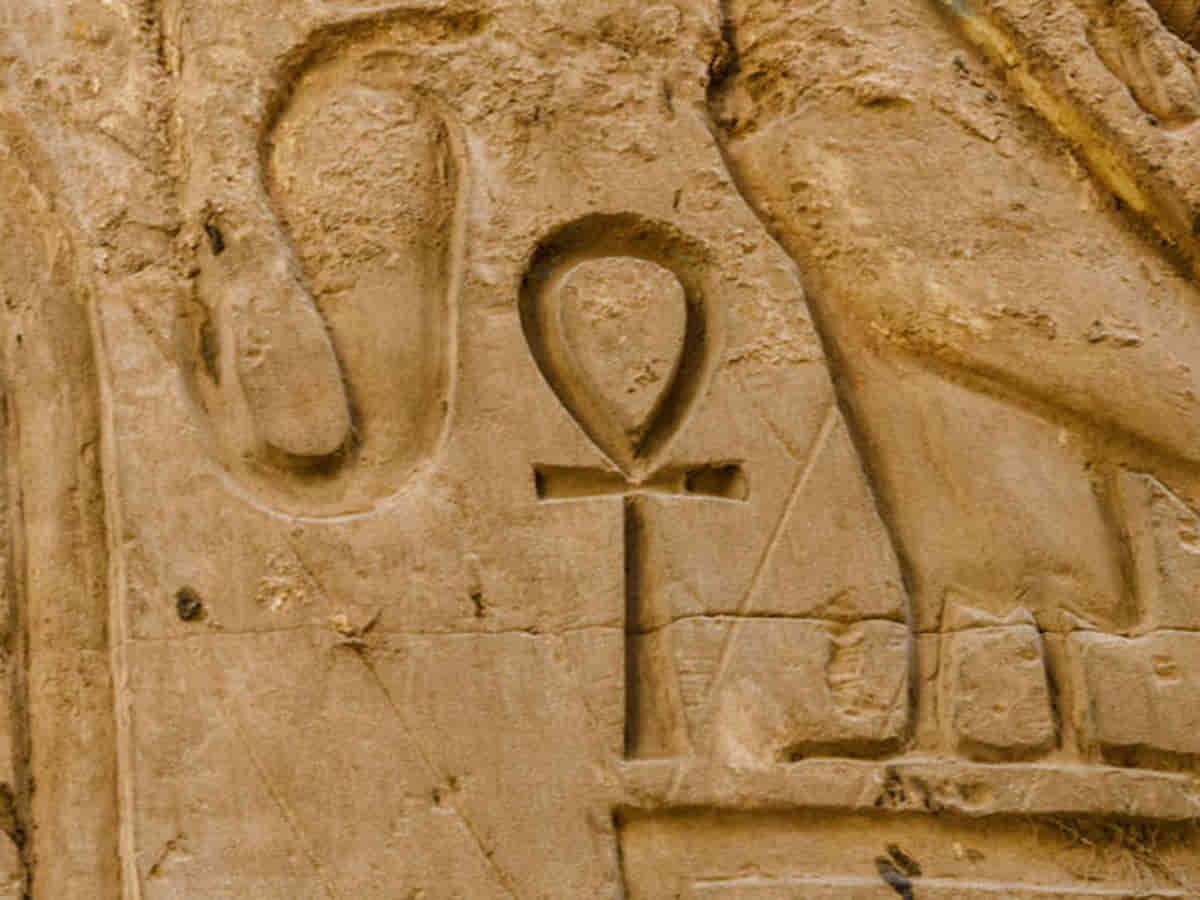
The ancient Egyptians, classical Greeks, and Romans primarily shaped the Coptic period in Egypt. This influence is evident in Coptic art, particularly in textiles that often feature ancient Egyptian symbols and motifs, such as the ankh, representing life. The ankh served as an alternative to the Christian cross; certain textiles display both symbols. Nevertheless, Coptic art predominantly reflects the more substantial impact of Greek and Roman traditions.

I’ve been unwell and facing difficulties lately (wearing out my apparatus and equipment in old age!), so I haven’t been able to post regularly. However, now that my illness is in a stillstand modus, I’m giving it a try!

Here, I present Marie Grillot‘s captivating account of the Christian Copts’ arrival in Egypt, their artistry, and their harmonious, peaceful way of life.

The Christian Necropolis of Bagawat

via égyptophile

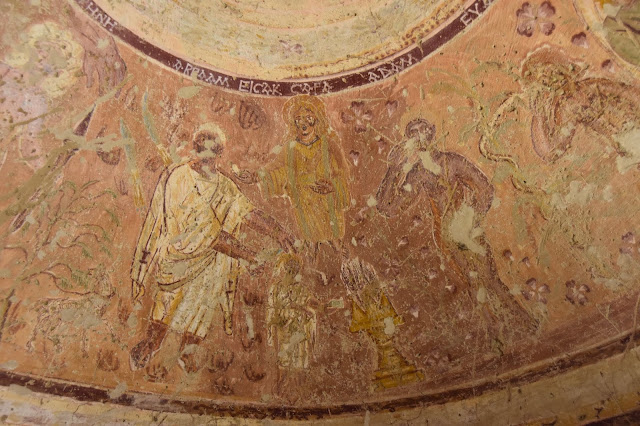
Mary, Noah’s Ark and Jacob, depicted on the dome of the Chapel of Peace in Bagawat.
“The central image shows the patriarch and his family in the ark. Two doves overlap between the praying Mary and the ship.
The alliance with Noah finds its fulfilment with the Annunciation” – Christian necropolis of Bagawat – Kharga Oasis – 5th – 6th centuries.

A little over a kilometre northwest of the temple of Hibis, in the oasis of Kharga, stretches a ridge about twenty meters high on the edge of the desert. It is the remains of a site from the very beginning of Christianity in Egypt.

This is the Bagawat necropolis, which was active from the 2nd to the 7th century. It is so unique that it is sometimes referred to as Coptic, Roman, Byzantine, or even Greco-Coptic or Romano-Byzantine.

Christian necropolis of Bagawat – Kharga Oasis – 2nd – 7th centuries

The middle of the first century of our era witnessed the arrival of Christianity, which caused proselytism to spread along the Nile… The edicts of Theodosius I, promulgated in 380 and then 391, led to the banning of pagan rites and the official closure of temples. The Copts, the first Christians in Egypt, affirmed their new faith and beliefs, engendering a new iconography and architecture… From its beginnings, Coptic art would draw inspiration from different cultures: Roman, Byzantine, Greek, and even Pharaonic.

During its 500 years of “activity,” in addition to digging hundreds of scattered pit tombs, the necropolis will see the construction of 263 chapels, examples of proto-Coptic art, surrounding a church built around the 4th century. As in Roman and Byzantine cemeteries, they are arranged along streets. Although they differ in size and specific details of their architectural structure, they restore an extremely harmonious overall unity.

Christian necropolis of Bagawat – Kharga Oasis – 2nd – 7th centuries

“The funerary chapels are built of mud brick, in most cases originally covered with white plaster on the outside and inside. Externally, they present an architectural mixture of classical and ancient Egyptian motifs, often with a “cavetto” type cornice and classical forms of engaged columns with Corinthian capitals. They are generally square and covered with domes on pendentives or, less frequently, rectangular with barrel vaults. In a few cases, the remains of wooden roofs are visible. On each of the three walls of the Chapel, except the entrance wall, there is usually a niche, while a few chapels have a projecting apse at the eastern end. These apsidal ends are either circular or octagonal. Some of the larger buildings consist of a double Chapel of two square compartments, while a few have front courts surrounded by a wall of columns and engaged arches,” analyzes Albert M. Lythgoe in “The Oasis of Kharga”.

In “Enciclopedia dell’ Arte Antica” (1973), H. Torp describes “two basic types of construction. The first is very simple, with a square or rectangular plan and with a roof of wooden beams. The other type is square, covered with a dome. Of the first type, there are a little over a hundred tombs; of the second, a little less. The other mausoleums are variants or combinations of these two types, except for a limited number of circular or rectangular mausoleums with a barrel vault, as well as five large structures composed of several rooms, partially covered with vaults or a roof”.

The painters who worked in Bagawat were the vectors of diverse influences, which they combined, adapted and enriched, thus making this necropolis an exceptional place.

In “The Necropolis of el-Bagawat in Kharga Oasis”, A. Fakhry indicates that twenty-two of these chapels have “painted decorations, but only seven contain figurative art, the others showing only painted crosses or the like”.

Three chapels are particularly notable for their paintings.

The Chapel of Peace – Christian Necropolis of Bagawat – Kharga Oasis – 5th-6th centuries

The Chapel of Peace (No. 30) dates from the 5th and 6th centuries. For experts, its decoration is unique in early Christian art. The biblical themes, with characters (from the front!), are treated in shades of ochre, purple and red while respecting the perspectives the dome-shaped structure certainly made difficult to execute. This is a “unique register of sophisticated representations of biblical figures ‘labelled’ Greco-Coptic which includes allegorical images of peace, prayers and rigour alongside Daniel, Jacob, Noah, Mary, …”

The style and quality of the paintings “reflect a level of technical skill far superior to that of other surviving decorations from the necropolis. The artist who painted them appears to have had formal training” (Matthew Martin).

The Chapel of the Exodus Christian necropolis of Bagawat – Kharga Oasis – 5th-6th centuries

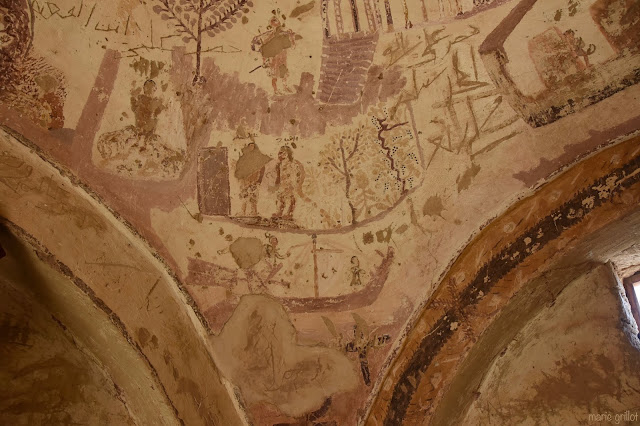
The Chapel of the Exodus (No. 80), whose centre of the dome is decorated with vine branches and filled with birds and naive trees, owes its name to its representations linked to the Hebrews’ departure from Egypt. It is declined in several scenes, such as Noah’s Ark, Daniel in the lion’s den, the three Jews in the furnace, the martyrdom of Isaiah, and episodes from the stories of Jonah and Job…

Chapel No. 25 – Christian Necropolis of Bagawat – Kharga Oasis – 5th-6th centuries

As for chapel no. 25, it offers magnificent white birds “standing on globes which support with their outstretched wings a solar disk covering the dome raised in the centre of the room.”

Thus, the domes and apses of the tombs and chapels contain “some masterpieces of Coptic painting, illustrating themes from the Old Testament and early Christianity, in a Hellenistic and Roman style. Wealthy Greeks certainly commissioned the paintings represented. Most of the frescoes are painted in red and purple tones, in a naive style but executed with great detail” (Hervé Beaumont, “The Necropolis of El-Bagawat” – Egypt: the guide to Egyptian civilizations, from the pharaohs to Islam).

Bagawat is an exceptional place, both architecturally and pictorially. It turns out to be, in a way, at the confluence of influences from the beginning of the Christian era…

It once again proves that religion is an immense source of inspiration for artists: to magnify their faith, they draw from the depths of themselves treasures of imagination and creativity to honour and glorify what is highest…

Marie Grillot

Sources:
Albert M. Lythgoe, The Oasis of Kharga, The Metropolitan Museum of Art Bulletin, 1908-11-01 https://archive.org/details/jstor-3253214/page/n1/mode/2up W. Hauser, The Christian Necropolis in the Khargeh Oasis, BMMA 27, March 1932, The Metropolitan Museum of Art https://www.metmuseum.org/pubs/bulletins/1/pdf/3255361.pdf.bannered.pdf?fbclid=IwAR1p4UODOMBAj8dYj_p9nCPa2fj6m7fZrNc7OXTinm8mJES3Tjgtr5fPp7s H. Torp, el BAGAWAT, Enciclopedia dell’Arte Antica, 1973 http://www.treccani.it/enciclopedia/el-bagawat_%28Enciclopedia-dell%27-Arte-Antica%29/ Hervé Beaumont, The Necropolis of El-Bagawat, Egypt: the guide to Egyptian civilizations, the pharaohs to Islam, Gallimard, 2000 Matthew Martin, Observations on the Paintings of the Exodus Chapel, Bagawat Necropolis, Kharga Oasis, Egypt, Byzantine Narrative, Papers in Honour of Roger Scott, Australian Association for Byzantine Studies, Byzantina Australiensia 16, John Burke, Ursula Betka, Penelope Buckley, Kathleen Hay, Roger Scott & Andrew Stephenson, Melbourne, 2006 https://www.academia.edu/364953/Observations_on_the_Paintings_of_the_Exodus_Chapel_Bagawat_Necropolis_Kharga_Oasis_Egypt

Confronting the Beyond through the Reflection of Existence

Standard

As I have done for the past few days, I sit calmly in front of my monitor, relishing the peace of having nothing to do. Yet, somewhere in my mind, someone offers me the challenge of taking on something!

I would rather resist the temptation to write, as I recognize that I lack the energy and concentration needed to compose a lengthy story—particularly about my struggle with the sudden changes brought on by ageing. (Reflecting on my seventy years of living, I see that my worst illness was a bad cold!), and now it happens such a big thing!!

However, I have often contemplated death, and this time, I find myself reflecting on it more deeply and with a sense of respect. I believe this is an important issue.

It is good to know there is an end, at least in this form as we live, and to let close friends and family accept once there is a farewell.

To hear from Dr Carl Gustave Jung how he tells us:

In 1944, Jung suffered a heart attack and experienced what he then claimed to be an experience ‘after death’: ‘What happens after death is so unspeakably glorious that our imagination and our feelings do not suffice to form even an approximate conception of it’ (Letters, Vol. 1,343, cited by Yates 1999:6).
… He addressed this issue on different occasions, notably in a letter addressed to Kristine Mann in 1945, in which he argued that this experience gave him a ‘glimpse behind the veil’ (Letters Vol. 1, 358-359, cited by Yates 1999:7).

From Carl Jung Depth Psychology

Of course, I don’t intend to say farewell—not yet! But in my new situation, I can consider it.

As you may know, I am not religious, and yet, I no longer identify as an atheist. I believe that once our bodies have fulfilled their purpose and naturally fade away, some unearthly energy hidden within our unconscious will be released into an unknown realm. If we can understand our dreams, we might provide insight into where this energy goes.

By the way, my condition is relatively stable, and I must maintain this until April when I am scheduled for another surgery, provided that everything remains the same or improves!? Thank you all for your support.💖🤗🙏

The image on the top by 1dontknows