Hello, friends! As I mentioned in my last post two weeks ago, I decided to take a break from sharing new posts to alleviate some pressure on myself. Unfortunately, my brief explanation about this decision led to misunderstandings among many of you, while a few friends grasped my point. So, to make it clear, I am not on holiday; I am working more than usual because my boss is still in the hospital. I appreciate your understanding!
Anyway, as you can see, I have a new post yet, though not something heavy. It’s light and deep, for sure! Simply put, as I’ve been reflecting on my experiences with WordPress over the past couple of years, I’ve realized that artists need inspiration to create art. However, that inspiration isn’t always readily available. This platform provides a wonderful opportunity for us to share our thoughts and feelings naturally rather than treating it like a mandatory series production we must complete out of obligation. Consequently, I have decided to give myself time and share my thoughts when I believe they are valuable. 🤗
I’m still experiencing a tough time because of my “Standby” position (Imagine waking up each day unsure if you can work from home or need to jump out and drive around!). I find it hard to focus on anything that could calm my restless mind, and I feel like losing my creative spark. I started working on the Egypt post, but it didn’t satisfy me, so I decided to share an instructive story and some charming videos about a great and knowledgeable thinker, Alan Watts. I hope you will enjoy it, and I can take another break!!
Let’s examine our lives and our existence. It is not so difficult; we just need to loosen the tension in every muscle in our body, especially our brains, and surf around.
Alan Watts played a significant role in popularizing Zen Buddhism in the West, paving the way for traditional teachers like Soto priest Suzuki Roshi. However, Watts did not consider himself a Zen Buddhist. In a talk animated by Trey Parker and Matt Stone, he clarifies, “I am not a Zen Buddhist; I am not advocating Zen Buddhism or trying to convert anyone. I have nothing to sell.” He identifies himself simply as “an entertainer.” Is he joking?
Watts was ordained an Episcopal priest in 1945 and served until 1950. He was a complex character—a strict anti-dogmatist who found rigid doctrine irritating at best and profoundly oppressive and dehumanizing at worst.
Watts wasn’t a strict Zen priest but learned a lot from Japanese Buddhist concepts, which he explains in the short section of the video above. He also found similar insights about the interconnectedness of all things in Daoism. Above, you’ll see a short animation by Eddie Rosas from The Simpsons, where Watts illustrates “Daoism in perfection” through a simple parable.
In this short animated parable by Steve Agnos below, he states, “The whole process of nature is an integrated process of immense complexity.” However, instead of illustrating a lesson about unity, he suggests that nature and reality are ultimately beyond our understanding. He argues that “it is really impossible to determine whether anything that occurs within it is good or bad.” Therefore, the most reasonable approach seems to avoid judging in either direction.
And how it can be easy to open our minds, honestly, to ourselves and use our brain to think over and not take the easy way to judge:
Alan Watts critiques the human tendency to make hasty judgments, as seen in this mastery “talk-animated” below by Tim McCourt and Wesley Louis of Westminster Arts & Film London. He explores personal identity and the ego’s separation from reality, emphasizing the theme of interconnectedness. Watts asserts it is “impossible to cut ourselves off from the social and natural environments; we are that.” To discover this truth, he encourages us to become “deep listeners” and to let go of embarrassment, shyness, and anxiety.
I am not selling anything, either! 😅 (unfortunately!!?), but I send my best wishes to you all. Have a lovely time and till then.🙏💖🌹
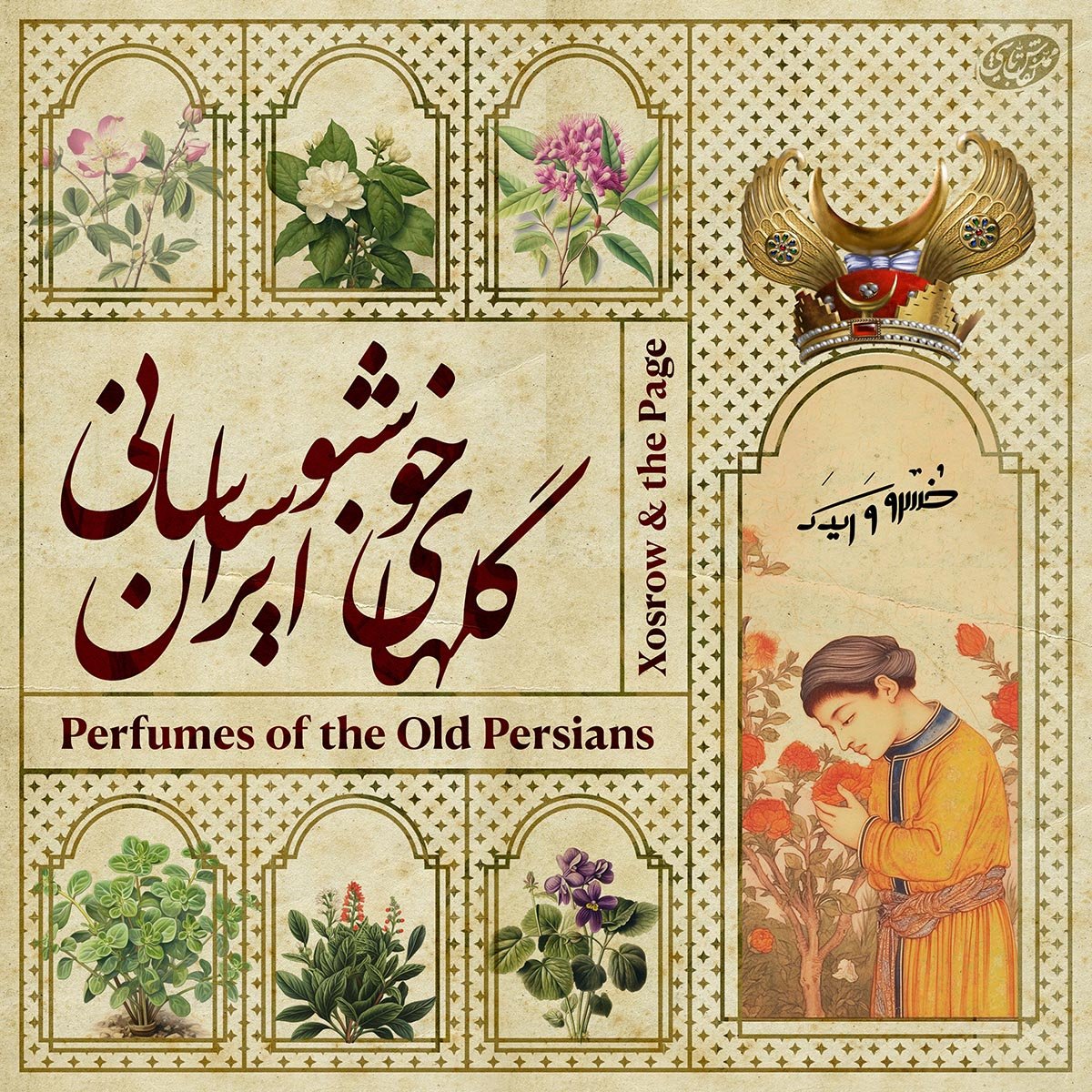
Perfume has a rich history in human culture, such as ancient Persia, which dominated the perfume trade for decades. This civilization is known for inventing non-oil-based perfumes, and the Persian nobility valued fragrances highly, with kings having unique “signature scents” reserved exclusively for them. Ancient Persia had many perfume-making workshops where people experimented with various distillation processes and scents.
“Khosrow & the Page” (Perhaps from the 7th century)
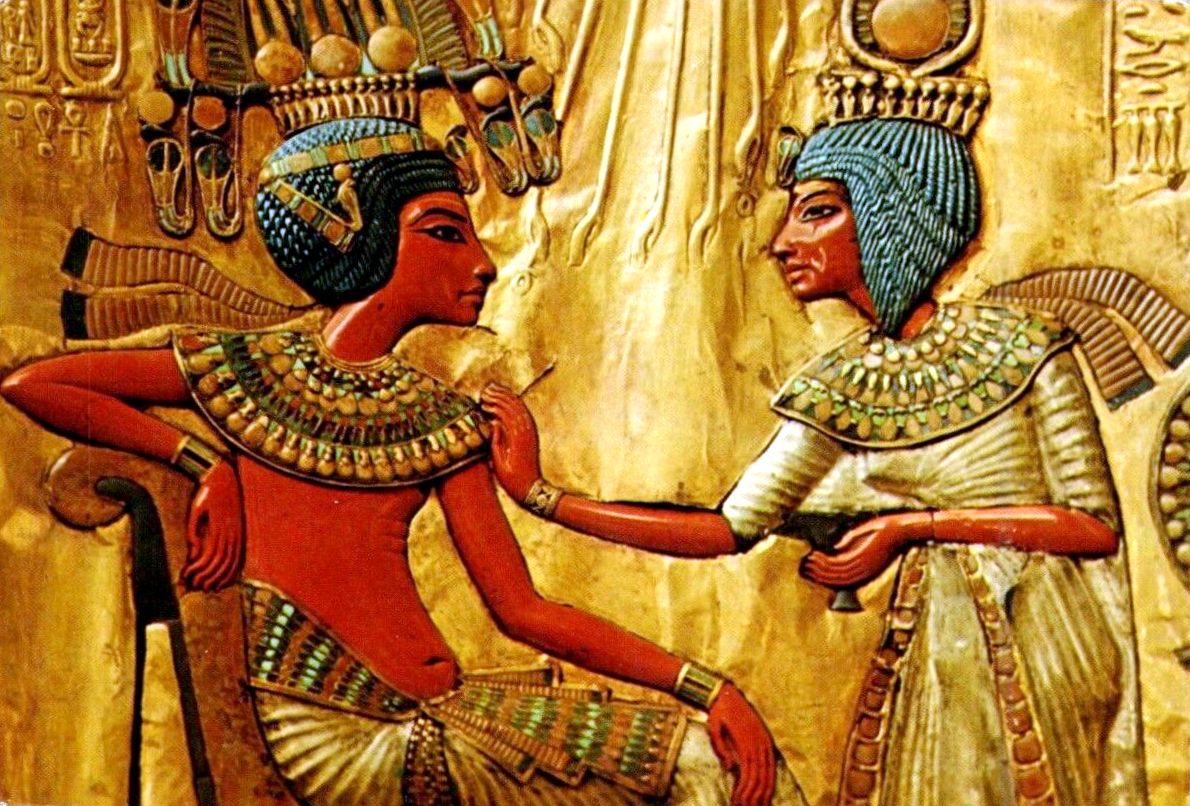
In Ancient Egypt, the elite highly valued perfume oils and fragrances. The god Nefertem, associated with perfume, is often depicted with water lilies, a key ingredient in ancient scents.
“Rise like Nefertum from the lotus to the nostrils of Ra, and come forth upon the horizon each day”.
Perfumes were created by distilling natural ingredients in non-scented oils, resulting in fruity, woodsy, or floral aromas. Notable figures like Queen Hatshepsut and Queen Cleopatra enjoyed these fragrances, using them for baths and personal grooming. It is rumoured they took perfumes to their graves.
Here is the story of finding a tiny but precious perfume bottle from ancient Egypt, written by Marie Grillot, with heartfelt gratitude.🙏💖
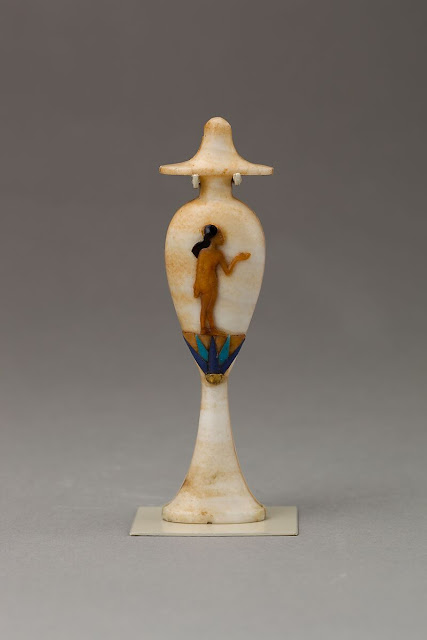
An Amarna princess on a vase-shaped perfume bottle: Hes.
Perfume bottle in the form of a hes vase with the representation of princess travertine (Egyptian alabaster), carnelian, obsidian, gold, coloured glass inlays New Kingdom – 18th Dynasty – reign of Akhenaten (1353 – 1336 BCE) Metropolitan Museum of Art, New York – accession number 40.2.4. (by acquisition from the Carter Estate in London in 1940) – museum photo
This delightful perfume bottle, in the form of a “Hes”( meaning “praise” or “favour) vase, is 10.8 cm high, 3 cm wide and has a diameter of 1.9 cm. According to some sources, it is made of calcite (Egyptian alabaster or travertine), with a decoration made of carnelian, obsidian, gold and coloured glass. In “Scepter of Egypt II”, William C. Hayes details its manufacturing technique thus: “The conical stopper was here cut in one piece with the pot itself. Since its tiny neck would have been too small to allow the insertion of a drilling tool, the bottle was made in two vertical halves, hollowed out and carefully joined with an orange resin glue”.
Perfume bottle in the form of a hes vase with the representation of princess travertine (Egyptian alabaster), carnelian, obsidian, gold, coloured glass inlays New Kingdom – 18th Dynasty – reign of Akhenaten (1353 – 1336 BCE) Metropolitan Museum of Art, New York – accession number 40.2.4. (by acquisition from the Carter Estate in London in 1940) – museum photo
Its charming appearance is enhanced by the presence, on one side, of a princess’s representation in inlays. Seen in profile, it reveals a naked, slim and youthful body. Her partially shaved skull displays on one side the “braid of childhood”; thick and black, it is thrown back. One leg is advanced, and she is in the apparent walking position. One arm hangs along the body, while the other displays a bent elbow and an outstretched hand, palm open. “The elegant gesture of the princess seems to signify a sign of greeting: standing on a lotus flower according to traditional symbolism, she embodies rebirth and rejuvenation”, analyzes Dorothea Arnold in “The Royal Women of Amarna”. Indeed, the ancient Egyptians considered the lotus as “the initial flower” and “the symbol of the birth of the divine star”.
For Egyptologist Valérie Angenot: “The gesture of the little princess, the hand outstretched in a cup, is stereotypical of the gestures of princesses since the time of Hatshepsut. It denotes the attitude of a child who wants to attract someone’s attention and address them by gently pulling their chin towards her. At Tell el-Amarna, the gesture is attested about fifteen times on the walls of private tombs, administrative monuments such as the king’s audience hall, steles, perhaps seal impressions, as well as on this vase. It exclusively features princesses, mostly to show that they interact or chat among themselves during long official ceremonies, which one imagines is tedious for young children. But we can also see them making this gesture in their interaction with their parents or even with the uraeus hanging from their foreheads. At Deir el-Bahari, Hatshepsut addresses the god Amon, her father, on whose knees she stands as a child. We must, therefore, imagine an elliptical interlocutor for this vase. Various reliefs show Akhenaten and Nefertiti performing a libation to the Aten with similar vases (but often adorned with a spout, 𝘯𝘦𝘮𝘴𝘦𝘵). Therefore, the ‘person’ to whom this little princess emerging from a solar lotus is addressing herself would be none other than the god Aton, whose honour the ritual would be simulated using this artificial vase. It is remarkable that we still find the same stereotypical gesture of the cupped hand sketched by one of the two Amarna ‘kings’ on the famous Berlin stele of Captain Pasi (ÄM 17813).”
Perfume bottle in the form of a hes vase with the representation of princess travertine (Egyptian alabaster), carnelian, obsidian, gold, coloured glass inlays New Kingdom – 18th Dynasty – reign of Akhenaten (1353 – 1336 BCE) Metropolitan Museum of Art, New York – accession number 40.2.4. (by acquisition from the Carter Estate in London in 1940) – museum photo
The details of its morphology, such as the elongation of the skull, the shape of the face, and the marked belly, attribute it to the Amarna period… William C. Hayes gives this sensitive description: “The naked figure of the young girl – which seems to come straight out of one of the scenes preserved in relief at Tell el-Amarna – is delicately carved in a thin sliver of carnelian, the back of which has been hollowed out to fit exactly the curved surface of the vase. The hair of the figure, topped with the characteristic heavy side lock, is a piece of polished obsidian or black glass beautifully worked and skillfully fitted. Spears and triangles of purple glass (imitation lapis lazuli) and polished carnelian have been joined together to form the lotus flower on which the figure stands, and at the base of the flower, a spot of sparkling yellow has been provided by a piece of thin gold plate.”
This precious artefact dates to the New Kingdom, the 18th Dynasty, the reign of Akhenaten (1353 – 1336 BC). It is in the Metropolitan Museum of Art in New York, where it has been registered under the accession number 40.2.4, with the “ancient provenance”: “possibly Thebes.” As for its “recent provenance,” it is “speaking”: “Howard Carter Collection, acquired from the Carter estate in London in 1940.”
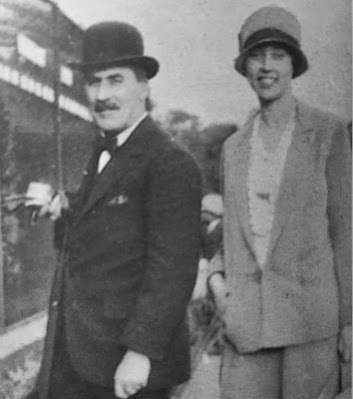
Portrait of Howard Carter, author and date unknown (London 9-5-1874 – 2-3-1939) Draughtsman and Egyptologist, discoverer, in November 1922 with Lord Carnarvon, of the tomb of Tutankhamun
Howard Carter, painter and designer, Egyptologist, collector, and discoverer with Lord Carnarvon of the tomb of Tutankhamun in 1922, died in London on March 2, 1939. In his will (drawn up on July 14, 1931), he had designated his niece Phyllis Walker as heir to the majority of his assets, stipulating that, for all matters concerning the sale of Egyptian antiquities, she should refer to the executors he had appointed: Harry Burton and Bruce Ingram. The latter, noting in his apartment the presence of artefacts from the tomb of Tutankhamun, opted for restitution to Egypt. On March 22, 1940, Phyllis Walker wrote to Etienne Drioton, director of Egyptian antiquities, to organize this “return”. This is how around twenty artefacts will be returned, via diplomatic bag, to King Farouk… before joining the Tahrir Museum…
Howard Carter Draughtsman and Egyptologist, discoverer, in November 1922 with Lord Carnarvon, of the tomb of Tutankhamun With his niece Phyllis Walker, who will be his primary heir
Returning to this point in “Howard Carter, The Path to Tutankhamun”, Thomas Garnet Henry James confides: “A further comment on this sensitive subject is that the antiquities in his possession at his death, after the extraction of the Tutankhamun objects, were valued by Messrs Spink at £1093. This was certainly a low estimate, as was often the case in estate matters, but it indicates the relatively modest nature of his private collection…”
Thus, in this inventory carried out on June 1, three months after the discoverer’s death, by the London art dealers Spink & Son of St James’s Street (“Spink list”), this bottle bears the number 55.
Of course, the question arises as to whether it is linked to the young pharaoh’s funerary treasure…
Thomas Garnet Henry James’s opinion is as follows: “It can be said that any fine small object dating from the 18th Dynasty which appeared in a private collection or on the market in the 1920s and 1930s was almost systematically attributed to the tomb of Tutankhamun”…
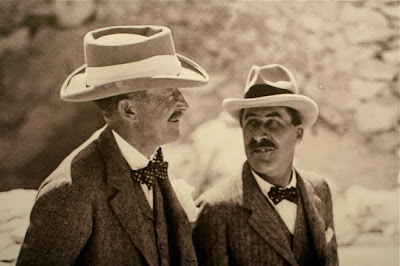
Lord Carnarvon and Howard Carter, discoverers of Tutankhamun’s tomb in 1922 (KV 62)
As for Marc Gabolde, he draws up, in his excellent “Tutankhamun”, published by Pygmalion in 2015, a list of “Objects possibly coming from the tomb of Tutankhamun and not found (somewhere else) in Egypt”. This calcite bottle in the shape of a libation vase (hs) appears there with the following information: “The quality of the work and the materials, as well as the date that can be assigned to the object thanks to the iconography of the inlaid figure, leave little doubt that it could come from the tomb of Tutankhamun. The figure of the princess is incompatible with the time of Amenhotep III, and the royal tomb of Amarna has not provided similar objects, especially in such a state of preservation”…
It is another time to take it easy and breathe to reflect on a former joy. However, I am overtaxed (as some dear friends might have noticed!) by some more stress caused by my boss lying in a hospital for hip surgery, and I must do his orders as in my so-called retirement (seclusion). That means every day on standby! I don’t know when I just will be left alone!!
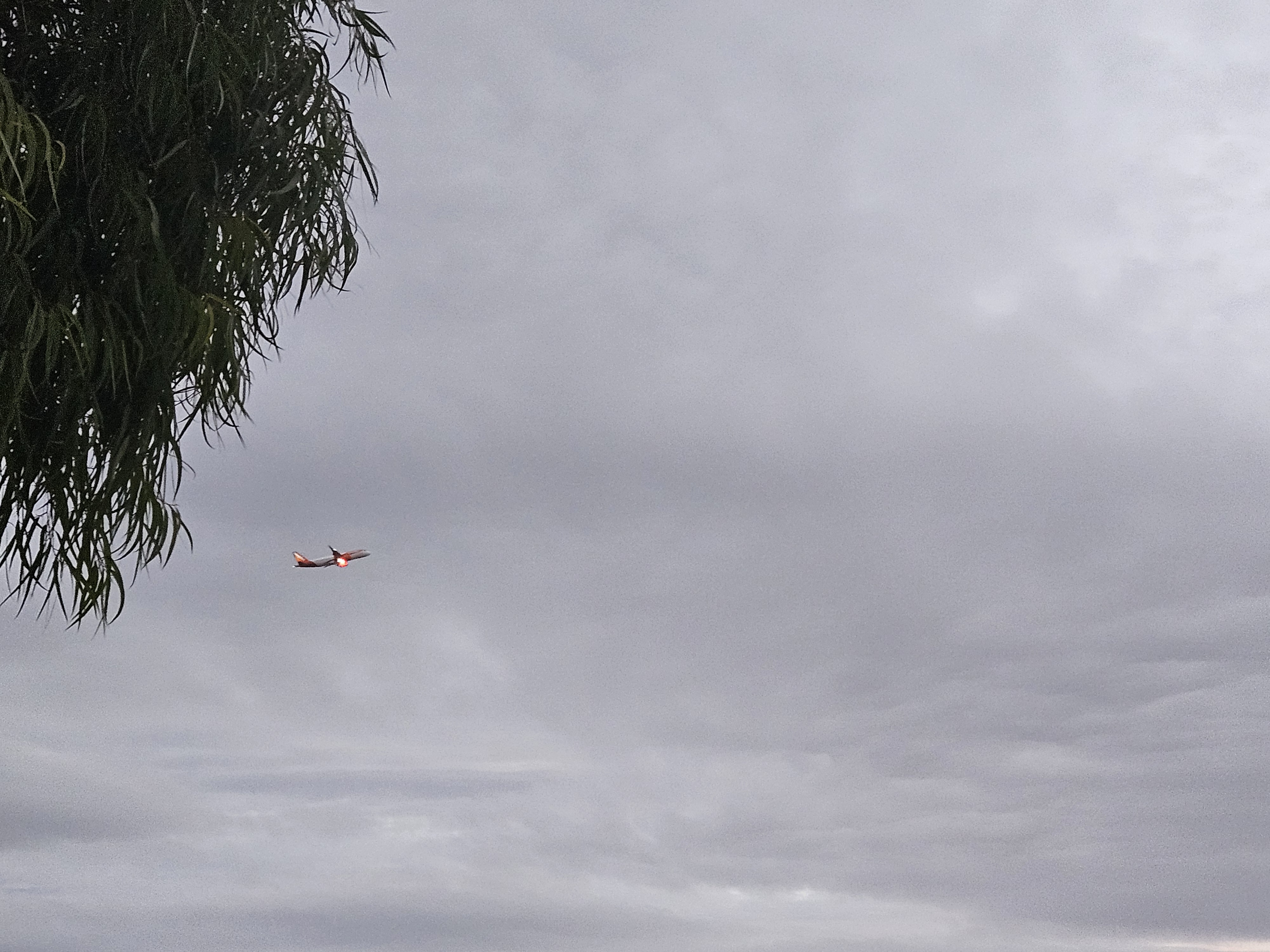
So, I just wanted to let you know that I will probably be almost off for the next two weeks. If you ever mind, you might forgive me for my lack of or late feedback! 🙏😅🙏 Now it is enough lamented; let’s go to one of the most beautiful Canadian islands.
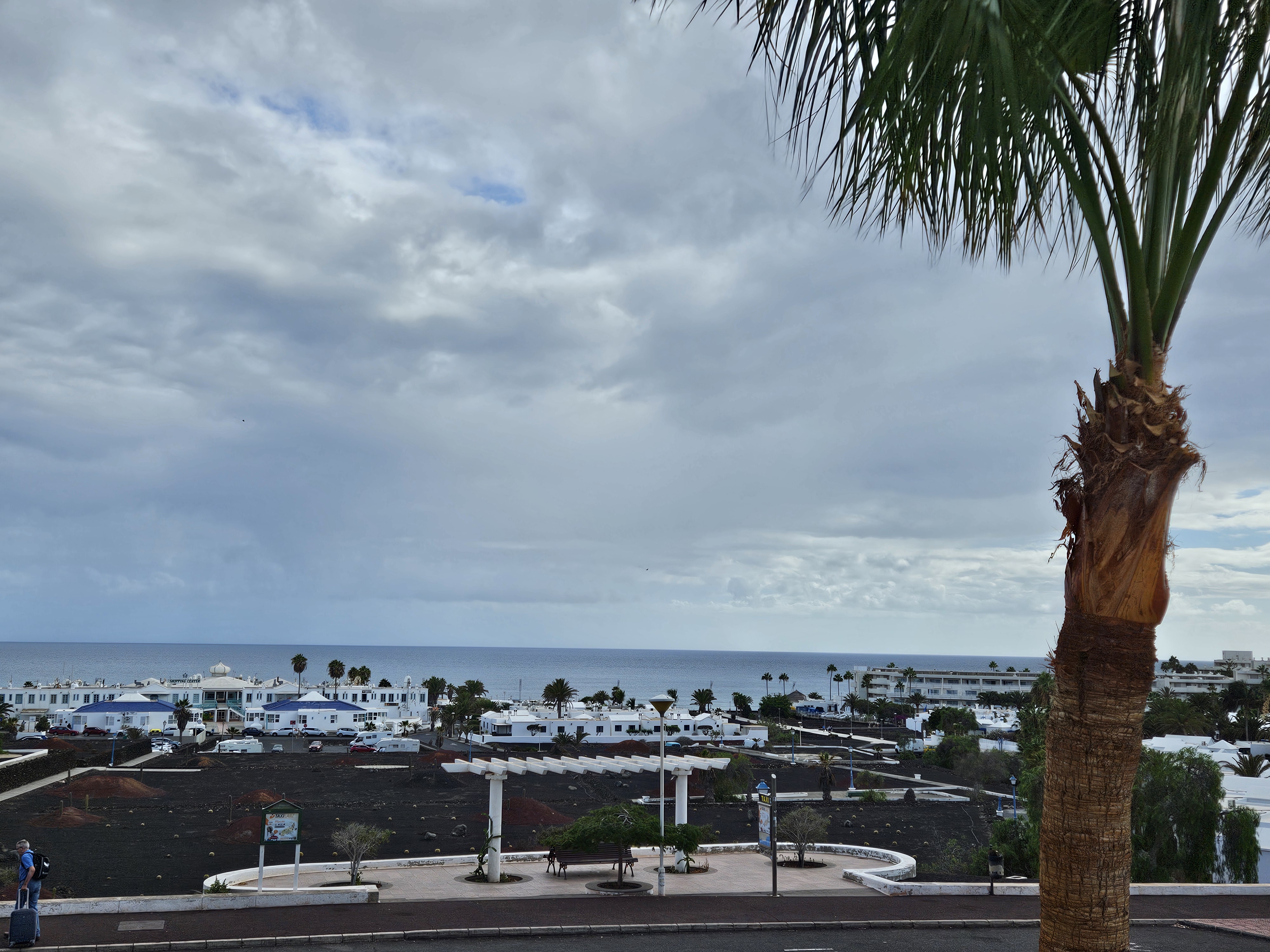
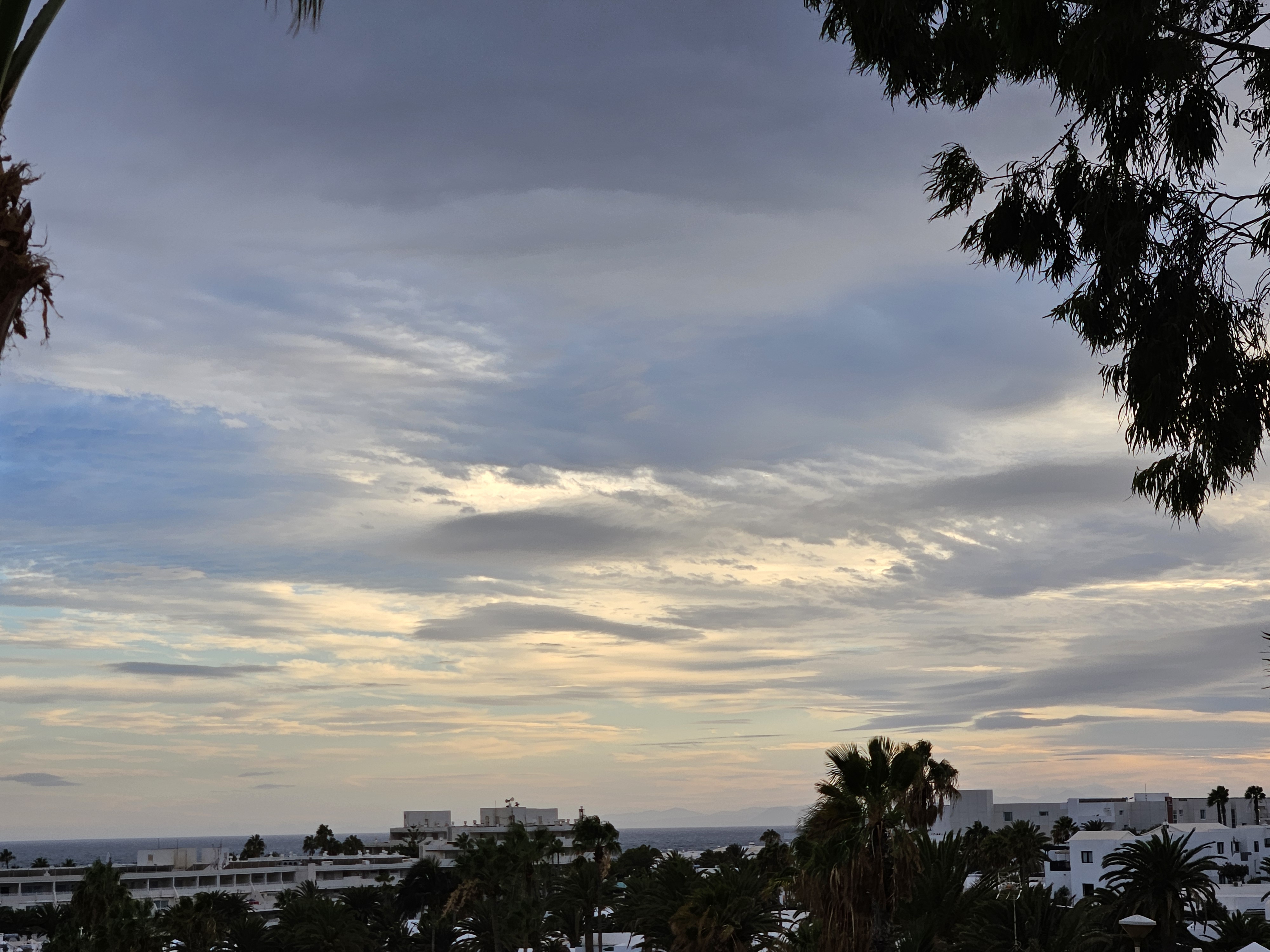
You may remember I shared four parts about the last trip there on New Year’s Eve 2021/22. For the first time, my adorable wife wanted to travel “again” to the same place. I promise she had never done it before! Her reason was obviously the stunning warmth of the winter there, the excellent hotel, and the fine mail. But, we had to recognise that that hotel and everything around it was not as perfect as those days, and the weather wasn’t cosy warm despite being autumn and not winter. However, we gave our best to enjoy, as accepted!
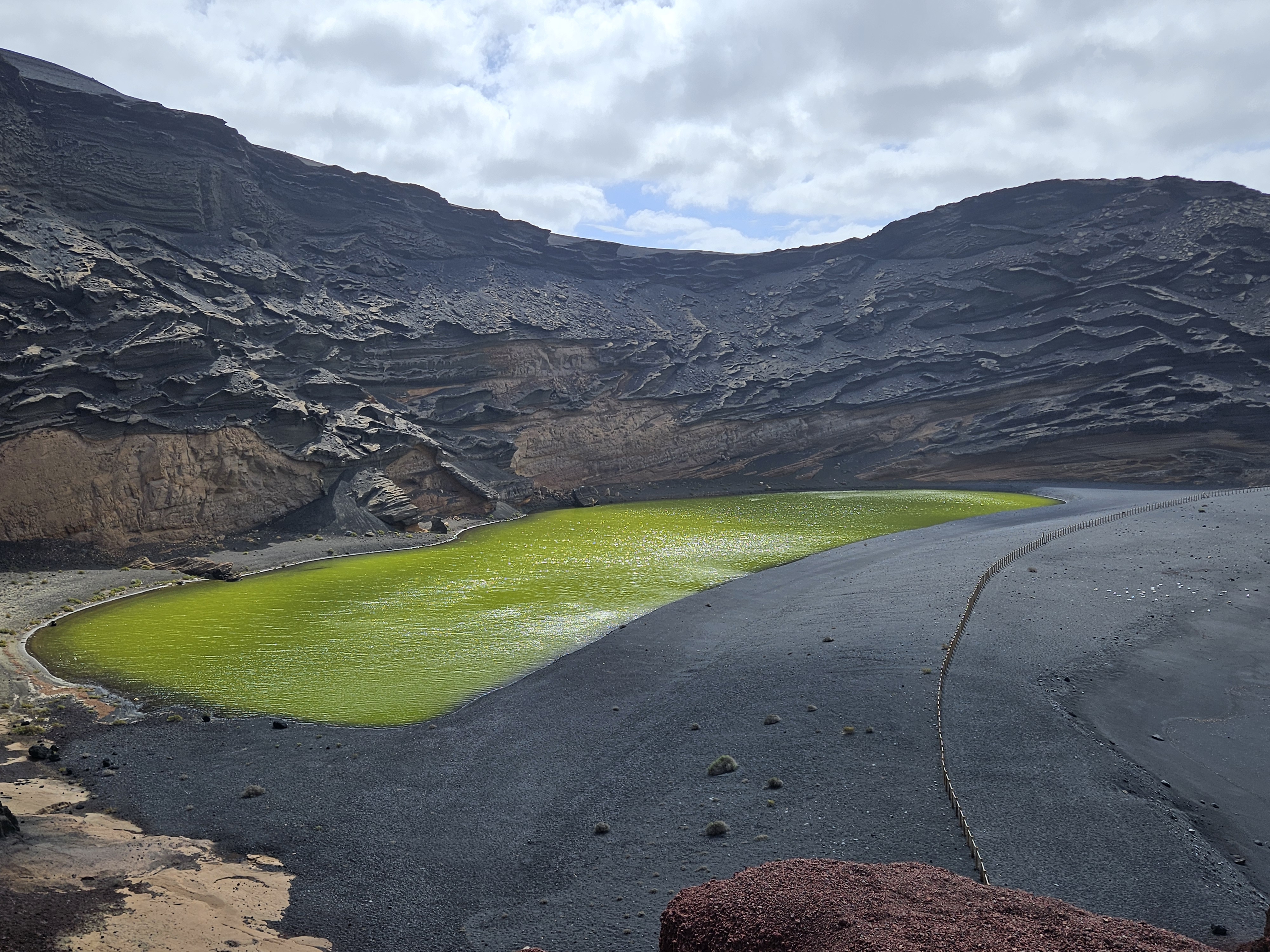
As you know, it is a volcanic island, but we didn’t want to repeat our review from the last time but to see those we missed. Like the green sea, which “fortunately” is forbidden to get near down to it!
I think it is enough for today, and I thank you, I thank you, for your passion and compassion. Have a precious time.🙏💖🌟✌🌹
Sorry! I can’t simply ignore this issue or stop worrying about the current situation. Perhaps it’s because I was born and raised in a dictatorship, which gives me a deeper understanding of the coming danger than many of my friends here, who have mostly been born and live in freedom.
The question is, when a nation feels disappointed with its situation and confused about its future, how easily can its patriotism be aroused and nationalism used to heal its social wounds? It is not related to a country’s political governing and social freedom, as we observe it occurring in both directories and Western democratic nations. I often wonder why people tend to embrace nationalism during moments of last-ditch pride, frequently seen in contexts like football national cups (a common occurrence in South America), historical racism (as observed in German history), or in leaning on their ancient heritage (as seen with figures like Mussolini in Italy and the Persians, which still resonates today).
Through scientific understanding, our world has become dehumanized. Man feels himself isolated in the cosmos. He is no longer involved in nature and has lost his emotional participation in natural events, which hitherto had a symbolic meaning for him… He no longer has a bush-soul identifying him with a wild animal. His immediate communication with nature is gone forever, and the emotional energy it generated has sunk into the unconscious. (C. G. Jung 1948/1980, para 585)
In today’s world, and likely in the years to come, politics will inevitably influence our lives, whether we want it to or not. I don’t intend to denigrate anyone, but when a single individual holds leadership in one of the most influential roles in the world with vast authority, it raises alarms about the potential for tyranny. And I’m sure all friends here must admit that no one will be immune to that seduction!
The word “democracy” originates from the Greek terms “demos,” meaning “people,” and “kratos,” meaning “power.” Therefore, democracy can be understood as the “power of the people”—a form of governance that relies on the people’s will. The idea of democracy derives its moral strength – and popular appeal – from two fundamental principles: 1- Individual Autonomy: This principle asserts that no one should be subject to rules others impose. People should be able to control their own lives within reasonable limits. 2- Equality: This principle holds that everyone should have the same opportunity to influence society’s decisions. Essentially, it emphasizes the disempowerment of concentrated power held by a single individual, transforming governance into a system where leaders serve the population rather than rule over them.
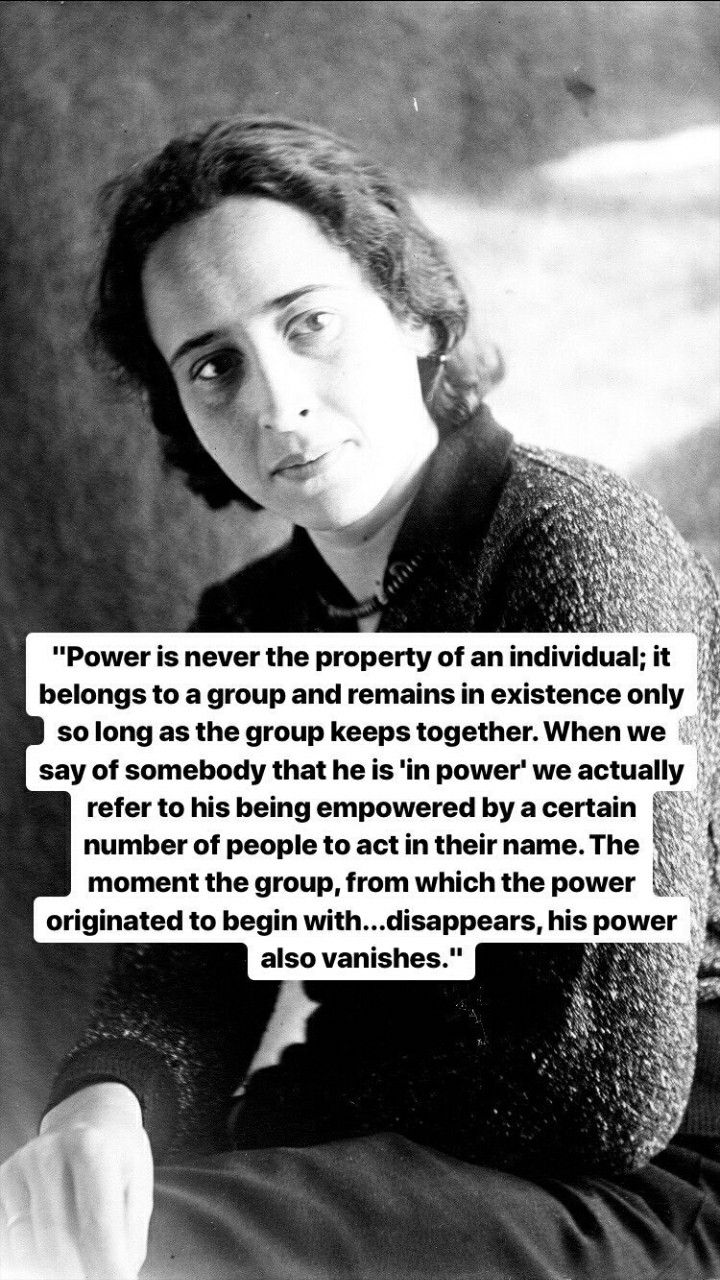
Lyndsey Stonebridge explains in her book “We Are Free To Change The World” (Hannah Arendt’s Lessons of Love and Disobedience): >In Arendt’s sense, having a free mind means turning away from dogma, political certainties, theoretical comfort zones, and satisfying ideologies. It means learning instead to cultivate the art of staying true to reality’s hazards, vulnerabilities, mysteries, and perplexities because, ultimately, that is our best chance of remaining human.< She also reflects that fundamental questions about the human condition are not beside the point in dire political times; they are the point. How can we think straight amidst cynicism and mendacity? What is there left to love, to cherish, to fight for? How can we act to secure it best? What fences and bridges do we need to build to protect freedom, and which walls do we need to destroy?
Hannah Arendt closely examined the regimes of Hitler and Stalin, their functionaries, the ideology of scientific racism, and the role of propaganda in creating what she described as “a curiously varying mixture of gullibility and cynicism.” This mixture is how individuals are expected to respond to their leaders’ ever-changing lies. In her 1951 work, “Origins of Totalitarianism,” she elaborated that this combination of gullibility and cynicism is prevalent across all levels of totalitarian movements:
In an ever-changing, incomprehensible world, the masses had reached the point where they would simultaneously believe everything and nothing, think that everything was possible and nothing was true… The totalitarian mass leaders based their propaganda on the correct psychological assumption that, under such conditions, one could make people believe the most fantastic statements one day and trust that if the next day they were given irrefutable proof of their falsehood, they would take refuge in cynicism; instead of deserting the leaders who had lied to them, they would protest that they had known all along that the statement was a lie and would admire the leaders for their superior tactical cleverness.
It is important to recognize the significant danger of trusting someone who makes promises. Why do such individuals often resort to constant and blatant lying? One reason is that it serves as a way to control their subordinates completely. These followers may feel compelled to abandon their own integrity to echo outrageous falsehoods, subsequently becoming tied to the leader through feelings of shame and complicity. Professor Jacob T. Levy from McGill University highlights the insights of prominent thinkers like George Orwell, Hannah Arendt, and Vaclav Havel. He notes that they can help us identify a specific type of falsehood. He states that “saying something obviously untrue and forcing your subordinates to repeat it earnestly in their own words is a shocking demonstration of power over them. This practice was widespread in totalitarian regimes.”
“You can read my lips… Repeat my words as I repeat them! Doesn’t this sound familiar? Arendt and others noted— as Levy writes— that “being forced to repeat an obvious lie makes it clear that you’re powerless.” She also identified how an avalanche of lies can render a populace unable to resist, a phenomenon we now refer to as ” “gaslighting”:
The result of a consistent and total substitution of lies for factual truth is not that the lie will now be accepted as truth and truth be defamed as a lie, but that the sense by which we take our bearings in the real world—and the category of truth versus falsehood is among the mental means to this end—is being destroyed.
However, time will reveal how a people or a nation can differentiate between right and wrong and how much their practice of democracy can help them recognize truth and falsehood. Democracy is not a gift that can be simply given; it requires thorough training to achieve its ultimate goal.
I must confess I am sick! Actually, I should have taken sick leave by you all (just the same as I usually do at work😁) and apologize to you for my absence this weekend, but I didn’t believe the cold I got last Sunday would take up all my energy throughout the week! That’s why I gathered all I had to do my ritual habit to make it well. Though my second post is just a video clip of a man, it is a great man we urgently need in today’s world, which is such a mess!
As I always believe that we need to accept our own darkness and try to understand it, we might hope to have a better world. I think it is better if the master takes the words: Wishing you all a good health!🙏💖
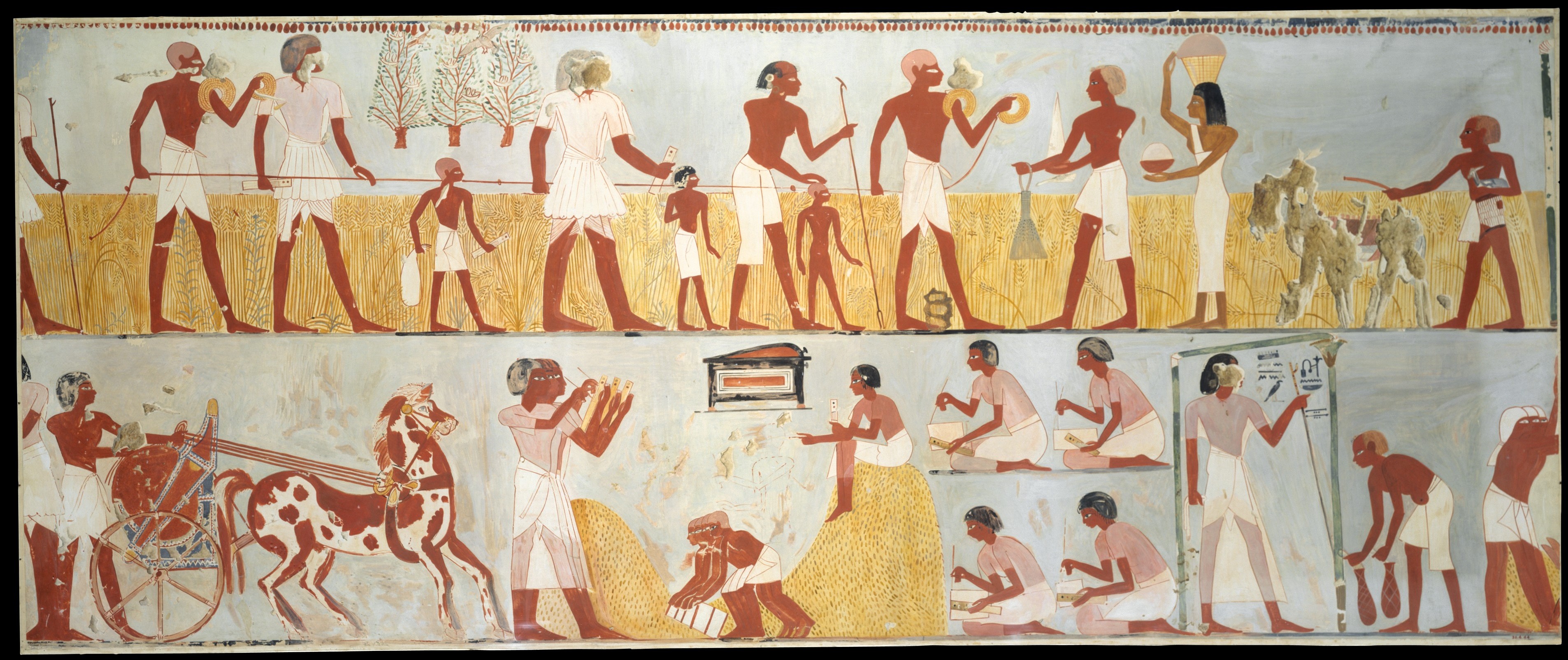
Charles K. Wilkinson Harvest Scenes, Tomb of Menna Twentieth Century; original New Kingdom The Metropolitan Museum of Art
And God said, “Behold, I have given you every plant yielding seed that is on the face of all the earth, and every tree with seed in its fruit. You shall have them for food. Genesis 1:29
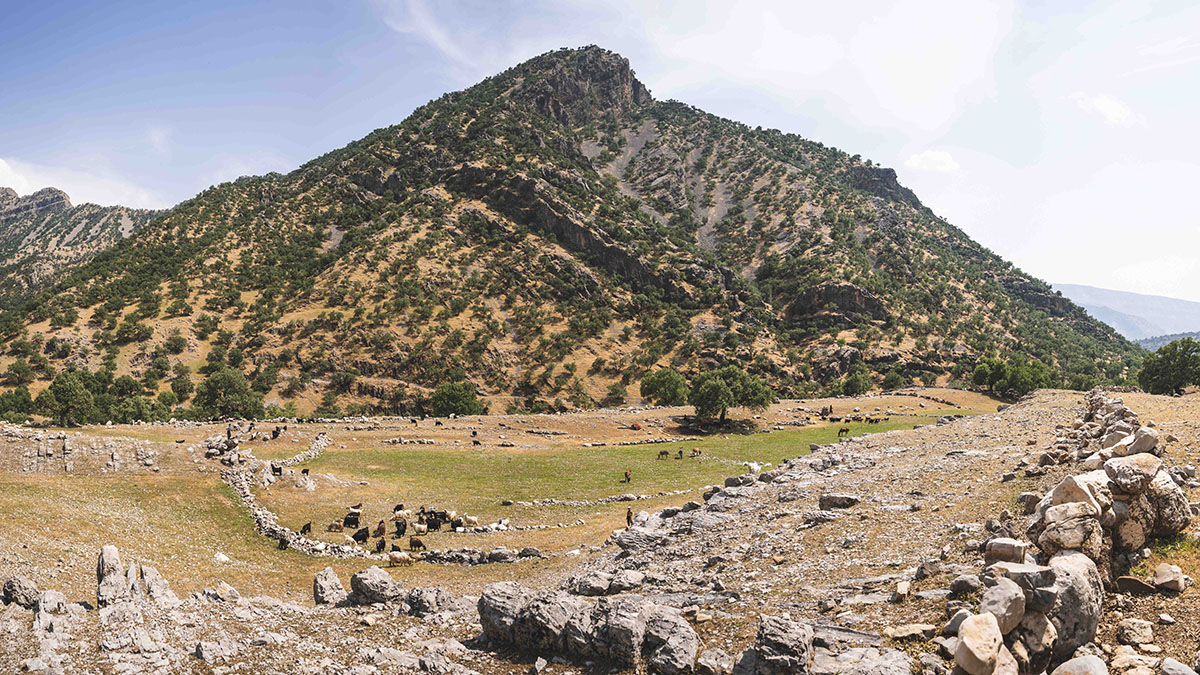
The Zagros Mountain range, located along the border between Iran and Iraq, was home to some of the world’s earliest farmers. Around 12,000 years ago, hunter-gatherer ancestors began experimenting with farming. Somewhere else, it says that Egyptians were among the first to practice agriculture on a large scale, starting in the pre-dynastic period from the end of the Paleolithic period into the Neolithic period, between around 10,000 BC and 4000 BC. This was made possible with the development of basin irrigation.
Neandertaler beim kochen!
However, this transition may have deeper historical roots. In “Neanderthals, Bandits, and Farmers,” author Tudge explains that agriculture was not abruptly invented 10,000 years ago; instead, it had already existed in a form he refers to as proto-farming or hobby farming for at least 30,000 years prior. This sheds light on the origins of the population explosion associated with the advent of agriculture.
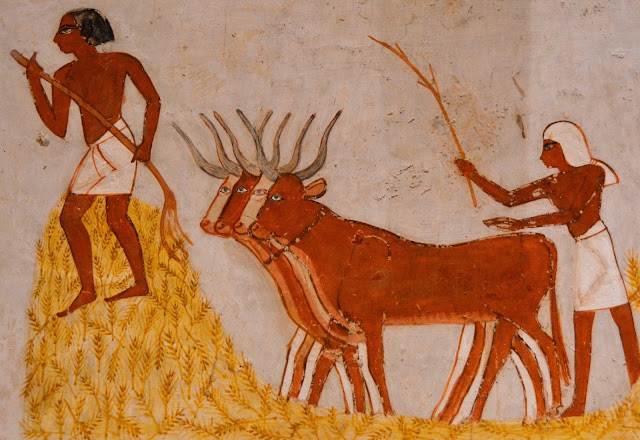
The sequential art found on the walls of the tomb of Menna The Theban Tomb TT69
Let’s return to Egypt, where agriculture and harvesting have been essential practices since ancient times. Thanks to the unforgettable friend Marc Chartier and the dear and adorable Marie Grillot for presenting this excellent article.
In ancient Egypt, the harvest season (“chemo”) was a period of intense activity that kept agricultural workers busy for several weeks. When they were not enough for the task, mobile teams of reapers were added to them. Harvesting cereals began in Upper Egypt and progressed north to the Delta.
Administrative preambles marked the beginning of each harvest to check the equivalence between the result obtained and the forecasts: “When the ears of corn began to turn yellow,” writes Pierre Montet, “the peasant saw with apprehension the fields invaded by his natural enemies, his masters or the representatives of his masters, with a swarm of scribes, surveyors, employees and gendarmes who would first measure the fields. After that, the grains would be measured by the bushel, and one could get a very exact idea of what the peasant would have to deliver, either to the agents of the treasury or to the administrators of a god such as Amon, who owned the best lands in the country.”
Tomb of Ounsou – photo The Louvre
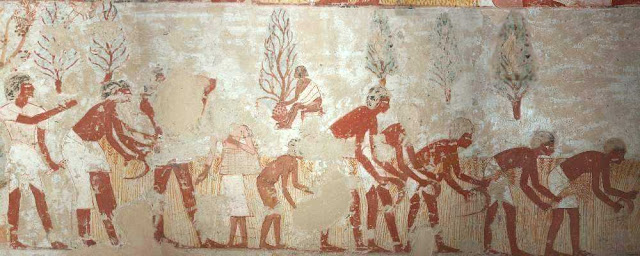
The peasants used sickles with short handles and straight wooden blades in which flint teeth were embedded for their harvesting work. Later, this tool was replaced by a sickle with a curved metal blade. The harvester, leaning slightly forward, did not cut the stalks at ground level but as close as possible to the ears of corn, which he let fall to the ground. Women collected the ears of corn in baskets which, once complete, were carried to the end of the field, then from there, on the backs of donkeys or men, in large wicker baskets suspended from long sticks, were transported to the threshing floor.
The work had to be carried out quickly, often punctuated by the sound of a flute player. A supervisor was particularly attentive to the smooth running of operations, “watching over the grain.”
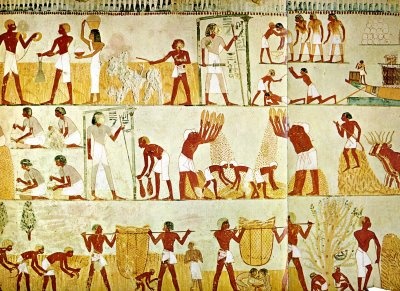
Tomb of Menna – photo Osirisnet.net
On the threshing floor, the harvested ears of corn were trampled to be threshed by oxen while the men used the flail to remove the grain and the pitchfork to separate the grain from the chaff. The final sequence was winnowing, often carried out by women, using hollowed-out ox hooves, curved pallets or wooden cups. The grain was finally stored in silos or warehouses, where scribes and controllers came to count the final product of the harvest. “The grains are cleaned,” Pierre Montet explains. “It is time for the scribes who come forward with everything they need to write and for the measurers who have taken their bushel. Woe to the peasant who has hidden part of his harvest or who, even in good faith, cannot give the lawyers everything that the field survey allows to be demanded. He is stretched out on the ground and beaten in rhythm, and worse misfortunes perhaps await him.”
The harvesters then had free rein to harvest for themselves, with the permission of the owners or managers, as much wheat or barley as they could gather in a day.
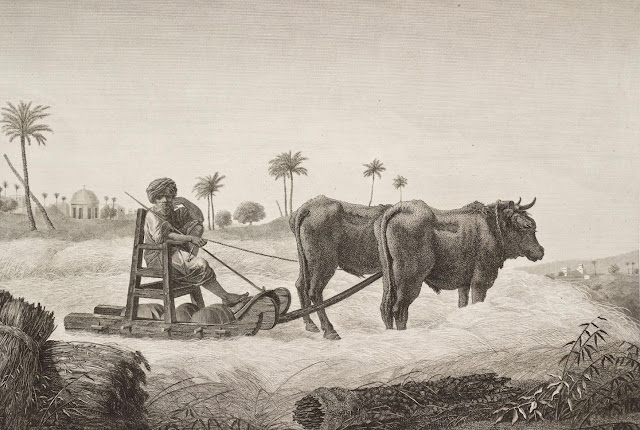
Looking back over the centuries, we note, from what Benoît de Maillet wrote in 1735 in his “Description of Egypt”, certain differences, but above all, a real continuity in peasant practices in the Nile Valley: “You would hardly forgive me if I forgot to tell you about harvest time and how it is done here. We regularly begin to work on the harvest at the end of April or in the first days of May. Then, we do not amuse ourselves by cutting the wheat, putting it in sheaves, and transporting it to places intended to preserve it for a long time in this way. The inhabitants of Egypt are more expeditious than all this. They begin by pulling up the grain and gathering it in the very middle of the fields in a space prepared to receive it. There, they gather it into a heap twenty to thirty feet in diameter, on which they first drive a few oxen to lower it. Then two oxen are yoked to a machine made in the form of a chair, furnished underneath with sharp stones, or eight or ten iron wheels threaded into a wooden axle. From this machine, a man seated there touches the oxen and makes several turns over this heap of barley or wheat until the wheels have cut the straw and separated the grain, which nevertheless remains with this chopped straw, which is kept for the cattle and serves as their oats. After this first method, the straw is separated from the grain and thrown lightly into the air with forks prepared for this purpose. Finally, there come sifters, who, with particular skill, separate the grain from the earth on the spot; after that, it is transported to granaries. This is how the harvest is carried out here, and this is all the trouble one has to collect the finest and best grain in the world.”
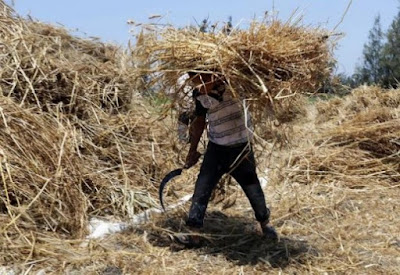
Photo Asma Waguth – Reuters
Two centuries later, the same observation: “[In Egypt], the wheat is cut with a primitive sickle; the ears are immediately tied into small sheaves, transported on camelback to the area where the grain will be threshed. This bare surface is usually set up near the fields. The sheaves are piled up there in large stacks.
The threshing machine, the ‘nôrag’, looks like a sledge. It is powered by oxen. Its wooden frame, on top of which sits the driver, supports solid iron wheels passed repeatedly over the wheat; they open the ears and separate the grain from the chaff. The detached stalks are collected, packed in net bags, and loaded onto donkeys’ backs. As for the grain, naturally mixed with straw, is piled up in heaps, ready to be winnowed. (…) Custom dictates that all harvesters are paid in kind. Lines of women and children can be seen returning from the fields carrying their wages on their heads. This custom goes back a long way and is observed to pay other people still.” (W.S. Blackman, Les fellahs de la Haute-Egypte, Payot, 1948)
It must be believed that in Egypt, perhaps more than elsewhere, agricultural practices and traditions span the centuries to the point of being almost timeless, even in their ritual side effects. In ancient Egypt, the beginning of the “chemo” season included the ceremony of the offering of the sheaf by the pharaoh: “presenting himself successively as protector and nourisher of Egypt” to the God Min, God of fertility, or other divinities such as Harsomtous.
Many centuries later, we read this account of another rite, certainly not directly linked to the pharaonic tradition, but no less important in popular “mythology”: “Before starting to cut the harvest, some villagers will pull out the most beautiful ears of corn by hand. They braid them according to a particular pattern, and the object thus formed, called the ‘bride of the grain’, ‘arûset el-qamh’, is used as a charm. One can hang one above the door of a house as a remedy against the evil eye; another will often take its place in the room containing the food provisions to ensure abundance.” (W.S. Blackman)
Sennedjem’s Tomb
Let us finally be guided to the Beyond of time, thanks to the symbolic richness of the tomb of Sennedjem (TT1) at Deir el-Medina in the fields of Ialou: “using a wooden sickle, the edge of which is encrusted with flint stones, Sennedjem, bent, cut the ears of corn very high. Thus, the straw will not be damaged by the trampling of the animals during threshing. Iyneferti (follows him) and collects the ears of corn, which she puts in a basket. We will notice in passing the size of the wheat stalks and the suggested immensity of the field that nothing limits. In the idyllic world of the Beyond, the harvests are always extraordinary.” (Osirisnet)
In these modern times, when Egypt is forced to buy wheat from foreign countries to meet the needs of its 90 million inhabitants, it is good to remember, as Benoît de Maillet wrote, that it produced “the most beautiful and best grain in the world.”
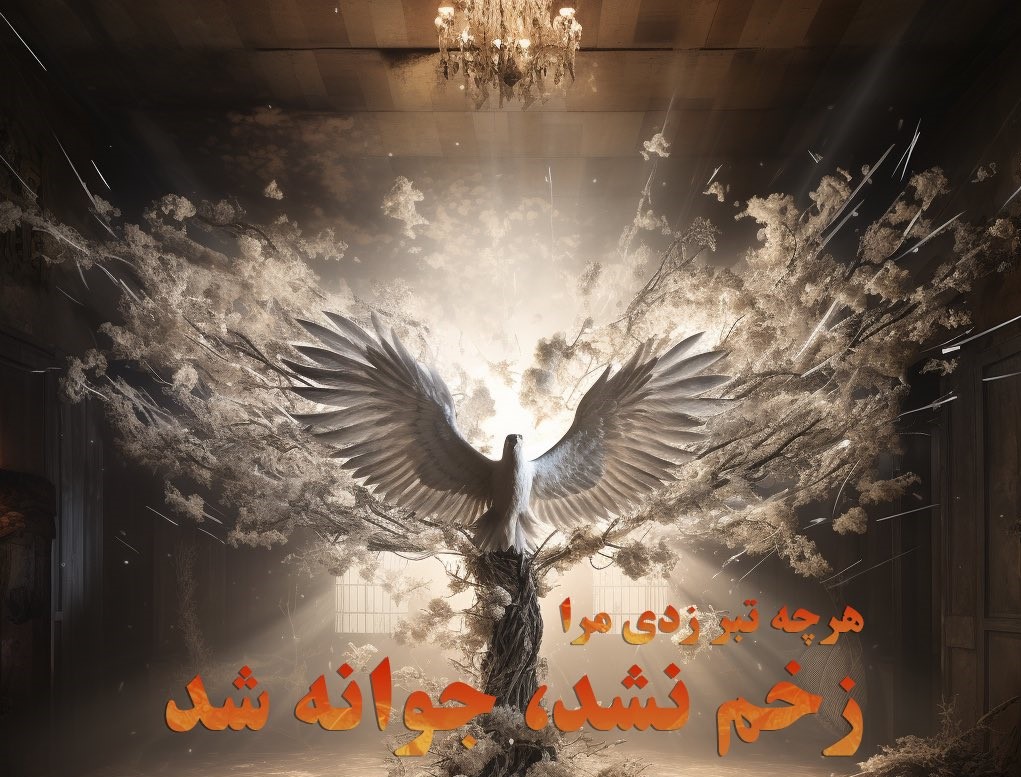
Whatever you shot me, it left no scar; it sprouted!
Many events are happening worldwide, but most are disheartening: millions of refugees, wars, hunger, uncertainty, and executions. However, I want to focus on the last one and have to, again, urge the world to put an end to it. It appears there is a systematic plan to eliminate the young—those full of hopes, dreams, and potential. They represent the future of Iran, brimming with creativity and energy, and they are at risk of being destroyed.
via Euronews
I don’t want to hurt my friends, but it appears that a brutal regime in the Middle East aims to massacre the youth and destroy the wealth of ancient and precious folk and their country!
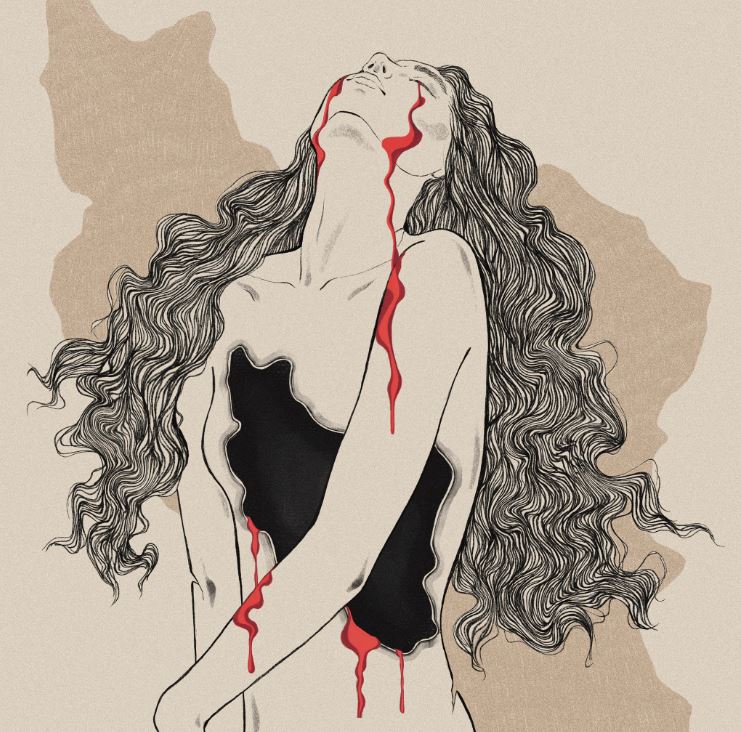
Iran-hair, via Ruth Millington: ‘For my brave Iranian sisters’ by r0yart @_r0yart
The Islamic Regime searches for them on purpose to get them, jail them, and execute them. Prisons, including special facilities for political prisoners, are present in the political history of many countries. In Iran, one such prison is known as Evin. It should have been demolished after the fall of the Shah; however, the mullahs found it to be much more advantageous for their purposes.
Woman-Life-Freedom- via Amnesty International
I have often mentioned that global superpowers benefit from having a chaotic regime or a wild dog in that region, like the Mullah Regime. They maintain control over those countries through fear, hoping that the West will take action against this threat. But how long should it go until no common sense remains there? And then, Westerpower engages another favourite doll to work with?!
Azadeh’ [Ah-Z-ah-d eh] (Persian: آزاده) ‘Meaning: She who is Free’ by Luna @lunaleonis
I believe you are as muddled as I am; what can we do? I just shout to the world: Stop this terrifying terror against humanity and our outstanding youth!
We might only keep praying for the lives of those who want their right to live, which is their inalienable right. The right to live in freedom!
Last week, I came across this song by Joan Baez and found it so pertinent to the topic because she always sang for the people who fought for their rights. #Woman_Life_Freedom!💖✊🙏
“There But For Fortune”
Joan Baez
Show me the prison, show me the jail Show me the prisoner whose life has gone stale And I’ll show you a young (wo)man With so many reasons why And there but for fortune, go you or I…
Show me the alley, show me the train Show me the hobo who sleeps out in the rain And I’ll show you a young (wo)man With so many reasons why And there but for fortune, go you or I, mm, mm
Show me the whiskey, stains on the floor Show me the drunkard as he stumbles out the door And I’ll show you a young (wo)man With so many reasons why And there but for fortune go you or I…
Show me the country where the bombs had to fall Show me the ruins of the buildings, once so tall And I’ll show you a young land With so many reasons why And there but for fortune go you and I, you and I.
Translated from volumes published by Lorenz Jung based on the edition “Gesammelte Werke” dtv.de The Symbols of Transformation (1952) and Aion (1950)
Today, I share the final part of the translation of Mana-Personality. It was full of joy for me to learn more and even better from his works because I had to read them word by word to achieve an understandable translation. I hope it was the same for you.
We often wonder why there are so many injustices, differences, and failures in human progress (decline?). Is God flawed? Dr. Jung suggests that God must be imperfect; otherwise, we cannot reach Him.
In the figure of the divine hero, God himself wrestles with his own imperfect, suffering, living creation; he even takes its suffering condition upon himself and, by this sacrificial act, accomplishes the opus magnum of salvation and victory over death.
He, instead, talks about the importance of the Self and Individuality.
He personally also admits that his explanation is sensitive to experiences that some may not have practised. He emphasizes:
I am deeply aware that in this work, I have not made any ordinary demands on the understanding of my reader. I have made every effort to smooth the path to understanding. Still, I have not been able to remove one great difficulty, namely the fact that the experiences underlying my explanations are probably unknown to most people and, therefore, strange...
Still, he tries to enlighten us on the matter based on his experiences.
The conception of God as an autonomous, psychological content makes God a moral problem – and that is, admittedly, very uncomfortable. But if this problem does not exist, then God is not real either because he does not intervene in our lives anywhere. Then, he is a historical conceptual bogeyman or a philosophical sentimentality.
If we leave the idea of a “divine” out of the equation and speak only of autonomous contents, we may remain intellectually and empirically correct, but we thereby conceal a note that psychologically cannot be missed. If we use the idea of a “divine”, we are thereby aptly expressing the peculiar way in which we experience the effects of autonomous content. We can also use the term “demonic” as long as we do not imply that we have reserved a concrete God somewhere who completely corresponds to our wishes and ideas. However, our intellectual sleight of hand tricks do not help us to create a being according to our wishes in reality, just as the world does not adapt to our expectations. If we, therefore, attribute the effects of autonomous contents with the attribute “divine”, we thereby acknowledge their relative superiority. And this superior is the power that has forced a man of all ages to think of the most unthinkable things and to inflict the greatest suffering on himself in order to do justice to those effects. This power is as real as hunger and fear of death.
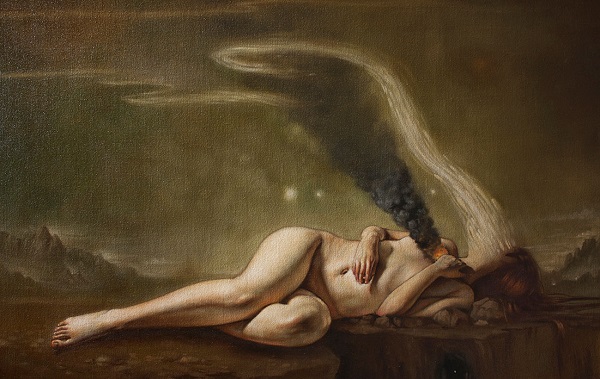
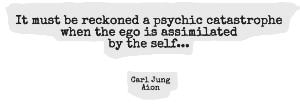
The Self could be characterized as a kind of compensation for the conflict between inside and outside. This formulation may not be a lousy fit insofar as the Self has the character of something that is a result, an achieved goal, something that has only gradually come about and has become possible through much effort. Thus, the Self is also the goal of life, for it is the complete expression of the combination of destinies that we call the individual, and not just of the individual human being, but of a whole group in which one completes the other to form the complete picture.
With the sensation of the Self as something irrational, indefinable, to which the ego is not opposed and not subject, but rather attached and around which it rotates, as the earth rotates around the sun, the goal of individuation is achieved. I use the word “sensation” to describe the perceptual character of the relationship between “I” and Self. There is nothing recognizable in this respect because we are unable to say anything about the contents of the Self. The “I” is the only content of the Self that we know. The individualized “I” perceives itself as the object of an unknown and superior subject. It seems to me that the psychological statement reaches its extreme end here because the idea of a Self is in and of itself a transcendent postulate that can be justified psychologically but cannot be proven scientifically. The step beyond science is an absolute requirement of the psychological development described here because, without this postulate, I could not adequately formulate the empirically occurring psychological processes. The Self, therefore, claims at least the value of a hypothesis corresponding to that of the atomic structure. And – should we still be enclosed in an image here – then it is something overwhelmingly alive, the interpretation of which is beyond my capabilities. I do not doubt that it is an image, but one in which we are still contained.
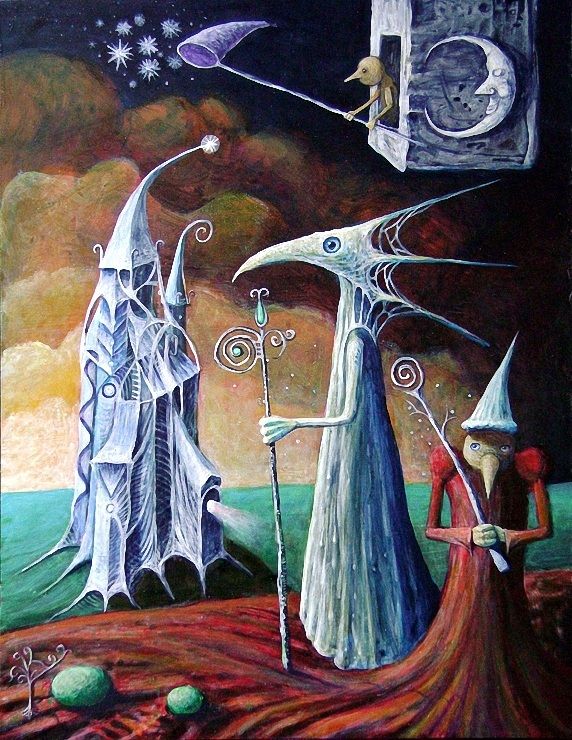
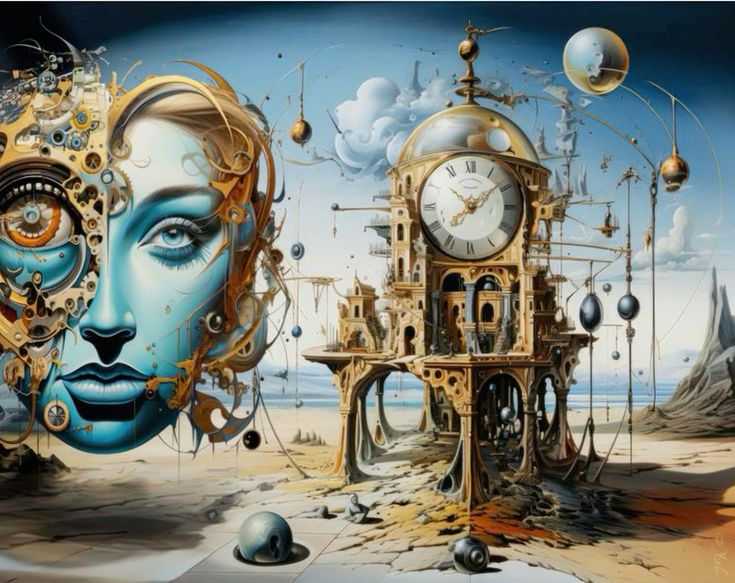
Youri Ivanov _ DIGITAL GRAPHIC ART _ SD World 141
I am deeply aware that in this work, I have not made any ordinary demands on the understanding of my reader. I have made every effort to smooth the path to understanding. Still, I have not been able to remove one great difficulty, namely the fact that the experiences underlying my explanations are probably unknown to most people and, therefore, strange. As a result, I cannot expect my readers to follow all of my conclusions. Although every author naturally enjoys understanding their audience, interpreting my observations is less important to me than pointing out a broad area of experience that has hardly been explored, which I would like to make accessible to many through this book. In this area, which has been so obscure up to now, it seems to me that the answers are recumbent to many puzzles that the psychology of consciousness has never even come close to solving. I do not wish to claim under any circumstances to have formulated these answers definitively. I am, therefore, quite content if my paper can be regarded as a tentative attempt at an answer.
I sincerely appreciate your support and interest. Thank you!🤗🙏💖
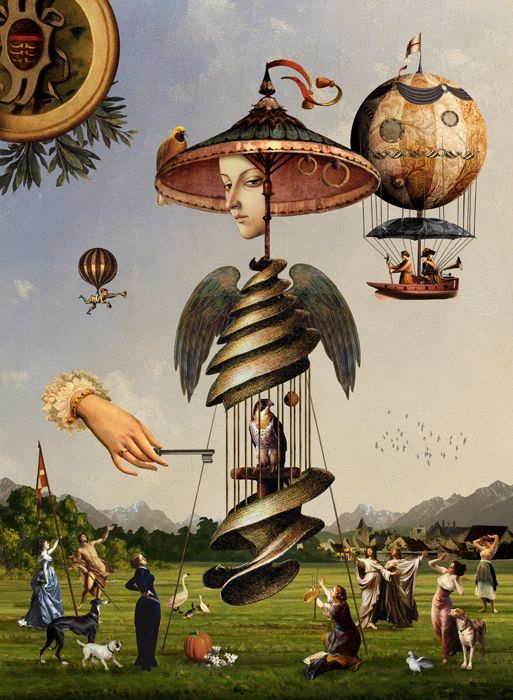
The title image: Maiden Voyage of the Airship Falcon” by Alexei Gurl






















 lampmagician
You must be logged in to post a comment.