Translated from volumes published by Lorenz Jung based on the edition “Gesammelte Werke” dtv.de The Symbols of Transformation (1952) and Aion (1950)
Mana-personality. A personified archetypal image of a supernatural force.
The Mana-personality is a dominant of the collective unconscious, the well-known archetype of the mighty man in the form of hero, chief, magician, medicine-man, saint, ruler of men and spirits, and the friend of God.[The Mana-Personality,” CW 7, par. 377.]
Mana is a Melanesian word referring to a bewitching or numinous quality in gods and sacred objects.
Historically, the Mana-Personality evolves into the hero and the godlike being, whose earthly form is the priest. How very much the doctor is still Mana is the whole plaint of the analyst! [Ibid., par. 389.]
A Mana-Personality embodies this magical power. In individual psychology, Jung used it to describe the inflationary effect of assimilating autonomous unconscious contents, particularly those associated with anima and animus. (The text and the image are from Carl Jung’s Depth Psychology by my brilliant friend Lewis Lafontaine.)
I started with these specific sections of my friend’s website to better understand this enigmatic topic. Personally, I find Mana to be funny, attractive, amusing, intriguing, and, at the same time, very monstrous.
And now, after sharing parts one and two, I present part three, which is a short one so as not to bore you, or better to say, because of the preparations for my trip! I will be taking a two-week vacation, and the internet connection can be difficult on this trip. But after that, I promise to share a larger and more interesting part when I return!!💖
Individuation The Mana Personality (P3)
In contrast, our pitifully limited “I”, if it possesses even a spark of self-knowledge, can only withdraw and quickly abandon any illusion of power and importance. It was an illusion: the “I” has not overcome the anima and, therefore, has not acquired its Mana. The consciousness has not become master of the unconscious, but the anima has lost its domineering presumption to the extent that the “I” has been able to come to terms with the unconscious. This conflict, however, was not a victory of consciousness over the unconscious but the establishment of a balance between the two worlds.
The ‘magician’ could only take possession of the “I” because the “I” dreamed of a victory over the anima. This was an attack, and every attack by the “I” would be followed by an attack by the unconscious.
>In a transformed figure I exercise grim power. < (Goethe: Faust II, Act 5, Scene 4, in Works in ten volumes, Vol. 4, 1961)
Faust surrounded by his Illustration, to Goethe’s Faust by Harry Clarke 1925
Therefore, if the “I” abandons its claim to victory, the obsession by the magician automatically ceases. But where does the Mana go? Who or what becomes Mana if even the magician can no longer perform magic? We now know that neither the conscious nor the unconscious has Mana, for it is certain that if the “I” does not claim power, then no obsession arises, which means that the unconscious has also lost its supremacy. In this state, the Mana must have fallen into the hands of Something that is conscious and unconscious, or neither conscious nor unconscious. This Something is the sought-after “centre” of the personality, that indescribable Something between the opposites, or the unifier of the opposites, or the result of the conflict, or the “achievement” of the energetic tension, the development of the personality, a most individual step forward, the next stage.
I do not expect the reader to follow the rapid overview of the whole problem in every detail. He should consider it a kind of exposition, the more detailed intellectual elaboration of which I will give in the following…
To be continued! I wish you all a great time.💖🙏💖🌹
PS: As the World Wide Web chaos happened yesterday, I hope our flight stays intact!!😁😅🙏
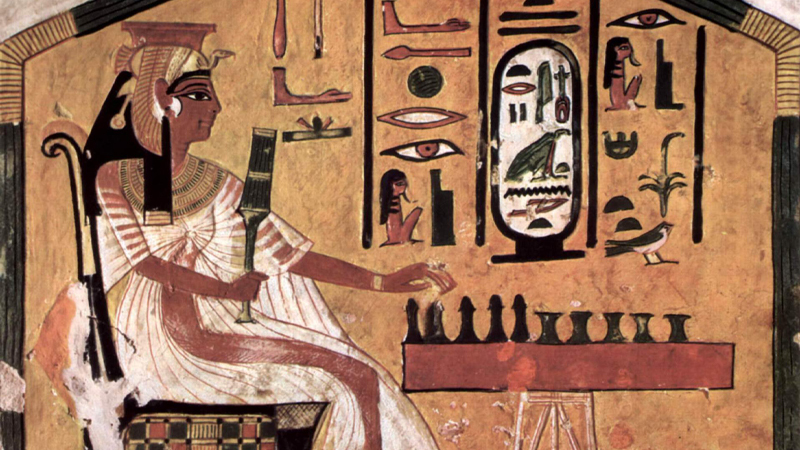
The ancient Egyptians had many beautiful women, including Queen Nefertari. She was known as “the most beautiful of them all” and was one of the most beloved queens of ancient Egypt, reigning during the 19th Dynasty. At the heart of the exhibition is Queen Nefertari, who was renowned for her beauty and prominence. She was called “the one for whom the sun shines” and was the favourite wife of Pharaoh Ramesses II.
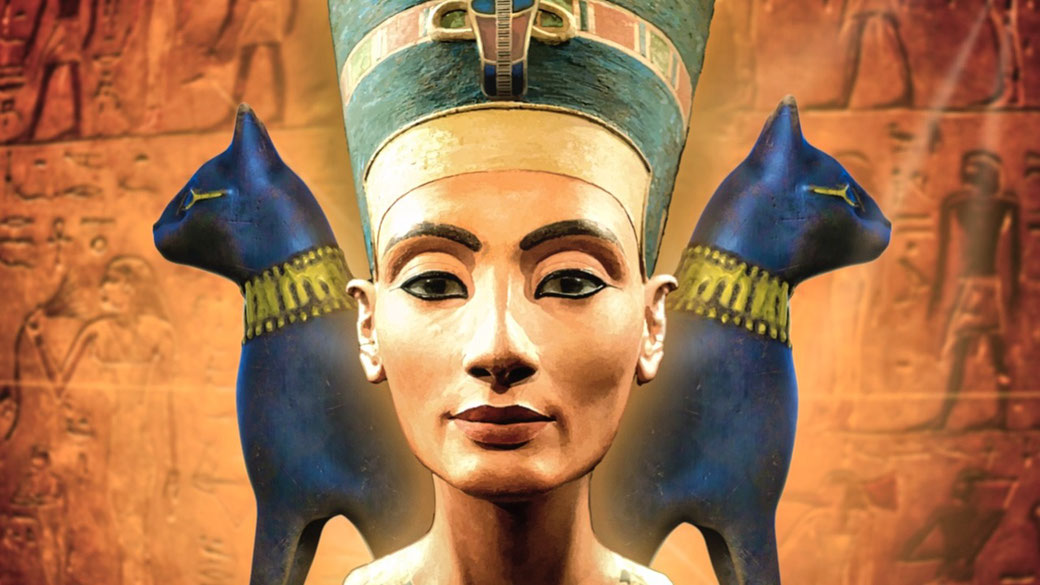
One of the most famous figures from ancient Egypt is Queen Nefertiti. Her name, “the beautiful one has come,” has solidified her status as an iconic figure from the 14th century BC. She lived alongside her husband, Pharaoh Akhenaten, during the New Kingdom. Nefertiti’s legacy is steeped in mystery and fascination, as her renowned beauty and significant cultural impact have left a lasting impression.
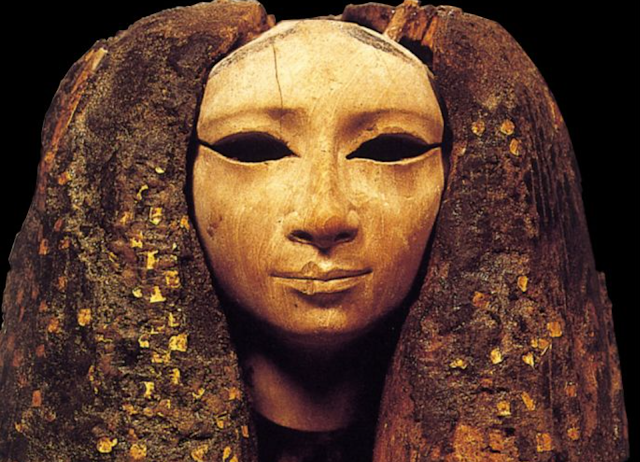
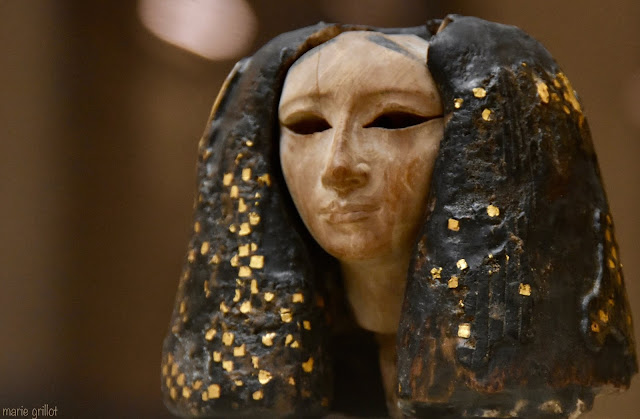
Head of the female statue – painted wood, gold leaf – Middle Kingdom – 12th dynasty discovered in 1907 during excavations in the area of the pyramid of Amenemhat I in Lisht by the Metropolitan Museum of Art Expedition, New York – Egyptian Museum, Cairo – JE 39390
The face is noble and perfectly symmetrical. The veins of the light wood give it a feeling of life. The general expression is gentle, calm, and peaceful.
The large almond-shaped eyes, of which only the orbits remain, are absent… and, despite this, they seem to question us… What presence did they give to the face? What did they reveal? Did the glass paste and rock crystal subtly and luminously animate their pupils? These questions remain forever unanswered.
The eyebrows are treated in relief, while the shadow line is treated in hollow. The nose is well-proportioned, and the lips are thin. The slight injury they suffered reminds us of the ravages of time.
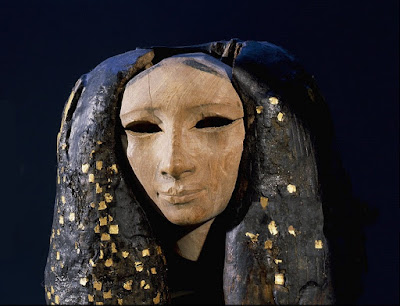
Head of the female statue – painted wood, gold leaf – Middle Kingdom – 12th dynasty discovered in 1907 during excavations in the area of the pyramid of Amenemhat I in Lisht by the Metropolitan Museum of Art Expedition, New York – Egyptian Museum, Cairo – JE 39390
What, obviously, impresses in this head of barely more than 10 cm is the imposing wig that generously frames it and must have reached the level of the shoulders, which have now disappeared. “The enveloping mass of the added hair is worked in a darker wood and blackened with paint; it is fixed to the head in lighter wood, using tenons”, specify Mohamed Saleh and Hourig Sourouzian in their “Official Catalogue of Egyptian Museum in Cairo. The deep black of the wig is enhanced with small squares of gold leaf, which have so many luminous touches. On the other hand, Rosanna Pirelli analyzes in “The Wonders of the Egyptian Museum in Cairo”: “The fact that the wig is particularly fine at the top, compared to the width of the lateral parts, suggests the presence of a crown or a diadem.”
Head of the female statue – painted wood, gold leaf – Middle Kingdom – 12th dynasty discovered in 1907 during excavations carried out in the area of the pyramid of Amenemhat in Lisht by the Expedition of the Metropolitan Museum of Art in New York – Egyptian Museum in Cairo – JE 39390
Who was this beautiful lady? A queen, a princess, a prominent person at the sovereign’s court? The work’s quality and the artist’s mastery, indeed, suggest that it may have come from the pharaoh’s workshops. Unfortunately, this face, which was that of a full-length statue, does not allow us to identify it.
This head—often used as a model to illustrate the beauty of ancient Egyptian women—was discovered in 1907 in Lower Egypt, precisely in Lisht, between Daschour and Meidoum.
This female statue head – painted wood, gold leaf – Middle Kingdom – 12th dynasty discovered in 1907 during excavations in the area of the pyramid of Amenemhat I in Lisht by the Expedition of the Metropolitan Museum of Art in New York – Egyptian Museum in Cairo – JE 39390 – illustrates numerous works
At the beginning of his reign, Amenemhat I “left Thebes to found a new city at the entrance to the Fayoum, named ‘Amenemhat-se-seizit-des-Deux-Terres’ not far from the current site of Lisht (“Pharaonic Egypt, history, society, culture”). In “L’Egypt Restorée”, Sydney Aufrere and Jean-Claude Golvin thus analyze the reasons which led to this “relocation”: “not only to break away from Thebes and the supporters of the last Montouhotep but also to keep an eye on the north and the Asian border, the city became the main royal residence during the 12th and 13th dynasties… They add, “Today we cannot give it any other reality and archaeological dimension than those which associate it with the two funerary monuments today reduced to two mounds: the pyramids of Amenemhat I and Sesostris I.”
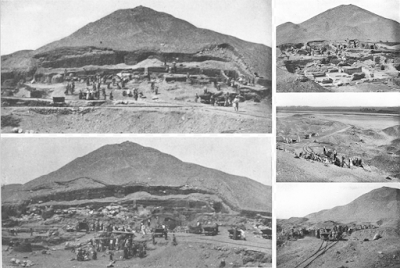
Excavation site of the Metropolitan Museum of Art Expedition in New York at the Lisht site in 1907 during the discovery of the head of a female statue in painted wood with gilding (JE 39390) from the 12th dynasty
In 1882, Gaston Maspero, successor to Auguste Mariette at the head of the antiquities service, undertook excavations on the site, work that allowed the identification of the pyramids. For practical reasons (there was sometimes up to 11 m of water, he relates), however, he was unable to go as far as the burial chamber. The study of the site was then taken up in 1894-1895 by the French School of Cairo (which, in 1898, became the French Institute of Oriental Archeology).
Then, in 1906, when Gaston Maspero returned to the directorship of antiquities, the Metropolitan Museum of Art in New York requested the concession. He obtains it and then settles in for several seasons of excavation.
Head of the female statue – painted wood, gold leaf – Middle Kingdom – 12th dynasty discovered in 1907 during excavations in the area of the pyramid of Amenemhat I in Lisht by the Metropolitan Museum of Art Expedition, New York – Egyptian Museum, Cairo – JE 39390
Indeed, the Egyptian department of the MMA was created on October 15, 1906, and its administrators, as well as its brand new director, Albert Morton Lythgoe, saw the point of enriching their knowledge, experience, and collections.
Thus began their first campaign, financed by private funds, under the joint leadership of the director, Herbert Eustis Winlock (Harvard) and Arthur C. Mace (Oxford).
One hundred fifty workers were recruited: some, already ‘trained’ for excavations, came from Upper Egypt, others from neighbouring villages; their number will continue to increase over the years.
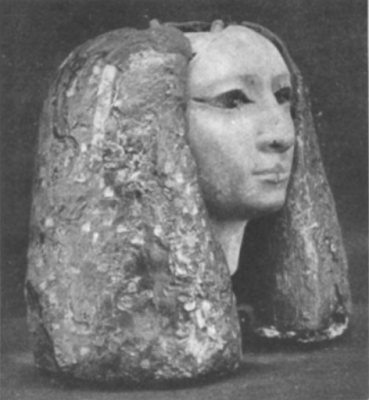
Head of the female statue – painted wood, gold leaf – Middle Kingdom – 12th dynasty discovered in 1907 during excavations in the area of the Amenemhat pyramid in Lisht by the Metropolitan Museum of Art Expedition, New York – Egyptian Museum, Cairo – JE 39390 reproduced for the first time in “The Metropolitan Museum of Art Bulletin” n° 10 – Oct. 1907
Albert M. Lythgoe does not explain the exact circumstances of the head’s discovery. In the October 1907 bulletin of the MMA, although it appears in a photo with the caption “figure 2. Head of wooden statuette from Lisht, 12th dynasty”, no details are given on the place where it was found. The author relates that the excavations concerned two sectors: the cemetery located west of the pyramid of Amenemhat, which revealed tombs of important figures of the 12th dynasty, as well as a sector situated on a promontory. Over a hundred tombs have been unearthed for most of the 12th dynasty.
As the head is illustrated opposite this paragraph, we can think that its discovery is linked to these areas where dignitaries, relatives, and ruling family members had the honour of resting not far from the pharaoh.
It should be noted that her arms were found two years later, in Situ, by Herbert Eustis Winlock…
This head is displayed at the Egyptian Museum in Tahrir Square in Cairo under number JE 39380.
The head of a woman surrounded with a placed hairdressing consists of two pieces of blackened wood, inlaid with gold, Musée égyptien du Caire https://egyptianmuseumcairo.eg/artefacts/head-of-a-woman/ The Metropolitan Museum of Art Bulletin, Vol. 1, No. 12, Nov. 1906 http://www.jstor.org/stable/i3634, http://www.jstor.org/stable/i363438 A. M. Lythgoe, The Egyptian Expedition, The Metropolitan Museum of Art Bulletin, Vol. 2, No. 4, Apr. 1907 https://www.jstor.org/stable/i363442 The Egyptian Expedition, Albert M. Lythgoe, The Metropolitan Museum of Art Bulletin, Vol. 2, No. 7, Jul. 1907, http://www.jstor.org/stable/3253292 The Egyptian Expedition, Albert M. Lythgoe, The Metropolitan Museum of Art Bulletin, Vol. 2, No. 10, Oct.1907 https://www.jstor.org/stable/3253176?seq=1#page_scan_tab_contents Mohamed Saleh, Hourig Sourouzian, Catalogue officiel du Musée égyptien du Caire, Verlag Philipp von Zabern, 1987 Sydney Aufrère, Jean-Claude Golvin, L’Egypte restituée – Tome 3 – Sites, temples et pyramides de Moyenne et Basse Égypte, Editions Errance, 1997 Christiane Ziegler, L’Art égyptien au temps des pyramides, Réunion des Musées Nationaux, 1999 Francesco Tiradritti, Trésors d’Egypte – Les merveilles du musée égyptien du Caire, Gründ, 1999 Guide National Geographic, Les Trésors de l’Egypte ancienne au musée égyptien du Caire, 2004 Pierre Tallet, Frédéric Payraudeau, Chloé Ragazzolli, Claire Somaglino, L’Egypte pharaonique, histoire, société, culture, Armand Colin, 2019
Of course, I am not Guglielmo Marconi, who, on 13 May 1897, sent the world’s first radio message across open water: “CAN YOU HEAR ME?” However, I’ve been feeling almost wireless lately due to the extensive renovation planned (by my wife!) for this entire week, which was supposed to happen immediately and has turned everything upside down. My only connection was my cell phone, which I could hardly do anything with.
I don’t mind renovations; I just need a heads-up to prepare for them. Although I must admit that my office, where I sit and write, was neglected for thirteen years and was covered in dust! In addition to computer equipment, I have many instruments, such as guitars, amplifiers, effects, music player devices, etc. There was suddenly a tangle of cables, and due to the dust of the past thirteen years, the view of the empty spaces was unpleasant. Nevertheless, it had to be done. Now, I’m so exhausted that I don’t have the energy to continue my regular work. However, I have to share with you that aside from my muscle pain, I also feel a deep emotional pain that I need to work through because I ended up throwing away a significant memory of my brother, Al.
The theme is not only about letting go of old things, but it also highlights Al’s remarkable effort and hard work in collecting cinematic masterpieces. Al has carefully recorded over five hundred video cassettes (VHS, with the capacity of three or four movies, each cassette; Long Play recording), containing many excellent works by great directors like Stanley Kubrick, Alfred Hitchcock, Martin Scorsese, Akira Kurosawa, Steven Spielberg, Billy Wilder, Federico Fellini, Francis Ford Coppola, Orson Welles, Ingmar Bergman, Howard Hawks, Jean-Luc Godard, David Lean, John Huston, John Ford, Fritz Lang, François Truffaut, Charlie Chaplin, James Cameron, Clint Eastwood, Buster Keaton, Miloš Forman, Sergio Leone, Luis Buñuel, Vittorio De Sica, Sam Peckinpah, Ernst Lubitsch, Elia Kazan, Michael Curtiz, Michelangelo Antonioni, Nicholas Ray, Roman Polanski, Sidney Lumet, Frank Capra, William Wyler, Joel Coen, Robert Altman, Oliver Stone, Otto Preminger, Woody Allen, Mel Brooks, Terry Gilliam, Bernardo Bertolucci, George Lucas, Luchino Visconti… are you still there?!
I was working six days a week, and my desire was that when I retired, we could both enjoy sitting and watching all these good movies together. But Al’s earlier departure and the rapid advancement of technique overtook my wish to fulfil this dream. That’s why, with all my pain, I decided to give up his outstanding work and throw away all these videos I have held onto for twenty years. I don’t know if anyone understands how deeply this decision hurt me.
Finally, the only thing that can calm my suffering is this fascinating and profound Tibetan ritual, which helps me understand that everything has no worth! There is a time to build and a Time To Destroy; nothing lasts forever! Heartfelt thanks, everybody.
Translated from volumes published by Lorenz Jung based on the edition “Gesammelte Werke” dtv.de The Symbols of Transformation (1952) and Aion (1950)
Recently, on X (Twitter), during one of Perian’s talks titled “The Way of Democratic Talk,” someone mentioned that social morals are crucial for keeping people mindful of their behaviour towards others. I responded that social morals are relative and not constant; throughout human history, they have consistently changed after wars or revolutions. I prefer to use the word “conscience.” Another friend said she would stick with “morals” because she was tired of having a guilty conscience. I replied that conscience is based on inner awareness and individuality and, therefore, has a more substantial and profound foundation, strengthening our consciousness as individuals.
Anyway, it was a prologue to noticing that words like consciousness, ego, anima, and their influential product, Mana, are important to take seriously. Mana may sound strange and unknown, but we all have it inside us!
Jung has always attempted to clarify that good and evil exist within every human and has made significant efforts to help us realize that it all depends on us to recognize these and find the balance between them.
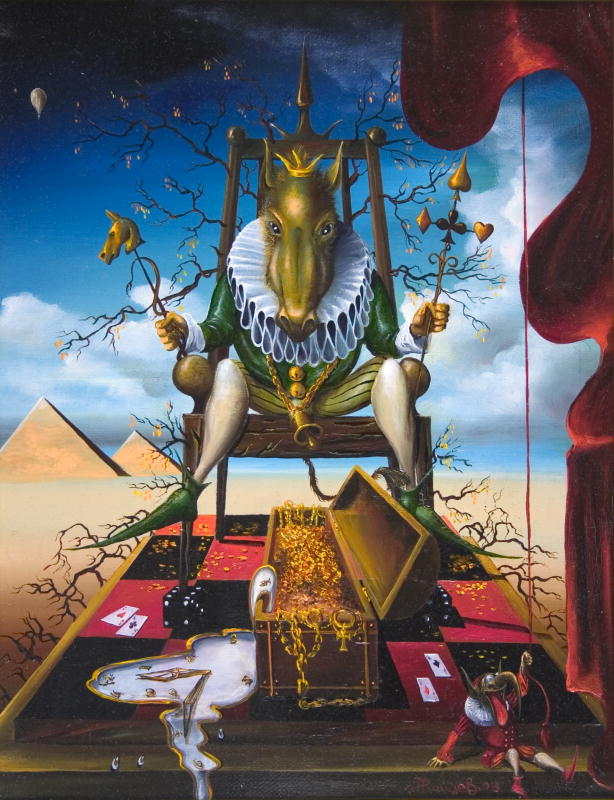
Illustration at the top: NIKOLAY ZAITSEV
Here, in the continuation of the first part, I share some more words from this magical Mana.
Individuation The Mana Personality (P2)
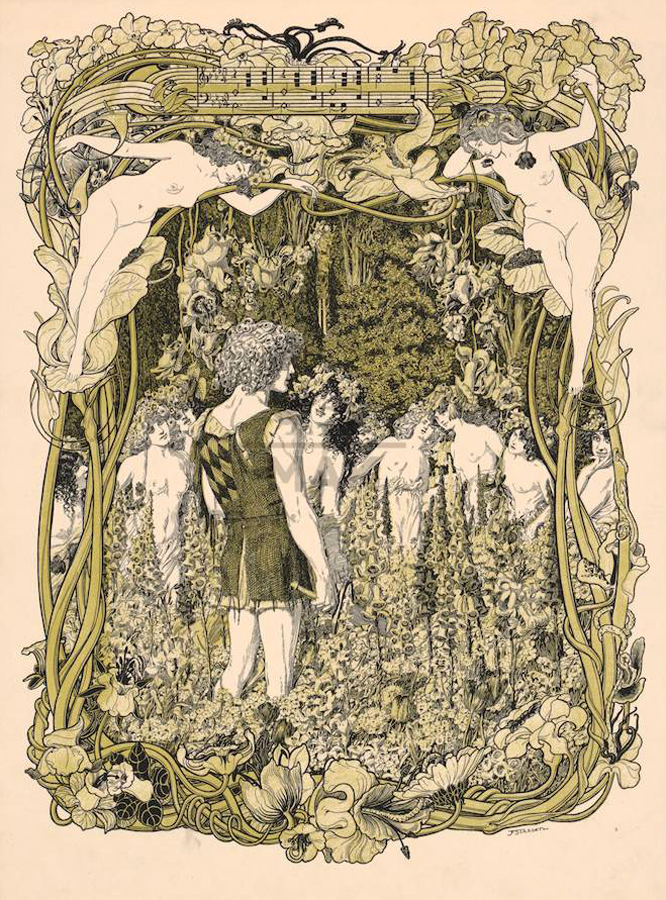
‘Parsifal’ illustrations for Richard Wagner’s opera by Franz Stassen.
Who has now come to terms with the anima? Apparently, the conscious “I”, and therefore the “I”, has taken over the Mana. In this way, the conscious “I” becomes the Mana personality. The Mana personality, however, is a Dominant of the collective unconscious, the well-known archetype of the mighty man in the form of the hero, the chief, the magician, the medicine man and saint, the lord of men and spirits, the friend of God.
This is now a male collective figure that emerges from the dark background and takes possession of the conscious personality. This psychological danger is of a subtle nature; by inflating consciousness, it can destroy everything that has been gained through the confrontation with the anima. It is, therefore, of no minor practical importance to know that in the hierarchy of the unconscious, the anima is only the lowest level and one of the possible figures and that its overcoming creates another collective figure that now takes over its Mana. In reality, it is the figure of the magician – as I will call her in short – that draws the Mana, that is, the autonomous value of the anima to itself. Only insofar as I am unconsciously identical with this figure can I imagine that I myself possess the Mana of the anima. But under these circumstances, I will do so infallibly.
SD World _ Youri Ivanov _ Jouris Kunst
The figure of the magician has a no less dangerous equivalent for women: it is a maternal, superior figure, the great mother, the all-merciful one who understands everything and forgives everything and always wanted the best, who always lived for others and never sought her own, the discoverer of great love, just as it is the herald of the ultimate truth. And just as great love is never appreciated, great wisdom is never understood either. And they can’t stand each other at all.
There must be a serious misunderstanding here because it is undoubtedly a case of inflation. The “I” has appropriated something that does not belong to it. But how did it appropriate this Mana? If it really was the ego that overcame the anima, then the Mana also belongs to it, and then the conclusion is correct: one has become significant. But why does this significance, the Mana, not affect others? That would be an essential criterion! It does not work because one has not become significant but has simply merged with an archetype, another unconscious figure. So, we must conclude that “I” has not overcome the anima and, therefore, has not acquired the Mana. It is just that a new merger has occurred, with a figure of the same sex that corresponds to the father’s imago and has perhaps even greater power.
From the power that binds all beings, The person who overcomes himself frees himself< (Goethe: The Mysteries. A Fragment, in. Works in ten volumes, Vol. 7, 1962)
Thus, he becomes a superman, superior to all powers, a demigod, perhaps even more. ‘I and the Father are one’, this powerful confession in all its terrible ambiguity stemming from precisely this psychological moment.
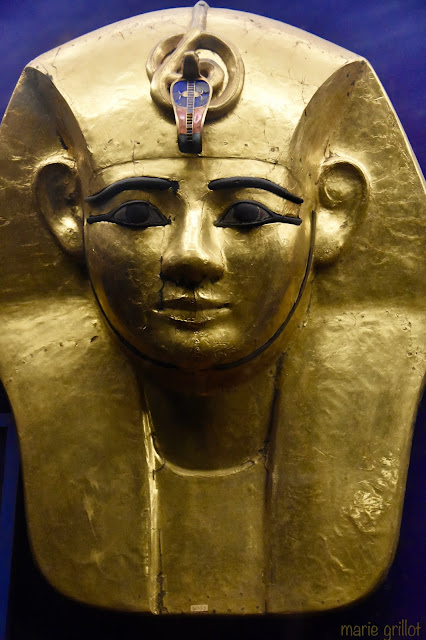
Usermaatre Amenemope was an ancient Egyptian pharaoh of the 21st Dynasty who ruled between 1001 and 992 BC or 993 and 984 BC. His tomb is one of only two entirely intact royal burials known from ancient Egypt, the other being that of Psusennes I. “His Instruction” (That is about thirty chapters (more than ten commands!)) is a literary work from ancient Egypt, most likely composed during the Ramesside Period. It contains thirty chapters of advice for successful living, attributed to the scribe Amenemope, son of Kanakht, as a legacy for his son.
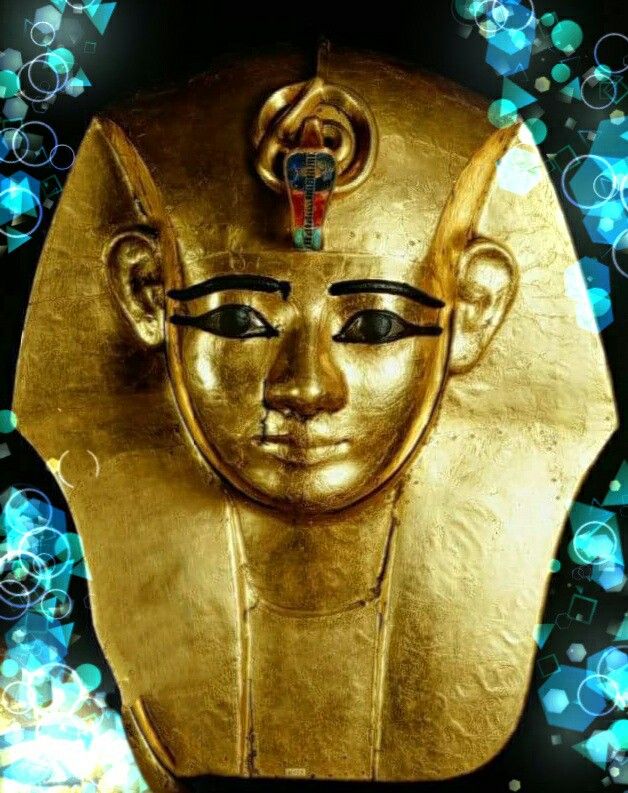
Treasure of Tanis, the golden mortuary mask of Pharaoh Amenemope. Egypt Musem
The pharaohs of Egypt were associated with Horus since the pharaoh was considered the earthly embodiment of the god. From around 3100 BCE, he was given a memorable royal “Horus name.” The falcon, representing divine kingship, symbolized the king as the earthly manifestation of Horus.
Here is the captivating story, by the brilliant Marie Grillot, of this incredible discovery.💖🙏
A falcon carrying Amenemopé’s cartridges in its talons
Falcon pendant – gold and cloisonné glass paste 21st Dynasty – reign of Amenemopé (c. 1000 BC) from Tanis, the tomb of Amenemopé – NRT III – discovered by Pierre Montet on April April 16 on display at the Egyptian Museum in Cairo – JE 86036 (museum photo)
In May 1929, the Egyptian government awarded Pierre Montet the concession for Tanis, now known as “Sân el-Hagar”, which lies in the “Tanitic branch” of the Nile Delta, over 100 km northeast of Cairo.
In 1722, Père Sicard identified this city as the ancient Tsa’ani” (“Tso’an” in Hebrew, “Tjaani” for the Copts, Greekized as “Djanet”). The scholars of the Commission d’Egypte partially excavated it, first by Jean-Jacques Rifaud (on behalf of consul Drovetti) and then by Auguste Mariette.
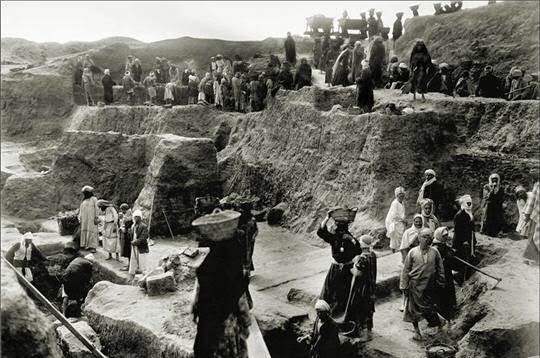
Pierre Montet’s excavations at Tanis
Its ruins, covering more than 400 hectares, witness its “activity” from the Old Kingdom to Roman times. However, the rulers of Dynasties XXI to XXIII marked its golden age by choosing it as their religious and funerary capital. By mirror effect, it became the “Thebes of the North”…
Pierre Montet’s team, summarily installed on this isolated and desolate site, worked with patience and perseverance for around ten years before the time came for the “rewards”. It was inaugurated in March 1939 with the discovery of the tomb of Chechonq II… From then on, the necropolis would yield many other treasures…
Elevation view of tomb NRT III containing the tombs of Psusennes I, his wife Moutnedjemet, then their son Amenemopé, another son of king Ânkhefenmout, the king’s chief general Oudjebaoundjed, and in the antechamber, the sarcophagus of Sheshonq II – Royal Necropolis of Tanis
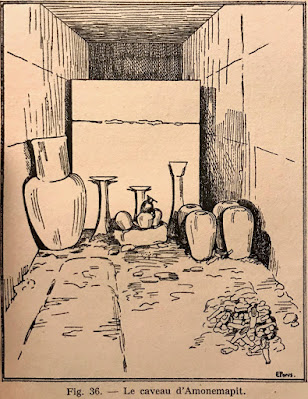
Thus, in “Tanis – Twelve years of excavations in a forgotten capital of the Egyptian Delta”, the Egyptologist Pierre Montet recounts the extraordinary day of the discovery of the tomb of Pharaoh Amenemopé: “The entrance was opened on April April 16). His Majesty King Farouk, who had arrived the day before in Saan, where he had erected a city of tents, was present, as was Canon Drioton, Director of the Egyptian Antiquities Service, and a young Egyptian Egyptologist, Professor Abou Bekr. The vault was furnished in much the same way as that of Psousennès: a granite sarcophagus at the bottom, canopic vases, metal vases, a large sealed jar, funerary statuettes and a vast gilded wooden chest that had collapsed due to the effects of time and humidity in the front half. Once these objects had been safely removed, the sarcophagus lid was placed in their place. Much less opulent than Psousannes, the new ruler had made do with a single stone sarcophagus and a wooden anthropoid coffin lined with gold. Wood was reduced to almost nothing. The gold plates were removed. Needless to say, the mummy had suffered enormously. His ornaments, less numerous than those of Psousennès, nevertheless constitute a wonderful collection: a gold mask, two necklaces, two pectorals, two scarabs, lapis and chalcedony hearts, bracelets and rings, a large cloisonné gold falcon with outstretched wings…”.
Falcon pendant – gold and cloisonné glass paste 21st Dynasty – reign of Amenemopé (c. 1000 BC) from Tanis, the tomb of Amenemopé – NRT III – discovered by Pierre Montet on April April 16 on display at the Egyptian Museum in Cairo – JE 86036 (museum photo)
The hawk, which seems to soar powerfully into the sky, is 10.5 cm high and 37.5 cm wide. The head and legs are in gold, while the rest of the body is in gold cloisonné with pâte de verre in shades of green, perfectly simulating the shimmer of the feathers.
In “Les trésors du musée égyptien”(The Treasures of the Egyptian Museum), Silvia Einaudi describes it as follows: “The falcon is depicted in flight with its wings spread. The head, turned to the left, is made of solid gold. The beak, eye, neck and decorative motif on the cheek are in dark pâte de verre. The raptor’s wings, body and tail are executed using the cloisonné technique: glass paste in delicate shades of pink and green is inlaid with gold, giving life to a simple polychromy. The wing feathers radiate outwards, forming two rows. On the other hand, the body is decorated with a teardrop motif that continues right down to the tail. The legs, also in solid gold, hold the ‘shen’ signs, a symbol of eternity, to which two gold plates bearing the sovereign’s name are attached. The hieroglyphs inside the cartouches are executed in coloured glass paste inlaid with gold. The plate on the right bears the pharaoh’s coronation name: ‘Usermaatra Setepenamon, beloved of Osiris and Ro-Setau (Memphis necropolis)’; on the left, his birth name: ‘Ménémopé Meramon, beloved of Osiris, lord of Abydos'”.
Amenemopé’s vault at its opening – Drawing by E. Pons Source: Pierre Montet, “Tanis”, Payot, 1942
Amenemopé, pharaoh of the 21st Dynasty, reigned from Tanis around 1001-992 BC. The successor of Psusennes I, he was, as the book mentioned above states: “buried in the latter’s tomb, in a granite-covered room originally created to house the remains of Moutnedjemet, wife and sister of Psusennes I”. We can only wonder why this small vault was chosen as his burial place when he “had” his own tomb referenced NRT IV (NRT = Nécropole Royale de Tanis).
Face of the pharaoh Amenemopé – gold leaf (upper surviving part of his gilded wooden sarcophagus) 21st Dynasty – reign of Amenemopé (c. 1000 BC) from Tanis, the tomb of Amenemopé – NRT III – discovered by Pierre Montet on April April 16 on display at the Egyptian Museum in Cairo – JE 86059
On May 3, May 3, in a truck protected by the army, Amenemopé’s treasure made its way to the Egyptian Museum in Tahrir Square. The falcon-shaped pendant was registered in the Journal des Entrées under reference: JE 86036.
As for Pierre Montet’s team, the dramatic events of the Second World War forced them to end their quest for the past of Tanis and turn their attention to the tragic present. Excavations will not resume until the end of the conflict…
The Hawk of King Amenemope http://www.globalegyptianmuseum.org/record.aspx?id=15530 Pierre Montet, Tanis – Twelve years of excavations in a forgotten capital of the Egyptian Delta, Payot, Historical Library, 1942 Pierre Montet, The royal necropolis of Tanis according to recent discoveries, Reports of the Academy of Inscriptions and Belles-Lettres sessions, 89th year, N. 4, 1945. pp. 504-517, Perseus https://www.persee.fr/doc/crai_0065-0536_1945_num_89_4_77901 Georges Goyon, The discovery of the treasures of Tanis, Pygmalion, 1987 Jean Yoyotte, Tanis l’or des pharaons, exhibition catalog Paris, National Galleries of the Grand Palais, March 26 – July 20, 1987, Association Française d’Action Artistique, 1987 Henri Stierlin, Christiane Ziegler, Tanis Trésors des pharaons, Seuil, 1987 Francesco Tiradritti, Treasures of Egypt – The wonders of the Egyptian Museum in Cairo, Gründ, 1999 Pharaons – Catalog of the exhibition presented at the Institute of the Arab World in Paris, from OctobeOctober 15 to April April 10, IMA, Flammarion, 2005












 lampmagician
You must be logged in to post a comment.