

“I must admit that I am still contemplating the mysteries of life. At this time, I wanted to share Socrates’ thoughts about the soul with you. But before that, some time ago, when the Iranian groups on Twitter (now X) were still more united (unfortunately, many differences have separated them!), one of our topics to discuss was whether AI could create art. The main question is: how much do we know about art? How much do we believe that art has a soul possessing such an intangible quality and AI can produce it as we do?
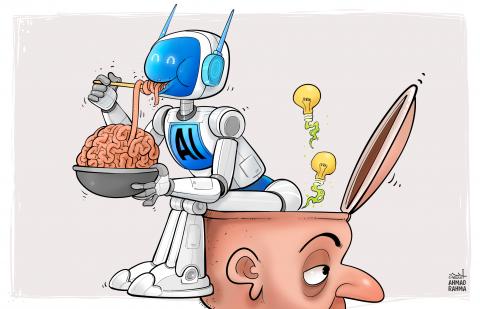
Honestly, I am worried about using AI because humans are naturally very lazy and comfortable; that’s why they like to be pampered! If you look at the story of this development, like the Alexas in the sitting room to the self-driving cars, it shows what will happen next.
Like our other muscles, our brains must be trained continuously to maintain our creativity and cognitive abilities. Otherwise, we risk losing our mental faculties.
Nonetheless, we must observe what these “machines”, which we might have invented, will do!

Actually, we are talking about what we don’t know exactly how it works: Soul, Creation, Art!? It made me wonder if we can differentiate between these in a world created by Mother Nature and how we attempt to do so with equal ability, though I believe art is a part of the creator’s essence, gifted us to use in our own creations.
The question is whether we have forgotten something we should remember. Is it possible that our souls have lived before they entered our bodies? Socrates believed in some form of reincarnation, in which our souls know of their previous existence before they come into our bodies. These were his final words before facing the court, as conveyed by Plato.”
[… oh souls and before, before they were a man they were, without bodies, and they had consciousness. Plato Phaedo 76 c ]
[…. or are they remembered, or learn to remember if they are. Plato Phaedo 76 a ]
“So, Simmia, our souls existed before, without the human form, separate from the body and possessing knowledge”. Plato of Phaedus
How well Dr Jung found this lost connection to our buried memories under our consciousness!

The idea is that the soul is immortal, as Plato claims in “Plato Phaedo, or Phaedrus 74-76. In the dialogue, Socrates discusses the nature of the afterlife on his last day before being executed by drinking hemlock.
Phaedo presents four distinct arguments supporting the immortality of the soul, namely, the Argument from Opposites, the Theory of Recollection, the Argument from Affinity, and the final Argument. However, we focus on whether humans can create perfection or whether artificial intelligence (AI) is perfect. In my opinion, perfection does not exist in our lives, or at least not how we imagine it. Even gods seem to make mistakes! Despite humans’ constant pursuit of perfection, imperfection has a certain allure.

In any case, I believe that AI cannot create art like “wo-man-kind” can. For example, we can understand this fact when we observe the Mona Lisa, read Dostoevsky, read or watch Shakespeare, or read Rilke…! We have got a worthy gift, which we might awake to life and use it.


I must confess I am a perfectionist. It’s not easy, I know. Perhaps this trait stems from my childhood traumas. However, I believe imperfection is natural and necessary. In the following, I have added a paragraph for those interested who might like to read.
Let’s see how Plato argues this:
The “Imperfection Argument” (Phaedo 74-76)
This is an argument for the existence of Forms and our possession of a priori concepts. Plato bases the debate on the imperfection of sensible objects and our ability to make judgments about those sensible objects. (The Forms are supposed to be the perfect objects that the sensible only imperfectly approximate).
The argument in Phaedo 74-76 concerns the concept of Equality, but it could equally well be given concerning several different concepts (any concept that might have some claim to being an a priori concept).
The argument tries to show that we cannot abstract the concept of Equality from our sense experience of equal objects. For;
We never experience (in sense-perception) objects that are really, precisely equal, and
We must already have the concept of Equality to judge the things we encounter in sense-perception to be approximately, imperfectly, equal.
The argument can be schematized as follows:
We perceive sensible objects to be F.
But every sensible object is, at best, imperfectly F. That is, it is both F and not F (in some respect – shades of Heraclitus??). It falls short of being perfectly F.
We are aware of this imperfection in the objects of perception.
So, we perceive objects to be imperfectly F.
To perceive something as imperfectly F, one must consider something perfectly F, something that the imperfectly F things fall short of. (For example, we have an idea of Equality that all sticks, stones, etc., only imperfectly exemplify.)
So we have in mind something that is perfectly F.
Thus, there is something that is perfectly F (e.g., Equality) that we have in mind in such cases.
Therefore, there is such a thing as the F itself (e.g., the Equal itself), distinct from any sensible object.
Source: University of Washington
I appreciate your kind interest. 🙏💖


🩶🩶
LikeLiked by 1 person
🙏💖
LikeLike
I found your article really thought provoking.. Artificial intelligence is a topic that fascinates me and at the same time scares me a little🌹
LikeLiked by 1 person
You say that, my dear friend. They are fascinating as well as monstrous. Thank you!😉🙏💖
LikeLiked by 1 person
You are most welcome . dear Aladin. It’s always my pleasure!🌹
LikeLiked by 1 person
Thanks 🙏💖🌺🌺😘😘
LikeLiked by 1 person
🙏💖🙏
LikeLiked by 1 person
Really interesting. My jury is out on AI. And our house is a Google and Alexa free zone.
LikeLiked by 1 person
Very good! I have always been sure thereabouts. Have a lovely Sunday. 🤗❤️
LikeLiked by 1 person
AI in general is pretty frightening with the potential to start wars and create financial destruction…I hope that governments bring in strict controls to restrict the potential for this type of use before it’s too late.
AI is a really contentious issue in the photographic world too, as was shown by Boris Eldagsen taking first place in one of the categories of the Sony World Photography awards. On winning he immediately admitted it was AI generated and to be honest when you look at the hands you can see that it is. Now many competitions are asking winners for the original RAW image to confirm that the picture isn’t AI.
AI has been around for many years in less advanced forms – some of the minor adjustments used in Photoshop use AI and most photographers use them, however the new options available to replace whole skies/faces etc at the press of a button isn’t, for me, part of the creative process. But I feel that if someone creates an idea for an image and found the words to describe precisely what they wanted would those words be coming from their creative soul and therefore the art created would have soul? Hmmm, another question to ponder! Thanks Aladin for another fascinating post.
LikeLiked by 1 person
Thank you, my lovely Lin, for this interesting information. In my opinion, it is ridiculous to use AI for creating art, especially in making photos. I love the beautiful black and white pictures you take and share in your blog. Take care, my friend. 🧡 🧡
LikeLiked by 1 person
I’m really not happy about this ‘AI’ thing at all. In fact, I think it’s rather worrying.
LikeLiked by 1 person
You might be absolutely right, my lovely Chris. 🤪🙏❤️
LikeLiked by 1 person
Your comment about “we risk losing our mental faculties” made me think about how research was once done… pouring through books and microfiche in libraries, now it is copy and paste. Fascinating research, as you do. Thank you. 🤓🙏🏻
LikeLiked by 1 person
You got the point, my beautiful lady; through being and living more comfortably, we are losing control! Your wise approval is a great inspiration for me. Thank you!🙏💖🦋🌹
LikeLiked by 1 person
An astute observation and ironical contrast of life as we currently know it. Thank you for kindly valuing my feedback. Greatly appreciated. 🙏🏻😊
LikeLiked by 1 person
For me, more. 🤗🙏🌹
LikeLiked by 1 person
I wouldn’t have thought so. To have a soul denotes life!
LikeLiked by 1 person
You said that, Brother. 🤙✌
LikeLike
No.
Although AI may come up with its BS soul version.
Yes, people are lazy, and the human race is being compromised with their own permission.
Many times I realize that I’m learning/or just learned something I already know. I figure that now I know it better, even though I don’t know where/how I learned it in the first place.
At 30, no one would have looked around my home, and said “she’s a perfectionist”.
Yet, I was. That perfection lay somewhere else that was important to me.
When I realized I/it could never be perfect, I flourished.
I think at that point, I strove for imperfectly F.
Perfect!
Great article, thank you Alaedin!
🤔💓💐
LikeLiked by 1 person
It’s always fantastic to read your comments, dear Resa. They motivate me to keep learning and growing! If I had to summarize your words in one word, it would be ‘experience.’ We gain knowledge and understanding bit by bit throughout our lives, and the important thing is, as you do, my friend, to remember and analyze everything we learn.
As my ever master, Dr Jung says:
“For, just as completeness is always imperfect, so perfection is always incomplete, and therefore represents a final state which is hopelessly sterile. “Ex perfecto nihil fit,” say the old Masters, whereas the imperfectum carries the seeds of its own improvement within it. Perfectionism always ends in a blind alley …”
I appreciate your being with me, my genius friend.🙏💖🤗🖖
LikeLike